Measure BMW 325i 1996 E36 Owner's Guide
[x] Cancel search | Manufacturer: BMW, Model Year: 1996, Model line: 325i, Model: BMW 325i 1996 E36Pages: 759
Page 297 of 759
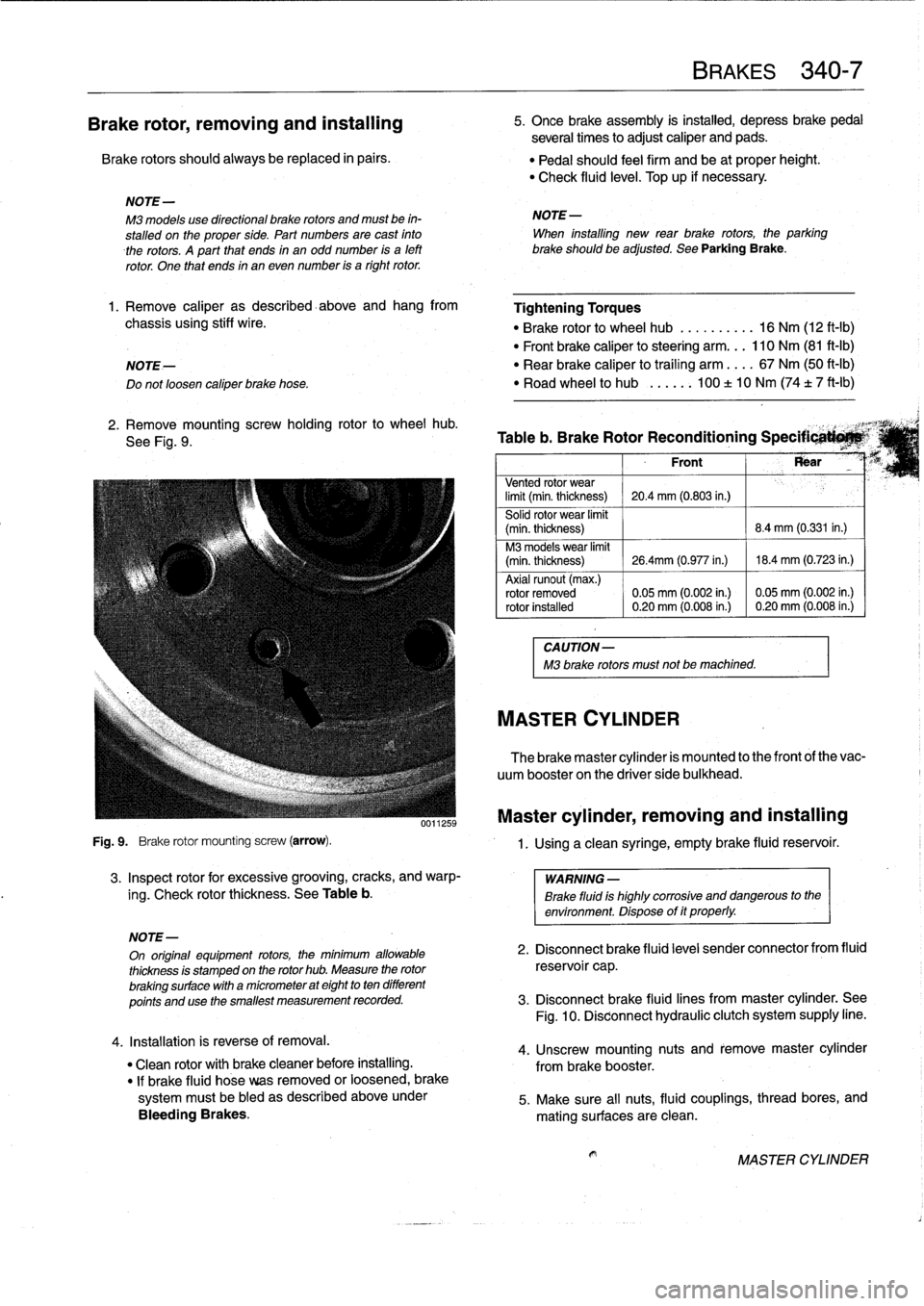
Brake
rotor,
removing
and
installing
Brake
rotors
shouldalways
be
replaced
in
pairs
.
Fig
.
9
.
Brake
rotor
mounting
screw
(arrow)
.
3
.
Inspect
rotor
for
excessive
grooving,
cracks,
and
warp-
ing
.
Check
rotor
thickness
.
See
Table
b
.
4
.
Installation
is
reverse
of
removal
.
"
Clean
rotor
with
brakecleaner
before
installing
.
"
If
brake
fluid
hose
veas
removed
or
loosened,
brake
systemmustbe
bled
as
described
aboveunder
Bleeding
Brakes
.
BRAKES
340-
7
5
.
Once
brake
assembly
is
instalind,
depress
brakepedal
several
times
to
adjust
caliper
and
pads
.
"
Pedal
should
feel
firm
and
be
at
proper
height
.
"
Check
fluid
leve¡
.
Top
up
if
necessary
.
NOTE-
M3
models
use
directional
brake
rotors
and
mustbe
in-
NOTE-
stalled
on
the
proper
side
.
Part
numbes
are
cast
finto
When
installing
new
rear
brake
rotors,
the
parking
therotors
.
A
part
that
ends
in
an
odd
number
is
a
left
brakeshouldbe
adjusted
.
See
Parking
Brake
.
rotor
.
One
that
ends
in
an
even
number
is
a
right
rotor
.
1.
Remove
caliper
as
described-above
and
hang
from
Tightening
Torques
chassis
using
stiff
wire
.
"
Brake
rotor
to
wheel
hub
..........
16
Nm
(12
ft-Ib)
"
Front
brake
caliper
to
steering
arm
...
110
Nm
(81
ft-Ib)
NOTE-
"
Rear
brake
caliper
to
traíling
arm
....
67
Nm
(50
ft-Ib)
Do
notloosen
caliper
brake
hose
.
"
Road
wheel
to
hub
...
..
.
100
±
10
Nm
(74
t
7
ft-Ib)
2
.
Remove
mountingscrew
holding
rotor
to
wheel
hub
.
,
See
Fig
.
9
.
Table
b
.
Brake
Rotor
Reconditioning
Specificati*M`
Front
Rear
Vented
rotor
wear
limit
(min
.
thickness)
20
.4
mm
(0
.803
in.)
Solid
rotor
wear
limit
(min
.
thickness)
8
.4
mm
(0.331
in
.)
M3
models
wear
limit
(min
.
thickness)
26
.4mm
(0
.977
in
.)
18
.4
mm
(0
.723
in
.)
Axial
runout
(max
.)
rotor
removed
0
.05
mm
(0
.002
in
.)
0
.05
mm
(0
.002
in
.)
rotor
installed
0
.20
mm
(0
.008
in
.)
0
.20
mm
(0
.008
in
.)
CAUTION-
M3
brake
rotors
must
not
be
machined
.
MASTER
CYLINDER
The
brake
master
cylinder
is
mounted
to
the
front
of
the
vac-
uum
booster
on
the
driver
side
bulkhead
.
Master
cylinder,
removing
and
installing
1
.
Using
a
clean
syringe,
empty
brake
fluid
reservoir
.
WARNING
-
Brake
fluid
is
highly
corrosive
and
dangerous
to
the
environment
.
Dispose
of
it
properly
.
NOTE-
On
original
equipment
rotors,
the
mínimum
allowable
2
.
Disconnect
brake
fluid
leve¡
sender
connector
from
fluid
thickness
is
stamped
on
the
rotor
hub
.
Measure
the
rotor
reservoi
r
cap
.
brakingsurface
with
a
micrometer
at
eight
to
ten
different
points
and
use
the
smallest
measurement
recorded
.
3
.
Disconnect
brake
fluid
lines
frommaster
cylinder
.
See
Fig
.
10
.
Disconnect
hydraulic
clutch
system
supply
line
.
4
.
Unscrew
mounting
nuts
and
remove
master
cylinder
from
brake
booster
.
5
.
Make
sure
all
nuts,
fluid
couplings,
thread
bores,
and
mating
surfaces
are
clean
.
MASTER
CYLINDER
Page 338 of 759
512-
8
DOOR
WINDOWS
NOTE-
To
achieve
an
accurate
window
adjustment
in
2-door
models
with
"close
with
door
shut"
feature,
simulate
a
closed
dooras
follows
:
On
early
cars,
manually
turn
the
latch
on
the
door
to
the
closed
position
.
See
Fig
.
16
.
On
latercars,
insert
a
wedge
of
wood
into
the
striker
on
the
body
to
close
the
striker
switch
.
Be
sure
to
open
thero-
tary
latch
(by
pulling
upon
the
door
handle)
or
remove
the
wedge
before
closing
the
door
.
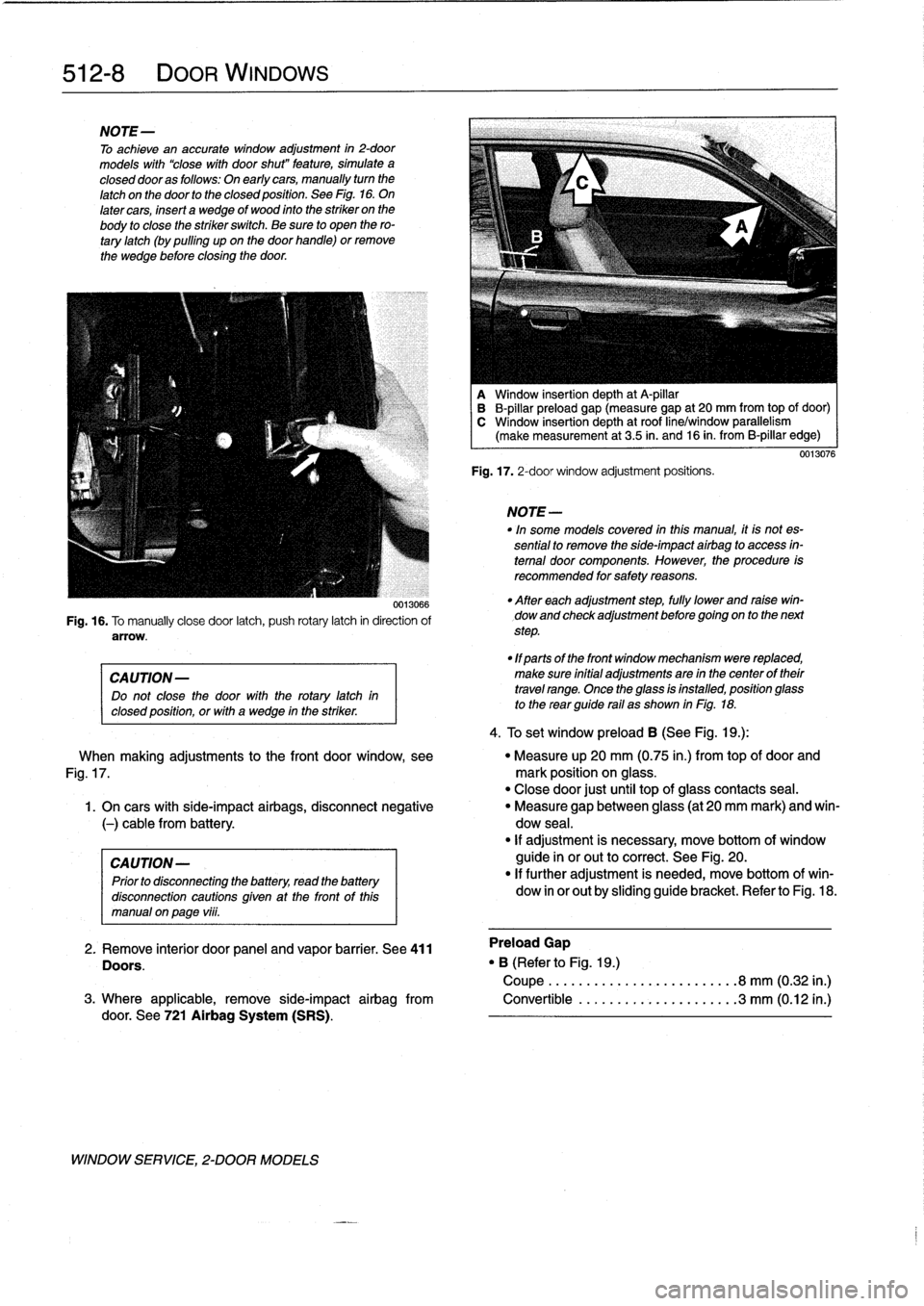
0013066
Fig
.
16
.
To
manually
close
door
latch,
push
rotary
latch
in
direction
of
arrow
.
CAUTION-
Do
not
close
the
door
with
therotary
latch
in
closed
position,
orwith
a
wedge
in
the
striker
.
WINDOW
SERVICE,
2-DOOR
MODELS
A
Window
insertion
depth
at
A-pillar
B
B-pillar
preload
gap
(measure
gap
at
20
mm
from
top
of
door)
C
Window
insertion
depth
at
roof
line/window
parallelism
(make
measurement
at
3
.5
in
.
and
16
in
.
from
B-pillar
edge)
Fig
.
17
.
2-door
window
adjustment
positions
.
NOTE-
In"
some
models
covered
inthis
manual,
it
is
not
es-
sential
to
remove
the
side-impact
airbag
to
access
in-
terna¡
door
components
.
However,
the
procedure
is
recommended
for
safety
reasons
.
"
After
each
adjustment
step,
fully
lower
and
raise
win-
dow
and
check
adjustment
before
goingon
to
the
next
step
.
"
1f
parts
of
the
front
window
mechanism
were
replaced,
make
sure
initial
adjustments
are
in
the
center
of
their
travel
range
.
Once
the
glass
isinstalled,
position
glass
to
the
rear
guide
rail
as
shown
in
Fig
.
18
.
4
.
To
set
window
preload
B
(See
Fig
.
1
g
.):
0013076
When
making
adjustments
to
the
front
door
window,
see
"
Measure
up
20
mm
(0
.75
in
.)
from
topof
door
and
Fig
.
17
.
mark
position
on
glass
.
"
Close
door
just
until
top
of
glass
contacts
seal
.
1
.
On
cars
with
side-impact
airbags,
disconnect
negative
"
Measure
gap
between
glass
(at
20
mm
mark)
and
win-
(-)
cable
from
battery
.
dow
seal
.
"
If
adjustment
is
necessary,
move
bottom
of
window
CAUTION-
guide
inor
out
to
correct
.
See
Fig
.
20
.
Prior
to
disconnecting
the
battery,
read
the
battery
"
If
further
adjustment
is
needed,
move
bottom
ofwin-
disconnection
cautionsgiven
at
the
front
of
this
dow
in
or
out
by
sliding
guide
bracket
.
Refer
to
Fig
.
18
.
manual
on
page
viii
.
2
.
Remove
interior
door
panel
and
vapor
barrier
.
See
411
Preload
Gap
Doors
.
"
B
(Referto
Fig
.
1
g
.)
Coupe
......................
.
.
.8
mm
(0
.32
in
.)
3
.
Where
applicable,
remove
side-impact
airbag
from
Convertible
..................
.
..
3
mm
(0
.12
in
.)
door
.
See
721
Airbag
System
(SRS)
.
Page 339 of 759
5tud
center
Window
glass
surface
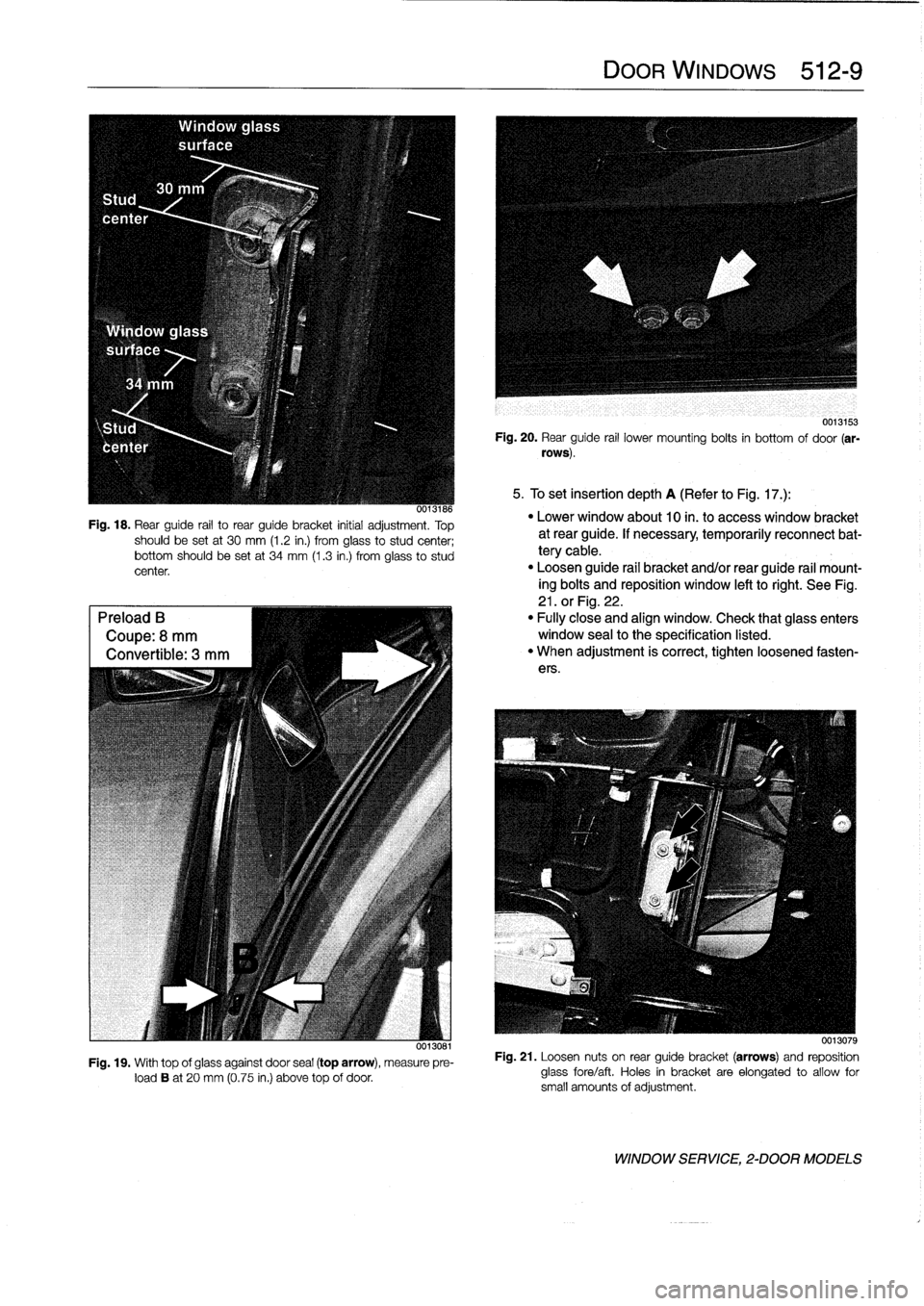
Fig
.
18
.
Rear
guide
rail
to
rear
guide
bracket
initial
adjustment
.
Top
should
be
setat
30
mm
(1
.2
in
.)
from
glass
to
studcenter
;
bottom
should
be
set
at
34
mm
(1
.3
in
.)
from
glass
to
stud
center
.
Preload
B
Coupe
:
8
mm
Convertible
:
3
mm
0013081
Fig
.
19
.
With
top
of
glassagainst
door
sea¡(top
arrow),
measure
pre-load
B
at
20
mm
(0
.75
in
.)
above
top
of
door
.
DOOR
WINDOWS
512-
9
0013153
Fig
.
20
.
Rear
guide
rail
lower
mounting
bolts
in
bottom
of
door
(ar-
rows)
.
5
.
To
set
insertion
depth
A
(Referto
Fig
.
17
.)
:
"
Lowerwindow
about
10
in
.
t
o
access
window
bracket
at
rear
guide
.
If
necessary,
temporarily
reconnect
bat-
tery
cable
.
"
Loosen
guide
rail
bracket
and/or
rear
guide
rail
mount-
ing
bolts
and
reposition
window
left
to
right
.
See
Fig
.
21
.
orFig
.
22
.
"
Fully
close
and
align
window
.
Check
that
glass
enters
window
sea¡
to
the
specification
listed
.
"
When
adjustment
is
correct,
tighten
loosened
fasten-
ers
.
0013079
Fig
.
21
.
Loosen
nuts
on
rear
guide
bracket
(arrows)
and
reposition
glass
fore/aft
.
Holes
in
bracket
areelongated
to
allow
for
small
amounts
of
adjustment
.
WINDOW
SERVICE,
2-DOOR
MODELS
Page 382 of 759
600-2
ELECTRICAL
SYSTEM-GENERAL
CAUTION
-
"
Always
turn
off
the
engine
and
disconnect
the
negative
()
cable
from
the
batterybefore
remov-
ing
any
electrical
components
.
Disconnecting
the
battery
may
erase
fault
code(s)
stored
in
control
module
memory
.
Check
for
fault
codes
using
spe-
cial
BMW
diagnostic
equipment
.
"
Prior
to
disconnecting
the
battery,
read
the
bat-
tery
disconnection
cautions
given
at
the
front
of
this
manual
onpage
viii
.
"
Connect
and
disconnect
ignition
system
wires,
multiple
connectors,
and
ignition
test
equipment
leads
only
while
the
ignition
is
off
.
"
Do
not
disconnect
the
battery
with
engine
run-
ning
.
"
Do
not
quick-charge
the
battery
(for
boost
start-
ing)
for
longer
than
one
minute,
and
do
not
ex-
ceed
16
.5
volts
at
the
battery
with
the
boosting
cables
attached
.
Wait
at
feast
one
minute
before
boosting
the
battery
a
second
time
.
"
Do
not
usea
test
famp
that
has
a
normal
incan-
descent
bulb
to
test
circuits
contafning
electronic
components
.
The
high
electrical
consumptionof
these
test
lamps
may
damage
the
components
.
"
Do
not
use
an
analog
meter
.
Use
onfy
a
digital
multimeter
.
"
Many
of
the
solid-state
modules
are
static
sensi-
tive
.
Static
discharge
will
permanently
damage
them
.
Always
handle
the
modules
using
proper
static
prevention
equipment
and
techniques
.
"
To
avoid
damaging
harness
connectors
or
relay
panel
sockets,
use
jumper
wires
with
flat-blade
connectors
that
are
the
same
size
as
the
connec-
tor
or
relay
terminals
.
"
Always
switch
a
digital
multimeter
to
the
appropri-
ate
function
and
range
before
making
test
con-
nections
.
"
Do
not
tryto
start
the
engine
of
a
carwhich
has
been
heated
above176°F
(80°C),
(for
example,
in
a
paint
dryingbooth)
.
Allow
it
to
cool
to
normal
temperature
.
"
Disconnect
the
battery
before
dolng
any
electric
welding
on
the
car
.
"
Do
not
wash
the
engine
while
it
is
runnfng,
or
any-
time
the
ignition
is
switched
on
.
WIRING
DIAGRAMS
Electrical
Test
Equipment
Many
of
the
electrical
tests
described
in
this
manual
call
for
measuring
voltage,
currentorresistanceusing
a
digital
multi-
meter
(DMM)
.
Digital
meters
are
preferred
for
precise
mea-
surements
and
for
electronics
work
because
they
are
generally
more
accuratethan
analog
meters
.
The
numerical
display
is
alsoless
likely
to
be
misread,
since
there
is
no
nee-
dle
position
to
be
misinterpreted
by
reading
at
an
angle
.
An
LED
test
light
is
a
safe,
inexpensive
tool
that
can
be
used
to
perform
many
simple
electrical
tests
that
would
otherwise
require
a
digital
multimeter
.
The
LED
indicates
when
voltage
is
present
between
anytwo
test-points
in
a
circuit
.
CA
UTION-
"
Choose
test
equipment
carefully
.
Use
a
digital
multimeter
with
at
leadt
10
megaohm
input
im-
pedance,or
an
LED
test
light
.
An
analog
meter
(swing-need1e)
ora
test
light
with
a
normal
incan-
descent
bulb
may
draw
enough
current
to
dam-
age
sensitive
electronic
components
.
"
An
ohmmeter
must
not
beused
to
measure
resis-
tance
on
solidstate
components
suchas
controlunits
or
time
delay
relays
.
"
Always
disconnect
the
battery
before
making
re-
sístance
(ohm)
measurements
on
the
circuit
.
WIRING
DIAGRAMS
The
wiring
diagrams
shown
in
Electrical
Wiring
Diagrams
have
been
specially
designed
to
enable
quick
and
efficientdi-
agnosis
and
troubleshooting
of
electrical
malfunctions
.
Wiring
Codes
and
Abbreviations
A
lot
of
information
is
included
in
each
wiring
diagram
if
you
know
how
to
read
them
.
Wire
colors
in
the
diagrams
are
ab-
breviated
.
Combined
color
codes
indicate
a
multi-colored
wire
.
For
example
the
code
BLU/RED
indicates
a
Blue
wire
with
a
Red
stripe
.
Many
electrical
components,
connectors,
fuses,
and
ground
locations
are
identified
using
a
unique
number
.
Each
of
there
numbers
corresponds
to
a
particular
part
in
the
circuit
commonly
found
in
Electrical
Wiring
Diagrams
.
Page 384 of 759
600-
4
ELECTRICAL
SYSTEM-GENERAL
Voltage
and
Voltage
Drops
The
wires,
connectors,
and
switches
that
carry
current
are
designed
with
very
low
resistance
so
that
current
flows
with
a
minimum
loss
of
voltage
.
A
voltage
drop
is
caused
by
higher
than
normal
resistance
in
a
circuit
.
This
additional
resistance
actually
decreases
or
stops
the
flow
of
current
.
A
voltage
drop
can
be
noticed
byproblems
ranging
fromdim
headlights
to
sluggish
wipers
.
Some
common
sources
of
voltage
drops
are
corroded
or
dirty
switches,
dirty
or
corroded
connections
or
contacts,
and
loose
or
corroded
ground
wires
and
ground
con-
nections
.
A
voltage
drop
test
is
a
good
test
to
make
if
current
is
flowing
through
the
circuit,
butthe
circuit
is
not
operating
correctly
.
A
voltage
drop
test
will
help
to
pinpoint
a
corroded
ground
strap
or
a
faulty
switch
.
Normally,
there
should
be
less
than
1
volt
drop
across
most
wires
or
closed
switches
.
A
voltage
drop
across
a
connector
or
short
cable
shouldnot
exceed
0
.5
volts
.
Voltage,
measuring
1
.
Connect
digital
multimeternegative
lead
to
a
reliable
ground
point
oncar
.
NOTE-
The
negative
(-)
battery
terminal
is
alwaysa
good
ground
point
.
2
.
Connect
digital
multimeter
positive
lead
to
point
incir-
cuit
you
wish
to
measure
.
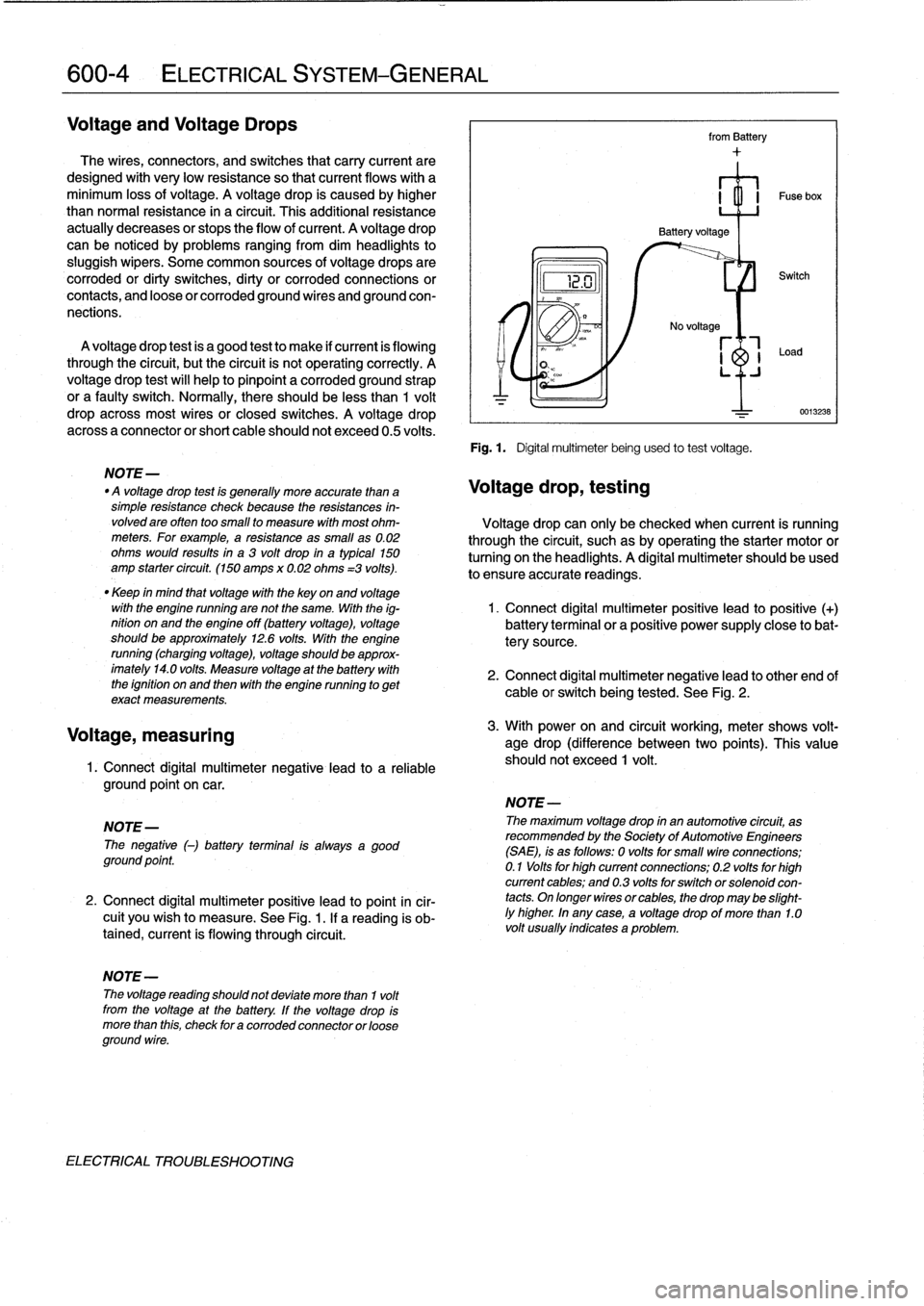
See
Fig
.
1
.
If
a
reading
is
ob-
tained,
current
is
flowing
through
circuit
.
NOTE-
The
voltage
reading
shouldnot
deviate
more
than
1
volt
from
the
voltage
at
the
battery
.
If
the
voltage
drop
is
more
than
this,
check
for
acorroded
connector
or
cose
ground
wire
.
ELECTRICAL
TROLIBLESHOOTING
from
Battery
Fig
.
1
.
Digital
multimeterbeing
used
to
test
voltage
.
No
voltage
r_l
-1
Load
LJ
Switch
NOTE-
The
maximum
voltage
drop
in
an
automotive
circuit,
as
recommended
by
the
Society
of
AutomotiveEngineers
(SAE),
is
as
follows
:
0
voltsfor
small
vire
connections
;
0
.1
Volts
for
high
current
connections
;
0
.2
volts
for
high
current
cables
;
and
0
.3volts
for
switch
or
solenoidcon-
tacts
.
On
longer
wires
or
cables,
the
drop
may
be
slight-ly
higher
.
In
any
case,
a
voltage
drop
of
more
than
1.0volt
usually
indicates
a
problem
.
0013238
NOTE-
"
A
voltage
drop
test
is
generally
more
accuratethan
a
Voltage
drop,
testing
simple
resistance
check
because
the
resistances
in-
volvedare
often
too
small
to
measure
with
most
ohm-
Voltage
drop
can
only
be
checked
when
current
is
running
meters
.
For
example,
a
resistance
as
small
as0
.02
through
the
circuit,
suchasby
operating
the
starter
motor
or
ohms
would
results
in
a
3
volt
drop
in
a
typical
150
turning
onthe
headlights
.
A
digital
multimeter
should
beused
amp
starter
circuit
.
(150
amps
x
0
.02
ohms
=3
volts)
.
lo
ensure
accurate
readings
.
"
Keep
in
mind
that
voltage
with
the
key
on
and
voltage
with
the
engine
running
arenotthe
same
.
With
the
ig-
1
.
Connect
digital
multimeter
positive
lead
to
positive
(+)
nition
on
and
the
engine
off
(battery
voltage),
voltage
battery
terminalor
a
positive
power
supply
close
lo
bat
should
be
approximately
12
.6volts
.
With
the
engine
tery
source
.
running
(charging
voltage),
voltage
should
be
approx-
imately
14
.0
volts
.
Measure
voltage
at
the
battery
with
2
.
Connect
digital
multimeter
negativelead
to
other
end
of
the
ignition
on
and
then
with
the
engine
running
to
get
cable
orswitch
being
tested
.
See
Fig
.
2
.
exact
measurements
.
3
.
With
power
on
and
circuit
working,
meter
shows
volt-
age
drop
(difference
between
two
points)
.
This
value
should
not
exceed
1
volt
.
Page 442 of 759
630-2
EXTERIOR
LIGHTING
Headlight
assembly,
removing
and
installing
CAUTION-
Followingheadlight
assembly
work
headlight
beam
aim
must
be
adjusted
using
special
equip-
ment
.
1
.
Left
side
:
Remove
air
filter
housing,
air
intake
duct,
and
air
mass
meter
.
See
100
Engine-General
.
2
.
Disconnect
harness
connectors
from
headlight
bulbs
.
3
.
Remove
front
turn
signal
.
See
Front
turn
signal
as-
sembly,
removingand
installing
later
in
this
repair
group
.
4
.
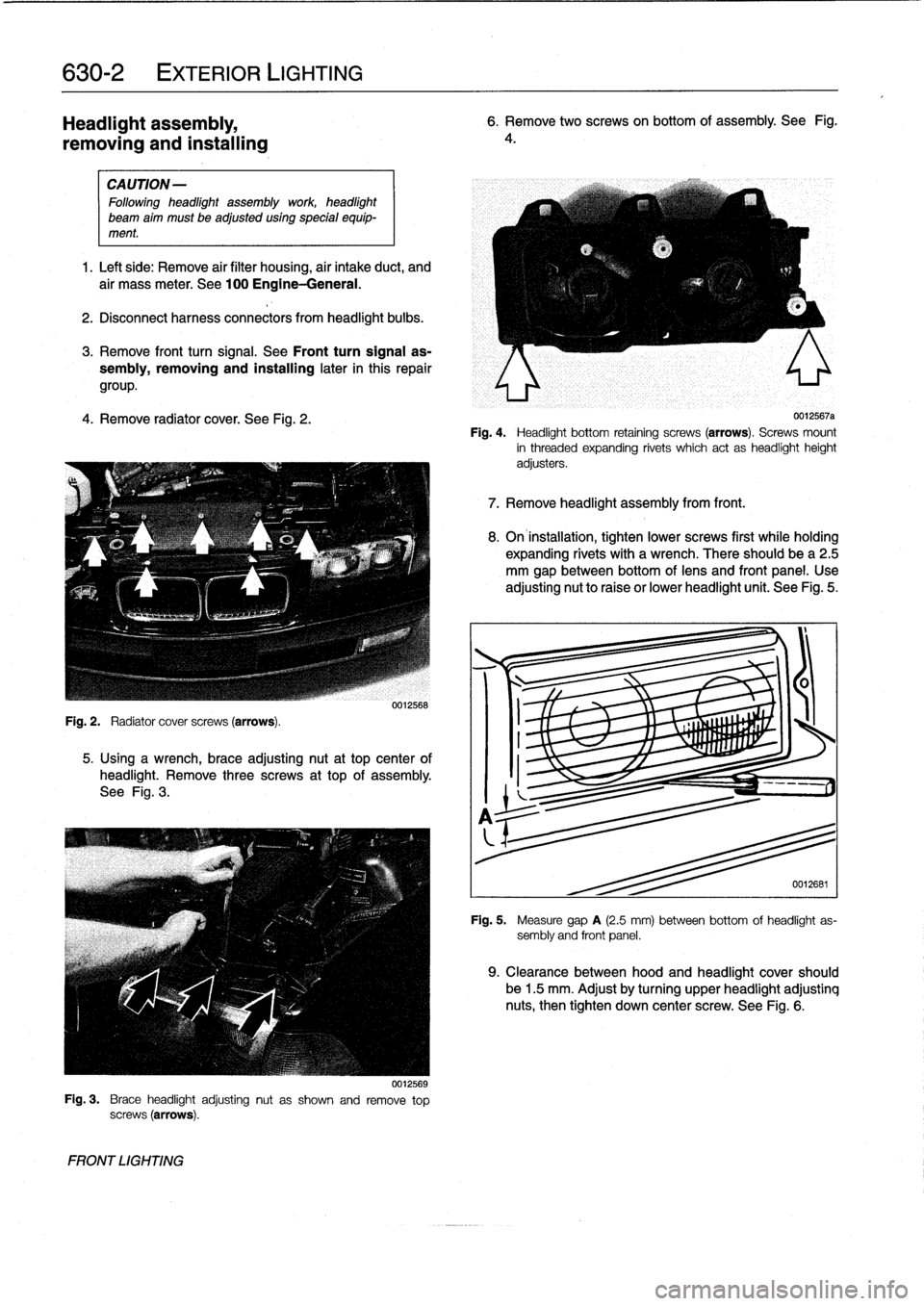
Remove
radiator
cover
.
See
Fig
.
2
.
5
.
Using
a
wrench,
brace
adjusting
nut
at
top
center
of
headlight
.
Remove
three
screws
at
top
of
assembly
.
See
Fig
.
3
.
Fig
.
3
.
Brace
headlightadjustingnut
as
shown
and
remove
top
screws
(arrows)
.
FRONT
LIGHTING
0012568
0012569
6
.
Remove
two
screwson
bottom
of
assembly
.
See
Fig
.
4
.
0012567a
Fig
.
4
.
Headlight
bottom
retaining
screws
(arrows)
.
Screws
mount
in
threaded
expanding
rivets
which
act
as
headlightheight
adjusters
.
7
.
Remove
headlight
assembly
from
front
.
8
.
On
installation,
tighten
lower
screws
first
while
holding
expanding
rivets
with
a
wrench
.
There
should
be
a
2
.5
mm
gap
between
bottom
oflens
and
front
panel
.
Use
adjusting
nut
to
raise
or
lower
headlight
unit
.
See
Fig
.
5
.
0012681
Fig
.
5
.
Measure
gap
A
(2.5
mm)
between
bottom
of
headlight
as-
sembly
and
front
panel
.
9
.
Clearance
between
hood
and
headlight
cover
should
be
1
.5
mm
.
Adjust
by
turning
upper
headlight
adjustinq
nuts,
then
tighten
down
center
screw
.
See
Fig
.
6
.
Page 443 of 759
4
Foglight
assembly,
removing
and
installing
1
.
Foglight
lens
release
catch
2
.
Foglight
lensrear
protective
cap
3
.
Foglight
bulb
4
.
Foglight
lens
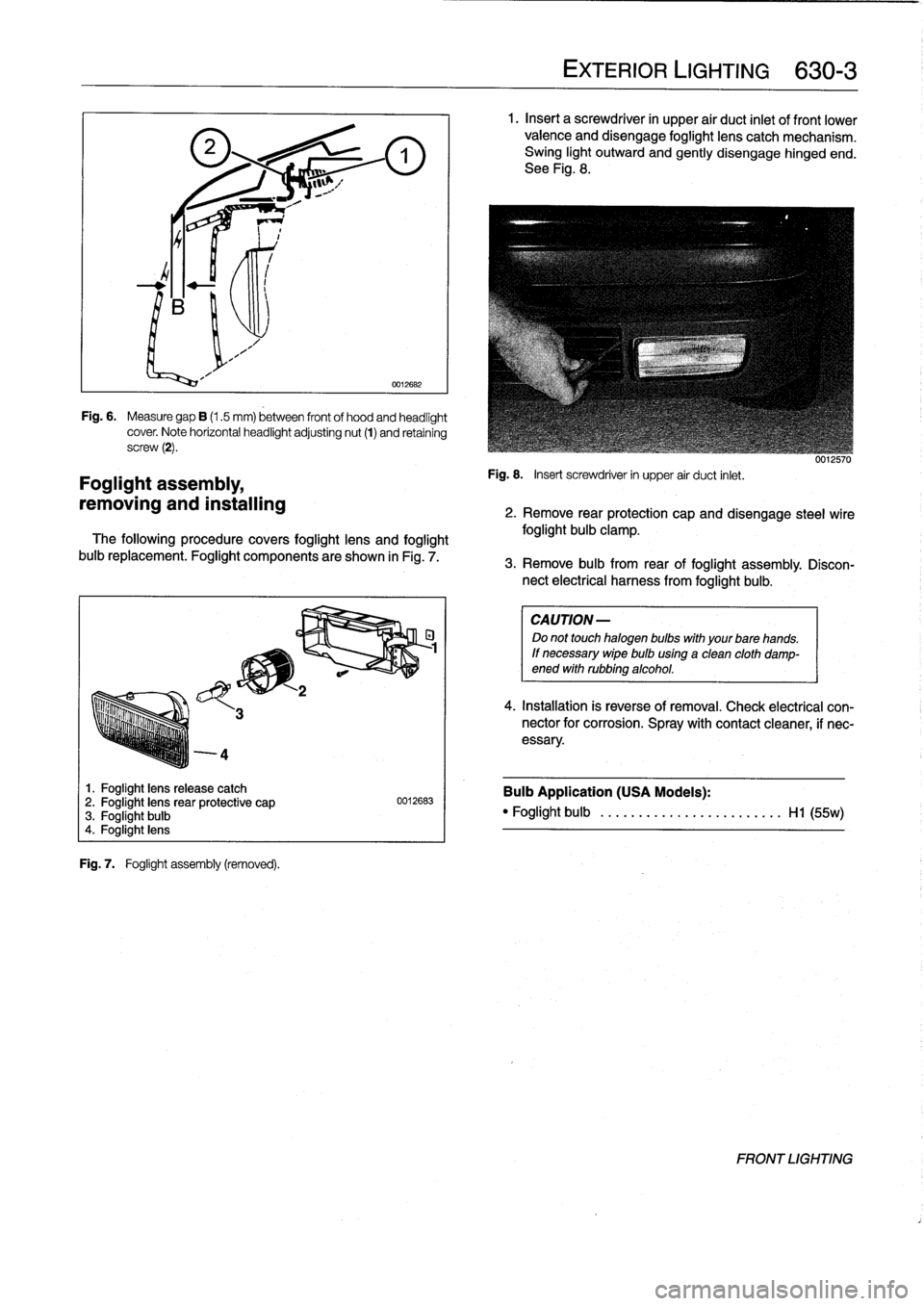
Fig
.
7
.
Foglight
assembly
(removed)
.
0012682
Fig
.
6
.
Measure
gap
B
(1.5
mm)
between
front
of
hood
and
headlight
cover
.
Note
horizontal
headlightadjusting
nut
(1)
and
retaining
screw
(2)
.
The
following
procedure
covers
foglight
lens
and
foglight
buib
replacement
.
Foglight
components
are
shown
in
Fig
.
7
.
0012683
EXTERIOR
LIGHTING
630-
3
1
.
Insert
a
screwdriver
in
upper
air
duct
inlet
of
front
lower
valence
and
disengage
foglight
lens
catch
mechanism
.
Swing
light
outward
and
gently
disengage
hinged
end
.
See
Fig
.
8
.
Fig
.
8
.
Insert
screwdriver
in
upper
air
duct
inlet
.
uu¡¿biu
2
.
Remove
rear
protection
capand
disengage
steel
wire
foglight
bulb
clamp
.
3
.
Remove
bulb
from
rear
of
foglight
assembly
.
Discon-
nect
electrical
harness
from
foglight
bulb
.
CAUTION
-
Do
not
touch
halogen
bulbs
with
yourbare
hands
.
If
necessary
wipe
buib
using
a
clean
cloth
damp-ened
withrubbing
alcohol
.
4
.
Installation
is
reverse
of
removal
.
Check
electrical
con-nector
for
corrosion
.
Spray
with
contact
cleaner,
if
nec-
essary
.
Bulb
Application
(USA
Models)
:
"
Foglight
bulb
......
...
..
...
..........
Hl
(55w)
FRONT
LIGHTING
Page 752 of 759
WARNING
Your
common
sense,
good
judge-
ment,
and
general
alertness
are
cru-
cial
to
safe
and
successful
service
work
.
Befcre
attempting
any
work
on
your
BMW,
read
the
warnings
and
cautions
on
page
vi¡
and
the
copyright
page
at
the
frontof
the
manual
.
Review
these
warnings
and
cautions
each
time
you
prepare
to
workon
your
BMW
.
Please
also
read
any
warnings
and
cautions
that
accom-
pany
the
procedures
in
the
manual
.
Door
glass
See
Door
windows
Door
windows
general
information
512-1
front
door
window
(2-door
models)
adjusting
512-7
removing/installing
512-5
front
door
window
(4-door
models)
initíalizing
512-1
removing/installing
512-2
rear
door
window
(4-door
models)
removing/installing
512-4
fixed
glass,
removing/installing
512-
4
rear
vent
window
or
vent
latch,
replacing
(2-door
models)
512-11
window
regulator
and
motor,
removing/installing
512-12
window
regulator
service
512-12Doorcheck
See
DoorsDoor
handle
See
Centrallocking
and
anti-theft
Door
panel
See
Doors
Doors
general
information
411-1
door
adjustment
411-2door
check,
replacing
411-2
door
panels
411-3
doors411-1
front
orrear
door,removing/installing
411-1
front
door
panel,
removing/installing
411-3
rear
door
panel,
removing/installing
411-4
rearsidepanel,
removing/installing
(two-door
model)
411-4
Drive
axle
See
Rear
suspension
Driveability
troubleshooting
See
Engine-general
Driveshaft
general
information
260-1
center
bearing
assembly,
replacing
260-6
driveshaft,
aligning
260-3
driveshaft,
installing
260-4
Driveshaft
(cont
.)
driveshaft,
removing260-4
driveshaftservice
260-3
flex-disc,
replacing
260-5
front
centering
guide,
replacing
260-7
guibo
See
flex-disc
troubleshooting260-1
ECM
(engine
control
module)
pin
assignment
See
Fuel
injection
Electrical
circuit
See
Electrical
system-general
Electrical
component
locations
general
information
610-1
auxíliary
relay
panel
610-2
component
location
table
610-9
component
locations
610-3
fuse
position
tables
610-19
fuse
positions
610-1
relay
positions
610-2
splice
panel,
left
610-2
splice
panel,
right
610-3
Electrical
system-general
general
information
600-1
continuity,
checking
600-5
electrical
test
equipment
600-2
safety
precautions
600-1
short
circuits
600-5
short
circuit,
testing
with
ohmmeter
600-6
short
circuit,
testing
with
voltmeter
600-6
troubleshooting
600-3
voltage,
measuring600-4
voltage
and
polarity
600-1
voltage
and
voltage
drops
600-4
voltage
drop,
testing
600-4
wiring
codes
and
abbreviations
600-2
wiring
diagrams
600-2
wiring,
fuses
and
relays
600-1
Electrical
wiring
diagrams
general
information
ELE-1
wiring
diagrams
ELE-2
ABS
ELE-117
ABS/AST
ELE-120
airbag
(supplemental
restraint
system)
ELE-140
air
conditioning
and
heating
ELE-
129
anti-theft
(Alpine)
system
ELE-144
anti-theft
(EWS
II)
ELE-150
body
computer
module
ELE-176
charging
system
ELE-67
convertible
top
ELE-253
cruise
control
ELE-112
data
link
connector
ELE-86
engine
cooling
ELE-94
engine
management
ELE-70
exterior
lights
ELE-194
ground
distribution
ELE-35
headlights/foglights
ELE-180
INDEX
3
Electrical
wiring
diagrams
(cont
.)
heated
seats
ELE-245
horns
ELE-153
instrument
panel
ELE-165
interior
lights/illumination
ELE-211
lumbar
control
ELE-247
on-board
computer
ELE-173
park
ventilation
ELE-139
power
distribution
ELE-2
power
door
locks
ELE-226
power
mirrors
ELE-241
power
seats
ELE-243
power
sunroof
ELE-248
power
windows
ELE-231
radio/cassette/CD/speakers
ELE-
255
rear
window
defogger
ELE-160
shift
interlock
ELE-110
starting
ELE-63
transmission
electronics
ELE-96
warning
systems`
.
chimes
ELE-178
wiper/washer
ELE-154
Emergencies
See
Fundamentals
for
the
do-it-
yourself
owner
Engine-general
general
information
100-1
air
flow
measurement
and
vacuum
leaks
100-12
basic
engine
settings
100-11
basic
requirements
100-11
battery
voltage
100-12connecting
rods
and
pistons
100-1
cooling
system
100-5
cylinder
block
and
crankshaft100-1
cylinder
compression,
checking
100-6
cylinder
head
and
valvetrain
100-2
DISA
(dual
resonance
intake
system)
100-3,130-3
driveability
troubleshooting
100-8
engine
management
system
100-3
fuel
delivery
100-5
fuel
supply
100-14ground
connections
100-13
ignition
100-5
lubrication
system100-5
mechanical
troubleshooting
100-5
on-board
diagnostics
(OBD)
100-8
oxygen
sensors
100-11
preventive
maintenance
100-11
VANOS
(variable
valve
timing)
100-2warningsand
cautions
100-5
wiring
andharness
connections100-
13Engine
control
module
(ECM)
See
Fuel
injection
Engine
removal
and
installation
general
information
110-1
engine,
removing/installing(4-cylinder
engines)
110-1
engine,
removing/installing
(6-cylinder
engines)
110-4
Engine
coolant
temperature
(ECT)
sensor
See
Fuel
injection
Engine
hood
See
Fenders,
enginehood