Measure BMW 325i 1996 E36 User Guide
[x] Cancel search | Manufacturer: BMW, Model Year: 1996, Model line: 325i, Model: BMW 325i 1996 E36Pages: 759
Page 111 of 759
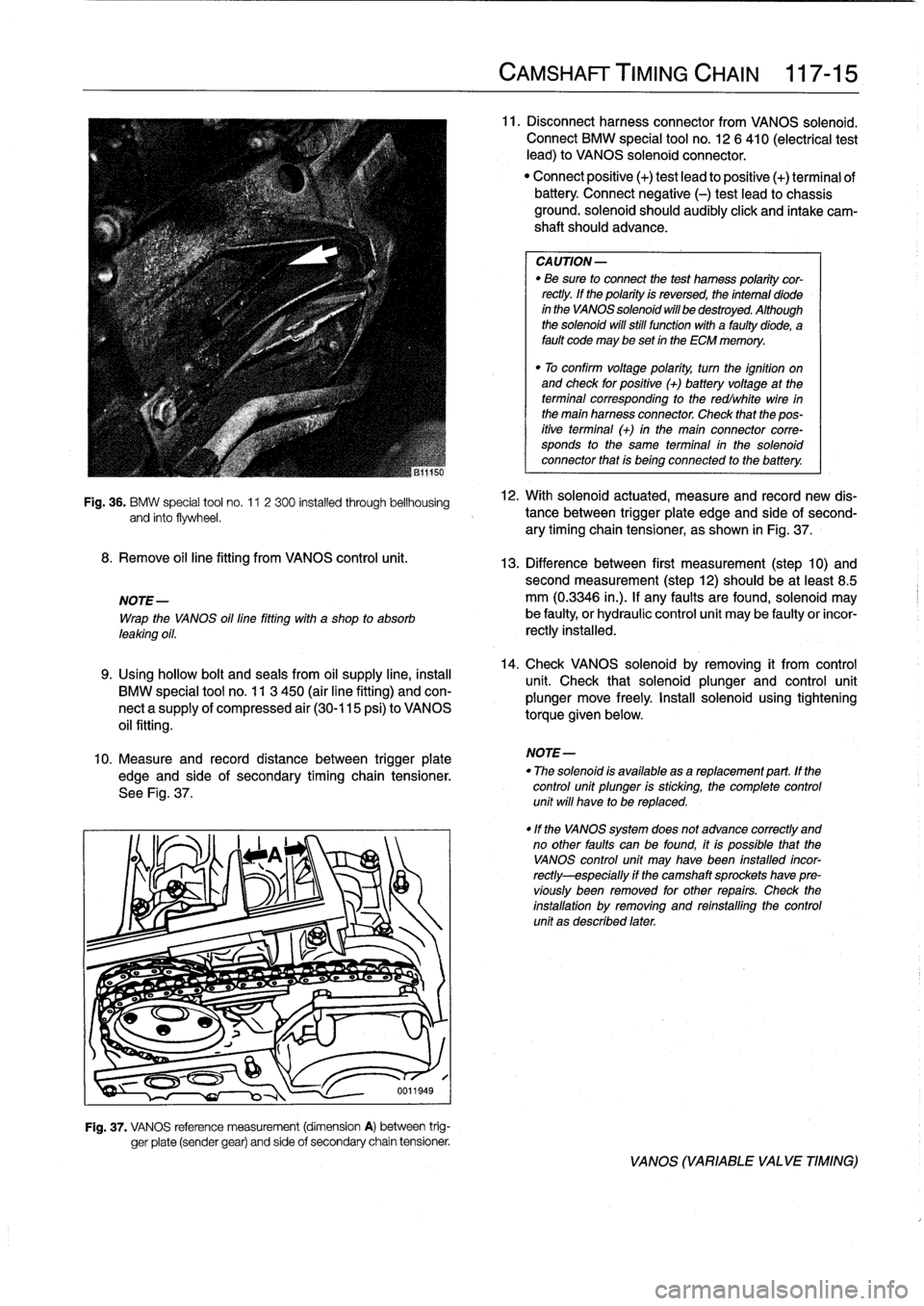
Fig
.
36
.
BMW
special
tool
no
.
11
2
300
installed
through
bellhousing
and
finto
flywheel
.
8
.
Remove
oil
line
fitting
from
VANOS
control
unit
.
NOTE-
Wrap
the
VANOS
oil
line
fitting
with
a
shop
to
absorb
leaking
oil
.
9
.
Using
hollow
bolt
and
seals
from
oil
supply
line,
instan
BMW
special
tool
no
.
11
3
450
(air
line
fitting)
and
con-
nect
a
supply
of
compressed
air
(30-115
psi)
to
VANOS
oil
fitting
.
10
.
Measure
and
record
distance
between
trigger
plate
edge
and
side
of
secondary
timing
chain
tensioner
.
See
Fig
.
37
.
Fig
.
37
.
VANOS
reference
measurement
(dimension
A)
between
trig-
ger
píate
(sender
gear)
and
side
of
secondary
chain
tensioner
.
CAMSHAFT
TIMING
CHAIN
117-
1
5
11
.
Disconnectharness
connector
from
VANOS
solenoid
.
Connect
BMW
special
tool
no
.
12
6
410
(electrical
test
lead)
to
VANOS
solenoid
connector
.
"
Connect
positive
(+)
test
lead
to
positive
(+)
terminal
ofbattery
Connect
negative
(-)
test
leadto
chassis
ground
.
solenoid
should
audibly
click
and
intake
cam-
shaft
should
advance
.
CA
UTION-
"
Be
sure
to
connect
the
test
hamess
polaritycor-
rectly
.
lf
the
polarity
is
reversed,
the
intemal
diode
in
the
VANOS
solenoid
will
be
destroyed
.
Although
the
solenoid
will
still
functionwith
a
faultydiode,
a
fault
code
may
be
set
in
the
ECM
memory
.
"
To
confirm
voltage
polarity,
turn
the
ignition
on
and
check
for
positive
(+)
batteryvoltage
at
the
terminal
corresponding
to
the
redlwhite
wire
in
the
main
harness
connector
.
Check
that
the
pos-
itive
terminal
(+)
in
the
main
connector
corre-
sponds
to
the
same
terminal
in
the
solenoid
connector
that
is
being
connected
to
the
battery
.
12
.
With
solenoid
actuated,
measure
and
record
new
dis-
tance
between
trigger
plate
edge
and
side'of
second-
ary
timing
chain
tensioner,
as
shown
in
Fig
.
37
.
13
.
Difference
between
first
measurement
(step
10)
andsecond
measurement
(step12)
should
be
at
least
8
.5
mm
(0
.3346
in
.)
.
lf
any
faults
arefound,
solenoid
may
be
faulty,
or
hydraulic
control
unit
may
be
faulty
or
incor-
rectly
installed
.
14
.
Check
VANOS
solenoid
byremoving
it
from
control
unit
.
Check
that
solenoid
plunger
and
control
unit
plunger
move
freely
.
Install
solenoid
using
tighteníng
torque
given
below
.
NOTE-
"
The
solenoid
is
available
asareplacement
part
.
lf
the
control
unit
plunger
is
sticking,
the
complete
control
unit
will
have
to
be
replaced
.
"lf
the
VANOS
system
does
not
advance
correctly
and
no
other
faults
can
be
found,
itis
possible
that
the
VANOS
control
unit
may
Nave
been
fnstalled
incor-
rectly-especially
if
the
camshaft
sprockets
have
pre-
víously
been
removed
for
other
repairs
.
Check
the
installation
by
removing
and
reinstalling
the
control
unit
as
described
later
.
VANOS
(VARIABLE
VALVE
TIMING)
Page 126 of 759
120-2
IGNITION
SYSTEM
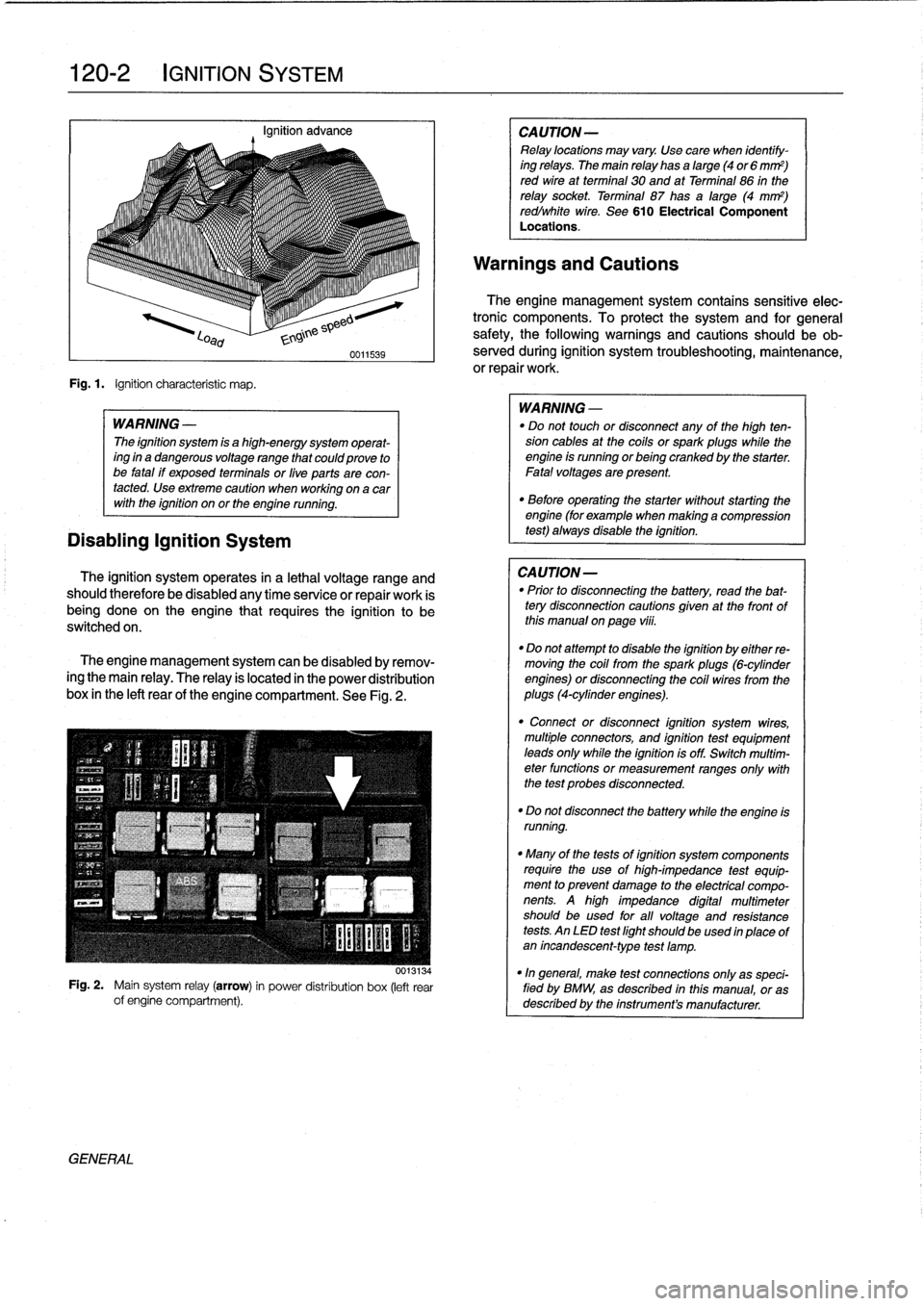
Fig
.1
.
Ignition
characteristic
map
.
Disabling
Ignition
System
WARNING
-
The
ignition
system
is
a
high-energy
system
operat-
ing
in
a
dangerous
voltage
range
that
couldprove
to
be
fatal
if
exposed
terminals
or
live
parts
are
con-
tacted
.
Use
extreme
caution
when
working
on
a
car
with
the
ignition
on
or
the
engine
running
.
The
ignition
system
operates
in
a
lethal
voltage
range
and
should
therefore
be
disabied
any
time
senrice
or
repair
work
is
being
doneon
the
engine
that
requires
the
ignition
to
be
switched
on
.
The
engine
management
system
can
be
disabled
byremov-
ingthe
main
relay
.
The
relay
is
located
in
the
power
distribution
box
in
the
left
rear
of
the
engine
compartment
.
See
Fig
.
2
.
0013134
Fig
.
2
.
Maínsystem
relay
(arrow)
in
power
distribution
box
(left
rear
of
engine
compartment)
.
GENERAL
WARNING
-
"
Do
not
touch
or
disconnect
any
of
the
high
ten-
sion
cables
at
the
cotls
orspark
plugs
while
the
engine
ts
running
orbeingcranked
by
the
starter
.
Fatalvoltages
are
present
.
"
Before
operating
the
starter
without
starting
the
engine
(for
example
when
making
a
compression
test)
always
disable
the
ignition
.
CAUTION-
"
Prior
to
disconnecting
the
battery,
read
the
bat-tery
disconnection
cautions
gtven
at
the
front
of
thts
manual
on
page
viti
.
"
Do
not
attempt
to
disable
the
ignition
by
either
re-
moving
the
cotl
from
the
spark
plugs
(6-cylinder
engines)
or
disconnecting
the
coll
wires
from
the
plugs
(4-cylinder
engines)
.
"
Connect
or
disconnect
ignition
system
wires,
multiple
connectors,
and
ignition
test
equipment
leads
only
while
the
ignitionis
off
.
Switch
multtm-
eter
functions
or
measurement
ranges
onty
with
the
test
probes
disconnected
.
"
Do
not
disconnect
the
battery
while
the
engine
ts
running
.
"
Many
of
the
tests
of
ignition
system
components
require
the
use
of
high-impedance
test
equip-
ment
to
prevent
damage
to
the
electrical
compo-
nents
.
A
high
impedance
digital
multimeter
should
be
used
for
all
voltage
and
resistance
tests
.
AnLED
test
light
shouldbe
used
in
place
of
an
incandescent-type
test
lamp
.
"In
general,
make
test
connections
only
as
speci-fied
by
BMW,
as
described
inthis
manual,
or
as
described
by
the
instrumenta
manufacturer
.
Page 138 of 759
121-2
BATTERY,
STARTER,
ALTERNATOR
CHARGING
SYSTEM
TROUBLESHOOTING
Static
currentdraw,
checking
Charging
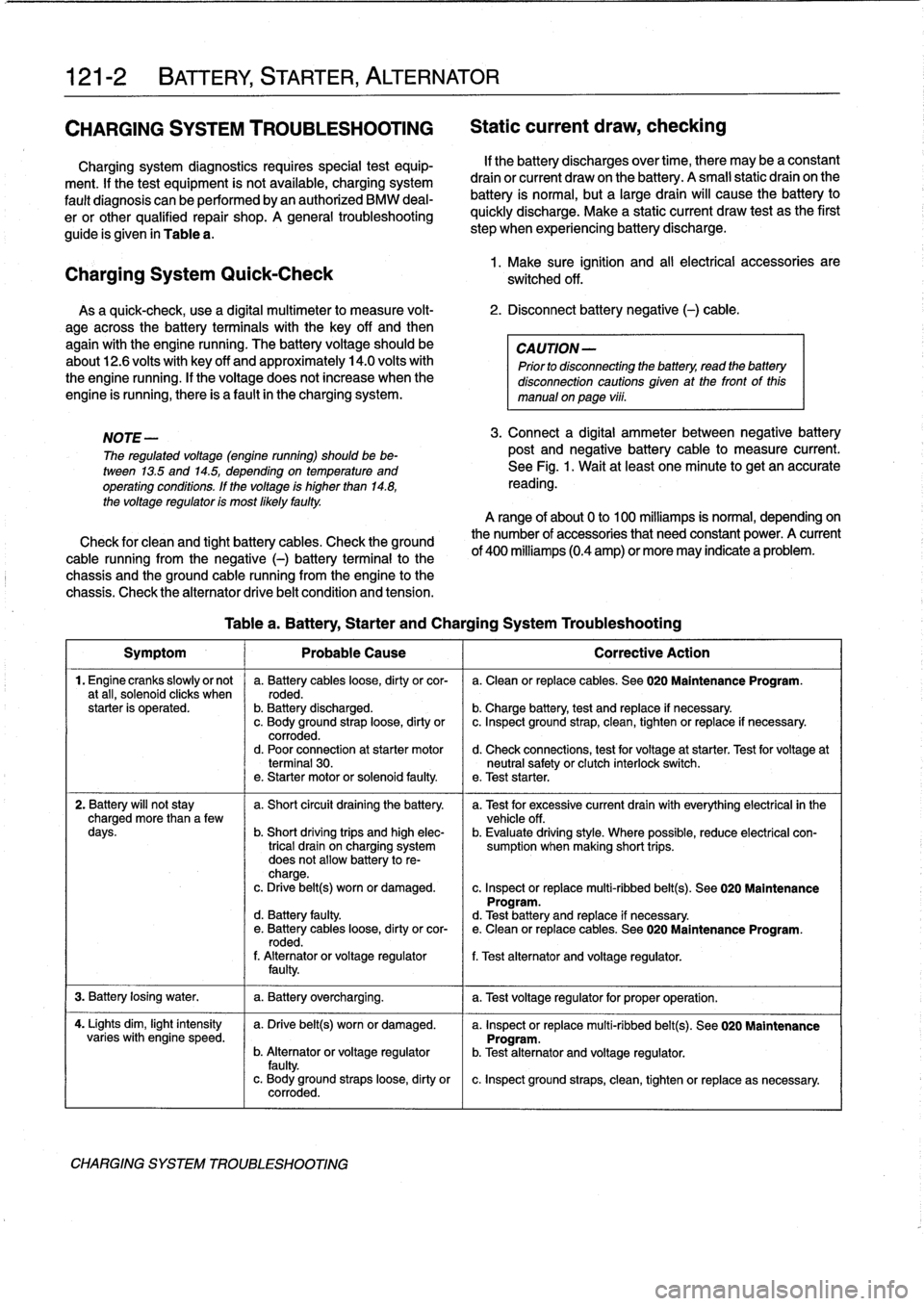
system
diagnostics
requires
special
test
equip-
ment
.
If
the
test
equipment
is
not
available,
charging
system
fault
diagnosis
can
be
performedby
an
authorized
BMW
deal-
eror
other
qualified
repair
shop
.
A
general
troubleshooting
guide
is
given
in
Table
a
.
Charging
System
Quick-Check
As
a
quick-check,
use
a
digital
multimeter
lo
measure
volt-
2
.
Disconnect
battery
negative
(-)
cable
.
age
across
the
battery
terminals
with
the
key
off
and
then
again
with
the
engine
running
.
The
battery
voltage
should
be
CAUTION-
about12
.6
volts
with
key
off
and
approximately
14
.0
volts
with
Prior
to
disconnecting
the
battery,
read
the
battery
the
engine
running
.
If
the
voltage
does
not
increase
when
the
disconnection
cautions
given
at
the
front
of
this
engine
is
running,there
is
a
fault
in
the
charging
system
.
manual
onpaga
viii
.
NOTE
-
The
regulated
voltage
(engine
running)
should
be
be-
tween
13
.5
and
14
.5,
depending
on
temperatura
and
operating
conditions
.
If
the
voltage
is
higher
than
14
.8,
the
voltage
regulator
is
most
Mely
faulty
.
Check
for
clean
and
tight
battery
cables
.
Check
the
ground
cable
running
from
the
negative
(-)
battery
terminal
lo
the
chassis
and
the
ground
cable
running
from
the
engine
lo
the
chassis
.
Check
the
alternator
drive
belt
condition
and
tension
.
If
the
battery
discharges
over
time,
there
may
be
a
constant
drain
or
current
draw
on
the
battery
.
A
small
static
drain
on
the
battery
is
normal,
but
a
largedrain
will
cause
the
battery
lo
quickly
discharge
.
Make
a
static
current
draw
test
asthe
first
step
when
experiencing
battery
discharge
.
1
.
Make
sure
ignition
and
al¡
electrical
accessories
are
switched
off
.
3
.
Connect
a
digital
ammeter
between
negative
battery
post
and
negative
battery
cable
lo
measure
current
.
See
Fig
.
1
.
Wait
at
least
one
minuta
lo
get
an
accurate
reading
.
A
range
of
about
0
lo
100
milliamps
is
normal,
dependingon
the
number
of
accessories
that
need
constant
power
.
A
current
of
400
milliamps
(0.4
amp)
or
more
may
indicate
a
problem
.
Table
a
.
Battery,
Starter
and
Charging
System
Troubleshooting
Symptom
1
Probable
Cause
1
Correctiva
Action
1
.
Engine
cranks
slowlyor
not
a
.
Battery
cables
loose,
dirty
orcor-
a
.
Clean
or
replace
cables
.
See020
Maintenance
Program
.
a
tall,
solenoíd
clicks
when
roded
.
starter
is
operated
.
b
.
Battery
discharged
.
b
.
Charge
battery,
test
and
replace
if
necessary
.
c
.
Body
ground
straploose,
dirty
or
c
.
Inspect
ground
strap,
clean,
tighten
or
replace
if
necessary
.
corroded
.
d
.
Poor
connection
at
starter
motor
d
.
Check
connections,
test
for
voltage
at
starter
.
Test
for
voltage
at
terminal
30
.
neutral
safety
or
clutch
interlock
switch
.
e
.
Starter
motor
or
solenoid
faulty
.
e
.
Test
starter
.
2
.
Battery
will
not
stay
a
.
Short
circuit
draining
the
battery
.
a
.
Test
for
excessive
current
drainwith
everything
electrical
in
the
charged
more
than
a
few
vehicle
off
.
days
.
b
.
Short
driving
trips
and
high
elec-
b
.
Evaluate
driving
style
.
Where
possible,
reduce
electrical
con
trical
drain
on
charging
system
sumption
when
making
short
trips
.
does
not
allow
battery
to
re-
charge
.
c
.
Drive
belt(s)
worn
or
damaged
.
c
.
Inspect
or
replace
multi-ribbed
belt(s)
.
See
020
Maintenance
Program
.
d
.
Battery
faulty
.
d
.
Test
battery
and
replace
íf
necessary
.
e
.
Battery
cables
loose,
dirty
orcor-
e
.
Clean
or
replace
cables
.
See
020
Maintenance
Program
.
rodad
.
f
.
Alternatoror
voltage
regulator
f
.
Test
alternator
and
voltage
regulator
.
faulty
.
3
.
Battery
losing
water
.
1
a
.
Battery
overcharging
.
1
a
.
Test
voltage
regulator
for
proper
operation
.
4
.
Lights
dim,
light
intensity
a
.
Drive
belt(s)
worn
or
damaged
.
a
.
Inspect
or
replace
multi-ribbed
belt(s)
.
See
020
Maintenance
varies
with
engine
speed
.
Program
.
b
.
Alternatoror
voltage
regulator
b
.
Test
alternator
and
voltage
regulator
.
faulty
.
c
.
Body
ground
straps
loose,
dirty
or
c
.
Inspect
ground
straps,
clean,
tighten
or
replace
as
necessary
.
corroded
.
CHARGING
SYSTEM
TROUBLESHOOTING
Page 139 of 759
Fig
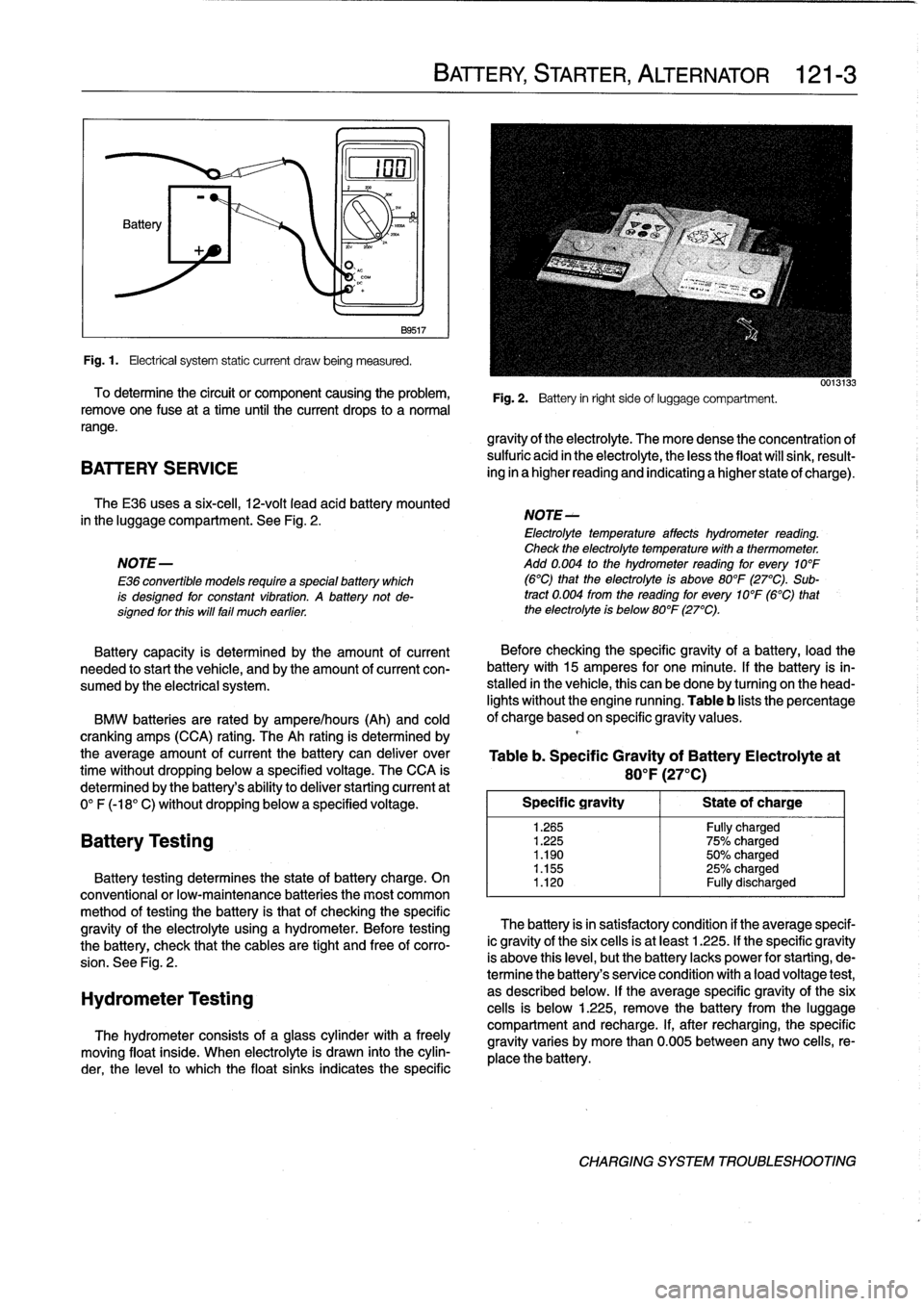
.1.
Electrical
system
static
current
draw
being
measured
.
To
determine
the
circuit
or
component
causing
the
problem,
remove
one
Puse
at
a
time
until
the
current
drops
to
a
normal
range
.
BATTERY
SERVICE
The
E36
uses
a
six-cell,
12-volt
leadacid
battery
mounted
in
the
luggage
compartment
.
See
Fig
.
2
.
NOTE-
E36
convertible
models
require
a
specialbattery
which
is
designed
for
constant
vibratfon
.
A
battery
not
de-signed
for
this
will
fail
much
earlier
.
Battery
capacity
is
determined
by
the
amount
of
current
needed
tostart
the
vehicle,
and
by
the
amount
of
current
con-
sumed
by
the
electrical
system
.
BMW
batteries
are
rated
by
ampere/hours
(Ah)
and
cold
cranking
amps
(CCA)
rating
.
The
Ah
rating
is
determined
by
the
average
amount
of
current
the
battery
can
deliver
over
time
without
dropping
below
a
specified
voltage
.
The
CCA
is
determined
by
the
battery's
ability
to
deliver
starting
current
at
0°
F
(-18°
C)
without
dropping
below
a
specified
voltage
.
Battery
Testing
noN~A
B9517
Battery
testing
determines
the
state
of
battery
charge
.
On
conventional
or
low-maintenance
batteries
the
most
common
method
of
testing
the
battery
is
that
of
checking
the
specific
gravity
of
the
electrolyte
using
a
hydrometer
.
Before
testing
the
battery,
check
that
the
cables
are
tight
and
free
of
corro-
sion
.
See
Fig
.
2
.
Hydrometer
Testing
The
hydrometer
consists
of
a
glass
cylinder
with
a
freely
moving
float
inside
.
When
electrolyte
is
drawn
into
the
cylin-
der,
the
levelto
which
the
float
sinks
indicates
the
specific
BATTERY,
STARTER,
ALTERNATOR
121-
3
Fig
.
2
.
Battery
in
right
sideof
luggage
compartment
.
gravity
of
the
electrolyte
.
The
more
dense
the
concentration
of
sulfuric
acid
in
the
electrolyte,
the
less
the
float
will
sink,
result-
ing
in
a
higher
reading
and
indicating
a
higher
state
of
charge)
.
NOTE-
Electrolyte
temperature
affects
hydrometer
reading
.
Check
the
electrolyte
temperaturewith
a
thermometer
.
Add
0
.004
to
the
hydrometer
reading
for
every
10°F
(6°C)
that
the
electrolyte
is
above
80°F
(27°C)
.
Sub-
tract
0
.004
from
the
reading
for
every
10°F
(6°C)
that
the
electrolyte
is
below
80°F
(27°C)
.
Before
checking
the
specificgravity
of
a
battery,
load
the
battery
with
15
amperes
for
one
minute
.
lf
the
battery
is
in-
stalled
in
the
vehicle,
this
can
be
done
by
turning
on
the
head-
lights
without
the
engine
running
.
Table
b
lists
the
percentage
of
charge
based
on
specific
gravity
values
.
Table
b
.
Specific
Gravity
of
Battery
Electrolyteat
80
°
F
(27°C)
Specific
gravity
1
Stateof
charge
1
.265
Fully
charged
1
.225
75%
charged
1
.190
50%
charged
1
.155
25%
charged
1
.120
Fully
discharged
The
battery
isin
satisfactory
condition
if
theaverage
specif-
ic
gravity
of
the
six
cells
is
at
least
1
.225
.
If
the
specific
gravity
is
above
this
leve¡,
butthe
battery
lacks
power
for
starting,
de-
termine
the
battery's
senrice
condition
with
a
load
voltage
test,
as
described
below
.
If
the
average
specific
gravity
of
the
six
cells
is
below
1
.225,
remove
the
battery
from
the
luggage
compartment
and
recharge
.
If,
after
recharging,
the
specific
gravity
varies
by
more
than
0
.005
between
any
two
celis,
re-
place
the
battery
.
CHARGING
SYSTEM
TROUBLESHOOTING
Page 143 of 759
Alternator
brushes,
STARTER
SERVICE
inspecting
and
replacing
Regulator
brushesarenot
available
as
replacement
parts
from
BMW
.
Replacement
brushes
may
be
available
from
af-
termarket
sources,
however
.
1
.
Remove
voltage
regulator
as
described
above
.
2
.
Clean
brush
contact
sürfaces
and
measure
brush
pro-trusion
.
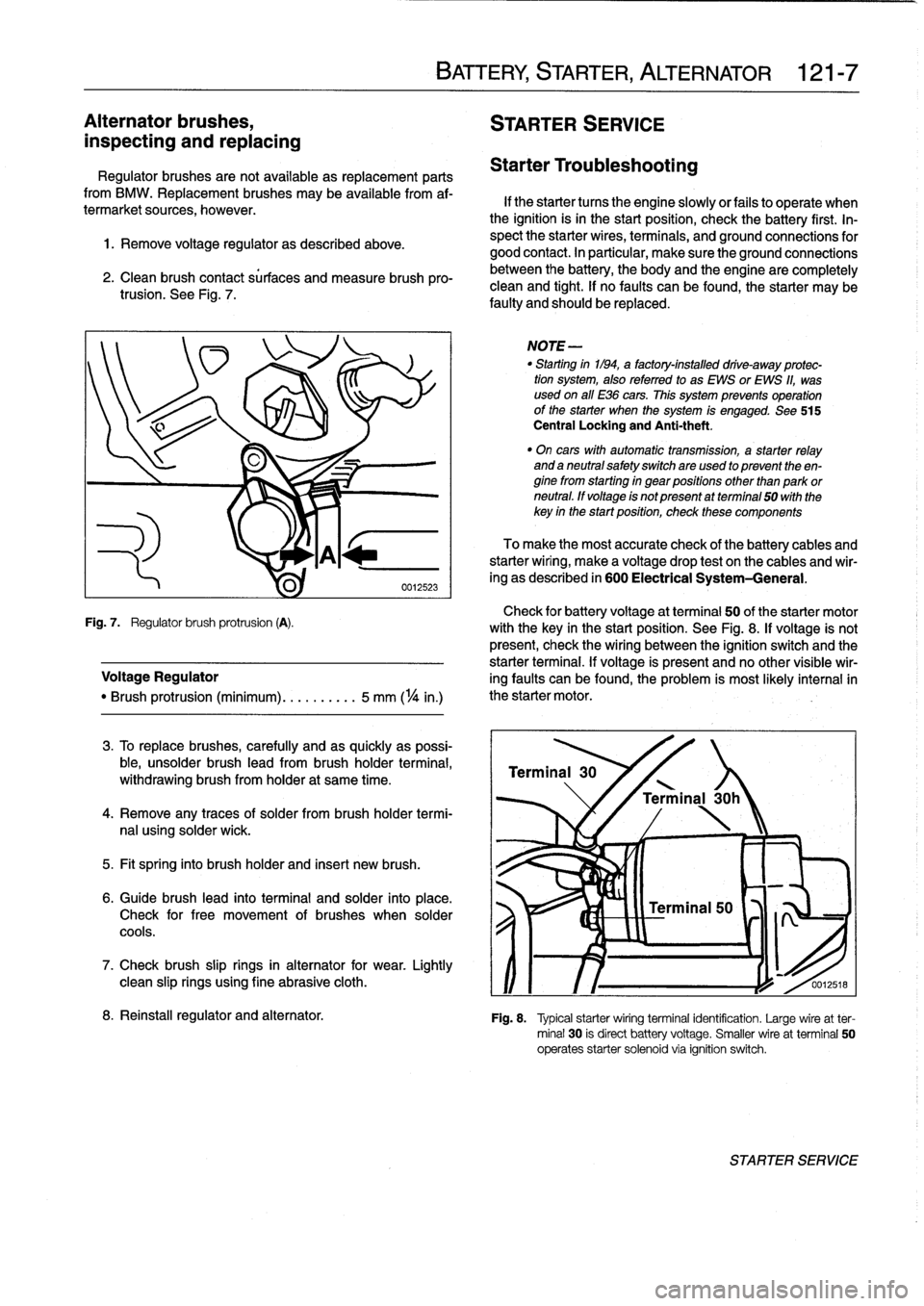
See
Fig
.
7
.
Check
for
battery
voltage
at
terminal
50
of
the
starter
motor
Fig
.
7
.
Regulator
brush
protrusion
(A)
.
with
the
key
in
the
start
position
.
See
Fig
.
8
.
If
voltage
is
not
present,
check
the
wiring
between
the
ignition
switch
and
the
starter
terminal
.
If
voltage
is
present
and
no
other
visible
wir
Voltage
Regulator
ing
faults
can
be
found,
the
problem
is
most
likely
interna¡in
"
Brush
protrusion
(minimum)
.......
.
..
5
mm
(
1
/4
in
.)
the
starter
motor
.
3
.
To
replace
brushes,
carefully
and
as
quickly
as
possi-
ble,
unsolder
brush
lead
from
brush
holder
termina¡,
withdrawing
brush
from
holder
at
same
time
.
4
.
Remove
any
traces
of
solder
frombrush
holder
termi-
nal
using
solder
wick
.
5
.
Fit
spring
into
brush
holder
and
inserí
new
brush
.
6
.
Guide
brush
lead
into
terminal
and
solder
into
place
.
Check
for
free
movement
of
brushes
when
solder
cools
.
7
.
Check
brush
slip
rings
in
alternator
for
wear
.
Lightly
clean
slip
rings
using
fine
abrasive
cloth
.
BATTERY,
STARTER,
ALTERNATOR
121-
7
Starter
Troubleshooting
If
the
starter
tucos
the
engine
slowlyor
fails
to
operate
when
the
ignition
isin
the
start
position,
check
the
battery
first
.
In-
spect
the
starter
wires,
terminals,
and
ground
connections
for
good
contact
.
In
particular,
make
sure
the
ground
connections
between
the
battery,
the
body
and
the
engine
are
completely
clean
and
tight
.
If
no
faults
can
be
found,
the
starter
may
be
faulty
and
should
be
replaced
.
NOTE
-
"
Starting
in1194,
a
factory-installed
drive-away
protec-
tion
system,
alsoreferred
to
as
EWS
or
EWS
11,
was
used
on
all
E36
cars
.
This
system
prevenís
operation
of
the
starter
when
the
system
is
engaged
.
See
515
Central
Locking
and
Anti-theft
.
"
On
cars
with
automatic
transmission,
a
starter
relay
and
a
neutral
safetyswitchare
used
to
present
theen-
ginefrom
starting
in
gear
positions
other
than
park
or
neutral
.
ff
voltage
is
not
present
atterminal
50
with
the
key
in
the
startposition,
check
these
components
To
make
the
most
accurate
check
of
the
battery
cables
and
starterwiring,
make
a
voltage
drop
test
on
the
cables
and
wir-
ing
as
described
in
600
Electrical
System-General
.
Terminal
30
'
\
/
Terminal
30h
0012518
8
.
Reinstall
regulator
and
alternator
.
Fig
.
8
.
Typical
starterwiring
terminal
identification
.
Large
wireat
ter-
minal
30
is
direct
battery
voltage
.
Smaller
wire
at
terminal
50
operates
starter
solenoid
via
ignition
switch
.
STARTER
SERVICE
Page 148 of 759
130-2
FUEL
INJECTION
GENERAL
This
repair
group
covers
fuel
injection
system
component
testing
and
repair
.
Special
equipment
is
necessary
for
some
of
the
procedures
given
in
this
repair
group
.
If
you
do
not
have
the
equipment
required
to
do
the
job,
it
is
recommended
that
these
repairs
be
left
to
an
authorized
BMW
dealer
.
The
BMW
dealer
is
equipped
with
sophisticated
diagnostic
test
equip-
ment
that
is
capable
of
quicklypinpointing
hard-to-find
fuel
in-
jection
problems
.
NOTE-
"
Wiring
diagrams
for
the
engine
management
system,
can
be
found
at
the
rear
of
the
manual
under
Electri-
cal
Wiring
Diagrams
.
"
For
ignition
system
repairinformation,
see120
Igni-
tion
System
.
"
For
fuel
supply
system
testing
and
repair,
see160
The
engine
control
module
(ECM)
uses
electrical
signals
Fuel
Tank
and
Fuel
Pump
.
from
the
mass
air
flow
sensor,
the
air
and
coolant
temperature
sensors,
the
crankshaft
position/rpm
sensor,
the
knock
sen
Principies
Of
Operation
sors
and
the
oxygen
sensorsas
the
primary
inputs
to
electron-
ically
control
fuel
delivery
and
ignition
timing
.
There
are
five
versions
of
engine
management
systems
usedon
the
E36
cars
.
Each
has
the
same
basic
components
and
operating
principles
.
The
most
notable
difference
is
that
1996
and
later
cars
use
a
sophisticated
OBD
II-compliant
sys-
tem
.
See
Table
a
.
Table
a
.
Engine
Management
System
Variants
Engine
code/year
1
System
4-cy1inder
M42
(1
.8
I)
1992-1995
Bosch
DME
Ml
.7
M44
(1
.91)
1996-1998
~
Bosch
DME
M5
.2
(OBD
II)
6-cylinder
M50
1992
(2.5
I)
Bosch
DME
M3
.1
1993-1995
(2.5
I)
Bosch
DME
M3
.3.1
(VANOS)
M52
1996-1998
(3281-
2
.8
I)
Siemens
MS
41
.1
(OBD
II)
1998
(3231
-
2
.5
I)
Siemens
MS
41
.1
(OBD
II)
M-Power
S50US
(M3
-
3
.01)
1995
Bosch
DME
M3
.3
.1
S52US
(M3
-
3
.21)
1997-1998
Siemens
MS
41
.1
(0131)
11)
NOTE-
-
Descriptions
and
procedures
in
the
first
partof
this
re-
pairgroup
refer
to
all
the
various
engine
management
systems
.
"
Particulars
of
each
fuel
injection
system
are
treated
in
separate
sections
in
the
second
part
of
this
repair
group
.
GENERAL
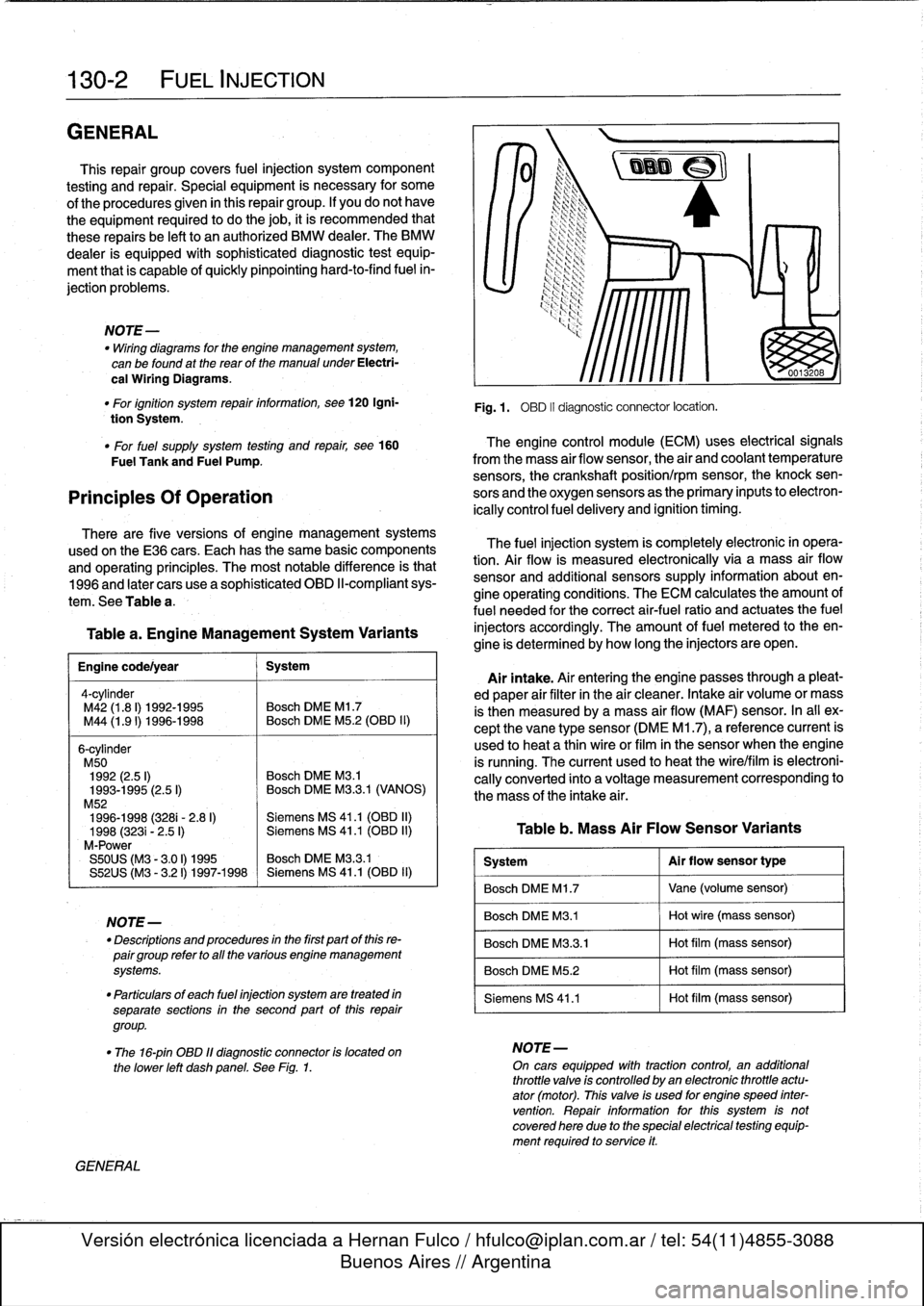
Fig
.1
.
OBD
II
diagnostic
connector
locatíon
.
The
fuel
injection
system
is
completely
electronic
in
opera-
tion
.
Air
flow
is
measured
electronically
via
a
mass
air
flow
sensor
and
additional
sensors
supply
information
about
en-
gine
operating
conditions
.
The
ECM
calculates
the
amount
of
fuel
needed
for
the
correct
air-fuel
ratio
and
actuates
the
fuel
injectors
accordingly
.
The
amount
offuel
metered
to
theen-
gine
is
determined
by
how
long
the
injectors
are
open
.
Airintake
.
Air
entering
the
engine
passes
through
a
pleat-
ed
paper
air
filter
in
the
air
cleaner
.
Intake
air
volume
or
mass
is
then
measured
bya
mass
air
flow
(MAF)
sensor
.
In
al¡
ex-
cept
the
vane
type
sensor
(DME
M1
.7),
a
reference
current
is
used
to
heat
a
thin
wireor
film
in
the
sensor
when
the
engine
is
running
.
The
current
used
to
heat
the
wire/film
is
electroni-
cally
converted
into
a
voltage
measurement
corresponding
to
the
mass
of
the
intake
air
.
Table
b
.
Mass
Air
Flow
Sensor
Variants
System
Al
r
flow
sensor
type
Bosch
DME
M1
.7
Vane
(volume
sensor)
Bosch
DME
M3
.1
Hot
wire
(mass
sensor)
Bosch
DME
M3
.3
.1
Hot
film
(mass
sensor)
Bosch
DME
M5
.2
Hot
film
(mass
sensor)
Siemens
MS
41
.1
Hot
film
(mass
sensor)
"
The
16-pin
OBD
11
diagnostic
connector
is
located
on
NOTE-
the
lower
left
dashpanel
.
See
Fig
.
1
.
On
cars
equipped
wíth
tractioncontrol,
an
additional
throttle
valve
is
controlled
by
an
electronic
throttle
actu-
ator
(motor)
.
This
valve
is
used
for
engine
speed
inter
vention
.
Repair
information
forthis
system
is
notcovered
here
due
to
the
special
electrical
testing
equip-
ment
required
to
service
it
.
Page 156 of 759
130-
1
0
FUEL
INJECTION
Relleving
fuel
pressure
and
connecting
fuel
pressure
gauge
WARNING
-
"
Gasoline
is
highly
flammable
and
its
vaporsare
explosive
.
Do
not
smoke
orwork
on
acarnear
heaters
or
other
fire
hazards
when
diagnosing
and
repairing
fuel
system
problems
.
Have
a
fire
extinguisher
available
in
case
of
an
emergency
.
"
When
working
onanopen
fuel
system,
wear
suit-
able
hand
protection
.
Prolonged
contact
with
fuel
can
cause
illnesses
and
skin
disorders
.
To
prevent
fuel
from
spraying
on
a
hot
engine,
system
fuel
pressure
should
be
relieved
before
disconnecting
fuel
lines
.
One
method
is
to
tightly
wrap
a
shop
towel
around
a
fuelline
fit-
ting
and
loosenor
disconnect
the
fitting
.
Cleanliness
is
essential
when
working
with
fuelcircuit
com-
ponents
.
Thoroughly
clean
theunionsbefore
disconnecting
fuellines
.
NOTE-
"
OnM44
engines,
a
Schrmder
valve
is
integrated
in
the
fuel
rail
.
Compressed
air
pressure
canbe
applied
at
the
valve
to
force
the
fuel
in
the
system
back
into
the
tank
.
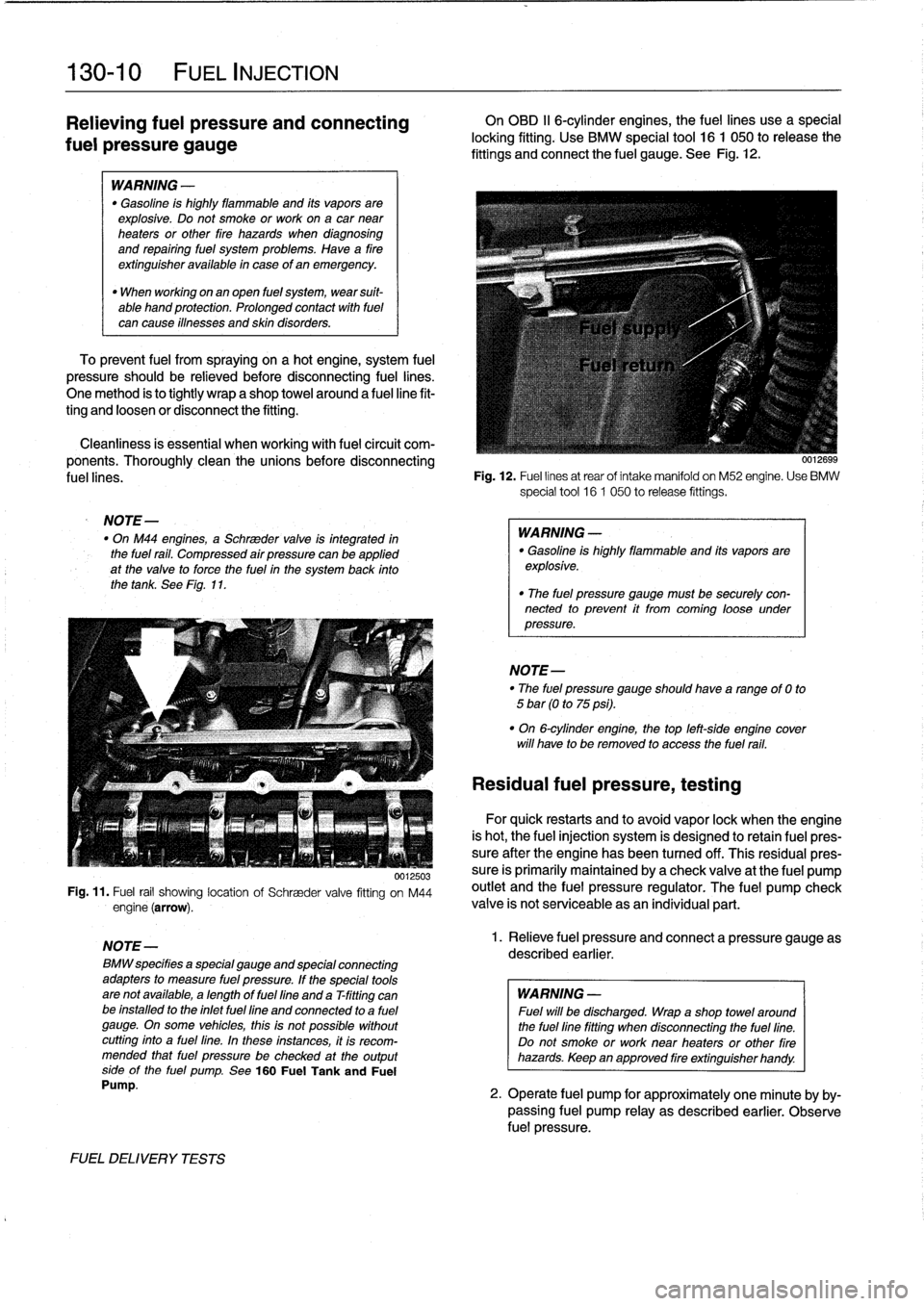
See
Fig
.
11
.
0012503
Fig
.
11
.
Fuel
rail
showing
location
of
Schraeder
valve
fitting
on
M44
engine
(arrow)
.
NOTE-
B~
specifies
a
special
gauge
and
special
connecting
adapters
to
measure
fuel
pressure
.
If
the
special
tools
arenot
available,
a
length
of
fuel
fine
and
a
T-fitting
canbe
installed
to
the
inlet
fuel
fine
and
connected
to
a
fuel
gauge
.
On
some
vehicles,
thisis
not
possible
without
cutting
finto
a
fuel
lino
.
In
these
lnstances,
it
Is
recom-
mended
that
fuel
pressure
be
checked
at
theoutput
sidoof
the
fuel
pump
.
See
160
Fuel
Tankand
Fuel
Pump
.
FUELDELIVERY
TESTS
On
OBD
II
6-cylinder
engines,
the
fuel
lines
use
a
special
locking
fitting
.
Use
BMW
special
tool
16
1
050
to
release
the
fittings
and
connect
the
fuel
gauge
.
See
Fig
.
12
.
0012699
Fig
.
12
.
Fuel
linos
at
rear
of
intake
manifold
on
M52
engine
.
Use
BMW
special
tool
16
1
050
torelease
fittings
.
WARNING
-
"
Gasoline
is
highly
flammable
and
its
vapors
are
explosive
.
"
The
fuel
pressure
gauge
must
be
securely
con-nected
to
prevent
it
from
coming
loose
under
pressure
.
NOTE-
"
The
fuel
pressure
gauge
should
have
arangoof
0
to
5
bar
(0
to
75
psi)
.
"
On
6-cylinder
engine,
thetop
left-sido
engine
cover
will
have
to
be
removed
to
access
the
fuel
rail
.
Residual
fuel
pressure,
testing
For
quick
restarts
and
to
avoid
vapor
lock
when
the
engine
is
hot,
the
fuel
injection
system
is
designed
to
retain
fuel
pres-
sure
after
the
engine
has
been
turned
off
.
Thís
residualpres-
sure
is
primarily
maíntained
by
a
check
valve
at
the
fuel
pump
outiet
and
the
fuel
pressure
regulator
.
The
fuel
pump
check
valve
is
not
serviceable
asan
individual
part
.
1.
Relieve
fuel
pressure
and
connect
a
pressure
gauge
as
described
earlier
.
WARNING
-
Fuel
will
be
discharged
.
Wrap
a
shop
towel
around
the
fuellino
fitting
when
disconnecting
the
fuel
fine
.
Do
not
smoke
or
worknear
heaters
or
other
fire
hazards
.
Keep
an
approved
fire
extinguisher
handy
.
2
.
Operate
fuel
pump
for
approximately
one
minuto
by
by-
passing
fuel
pump
relay
as
described
earlier
.
Observe
fuel
pressure
.
Page 163 of 759
BOSCH
DME
MM
AND
M33
.1
COMPONENT
TESTS
AND
REPAIRS
Consult
Table
a
for
engine
application
information
for
the
Bosch
DME
3
.1
and
3
.3.1
systems
.
The
DME
3
.1
and
DME
3
.3
.1
systems
are
similar
in
opera-
tion,
with
knock
control
and
VANOS
operation
being
the
key
differences
.
DME
3
.1
engines
arenot
equipped
with
VANOS
or
knock
detectors,
while
the
DM
E3
.3
.1
system
is
.
CA
UTION-
Use
onty
a
digital
multimeter
when
testing
wiring
.
Use
of
an
analog
VOM
may
damage
the
engine
control
module
.
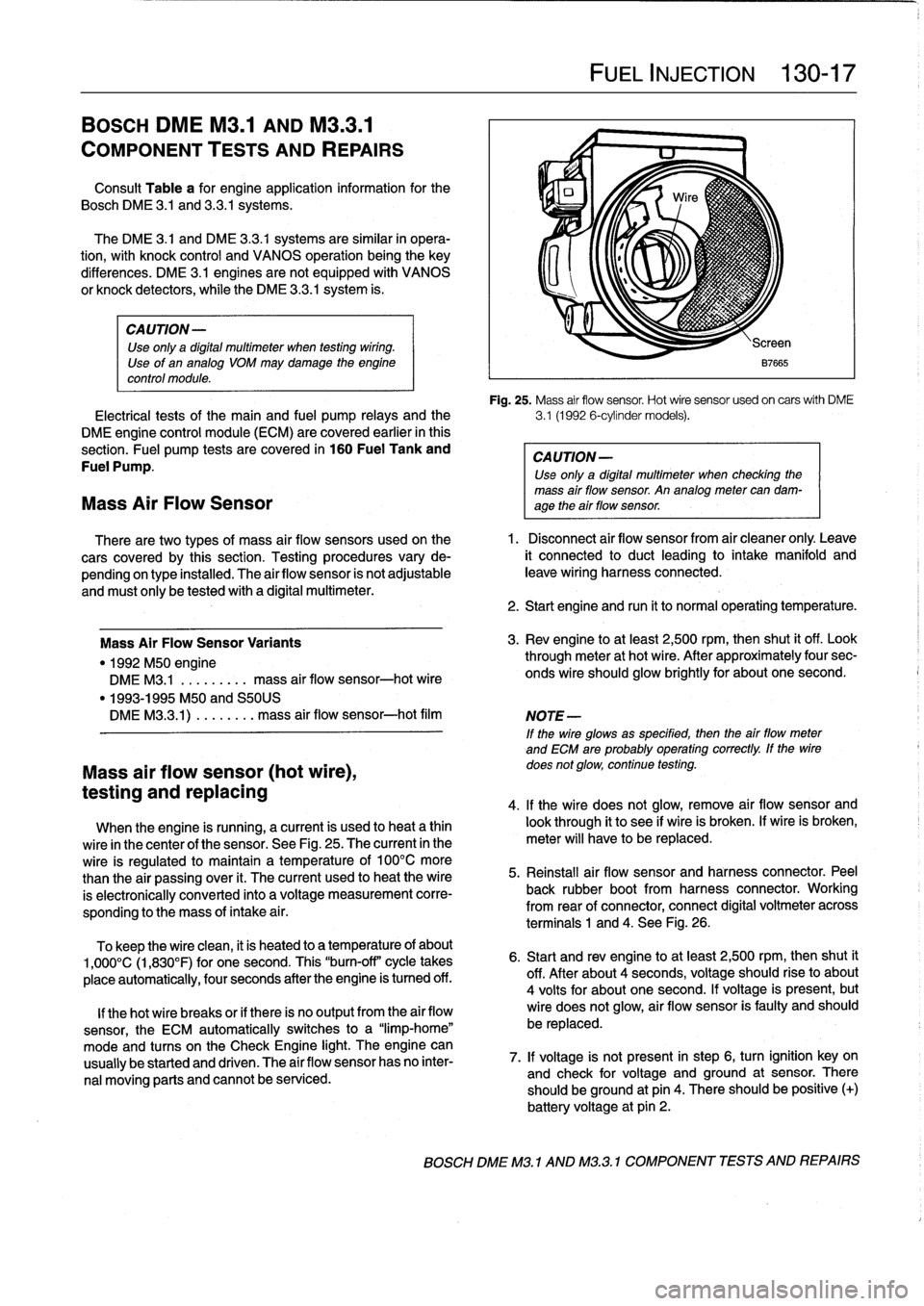
Fig
.
25
.
Mass
air
flow
sensor
.
Hot
wire
sensor
usedon
carswith
DME
Electrical
tests
of
the
main
and
fuel
pump
relays
and
the
3
.1
(1992
6-cylinder
models)
.
DME
engine
control
module
(ECM)
are
covered
earlier
in
this
section
.
Fuel
pump
tests
are
covered
in
160
Fuel
Tank
and
CAUTION-
Fuel
Pump
.
Use
only
a
digital
multimeter
when
checking
the
mass
air
flow
sensor
.
An
analog
meter
can
dam-
Mass
Air
Flow
Sensor
age
theair
flow
sensor
.
There
are
two
types
of
mass
air
flow
sensors
used
onthe
1
.
Disconnect
air
flow
sensor
from
air
cleaner
only
.
Leave
cars
covered
by
this
section
.
Testing
procedures
vary
de-
it
connected
to
duct
leading
to
intake
manifold
and
pending
on
type
installed
.
The
airflow
sensor
is
not
adjustable
leave
wiring
harness
connected
.
and
must
only
be
tested
with
a
digital
multimeter
.
Mass
Air
FlowSensor
Variants
"
1992
M50
engine
DME
M3
.1
.
.
.
.
...
..
mass
air
flow
sensor-hot
wire
"
1993-1995
M50
and
S50US
DMEM33
.1)
.
...
...
.
mass
air
flow
sensor-hot
film
Mass
air
flow
sensor
(hot
wire),
testing
and
replacing
When
the
engine
is
running,
a
current
is
used
to
heat
a
thin
wire
in
the
center
of
the
sensor
.
See
Fig
.
25
.
The
current
in
the
wire
is
regulated
to
maintain
a
temperature
of
100°C
more
than
the
air
passing
over
it
.
The
current
used
to
heat
the
wire
is
electronically
conneced
into
a
voltage
measurement
corre-
sponding
to
the
mass
of
intake
a¡
r
.
To
keep
the
wire
clean,
it
is
heated
to
a
temperature
of
about
1,000°C
(1,830°F)
for
one
second
.
This
"burn-off"
cycle
takes
place
automatically,
four
seconds
after
the
engine
is
tumed
off
.
lf
thehot
wire
breaks
or
if
there
is
no
output
from
the
air
flow
sensor,
the
ECM
automatically
switches
to
a
"limp-home"
mode
and
tucos
on
the
Check
Engine
light
.
The
engine
can
usually
be
started
and
driven
.
The
air
flow
sensor
has
no
inter-
nal
moving
parts
and
cannot
be
serviced
.
FUEL
INJECTION
130-
1
7
2
.
Start
engine
and
run
it
to
normal
operating
temperature
.
3
.
Rev
engine
toat
least
2,500
rpm,then
shut
it
off
.
Look
through
meter
at
hot
wire
.
After
approximately
four
sec-
onds
wire
should
glow
brightly
for
about
one
second
.
NOTE
-
If
the
wire
glowsas
specified,
then
the
airflow
meter
and
ECM
are
probably
operating
correctly
.
lf
the
wire
does
not
glow,
continue
testing
.
4
.
lf
the
wire
does
not
glow,
remove
air
flow
sensor
and
look
through
it
to
see
if
wire
is
broken
.
lf
wire
is
broken,
meter
will
have
to
be
replaced
.
5
.
Reinstall
air
flow
sensor
and
harness
connector
.
Peel
back
rubber
bootfrom
harness
connector
.
Working
from
rear
of
connector,
connect
digital
voltmeter
across
terminals
1
and
4
.
See
Fig
.
26
.
6
.
Start
and
rev
engine
toat
least
2,500
rpm,thenshut
it
off
.
After
about
4
seconds,
voltage
should
riseto
about
4
volts
for
about
one
second
.
lf
voltage
is
present,
but
wire
does
not
glow,
air
flow
sensor
is
faulty
and
should
be
replaced
.
7
.
lf
voltage
is
not
present
in
step
6,
turn
ignition
key
on
and
check
for
voltage
and
ground
at
sensor
.
There
should
beground
at
pin
4
.
There
should
be
positive
(+)
battery
voltage
at
pin
2
.
BOSCH
DME
M3
.1
AND
M32
.1
COMPONENT
TESTS
AND
REPAIRS
Page 164 of 759
130-18
FUEL
INJECTION
The
engine
coolant
temperature
(ECT)
sensor
sends
con-
tinuous
engine
coolant
temperature
information
to
the
ECM
.
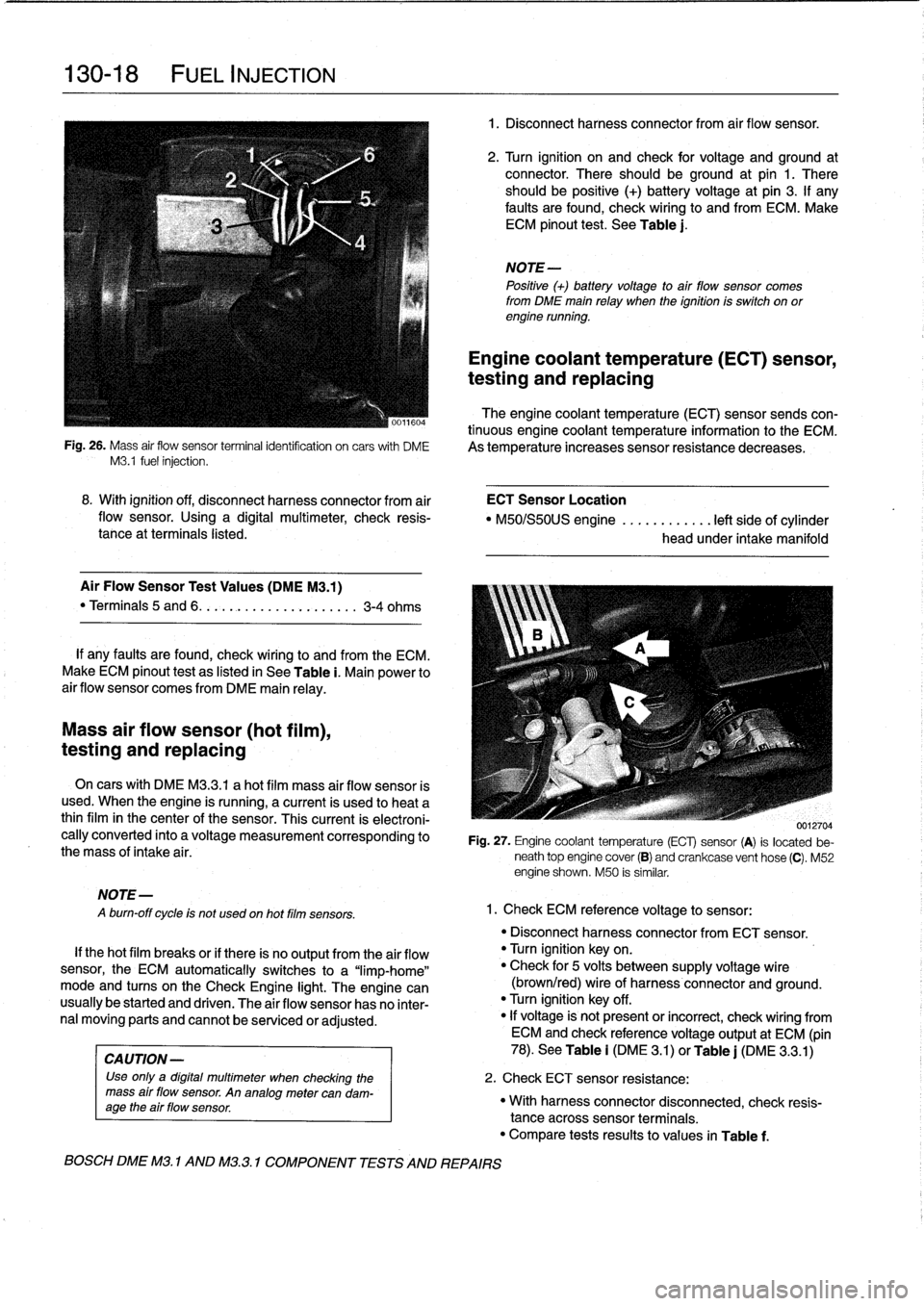
Fig
.
26
.
Mass
air
flow
sensor
terminalidentifcation
on
carswith
DME
As
temperature
increases
sensor
resistance
decreases
.
M3
.1
fuel
injection
.
Mass
air
flow
sensor
(hot
film),
testing
and
replacing
MOTE-
A
burn-off
cycle
is
not
used
on
hot
film
sensors
.
8
.
With
ignition
off,
disconnect
harness
connector
from
air
ECT
Sensor
Location
flow
sensor
.
Using
a
digital
multimeter,
check
resis-
"
M50/S50US
engine
............
left
side
of
cylinder
tance
at
terminals
listed
.
head
under
intake
manifold
Air
Flow
Sensor
Test
Values
(DMEM3
.1)
"
Terminals
5
and
6
.
.
.
.........
..
.
..
....
3-4
ohms
If
any
faults
are
found,
check
wiring
lo
and
from
the
ECM
.
Make
ECM
pinout
test
as
listed
in
See
Table
i
.
Main
power
to
air
flow
sensor
comes
from
DME
main
relay
.
On
cars
with
DME
M3
.3
.1
a
hot
film
mass
air
flow
sensor
is
used
.
When
the
engine
is
running,
a
current
is
used
lo
heat
a
thinfilm
in
the
center
of
the
sensor
.
This
current
is
electroni-
cally
converted
into
a
voltage
measurement
corresponding
to
the
mass
of
intake
air
.
If
thehot
film
breaks
or
if
there
is
no
output
from
the
air
flow
sensor,
the
ECM
automatically
switches
to
a
"limp-home"
mode
and
tucos
on
the
Check
Engine
light
.
The
engine
can
usually
be
started
and
driven
.
The
air
flow
sensor
has
no
inter-
nal
moving
parts
and
cannot
be
senricedor
adjusted
.
CA
UTION-
Use
only
a
digital
multimeter
when
checking
the
mass
air
flow
sensor
.
An
analogmetercan
dam-
age
the
air
flow
sensor
.
BOSCH
DME
M3
.
1
AND
M32
.1
COMPONENT
TESTS
AND
REPAIRS
1
.
Disconnect
harnessconnector
from
air
flow
sensor
.
2
.
Turn
ignition
on
and
check
for
voltage
and
ground
at
connector
.
There
should
beground
at
pin
1
.
There
should
be
positive
(+)
battery
voltage
at
pin
3
.
If
any
faults
are
found,
check
wiring
to
and
from
ECM
.
Make
ECM
pinout
test
.
See
Table
j
.
NOTE-
Positive
(+)
battery
voltage
to
air
flow
sensor
comes
from
DME
main
relay
when
the
ignition
is
switch
on
orengine
running
.
Engine
coolant
temperature
(ECT)
sensor,
testing
and
replacing
0012704
Fig
.
27
.
Engine
coolant
temperature
(ECT)
sensor
(A)
is
located
be-
neath
top
engine
cover
(B)
and
crankcase
vent
hose
(C)
.
M52
engine
shown
.
M50
is
similar
.
1
.
Check
ECM
reference
voltage
to
sensor
:
"
Disconnect
harnessconnector
from
ECT
sensor
.
"
Turn
ignition
keyon
.
"
Check
for
5
volts
between
supply
voltage
wire
(brown/red)
wire
of
harness
connector
and
ground
.
"
Turn
ignition
key
off
.
"
If
voltage
is'
not
present
or
incorrect,
check
wiring
from
ECM
and
check
referencevoltage
output
at
ECM
(pin
78)
.
See
Table
i
(DM
E
3
.1)
or
Table
j
(DME
3
.3
.1)
2
.
Check
ECT
sensor
resistance
:
"
With
harnessconnector
disconnected,
check
resis-
tance
acrosssensor
terminals
.
"
Compare
tests
results
to
values
in
Table
f
.
Page 174 of 759
130-
2
8
FUEL
INJECTION
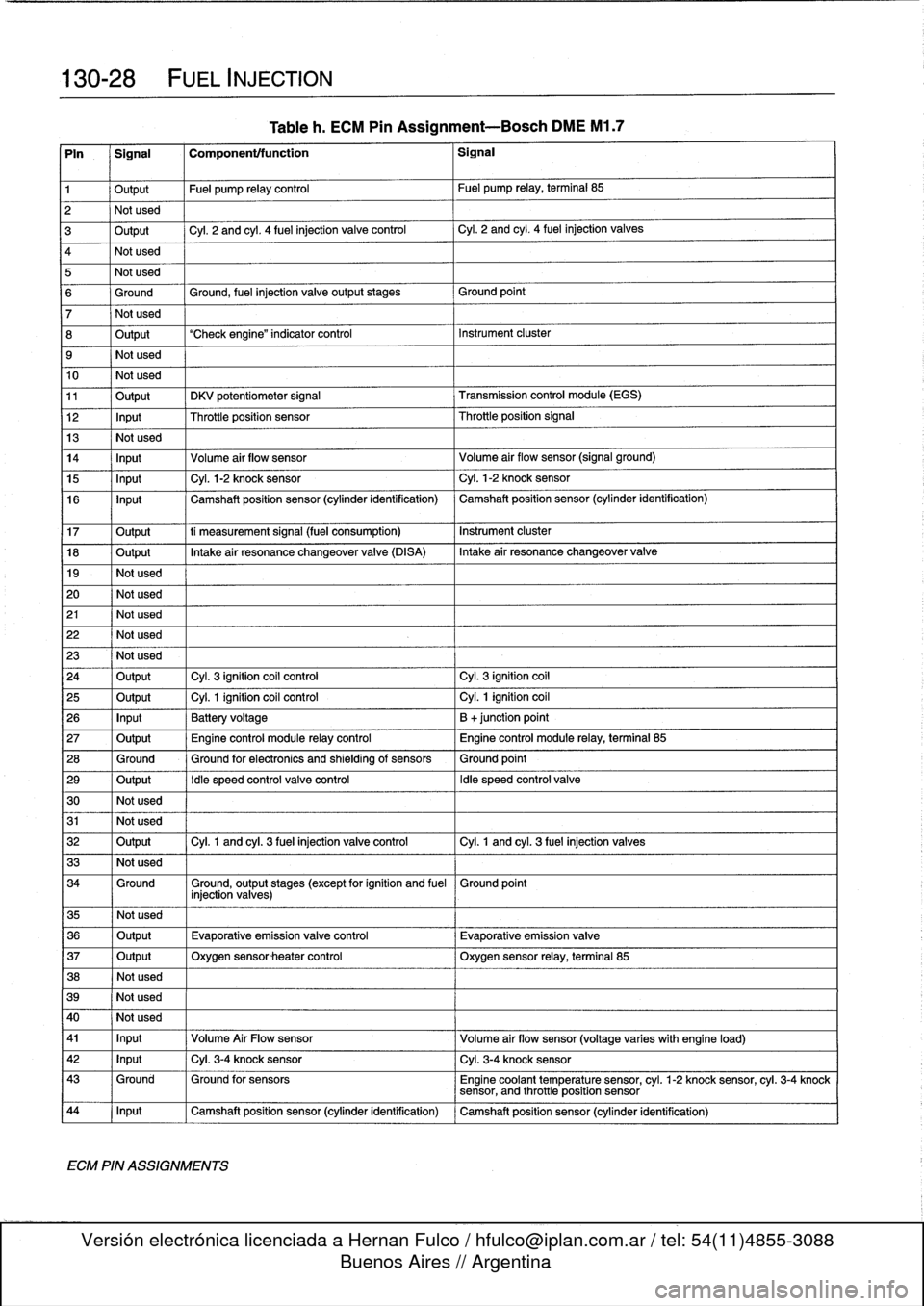
Tableh
.
ECM
Pin
Assignment-Bosch
DME
M1
.7
Pin
Signal
Componenttfunction
Signal
1
Output
Fuel
pump
relay
control
Fuel
pump
relay,
terminal
85
2
Not
used
3
Output
Cyl
.
2
and
cyl
.
4
fuel
injection
valve
control
Cyl
.
2
and
cyl
.
4
fuel
injection
valves
4
Not
used
5
Not
used
6
Ground
Ground,
fuel
injection
valveoutputstages
Ground
point
7
Not
used
8
Output
"Check
engine"
indicator
control
Instrument
cluster
9
Not
used
10
Not
used
11
Output
DKV
potentiometer
signal
Transmission
control
module
(EGS)
12
Input
Throttleposition
sensor
Throttleposition
Signal
13
Not
used
14
Input
Volume
air
flow
sensor
Volume
air
flow
sensor
(signal
ground)
15
Input
Cyl
.
1-2
knock
sensor
Cyl
.
1-2
knock
sensor
16
Input
Camshaft
position
sensor
(cylinder
identification)
Camshaft
position
sensor
(cylinder
identification)
17
Output
ti
measurement
signal
(fuel
consumption)
Instrument
cluster
18
Output
Intakeair
resonance
changeover
valve
(DISA)
Intake
air
resonance
changeover
valve
19
-
Not
used
20
Not
used
21
Not
used
22
Not
used
23
Not
used
24
Output
Cyl
.
3
ignition
coil
control
Cyl
.
3
ignition
coil
25
Output
Cyl
.
1
ignition
coil
control
Cyl
.
1
ignition
coil
26
Input
Battery
voltage
B
+junction
point
27
Output
Engine
control
module
relay
control
Engine
control
module
relay,
terminal
85
28
Ground
Ground
for
electronics
and
shielding
of
sensors
Ground
point
29
Output
Idle
speed
control
valve
control
Idle
speed
control
valve
30
Not
used
31
Not
used
32
Output
Cyl
.
1
and
cyl
.
3
fuel
injection
valve
control
Cyl
.
1
and
cyl
.
3
fuel
injection
valves
33
Not
used
34
Ground
Ground,
output
stages
(except
for
ignition
and
fuel
Ground
point
injection
valves)
35
Not
used
36
Output
Evaporative
emissionvalve
control
Evaporative
emission
valve
37
Output
Oxygen
sensor
heater
control
Oxygen
sensor
relay,
terminal
85
38
Not
used
39
Not
used
40
I
Not
used
41
I
Input
,
Volume
Air
Flow
sensor
Volume
air
flow
sensor
(voltage
varies
with
engine
load)
42
1
Input
1
Cyl
.
3-4
knock
sensor
1
Cyl
.
3-4
knock
sensor
43
Ground
Ground
for
sensors
Engine
coolant
temperature
sensor,
cyl
.
1-2
knock
sensor,
cyl
.
3-4
knock
sensor,
and
throttle
position
sensor
44
1
Input
1
Camshaft
position
sensor
(cylinder
identification)
1
Camshaft
position
sensor
(cylinder
identification)
ECM
PIN
ASSIGNMENTS