Water BMW 325i 1998 E36 User Guide
[x] Cancel search | Manufacturer: BMW, Model Year: 1998, Model line: 325i, Model: BMW 325i 1998 E36Pages: 759
Page 42 of 759
020-20
MAINTENANCE
PROGRAM
Seat
Belts
Washing
Chassis
Dirt
and
other
abrasive
particles
will
damage
seat
belt
web-
Periodic
washing
of
the
underside
of
the
car,
especially
in
bing
.
If¡t
is
necessary
to
clean
seat
belts,
use
a
mild
soap
solu-
winter,
will
help
prevent
accumulation
of
road
salt
and
rust
.
The
tion
.
Bleach
and
other
strong
cleaning
agents
may
weaken
the
besttime
to
wash
the
underside
is
just
after
the
car
has
been
belt
webbing
and
should
be
avoided
.
driven
in
wet
conditions
.
Spray
the
chassis
with
a
powerful
jet
of
water
.
Commercial
or
self-service
car
washes
may
not
be
best
WARNING-
for
this,
as
they
may
recycle
the
salt-contaminated
water
.
Do
not
clean
the
seat
belt
webbing
using
dry
clean-
ing
or
other
chemicals
.
Allow
wet
belts
to
dry
before
allowing
them
to
retract
.
Speeial
Cleaning
The
condition
of
the
belt
webbing
and
the
function
of
the
re-
tractor
mechanisms
should
be
inspected
.
See720
Seat
Belts
for
seat
belt
inspection
information
.
Exterior
Washing
The
longer
dirt
isleft
on
the
paint,
the
greater
the
risk
of
dam-
aging
the
glossy
finish,
either
by
scratching
or
by
the
chemical
effect
dirt
particles
may
have
on
the
paintedsurface
.
Do
not
wash
the
car
in
direct
sunlight
.
If
the
engine
hood
is
warm,
allow
it
to
cool
.
Beads
of
water
not
only
leavespots
when
dried
rapidly
by
the
sun
or
heat
from
the
engine,
but
also
can
act
as
small
magnifyingglasses
and
burn
spots
into
the
finish
.
Wash
thecar
with
a
mixture
of
lukewarmwater
and
a
car
wash
product
.
Rinse
using
plenty
of
clear
water
.
Wipe
the
body
dry
witha
soft
cloth
towel
or
chamois
to
prevent
water-spotting
.
Waxing
For
a
long-lasting,protective,
and
glossy
finish,
apply
a
hard
wax
after
thecar
has
been
washed
and
dried
.
Use
carnauba
or
synthetic
based
products
.
Waxing
is
not
needed
after
every
washing
.
You
can
tell
when
waxing
is
required
by
looking
at
the
finísh
when
it
is
wet
.
If
the
water
coats
the
paint
in
smooth
sheets
instead
of
forming
beads
that
rol¡
off,
a
new
coat
of
wax
is
needed
.
Wax
shouldnot
be
applied
to
black
trim
pieces,
rub-
ber,or
other
plastic
parts
.
Polishing
Use
paintpolish
only
if
the
finish
assumes
a
dull
lock
after
long
service
.
Polish
can
beused
to
remove
tar
spots
and
tar-
nish,
but
afterwards
a
coat
of
wax
should
be
applied
to
protect
the
clean
finish
.
Do
not
use
abrasive
polish
or
cleaners
on
alu-
minum
trimor
accessories
.
BODYAND
INTERIOR
MAINTENANCE
Cylinder
Head
and
Valvetrain
The
aluminum
cylinder
head
uses
chain-driven
double
overhead
camshafts
and
four
valves
per
cylinder
.
See
Fig
.
1
.
Tha
rvfinriar
hand
nmnlnve
n
ernceflnier
rineinn
fnr
nronter
Tar
spots
canbe
removed
with
a
bugand
tar
remover
.
Never
use
gasoline,
kerosene,
nail
polish
remover,
or
other
unsuitable
solvents
.
Insect
spots
also
respond
to
tar
remover
.
A
bit
of
bak-
ing
soda
dissolved
in
the
wash
water
will
facilitate
their
removal
.
This
method
can
also
beused
to
remove
spotting
from
tree
sap
.
Interior
Care
Dirt
spots
can
usually
be
removed
with
lukewarm
soapy
wa-
ter
or
a
dry
foam
cleaner
.
Use
spot
remover
for
grease
and
o¡I
spots
.
Do
not
pour
the
(quid
directly
on
the
carpetor
fabric,
but
dampen
a
clean
cloth
and
rub
carefully,starting
at
the
edge
of
the
spot
and
working
inward
.
Do
not
use
gasoline,
naptha,
or
other
flammable
substances
.
Leather
Upholstery
and
Trim
Leather
upholstery
and
trim
should
be
periodically
cleaned
using
a
slightly
damp
cotton
or
wool
cloth
.
The
idea
is
to
get
rid
of
the
dirtin
the
creases
and
pores
that
can
cause
brittleness
and
premature
aging
.
On
heavily
soiled
areas,
usea
mild
deter-
gent
(such
as
Woolite®)
or
other
specially
formulated
leather
r
cleaners
.
Use
two
tablespoons
to
one
quart
of
cold
water
.
Dry
the
trim
and
upholstery
completely
using
a
soft
cloth
.
Regular
use
of
agood
quality
leather
conditioner
will
reduce
drying
and
crackingof
the
leather
.
1
.
Camshafts
2
.
Rocker
arms
3
.
Hydraulic
valve
adjusters
(HVA)
4
.
Valve
and
conical
valve
spring
Page 137 of 759
CHARGING
SYSTEM
TROUBLESHOOTING
.............
.
.
.
.
.121-2
Charging
System
Quick-Check
...
.
..
.
...
.
121-2
Static
current
draw,
checking
........
.
...
.
121-2
BATTERY
SERVICE
....................
121-3
Battery
Testing
.
.
.
.
.
.........
.
........
.
121-3
Hydrometer
Testing
.
...
.
.
.
...
.
.........
121-3
Battery
Open-Circuit
Voltage
Test
....
.
....
121-4
Battery
Load
Voltage
Test
.
.
.
.
.
.
.........
121-4
Battery
Charging
.
.
.
.
...
.
.
.
.
.
.
.
.........
121-4
ALTERNATOR
SERVICE
.
.
.
.
.
.
.....
.
...
121-4
Chargingsystem,checking
.
.
.
.
.
.........
121-4
Alternator,
removingand
installing
(4-cylinder
engine)
....
.
.
.
.
.
.
.
.........
121-5
Alternator,
removingand
installing
(6-cylinder
engine)
..
.
.
.
.
.
.
.
.
.
.........
121-6
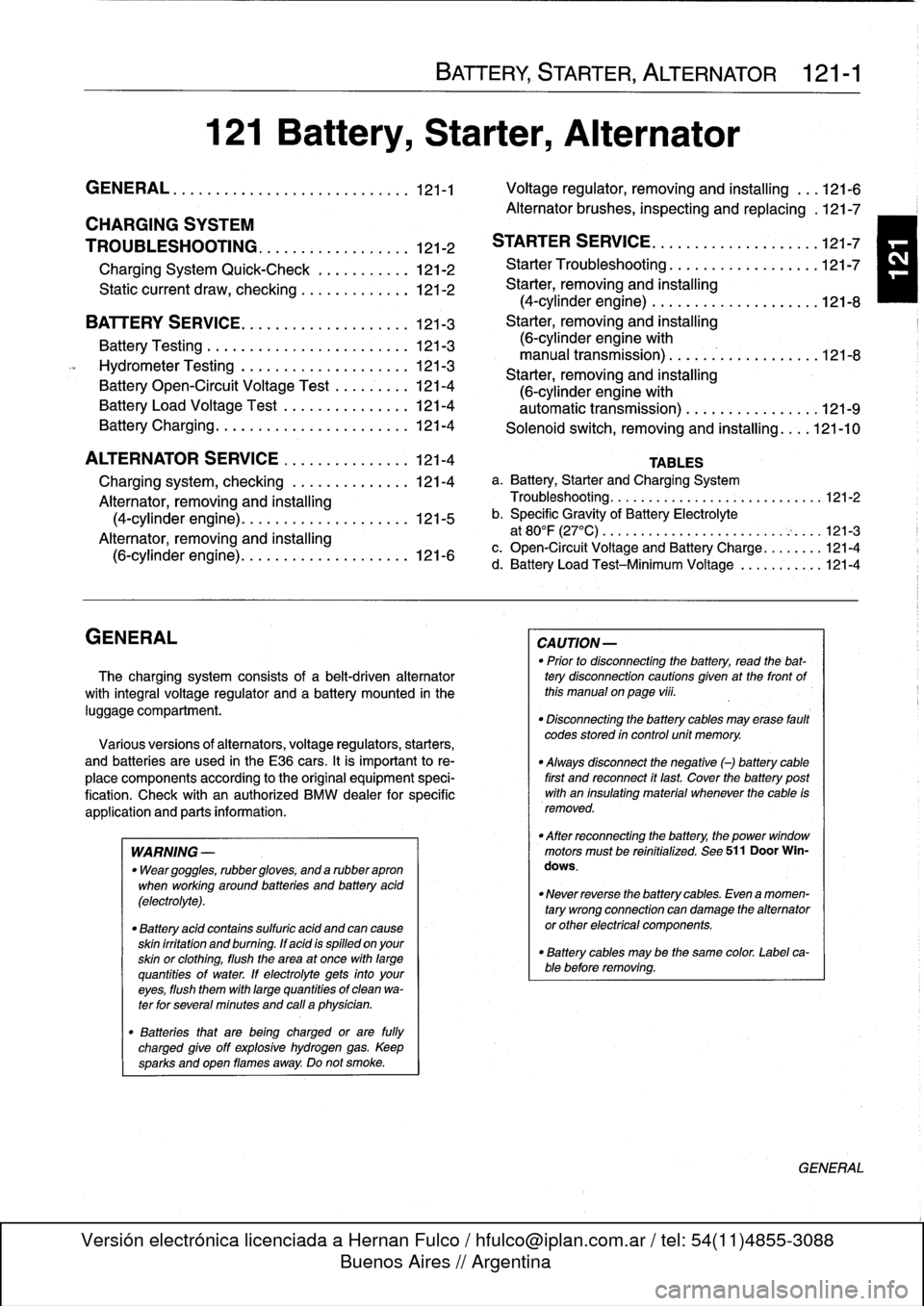
GENERAL
The
charging
system
consists
of
a
belt-driven
alternator
with
integral
voltage
regulator
and
a
battery
mounted
in
the
luggage
compartment
.
Various
versions
of
alternators,
voltage
regulators,
starters,
and
batteries
are
used
in
the
E36
cars
.
It
is
important
to
re-
place
components
according
tothe
original
equipment
speci-
fication
.
Check
with
an
authorized
BMW
dealer
for
specific
application
and
parts
information
.
WARNING
-
"
Weargoggles,
rubbergloves,
and
a
rubberapron
when
working
around
batteries
and
battery
acid
(electrolyte)
.
"
Battery
acid
contains
sulfuric
acid
and
can
cause
skin
irritation
and
burning
.
ff
acid
is
spilled
onyour
skin
or
clothing,
flush
the
area
at
once
with
large
quantities
of
water
.
lf
electrolyte
gets
into
your
eyes,flush
them
with
largequantities
of
clean
wa-
terfor
several
minutes
and
call
a
physician
.
"
Batteries
that
are
being
charged
or
are
fully
charged
give
off
explosive
hydrogen
gas
.
Keep
sparks
and
open
flames
away
.
Do
not
smoke
.
BATTERY,
STARTER,
ALTERNATOR
121-1
121
Battery,
Starter,
Alternator
GENERAL
..
.
...
.
........
.
...
.
.
.
.
.
.
.
.
.
121-1
Voltage
regulator,
removing
and
ínstalling
.
.
.
121-6
Alternator
brushes,
inspecting
and
replacing
.121-7
STARTER
SERVICE
....
.
.
.
.
.
..........
.121-7
Starter
Troubleshootíng
121-7
15
..
.
.
.
.
.
........
.
.
.
Starter,
removing
and
installing
(4-cylinder
engine)
....
.
.
.
............
.
121-8
Starter,
removing
and
installing
(6-cylinder
engine
with
manual
transmission)
..
.
...........
.
...
121-8
Starter,
removing
and
installing
(6-cylinder
engine
with
automatic
transmission)
................
121-9
Solenoid
switch,
removingand
installing
....
121-10
TABLES
a
.
Battery,
Starter
and
Charging
System
Troubleshooting
............
.
.
.
.
:...
........
121-2
b
.
Specific
Gravity
of
Battery
Electrolyte
at
80°F
(27°C)
...............
.
.
..
..........
121-3
c
.
Open-Circuit
Voltage
and
Battery
Charge
........
121-4
d
.
Battery
Load
Test-Minimum
Voltage
.
..........
121-4
CAUTION
-
"
Prior
to
disconnectiog
the
battery,
read
the
bat-tery
disconnection
cautions
given
at
the
front
of
this
manual
on
page
viii
.
"
Disconnecting
the
battery
cables
may
erase
fault
codes
stored
in
control
unit
memory
.
"
Always
disconnect
the
negative
()
battery
cable
first
and
reconnect
it
last
.
Cover
the
battery
post
with
an
insulating
material
whenever
the
cable
is
removed
.
"
After
reconnecting
the
battery,
the
power
window
motors
must
be
reinitialized
.
See
511
Door
Win-
dows
.
"
Never
reverse
the
battery
cables
.
Even
a
momen-
tary
wrong
connection
can
damage
the
alternatoror
other
electrical
components
.
"
Battery
cables
may
be
the
same
color
.
Label
ca-blebefore
removing
.
GENERAL
Page 138 of 759
121-2
BATTERY,
STARTER,
ALTERNATOR
CHARGING
SYSTEM
TROUBLESHOOTING
Static
currentdraw,
checking
Charging
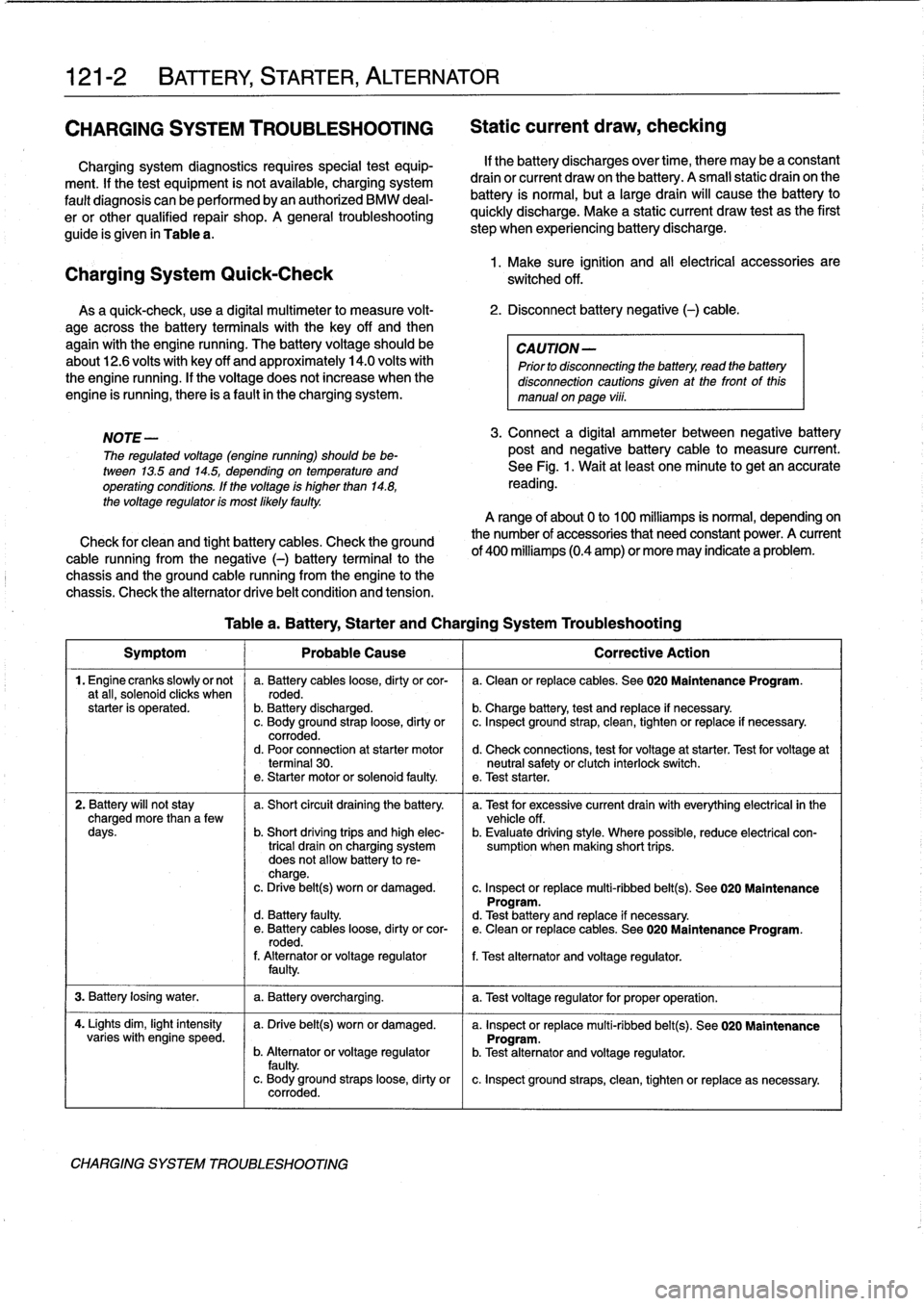
system
diagnostics
requires
special
test
equip-
ment
.
If
the
test
equipment
is
not
available,
charging
system
fault
diagnosis
can
be
performedby
an
authorized
BMW
deal-
eror
other
qualified
repair
shop
.
A
general
troubleshooting
guide
is
given
in
Table
a
.
Charging
System
Quick-Check
As
a
quick-check,
use
a
digital
multimeter
lo
measure
volt-
2
.
Disconnect
battery
negative
(-)
cable
.
age
across
the
battery
terminals
with
the
key
off
and
then
again
with
the
engine
running
.
The
battery
voltage
should
be
CAUTION-
about12
.6
volts
with
key
off
and
approximately
14
.0
volts
with
Prior
to
disconnecting
the
battery,
read
the
battery
the
engine
running
.
If
the
voltage
does
not
increase
when
the
disconnection
cautions
given
at
the
front
of
this
engine
is
running,there
is
a
fault
in
the
charging
system
.
manual
onpaga
viii
.
NOTE
-
The
regulated
voltage
(engine
running)
should
be
be-
tween
13
.5
and
14
.5,
depending
on
temperatura
and
operating
conditions
.
If
the
voltage
is
higher
than
14
.8,
the
voltage
regulator
is
most
Mely
faulty
.
Check
for
clean
and
tight
battery
cables
.
Check
the
ground
cable
running
from
the
negative
(-)
battery
terminal
lo
the
chassis
and
the
ground
cable
running
from
the
engine
lo
the
chassis
.
Check
the
alternator
drive
belt
condition
and
tension
.
If
the
battery
discharges
over
time,
there
may
be
a
constant
drain
or
current
draw
on
the
battery
.
A
small
static
drain
on
the
battery
is
normal,
but
a
largedrain
will
cause
the
battery
lo
quickly
discharge
.
Make
a
static
current
draw
test
asthe
first
step
when
experiencing
battery
discharge
.
1
.
Make
sure
ignition
and
al¡
electrical
accessories
are
switched
off
.
3
.
Connect
a
digital
ammeter
between
negative
battery
post
and
negative
battery
cable
lo
measure
current
.
See
Fig
.
1
.
Wait
at
least
one
minuta
lo
get
an
accurate
reading
.
A
range
of
about
0
lo
100
milliamps
is
normal,
dependingon
the
number
of
accessories
that
need
constant
power
.
A
current
of
400
milliamps
(0.4
amp)
or
more
may
indicate
a
problem
.
Table
a
.
Battery,
Starter
and
Charging
System
Troubleshooting
Symptom
1
Probable
Cause
1
Correctiva
Action
1
.
Engine
cranks
slowlyor
not
a
.
Battery
cables
loose,
dirty
orcor-
a
.
Clean
or
replace
cables
.
See020
Maintenance
Program
.
a
tall,
solenoíd
clicks
when
roded
.
starter
is
operated
.
b
.
Battery
discharged
.
b
.
Charge
battery,
test
and
replace
if
necessary
.
c
.
Body
ground
straploose,
dirty
or
c
.
Inspect
ground
strap,
clean,
tighten
or
replace
if
necessary
.
corroded
.
d
.
Poor
connection
at
starter
motor
d
.
Check
connections,
test
for
voltage
at
starter
.
Test
for
voltage
at
terminal
30
.
neutral
safety
or
clutch
interlock
switch
.
e
.
Starter
motor
or
solenoid
faulty
.
e
.
Test
starter
.
2
.
Battery
will
not
stay
a
.
Short
circuit
draining
the
battery
.
a
.
Test
for
excessive
current
drainwith
everything
electrical
in
the
charged
more
than
a
few
vehicle
off
.
days
.
b
.
Short
driving
trips
and
high
elec-
b
.
Evaluate
driving
style
.
Where
possible,
reduce
electrical
con
trical
drain
on
charging
system
sumption
when
making
short
trips
.
does
not
allow
battery
to
re-
charge
.
c
.
Drive
belt(s)
worn
or
damaged
.
c
.
Inspect
or
replace
multi-ribbed
belt(s)
.
See
020
Maintenance
Program
.
d
.
Battery
faulty
.
d
.
Test
battery
and
replace
íf
necessary
.
e
.
Battery
cables
loose,
dirty
orcor-
e
.
Clean
or
replace
cables
.
See
020
Maintenance
Program
.
rodad
.
f
.
Alternatoror
voltage
regulator
f
.
Test
alternator
and
voltage
regulator
.
faulty
.
3
.
Battery
losing
water
.
1
a
.
Battery
overcharging
.
1
a
.
Test
voltage
regulator
for
proper
operation
.
4
.
Lights
dim,
light
intensity
a
.
Drive
belt(s)
worn
or
damaged
.
a
.
Inspect
or
replace
multi-ribbed
belt(s)
.
See
020
Maintenance
varies
with
engine
speed
.
Program
.
b
.
Alternatoror
voltage
regulator
b
.
Test
alternator
and
voltage
regulator
.
faulty
.
c
.
Body
ground
straps
loose,
dirty
or
c
.
Inspect
ground
straps,
clean,
tighten
or
replace
as
necessary
.
corroded
.
CHARGING
SYSTEM
TROUBLESHOOTING
Page 140 of 759
121-
4
BATTERY,
STARTER,
ALTERNATOR
BatteryOpen-Circuit
Voltage
Test
Battery
Charging
Before
making
the
test,
load
the
battery
with
15
amperes
for
Discharged
batteries
can
be
recharged
using
a
battery
one
minute
with
a
batteryload-tester
or
turn
on
the
headlights
charger
.
The
battery
should
be
removed
from
the
luggage
for
about
one
minute
without
the
engine
running
.Then
discon-
compartment
during
charging
.
nect
the
battery
negative
(-)
cable
and
connect
a
digital
volt-
meter
acrossthe
battery
terminals
.
Open-circuit
voltage
Prolonged
charging
causes
electrolyte
evaporation
to
a
lev
levels
are
given
in
Table
c
.
el
that
can
damage
the
battery
.
Itis
bestto
use
a
low-current
charger
(6
amperes
or
less)
to
prevent
battery
damage
If
the
open-circuit
voltage
ís
OK
butthe
battery
still
lacks
caused
by
overheating
.
power
for
starting,
make
a
load
voltage
test
.
If
the
open-circuit
voltage
is
below
12
.4
volts,
recharge
the
battery
and
retest
.
WARNING
-
Hydrogen
gas
given
off
by
the
battery
duringcharg-
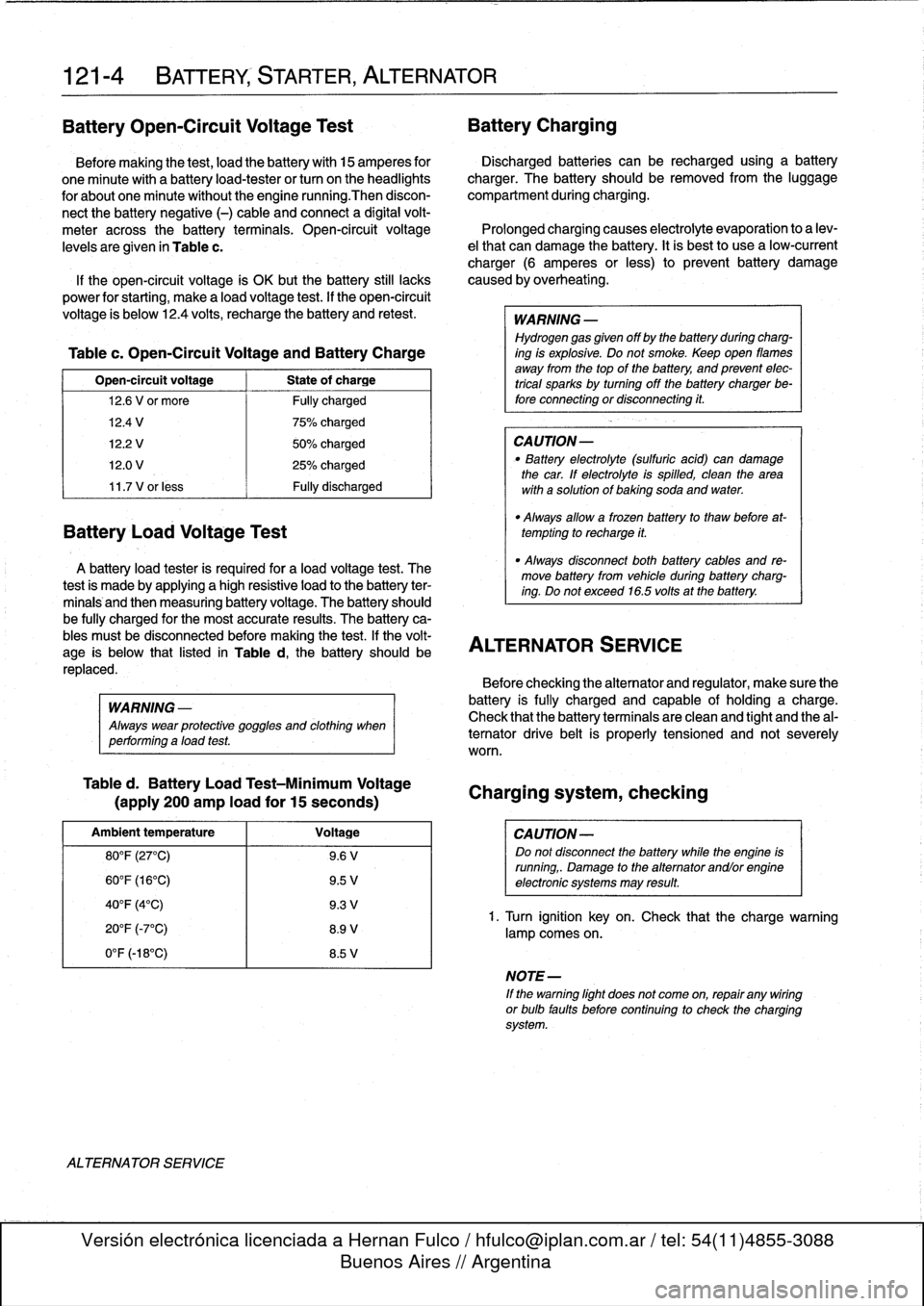
Table
c
.
Open-Circuit
Voltage
and
Battery
Charge
ing
is
explosive
.
Do
not
smoke
.
Keep
open
llames
away
from
the
top
of
the
battery,
and
prevent
elec
Open-circuit
voltage
State
of
charge
trical
sparks
by
turning
offthe
battery
charger
be-
12
.6
V
or
more
Fully
charged
fore
connecting
or
disconnecting
it
.
12
.4
V
1
75%
charged
12
.2
V
50%
charged
CAUTION-
12
.0
V
25%
charged
"
Battery
electrolyte
(sulfuric
acid)
can
damage
the
car
.
If
electrolyte
isspilled,
clean
the
area
11
.7
V
or
less
Fully
discharged
with
a
solution
of
baking
soda
and
water
.
Battery
Load
Voltage
Test
A
battery
load
tester
is
required
for
a
load
voltage
test
.
The
-
Always
disconnect
both
battery
cables
and
re-
test
is
made
by
applying
a
high
resistive
load
to
the
battery
ter-
move
battery
from
vehicle
during
battery
charg-
ing
.
Do
not
exceed
16
.5volts
at
the
battery
.
minals
and
then
measuring
battery
voltage
.
The
battery
should
be
fully
charged
for
the
most
accurate
results
.
The
battery
ca-
bles
mustbe
disconnected
before
making
the
test
.
If
the
volt-
ALTERNATOR
$ERVICE
age
is
below
that
listed
in
Table
d,
the
battery
should
be
replaced
.
WARNING
-
Always
wear
protective
goggles
and
clothing
when
performing
aload
test
.
Table
d
.
Battery
Load
Test-Minimum
Voltage
(apply
200
amp
load
for
15
seconds)
Ambient
temperature
Voltage
80°F
(27°C)
9
.6
V
60°F
(16°C)
9
.5
V
40°F
(4°C)
9
.3
V
20°F
(-7°C)
8
.9
V
0°F
(-18°C)
8
.5
V
ALTERNATOR
SERVICE
"
Always
allow
a
frozen
battery
to
thaw
before
at-
tempting
to
recharge
it
.
Before
checking
the
alternator
and
regulator,
make
sure
the
battery
is
fully
charged
and
capable
of
holding
acharge
.
Check
that
the
battery
terminals
are
clean
and
tight
and
the
al-
ternator
drive
belt
is
properly
tensioned
and
not
severely
worn
.
Charging
system,
checking
CAUTION-
Do
not
disconnect
the
battery
while
the
engine
is
running,
.
Damage
to
the
alternator
andlorengine
electronic
systems
may
result
.
1.
Turn
ignition
key
on
.
Check
that
the
chargewarning
lamp
comes
on
.
NOTE-
If
the
warning
light
does
not
come
on,
repair
any
wiring
or
bulb
faults
before
continuing
to
check
the
charging
system
.
Page 196 of 759
170-2
RADIATOR
AND
COOLING
SYSTEM
Cooling
Fans
TROUBLESHOOTING
Belt-driven
coolingfan
.
The
primary
cooling
fan
is
belt-
driven
.
It
is
mounted
to
the
frontof
the
coolant
pump
through
a
fan
clutch
.
The
fan
clutch
is
a
viscous
fluid
coupling
that
con-
trols
the
speed
of
thefan
based
on
engine
compartment
tem-
perature
.
Electric
cooling
fan
.
Models
with
M44
engine
and
stan-
dard
transmission
substitute
an
electric
fan
for
the
belt-driven
viscous
fan
.
This
is
attached
to
the
rear
of
the
radiator
and
controlledvia
the
DME
5
.2
engine
management
system
.
NOTE-
The
electric
cooling
fan
in
these
models
is
activated
by
the
engine
control
module
(ECM)
.
Auxiliary
coolingfan
.
In
al¡
models
a
two-speed
electric
auxiliary
cooling
fan
is
mounted
behind
the
front
grill
and
in
front
of
the
radiator
.
This
fan
is
primarily
used
for
the
A/C
sys-
tem,
but
also
operates
when
the
coolant
temperature
ex-
ceeds
a
predetermined
leve¡
.
Warnings
and
Cautions
The
following
warnings
and
Cautions
should
beobserved
when
working
on
the
cooling
system
.
WARNING
-
"
Atnormal
operating
temperature
the
cooling
sys-
tem
is
pressurized
.
Allow
the
system
to
cool
as
long
as
possible
before
opening-a
minimum
of
an
hour-then
release
the
cap
slowly
to
allow
sale
release
of
pressure
.
"
Releasing
the
cooling
system
pressure
lowers
the
coolants
boiling
point
and
the
coolant
may
boíl
suddenly
.
Use
heavy
gloves
and
wear
eye
and
laceprotection
to
guard
against
scalding
.
"
Use
extreme
care
when
draining
and
disposing
of
engine
coolant
.
Coolant
is
poisonous
and
lethal
to
humans
and
pets
.
Pets
are
attracted
to
coolant
because
of
its
sweet
smell
and
taste
.
Consult
a
veterinarian
immediately
if
coolant
is
ingested
byan
animal
.
CAUTION-
"
Avoidadding
cold
water
to
the
coolant
while
the
engine
is
hot
or
overheated
.
If
it
is
necessary
to
add
coolant
to
ahot
system,
do
so
only
with
the
engine
running
and
coolant
pump
tuming
.
"
Prior
to
disconnecting
the
battery,
read
the
bat-
tery
disconnection
cautions
given
at
the
front
of
this
manual
on
page
viii
.
TROUBLESHOOTING
Most
cooling
system
faults
can
be
grouped
into
one
of
three
categories
:
"
Cooling
system
leaks
"
Poor
coolant
circulation
"
Radiator
cooling
fan
faults
When
investigating
the
cause
of
overheating
or
coolant
loss,
begin
with
a
visual
inspection
.
Be
sure
to
check
the
con-
dition
and
tension
of
the
coolant
pump
drive
belt
.
Check
hoses
for
cracks
or
softness
.
Check
clamps
for
looseness
.
Check
the
coolant
leve¡
and
check
for
evidence
of
coolantleaks
from
the
engine
.
Check
that
the
radiator
fins
are
not
blocked
with
dirt
or
de-
bris
.
Clean
the
radiator
using
low-pressure
water
or
com-
pressed
air
.
Blow
outward,
fromthe
engine
side
out
.
Inspect
the
coolant
pump
by
first
removing
the
drive
belt
from
the
pump
.
Firmly
grasp
opposite
sídes
of
the
pulley
and
check
for
play
in
all
directions
.
Spin
the
pulley
and
check
that
the
shaft
runs
smoothly
.
NOTE-
The
coolant
provides
lubrication
for
the
pump
shaft,
soan
occasional
drop
of
coolant
leaking
from
the
pump
is
acceptable
.
If
coolant
drips
steadily
from
the
vent
hole,
the
pump
should
be
replaced
.
The
cooling
system
becomes
pressurized
at
normal
operat-
ing
temperature,
which
raises
the
boiling
point
of
the
coolant
.
Leaks
may
prevent
the
system
from
becoming
pressurized,
allowing
the
coolant
to
boil
at
a
lower
temperature
.
If
visual
ev-
idence
is
inconclusive,
a
cooling
system
pressure
test
can
help
to
pinpointhard-to-find
leaks
.
If
the
cooling
system
is
full
of
coolant
and
holds
pressure,
the
next
most
probable
cause
of
overheating
are
:
"
Faulty
radiator
fan
"
Loose
or
worn
drive
belt
"
Failed
thermostat
or
coolant
pump
"
Clogged/plugged
radiator
or
coolant
passages
.
NOTE
-
"
Some
early
style
coolant
pumps
were
fitted
wíth
fi-
berlplastic
type
impellers
.
Over
time,
this
impeller
can
wear
away
and
result
in
overheating
.
The
plastic
im-
peller
can
also
slip
or
free-wheel
on
the
pump
shaft
.
If
the
engine
overheats
and
no
other
faults
canbe
found,
theold
style
impeller
may
be
the
cause
of
the
problem
.
"
Only
pumps
with
the
updated
metal
impeller
should
be
used
for
replacement
.
Page 200 of 759
170-6
RADIATOR
AND
COOLING
SYSTEM
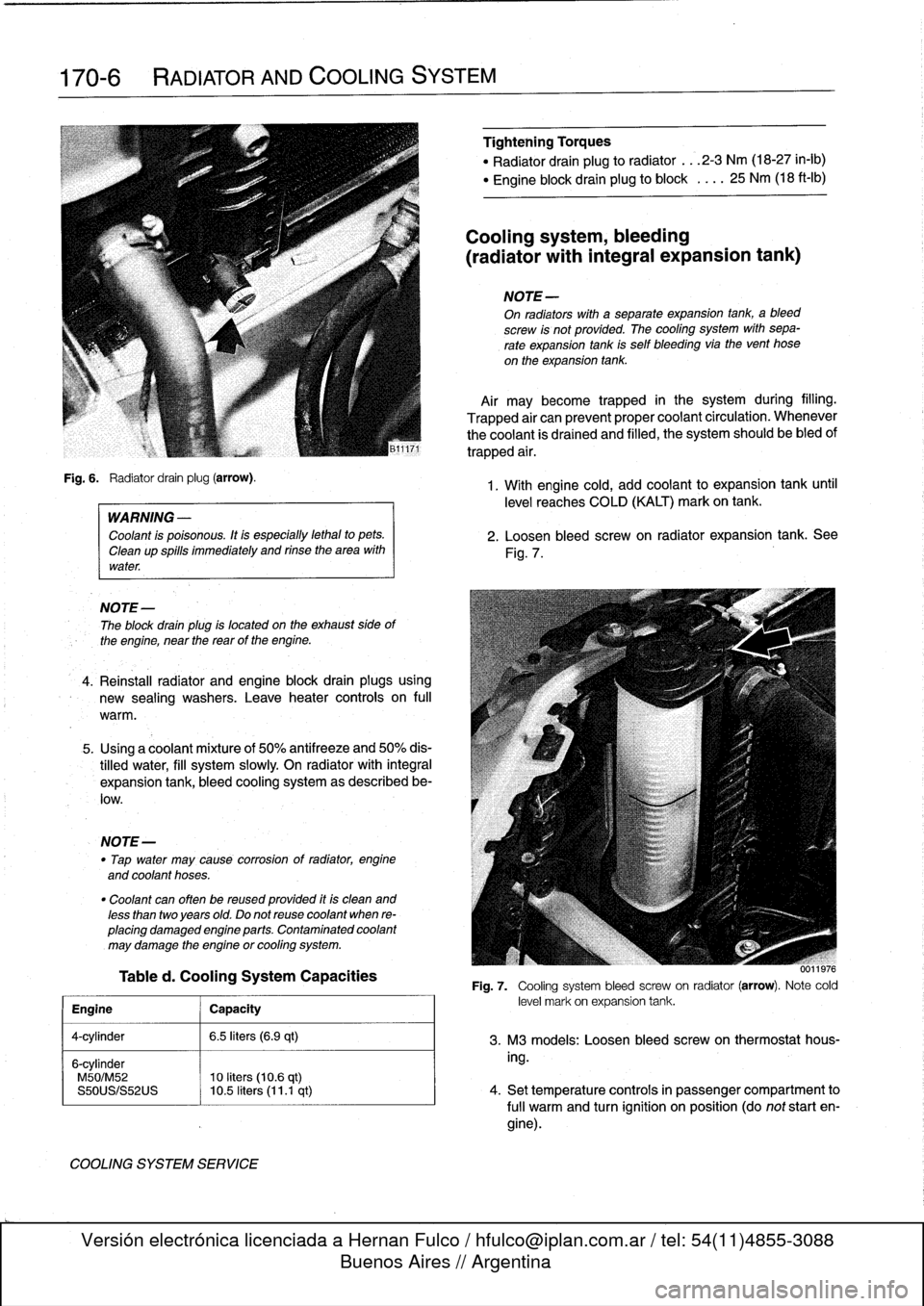
Fig
.
6
.
Radiator
drain
plug
(arrow)
.
WARNING
-
Coolant
is
poisonous
.
Itis
especially
lethal
to
pets
.
Cleanup
spills
immediately
and
rinse
the
area
with
water
.
NOTE
-
The
block
drain
plug
is
located
on
the
exhaust
side
of
the
engine,
near
the
reas
of
the
engine
.
4
.
Reinstall
radiator
and
engine
block
drain
plugsusing
new
sealing
washers
.
Leave
heater
controis
on
full
warm
.
5
.
Using
a
coolantmixture
of
50%
antifreeze
and
50%
dis-
tilled
water,
fill
system
slowly
On
radiator
with
integral
expansion
tank,
bleed
cooling
system
as
described
be-
low
.
NOTE-
"
Tap
water
may
cause
corrosion
of
radiator,
engine
and
coolant
hoses
.
"
Coolant
can
often
be
reused
provided
itis
clean
and
less
than
twoyears
old
.
Do
not
reuse
coolant
when
re-
placing
damaged
engine
parts
.
Contaminated
coolant
may
damage
the
engine
or
cooling
system
.
Tabled
.
Cooling
System
Capacities
Engine
j
Capacity
4-cylinder
1
6
.5
liters
(6.9
qt)
6-cylinder
M50/M52
10
liters
(10
.6
qt)
S50US/S52US
10
.5
liters
(11
.1
qt)
COOLING
SYSTEM
SERVICE
Tightehing
Torques
"
Radiator
drain
plug
to
radiator
...
2-3
Nm
(18-27
in-lb)
"
Engine
block
drain
plug
to
block
.
.
..
25
Nm
(18
ft-Ib)
Cooling
system,
bleeding
(radiator
with
integral
expansion
tank)
NOTE
-
On
radiators
with
a
separate
expansion
tank,
ableed
screw
is
not
provided
.
The
cooling
system
with
sepa-
rate
expansion
tank
is
self
bleeding
via
the
vent
hose
on
the
expansion
tank
.
Air
maybecome
trapped
in
the
system
during
filling
.
Trapped
air
can
prevent
proper
coolant
circulation
.
Whenever
the
coolant
is
drained
and
filled,
the
system
should
be
bled
of
trapped
air
.
1
.
With
engine
cold,
add
coolant
to
expansion
tank
until
level
reaches
COLD
(KALT)
mark
on
tank
.
2
.
Loosen
bleed
screw
on
radiator
expansion
tank
.
See
Fig
.
7
.
0011976
Fig
.
7
.
Cooling
system
bleed
screwon
radiator
(arrow)
.
Note
cold
level
mark
on
expansion
tank
.
3
.
M3
models
:
Loosen
bleed
screw
on
thermostathous-
ing
.
4
.
Set
temperature
controls
in
passenger
compartment
to
fui¡
warm
and
turn
ignition
on
position
(do
not
start
en-
gine)
.
Page 216 of 759
210-2
CLUTCH
Clutch
hydraulic
system,
bleeding
and
flushing
If
the
clutch/brake
fluid
is
murky
or
muddy,
or
has
not
been
changed
within
the
last
two
years,
the
system
should
be
flushed
.
Flushing
the
old
fluid
from
the
clutch
lines
is
done
us-
ing
a
brake
system
pressure
bleeder
.
1
.
Remove
brake
fluíd
reservoir
cap
.
Usinga
clean
sy-
ringe,
remove
brake
fluid
from
reservoir
.
Refill
reservoir
with
clean
fluid
.
2
.
Attach
pressure
brake
bleeder
to
fluid
reservoír
.
CA
UTION-
Do
not
exceed
2
bar
(29
psi)
pressure
at
the
fluid
reservoir
when
bleeding
or
flushing
the
hydraulic
system
.
3
.
Connect
a
length
of
hose
from
clutch
slave
cylinder
bleeder
valve
lo
a
container
.
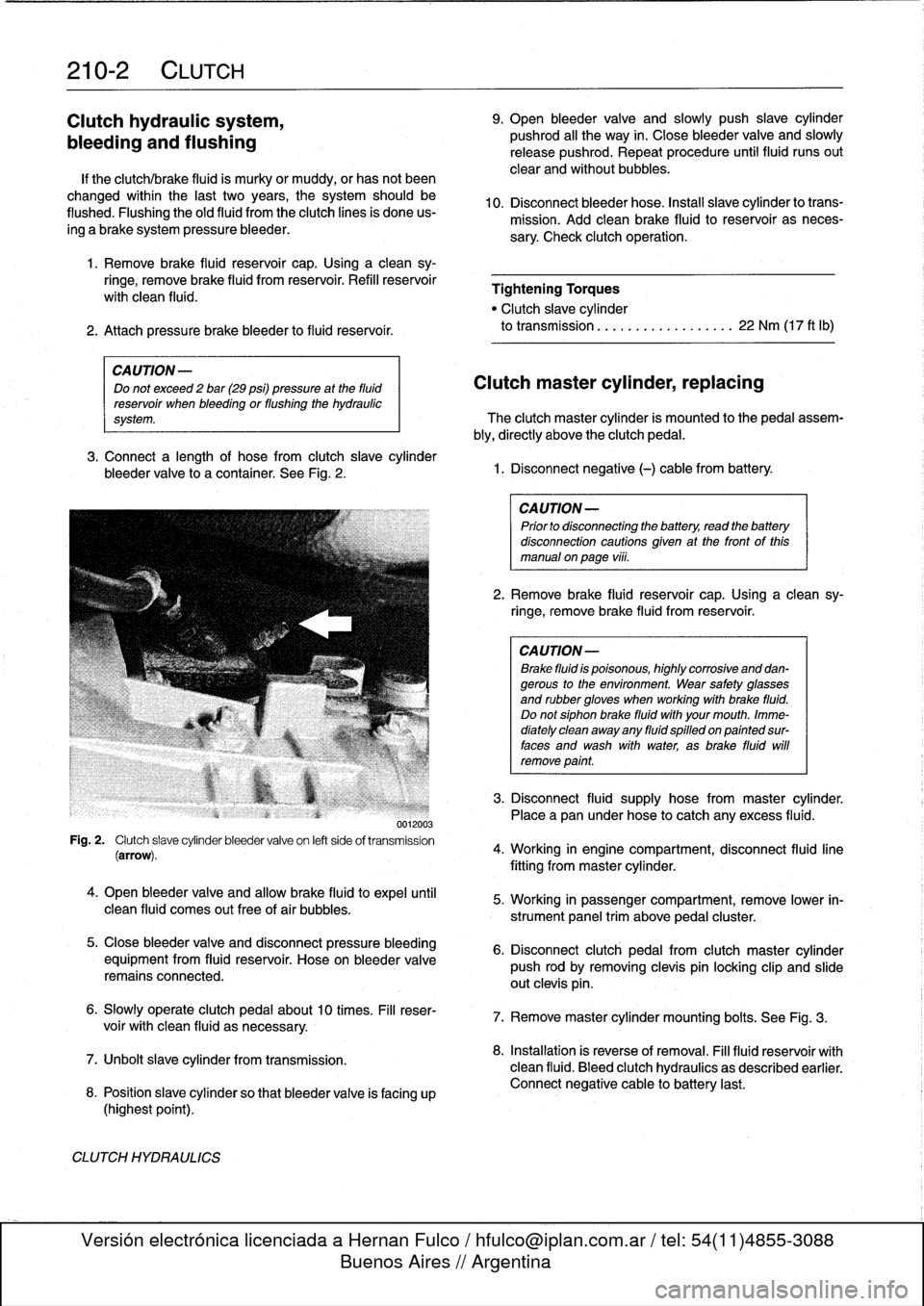
See
Fig
.
2
.
0012003
Fig
.
2
.
Clutch
slave
cylinder
bleeder
valve
on
left
side
of
transmission
(arrow)
.
4
.
Open
bleeder
valve
and
allow
brake
fluid
to
expel
until
clean
fluid
comes
out
free
of
air
bubbles
.
5
.
Close
bleeder
valve
and
disconnect
pressure
bleeding
equipment
from
fluid
reservoir
.
Hose
on
bleeder
valve
remainsconnected
.
6
.
Slowly
operate
clutch
pedal
about10
times
.
Fill
reser-
voir
with
clean
fluid
asnecessary
.
7
.
Unbolt
slavecylinder
from
transmission
.
8
.
Position
slave
cylinder
so
that
bleeder
valve
is
facing
up
(highest
point)
.
CLUTCH
HYDRAULICS
9
.
Open
bleeder
valve
and
slowly
push
slave
cylinder
pushrod
al¡
the
way
in
.
Close
bleeder
valve
and
slowly
release
pushrod
.
Repeat
procedure
until
fluid
runs
out
clear
and
without
bubbles
.
10
.
Disconnect
bleeder
hose
.
Instan
slavecylinder
lo
trans-
mission
.
Add
cleanbrake
fluid
to
reservoir
as
neces-
sary
.
Check
clutch
operation
.
Tightening
Torques
"
Clutch
slave
cylinder
to
transmission
................
..
22
Nm
(17
ft
lb)
Clutch
master
cylinder,
replacing
The
clutch
master
cylinder
is
mounted
to
the
pedal
assem-
bly,
directly
above
the
clutch
pedal
.
1
.
Disconnect
negative
(-)
cable
from
battery
.
CAUTION-
Prior
to
disconnectiog
the
battery,
read
the
battery
disconnection
cautionsgiven
at
the
front
of
this
manual
on
page
viii
.
2
.
Remove
brake
fluid
reservoir
cap
.
Usinga
clean
sy-
ringe,
remove
brake
fluid
from
reservoir
.
CA
UTION-
Brake
fluid
is
poisonous,
highly
corrosive
and
dan-gerous
to
the
environment
.
Wear
safety
glasses
and
rubbergloves
when
working
with
brake
fluid
.
Do
notsiphonbrake
fluid
with
your
mouth
.
Imme-
diately
clean
away
any
fluid
spilled
on
painted
sur-
faces
and
wash
with
water,
asbrake
fluid
will
remove
point
.
3
.
Disconnect
fluid
supply
hose
from
master
cylinder
.
Placea
pan
under
hose
to
catch
any
excess
fluid
.
4
.
Working
in
engine
compartment,
disconnect
fluid
line
fitting
frommaster
cylinder
.
5
.
Working
in
passenger
compartment,
remove
lower
in-
strument
panel
trim
above
pedal
cluster
.
6
.
Disconnect
clutch
pedal
from
clutch
master
cylinder
push
rod
by
removing
clevis
pin
locking
clip
and
slide
out
clevis
pin
.
7
.
Remove
master
cylinder
mounting
bolts
.
See
Fig
.
3
.
8
.
Installation
is
reverse
of
removal
.
Fill
fluid
reservoir
with
clean
fluid
.
Bleed
clutch
hydraulics
as
described
earlier
.
Connect
negative
cable
to
battery
last
.
Page 224 of 759
230-
4
MANUAL
TRANSMISSION
Output
shaft
sea¡,
replacing
(transmission
installed)
1
.
Raise
and
safely
support
vehicle
.
Support
transmission
with
transmission
jack
.
WARNING
-
"
When
raising
thecar
using
a
floor
jack
or
a
hy-
draulic
lift,
carefully
position
the
jack
pad
to
pre-vent
damaging
the
car
body
.
A
suitable
liner
(wood,
rubber,
etc
.)
should
be
placed
between
the
jack
and
the
car
to
prevent
body
damage
.
"
Watch
the
jack
closely
.
Make
sure
it
stays
stable
and
does
not
shift
or
tilt
.
As
the
car
is
raised,
the
car
may
roll
slightly
and
the
jack
may
shift
.
2
.
Remove
driveshaft
.
See
260
Driveshaft
.
3
.
Remove
transmission
crossmember
and
lower
trans-
mission
at
rear
.
CAUTION-
Tilting
the
engine
to
lower
thetransmissíon
can
lead
to
damage
to
various
componente
due
to
lackof
clearance
.
-On
cars
with
AST
(traction
control)
remove
throt-
tle
body
before
tilting
engine
.
-Remove
brake
fluid
reservoir
if
necessary
.
4
.
Bend
back
and
remove
collar
nut
lockplate
.
5
.
Hold
flange
steady
andremove
collar
lock
nut
(use
30mm
thin-walled
deep
socket
.)
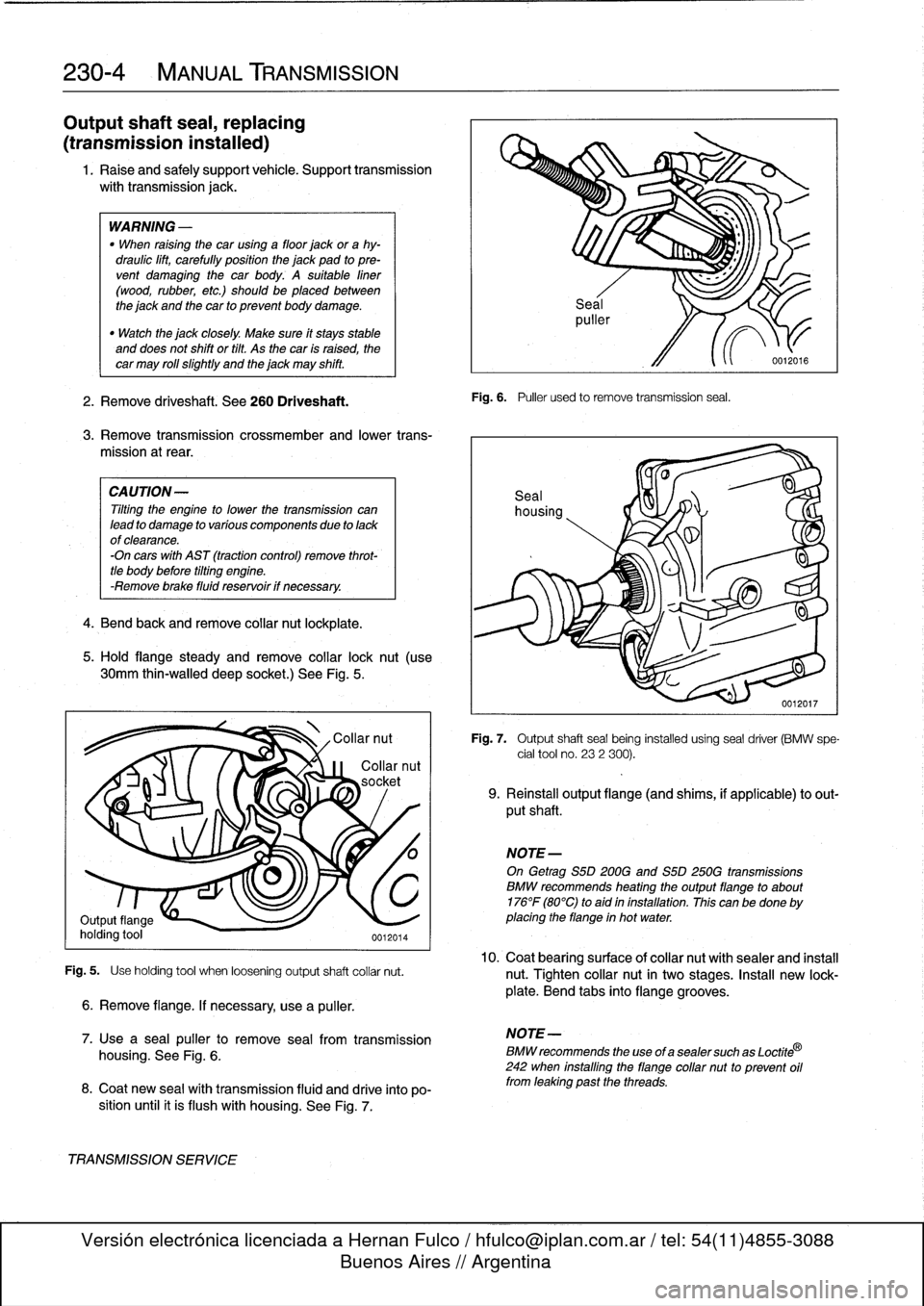
See
Fig
.
5
.
Fig
.
5
.
Use
holding
tool
when
loosening
output
shaft
collar
nut
.
6
.
Remove
flange
.
If
necessary,
use
a
puller
.
7
.
Use
a
sea¡
puller
to
remove
seal
from
transmission
housing
.
See
Fig
.
6
.
8
.
Coat
new
sea¡
wíth
transmission
fluid
and
drive
into
po-
sition
until
it
is
flush
with
housing
.
See
Fig
.
7
.
TRANSMISSIONSERVICE
Fig
.
6
.
Puller
used
to
remove
transmission
seal
.
Fig
.
7
.
Output
shaftseal
being
installed
using
seal
driver
(BMW
spe-
cial
tool
no
.
232
300)
.
9
.
Reinstall
output
flange
(and
shims,
if
applicable)
to
out-
put
shaft
.
NOTE-
On
Getrag
S5D200G
and
S5D
250G
transmissions
BMW
recommends
heating
theoutputflange
to
about
176°F
(80°C)
to
aid
in
installation
.
This
canbe
done
by
placing
the
flange
in
hot
water
.
10
.
Coat
bearingsurface
ofcollar
nut
withsealer
and
install
nut
.
Tighten
collar
nut
in
two
stages
.
Insta¡¡
new
lock-
plate
.
Bend
tabs
into
flange
grooves
.
NOTE-
BMW
recommends
the
use
of
a
sealer
such
as
Loctite
®
242
when
installing
the
flange
collar
nut
to
prevent
oil
from
leaking
past
the
threads
.
Page 291 of 759
Brake
rotor,
removing
and
installing
.
.
.
.
.
.
.
.
340-7
MASTER
CYLINDER
............
.
.
.
.
.
.
.340-7
Master
cylinder,
removing
and
installing
.
...
.
340-7
GENERAL
TROUBLESHOOTING
WARNING
-
"
Although
semi-metallic
and
metallic
Brake
friction
materials
in
Brake
pads
or
shoes
no
longer
con-
tain
asbestos,
they
produce
dangerous
dust
.
"
Brake
fluid
is
poisonous,
highly
corrosive
and
dangerous
to
the
environment
Wear
safety
glasses
and
rubber
gloves
when
working
with
Brake
fluid
.
Do
not
siphonBrake
fluid
with
your
mouth
.
Immediately
clean
away
any
fluid
spilled
on
painted
surfaces
and
wash
with
water,
asBrake
fluid
will
remove
paint
.
"
Always
use
new
Brake
fluid
froma
fresh,
un-
opened
container
.
Brake
fluid
will
absorb
mois-
ture
from
the
air
.
This
canlead
to
corrosion
problems
in
the
brakingsystem,
and
will
also
low-
er
the
Brake
fluid's
boiling
point
.
Dispose
of
Brake
fluid
properly
.
"
Do
notreuse
self-locking
nuts,bolts
or
fasteners
.
They
are
designed
to
be
used
only
once
and
may
failif
reused
.
Always
replace
them
with
new
self-
locking
fasteners
.
BMW
E36
models
areequipped
with
vacuum
power-assist-
ed
four-wheel
disc
brakes
with
an
integral
Antilock
Brake
Sys-
tem
(ABS)
.
Single-pistoncalipers
act
on
solid
or
vented
front
rotors
and
solid
rear
rotors
.
A
brake
pad
wear
sensor
for
each
axle
indicates
when
brake
padsneed
replacement
.
The
dual
drum-type
parking
brakesystem
is
integrated
with
the
rear
brake
rotors
.
NOTE-
M3
models
havevented
directional
Brake
rotors
on
the
rearaxle
as
well
ason
the
front
.
340
Brakes
BRAKES
340-1
GENERAL
.
.
.
.
.
.
.........
.
.
.
..........
340-1
BRAKE
BOOSTER
.........
.
.
.
.
.
...
.
.
.
.
340-8
TROUBLESHOOTING
.......
.
......
.
...
340-1
Brake
booster,
removing
and
installing
....
.
.
340-8
PARKING
BRAKE
.
.....
.
...
.
.
.
.....
.
.
.
340-10
BLEEDING
BRAKES
.
.
.
.
.
.
.
.
..........
340-3
Parking
brake,adjusting
.
.
.
.
.
.
.
.
.
.
.....
.
340-10
Pressure
bleeding
brakes
Parking
brake
shoes,
removing
and
installing
.
340-11(except
cars
with
AST)
.
.
.
.
.
.
.
.
.
...
.
.
.
.
.340-3
Parking
Brake
cable,
replacing
.
.
.
.
.
.
.
.
.
.
.
.
340-11
BRAKE
PADS,
CALIPERS,
ANTILOCK
BRAKE
SYSTEM
(ABS)
.
.
.
.340-11
AND
ROTORS
..........
.
.......
.
.
.
.
.
.
.
340-3
ABS
System
Inspection
.
...
.
.......
.
.
.
..
340-12
Brake
pads,
replacing
............
.
.
.
.
.
.
.
340-4
ABS
wheel
speed
sensors,
replacing
.
.
.
.
..
340-12
Brake
caliper,
removing
and
installing
.
..
..
.
340-6
TABLES
a
.
Brake
System
Troubleshooting
.....
...
.
.
.....
.340-2
b
.
Brake
Rotor
Reconditioning
Specifications
.
.....
.340-7
Brakeperformance
is
mainly
affected
by
three
things
:
the
leve¡
and
condition
of
the
brake
fluid,
the
system's
abilíty
to
create
and
maintain
hydraulic
pressure,
and
the
condition
of
the
friction
components
.
Air
in
the
Brake
fluid
will
make
the
Brake
pedal
feel
spongy
during
braking
or
will
increase
the
Brake
pedalforce
required
to
stop
.
Fluid
contaminated
by
moisture
or
dirt
can
corrode
the
system
.
Inspect
the
Brake
fluid
inside
the
reservoir
.
Ifit
is
dirty
or
murky,
or
is
over
a
year
old,
the
fluid
should
be
replaced
.
Visually
check
the
hydraulic
system
startingat
the
master
cylinder
.
To
check
the
function
of
the
master
cylinder
hold
the
brake
pedal
down
hard
with
the
engine
running
.
The
pedal
should
feelsolid
and
stay
solid
.
If
the
pedal
slowly
falls
to
the
floor,
either
the
master
cylinder
is
leaking
internally,
or
fluid
is
leaking
externally
.
If
no
leaks
canbe
found,
the
master
cylin-
der
is
faulty
and
should
be
replaced
.
Check
all
Brake
fluid
lines
and
couplings
for
leaks,
kinks,
chafing
and
corrosion
.
Check
the
Brake
booster
by
pumping
the
Brake
pedal
ap-
proximately
10
times
with
the
engine
off
.
Hold
the
pedal
down
and
start
the
engine
.
The
pedal
should
fa¡¡
slightly
.
If
not,
check
for
any
visiblefaults
before
suspecting
a
faulty
brake
booster
.
Check
for
strong
vacuum
at
the
vacuum
hose
fitting
at
the
booster,
and
check
the
non-retum
valve
for
one-way
flow
.
Worn
or
contaminated
brake
pads
will
cause
poor
braking
performance
.
Oil-contaminated
or
glazed
pads
will
cause
stopping
distances
to
increase
.
Inspect
the
rotors
for
glazing,
discoloration
and
scoring
.
Steering
wheel
vibration
while
braking
at
speed
is
often
caused
by
warped
rotors,
but
can
also
be
caused
byworn
suspension
components
.
TROUBLESHOOTING
Page 333 of 759
0011697
Fig
.
3
.
Window
lifting
arms
shown
removed
from
slides
(arrows)
.
Front
door
window,
adjusting
(4-door
models)
Whenever
the
front
window
or
window
regulator
is
re-
moved,
window
adjustment
should
be
checked
.
The
glass
should
contact
the
top
of
the
window
squarely
and
should
seat
against
the
window
sea¡
uniformly
.
NOTE
-
If
the
window
does
not
contact
the
window
seal
uni-formly,
wind
noise
or
water
infiltration
may
result
Be
sure
to
re-initialize
the
window
motors
as
described
ear-
lier
.
WARNING
-
Some
1997and
all
1998
cars
are
fitted
wíthside-im-
pact
airbags
in
the
front
doors
.
When
servicing
the
door
windows
on
cars
with
front
side-impact
air-
bags,
always
disconnect
the
negative
()
battery
cable
.
See
721Airbag
System
(SRS)
for
cautions
and
procedures
relating
to
the
airbag
system
.
CA
UTION-
"
In
models
with
side-impact
airbags,
adjusting
the
front
window
requires
that
the
battery
cable
bereconnected
with
the
side-impact
airbag
discon-
nected
.
This
will
set
a
fault
code
in
the
SRS
con-
trol
module,
turn
on
the
SRS
warning
light,
and
disable
the
SRS
system
until
the
fault
memory
is
cleared
using
special
SRS
test
equipment
.
"
Prior
to
disconnectiog
the
battery,
read
the
bat-tery
disconnection
cautions
given
at
the
front
of
this
manual
on
page
viii
.
1
.
Raise
door
window
to
top
of
its
travel
.
DOOR
WINDOWS
512-
3
3
.
Remove
front
door
panel
and
vapor
barrier
as
de-
scribed
in
411
Doors
.
4
.
Remove
airbag
unit
from
door
.
See
721Airbag
Sys-
tem
(SRS)
.
NOTE-
In
some
models
covered
inthis
manual,
it
is
not
essen-
tial
to
remove
the
side-impact
airbag
to
access
interna¡
door
components
.
However,
the
procedure
is
recom-
mended
for
safety
reasons
.
5
.
Loosen
regulator
stop
at
window
regulator
support
.
See
Fig
.
4
.
Fig
.
4
.
Wíndow
regulator
stop
(arrow)
.
0013075
6
.
If
glass
is
not
squarely
positioned
in
window
frame,
loosen
support
arm
bolt
and
reposition
arm
as
neces-
sary
.
Tighten
bolt
.
See
Fig
.
5
.
2
.
On
cars
with
side-impact
airbags,
disconnect
negative
(-)
cable
from
battery
.
Fig
.
5
.
Adjust
window
to
its
frameby
loosening
bolt
(arrow)
and
re-
positioning
support
arm
up
or
down
.
WINDOW
SERVICE,
4-DOOR
MODELS