air condition BMW 325I 2001 User Guide
[x] Cancel search | Manufacturer: BMW, Model Year: 2001, Model line: 325I, Model: BMW 325I 2001Pages: 203, PDF Size: 2.07 MB
Page 81 of 203
81n
IndexDataTechnologyRepairsCar careControlsOverview
DSC
* Ð BMW 325i
The concept DSC helps maintain vehicle stability,
even in critical driving situations.
The system optimizes vehicle stability
during acceleration and when starting
from a full stop, as well as optimizing
traction. In addition, the system recog-
nizes unstable vehicle conditions
(understeering or oversteering, for
example) and helps hold the vehicle on
a sure course by intervening via the
engine and by braking intervention at
the individual wheels.
The DSC is operational every time you
start the engine. DSC contains the
functions of ADB and CBC, refer to
page 117.
The ADB (Automatic Differential
Braking) copies the function of conven-
tional differential and transverse lock
through brake intervention, and
increases traction whenever conditions
merit, e. g. when driving on snow-
covered roads.
If the DSC is switched off the ADB will
still be in ready mode.
Indicator lamp
The indicator lamp in the instru-
ment cluster goes out shortly
after you switch on the ignition.
Refer to pages 21 and 22.
Indicator lamp flashes:
DSC is active and governs the drive
force and braking force.
The indicator lamp lights up continu-
ously:
The DSC has been turned off via the
switch; ADB is ready to use.
ADB intervention is not indicated.
The indicator lamp and the
brake warning lamp lights up
continuously:
The DSC, ADB and DBC have
been switched off via the button
or are defective.
Indicator and warning lamps for
Canadian models.
You can continue to drive the vehicle
normally, but without DSC. Please
consult your BMW center in the event
of a malfunction, refer to pages 21
and 22.
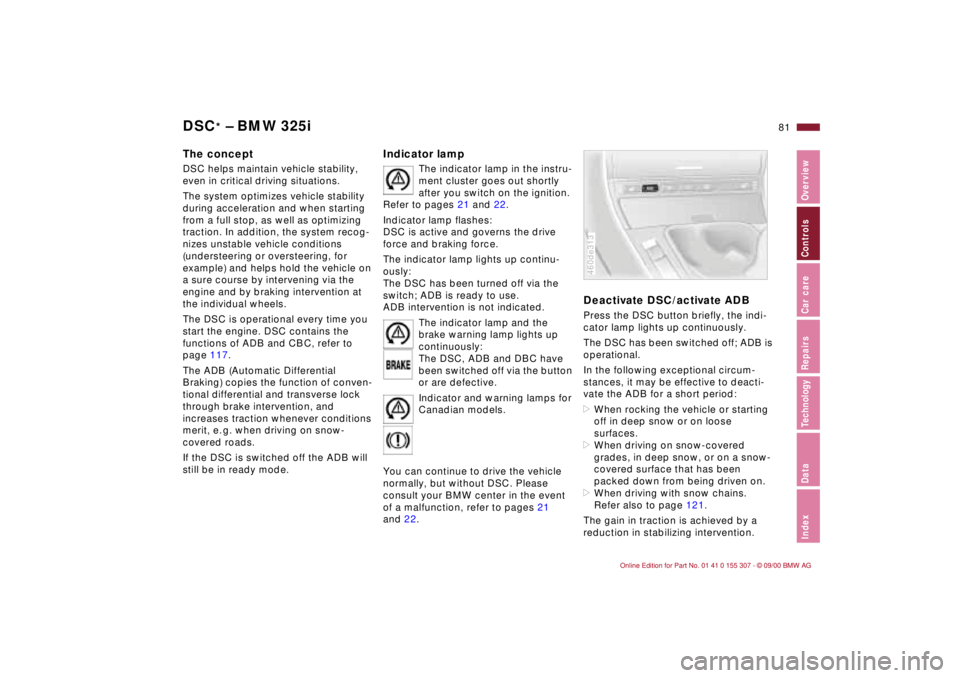
Deactivate DSC/activate ADBPress the DSC button briefly, the indi-
cator lamp lights up continuously.
The DSC has been switched off; ADB is
operational.
In the following exceptional circum-
stances, it may be effective to deacti-
vate the ADB for a short period:
>When rocking the vehicle or starting
off in deep snow or on loose
surfaces.
>When driving on snow-covered
grades, in deep snow, or on a snow-
covered surface that has been
packed down from being driven on.
>When driving with snow chains.
Refer also to page 121.
The gain in traction is achieved by a
reduction in stabilizing intervention.460de313
Page 83 of 203
83n
IndexDataTechnologyRepairsCar careControlsOverview
DSC Ð BMW 325xiThe conceptDSC maintains vehicle stability, even in
critical driving situations.
The system enhances vehicle stability
during acceleration and when starting
up from a full stop, and optimizes trac-
tion as well. In addition, it recognizes
unstable vehicle conditions, such as
understeering or oversteering, and, as
far as is possible within the laws of
physics, helps keep the vehicle on a
steady course by reducing the engine
output and brake applications to the
individual wheels.
The DSC is operational every time you
start the engine. DSC contains ADB-X
und DBC, refer to page 118.
The ADB-X (Automatic Differential
Braking) replaces the function of
conventional differential and transverse
lock through brake intervention, and
increases traction whenever conditions
merit, e. g. when driving on snow-
covered streets.Indicator lamp
The indicator lamp on the instru-
ment cluster will go out shortly
after the ignition has been
started. Refer to pages 21, 22.
If the indicator lamp flashes:
DSC controls the drive and braking
forces.
The indicator lamp stays lit:
DSC is switched off via the switch;
ADB-X is operational.
ADB-X intervention not indicated.
If the indicator lamp does not go
out after repeatedly pressing the
DSC switch, then the DSC and the
ADB-X are defective, and the interven-
tion described to the right is then no
longer available.<
The vehicle will remain completely
operational, however, without DSC. In
the event of a fault, please see your
BMW center. Refer to pages 21, 22.
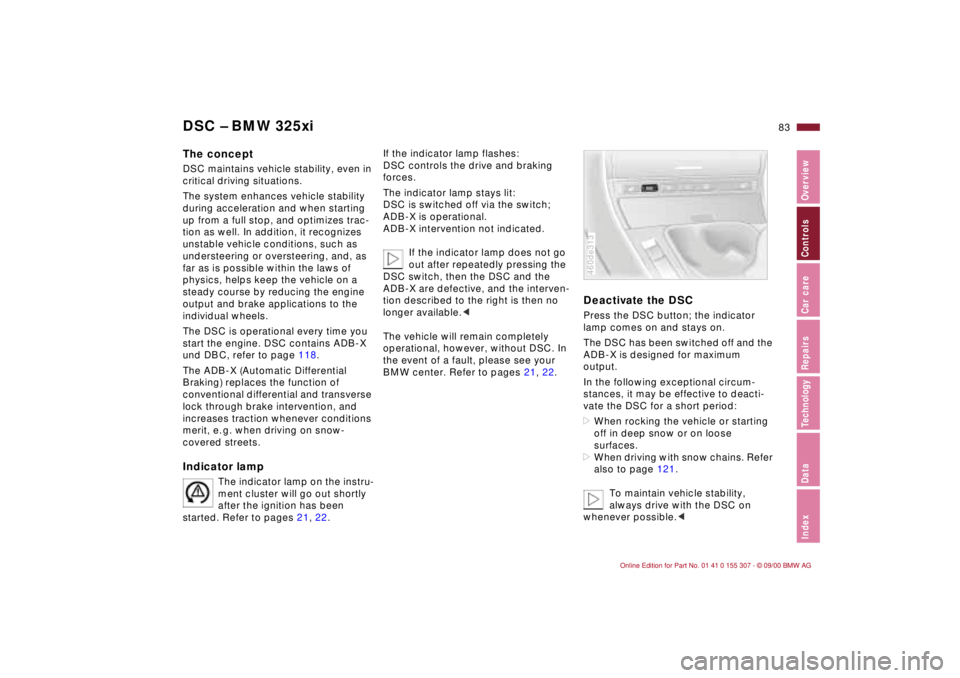
Deactivate the DSCPress the DSC button; the indicator
lamp comes on and stays on.
The DSC has been switched off and the
ADB-X is designed for maximum
output.
In the following exceptional circum-
stances, it may be effective to deacti-
vate the DSC for a short period:
>When rocking the vehicle or starting
off in deep snow or on loose
surfaces.
>When driving with snow chains. Refer
also to page 121.
To maintain vehicle stability,
always drive with the DSC on
whenever possible.<460de313
Page 90 of 203
90n
460us299Air conditioner
Page 91 of 203

91n
IndexDataTechnologyRepairsCar careControlsOverview
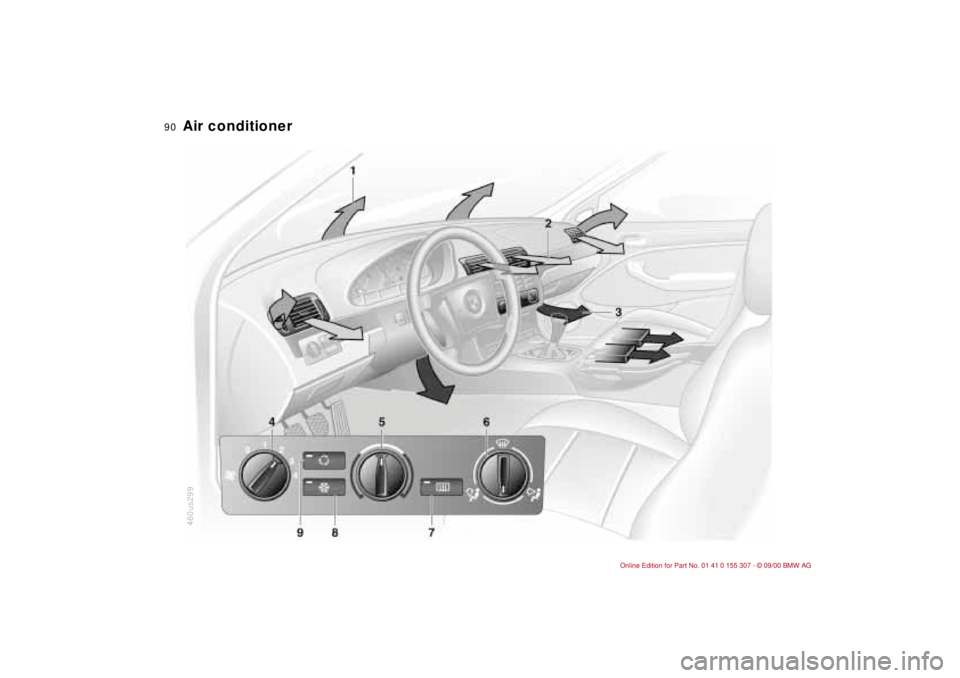
Air conditioner1 Air onto the windshield and onto the
side windows
2 Air flow for the upper body
The side rotary dials allow you to
open and close the air supply through
an infinitely-variable range, while the
levers change the airflow direction.
The center rotary dial controls the
temperature of the air as it flows out.
Refer to page 92
3 Ventilation for the front footwell
There are corresponding air vents in
the rear footwell as well
4 Air supply
Heating and ventilation are available
starting with position 1. Refer to
page 92
5 Temperature92
6 Air distribution toward
>the windows
>the upper body
>the footwell
All intermediate settings are possible.
Refer to page 92
7 Rear window defroster92
8 Air conditioner92
9 Recirculated-air mode92
Page 92 of 203
92n
Air conditionerAir supply
You can select fan speeds
from 1 to 4. The greater the air
supply, the more effective the
heating and ventilation are. In
position 0, the fan and the heater are
switched off. By using position 0, you
can totally block the interior ventilation
outlets by pressing the button for the
recirculated-air mode.
Temperature
In order to increase the
temperature of the passenger
compartment, turn it to the
right (red). Temperature regu-
lation will keep the interior temperature
you have selected constant.
Air distribution
You can direct air to flow onto
the windows , toward the
upper body and into the
footwell . You can also
make all intermediate settings. In the
setting, there is a low flow of air onto
the windows to keep them free of
condensation. The "6 o'clock" setting is
recommended as a normal setting (refer
also to the illustration and overview on
page 90).
Rear window defroster
When the rear window defroster
is activated, the indicator lamp
comes on. The rear window defroster
switches off automatically. Refer to
page 70.
Air conditioner
The air is cooled and dehumidi-
fied and Ð depending on the
temperature setting Ð rewarmed when
the air conditioner system is switched
on.
Depending on the weather, the wind-
shield may fog over briefly when the
engine is started.
Use the button to switch the air condi-
tioner off at outside temperatures
below approx. 41 7(+5 6). This will
help to prevent the windows from
fogging up.
If the windows fog over after switching
the air conditioner off, switch it back
on.
Condensation forms in the air
conditioner system during opera-
tion, which then exits under the vehicle.
Traces of condensed water of this kind
are thus normal.<
Recirculated-air mode
You can respond to unpleasant
external odors by temporarily
blocking the outside air. The system
then recirculates the air already within
the vehicle.
If the windows fog over in the
recirculated air mode, switch the
recirculated air off and increase the air
supply as required.<
Page 93 of 203
93n
IndexDataTechnologyRepairsCar careControlsOverview
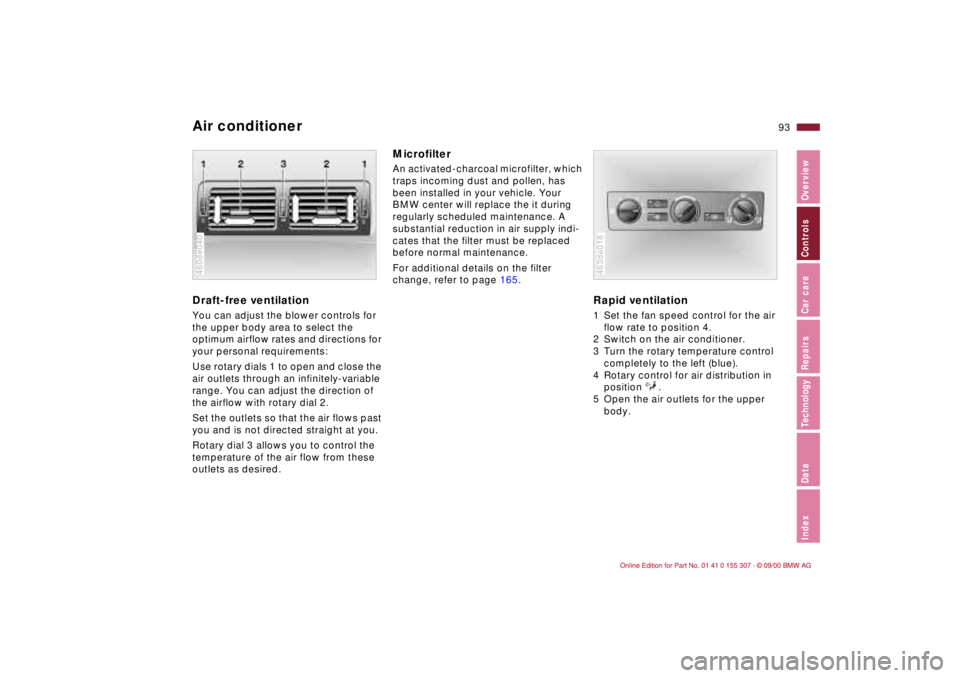
Air conditionerDraft-free ventilationYou can adjust the blower controls for
the upper body area to select the
optimum airflow rates and directions for
your personal requirements:
Use rotary dials 1 to open and close the
air outlets through an infinitely-variable
range. You can adjust the direction of
the airflow with rotary dial 2.
Set the outlets so that the air flows past
you and is not directed straight at you.
Rotary dial 3 allows you to control the
temperature of the air flow from these
outlets as desired.460de040
MicrofilterAn activated-charcoal microfilter, which
traps incoming dust and pollen, has
been installed in your vehicle. Your
BMW center will replace the it during
regularly scheduled maintenance. A
substantial reduction in air supply indi-
cates that the filter must be replaced
before normal maintenance.
For additional details on the filter
change, refer to page 165.
Rapid ventilation1 Set the fan speed control for the air
flow rate to position 4.
2 Switch on the air conditioner.
3 Turn the rotary temperature control
completely to the left (blue).
4 Rotary control for air distribution in
position .
5 Open the air outlets for the upper
body.463de018
Page 94 of 203
94n
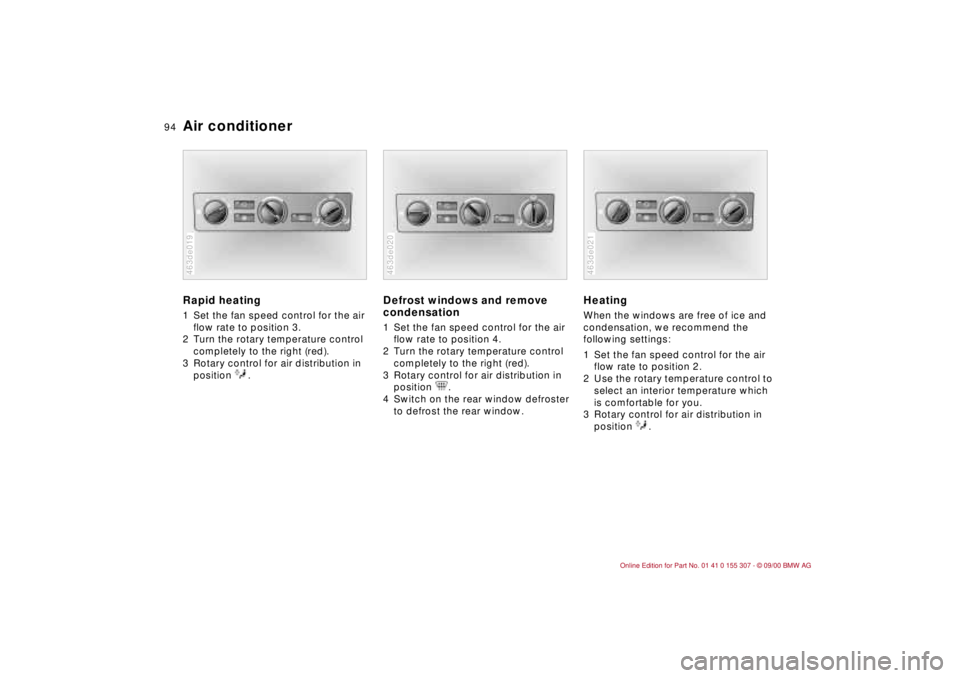
Air conditionerRapid heating1 Set the fan speed control for the air
flow rate to position 3.
2 Turn the rotary temperature control
completely to the right (red).
3 Rotary control for air distribution in
position .463de019
Defrost windows and remove
condensation1 Set the fan speed control for the air
flow rate to position 4.
2 Turn the rotary temperature control
completely to the right (red).
3 Rotary control for air distribution in
position .
4 Switch on the rear window defroster
to defrost the rear window. 463de020
HeatingWhen the windows are free of ice and
condensation, we recommend the
following settings:
1 Set the fan speed control for the air
flow rate to position 2.
2 Use the rotary temperature control to
select an interior temperature which
is comfortable for you.
3 Rotary control for air distribution in
position .390de127463de021
Page 97 of 203

97n
IndexDataTechnologyRepairsCar careControlsOverview
Automatic climate control
*
1 Air onto the windshield and the side
windows
2 Air flow toward the upper body
The side rotary dials provide infi-
nitely-variable regulation of the air
supply, while the levers change the
air-flow direction. The center rotary
dial controls the temperature of the
air as it flows out. Refer to page 100
3 Front footwell ventilation
There are corresponding air vents in
the rear footwell as well
4 Recirculated air mode/Automatic
recirculated air control (AUC)99
5 Air supply99
6 Temperature98
7 Automatic air distribution98
8 Individual air distribution98
9 Air grill for interior temperature
sensor Ð please keep clear and
unobstructed
10 Display for temperature and air
supply98
11 Defrost windows and remove
condensation99
12 Air conditioner99
13 Rear window defroster70, 99
Page 98 of 203

98n
Automatic climate control
*
Tips for pleasant drivingUse the automatic system (switch on
AUTO button 7). Select an interior
temperature that is comfortable for
you Ð we recommend +72 7 (+22 6).
When the outside temperature is above
+41 7 (+5 6), you can also use the air
conditioner 12. This will dry the air as
well as preventing condensation on the
window surfaces Ð if there are passen-
gers with damp clothing, for example.
Set the outlets 2 so that the air flows
past you and is not directed straight at
you. Set the rotary dial between the air
outlets 2 for the upper body to a
medium position, since air that is some-
what cooler promotes driving without
fatigue.
Detailed setting options are described
for you in the following section.
Automatic air distribution
The AUTO program assumes
the adjustment of the air distri-
bution and the air supply for you and
adapts the temperature to external
influences (summer, winter) to meet
preferences you can specify. This
program maintains a comfortable in-car
climate regardless of the season. Select
an interior temperature that is comfort-
able for you Ð we recommend +72 7
(+22 6). The selected temperature
and AUTO for the air flow appear in
the display 10 (refer to the overview on
page 96). Open the air outlets for the
upper body area. Switch on the air
conditioner in warm weather. The
maximum cooling capacity is achieved
when you set rotary dial 3 (refer to
page 100) to cold.
Individual air distribution
You can cancel the AUTO
program by selecting specific
distribution patterns to suit your
own individual requirements.
You can direct air to flow onto the
windows , toward the upper body
and into the footwell .
Temperature
The figures in the display
provide a general indication of
interior temperature. We recommend
+72 7 (+22 6) as a comfortable
setting, whether the air conditioner is
operating or not. When you start the
vehicle, the system ensures that the
selected temperature is reached as
quickly as possible. It then maintains
this temperature, regardless of the
season.
Set rotary dial 3 (refer to "Draft-free
ventilation" on page 100) to a medium
setting, since air that is somewhat
cooler promotes driving without fatigue.
You can use this setting for mixing air to
make minor comfort modifications.
You can set uncontrolled heater
output up to +90 7 (+32 6). At
+60 7 (+16 6), full cooling output is
available from an activated air condi-
tioner.<
Page 99 of 203
99n
IndexDataTechnologyRepairsCar careControlsOverview
Automatic climate control
*
Air supply
By pressing the left or right half
of the button, you can vary the
air supply. By doing this, you switch off
the automatic control for the air supply.
Nevertheless, the automatic air distri-
bution remains unchanged.
When you set the lowest blower speed
by pressing the left half of the button,
all of the displays are canceled: the
blower, heating and air conditioner are
switched off, and the air supply stops.
You can reactivate the system by
pressing any button of the automatic
climate control.
Defrost windows and remove
condensation
This program quickly removes
ice and condensation from the
windshield and side windows.
Air conditioner
The air is cooled and dehumidi-
fied and Ð depending on the
temperature setting Ð rewarmed when
the air conditioner system is switched
on.
Depending on the weather, the wind-
shield may fog over briefly when the
engine is started.
Use the button to switch the air condi-
tioner off when outside air temperatures
are below approx. +41 7 (+5 6). This
will help to prevent the windows from
fogging up.
If the windows fog over after switching
the air conditioner off, switch it back on.
Condensation forms in the air
conditioner system during opera-
tion, that then exits under the vehicle.
Traces of condensed water of this kind
are thus normal.<
Automatic recirculated air control
(AUC)
You can respond to unpleasant
external odors by temporarily
blocking the outside air. The system
then recirculates the air already within
the vehicle. By repeated actuation of
the button, you can select one of three
different operation modes.
>Indicator lamps off: fresh air flows
into the vehicle.
>Left-hand indicator lamp on Ð AUC
mode: the system detects pollutants
in the outside air and responds by
deactivating the outside air flow as
required. The system then recircu-
lates the air already within the vehicle.
Depending on air quality require-
ments, the system automatically
switches between outside air supply
and recirculation of the air already
within the vehicle.
>Right-hand indicator lamp on: the
flow of outside air is permanently
blocked. The system recirculates the
air already within the vehicle.
If the windows fog over in the
recirculated air mode, switch this
mode off and increase the air supply as
required.
is turned on, the indicator lamp
comes on; refer to page 70.