air condition BMW 325I 2001 Owner's Manual
[x] Cancel search | Manufacturer: BMW, Model Year: 2001, Model line: 325I, Model: BMW 325I 2001Pages: 203, PDF Size: 2.07 MB
Page 113 of 203
Overview
Controls and features
Operation, care
and maintenance
Owner service procedures
Technical data
Index Advanced technology
113n
Index DataTechnologyRepairs Car care Controls Overview
Special operating instructions:
Break-in procedures114
Driving notes115
Catalytic converter115
Antilock Brake System
(ABS)116
Disc brakes118
Brake system120
Winter operation121
Power steering123
Cellular phone123
Radio reception123
Wheels and tires:
Tire inflation pressure124
Tire condition124
Tire replacement125
Tire rotation126
Wheel and tire
combinations127
Winter tires128
Snow chains128
Approved wheel and tire
specifications129Under the hood:
Hood130
Engine compartment132
Washer fluids134
Washer nozzles134
Engine oil135
Coolant137
Brake fluid138
Vehicle Identification
Number139
Care and maintenance:
The BMW Maintenance
System140
Caring for your vehicle141
Airbags147
Vehicle storage147
Laws and regulations:
Technical modifications148
California Proposition
65 Warning148
OBD interface socket149
Car care
Page 118 of 203

118n
Antilock Brake System (ABS) Disc brakesDynamic Brake Control (DBC)*DBC is included in the DSC, refer to
information beginning on page 81.
If you step on the brake rapidly, this
system automatically produces
maximum braking force boost and thus
helps to achieve the shortest possible
braking distance during "panic stops."
All of the benefits of the ABS system
are exploited under these circum-
stances.
Do not reduce the pressure on the
brake pedal for the duration of the
brake application. When the brake
pedal is released, the DBC is deacti-
vated.
In the event of a malfunction,
the yellow warning lamp comes
on. Normal braking efficiency
and the anti-lock braking system are
still fully available.
Have the system checked and repaired
at your BMW center as soon as
possible.
Refer to the "Information for your
safety" covering the ABS system.
This information also generally applies
for DBC.<
Disc brakes furnish optimum decelera-
tion and braking control and greater
fade resistance under heavy use.
When the vehicle is driven only occa-
sionally, during extended periods when
the vehicle is not used at all, and in
operating conditions where brake appli-
cations are less frequent, there is an
increased tendency for corrosion of the
discs and accumulation of contamina-
tion on the brake pads. This occurs
because the minimal pressure that must
be exerted by the pads to clean the
discs by brake applications is not
reached.
If the brake discs are corroded, they will
tend to respond to braking with a
pulsating effect that even extended
brake applications will fail to cure.
For your own safety: use only
brake pads which BMW has
approved for your specific vehicle
model. BMW cannot evaluate
non-approved brake pads to determine
if they are suited for use, and therefore
cannot ensure the operating safety of
the vehicle if they are installed.<
Page 119 of 203

119n
IndexDataTechnologyRepairsCar careControlsOverview
Disc brakesDriving notesWhen driving in wet conditions and in
heavy rain, it is effective to apply light
pressure to the brakes every few miles
or kilometers. Watch traffic conditions
to ensure that this maneuver does not
endanger other drivers. The heat which
is generated by the brake applications
helps to dry the brake pads and discs.
Maximum braking force is obtained
while the wheels are not locked, but
rather when they are still barely turning
immediately prior to locking. ABS main-
tains this state automatically. If the ABS
fails, you should revert to the staggered
braking technique (refer to page 122).
Extended or steep mountain descents
should be driven in the gear in which
only minimal periodic brake application
is required. This avoids excessive strain
on the brakes and possible
impairment of the braking effect.
The braking effect of the engine can be
further increased by downshifting, into
first gear, if necessary. In the manual
mode of the automatic transmission,
you can also downshift into first gear.
Refer to page 66.If engine braking should prove to be
inadequate, you should still avoid
extended, continuous braking. Instead
of maintaining low to moderate pres-
sure over an extended period of time,
you should decelerate by applying
more substantial pressure to the brake
pedal (watch for following traffic),
releasing the pedal, and then repeating
the application (staggered braking). The
cooling phases between active braking
intervals prevent the brakes from over-
heating, thus ensuring that full braking
capacity remains available at all times.
Do not allow the vehicle to coast
when the clutch is depressed or
by shifting into neutral while moving. Do
not drive when the engine is switched
off. The engine provides no braking
control when the clutch is depressed or
the transmission is in "Neutral" and
there is no power-assist for the brakes
when the engine is shut off.
BMW 325xi: have brake inspections
performed at a BMW center only. If you
do not, parts of the four-wheel drive
system could be damaged.
Do not allow floor mats, carpets or any
other objects to protrude into the area
around the brake pedal, the clutch or
the accelerator which could obstruct
their freedom of movement.<
Page 124 of 203
124n
Information for your safetyThe factory-approved radial tires are
matched to the vehicle and have been
selected to provide optimum safety and
driving comfort on your vehicle.
It is not merely the tire's service life, but
also driving comfort and Ð above all
else Ð driving safety that depend on the
condition of the tires and the mainte-
nance of the specified tire pressure.
Incorrect inflation pressure is a frequent
cause of tire damage. It also signifi-
cantly influences the roadholding ability
of your BMW.
Check the tire inflation pressure Ð
for the space-saver spare tire or
spare tire Ð on a regular basis (refer to
page 28), at least twice a month, and
before starting out on any extended
trip. If this is not done, incorrect tire
pressures can cause driving instability
and tire damage, ultimately resulting in
an accident.<
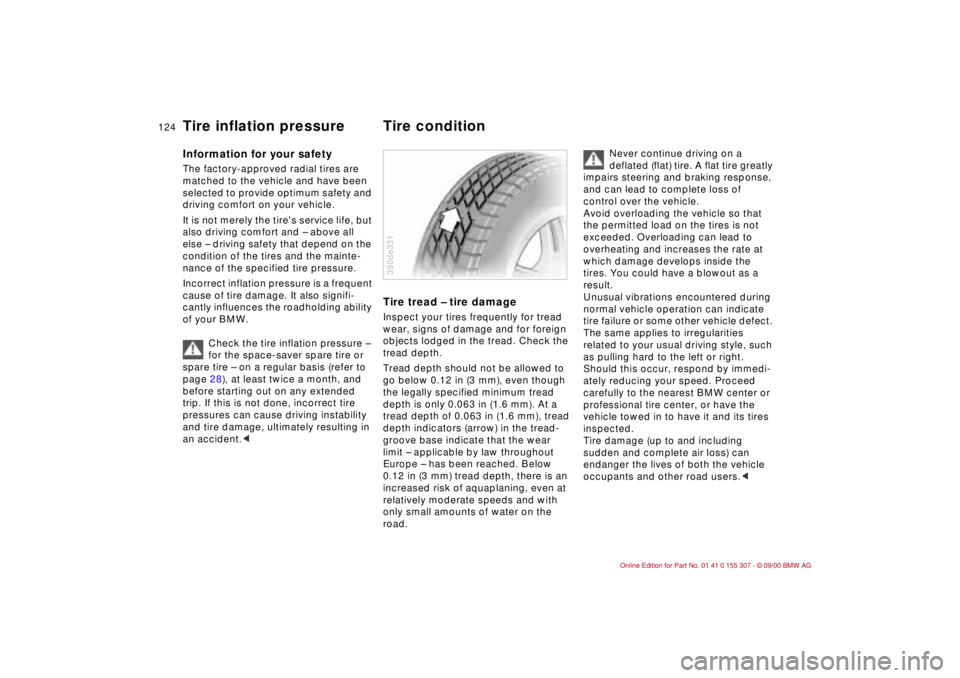
Tire tread Ð tire damageInspect your tires frequently for tread
wear, signs of damage and for foreign
objects lodged in the tread. Check the
tread depth.
Tread depth should not be allowed to
go below 0.12 in (3 mm), even though
the legally specified minimum tread
depth is only 0.063 in (1.6 mm). At a
tread depth of 0.063 in (1.6 mm), tread
depth indicators (arrow) in the tread-
groove base indicate that the wear
limit Ð applicable by law throughout
Europe Ð has been reached. Below
0.12 in (3 mm) tread depth, there is an
increased risk of aquaplaning, even at
relatively moderate speeds and with
only small amounts of water on the
road.390de331
Never continue driving on a
deflated (flat) tire. A flat tire greatly
impairs steering and braking response,
and can lead to complete loss of
control over the vehicle.
Avoid overloading the vehicle so that
the permitted load on the tires is not
exceeded. Overloading can lead to
overheating and increases the rate at
which damage develops inside the
tires. You could have a blowout as a
result.
Unusual vibrations encountered during
normal vehicle operation can indicate
tire failure or some other vehicle defect.
The same applies to irregularities
related to your usual driving style, such
as pulling hard to the left or right.
Should this occur, respond by immedi-
ately reducing your speed. Proceed
carefully to the nearest BMW center or
professional tire center, or have the
vehicle towed in to have it and its tires
inspected.
Tire damage (up to and including
sudden and complete air loss) can
endanger the lives of both the vehicle
occupants and other road users.<
Tire inflation pressure Tire condition
Page 125 of 203

125n
IndexDataTechnologyRepairsCar careControlsOverview
To maintain good handling and vehicle
response, use only tires of a single
tread configuration from a single manu-
facturer. BMW tests and approves
wheel/tire combinations. Refer to
page 129.DOT Quality GradesTreadwear
Traction AA A B C
Temperature A B C
All passenger car tires must
conform to Federal Safety
Requirements in addition to these
grades.< Tread wearThe tread wear grade is a comparative
rating based on the wear rate of the tire
when tested under controlled condi-
tions on a specified government test
course.
For example, a tire graded 150 would
wear one and one-half (1g) times as
well on the government course as a tire
graded 100. The relative performance
of tires depends upon the actual condi-
tions of their use, however, and may
depart significantly from the norm due
to variations in driving habits, service
practices and differences in road char-
acteristics and climate.
TractionThe traction grades, from highest to
lowest, are AA, A, B, and C.
Those grades represent the tire's ability
to stop on wet pavement as measured
under controlled conditions on speci-
fied government test surfaces of asphalt
and concrete. A tire marked C may have
poor traction performance.
The traction grade assigned to
this tire is based on straight-
ahead braking traction tests, and does
not include acceleration, cornering,
hydroplaning, or peak traction charac-
teristics.< TemperatureThe temperature grades are A (the
highest), B, and C, representing the
tire's resistance to the generation of
heat and its ability to dissipate heat
when tested under controlled condi-
tions on a specified indoor laboratory
test wheel.
Sustained high temperature can cause
the material of the tire to degenerate
and reduce tire life, and excessive
temperature can lead to sudden tire
failure. The grade C corresponds to a
level of performance which all
passenger car tires must meet under
the Federal Motor Vehicle Safety Stan-
dard No. 109. Grades B and A repre-
sent higher levels of performance on
the laboratory test wheel than the
minimum required by law.
The temperature grade for this tire
is established for a tire that is
properly inflated and not overloaded.
Excessive speed, under-inflation, or
excessive loading, either separately or
in combination, can cause heat buildup
and possible tire failure.< Uniform Tire Quality Grading Quality grades can be found where
applicable on the tire sidewall between
tread shoulder and maximum section
width. For example:
Tread wear 200 Traction AA
Temperature A
Do not use retreaded tires. Driving
safety may be impaired by their
use. This is due to the possible varia-
tions in casing structures and, in some
cases, to their extreme age, which can
lead to a decrease in their durability.<
Tire replacement
Page 128 of 203

128n
Winter tiresChoosing the right tireBMW recommends winter tires (M+S
radial tires) for driving in adverse winter
road conditions. So-called all-season
tires with the M+S-identification mark
do indeed possess better winter trac-
tion than summer tires with the load
rating H, V, W, Y und ZR, but usually do
not achieve the same level of perfor-
mance as winter tires.
In the interests of safe tracking and
steering response, install radial tires
made by the same manufacturer and
with the same tread configuration on all
four wheels if you elect to mount winter
tires.
Mount only winter tires which have
been approved by BMW. Any BMW
center will be glad to provide you with
information on the best winter tires for
your particular driving conditions.
Do not exceed specified
maximum speeds
Never exceed the maximum speed
for which the tires are rated.
Unprofessional attempts by laymen to
service tires can lead to damage and
accidents.
Have this work performed by skilled
professionals only. Any BMW center
has the required technical knowledge
and the proper equipment and will be
happy to assist you.<
Tire condition, tire pressureOnce the tire wears to below 0.16 in
(4 mm), winter tires display a percep-
tible decrease in their ability to cope
with winter driving conditions, and
should be replaced in the interest of
safety.
Comply with the specified tire inflation
pressures Ð and be sure to have the
wheel and tire assemblies balanced
every time you change the tires.
StorageAlways store tires in a cool, dry place.
Store them away from light whenever
possible. Protect the tires against
contact with oil, grease and fuel.Snow chains
*
The use of narrow-link BMW snow
chains on summer or winter tires is
approved only in pairs and only on the
rear wheels. Comply with all manufac-
turer's safety precautions when
mounting the chains.
BMW 325xi: in a worst-case scenario,
i.e. if your vehicle is stuck on one side
or you cannot access one tire, then only
one chain may be attached to a rear
wheel for a short period of time.
Comply with all manufacturer's safety
precautions when mounting the chains.
Page 135 of 203
135n
IndexDataTechnologyRepairsCar careControlsOverview
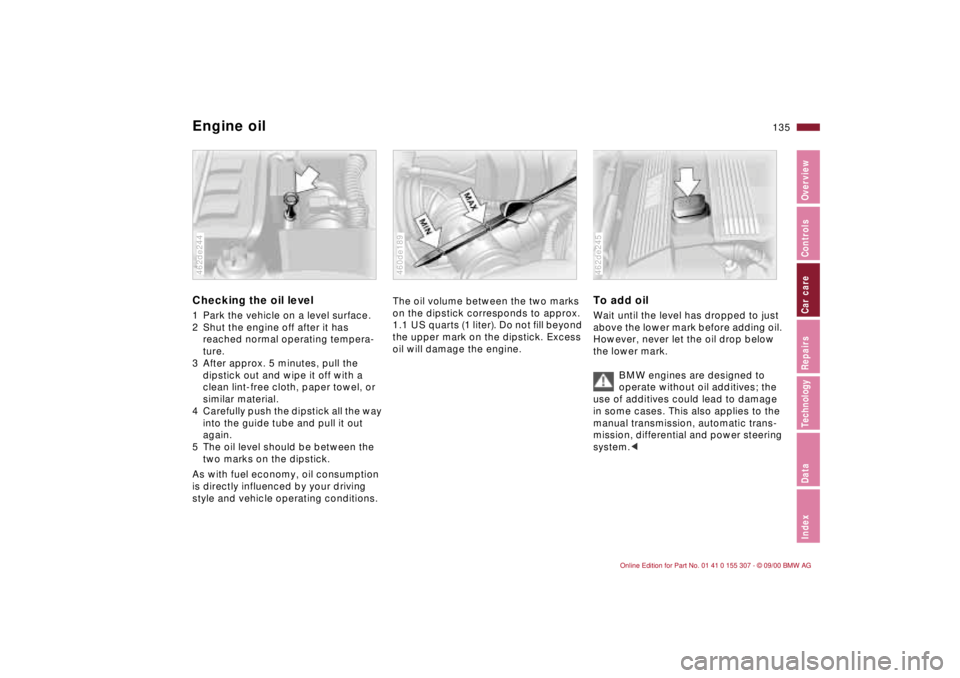
Engine oilChecking the oil level 1 Park the vehicle on a level surface.
2 Shut the engine off after it has
reached normal operating tempera-
ture.
3 After approx. 5 minutes, pull the
dipstick out and wipe it off with a
clean lint-free cloth, paper towel, or
similar material.
4 Carefully push the dipstick all the way
into the guide tube and pull it out
again.
5 The oil level should be between the
two marks on the dipstick.
As with fuel economy, oil consumption
is directly influenced by your driving
style and vehicle operating conditions.462de244
The oil volume between the two marks
on the dipstick corresponds to approx.
1.1 US quarts (1 liter). Do not fill beyond
the upper mark on the dipstick. Excess
oil will damage the engine.460de189
To add oil Wait until the level has dropped to just
above the lower mark before adding oil.
However, never let the oil drop below
the lower mark.
BMW engines are designed to
operate without oil additives; the
use of additives could lead to damage
in some cases. This also applies to the
manual transmission, automatic trans-
mission, differential and power steering
system.<462de245
Page 140 of 203

140n
The BMW Maintenance System has
been designed as a reliable means for
providing maximum driving and operat-
ing safety Ð and as cost effectively as
possible for you.
Please keep in mind that regular main-
tenance is not only necessary for the
safety of your vehicle, but also plays a
significant role in maintaining the resale
value of the vehicle.
Service Interval DisplayAdvanced technology is employed
to calculate the optimal maintenance
intervals. These are then indicated in
the Service Interval Display. While
conventional systems rely on distance
traveled alone to determine when
service is due, the BMW Maintenance
System has for years considered the 460us112
actual conditions under which the
vehicle operates, because miles can be
traveled in many different ways:
From a maintenance perspective,
62,000 miles (100,000 km) of short-
distance urban driving are not equiva-
lent to 62,000 miles (100,000 km)
covered at moderate speeds in long-
distance highway travel.
The BMW Maintenance System
includes the Engine Oil Service and
Inspections I and II.
Determining the maintenance intervals
according to the actual use of the vehi-
cle covers every kind of operating situa-
tion. However, even those who drive
only short distances Ð significantly less
than 6,000 miles (10,000 km) annually Ð
should have the engine oil changed at
least every 2 years since oil deterio-
rates over time, regardless of use.
Service and Warranty Information
Booklet (US models)/Warranty and
Service Guide (Canada models)For additional information on mainte-
nance intervals and procedures, please
refer to the Service and Warranty Infor-
mation Booklet (US models) or to the
Warranty and Service Guide (Canadian
models).
As a precaution against rust, it is
advisable to have the body checked for
damage from rocks or gravel at the
same time, depending upon operating
conditions.
Have your BMW center perform
maintenance and repair.
Your BMW center is always "up to date"
on the latest maintenance work and
repair techniques and equipped with
the required special tools. In addition,
checking parts known from experience
to be subject to wear is a permanent
part of the maintenance specifications.
Be sure that all maintenance work is
confirmed in the Service and Warranty
Information Booklet (US models) or the
Warranty and Service Guide (Canadian
models). These entries will constitute
your proof that the vehicle has received
regular maintenance. They are also
required for warranty claims.<
The BMW Maintenance System
Page 163 of 203

163n
IndexDataTechnologyRepairsCar careControlsOverview
BatteryBattery careThe battery is completely maintenance-
free. That means that the original acid
will normally last for the service life of
the battery under temperate climatic
conditions.
For all questions that regard the
battery, please consult your BMW
center. Since the battery is absolutely
maintenance-free, the following is for
your information only.
please be cautious whenever you work
with or near the battery.
Before handling the battery,
please read the following infor-
mation.
Wear eye protection. Do not al-
low particles containing battery
acid or lead to come into con-
tact with your eyes, your skin, or your
clothing.
Battery acid is extremely corro-
sive. Wear eye protection and
protective gloves. Do not tip the
battery. Battery acid can leak from the
ventilation openings.
Do not allow children to have
access to batteries and battery
acid.
Never allow sparks or open
flame near the battery. Do
not smoke in the vicinity of the
battery. Avoid sparks from electrical
cables or electrical equipment. Turn the
key to position 0 in the steering lock
when disconnecting or connecting the
battery. Never short-circuit the battery
terminals. This creates a risk of injury
from high-energy sparks.
A highly explosive gas is gener-
ated when the battery is
charged.
If you happen to get acid in
your eyes, rinse thoroughly for
15 minutes with clear water.
Consult a physician immediately. If you
get acid spray on your skin or clothing,
rinse with plenty of water. If acid is
accidentally swallowed, consult a
physician immediately.
In order to protect the battery
case from ultraviolet radiation,
do not place it in direct sunlight.
A discharged battery can freeze. Store
the battery in areas where temperature
remains above freezing.
Removal and installation
Do not disconnect the battery
while the engine is running.
Disconnecting the battery cable when
the engine is running will cause a
voltage surge which will damage the
vehicle's onboard electronics.
Do not make any modifications in the
wires to the positive terminal. If you do
so, the protective function of the safety
battery terminal is no longer ensured.
Repairs and disposal may only be per-
formed by specially trained personnel.<
When removing the battery, disconnect
the cable on the negative terminal first,
then the cable on the positive terminal.
Loosen the center adjusting screw on
the battery retaining strap (use the
screwdriver included with the onboard
tool kit) and disconnect the strap.
When installing a battery, connect the
positive terminal first, then connect the
negative terminal.
When installing a battery, be sure
that it is mounted properly and that
the retaining strap is installed using the
center adjustment screw, otherwise, the
battery will not be secure enough in
case of an accident.<
Page 173 of 203
173n
IndexDataTechnologyRepairsCar careControlsOverview
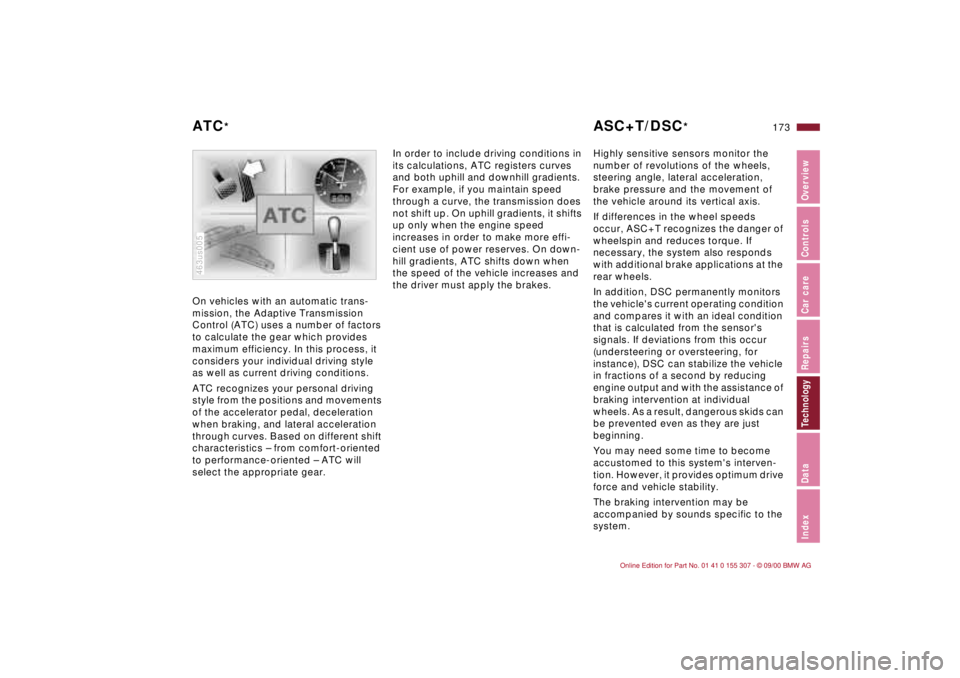
On vehicles with an automatic trans-
mission, the Adaptive Transmission
Control (ATC) uses a number of factors
to calculate the gear which provides
maximum efficiency. In this process, it
considers your individual driving style
as well as current driving conditions.
ATC recognizes your personal driving
style from the positions and movements
of the accelerator pedal, deceleration
when braking, and lateral acceleration
through curves. Based on different shift
characteristics Ð from comfort-oriented
to performance-oriented Ð ATC will
select the appropriate gear.463us005
In order to include driving conditions in
its calculations, ATC registers curves
and both uphill and downhill gradients.
For example, if you maintain speed
through a curve, the transmission does
not shift up. On uphill gradients, it shifts
up only when the engine speed
increases in order to make more effi-
cient use of power reserves. On down-
hill gradients, ATC shifts down when
the speed of the vehicle increases and
the driver must apply the brakes.Highly sensitive sensors monitor the
number of revolutions of the wheels,
steering angle, lateral acceleration,
brake pressure and the movement of
the vehicle around its vertical axis.
If differences in the wheel speeds
occur, ASC+T recognizes the danger of
wheelspin and reduces torque. If
necessary, the system also responds
with additional brake applications at the
rear wheels.
In addition, DSC permanently monitors
the vehicle's current operating condition
and compares it with an ideal condition
that is calculated from the sensor's
signals. If deviations from this occur
(understeering or oversteering, for
instance), DSC can stabilize the vehicle
in fractions of a second by reducing
engine output and with the assistance of
braking intervention at individual
wheels. As a result, dangerous skids can
be prevented even as they are just
beginning.
You may need some time to become
accustomed to this system's interven-
tion. However, it provides optimum drive
force and vehicle stability.
The braking intervention may be
accompanied by sounds specific to the
system.
ATC
*
ASC+T/DSC
*