brake light BMW 325I 2001 User Guide
[x] Cancel search | Manufacturer: BMW, Model Year: 2001, Model line: 325I, Model: BMW 325I 2001Pages: 203, PDF Size: 2.07 MB
Page 117 of 203
117n
IndexDataTechnologyRepairsCar careControlsOverview
Antilock Brake System (ABS)Nevertheless, ABS possesses the
advantage of vehicle stability and
steering response.Information for your safetyNot even ABS can suspend the laws
of physics. The consequences of brake
applications with inadequate clea-
rances for safety between vehicles,
excessive speed or if aquaplaning
occurs are always the responsibility of
the driver. You should never allow the
added safety of ABS to lull you into a
false sense of security, or mislead you
into taking risks that could affect your
own safety and that of others.
Do not make any modifications to
the ABS system.
Service procedures on ABS are to be
performed by authorized technicians
only.
opment of ABS. When braking while
cornering at high speed or braking
during high lateral acceleration, or
when braking during a lane change,
vehicle stability is improved and
steering response is enhanced.
In the event of a malfunction
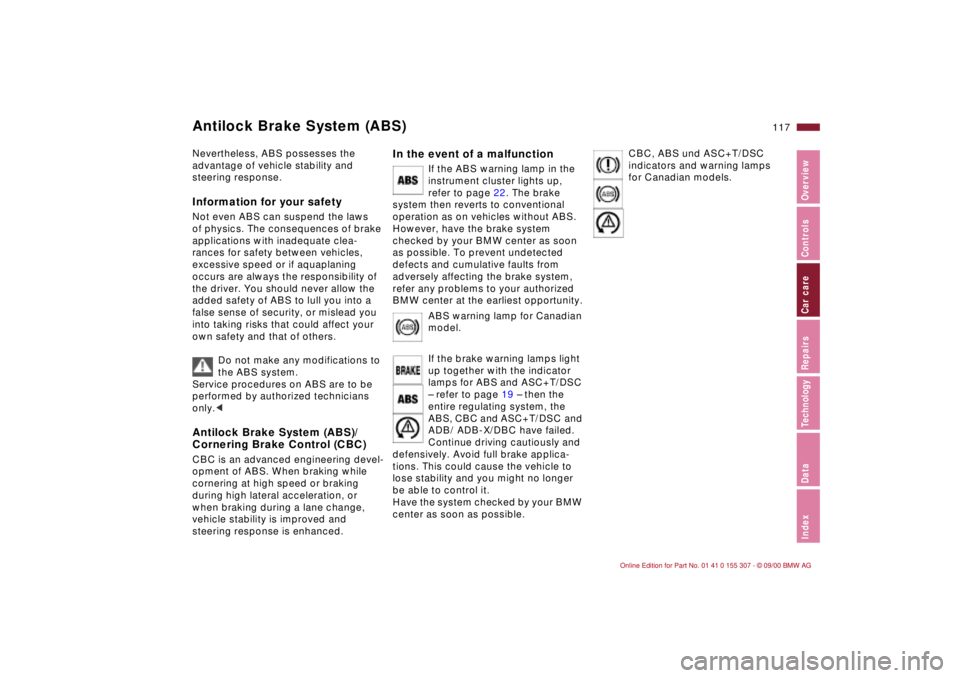
If the ABS warning lamp in the
instrument cluster lights up,
refer to page 22. The brake
system then reverts to conventional
operation as on vehicles without ABS.
However, have the brake system
checked by your BMW center as soon
as possible. To prevent undetected
defects and cumulative faults from
adversely affecting the brake system,
refer any problems to your authorized
BMW center at the earliest opportunity.
ABS warning lamp for Canadian
model.
If the brake warning lamps light
up together with the indicator
lamps for ABS and ASC+T/DSC
Ð refer to page 19 Ð then the
entire regulating system, the
ABS, CBC and ASC+T/DSC
and
ADB/ ADB-X/DBC have failed.
Continue driving cautiously and
defensively. Avoid full brake applica-
tions. This could cause the vehicle to
lose stability and you might no longer
be able to control it.
Have the system checked by your BMW
center as soon as possible.
CBC, ABS und ASC+T/DSC
indicators and warning lamps
for Canadian models.
Page 119 of 203

119n
IndexDataTechnologyRepairsCar careControlsOverview
Disc brakesDriving notesWhen driving in wet conditions and in
heavy rain, it is effective to apply light
pressure to the brakes every few miles
or kilometers. Watch traffic conditions
to ensure that this maneuver does not
endanger other drivers. The heat which
is generated by the brake applications
helps to dry the brake pads and discs.
Maximum braking force is obtained
while the wheels are not locked, but
rather when they are still barely turning
immediately prior to locking. ABS main-
tains this state automatically. If the ABS
fails, you should revert to the staggered
braking technique (refer to page 122).
Extended or steep mountain descents
should be driven in the gear in which
only minimal periodic brake application
is required. This avoids excessive strain
on the brakes and possible
impairment of the braking effect.
The braking effect of the engine can be
further increased by downshifting, into
first gear, if necessary. In the manual
mode of the automatic transmission,
you can also downshift into first gear.
Refer to page 66.If engine braking should prove to be
inadequate, you should still avoid
extended, continuous braking. Instead
of maintaining low to moderate pres-
sure over an extended period of time,
you should decelerate by applying
more substantial pressure to the brake
pedal (watch for following traffic),
releasing the pedal, and then repeating
the application (staggered braking). The
cooling phases between active braking
intervals prevent the brakes from over-
heating, thus ensuring that full braking
capacity remains available at all times.
Do not allow the vehicle to coast
when the clutch is depressed or
by shifting into neutral while moving. Do
not drive when the engine is switched
off. The engine provides no braking
control when the clutch is depressed or
the transmission is in "Neutral" and
there is no power-assist for the brakes
when the engine is shut off.
BMW 325xi: have brake inspections
performed at a BMW center only. If you
do not, parts of the four-wheel drive
system could be damaged.
Do not allow floor mats, carpets or any
other objects to protrude into the area
around the brake pedal, the clutch or
the accelerator which could obstruct
their freedom of movement.<
Page 138 of 203
138n
Coolant Brake fluidAdding coolant Wait until the engine cools before
removing the cap from the expansion
tank. The needle of the coolant gauge
in the instrument cluster must be
located in the blue zone. If it is not,
there is a danger of scalding.
1 Turn the cap slightly counterclock-
wise in order to allow accumulated
pressure to escape, then open.
2 If the coolant is low, slowly add
coolant until the correct level is
reached Ð do not overfill.
The coolant is a mixture of water and
extended-duty antifreeze with corrosion
inhibitor. Always maintain the
prescribed all-season 50:50 mixture
ratio for year-round protection against
internal corrosion. No other additives
are required.
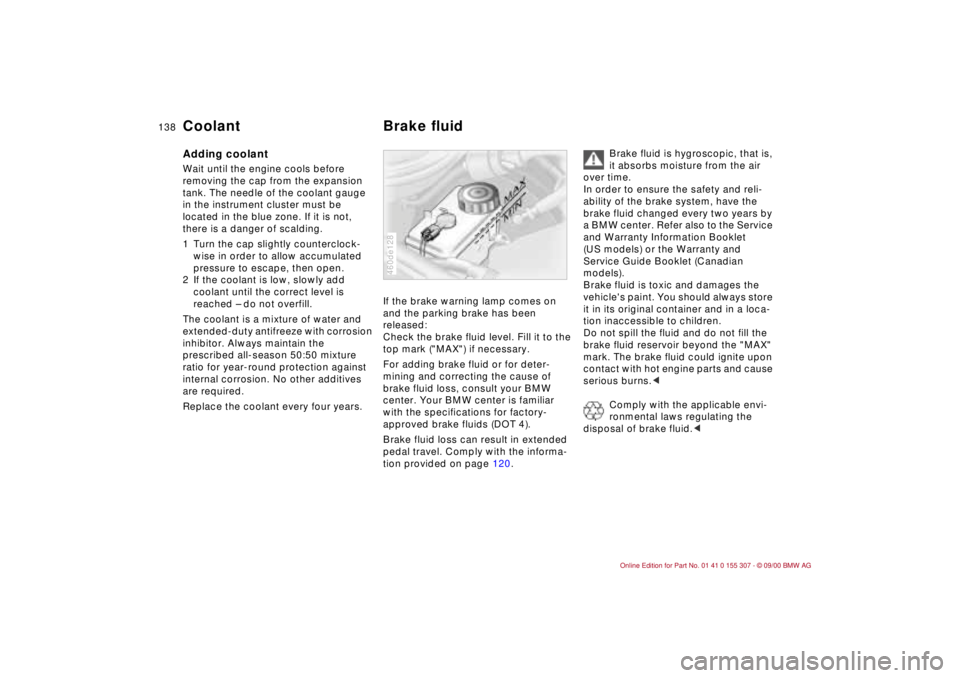
Replace the coolant every four years.If the brake warning lamp comes on
and the parking brake has been
released:
Check the brake fluid level. Fill it to the
top mark ("MAX") if necessary.
For adding brake fluid or for deter-
mining and correcting the cause of
brake fluid loss, consult your BMW
center. Your BMW center is familiar
with the specifications for factory-
approved brake fluids (DOT 4).
Brake fluid loss can result in extended
pedal travel. Comply with the informa-
tion provided on page 120.
460de128
Brake fluid is hygroscopic, that is,
it absorbs moisture from the air
over time.
In order to ensure the safety and reli-
ability of the brake system, have the
brake fluid changed every two years by
a BMW center. Refer also to the Service
and Warranty Information Booklet
(US models) or the Warranty and
Service Guide Booklet (Canadian
models).
Brake fluid is toxic and damages the
vehicle's paint. You should always store
it in its original container and in a loca-
tion inaccessible to children.
Do not spill the fluid and do not fill the
brake fluid reservoir beyond the "MAX"
mark. The brake fluid could ignite upon
contact with hot engine parts and cause
serious burns.<
Comply with the applicable envi-
ronmental laws regulating the
disposal of brake fluid.<
Page 141 of 203
141n
IndexDataTechnologyRepairsCar careControlsOverview
Washing your vehicle You can wash your BMW at an auto-
matic car wash, even when it is new.
Brushless systems are preferable.
Wipe away tough dirt and loosen and
remove dead insects before washing
the vehicle.
In order to avoid spots, do not wash
the vehicle when the hood is warm, or
during or immediately after exposure to
strong sunlight.
When using an automatic car wash, be
sure that:
>The car wash system is suited for the
dimensions of your vehicle.
>No damage will occur to vehicles
with attached body accessories (such
as spoilers or antennas). Consult the
car wash operator if necessary.
>The wheels and tires of your vehicle
cannot be damaged by the convey-
ance devices of the car wash system.
>The vehicle is cleaned with minimum
brush pressure, and that ample water
is available for washing and rinsing.
Vehicles with rain sensor:
Clean the windshield regularly. Wax
from automatic car washes or insects
can cause malfunctions in the function
of the rain sensor.Turn the rain sensor off (refer to
page 69) when passing through an
automatic car wash. Failure to do so
could result in damage caused by unin-
tended wiper activation.<
Parts of the vehicle which are
inaccessible to the automatic washer Ð
such as door sills, door and hood
edges, etc. Ð should be cleaned by
hand.
In the winter months, it is especially
important to ensure that the vehicle is
washed on a regular basis. Large quan-
tities of dirt and road salt are difficult to
remove, and they also damage the
vehicle.
If spray wands or high-pressure
washers are used, be sure to
maintain an adequate distance between
the spray source and the vehicle's
surface. Inadequate distance and
excessive pressure can damage or
weaken the finish, making it more
susceptible to subsequent attack. In
addition, moisture could penetrate to
vehicle components, leading to long-
term damage.<
When cleaning the headlamps,
please observe the following:
do not clean by wiping with a dry cloth
(scratches). Never use abrasives or
strong solvents to clean the covers.
Remove dirt and contamination (such
as insects) by soaking with BMW Car
Shampoo and then rinsing with plenty
of water. Always use a deicer spray to
remove accumulated ice and snow Ð
never use a scraper.<
After washing the vehicle, apply
the brakes briefly to dry them.
Braking efficiency might otherwise be
reduced by the moisture and the brake
rotors could be corrode.<
Caring for your vehicle
Page 156 of 203
156n
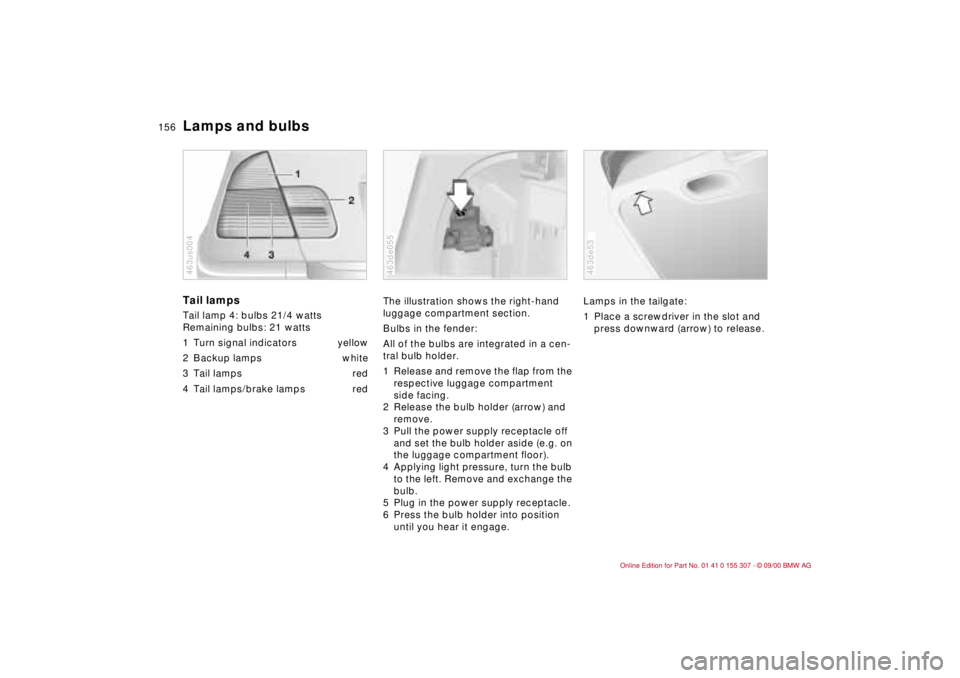
Lamps and bulbsTail lamps Tail lamp 4: bulbs 21/4 watts
Remaining bulbs: 21 watts
1 Turn signal indicators yellow
2 Backup lamps white
3 Tail lamps red
4 Tail lamps/brake lamps red463us004
The illustration shows the right-hand
luggage compartment section.
Bulbs in the fender:
All of the bulbs are integrated in a cen-
tral bulb holder.
1 Release and remove the flap from the
respective luggage compartment
side facing.
2 Release the bulb holder (arrow) and
remove.
3 Pull the power supply receptacle off
and set the bulb holder aside (e.g. on
the luggage compartment floor).
4 Applying light pressure, turn the bulb
to the left. Remove and exchange the
bulb.
5 Plug in the power supply receptacle.
6 Press the bulb holder into position
until you hear it engage.463de055
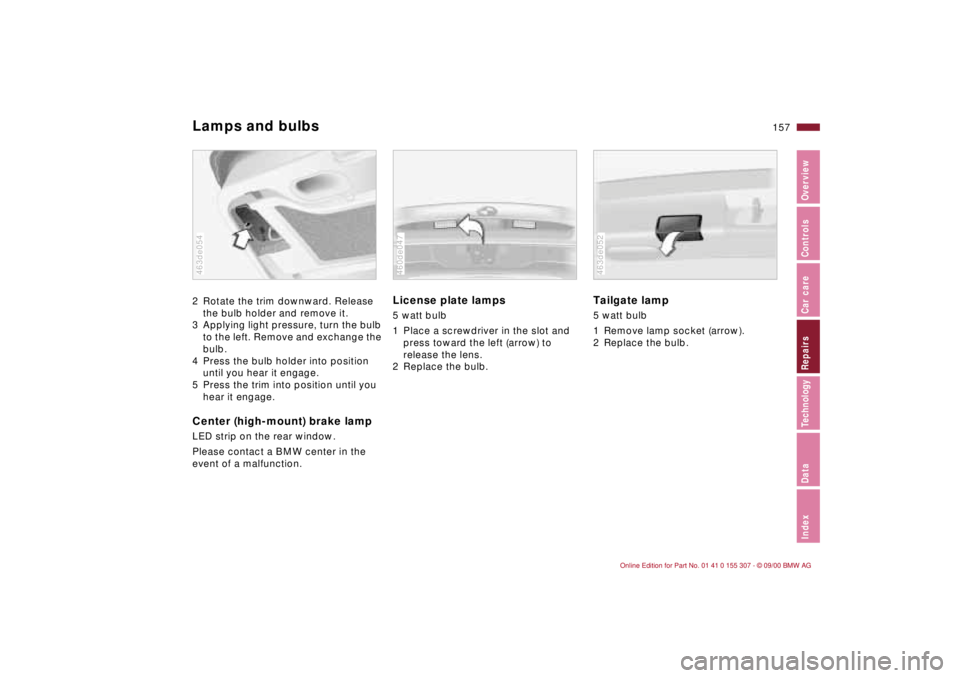
Lamps in the tailgate:
1 Place a screwdriver in the slot and
press downward (arrow) to release.463de53
Page 157 of 203
157n
IndexDataTechnologyRepairsCar careControlsOverview
Lamps and bulbs2 Rotate the trim downward. Release
the bulb holder and remove it.
3 Applying light pressure, turn the bulb
to the left. Remove and exchange the
bulb.
4 Press the bulb holder into position
until you hear it engage.
5 Press the trim into position until you
hear it engage.Center (high-mount) brake lamp
LED strip on the rear window.
Please contact a BMW center in the
event of a malfunction.463de054
License plate lamps 5 watt bulb
1 Place a screwdriver in the slot and
press toward the left (arrow) to
release the lens.
2 Replace the bulb.460de047
Tailgate lamp 5 watt bulb
1 Remove lamp socket (arrow).
2 Replace the bulb.463de052
Page 193 of 203
Everything from A to Z
193n
IndexDataTechnologyRepairsCar careControlsOverview
Changing a wheel159
Charge indicator lamp20
Check air pressure28
Check Control75
Check engine oil level135
Child restraint
systems54,60
Child-safety locks58
Child's seat54
Cigarette lighter104
Cleaning windshield68
Clock75
refer also to the Radio or
Computer Owner's Manual
Cockpit16
Coin holder102
Combination switch68
Compression184
Computer76
Configure settings52
Consumption77
display74
Contents10
Control elements20
Coolant121,137,187
antifreeze121
Coolant temperature
gauge74
Cooling system187
Copyright4
Cornering Brake Control
(CBC)21,117 Cruise control71
Cruising range77
Cup holder, refer to
beverage holder102
Curb weight186
Current check indicator20
D
Dashboard16
Data
dimensions185
engine184
technical184
weights186
Daytime-driving lamp
switch87
DBC (Dynamic Brake
Control)118
Defrost position94,98
Defrostable rear window99
Defrosting
rear window92
windows94,98
Digital clock75
Dimensions185
Dipstick, engine oil135
Disc brakes118
Displacement184
Display lighting87
Displays18
Distance warning78 Diversity Antenna
system174
Door key32,35
Door locks, care121
Doors
child-safety locks58
emergency operation34
unlocking and locking34
DOT Quality Grades125
Draft-free ventilation93
Drive belts188
Driving hints115
Driving in winter121
Driving lamps87
DSC (Dynamic Stability
Control)81,173
Dynamic Brake Control
(DBC)118
Dynamic Stability Control
(DSC)22,81,173
E
Electric power seat48
Electric power windows43
Electrical accessories,
failure164
Electrical system188
Electronic vehicle
immobilizer33
Elements of operation16 Emergency operation,
doors34
Energy Control73
Engine
coolant137,187
data184
starting61
Engine oil
capacity187
consumption135
pressure20
quality136
specifications136
viscosity136
Engine speed184
Exterior mirrors51
F
Failure messages75
Fault displays75
Fault, ABS117
Filler cap cover27
Filling capacities187
Filling the washer
reservoir187
First-aid kit26
Fittings, tow starting and
towing168
Flashlight101
Flat tire124,159
Fog lamps88
Page 194 of 203
Everything from A to ZFolding rear backrest108
Footbrake118
Footwell lamps88
bulb replacement158
Four-wheel drive175
Front fog lamps, bulb
replacement155
Front seat adjustment46
Frost protection,
radiator137
Fuel28
consumption77
consumption display74
gauge74
preparation184
quality28
Fuel filler door
releasing following an
electrical malfunction166
Fuel reserve indicator
lamp74
Fuel tank capacity187
Fuel tank gauge74
Functional status179
Fuses164 G
Gasoline28
Gasoline gauge74
Gasoline quality28
Glove compartment101 Glove compartment lamp,
bulb replacement158
Gross vehicle weight186
H
Handbrake63
Hands-free system103
Hazard warning flashers26
Hazard warning triangle26
Head restraint47
Headlamp covers,
care141,153
Headlamp flasher88
Headlamp washer
system70,134,187
Heated seats100
Heating, rapid94
Heavy loads110
Height185
HiFi system101
High beams23,68,88
bulb replacement153
High Performance Synthetic
Oils136
High-mount brake lamp157
Hood release130
Horn17
Hubcap160
Hydraulic Brake assistant,
refer to DBC118
I
Ice warning76
Icy roads76,121
Identification, tires127
Ignition key32,35
Ignition lock61
Imprint4
Indicator lamps20
Inflation pressure28,124
monitoring85,178
INSPECTION74
Installation child restraint
systems60
Instrument cluster18
Instrument lighting87
Interaxle tire rotation126
Interface socket for Onboard
Diagnostics149
Interference, cellular
phone123
Interior lamps36,88
bulb replacement158
remote control36
Interior motion sensor41
Interior rearview mirror51
automatic dimming
feature52,176
Interlock61
Intermittent wipe68
J
Jack159
Jump-starting167 K
Key32,35
Key Memory52 L
Lamps and bulbs153
Lashing eyes110
LATCH attachment of the
child seat58
Leather care145
Length185
License plate lamp
bulb replacement157
Light switch87
Light-alloy wheels129
Lighter104
Load-securing devices110
Louvers90,96
Low beam headlamps87
bulb replacement153
Lug bolts160
Lug wrench159
Page 196 of 203
Everything from A to ZRemote control35
Removal from service of the
vehicle147
Removing condensation
from the windows94
Reporting safety defects7
Restraint system54
Retaining straps40
Reverse17,64
Roll-up cover107
Roof load capacity186
Roof luggage rack111
Rubber parts121 S
Safety belt height
adjustment53
Safety belt tensioners175
Safety belts53
height adjustment53
Safety defects, reporting7
Safety feature43
Safety lock buttons38
Seat
electric power48
mechanical46
Seat adjustment46
Seat heating100
Seat memory49
Securing cargo110
Securing loads110 Selector lever, automatic
transmission65
Self-defrosting mirrors51
Self-diagnostics179
Service and Warranty
Information Booklet
(US models)140
Service Interval Display74
Setting the temperature98
Shiftlock65
Side airbags58
Side impact Head Protection
System58
Side lamps87
bulb replacement154
Ski bag106
Skid control122
Sliding/tilt sunroof44
close in the event of an
electrical short166
convenience operation34
Slippery roads122
Snow chains121
Socket104
for electrical
appliances104
for flashlights104
for vacuum cleaner104
refer also to power
outlet105
Space-saver spare tire159 Spare key32,35
with radio remote
control32,35
Spare tire159
Spark plugs188
Speaker103
Speed control71
Speedometer18
Sports seat48
Sports steering wheel25
Starting assistance167
Starting
problems115,167
Starting the engine61
Steel wheels129
Steering123
Steering wheel lock61
Steering wheel,
adjusting50
Steptronic65
Stereo system Ð harman
kardon101
Stopping the vehicle62
Storage compartments102
Storing the vehicle147
Stroke184
Summer tires127
Sun visors51
Sunroof44
Switching off the engine62
Symbols4,163 Synthetic oils136
T
Tachometer73
Tail lamps156
bulb replacement156
Tailgate
emergency release166
Tailgate lamp, bulb
replacement157
Tank capacity187
Technical data184
Technical
modifications6,148
Telephone
refer to the separate
Owner's Manual
Telephone hookup103
Temperature adjustment98
Temperature display,
outside temperature76
Temperature gauge, engine
coolant74
Temperature
layering93,100
Thigh support area,
adjusting48
Third brake lamp157
Tilt alarm42
Tilt sensor alarm system36
remote control36
Tire changing159