oil level BMW 325I 2001 Owners Manual
[x] Cancel search | Manufacturer: BMW, Model Year: 2001, Model line: 325I, Model: BMW 325I 2001Pages: 203, PDF Size: 2.07 MB
Page 19 of 203

19n
IndexDataTechnologyRepairsCar careControlsOverview
Instrument cluster
1 Fuel gauge with indicator lamp for
fuel reserve74
2 Turn signal indicator23
3 Speedometer
4 Indicator lamp for:
>
Battery charge current20
>
High beams23
>
Engine oil pressure/Engine oil
level20, 22
5 Tachometer and Energy Control73
6 Engine coolant temperature gauge
with "Coolant temperature too high"
indicator74
7 Indicator and warning lamps
(clockwise) for:
> Parking brake/Brake hydraulic
system/Cornering Brake Control
(CBC)/(DBC)20, 21 >
Antilock Brake System (ABS)22
>
Brake pads22
>
Tire Pressure Control
(RDC)20, 22
>
Airbags21
>
Please fasten safety belts21
>
Cruise control
* 23
8 Adjusting knob for the clock759 Program display for automatic
transmission65, 67
Indicator lamp for automatic
transmission21, 65, 67
10 Indicator lamp for Automatic
Stability Control plus Traction
(ASC+T)/Dynamic Stability Control
(DSC) or DSC and
ADB/ADB-X22
11 Indicator for:
>
Odometer73
>
Trip odometer73
>
Clock75
>
Service Interval74
Display for computer, operation
via the turn signal lever, refer to
page 76:
>
Clock
>
Outside temperature
>
Average fuel consumption
> Cruising range >
Average speed
12 Indicator for Check Control75
13 Trip odometer, reset to zero7314 Indicator and warning lamps
(clockwise) for:
>
Fog lamps23
>
Add washer fluid22
>
Coolant level23
>
Electronic Throttle Control
(EML)
*
23
>
Service engine soon23
You can display the outside
temperature and distance driven
in different units of measurement.
<
Page 20 of 203
20n
Indicator and warning lamps
Technology that monitors itself
Many of the systems of your BMW
monitor themselves automatically, both
during engine starts and while you are
driving. Indicator and warning lamps
that are identified by "
l
" are tested for
proper functioning whenever the igni-
tion key is turned. They each light up
once for different periods of time.
If a fault should occur in one of these
systems, the corresponding lamp does
not go out after the engine is started or
it will light up while the vehicle is
moving. You will see how to react to
this below.
Red: stop immediately
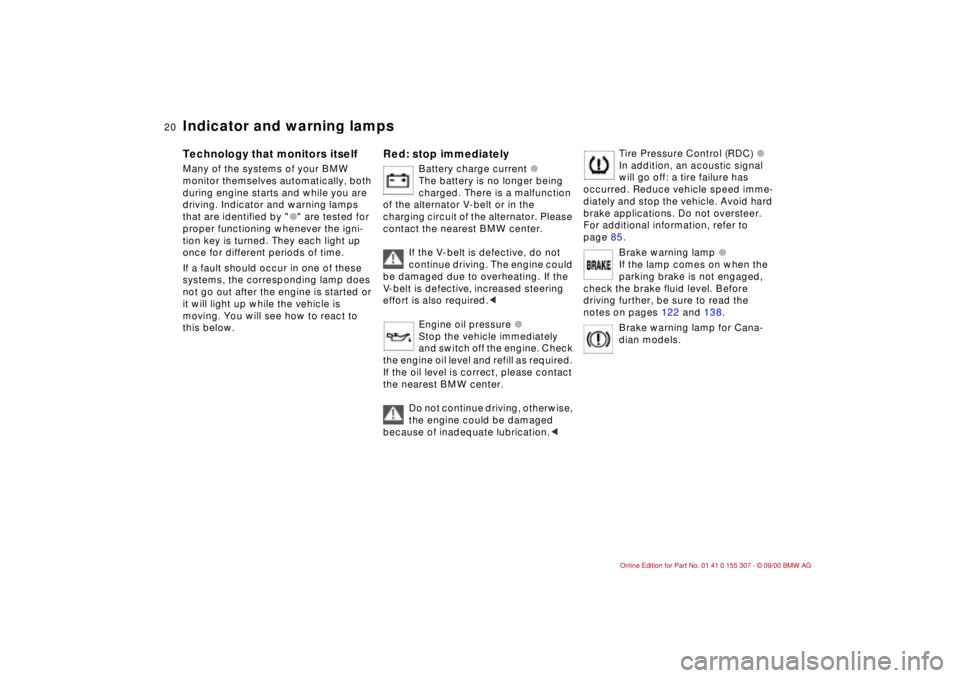
Battery charge current
l
The battery is no longer being
charged. There is a malfunction
of the alternator V-belt or in the
charging circuit of the alternator. Please
contact the nearest BMW center.
If the V-belt is defective, do not
continue driving. The engine could
be damaged due to overheating. If the
V-belt is defective, increased steering
effort is also required.
<
Engine oil pressure
l
Stop the vehicle immediately
and switch off the engine. Check
the engine oil level and refill as required.
If the oil level is correct, please contact
the nearest BMW center.
Do not continue driving, otherwise,
the engine could be damaged
because of inadequate lubrication.
<
Tire Pressure Control (RDC) l
In addition, an acoustic signal
will go off: a tire failure has
occurred. Reduce vehicle speed imme-
diately and stop the vehicle. Avoid hard
brake applications. Do not oversteer.
For additional information, refer to
page 85.
Brake warning lamp l
If the lamp comes on when the
parking brake is not engaged,
check the brake fluid level. Before
driving further, be sure to read the
notes on pages 122 and 138.
Brake warning lamp for Cana-
dian models.
Page 22 of 203
22n
Indicator and warning lampsYellow: check as soon as possible
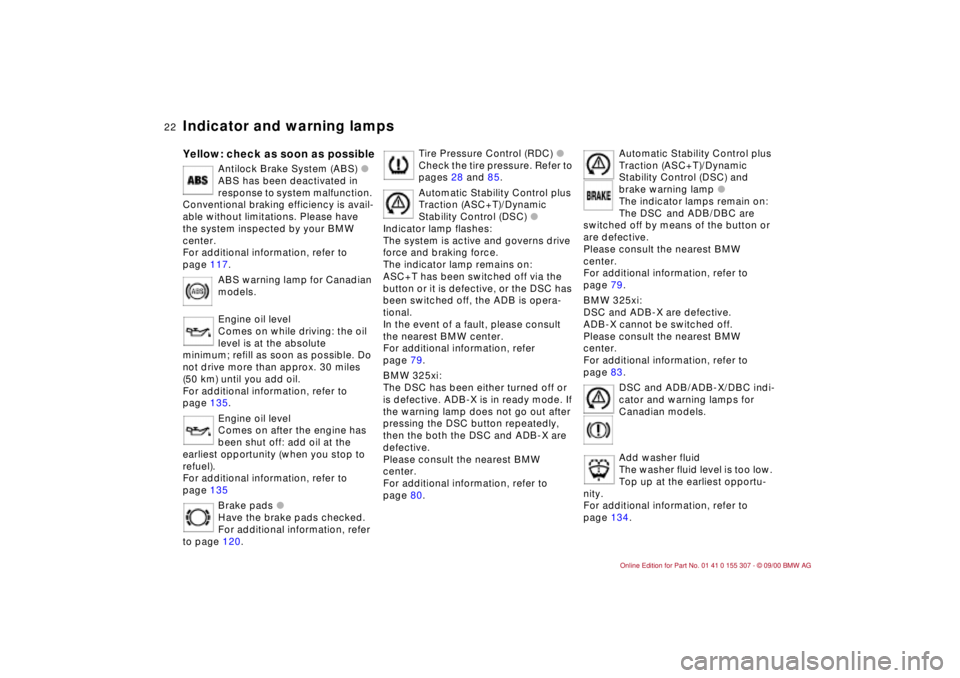
Antilock Brake System (ABS) l
ABS has been deactivated in
response to system malfunction.
Conventional braking efficiency is avail-
able without limitations. Please have
the system inspected by your BMW
center.
For additional information, refer to
page 117.
ABS warning lamp for Canadian
models.
Engine oil level
Comes on while driving: the oil
level is at the absolute
minimum; refill as soon as possible. Do
not drive more than approx. 30 miles
(50 km) until you add oil.
For additional information, refer to
page 135.
Engine oil level
Comes on after the engine has
been shut off: add oil at the
earliest opportunity (when you stop to
refuel).
For additional information, refer to
page 135
Brake pads l
Have the brake pads checked.
For additional information, refer
to page 120.
Tire Pressure Control (RDC) l
Check the tire pressure. Refer to
pages 28 and 85.
Automatic Stability Control plus
Traction (ASC+T)/Dynamic
Stability Control (DSC) l
Indicator lamp flashes:
The system is active and governs drive
force and braking force.
The indicator lamp remains on:
ASC+T has been switched off via the
button or it is defective, or the DSC has
been switched off, the ADB is opera-
tional.
In the event of a fault, please consult
the nearest BMW center.
For additional information, refer
page 79.
BMW 325xi:
The DSC has been either turned off or
is defective. ADB-X is in ready mode. If
the warning lamp does not go out after
pressing the DSC button repeatedly,
then the both the DSC and ADB-X are
defective.
Please consult the nearest BMW
center.
For additional information, refer to
page 80.
Automatic Stability Control plus
Traction (ASC+T)/Dynamic
Stability Control (DSC) and
brake warning lamp l
The indicator lamps remain on:
The DSC
and ADB/DBC are
switched off by means of the button or
are defective.
Please consult the nearest BMW
center.
For additional information, refer to
page 79.
BMW 325xi:
DSC and ADB-X are defective.
ADB-X cannot be switched off.
Please consult the nearest BMW
center.
For additional information, refer to
page 83.
DSC and ADB/ADB-X/DBC indi-
cator and warning lamps for
Canadian models.
Add washer fluid
The washer fluid level is too low.
Top up at the earliest opportu-
nity.
For additional information, refer to
page 134.
Page 74 of 203
74n
Fuel gauge
Coolant temperature gauge
Service Interval Display
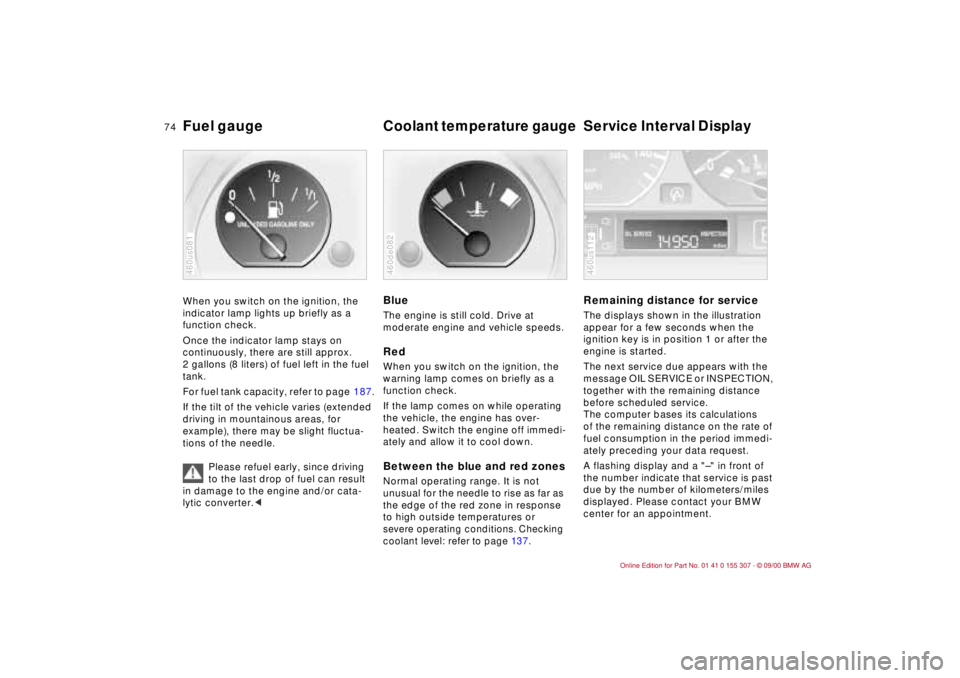
When you switch on the ignition, the
indicator lamp lights up briefly as a
function check.
Once the indicator lamp stays on
continuously, there are still approx.
2 gallons (8 liters) of fuel left in the fuel
tank.
For fuel tank capacity, refer to page 187.
If the tilt of the vehicle varies (extended
driving in mountainous areas, for
example), there may be slight fluctua-
tions of the needle.
Please refuel early, since driving
to the last drop of fuel can result
in damage to the engine and/or cata-
lytic converter.<460us081
BlueThe engine is still cold. Drive at
moderate engine and vehicle speeds.RedWhen you switch on the ignition, the
warning lamp comes on briefly as a
function check.
If the lamp comes on while operating
the vehicle, the engine has over-
heated. Switch the engine off immedi-
ately and allow it to cool down.Between the blue and red zonesNormal operating range. It is not
unusual for the needle to rise as far as
the edge of the red zone in response
to high outside temperatures or severe operating conditions. Checking
coolant level: refer to page 13 7.460de082
Remaining distance for serviceThe displays shown in the illustration
appear for a few seconds when the
ignition key is in position 1 or after the
engine is started.
The next service due appears with the
message OIL SERVICE or INSPECTION,
together with the remaining distance
before scheduled service.
The computer bases its calculations
of the remaining distance on the rate of
fuel consumption in the period immedi-
ately preceding your data request.
A flashing display and a "Ð" in front of
the number indicate that service is past
due by the number of kilometers/miles
displayed. Please contact your BMW
center for an appointment.460us112
Page 128 of 203

128n
Winter tiresChoosing the right tireBMW recommends winter tires (M+S
radial tires) for driving in adverse winter
road conditions. So-called all-season
tires with the M+S-identification mark
do indeed possess better winter trac-
tion than summer tires with the load
rating H, V, W, Y und ZR, but usually do
not achieve the same level of perfor-
mance as winter tires.
In the interests of safe tracking and
steering response, install radial tires
made by the same manufacturer and
with the same tread configuration on all
four wheels if you elect to mount winter
tires.
Mount only winter tires which have
been approved by BMW. Any BMW
center will be glad to provide you with
information on the best winter tires for
your particular driving conditions.
Do not exceed specified
maximum speeds
Never exceed the maximum speed
for which the tires are rated.
Unprofessional attempts by laymen to
service tires can lead to damage and
accidents.
Have this work performed by skilled
professionals only. Any BMW center
has the required technical knowledge
and the proper equipment and will be
happy to assist you.<
Tire condition, tire pressureOnce the tire wears to below 0.16 in
(4 mm), winter tires display a percep-
tible decrease in their ability to cope
with winter driving conditions, and
should be replaced in the interest of
safety.
Comply with the specified tire inflation
pressures Ð and be sure to have the
wheel and tire assemblies balanced
every time you change the tires.
StorageAlways store tires in a cool, dry place.
Store them away from light whenever
possible. Protect the tires against
contact with oil, grease and fuel.Snow chains
*
The use of narrow-link BMW snow
chains on summer or winter tires is
approved only in pairs and only on the
rear wheels. Comply with all manufac-
turer's safety precautions when
mounting the chains.
BMW 325xi: in a worst-case scenario,
i.e. if your vehicle is stuck on one side
or you cannot access one tire, then only
one chain may be attached to a rear
wheel for a short period of time.
Comply with all manufacturer's safety
precautions when mounting the chains.
Page 135 of 203
135n
IndexDataTechnologyRepairsCar careControlsOverview
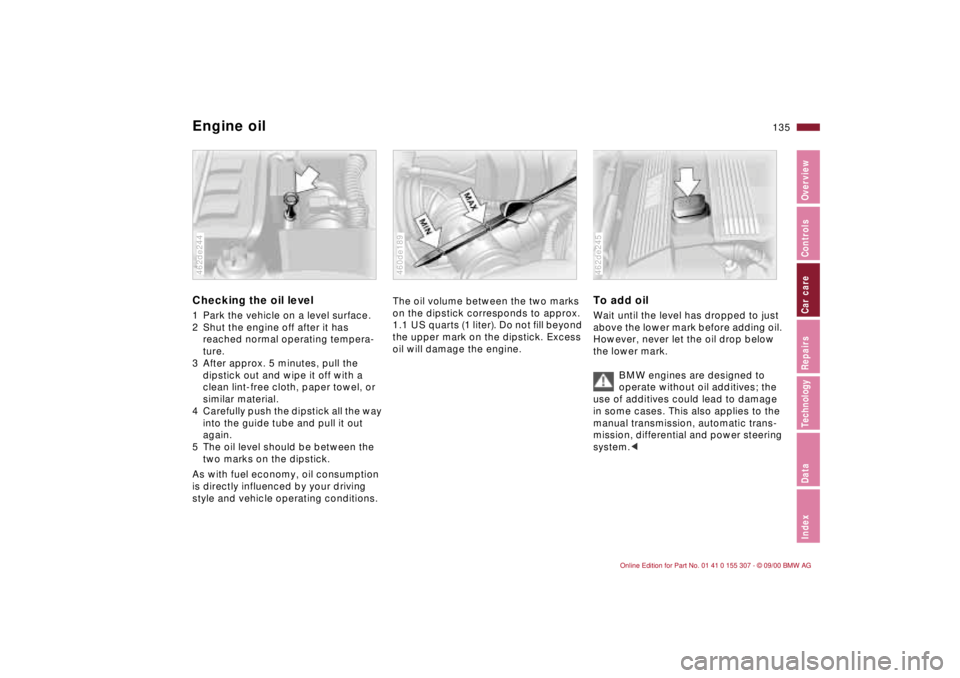
Engine oilChecking the oil level 1 Park the vehicle on a level surface.
2 Shut the engine off after it has
reached normal operating tempera-
ture.
3 After approx. 5 minutes, pull the
dipstick out and wipe it off with a
clean lint-free cloth, paper towel, or
similar material.
4 Carefully push the dipstick all the way
into the guide tube and pull it out
again.
5 The oil level should be between the
two marks on the dipstick.
As with fuel economy, oil consumption
is directly influenced by your driving
style and vehicle operating conditions.462de244
The oil volume between the two marks
on the dipstick corresponds to approx.
1.1 US quarts (1 liter). Do not fill beyond
the upper mark on the dipstick. Excess
oil will damage the engine.460de189
To add oil Wait until the level has dropped to just
above the lower mark before adding oil.
However, never let the oil drop below
the lower mark.
BMW engines are designed to
operate without oil additives; the
use of additives could lead to damage
in some cases. This also applies to the
manual transmission, automatic trans-
mission, differential and power steering
system.<462de245
Page 137 of 203
137n
IndexDataTechnologyRepairsCar careControlsOverview
Engine oil Coolant
Comply with the applicable envi-
ronmental laws regulating the
disposal of used oil.<
Recommendation: have the oil changed
by your BMW center only.
Continuous exposure to used oil
has caused cancer in laboratory
testing.
For this reason, thoroughly wash any
areas of skin that come into contact
with oil using soap and water.
Always store oils, grease and similar
materials so that they are inaccessible
to children. Comply with warning labels
and information on containers.<
Do not add coolant to the cooling
system when the engine is hot.
If you do, escaping coolant can cause
burns.
To avoid the possibility of damage later
on, never use anything other than
factory-approved, nitrite- and amino-
free extended-duty antifreeze with
corrosion inhibitor. Your BMW center is
familiar with the approved specifica-
tions.
Antifreeze and anticorrosion agents are
hazardous to health. You should always
store it in its original container and in a
location that is inaccessible to children.
Extended-duty antifreeze with corro-
sion inhibitor contains the flammable
substance ethylene glycol. Therefore,
do not spill antifreeze with corrosion
inhibitor on hot engine parts. It could
ignite and cause burns.<
Comply with the applicable envi-
ronmental laws regulating the
disposal of extended-duty antifreeze
with corrosion inhibitor.<
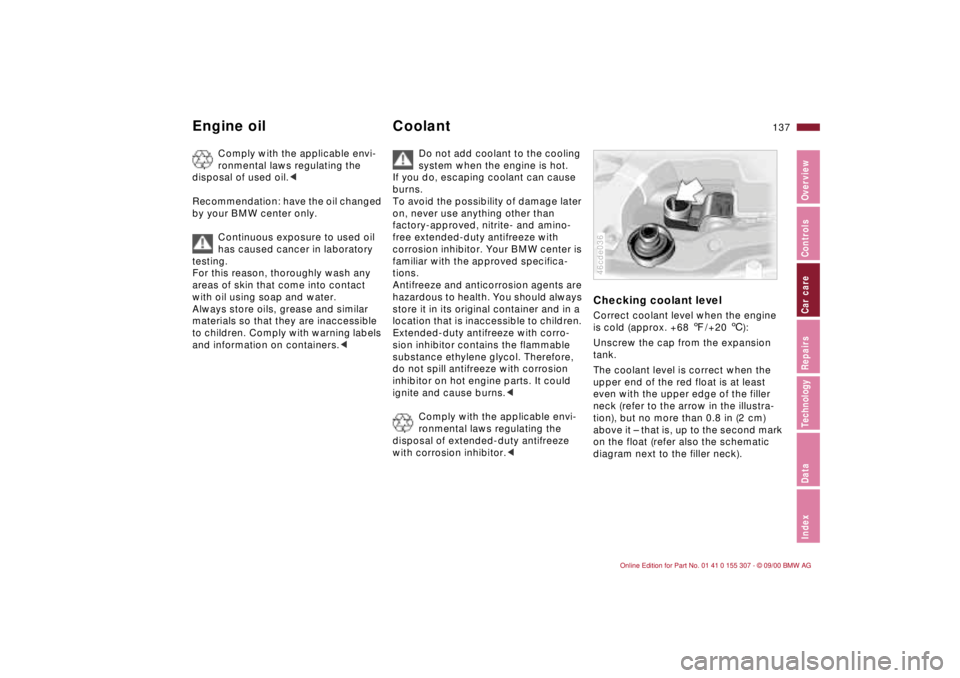
Checking coolant levelCorrect coolant level when the engine
is cold (approx. +68 7/+20 6):
Unscrew the cap from the expansion
tank.
The coolant level is correct when the
upper end of the red float is at least
even with the upper edge of the filler
neck (refer to the arrow in the illustra-
tion), but no more than 0.8 in (2 cm)
above it Ð that is, up to the second mark
on the float (refer also the schematic
diagram next to the filler neck).46cde036
Page 142 of 203

142n
Caring for your vehicleExterior finish To provide effective corrosion protec-
tion, multilayer paintwork is applied at
the factory. Cataphoretic immersion
priming techniques are supplemented
with special body-cavity protectants,
by applying specially-developed and
extensively tested materials.
A layer of flexible PVC is first applied
to the undercarriage. Following this,
a comprehensive undercoating treat-
ment with a wax-based protectant is
applied. Regular maintenance makes
an important contribution to maintaining
the safety and value of your vehicle.
Increasing awareness of the effects of
harmful environmental factors on vehi-
cle finishes have led paint and vehicle
manufacturers to initiate programs
designed to further improve the durabil-
ity of their finishes. Despite this, envi-
ronmental factors that occur locally or
regionally can have negative effects on
the finish of your vehicle. Use the
factors to determine the frequency and
extent of your efforts to maintain the
vehicle finish.Depending upon material and type of
impact (perforation of paint layer),
physical stresses from sand, road salt,
gravel, etc., can cause corrosion to start
extending beneath the finish, starting at
the point of impact.
Road dirt, tar spots, dead insects,
animal droppings (strong alkali effect)
and tree excretions (resins and pollen)
all contain substances capable of
causing damage when allowed to
remain on the finish of your vehicle for
any extended period of time (spots,
etching, flaking, separation in the top
coat).
In industrial areas, flue dust deposits,
lime, oily soot, precipitation containing
sulfur-dioxide (acid rain) and other envi-
ronmental pollutants will damage the
vehicle's finish unless adequate care is
provided Ð even though this is generally
limited to the outside horizontal sur-
faces.In coastal regions, high levels of
atmospheric salt and humidity promote
corrosion.
In tropical zones, temperatures of over
+105 7 (+40 6) in the shade prevail,
in addition to heavy ultraviolet radiation
and high humidity. Under those condi-
tions, light paints can reach tempera-
tures up to +175 7 (+80 6) and dark
paints up to +250 7 (+120 6).
Page 143 of 203

143n
IndexDataTechnologyRepairsCar careControlsOverview
Caring for your vehicleCaring for the vehicle finish Regular washing is a preventive
measure against long-term effects from
substances that are harmful to the
vehicle's finish, especially if you drive
your vehicle in areas with high levels of
air pollution or aggressive natural
substances (tree resins, pollen).
Nevertheless, you should immediately
remove especially aggressive
substances. Failure to do so can lead to
changes in the paint's chemical
structure or to discoloration. Gasoline
spilled during refueling, oil, grease and
brake fluid should always be cleaned
away immediately, as should bird
droppings.
Any contamination remaining on the
surface of the vehicle will be especially
conspicuous after washing. Use
cleaning fluid or alcohol with a clean
cloth or cotton pad to remove. Remove
tar spots with tar remover. After clean-
ing, the affected areas should be waxed
to ensure continued protection.
Use the cleaning and car-care
products available at your BMW
center.<
Waxing your vehicle Protect the finish using only carnauba
or synthetic-based waxes.
The best way to determine when the
finish needs to be waxed is by noting
when water stops beading on the
surface.
You can use a glass cleaner to remove
any wax or silicone that may have been
left on the windows during waxing.
Use the cleaning and car-care
products available at your BMW
center.<
Paint damageYou can touch up small areas of paint
damage with a BMW spray paint or a
BMW touchup stick.
The paint color code for your car is
provided on a sticker located on the
righthand side under the hood and on
the first page of your Service and
Warranty Information Booklet
(US models) or Warranty and Service
Guide (Canadian models).
Damage caused by flying stones,
scratches, etc., must be touched up
without delay to prevent rust from
forming.
If corrosion has started to form in an
area with paint damage, remove all rust
and clean the area. Then prime the
area with a BMW Primer Stick. Finally,
apply the finish coat. Wait a few days,
then polish the repaired area. Finish by
applying a wax preservative.
More extensive paint damage should
be repaired professionally in accor-
dance with the manufacturer's instruc-
tions. Your BMW center uses original
BMW finish materials in accordance
with approved repair procedures.
Page 193 of 203

Everything from A to Z
193n
IndexDataTechnologyRepairsCar careControlsOverview
Changing a wheel159
Charge indicator lamp20
Check air pressure28
Check Control75
Check engine oil level135
Child restraint
systems54,60
Child-safety locks58
Child's seat54
Cigarette lighter104
Cleaning windshield68
Clock75
refer also to the Radio or
Computer Owner's Manual
Cockpit16
Coin holder102
Combination switch68
Compression184
Computer76
Configure settings52
Consumption77
display74
Contents10
Control elements20
Coolant121,137,187
antifreeze121
Coolant temperature
gauge74
Cooling system187
Copyright4
Cornering Brake Control
(CBC)21,117 Cruise control71
Cruising range77
Cup holder, refer to
beverage holder102
Curb weight186
Current check indicator20
D
Dashboard16
Data
dimensions185
engine184
technical184
weights186
Daytime-driving lamp
switch87
DBC (Dynamic Brake
Control)118
Defrost position94,98
Defrostable rear window99
Defrosting
rear window92
windows94,98
Digital clock75
Dimensions185
Dipstick, engine oil135
Disc brakes118
Displacement184
Display lighting87
Displays18
Distance warning78 Diversity Antenna
system174
Door key32,35
Door locks, care121
Doors
child-safety locks58
emergency operation34
unlocking and locking34
DOT Quality Grades125
Draft-free ventilation93
Drive belts188
Driving hints115
Driving in winter121
Driving lamps87
DSC (Dynamic Stability
Control)81,173
Dynamic Brake Control
(DBC)118
Dynamic Stability Control
(DSC)22,81,173
E
Electric power seat48
Electric power windows43
Electrical accessories,
failure164
Electrical system188
Electronic vehicle
immobilizer33
Elements of operation16 Emergency operation,
doors34
Energy Control73
Engine
coolant137,187
data184
starting61
Engine oil
capacity187
consumption135
pressure20
quality136
specifications136
viscosity136
Engine speed184
Exterior mirrors51
F
Failure messages75
Fault displays75
Fault, ABS117
Filler cap cover27
Filling capacities187
Filling the washer
reservoir187
First-aid kit26
Fittings, tow starting and
towing168
Flashlight101
Flat tire124,159
Fog lamps88