flat tire BMW 325I 2002 User Guide
[x] Cancel search | Manufacturer: BMW, Model Year: 2002, Model line: 325I, Model: BMW 325I 2002Pages: 155, PDF Size: 2.17 MB
Page 107 of 155
107n
OverviewControlsMaintenanceRepairsDataIndex
Information for your safetyThe factory-approved radial tires are
matched to the vehicle and have been
selected to provide optimum safety and
driving comfort.
It is not merely the tire's service life, but
also driving comfort and Ð above all else
Ð driving safety that depend on the
condition of the tires and the mainte-
nance of the specified tire inflation
pressure.
Incorrect tire inflation pressure is
a frequent cause of tire damage. It
also significantly influences the road-
holding ability of your BMW. Be sure to
check the tire inflation pressure,
including the space-saver spare tire or
the spare tire, on a regular basis, at
least twice a month and before every
extended journey, refer to page 24. If
this is not done, incorrect tire pressures
can cause driving instability and tire
damage, ultimately resulting in an
accident.<
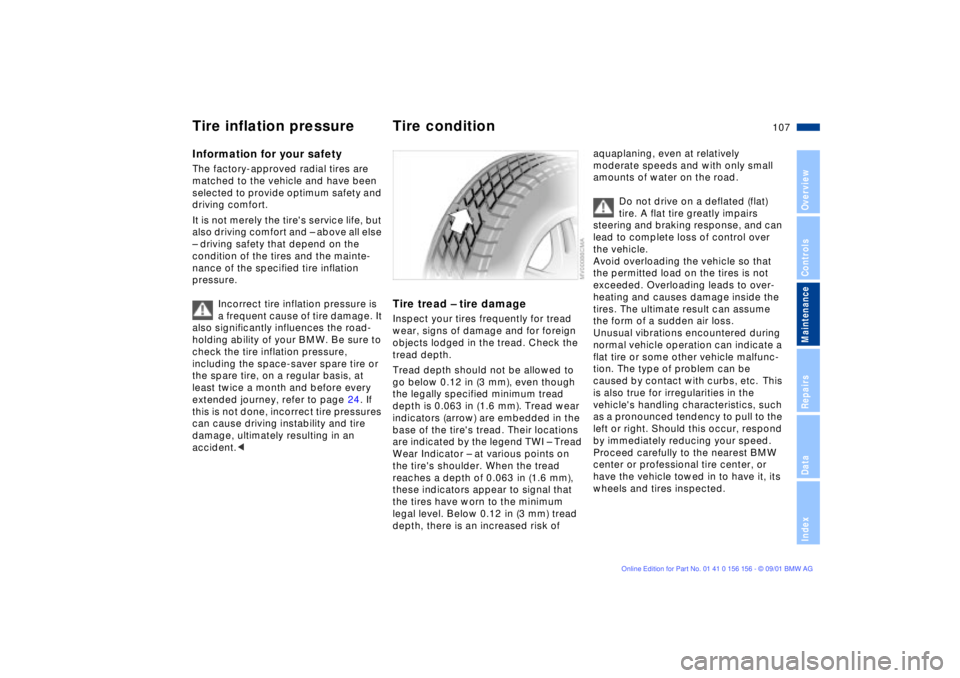
Tire tread Ð tire damageInspect your tires frequently for tread
wear, signs of damage and for foreign
objects lodged in the tread. Check the
tread depth.
Tread depth should not be allowed to
go below 0.12 in (3 mm), even though
the legally specified minimum tread
depth is 0.063 in (1.6 mm). Tread wear
indicators (arrow) are embedded in the
base of the tire's tread. Their locations
are indicated by the legend TWI Ð Tread
Wear Indicator Ð at various points on
the tire's shoulder. When the tread
reaches a depth of 0.063 in (1.6 mm),
these indicators appear to signal that
the tires have worn to the minimum
legal level. Below 0.12 in (3 mm) tread
depth, there is an increased risk of
aquaplaning, even at relatively
moderate speeds and with only small
amounts of water on the road.
Do not drive on a deflated (flat)
tire. A flat tire greatly impairs
steering and braking response, and can
lead to complete loss of control over
the vehicle.
Avoid overloading the vehicle so that
the permitted load on the tires is not
exceeded. Overloading leads to over-
heating and causes damage inside the
tires. The ultimate result can assume
the form of a sudden air loss.
Unusual vibrations encountered during
normal vehicle operation can indicate a
flat tire or some other vehicle malfunc-
tion. The type of problem can be
caused by contact with curbs, etc. This
is also true for irregularities in the
vehicle's handling characteristics, such
as a pronounced tendency to pull to the
left or right. Should this occur, respond
by immediately reducing your speed.
Proceed carefully to the nearest BMW
center or professional tire center, or
have the vehicle towed in to have it, its
wheels and tires inspected.
Tire inflation pressure
Tire condition
Page 109 of 155

109n
OverviewControlsMaintenanceRepairsDataIndex
Tire replacementunder the Federal Motor Vehicle Safety
Standard No. 109. Grades B and A
represent higher levels of performance
on the laboratory test wheel than the
minimum required by law.
The temperature grade for this tire
is established for a tire that is
properly inflated and not overloaded.
Excessive speed, underinflation, or
excessive loading, either separately or
in combination, can cause heat buildup
and possible tire failure.< Uniform Tire Quality Grading Quality grades can be found where
applicable on the tire sidewall between
tread shoulder and maximum section
width. For example:
Tread wear 200
Traction AA
Temperature A
Do not use retreaded tires, since
driving safety may be impaired.
This is due to the possible variations in
casing structures and, in some cases,
to their extreme age, which can lead to
a decrease in their durability.<
Tire ageThe date on which the tire was manu-
factured is indicated by the code on the
sidewall:
DOT ... 4101 indicates that the tire was
manufactured in Week 41 of the year
2001.
Although tires may have a theoretical
service life of up to 10 years, BMW
strongly recommends that you replace
all tires after an absolute maximum of
6 years.
Safety tires
*
Safety tires consist of self-supporting
tires and special rims. The tire rein-
forcement ensures that the tire retains
some residual safety in the event of
pressure drop and driving remains
possible to a restricted degree. The
vehicle is equipped with Tire Pressure
Monitor (RDC) or Flat Tire Monitor,
which indicate a flat tire.
For additional information on Tire Pres-
sure Monitor (RDC) or Flat Tire Monitor
refer to page 78 or 80.
Safety tires are only possible in
conjunction with Tire Pressure
Monitor (RDC) or Flat Tire Monitor.<
Page 110 of 155

110n
Wheel and tire combinationsThe right choice
Never mount wheels and tires that
have not been specifically
approved by BMW for use on your
particular model. Although other wheels
and tires may theoretically have the
same dimensions, variations in factors
such as manufacturing tolerances can
result in contact between tire and body-
work, ultimately leading to serious acci-
dents. BMW can not evaluate all tires
and wheels on the market, and is thus
unable to guarantee that the vehicle will
continue to perform safely if unap-
proved tires and/or wheels are
mounted.
The correct wheel and tire combi-
nation affects various systems
that would otherwise be impaired, for
example ABS, ATC, ASC+T/DSC and
ADB/ADB-X/DBC.
For this reason, use only tires of the
same manufacture and tread configura-
tion. In the event of a flat tire, for
example, remount the approved wheel
and tire combination as soon as
possible.<
Page 111 of 155

111n
OverviewControlsMaintenanceRepairsDataIndex
Winter tiresChoosing the right tireBMW recommends winter tires (M+S
radial tires) for operation under
inclement winter driving conditions.
While all-season tires (M+S designa-
tion) provide better winter traction than
summer tires with the load ratings H, V,
W, Y and ZR, they generally do not
achieve the performance of winter tires.
In the interest of safe tracking and
steering response, install winter tires
made by the same manufacturer having
the same tread configuration on all four
wheels.Never exceed the maximum
speed for which the winter tires
are rated.
Unprofessional attempts by laymen to
service tires can lead to damage and
accidents.
Have this work performed by trained
professionals only. Any BMW center
has the required technical knowledge
and the proper equipment and will be
happy to assist you.<
Tire condition, tire pressureOnce the tire wears to below 0.16 in
(4 mm), winter tires display a percep-
tible decrease in their ability to cope
with winter driving conditions, and
should be replaced in the interest of
safety.
Comply with the specified tire inflation
pressures Ñ and be sure to have the
wheel and tire assemblies balanced
every time you change the tires.
StorageAlways store tires in a cool, dry place.
Store them away from light whenever
possible. Protect the tires against
contact with oil, grease and fuel.Snow chains
*
Use BMW narrow-link snow chains on
summer or winter tires in pairs only and
only on the rear wheels.
BMW 325xi: in an extreme emergency Ð
for instance, with the vehicle stuck on
one side, or when obstructions make it
impossible to reach one tire Ð a chain
may also be mounted on just one tire
for the limited period needed to resolve
the problem.
Comply with all manufacturer's safety
precautions when mounting the chains.
You cannot mount snow chains on the
following tires:
225/50 R 16 92
225/45 R 17 91
245/40 ZR 17
Page 129 of 155
129n
OverviewControlsMaintenanceRepairsDataIndex
Lamps and bulbs Changing a wheelTailgate lamp5 watt bulb
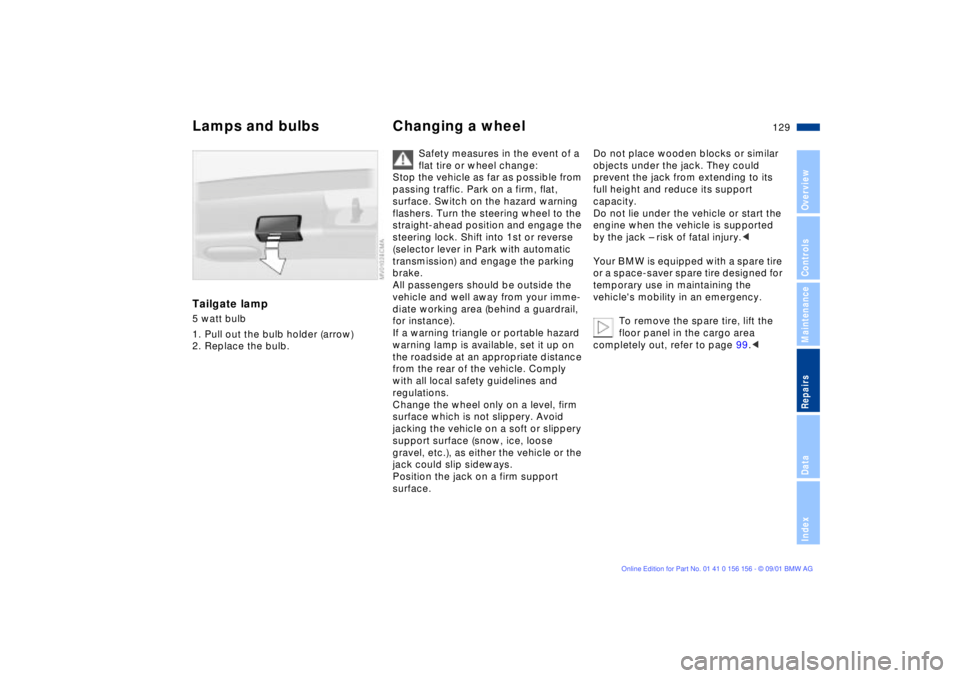
1. Pull out the bulb holder (arrow)
2. Replace the bulb.
Safety measures in the event of a
flat tire or wheel change:
Stop the vehicle as far as possible from
passing traffic. Park on a firm, flat,
surface. Switch on the hazard warning
flashers. Turn the steering wheel to the
straight-ahead position and engage the
steering lock. Shift into 1st or reverse
(selector lever in Park with automatic
transmission) and engage the parking
brake.
All passengers should be outside the
vehicle and well away from your imme-
diate working area (behind a guardrail,
for instance).
If a warning triangle or portable hazard
warning lamp is available, set it up on
the roadside at an appropriate distance
from the rear of the vehicle. Comply
with all local safety guidelines and
regulations.
Change the wheel only on a level, firm
surface which is not slippery. Avoid
jacking the vehicle on a soft or slippery
support surface (snow, ice, loose
gravel, etc.), as either the vehicle or the
jack could slip sideways.
Position the jack on a firm support
surface.
Do not place wooden blocks or similar
objects under the jack. They could
prevent the jack from extending to its
full height and reduce its support
capacity.
Do not lie under the vehicle or start the
engine when the vehicle is supported
by the jack Ð risk of fatal injury.<
Your BMW is equipped with a spare tire
or a space-saver spare tire designed for
temporary use in maintaining the
vehicle's mobility in an emergency.
To remove the spare tire, lift the
floor panel in the cargo area
completely out, refer to page 99.<
Page 131 of 155
131n
OverviewControlsMaintenanceRepairsDataIndex
Changing a wheel4. Loosen the lug bolts by rotating half
a turn
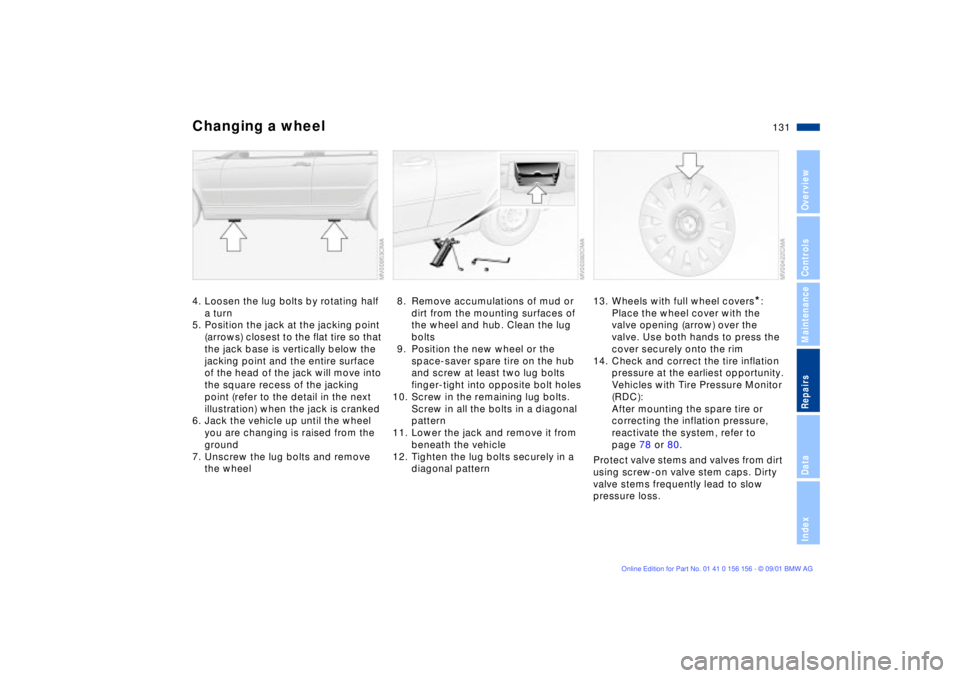
5. Position the jack at the jacking point
(arrows) closest to the flat tire so that
the jack base is vertically below the
jacking point and the entire surface
of the head of the jack will move into
the square recess of the jacking
point (refer to the detail in the next
illustration) when the jack is cranked
6. Jack the vehicle up until the wheel
you are changing is raised from the
ground
7. Unscrew the lug bolts and remove
the wheel
8. Remove accumulations of mud or
dirt from the mounting surfaces of
the wheel and hub. Clean the lug
bolts
9. Position the new wheel or the
space-saver spare tire on the hub
and screw at least two lug bolts
finger-tight into opposite bolt holes
10. Screw in the remaining lug bolts.
Screw in all the bolts in a diagonal
pattern
11. Lower the jack and remove it from
beneath the vehicle
12. Tighten the lug bolts securely in a
diagonal pattern
13. Wheels with full wheel covers
*:
Place the wheel cover with the
valve opening (arrow) over the
valve. Use both hands to press the
cover securely onto the rim
14. Check and correct the tire inflation
pressure at the earliest opportunity.
Vehicles with Tire Pressure Monitor
(RDC):
After mounting the spare tire or
correcting the inflation pressure,
reactivate the system, refer to
page 78 or 80.
Protect valve stems and valves from dirt
using screw-on valve stem caps. Dirty
valve stems frequently lead to slow
pressure loss.
Page 132 of 155

132n
Changing a wheel
Only use original BMW full wheel
covers, otherwise, the trim piece
may not fit securely. The full wheel
cover may not be installed on the
space-saver spare tire, since this could
damage the cover.<
The vehicle jack is designed for
changing wheels only. Do not
attempt to raise another vehicle model
with it or to raise any load of any kind.
To do so could cause accidents and
personal injury.
To ensure continued safety, have the
tightness of the lug bolts checked with
a calibrated torque wrench [torque
specification: 72 lb ft (100 Nm)] at the
earliest opportunity.<
When storing a wheel in the spare tire
recess take care to avoid bending the
threaded rod.
If the original BMW light-alloy wheels
have been replaced with other light-
alloy wheels, different lug bolts may be
required.
Replace the defective tire as soon as
possible and have the new wheel/tire
balanced.
Driving with the space-saver
spare tireDrive cautiously. Do not exceed a
speed of 50 mph (80 km/h).
You can anticipate changes in vehicle
handling such as delayed braking
response, longer braking distances and
sacrifices in roadholding.
The changes in handling characteristics
will be even more pronounced if winter
tires are mounted.
Only one space-saver spare tire
may be mounted at a time. Rein-
stall wheels and tires of the same size
and specification as soon as possible.
Maintain correct tire pressures, refer to
page 24.<
Safety tires
*
Safety tires consist of self-supporting
tires and special rims. The tire rein-
forcement ensures that the tire retains
some residual safety in the event of
pressure drop and driving remains
possible to a restricted degree. The
vehicle is equipped with Tire Pressure
Monitor (RDC) or Flat Tire Monitor,
which indicate a flat tire.Flat tireIf there is a tire failure, the red warning
lamp symbol lights up. A supplemen-
tary gong is also heard.
For additional information on Tire Pres-
sure Monitor (RDC) or Flat Tire Monitor
refer to page 78 or 80.
Reduce vehicle speed carefully to
under 50 mph (80 km/h), avoiding hard
brake applications and steering maneu-
vers.
With the safety tires, you can drive
another approx. 155 miles (250 km) to
reach a safe parking location, a service
station or the nearest BMW center.
With a low vehicle load, this can also be
considerably more than 155 miles
(250 km).
Page 133 of 155
133n
OverviewControlsMaintenanceRepairsDataIndex
Changing a wheel Battery Fuses
Safety tires are only possible in
conjunction with Tire Pressure
Monitor (RDC) or Flat Tire Monitor.<
If the defective wheel cannot be seen
as such immediately from the outside,
check the tire inflation pressure at all
four wheels.
Have the tires changed by your
BMW center. For safety reasons,
do not have a safety tire repaired. Your
BMW center has the information
needed for working with safety tires
and is equipped with the necessary
special tools.<
If appropriate, please consult your
BMW center to reequip your
vehicle from summer to winter tires Ð or
vice versa.<
Battery careThe battery is absolutely maintenance-
free, that is, the original electrolyte will
normally last for the service life of the
battery under moderate climatic condi-
tions.
Please consult your BMW center
whenever you have any questions
concerning the battery. Since the battery
is absolutely maintenance-free, the
following is for your information only.<
Never disconnect the battery
when the engine is running; the
ensuing voltage surge would seriously
damage the vehicle's onboard elec-
tronic systems.
Connect the charge cables to the termi-
nals in the engine compartment.
Terminal locations, refer to Jump-
starting on page 134.
Return used batteries to a recycling
point or your BMW center. Maintain
the battery in an upright position for
transport and storage. Secure the
battery against tilting during transport.<
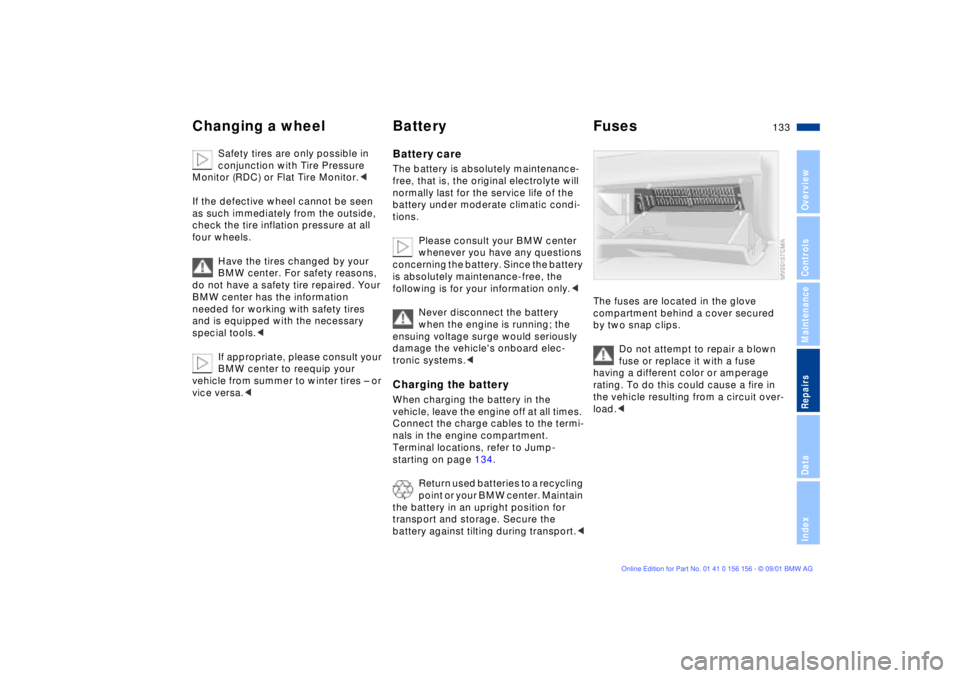
The fuses are located in the glove
compartment behind a cover secured
by two snap clips.
Do not attempt to repair a blown
fuse or replace it with a fuse
having a different color or amperage
rating. To do this could cause a fire in
the vehicle resulting from a circuit over-
load.<
Page 148 of 155

Everything from A to ZDistance warning70
Door keys28
Doors
electrical malfunction31
locking and unlocking29
manual operatiom31
DOT Quality Grades,
tires108
Draft-free ventilation87, 90
Drawbar weight142
Drink holder, refer to
beverage holder93
Drive belts17
Driving notes105
DSC (Dynamic Stability
Control)19, 73
Dynamic Brake Control
(DBC)74
Dynamic Stability Control
(DSC)19, 73 E
Electric power windows37
Electrical malfunction
doors31
fuel filler door22
sliding/tilt sunroof39
tailgate33 Electrical power socket95
Elements of operation14
Energy Control65
Engine compartment
essentials113
Engine coolant143
Engine data140
Engine oil
capacity143
consumption115
disposal116
quality116
specifications116
viscosity116
Engine oil level115
checking115
indicator lamp19
Engine specifications140
Engine speed140
F
Fault displays67
Filling capacities143
Fittings, tow starting and
towing135
Flashlight92
Flat Tire
Monitor80, 109, 132 Flat tires107, 129, 132
Fog lamps83
Follow me home lamps82
Front fog lamps83
Front seat adjustment40
Fuel consumption69
display66
Fuel filler door22
electrical malfunction22
manual operation22
Fuel gauge66
Fuel injection system140
Fuel reserve indicator
lamp66
Fuel tank capacity143
Fuel tank gauge66
Fuses133
G
Gasoline gauge66
Glove compartment92
Gross vehicle weight142 H
Handbrake57
Hands-free system94
microphone94 Harman Kardon premium
sound system91
Hazard warning triangle22
HDC (Hill Descent
Control)77
Head restraints43
Headlamp cover, care125
Headlamp flasher83
Headlamp washer
system114
capacity143
Headlight control82
Heated seats46
High beams20, 60, 83
bulb replacement125
High Performance Synthetic
Oil116
Hill Descent Control
(HDC)77
Holder for beverage
cans93
Hood release112
Horn14
Page 149 of 155

Everything from A to Z
149n
OverviewControlsMaintenanceRepairsDataIndex
I
Ice warning68
Icy roads68
Ignition keys28
Ignition lock55
Imprint4
Indicator lamps17
Inflation pressures24, 107
INSPECTION66
Instrument cluster15
Instrument lighting83
Instrument panel15
Interface socket
for onboard diagnostics
(OBD)121
Interior lamps30, 84
remote control30
Interior motion sensor35
operation via remote
control30
switching off36
Interior rearview mirror47
automatic dimming
feature48
Interlock55
J
Jack129
Jump-starting134 K
Key Memory54
Key set28
Keys28 L
Lamps and bulbs,
replacement125
Lashing eyes100
License plate lamps, bulb
replacement128, 129
LIGHTS ON warning82
Litter bag holder93
Loading and driving
notes100
Load-securing devices100
Lock buttons32
Low beams82
bulb replacement125
Lug wrench129
Luggage cover, refer to
cargo area cover
Luggage rack100
M
M+S tires111
Maintenance66, 119
Malfunction displays67
Manual operation
doors31
fuel filler door22
sliding/tilt sunroof39
tailgate33
Manual seat adjustment41
Manual transmission57
Manually controlled recircu-
lated-air90
Master keys28
Memory settings45
MFL (Multifunction steering
wheel)21
Microfilter87, 91
Mirror defrosting47
Mirror memory45
Mirrors47
Mobile phone94
Modifications,
technical10, 120
Motion sensor, refer to
interior motion sensor35
Multifunction steering wheel
(MFL)21
O
OBD interface socket121
Odometer65
Oil
additives115
capacity143
consumption115
quality116
specifications116
viscosity116
Oil change intervals, see the
Service and Warranty
Information Booklet
Oil dipstick115
Oil filter change143
OILSERVICE66
Onboard computer68
refer also to the "Owner's
Manual Onboard
Computer"
Onboard tool kit124
Opening and closing
from the inside32
via the door lock31
via the remote control29
Outside temperature
display68