ECO mode BMW 325i TOURING 2001 E46 Owner's Guide
[x] Cancel search | Manufacturer: BMW, Model Year: 2001, Model line: 325i TOURING, Model: BMW 325i TOURING 2001 E46Pages: 203, PDF Size: 2.07 MB
Page 97 of 203

97n
IndexDataTechnologyRepairsCar careControlsOverview
Automatic climate control
*
1 Air onto the windshield and the side
windows
2 Air flow toward the upper body
The side rotary dials provide infi-
nitely-variable regulation of the air
supply, while the levers change the
air-flow direction. The center rotary
dial controls the temperature of the
air as it flows out. Refer to page 100
3 Front footwell ventilation
There are corresponding air vents in
the rear footwell as well
4 Recirculated air mode/Automatic
recirculated air control (AUC)99
5 Air supply99
6 Temperature98
7 Automatic air distribution98
8 Individual air distribution98
9 Air grill for interior temperature
sensor Ð please keep clear and
unobstructed
10 Display for temperature and air
supply98
11 Defrost windows and remove
condensation99
12 Air conditioner99
13 Rear window defroster70, 99
Page 99 of 203
99n
IndexDataTechnologyRepairsCar careControlsOverview
Automatic climate control
*
Air supply
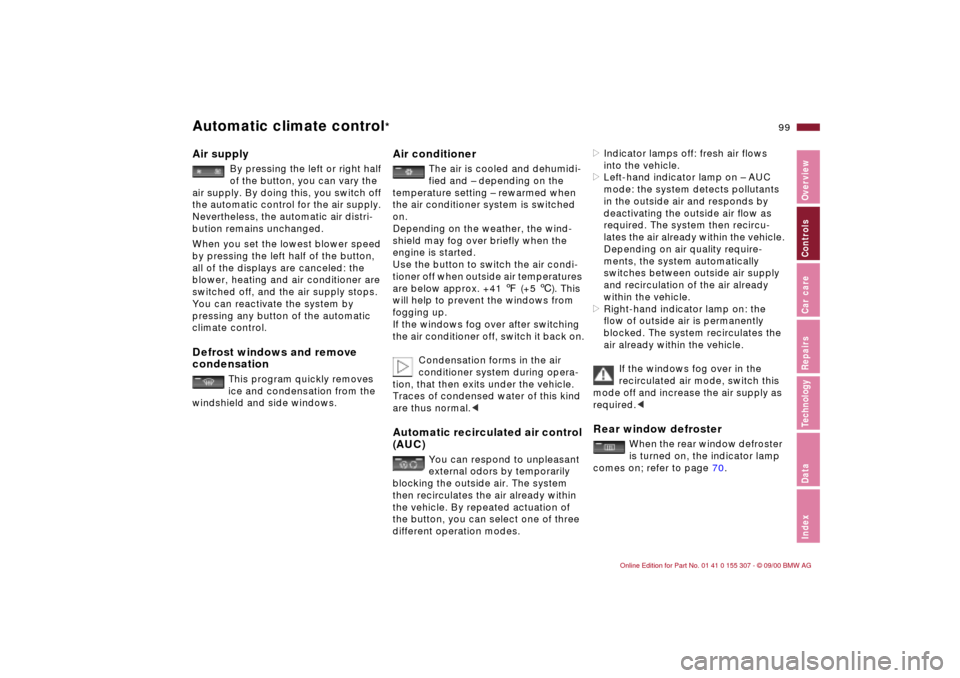
By pressing the left or right half
of the button, you can vary the
air supply. By doing this, you switch off
the automatic control for the air supply.
Nevertheless, the automatic air distri-
bution remains unchanged.
When you set the lowest blower speed
by pressing the left half of the button,
all of the displays are canceled: the
blower, heating and air conditioner are
switched off, and the air supply stops.
You can reactivate the system by
pressing any button of the automatic
climate control.
Defrost windows and remove
condensation
This program quickly removes
ice and condensation from the
windshield and side windows.
Air conditioner
The air is cooled and dehumidi-
fied and Ð depending on the
temperature setting Ð rewarmed when
the air conditioner system is switched
on.
Depending on the weather, the wind-
shield may fog over briefly when the
engine is started.
Use the button to switch the air condi-
tioner off when outside air temperatures
are below approx. +41 7 (+5 6). This
will help to prevent the windows from
fogging up.
If the windows fog over after switching
the air conditioner off, switch it back on.
Condensation forms in the air
conditioner system during opera-
tion, that then exits under the vehicle.
Traces of condensed water of this kind
are thus normal.<
Automatic recirculated air control
(AUC)
You can respond to unpleasant
external odors by temporarily
blocking the outside air. The system
then recirculates the air already within
the vehicle. By repeated actuation of
the button, you can select one of three
different operation modes.
>Indicator lamps off: fresh air flows
into the vehicle.
>Left-hand indicator lamp on Ð AUC
mode: the system detects pollutants
in the outside air and responds by
deactivating the outside air flow as
required. The system then recircu-
lates the air already within the vehicle.
Depending on air quality require-
ments, the system automatically
switches between outside air supply
and recirculation of the air already
within the vehicle.
>Right-hand indicator lamp on: the
flow of outside air is permanently
blocked. The system recirculates the
air already within the vehicle.
If the windows fog over in the
recirculated air mode, switch this
mode off and increase the air supply as
required.
is turned on, the indicator lamp
comes on; refer to page 70.
Page 117 of 203
117n
IndexDataTechnologyRepairsCar careControlsOverview
Antilock Brake System (ABS)Nevertheless, ABS possesses the
advantage of vehicle stability and
steering response.Information for your safetyNot even ABS can suspend the laws
of physics. The consequences of brake
applications with inadequate clea-
rances for safety between vehicles,
excessive speed or if aquaplaning
occurs are always the responsibility of
the driver. You should never allow the
added safety of ABS to lull you into a
false sense of security, or mislead you
into taking risks that could affect your
own safety and that of others.
Do not make any modifications to
the ABS system.
Service procedures on ABS are to be
performed by authorized technicians
only.
opment of ABS. When braking while
cornering at high speed or braking
during high lateral acceleration, or
when braking during a lane change,
vehicle stability is improved and
steering response is enhanced.
In the event of a malfunction
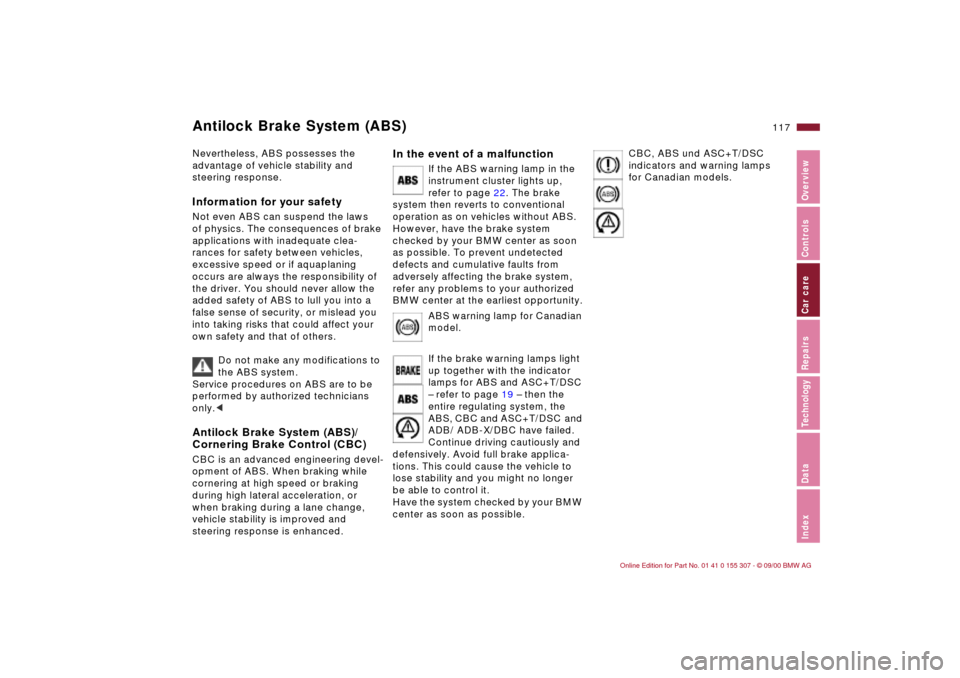
If the ABS warning lamp in the
instrument cluster lights up,
refer to page 22. The brake
system then reverts to conventional
operation as on vehicles without ABS.
However, have the brake system
checked by your BMW center as soon
as possible. To prevent undetected
defects and cumulative faults from
adversely affecting the brake system,
refer any problems to your authorized
BMW center at the earliest opportunity.
ABS warning lamp for Canadian
model.
If the brake warning lamps light
up together with the indicator
lamps for ABS and ASC+T/DSC
Ð refer to page 19 Ð then the
entire regulating system, the
ABS, CBC and ASC+T/DSC
and
ADB/ ADB-X/DBC have failed.
Continue driving cautiously and
defensively. Avoid full brake applica-
tions. This could cause the vehicle to
lose stability and you might no longer
be able to control it.
Have the system checked by your BMW
center as soon as possible.
CBC, ABS und ASC+T/DSC
indicators and warning lamps
for Canadian models.
Page 119 of 203

119n
IndexDataTechnologyRepairsCar careControlsOverview
Disc brakesDriving notesWhen driving in wet conditions and in
heavy rain, it is effective to apply light
pressure to the brakes every few miles
or kilometers. Watch traffic conditions
to ensure that this maneuver does not
endanger other drivers. The heat which
is generated by the brake applications
helps to dry the brake pads and discs.
Maximum braking force is obtained
while the wheels are not locked, but
rather when they are still barely turning
immediately prior to locking. ABS main-
tains this state automatically. If the ABS
fails, you should revert to the staggered
braking technique (refer to page 122).
Extended or steep mountain descents
should be driven in the gear in which
only minimal periodic brake application
is required. This avoids excessive strain
on the brakes and possible
impairment of the braking effect.
The braking effect of the engine can be
further increased by downshifting, into
first gear, if necessary. In the manual
mode of the automatic transmission,
you can also downshift into first gear.
Refer to page 66.If engine braking should prove to be
inadequate, you should still avoid
extended, continuous braking. Instead
of maintaining low to moderate pres-
sure over an extended period of time,
you should decelerate by applying
more substantial pressure to the brake
pedal (watch for following traffic),
releasing the pedal, and then repeating
the application (staggered braking). The
cooling phases between active braking
intervals prevent the brakes from over-
heating, thus ensuring that full braking
capacity remains available at all times.
Do not allow the vehicle to coast
when the clutch is depressed or
by shifting into neutral while moving. Do
not drive when the engine is switched
off. The engine provides no braking
control when the clutch is depressed or
the transmission is in "Neutral" and
there is no power-assist for the brakes
when the engine is shut off.
BMW 325xi: have brake inspections
performed at a BMW center only. If you
do not, parts of the four-wheel drive
system could be damaged.
Do not allow floor mats, carpets or any
other objects to protrude into the area
around the brake pedal, the clutch or
the accelerator which could obstruct
their freedom of movement.<
Page 120 of 203

120n
Brake systemBrake fluid level
The warning lamp for the brake
comes on with the parking
brake released:
The brake fluid level is too low in the
reservoir (refer to page 138).
If the brake fluid level is too low and
brake pedal travel has become notice-
ably longer, there may be a defect in
one of the brake system's hydraulic
circuits.
Brake warning lamp for Cana-
dian models.
Proceed to the nearest BMW
center. Higher brake application
pressure may be necessary under these
conditions, and brake pedal travel may
be significantly longer. Please
remember to adapt your driving style
accordingly.<
Brake linings
The warning lamp for the brake
pads comes on:
The brake pads have reached
their minimum pad thickness. Proceed
to the nearest BMW center as soon as
possible to have the pads replaced.
For your own safety: use only
BMW approved brake pads for
your specific vehicle model. BMW
cannot evaluate non-approved brake
pads to determine if they are suited for
use, and therefore cannot ensure the
operating safety of the vehicle if they
are installed.<
Page 143 of 203

143n
IndexDataTechnologyRepairsCar careControlsOverview
Caring for your vehicleCaring for the vehicle finish Regular washing is a preventive
measure against long-term effects from
substances that are harmful to the
vehicle's finish, especially if you drive
your vehicle in areas with high levels of
air pollution or aggressive natural
substances (tree resins, pollen).
Nevertheless, you should immediately
remove especially aggressive
substances. Failure to do so can lead to
changes in the paint's chemical
structure or to discoloration. Gasoline
spilled during refueling, oil, grease and
brake fluid should always be cleaned
away immediately, as should bird
droppings.
Any contamination remaining on the
surface of the vehicle will be especially
conspicuous after washing. Use
cleaning fluid or alcohol with a clean
cloth or cotton pad to remove. Remove
tar spots with tar remover. After clean-
ing, the affected areas should be waxed
to ensure continued protection.
Use the cleaning and car-care
products available at your BMW
center.<
Waxing your vehicle Protect the finish using only carnauba
or synthetic-based waxes.
The best way to determine when the
finish needs to be waxed is by noting
when water stops beading on the
surface.
You can use a glass cleaner to remove
any wax or silicone that may have been
left on the windows during waxing.
Use the cleaning and car-care
products available at your BMW
center.<
Paint damageYou can touch up small areas of paint
damage with a BMW spray paint or a
BMW touchup stick.
The paint color code for your car is
provided on a sticker located on the
righthand side under the hood and on
the first page of your Service and
Warranty Information Booklet
(US models) or Warranty and Service
Guide (Canadian models).
Damage caused by flying stones,
scratches, etc., must be touched up
without delay to prevent rust from
forming.
If corrosion has started to form in an
area with paint damage, remove all rust
and clean the area. Then prime the
area with a BMW Primer Stick. Finally,
apply the finish coat. Wait a few days,
then polish the repaired area. Finish by
applying a wax preservative.
More extensive paint damage should
be repaired professionally in accor-
dance with the manufacturer's instruc-
tions. Your BMW center uses original
BMW finish materials in accordance
with approved repair procedures.
Page 149 of 203
149n
IndexDataTechnologyRepairsCar careControlsOverview
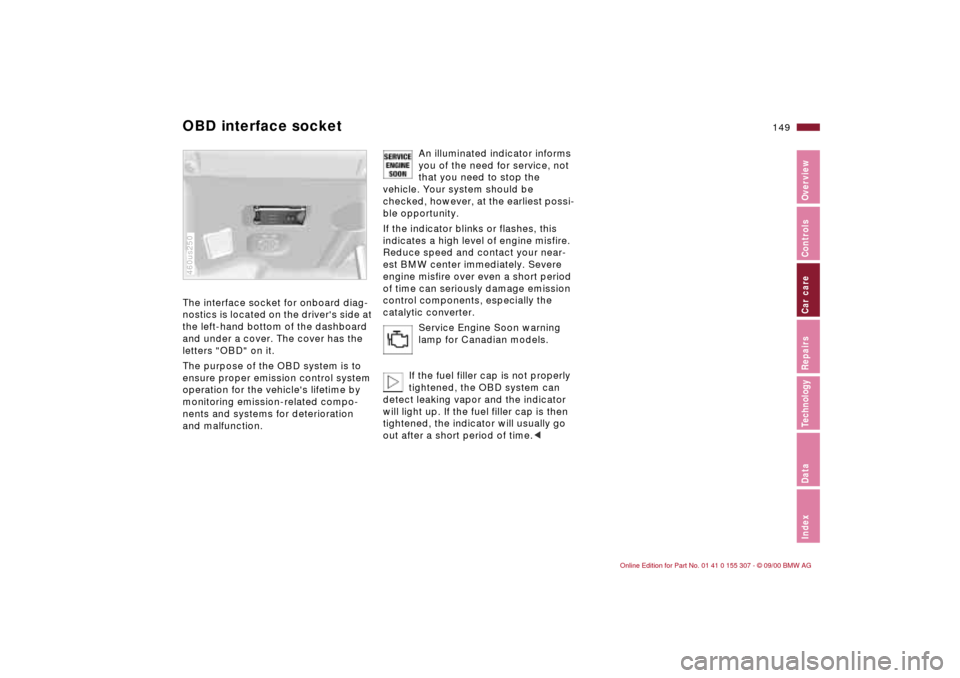
OBD interface socket The interface socket for onboard diag-
nostics is located on the driver's side at
the left-hand bottom of the dashboard
and under a cover. The cover has the
letters "OBD" on it.
The purpose of the OBD system is to
ensure proper emission control system
operation for the vehicle's lifetime by
monitoring emission-related compo-
nents and systems for deterioration
and malfunction.460us250
An illuminated indicator informs
you of the need for service, not
that you need to stop the
vehicle. Your system should be
checked, however, at the earliest possi-
ble opportunity.
If the indicator blinks or flashes, this
indicates a high level of engine misfire.
Reduce speed and contact your near-
est BMW center immediately. Severe
engine misfire over even a short period
of time can seriously damage emission
control components, especially the
catalytic converter.
Service Engine Soon warning
lamp for Canadian models.
If the fuel filler cap is not properly
tightened, the OBD system can
detect leaking vapor and the indicator
will light up. If the fuel filler cap is then
tightened, the indicator will usually go
out after a short period of time.<
Page 161 of 203
161n
IndexDataTechnologyRepairsCar careControlsOverview
Changing a wheel8 Remove mud or dirt accumulation
from the mounting surfaces of the
wheel and hub. Clean the lug bolts.
9 Position the new wheel or the
space-saver tire on the hub and
screw at least two lug bolts finger-
tight into opposite bolt holes.
10 Screw in the remaining lug bolts.
Tighten all the bolts snugly.
11 Lower the jack and remove it from
beneath the vehicle.
12 Tighten the lug bolts in a diagonal
pattern.
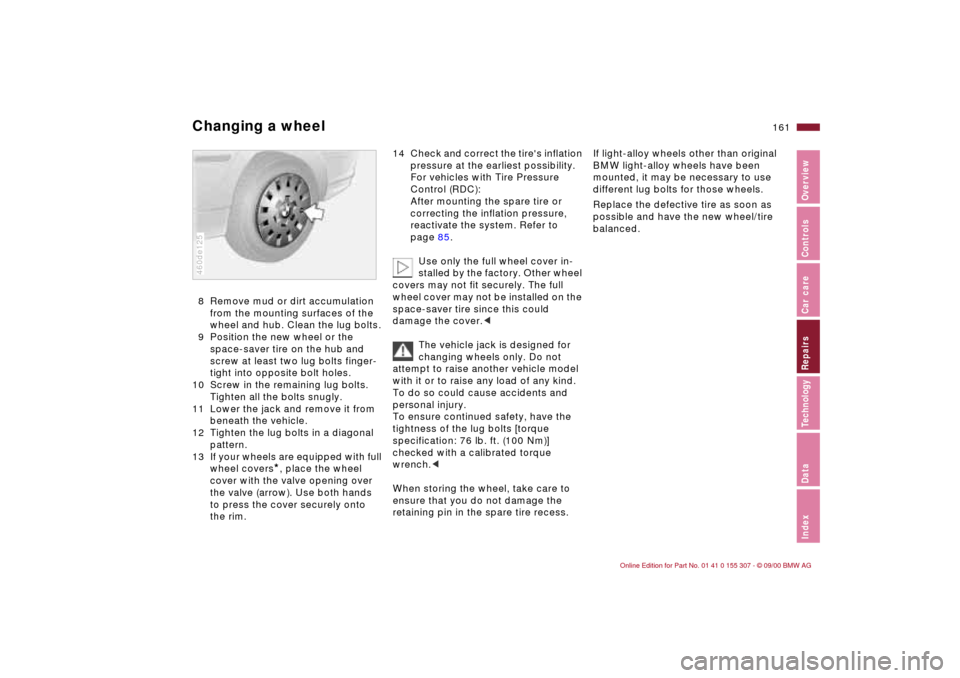
13 If your wheels are equipped with full
wheel covers
*, place the wheel
cover with the valve opening over
the valve (arrow). Use both hands
to press the cover securely onto
the rim.
460de125
14 Check and correct the tire's inflation
pressure at the earliest possibility.
For vehicles with Tire Pressure
Control (RDC):
After mounting the spare tire or
correcting the inflation pressure,
reactivate the system. Refer to
page 85.
Use only the full wheel cover in-
stalled by the factory. Other wheel
covers may not fit securely. The full
wheel cover may not be installed on the
space-saver tire since this could
damage the cover.<
The vehicle jack is designed for
changing wheels only. Do not
attempt to raise another vehicle model
with it or to raise any load of any kind.
To do so could cause accidents and
personal injury.
To ensure continued safety, have the
tightness of the lug bolts [torque
specification: 76 lb. ft. (100 Nm)]
checked with a calibrated torque
wrench.<
When storing the wheel, take care to
ensure that you do not damage the
retaining pin in the spare tire recess.
If light-alloy wheels other than original
BMW light-alloy wheels have been
mounted, it may be necessary to use
different lug bolts for those wheels.
Replace the defective tire as soon as
possible and have the new wheel/tire
balanced.
Page 195 of 203

Everything from A to Z
195n
IndexDataTechnologyRepairsCar careControlsOverview
Luggage
compartment38,107
capacity186
emergency release166
lamps39
lamps, bulb
replacement158
remote control system37
trunk floor40
Luggage compartment lid
emergency release166
Luggage rack111
Lumbar support48 M
Maintenance74
Malfunction displays75
Manual transmission64
Memory49
MFL (Multifunction steering
wheel)24
Microfilter93,165
Mirror memory49
Mirrors51
Mobile phone123
Modifications,
technical6,148
Motion sensor, interior41
Multifunction steering wheel
(MFL)24
M+S tires128
N
Neckrest47
Nozzles96 O
OBD interface socket149
Obstruction protection43
Odometer73
Oil
additives135
capacity187
consumption135
dipstick135
quality136
specifications136
viscosity136
Oil change intervals, refer to
the Service and Warranty
Information Booklet or to
the Warranty and Service
Guide Booklet
Oil filter change187
Oil level, indicator lamp20
Oil pressure, indicator
lamp20
OILSERVICE74
Onboard computer, please
refer to Computer76
Onboard tool kit152
Opening and closing
from the inside38
from the outside34 Opening the rear
window40
Outside temperature
display76
Owner service
procedure141
P
Paint blemishes142
Paintwork
minor repairs143
waxing143
Paint, care142
Park Distance Control
(PDC)78
Parking brake63
Parking help78
Parking lamps88
Parking, winter122
Partition net107
PDC (Park Distance
Control)78
Performance184
Phone, mobile123
Pocket lamp101
Pollen93,100
Power outlet105
Power steering123
Power windows43
safety switch44
Pressure monitoring,
tires85,178
Pressure, tires28,124
Q
Quality Grades125 R
Radiator187
Radio
refer to the separate
Owner's Manual
Radio Data System
(RDS)174
Radio reception123,174
Rain sensor69,177
RDC (Tire Pressure
Control)85,178
RDS (Radio Data
System)174
Reading lamps88
Rear backrest, folded
down108
Rear hatch lamp
bulb replacement157
Rear lamps156
Rear seat backrest,
folding107
Rear window
defroster70,92,99
Rearview mirror51
Recirculated air control92
automatic99
Recirculated-air mode92
Reclining seat46
Refueling27
Page 197 of 203

Everything from A to Z
197n
IndexDataTechnologyRepairsCar careControlsOverview
Tire codes127
Tire damages124
Tire inflation
pressure28,124
Tire Pressure Control
(RDC)85,178
Tire pressure
monitoring85,178
Tire Quality Grading125
Tire replacement125,126
Tire specifications129
Tire tread124
Tools152
Torque184
Tow fittings168
Tow starting168
Towing168
Track185
Traction Control System,
refer to DSC79
Transmission64
Transporting children
safely58
Tread depth, tires124
Trip odometer73
Trunk38
Turn signal
indicator23,68,154
bulb replacement154
Turning radius185
Two-way radios123
U
Uniform Tire Quality
Grading125
Used batteries164 V
Vacuum cleaner,
connecting104
Vanity mirror51
bulb replacement158
Vehicle battery162,188
Vehicle care
exterior142
interior144
Vehicle Identification
Number (VIN)139
Vehicle immobilizer33
Vehicle painting142
Vehicle removal from
service147
Vehicle storage147
Vehicle weight186
Ventilation90,93,96
draft-free93,100
Vinyl upholstery, care144
Voice recognition24,25 W
Warning lamps20
Warning messages75
Warranty and Service Guide
(Canadian models)140 Washer fluids134
Washer nozzles134
Washer reservoir, filling134
Washing your car141
Water on roadways
deep water115
Waxing, paintwork143
Weights186
Wheel changing159
Wheel lug wrench159
Wheel rims127
Wheel stud wrench159
Wheelbase185
Wheels and tires127,129
Width185
Windows, convenience
operation34
Windshield washer nozzle
adjustment134
Windshield washer reservoir,
filling134,187
Windshield wiper68
blade replacement152
Winter operation121
Winter tires127,128
Wiper blade
replacement152
Wiper system68
Work in the engine
compartment130
X
Xenon lamp154,180