Rear light BMW 325XI TOURING 2006 E91 Owner's Guide
[x] Cancel search | Manufacturer: BMW, Model Year: 2006, Model line: 325XI TOURING, Model: BMW 325XI TOURING 2006 E91Pages: 160, PDF Size: 4.86 MB
Page 101 of 160
Reference
At a glance
Controls
Driving tips
Mobility
99
Load
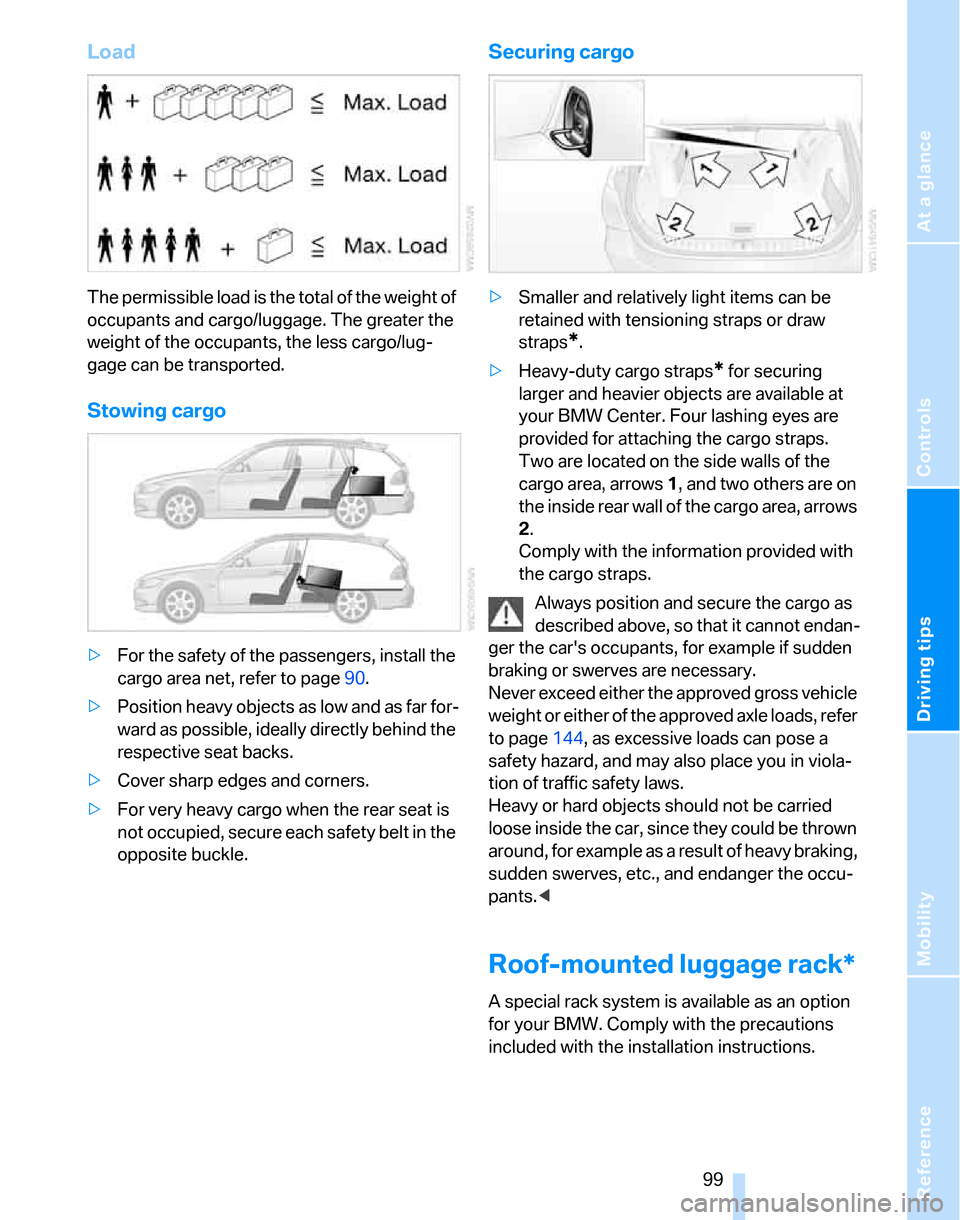
The permissible load is the total of the weight of
occupants and cargo/luggage. The greater the
weight of the occupants, the less cargo/lug-
gage can be transported.
Stowing cargo
>For the safety of the passengers, install the
cargo area net, refer to page90.
>Position heavy objects as low and as far for-
ward as possible, ideally directly behind the
respective seat backs.
>Cover sharp edges and corners.
>For very heavy cargo when the rear seat is
not occupied, secure each safety belt in the
opposite buckle.
Securing cargo
>Smaller and relatively light items can be
retained with tensioning straps or draw
straps
*.
>Heavy-duty cargo straps
* for securing
larger and heavier objects are available at
your BMW Center. Four lashing eyes are
provided for attaching the cargo straps.
Two are located on the side walls of the
cargo area, arrows 1, and two others are on
the inside rear wall of the cargo area, arrows
2.
Comply with the information provided with
the cargo straps.
Always position and secure the cargo as
described above, so that it cannot endan-
ger the car's occupants, for example if sudden
braking or swerves are necessary.
Never exceed either the approved gross vehicle
weight or either of the approved axle loads, refer
to page144, as excessive loads can pose a
safety hazard, and may also place you in viola-
tion of traffic safety laws.
Heavy or hard objects should not be carried
loose inside the car, since they could be thrown
around, for example as a result of heavy braking,
sudden swerves, etc., and endanger the occu-
pants.<
Roof-mounted luggage rack*
A special rack system is available as an option
for your BMW. Comply with the precautions
included with the installation instructions.
Page 106 of 160
Refueling
104
Refueling
Always switch off the engine before refu-
eling, otherwise, fuel cannot be added to
the tank and a message will be displayed.<
Take all precautionary measures and
observe all applicable regulations when
handling fuel. Do not carry any spare fuel con-
tainers in your vehicle. They can develop a leak
and cause an explosion or cause a fire in the
event of an accident.<
Gas cap
Opening
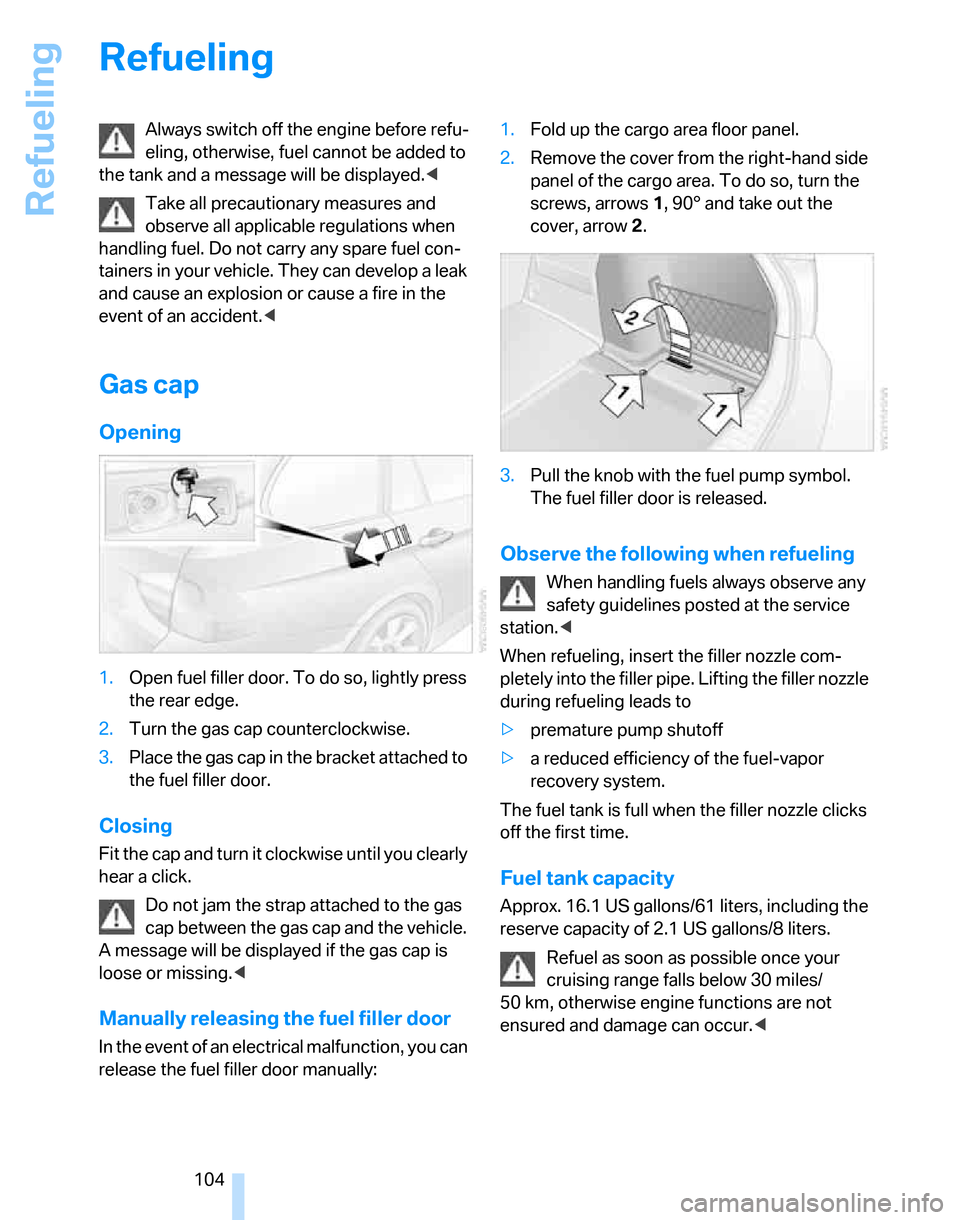
1.Open fuel filler door. To do so, lightly press
the rear edge.
2.Turn the gas cap counterclockwise.
3.Place the gas cap in the bracket attached to
the fuel filler door.
Closing
Fit the cap and turn it clockwise until you clearly
hear a click.
Do not jam the strap attached to the gas
cap between the gas cap and the vehicle.
A message will be displayed if the gas cap is
loose or missing.<
Manually releasing the fuel filler door
In the event of an electrical malfunction, you can
release the fuel filler door manually:1.Fold up the cargo area floor panel.
2.Remove the cover from the right-hand side
panel of the cargo area. To do so, turn the
screws, arrows 1, 90° and take out the
cover, arrow 2.
3.Pull the knob with the fuel pump symbol.
The fuel filler door is released.
Observe the following when refueling
When handling fuels always observe any
safety guidelines posted at the service
station.<
When refueling, insert the filler nozzle com-
pletely into the filler pipe. Lifting the filler nozzle
during refueling leads to
>premature pump shutoff
>a reduced efficiency of the fuel-vapor
recovery system.
The fuel tank is full when the filler nozzle clicks
off the first time.
Fuel tank capacity
Approx. 16.1 US gallons/61 liters, including the
reserve capacity of 2.1 US gallons/8 liters.
Refuel as soon as possible once your
cruising range falls below 30 miles/
50 km, otherwise engine functions are not
ensured and damage can occur.<
Page 113 of 160
Reference
At a glance
Controls
Driving tips
Mobility
111
Run-Flat Tires
When mounting new tires or changing over
from summer to winter tires and vice versa,
mount Run-Flat Tires for your own safety. In the
event of a flat, moreover, no spare wheel is
available. Your BMW Center will be glad to
advise you.
For safety reasons, BMW recommends
that damaged Run-Flat Tires be replaced
rather than repaired.<
Special characteristics of winter tires
BMW recommends winter tires for use in cold
winter driving conditions. Although all-season
M+S tires provide better winter traction than
summer tires, they generally fail to provide the
same levels of cold-weather performance as
winter tires.
Pay attention to speed
Always comply with the speed limit for the
winter tires mounted on your car; failure
to do so could result in tire damage and acci-
dents.<
If the car is capable of speeds higher than that
permitted for the winter tires, a label stating the
maximum permitted speed for the mounted
tires must be displayed in your field of view.
Specialist tire dealers and your BMW Center
can supply these labels.
Storage
Always store wheels and tires in a cool, dry
place with as little exposure to light as possible.
Always protect tires against all contact with oil,
grease and fuels. Do not exceed the maximum
tire inflation pressure indicated on the sidewall
of the tire.
Snow chains*
Only certain fine-link snow chains have been
tested by BMW, classified as safe for use and
recommended. Consult your BMW Center for
more information. Attach snow chains in pairs
and only to the rear wheels. Observe the manu-facturer's instructions when mounting snow
chains. Do not exceed a speed of 30 mph or
50 km/h.
You are not permitted to mount snow chains to
tires of the following sizes:
>255/40 R 17
>255/35 R 18
>255/30 R 19
Do not initialize the Flat Tire Monitor if
snow chains are mounted, otherwise the
instrument might issue an incorrect reading.
When driving with snow chains, you may find it
helpful to activate DTC temporarily, refer to
page66.<
Page 129 of 160
Reference
At a glance
Controls
Driving tips
Mobility
127
Your BMW has a special nut as body ground
or negative pole.
5.Attach the second terminal clamp of the
minus/– jumper cable to the negative termi-
nal of the battery or to the engine or body
ground of the vehicle to be started.
Starting the engine
1.Start the engine of the donor vehicle and
allow it to run for a few minutes at slightly
increased idle speed.
2.Start the engine on the other vehicle in the
usual way.
If the first start attempt is not successful,
wait a few minutes before another attempt
in order to allow the discharged battery to
recharge.
3.Let the engines run for a few minutes.
4.Disconnect the jumper cables by reversing
the above connecting sequence.
If necessary, have the battery checked and
recharged.
Never use spray fluids to start the
engine.<
Tow-starting, towing away
Observe the applicable laws and regula-
tions for tow-starting and towing vehi-
cles.<
Do not transport any occupants other
than the driver in a vehicle that is being
towed.<
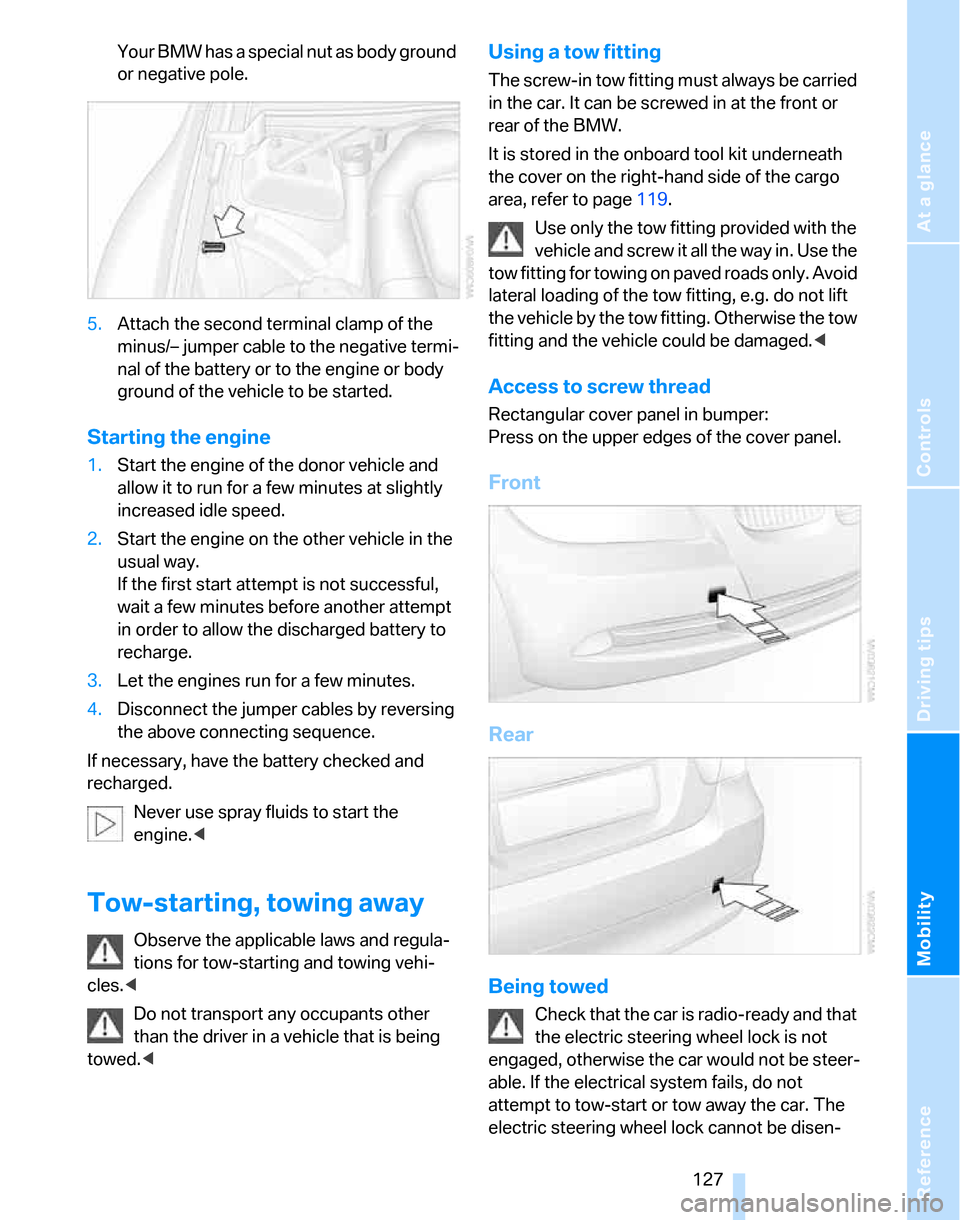
Using a tow fitting
The screw-in tow fitting must always be carried
in the car. It can be screwed in at the front or
rear of the BMW.
It is stored in the onboard tool kit underneath
the cover on the right-hand side of the cargo
area, refer to page119.
Use only the tow fitting provided with the
vehicle and screw it all the way in. Use the
tow fitting for towing on paved roads only. Avoid
lateral loading of the tow fitting, e.g. do not lift
the vehicle by the tow fitting. Otherwise the tow
fitting and the vehicle could be damaged.<
Access to screw thread
Rectangular cover panel in bumper:
Press on the upper edges of the cover panel.
Front
Rear
Being towed
Check that the car is radio-ready and that
the electric steering wheel lock is not
engaged, otherwise the car would not be steer-
able. If the electrical system fails, do not
attempt to tow-start or tow away the car. The
electric steering wheel lock cannot be disen-
Page 130 of 160
Giving and receiving assistance
128 gaged and the car is not steerable. Jump start-
ing, refer to page126.
Power steering assistance is not available when
the engine is not running. Thus, braking and
steering will require increased effort.<
Switch on the hazard warning flashers, depend-
ing on local regulations.
Manual transmission
Gearshift lever in idle position.
Automatic transmission
Selector lever in position N.
Changing selector lever positions, refer to
page45.
Do not exceed a towing speed of 45 mph
or 70 km/h and a towing distance of
90 miles/150 km, otherwise the automatic
transmission may be damaged.<
Towing with a tow bar
The towing vehicle must not be lighter
than the towed vehicle, otherwise it may
be impossible to maintain control.<
The tow fittings used should be on the same
side on both vehicles. Should it prove impossi-
ble to avoid mounting the tow bar at an angle,
please observe the following:
>Clearance and maneuvering capability will
be sharply limited during cornering.
>The tow bar will generate lateral forces if it is
attached offset.
Attach the tow bar to the tow fittings only,
as attaching it to other parts of the vehicle
could result in damage.<
Towing with a tow rope
When starting off in the towing vehicle, make
sure that the tow rope is taut.
To avoid jerking and the associated
stresses on vehicle components when
towing, always use nylon ropes or nylon straps.
Attach the tow rope to the tow fittings only, as
attaching it to other parts of the vehicle could
result in damage.<
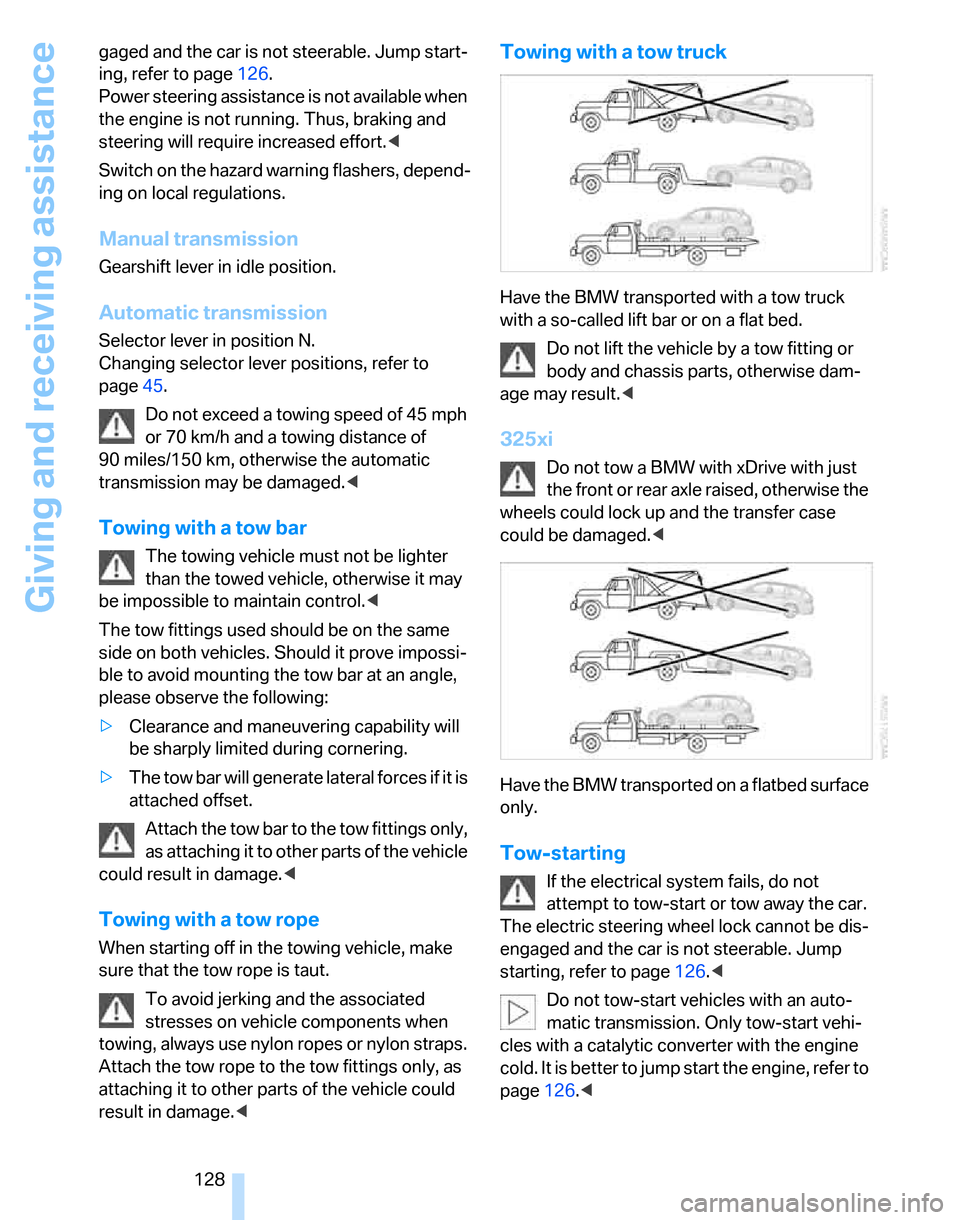
Towing with a tow truck
Have the BMW transported with a tow truck
with a so-called lift bar or on a flat bed.
Do not lift the vehicle by a tow fitting or
body and chassis parts, otherwise dam-
age may result.<
325xi
Do not tow a BMW with xDrive with just
the front or rear axle raised, otherwise the
wheels could lock up and the transfer case
could be damaged.<
Have the BMW transported on a flatbed surface
only.
Tow-starting
If the electrical system fails, do not
attempt to tow-start or tow away the car.
The electric steering wheel lock cannot be dis-
engaged and the car is not steerable. Jump
starting, refer to page126.<
Do not tow-start vehicles with an auto-
matic transmission. Only tow-start vehi-
cles with a catalytic converter with the engine
cold. It is better to jump start the engine, refer to
page126.<
Page 133 of 160
Reference
At a glance
Controls
Driving tips
Mobility
131
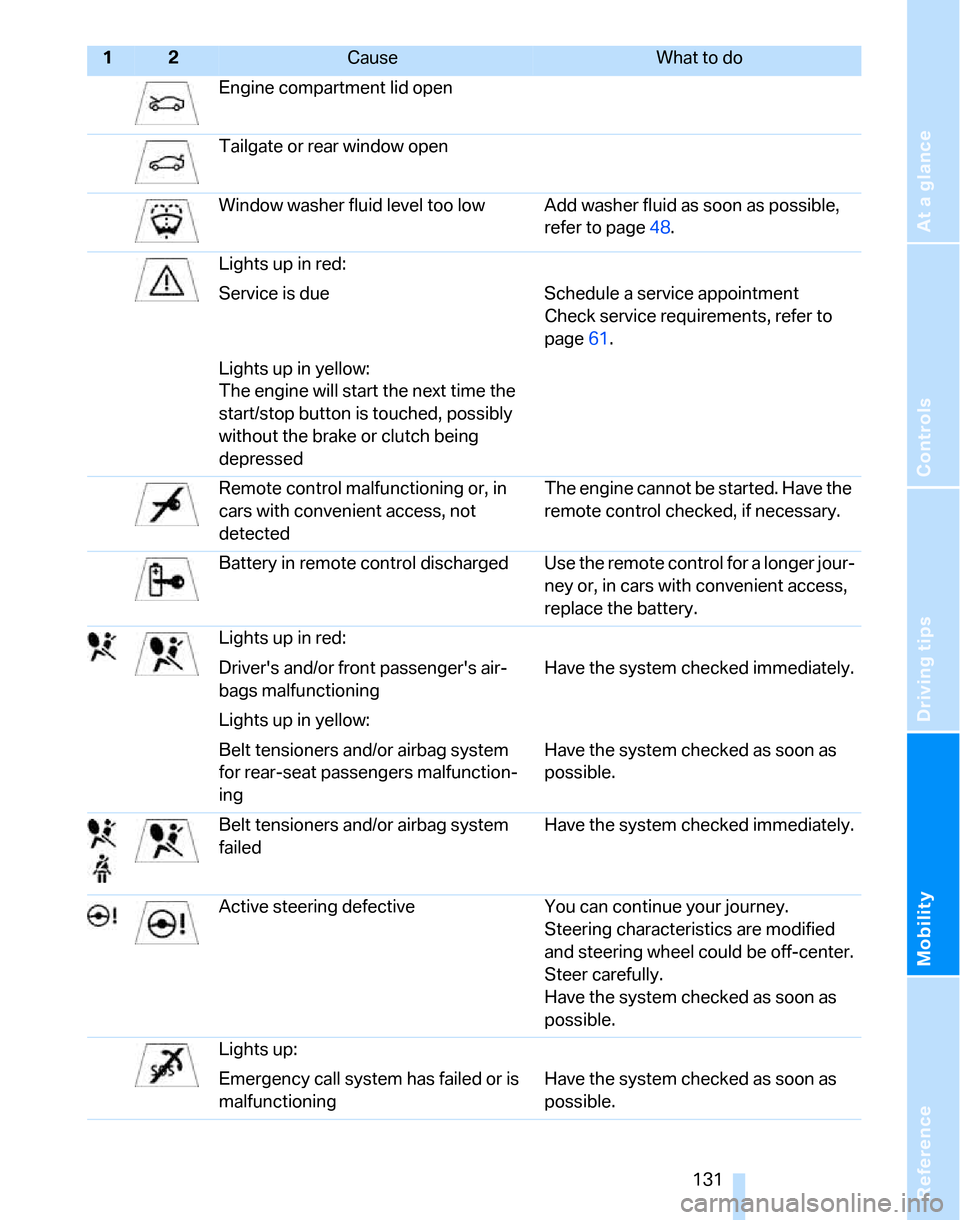
Engine compartment lid open
Tailgate or rear window open
Window washer fluid level too low Add washer fluid as soon as possible,
refer to page48.
Lights up in red:
Service is due Schedule a service appointment
Check service requirements, refer to
page61.
Lights up in yellow:
The engine will start the next time the
start/stop button is touched, possibly
without the brake or clutch being
depressed
Remote control malfunctioning or, in
cars with convenient access, not
detectedThe engine cannot be started. Have the
remote control checked, if necessary.
Battery in remote control discharged Use the remote control for a longer jour-
ney or, in cars with convenient access,
replace the battery.
Lights up in red:
Driver's and/or front passenger's air-
bags malfunctioningHave the system checked immediately.
Lights up in yellow:
Belt tensioners and/or airbag system
for rear-seat passengers malfunction-
ingHave the system checked as soon as
possible.
Belt tensioners and/or airbag system
failedHave the system checked immediately.
Active steering defective You can continue your journey.
Steering characteristics are modified
and steering wheel could be off-center.
Steer carefully.
Have the system checked as soon as
possible.
Lights up:
Emergency call system has failed or is
malfunctioningHave the system checked as soon as
possible.
12Cause What to do
Page 148 of 160
Everything from A to Z
146
Everything from A to Z
Index
A
ABS Antilock Brake
System66
ACC, refer to Active cruise
control50
Accessories, refer to The
individual vehicle5
Activated-charcoal filter for
automatic climate control83
Active cruise control50
– indicator lamps53
– malfunction54
– selecting distance52
– sensor54
Active steering70
– warning lamp71
Adapter for spare key18
Adaptive Head Light75
Additives
– coolant115
Adjusting temperature inside
the car, refer to Air
conditioner79
Adjusting temperature inside
the car, refer to Automatic
climate control81
Airbags71
– sitting safely31
– warning lamp73
Air conditioner78
Air conditioning mode
– air conditioner79
– automatic climate control81
– ventilation80,83
Air distribution
– automatic82
– individual79
– manual79
Air flow rate79,82
Airing, refer to
Ventilation80,83Air outlets, refer to Air
vents78
Air pressure, tires106
Air recirculation, refer to
Recirculated-air
mode79,82
Air supply
– air conditioner79
– automatic climate control81
– ventilation80,83
Air vents78
AKI, refer to Fuel
specifications105
Alarm system25
– avoiding unintentional
alarms25
– interior motion sensor25
– switching off an alarm25
– tilt alarm sensor25
All-season tires, refer to
Winter tires111
Ambient air, refer to
Recirculated-air
mode79,82
Antifreeze
– coolant115
– washer fluid48
Anti-theft alarm system, refer
to Alarm system25
Anti-theft system19
Anti-trapping mechanism
– windows28
Approved axle loads, refer to
Weights144
Approved gross vehicle
weight, refer to Weights144
Armrest, refer to Center
armrest87
Ashtray
– front88
– rear89Assistance systems, refer to
Dynamic Stability Control
DSC66
AUC Automatic recirculated-
air control82
Audio device, external87
Automatic
– air distribution82
– air flow rate82
– cruise control48,50
– headlamp control74
Automatic climate control78
– automatic air distribution82
Automatic curb monitor37
Automatic recirculated-air
control AUC82
Automatic transmission with
Steptronic44
– interlock44,45
– overriding selector lever
lock46
– shiftlock45
– sport program45
AUTO program for automatic
climate control82
AUX-IN
– port87
Average fuel consumption58
– setting the units60
Average speed58
Avoiding unintentional
alarms25
Axle loads, refer to
Weights144
B
Backrests, refer to Seats31
Backrest width adjustment33
Back seats
– refer to Rear seats
Backup lamps
– replacing bulbs122
Page 152 of 160
Everything from A to Z
150 Filter
– refer to Microfilter/activated-
charcoal filter for automatic
climate control83
– refer to Microfilter for air
conditioner80
First aid pouch125
Fixture for remote control,
refer to Ignition lock42
Flashlight, refer to
Rechargeable flashlight87
Flash when locking/
unlocking21
Flat
– Run-Flat Tires110
Flat Tire Monitor FTM69
– indicating a flat tire70
– initializing the system69
– malfunction70
– snow chains69,111
– system limits69
Flat tires, refer to Tire
condition109
Fog lamps76
– indicator lamp76,130
Folding rear seat back90
Footbrake, refer to Braking
safely97
Footwell lamps77
For your own safety5
Front airbags71
Front seat adjustment31
FTM, refer to Flat Tire
Monitor69
Fuel105
– display58
– high-quality brands105
– quality105
– specifications105
– tank capacity145
Fuel clock, refer to Fuel
gauge58
Fuel consumption, refer to
Average fuel
consumption58
Fuel display, refer to Fuel
gauge58Fuel filler door104
– releasing in the event of
electrical malfunction104
Fuses124
G
Garage door opener, refer to
Integrated universal remote
control84
Gasoline, refer to Required
fuel105
Gasoline display, refer to Fuel
gauge58
Gasoline engine, checking oil
level113
Gear indicator
– automatic transmission with
Steptronic44
Gearshift lever
– automatic transmission with
Steptronic45
– manual transmission44
Gearshifts
– with automatic
transmission45
– with manual transmission44
General driving notes96
Glass sunroof, electric
– closing after electrical
malfunction30
– convenient operation20,22
– operation with convenient
access26
– remote control20
Glove compartment87
– rechargeable flashlight87
Grills, refer to Air vents78
Gross vehicle weight, refer to
Weights144
H
Halogen lamps
– replacing bulbs120
Handbrake44
– indicator lamp44
– manual release22Hand lamp, refer to
Rechargeable flashlight87
Hands-free system14
Hazard warning flashers14
Head airbags71
Headlamp control,
automatic74
Headlamp cover120
Headlamp flasher46
– indicator lamp11,14,130
Headlamps
– care, refer to Caring for your
vehicle brochure
– replacing bulbs120
Head restraints33
– sitting safely31
Heated
– mirrors37
– rear window79,83
– seats34
Heating78
– mirrors37
– rear window79,83
– seats34
Heating while at a standstill,
refer to Using residual
heat82
Heavy loads, refer to Stowing
cargo99
Height, refer to
Dimensions143
Height adjustment
– seats32
– steering wheel38
High beams76
– headlamp flasher76
– indicator lamp130
– replacing bulbs120
High water, refer to Driving
through water97
Hills97
Holders for cups88
Homepage4
Hood112
Horn10
Hot exhaust system96
Hydraulic brake assist, refer to
Dynamic Brake Control66
Hydroplaning
97
Page 153 of 160
Reference
At a glance
Controls
Driving tips
Mobility
151
I
Ice warning57
Ignition42
– switched off42
– switched on42
Ignition key, refer to
Integrated key/remote
control18
Ignition key position 1, refer to
Radio readiness42
Ignition key position 2, refer to
Ignition on42
Ignition lock42
Indicator and warning
lamps13,130
Individual air distribution79
Individual settings, refer to
Personal Profile19
Initializing
– compass, refer to
Calibrating86
– Flat Tire Monitor FTM69
– panorama glass roof30
Instrument cluster12
Instrument lighting76
Instrument panel, refer to
Cockpit10
Integrated key18
Integrated universal remote
control84
Interior lamps77
– remote control20
Interior motion sensor25
Interior rearview mirror37
– automatic dimming
feature97
Interior rearview mirror with
digital compass85
Interlock45
Intermittent mode of the
wipers47
J
Jacking points123
Jumpering, refer to Jump
starting126
Jump starting126
K
Key, refer to Integrated key/
remote control18
Keyless Go, refer to
Convenient access26
Keyless opening and closing,
refer to Convenient
access26
Key Memory, refer to Personal
Profile19
Kick-down45
– automatic transmission with
Steptronic45
Knock control105
L
Lamps, refer to Parking lamps/
low beams74
Lamps and bulbs, replacing
bulbs119
Lap-and-shoulder safety
belt36
Lashing eyes, refer to
Securing cargo99
LATCH child-restraint fixing
system40
LEDs light-emitting
diodes120
Length, refer to
Dimensions143
License plate lamp, replacing
bulbs123
Light-emitting diodes
LEDs120
Lighter89
Lighting
– instruments76
– lamps and bulbs119
– of the vehicle, refer to
Lamps74
Light switch74
Limit138
Loading
– securing cargo99
Load securing equipment,
refer to Securing cargo99Lock buttons in the doors,
refer to Locking23
Locking
– adjusting confirmation
signal21
– from inside23
– from outside20
– without remote control, refer
to Convenient access26
Locking and unlocking doors
– from inside22
– from outside20
Low beams74
– automatic74
– replacing bulbs120
Lower back support, refer to
Lumbar support32
Luggage compartment
– capacity144
– opening from inside23
Luggage compartment, refer
to Cargo area23
Luggage compartment net,
refer to Cargo area net90
Luggage compartment net,
refer to Securing cargo99
Luggage rack, refer to Roof-
mounted luggage rack99
Lumbar support32
M
M+S tires, refer to Winter
tires111
Maintenance, refer to Service
Booklet
Maintenance system117
Malfunction warnings, refer to
Check Control63
Manual air distribution79
Manual mode
– automatic transmission with
Steptronic45
Page 154 of 160
Everything from A to Z
152 Manual operation
– door lock22
– glass sunroof30
– panorama glass roof30
– tailgate24
– transmission lock, automatic
transmission46
Manual release
– fuel filler door104
Manual transmission44
Master key, refer to Integrated
key/remote control18
Maximum cooling81
Maximum speed
– with winter tires111
Memory, refer to Seat and
mirror memory34
Microfilter
– BMW Maintenance
System117
– for air conditioner80
– for automatic climate
control83
Microfilter/activated-charcoal
filter
– BMW Maintenance
System117
Microphone for telephone14
Mirror dimming feature97
Mirrors36
– automatic curb monitor37
– exterior mirrors36
– heating37
– interior rearview mirror37
Mobile phone
– installation location, refer to
Center armrest87
– refer to separate Owner's
Manual
Mobile phone, installation
location, refer to Center
armrest87
Mobile phone, refer to the
separate Owner's Manual
Mobile phone in the vehicle96
Mobile phones, use inside the
car, refer to Mobile phone in
the vehicle96Modifications, technical, refer
to For your own safety5
Monitoring system for tire
pressures, refer to Flat Tire
Monitor69
Multifunctional steering
wheel, refer to Buttons on
the steering wheel11
Multifunction switch
– refer to Turn signals/
headlamp flasher46
– refer to Wiper system47
N
Neck support, refer to Head
restraints33
Nets, refer to Storage
compartments88
New tires110
Nose weight144
Nozzles, refer to Windshield
washer nozzles48
Number of cylinders, refer to
Engine data142
O
OBD socket118
OBD socket, refer to Socket
for On-Board Diagnosis118
Octane ratings, refer to Fuel
specifications105
Odometer57
Oil
– capacity145
Oil, refer to Engine oil113
Oil consumption113
Oil level113
Old batteries, refer to
Disposal123
Onboard tool kit119
Opening and closing
– convenient access26
– from inside22
– from outside20
– using the door lock22
– via the remote control20Opening and unlocking
– from the inside23
Outlets
– refer to Ventilation80,83
Outlets, refer to Air vents78
Output, refer to Engine
data142
Outside-air mode
– automatic climate control82
Outside-temperature
display57
– changing units of
measure60
– in computer60
Overheated engine, refer to
Coolant temperature57
Overriding selector lever
lock46
P
Panorama glass roof28
– closing after electrical
malfunction30
– convenient operation20
– opening, closing29
– raising29
– remote control20
Parking
– vehicle43
Parking aid, refer to PDC Park
Distance Control65
Parking brake, refer to
Handbrake44
Parking lamps/low beams74
– replacing bulbs121
Parts and accessories, refer to
The individual vehicle5
Passenger-side mirror tilt
function37
Pathway lighting74
PDC Park Distance Control65
Personal Profile19
Placing a call, refer to
telephone owner's manual