wheel BMW 328Ci CONVERTIBLE 2000 E46 Owner's Guide
[x] Cancel search | Manufacturer: BMW, Model Year: 2000, Model line: 328Ci CONVERTIBLE, Model: BMW 328Ci CONVERTIBLE 2000 E46Pages: 199, PDF Size: 1.77 MB
Page 139 of 199

139n
IndexDataTechnologyRepairsCar careControlsOverview
Washing your vehicle You can wash your BMW at an auto-
matic car wash, even when it is new.
Brushless systems are preferable (refer
to page 144 as well).
Wipe away tough dirt and loosen and
remove dead insects before washing
the vehicle.
In order to avoid spots, do not wash the
vehicle when the hood is warm, or dur-
ing or immediately after exposure to
strong sunlight.
When using an automatic car wash, be
sure that:
>The car wash system is suited for the
dimensions of your vehicle
>No damage will occur to vehicles
with attached body accessories (such
as spoilers or antennas). Consult the
car wash operator if necessary
>The wheels and tires of your vehicle
cannot be damaged by the convey-
ance devices of the car wash system
>The vehicle is cleaned with minimum
brush pressure, and that ample water
is available for washing and rinsing.Vehicles with rain sensor
*:
Clean the windshield regularly. Wax
from automatic car washes or insects
can cause the rain sensor* to malfunc-
tion.
Turn the rain sensor* off (refer to
page 78) when passing through an
automatic car wash. Failure to do so
could result in damage caused by unin-
tended wiper activation.<
Parts of the vehicle that are inaccessi-
ble to the automatic washer – such as
door sills, door and hood edges, etc. –
should be cleaned by hand.
In the winter months, it is especially im-
portant to ensure that the vehicle is
washed on a regular basis. Large quan-
tities of dirt and road salt are difficult to
remove, and they also damage the
vehicle.
If spray wands or high-pressure
washers are used, be sure to
maintain an adequate distance between
the spray source and the vehicle's sur-
face. Inadequate distance and exces-
sive pressure can damage or weaken
the finish, making it more susceptible to
subsequent attack. In addition, mois-
ture could penetrate to vehicle compo-
nents, leading to long-term damage.<
When cleaning the headlamps,
please observe the following:
Do not clean by wiping with a dry cloth
(scratches). Never use abrasives or
strong solvents to clean the covers.
Remove dirt and contamination (such
as insects) by soaking with BMW Car
Shampoo and then rinsing with plenty
of water. Always use a deicer spray to
remove accumulated ice and snow –
never use a scraper.<
After washing the vehicle, apply
the brakes briefly to dry them.
Braking efficiency might otherwise be
reduced by the moisture and the brake
rotors could also corrode.<
Caring for your vehicle
Page 141 of 199

141n
IndexDataTechnologyRepairsCar careControlsOverview
Caring for your vehicleWaxing your vehicle Protect the finish using only carnauba
or synthetic-based waxes.
The best way to determine when the
finish needs to be waxed is by noting
when water stops beading on the
surface.
You can use a glass cleaner to remove
any wax or silicone that may have been
left on the windows during waxing.
Use the cleaning and car-care
products available at your BMW
center.<
Paint damageYou can touch up small areas of paint
damage with a BMW spray paint or a
BMW touchup stick.
The paint color code for your vehicle is
provided on a sticker located on the
right hand side under the hood and on
the first page of your Service and War-
ranty Information Booklet (US models)
or Warranty and Service Guide (Cana-
dian models).
Damage caused by flying stones,
scratches, etc., must be touched up
without delay to prevent rust from
forming.
If corrosion has started to form in an
area with paint damage, remove all rust
and clean the area. Then prime the area
with a BMW Primer Stick. Finally, apply
the finish coat. Wait a few days, then
polish the repaired area. Finish by ap-
plying a wax preservative.
More extensive paint damage should
be repaired professionally in accor-
dance with the manufacturer's instruc-
tions. Your BMW center uses original
BMW finish materials in accordance
with approved repair procedures.
Caring for other vehicle
components and materials Light-alloy wheels should be treated
with alloy wheel cleaner, especially dur-
ing the winter months. However, do not
use aggressive products containing ac-
ids, strong alkalis or abrasives. Do not
use steam cleaners operating at tem-
peratures above 140 7 (+60 6). Fol-
low the manufacturer's instructions.
If your vehicle has chrome parts
*, such
as the window frames and door han-
dles, clean these parts carefully with
ample clean water and a shampoo sup-
plement if desired, especially if they
have an accumulation of road salt.
Use a chrome polish for an additional
treatment.
You can use window and glass cleaner
to clean inside window surfaces and
mirrors without smearing and streaking.
Never use polishing pastes or abrasive
(quartz) cleansers on mirror lenses.
Page 146 of 199
146n
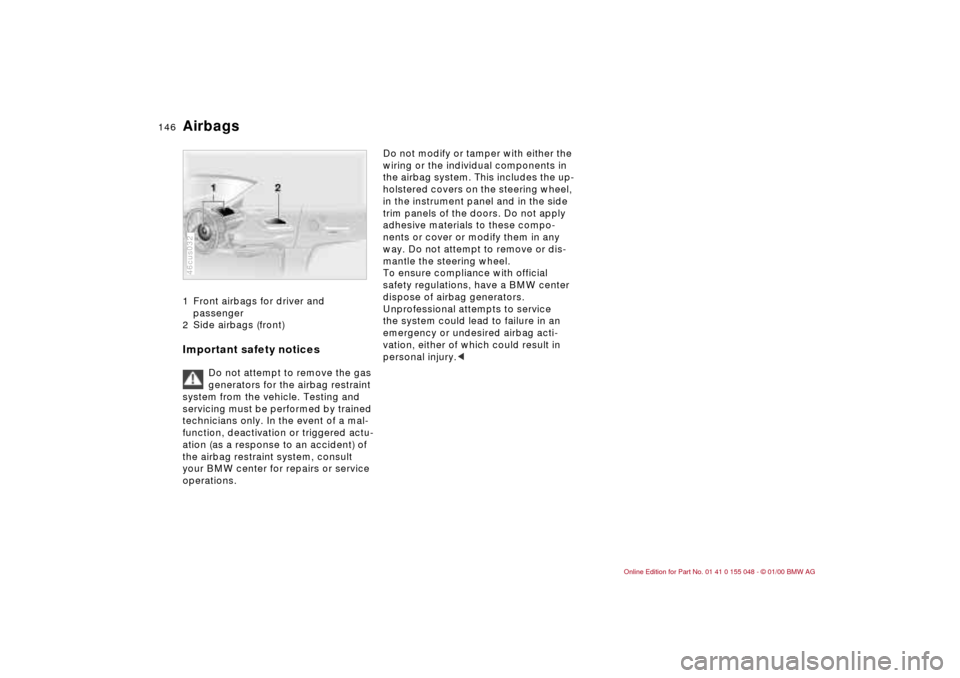
Airbags 1 Front airbags for driver and
passenger
2 Side airbags (front)Important safety notices
Do not attempt to remove the gas
generators for the airbag restraint
system from the vehicle. Testing and
servicing must be performed by trained
technicians only. In the event of a mal-
function, deactivation or triggered actu-
ation (as a response to an accident) of
the airbag restraint system, consult
your BMW center for repairs or service
operations.
46cus032
Do not modify or tamper with either the
wiring or the individual components in
the airbag system. This includes the up-
holstered covers on the steering wheel,
in the instrument panel and in the side
trim panels of the doors. Do not apply
adhesive materials to these compo-
nents or cover or modify them in any
way. Do not attempt to remove or dis-
mantle the steering wheel.
To ensure compliance with official
safety regulations, have a BMW center
dispose of airbag generators.
Unprofessional attempts to service
the system could lead to failure in an
emergency or undesired airbag acti-
vation, either of which could result in
personal injury.<
Page 147 of 199

147n
IndexDataTechnologyRepairsCar careControlsOverview
Vehicle storage
If you intend to store the vehicle
for more than three months, have
the maintenance operations described
on this page performed.<
Preparations for storageHave your BMW center perform the fol-
lowing procedures:
1 Clean and apply a rustproofing agent
or other treatment to the engine,
engine compartment, undercarriage,
axles and major components in ac-
cordance with approved repair pro-
cedures. Washing the vehicle, any in-
terior cleaning and subsequent paint-
and chrome care, and cleaning any
rubber seals for the hood and doors,
should be carried out in compliance
with approved procedures as well
2 Change engine oil and oil filter at op-
erating temperature. As an additional
corrosion protection measure, an an-
ticorrosive agent can be added to the
engine when refueling in accordance
with the manufacturer's instructions
3 Check the coolant level and concen-
tration and top off if necessary
4 Fill the fuel tank completely to pre-
vent the formation of condensation
5 Increase the tire inflation pressure to
51 psi (350 kPa).
Before parking the vehicle1 Dry the parking brake and footbrakes
completely to keep the brake discs
and drums from corroding
2 Park the vehicle in a covered, dry,
and well-ventilated space. Place the
transmission in first gear or set the
selector lever to the "P" position.
Chock the wheels to prevent the ve-
hicle from rolling if necessary. Do not
apply the parking brake
3 Remove the battery, charge it com-
pletely and store it in a cool (but
frost-free) room
4 Remove the hardtop
* and store it
separately. Refer to page 121
5 Close the convertible top.
During storageRecharge the battery every six months.
If it is not recharged, it will not be ser-
viceable. Every time the battery drains,
especially over extended periods, its
service life is reduced.
Removing the vehicle from
storageRecharge the battery if the "Magic
Eye"
* turns black. Refer to page 162.
Then have Inspection I performed by
your BMW center, including a brake
fluid replacement if necessary. Refer to
the Service and Warranty Information
Booklet (US models) or the Warranty
and Service Guide (Canadian models).
Page 151 of 199
Overview
Controls and features
Operation, care
and maintenance
Owner service procedures
Technical data
Index Advanced technology
151n
IndexDataTechnologyRepairsCar careControlsOverview
Replacement procedures:
Onboard tool kit152
Windshield wiper blades152
Lamps and bulbs152
Changing a wheel159
Battery162
Fuses165
In case of electrical
malfunction:
Fuel filler door165
Fully automatic convertible
top166
Assistance, giving and
receiving:
Jump-starting168
Towing the vehicle169
Repairs
Page 159 of 199
159n
IndexDataTechnologyRepairsCar careControlsOverview
Changing a wheel
Safety measures in the event of a
flat tire or wheel change:
Stop the vehicle as far as possible from
passing traffic. Park on a firm, flat sur-
face. Switch on the hazard flashers.
Turn the steering wheel to the straight-
ahead position, remove the key and en-
gage the steering lock. Shift into 1st or
reverse (selector lever in "Park" with au-
tomatic transmission) and engage the
parking brake.
Have all passengers leave the vehicle
and remain well away from your immedi-
ate working area (behind a guardrail, for
instance).
If a warning triangle
* or portable hazard
warning lamp is available, set it up on
the roadside at an appropriate distance
from the rear of the vehicle. Comply with
all safety guidelines and regulations.
Change the wheel only on a level, firm
surface that is not slippery. Avoid jack-
ing the vehicle on a soft or slippery sup-
port surface (snow, ice, loose gravel,
etc.), as it could slide sideways.
Position the jack on a firm support sur-
face.
Do not place wooden blocks or similar
objects under the jack, otherwise, the
jack might not be able to reach its full
support capacity because of the limited
height.
Do not lie under the vehicle or start the
engine when the vehicle is supported by
the jack. Failure to comply with this cre-
ates a risk of fatal injury.<
Your BMW has a space-saver spare
tire for temporary use to ensure your
mobility.
To remove the space-saver spare
tire, lift the floor panel in the lug-
gage compartment completely out
(refer to page 41).<
What you will needIn order to avoid rattling noises later,
note the position of the tools when you
remove them and return them to their
original position when you are through
using them.
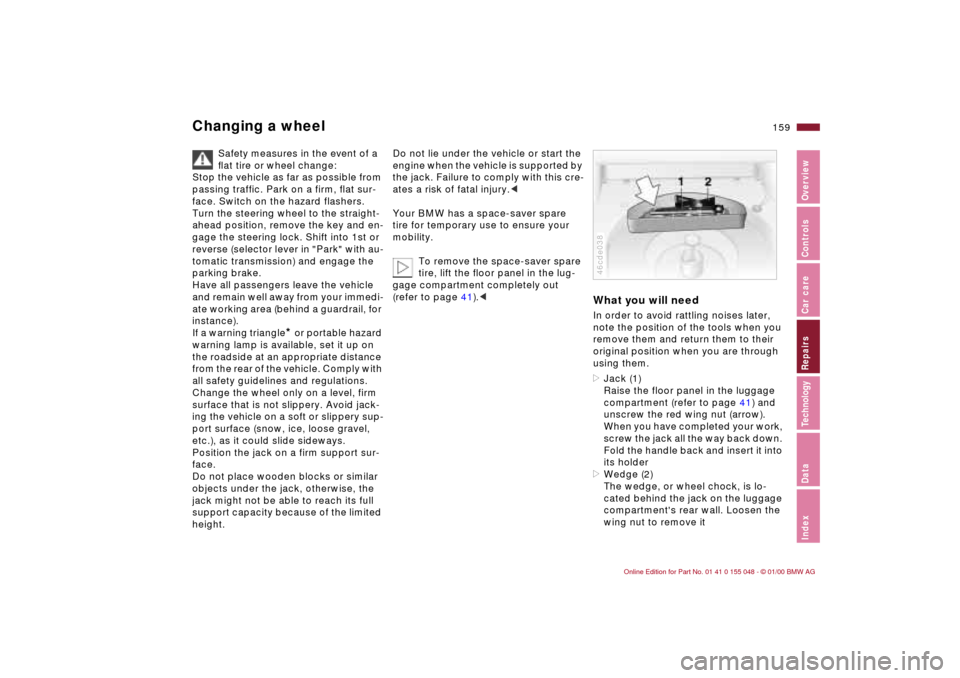
>Jack (1)
Raise the floor panel in the luggage
compartment (refer to page 41) and
unscrew the red wing nut (arrow).
When you have completed your work,
screw the jack all the way back down.
Fold the handle back and insert it into
its holder
>Wedge (2)
The wedge, or wheel chock, is lo-
cated behind the jack on the luggage
compartment's rear wall. Loosen the
wing nut to remove it46cde038
Page 160 of 199
160n
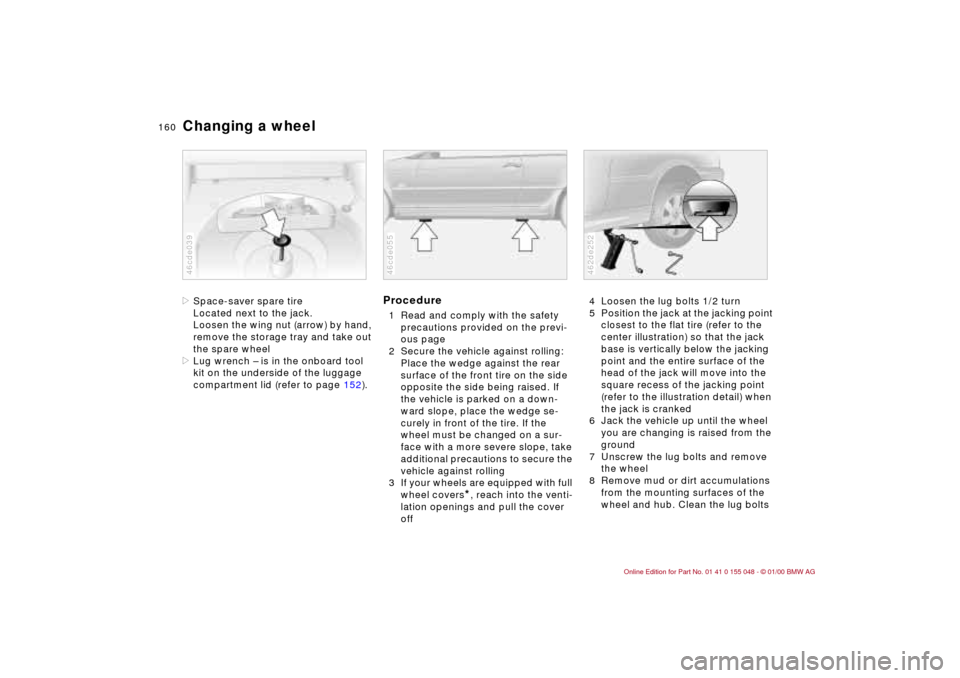
Changing a wheel>Space-saver spare tire
Located next to the jack.
Loosen the wing nut (arrow) by hand,
remove the storage tray and take out
the spare wheel
>Lug wrench – is in the onboard tool
kit on the underside of the luggage
compartment lid (refer to page 152).46cde039
Procedure1 Read and comply with the safety
precautions provided on the previ-
ous page
2 Secure the vehicle against rolling:
Place the wedge against the rear
surface of the front tire on the side
opposite the side being raised. If
the vehicle is parked on a down-
ward slope, place the wedge se-
curely in front of the tire. If the
wheel must be changed on a sur-
face with a more severe slope, take
additional precautions to secure the
vehicle against rolling
3 If your wheels are equipped with full
wheel covers
*, reach into the venti-
lation openings and pull the cover
off
46cde055
4 Loosen the lug bolts 1/2 turn
5 Position the jack at the jacking point
closest to the flat tire (refer to the
center illustration) so that the jack
base is vertically below the jacking
point and the entire surface of the
head of the jack will move into the
square recess of the jacking point
(refer to the illustration detail) when
the jack is cranked
6 Jack the vehicle up until the wheel
you are changing is raised from the
ground
7 Unscrew the lug bolts and remove
the wheel
8 Remove mud or dirt accumulations
from the mounting surfaces of the
wheel and hub. Clean the lug bolts462de252
Page 161 of 199
161n
IndexDataTechnologyRepairsCar careControlsOverview
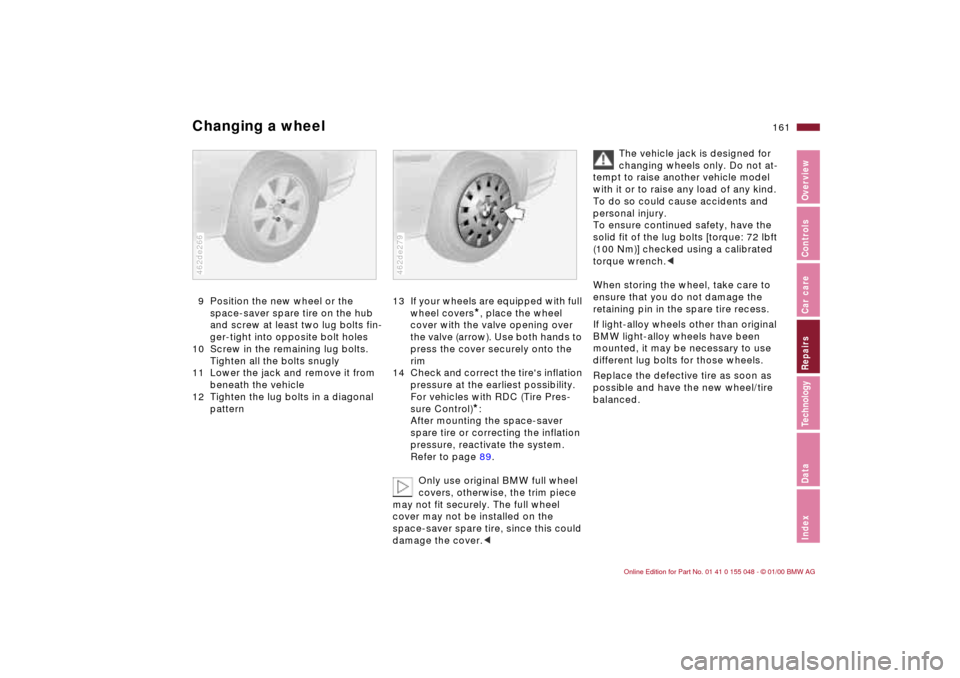
Changing a wheel9 Position the new wheel or the
space-saver spare tire on the hub
and screw at least two lug bolts fin-
ger-tight into opposite bolt holes
10 Screw in the remaining lug bolts.
Tighten all the bolts snugly
11 Lower the jack and remove it from
beneath the vehicle
12 Tighten the lug bolts in a diagonal
pattern462de266
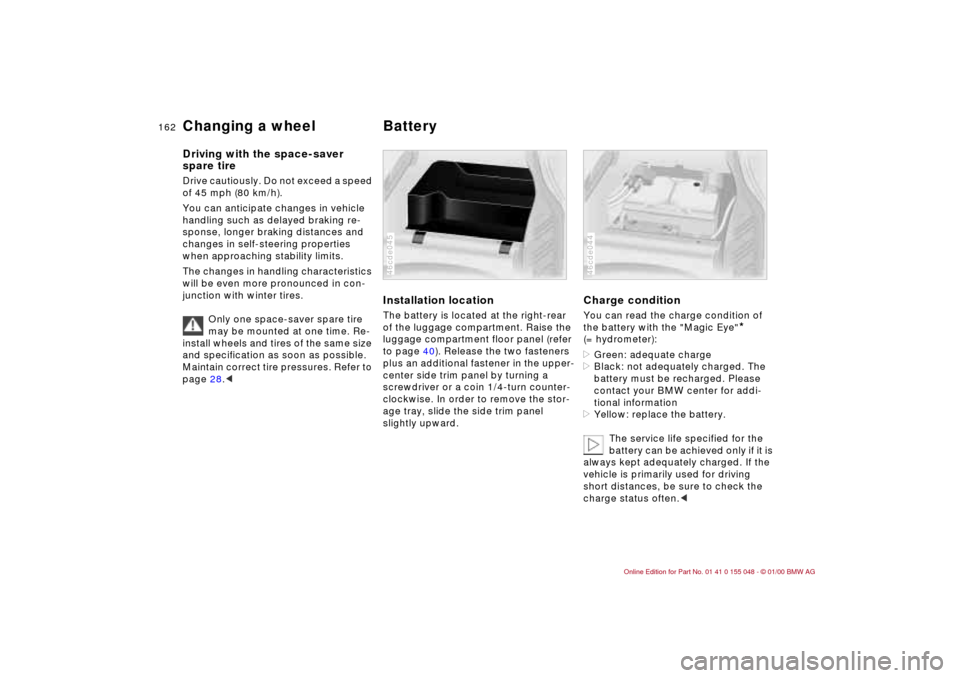
13 If your wheels are equipped with full
wheel covers
*, place the wheel
cover with the valve opening over
the valve (arrow). Use both hands to
press the cover securely onto the
rim
14 Check and correct the tire's inflation
pressure at the earliest possibility.
For vehicles with RDC (Tire Pres-
sure Control)*:
After mounting the space-saver
spare tire or correcting the inflation
pressure, reactivate the system.
Refer to page 89.
Only use original BMW full wheel
covers, otherwise, the trim piece
may not fit securely. The full wheel
cover may not be installed on the
space-saver spare tire, since this could
damage the cover.<
462de279
The vehicle jack is designed for
changing wheels only. Do not at-
tempt to raise another vehicle model
with it or to raise any load of any kind.
To do so could cause accidents and
personal injury.
To ensure continued safety, have the
solid fit of the lug bolts [torque: 72 lbft
(100 Nm)] checked using a calibrated
torque wrench.<
When storing the wheel, take care to
ensure that you do not damage the
retaining pin in the spare tire recess.
If light-alloy wheels other than original
BMW light-alloy wheels have been
mounted, it may be necessary to use
different lug bolts for those wheels.
Replace the defective tire as soon as
possible and have the new wheel/tire
balanced.
Page 162 of 199
162n
Changing a wheel Battery Driving with the space-saver
spare tireDrive cautiously. Do not exceed a speed
of 45 mph (80 km/h).
You can anticipate changes in vehicle
handling such as delayed braking re-
sponse, longer braking distances and
changes in self-steering properties
when approaching stability limits.
The changes in handling characteristics
will be even more pronounced in con-
junction with winter tires.
Only one space-saver spare tire
may be mounted at one time. Re-
install wheels and tires of the same size
and specification as soon as possible.
Maintain correct tire pressures. Refer to
page 28.<
Installation locationThe battery is located at the right-rear
of the luggage compartment. Raise the
luggage compartment floor panel (refer
to page 40). Release the two fasteners
plus an additional fastener in the upper-
center side trim panel by turning a
screwdriver or a coin 1/4-turn counter-
clockwise. In order to remove the stor-
age tray, slide the side trim panel
slightly upward.46cde045
Charge conditionYou can read the charge condition of
the battery with the "Magic Eye"
*
(= hydrometer):
>Green: adequate charge
>Black: not adequately charged. The
battery must be recharged. Please
contact your BMW center for addi-
tional information
>Yellow: replace the battery.
The service life specified for the
battery can be achieved only if it is
always kept adequately charged. If the
vehicle is primarily used for driving
short distances, be sure to check the
charge status often.<
46cde044
Page 169 of 199
169n
IndexDataTechnologyRepairsCar careControlsOverview
Towing the vehicleTow fittingThe screw-in tow fitting is stored in the
onboard tool kit; be sure that it remains
in the vehicle at all times. This fitting
is designed for installation in the tow
sockets located at the front and rear of
the vehicle. It is intended for towing on
paved road surfaces only. This fitting
should not be used to pull a vehicle out
of deep snow, mud, sand, etc.
Always comply with all applicable
towing laws and regulations.Access to tow socketsFront:
Using a screwdriver, press out the cover
panel on the top part of the recess.462de254
Rear:
Using a screwdriver, press out the cover
panel on the top part of the recess.
Screw the tow fittings in com-
pletely and tightly. If you do not,
the threads could be damaged.
Do not tow the vehicle by any compo-
nents of the running gear, or lash them
down in any way. If you do, the compo-
nents could be damaged, leading to
possible accidents.<462de255
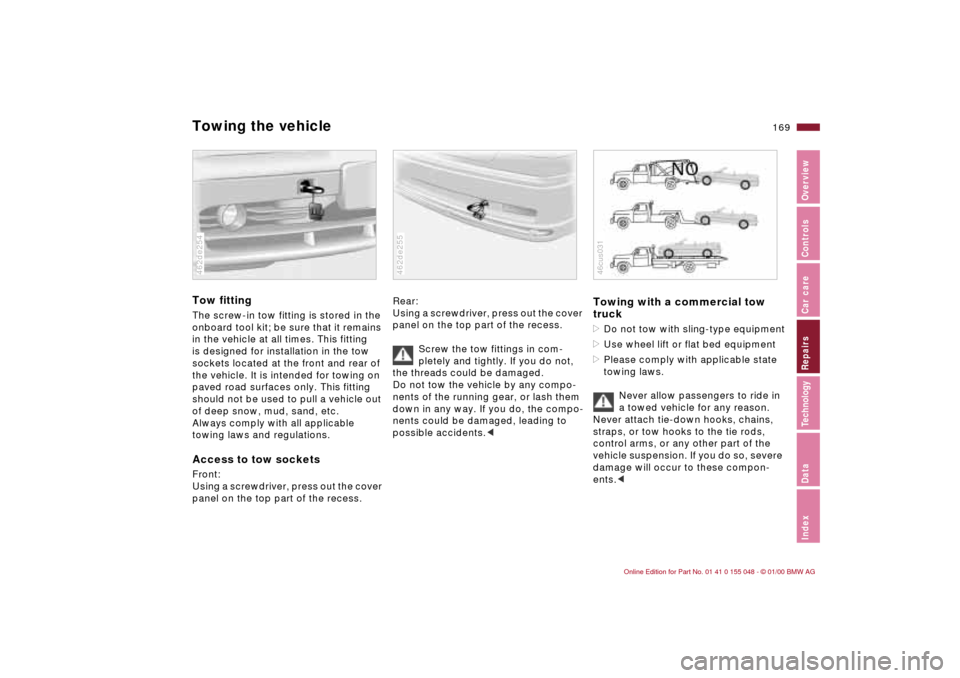
Towing with a commercial tow
truck>Do not tow with sling-type equipment
>Use wheel lift or flat bed equipment
>Please comply with applicable state
towing laws.
Never allow passengers to ride in
a towed vehicle for any reason.
Never attach tie-down hooks, chains,
straps, or tow hooks to the tie rods,
control arms, or any other part of the
vehicle suspension. If you do so, severe
damage will occur to these compon-
ents.c46cus031