oil BMW 328Ci COUPE 2000 E46 User Guide
[x] Cancel search | Manufacturer: BMW, Model Year: 2000, Model line: 328Ci COUPE, Model: BMW 328Ci COUPE 2000 E46Pages: 189, PDF Size: 1.68 MB
Page 125 of 189
123n
RepairsIndexOverview Controls Car care Technology Data
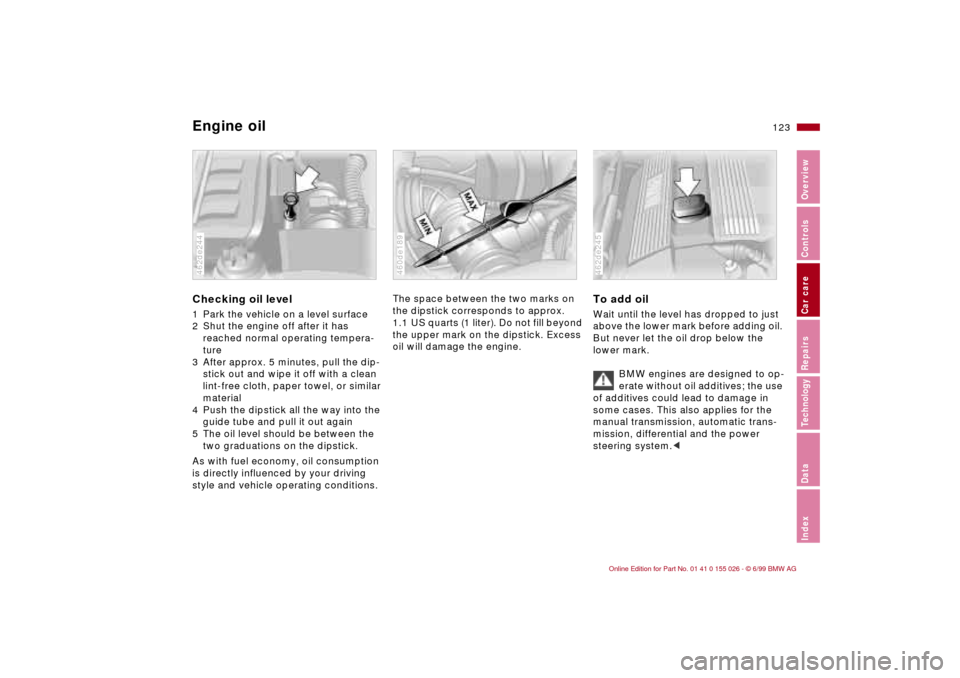
Engine oilChecking oil level 1 Park the vehicle on a level surface
2 Shut the engine off after it has
reached normal operating tempera-
ture
3 After approx. 5 minutes, pull the dip-
stick out and wipe it off with a clean
lint-free cloth, paper towel, or similar
material
4 Push the dipstick all the way into the
guide tube and pull it out again
5 The oil level should be between the
two graduations on the dipstick.
As with fuel economy, oil consumption
is directly influenced by your driving
style and vehicle operating conditions.462de244
The space between the two marks on
the dipstick corresponds to approx.
1.1 US quarts (1 liter). Do not fill beyond
the upper mark on the dipstick. Excess
oil will damage the engine.460de189
To add oil Wait until the level has dropped to just
above the lower mark before adding oil.
But never let the oil drop below the
lower mark.
BMW engines are designed to op-
erate without oil additives; the use
of additives could lead to damage in
some cases. This also applies for the
manual transmission, automatic trans-
mission, differential and the power
steering system.<462de245
Page 126 of 189
124n
Engine oil Prescribed engine oilThe quality of the engine oil is extremely
important for the function and life of an
engine. Based on extensive testing,
BMW has approved only certain kinds
of engine oil.
Use only approved "BMW High Perfor-
mance Synthetic Oil".
If you are unable to obtain "BMW High
Performance Synthetic Oil", you can
add small amounts of synthetic oil in
between oil changes. Only use oils with
the API SH specification or higher.
Ask your authorized BMW center
for details concerning the specific
"BMW High Performance Synthetic Oil"
or synthetic oils that have been ap-
proved.<
You can also call BMW of North America
at 1-800-831-1117 or visit this website:
www.bmwusa.com to obtain this infor-
mation.
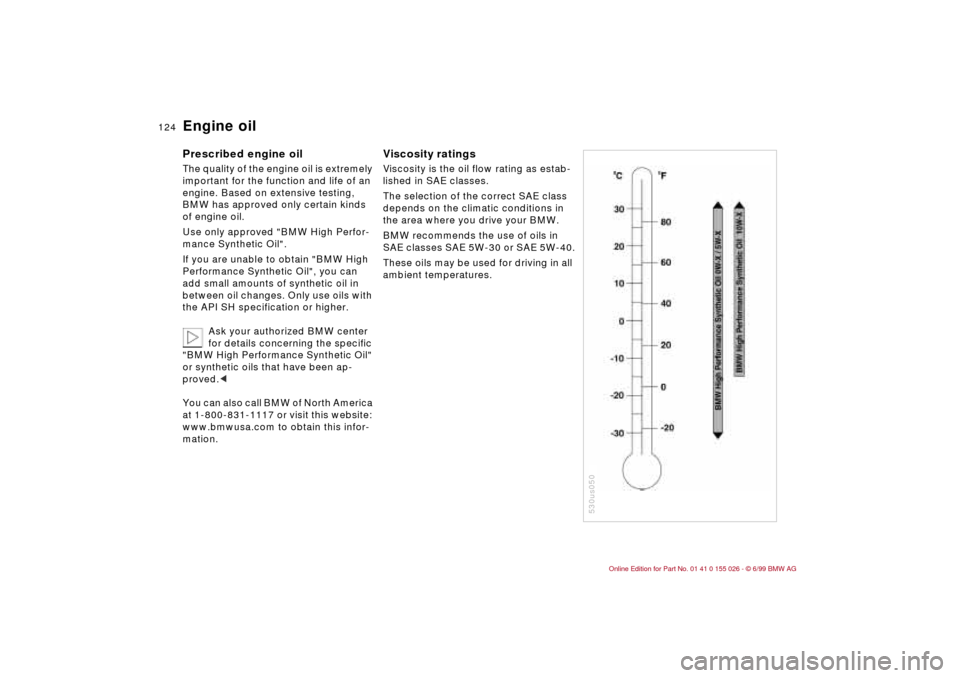
Viscosity ratings Viscosity is the oil flow rating as estab-
lished in SAE classes.
The selection of the correct SAE class
depends on the climatic conditions in
the area where you drive your BMW.
BMW recommends the use of oils in
SAE classes SAE 5W-30 or SAE 5W-40.
These oils may be used for driving in all
ambient temperatures.
530us050
Page 127 of 189

125n
RepairsIndexOverview Controls Car care Technology Data
Engine oil
Always observe all environmental
protection laws when disposing of
used oil.<
Recommendation: Have the oil changed
by your BMW center only.
Continuous exposure to used oil
has caused cancer in laboratory
testing. Any skin areas that come in
contact with oil should be thoroughly
washed with soap and water.
Always store oil, grease, etc., out of
reach of children. Comply with all warn-
ing labels and information on lubricant
containers.<
Page 131 of 189
129n
RepairsIndexOverview Controls Car care Technology Data
The BMW Maintenance System has
been designed as a reliable means of
providing maximum driving and operat-
ing safety – and as cost-effectively as
possible for you. With respect to the
previous version, maintenance costs
can clearly be reduced due to technical
innovations.
Please keep in mind that regular main-
tenance is not only necessary for the
safety of your vehicle, but also plays a
significant role in maintaining the resale
value of the vehicle. 462us022
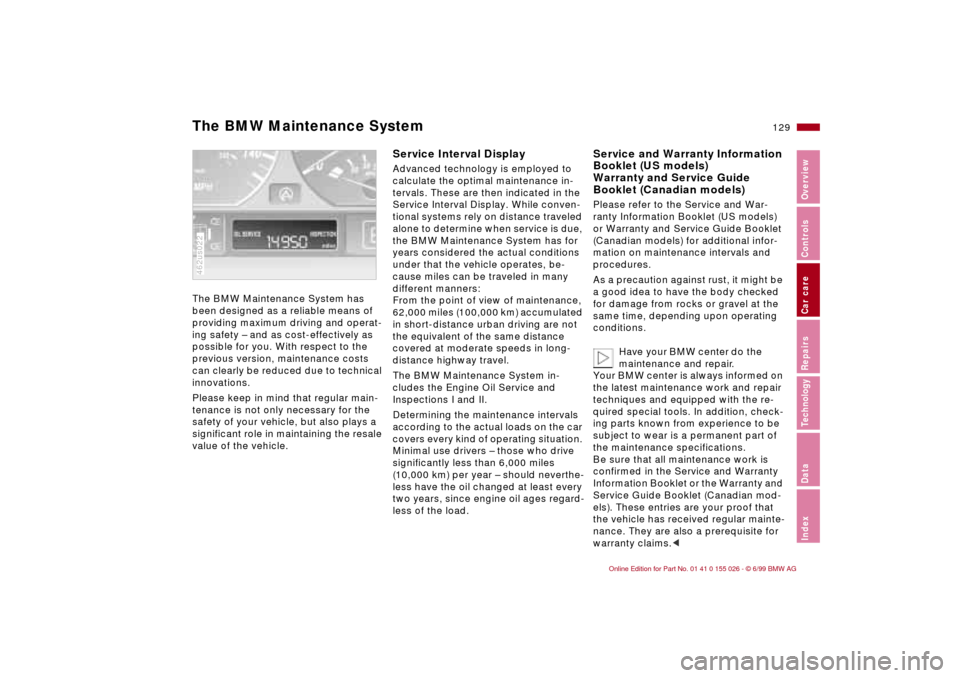
Service Interval DisplayAdvanced technology is employed to
calculate the optimal maintenance in-
tervals. These are then indicated in the
Service Interval Display. While conven-
tional systems rely on distance traveled
alone to determine when service is due,
the BMW Maintenance System has for
years considered the actual conditions
under that the vehicle operates, be-
cause miles can be traveled in many
different manners:
From the point of view of maintenance,
62,000 miles (100,000 km) accumulated
in short-distance urban driving are not
the equivalent of the same distance
covered at moderate speeds in long-
distance highway travel.
The BMW Maintenance System in-
cludes the Engine Oil Service and
Inspections I and II.
Determining the maintenance intervals
according to the actual loads on the car
covers every kind of operating situation.
Minimal use drivers – those who drive
significantly less than 6,000 miles
(10,000 km) per year – should neverthe-
less have the oil changed at least every
two years, since engine oil ages regard-
less of the load.
Service and Warranty Information
Booklet (US models)
Warranty and Service Guide
Booklet (Canadian models)Please refer to the Service and War-
ranty Information Booklet (US models)
or Warranty and Service Guide Booklet
(Canadian models) for additional infor-
mation on maintenance intervals and
procedures.
As a precaution against rust, it might be
a good idea to have the body checked
for damage from rocks or gravel at the
same time, depending upon operating
conditions.
Have your BMW center do the
maintenance and repair.
Your BMW center is always informed on
the latest maintenance work and repair
techniques and equipped with the re-
quired special tools. In addition, check-
ing parts known from experience to be
subject to wear is a permanent part of
the maintenance specifications.
Be sure that all maintenance work is
confirmed in the Service and Warranty
Information Booklet or the Warranty and
Service Guide Booklet (Canadian mod-
els). These entries are your proof that
the vehicle has received regular mainte-
nance. They are also a prerequisite for
warranty claims.<
The BMW Maintenance System
Page 132 of 189

130n
Washing your car Right from the start, you can wash your
new BMW in an automatic car wash.
Car wash systems that do not employ
brushes are preferable.
Wipe away tough dirt and loosen and
remove dead insects before washing
the car.
To prevent spots, avoid washing when
the hood is still warm, or immediately
after and during exposure to strong
sunlight.
When using an automatic car wash, be
sure that:
>The car wash system is suited for the
dimensions of your vehicle
>No damage will occur on vehicles
with attached body accessories (such
as spoilers or antennas). Consult the
car wash operator if necessary
>The wheels and tires of your vehicle
cannot be damaged by the convey-
ance devices of the car wash system
>The vehicle is cleaned with minimum
brush pressure, and that ample water
is available for washing and rinsing.Vehicles with rain sensor:
Clean the windshield regularly. Wax
from car washes or the presence of
dead insects can cause rain sensor
malfunctions.
Switch the rain sensor off when
the vehicle passes through the car
wash (refer to page 70). Damage could
occur by an undesired actuation of the
wipers if the system is not deacti-
vated.<
Parts of the car that are inaccessible
to the automatic washer – such as door
sills, door and hood edges, etc. –
should be cleaned by hand.
In the winter months, it is especially im-
portant to ensure that the car is washed
on a regular basis. Large quantities of
dirt and road salt are difficult to remove,
and they also cause damage to the ve-
hicle.
If spray wands or high-pressure
washers are used, be sure to
maintain an adequate distance between
the spray source and the vehicle's sur-
face. Inadequate distance and exces-
sive pressure can damage or weaken
the finish, making it more susceptible to
subsequent attack. In addition, mois-
ture could penetrate to vehicle compo-
nents, leading to long-term damage.<
When cleaning the headlamps,
please observe the following:
>Do not rub dry. Never use abrasives
or strong cleaning agents to clean the
covers
>Remove dirt and contamination
(such as insects) by soaking with
BMW Car Shampoo and then rinsing
with plenty of water
>Always use a deicer spray to remove
accumulated ice and snow – never
use a scraper.<
After washing the car, apply the
brakes briefly to dry them. Braking
efficiency might otherwise be reduced
by the moisture and the brake rotors
could also be corroded.<
Caring for your car
Page 133 of 189

131n
RepairsIndexOverview Controls Car care Technology Data
Caring for your carExterior finish To provide effective corrosion protec-
tion, multilayer paintwork is applied at
the factory. Cataphoretic immersion
priming techniques are supplemented
using special body-cavity protectants,
with the application of specially-devel-
oped and extensively tested materials.
A layer of flexible PVC is first applied to
the undercarriage. Following this, a
comprehensive undercoating treatment
with a wax-based protectant is applied.
Regular maintenance makes an impor-
tant contribution to maintaining the
safety and resale value of your vehicle.
Increasing awareness of the effects of
harmful environmental factors on vehi-
cle finishes have led paint and vehicle
manufacturers to initiate ongoing pro-
grams designed to further improve the
durability of their finishes. Despite this,
environmental factors that occur locally
or regionally can have negative effects
on the finish of your vehicle. These
should guide you in determining the fre-
quency and extent of your efforts to
maintain the vehicle finish.
Depending upon material and type
of impact (perforation of paint layer),
physical stresses from sand, road salt,
gravel, etc., can cause corrosion to
start extending beneath the finish, start-
ing at the point of impact.Road dirt, tar spots, dead insects, ani-
mal droppings (strong alkali concentra-
tion) and tree excretions (resins and
pollen) all contain substances capable
of causing damage when allowed to re-
main on the finish of your car for any
period of time (spots, etching, flaking,
separation in the top coat).
In industrial areas, deposits of flue dust,
lime, oily soot, precipitation containing
sulfur-dioxide (acid rain) and other envi-
ronmental pollutants will damage the
car's finish unless adequate care is pro-
vided – even though this generally lim-
ited to the outside horizontal surfaces.
In coastal regions, high levels of atmo-
spheric salt and humidity promote cor-
rosion.
In tropical zones temperatures of over
1007 (406) in the shade prevail, in
addition to heavy ultraviolet radiation
and high humidity. Under those circum-
stances light colored paints reach tem-
peratures of up to 1807 (806) and
dark paints up to 2507 (1206).
Caring for the vehicle finish Regular washing is a preventive mea-
sure against long-term effects from
substances that are harmful to the vehi-
cle's finish, especially if you drive your
vehicle in areas with high levels of air
pollution or aggressive natural sub-
stances (tree resins, pollen).
Nevertheless, you should immediately
remove especially aggressive sub-
stances. Failure to do so can lead to
changes in the paint's chemical struc-
ture or to discoloration. Gasoline spilled
during refueling, oil, grease and brake
fluid should always be cleaned away
immediately, as should bird droppings.
All of these substances cause damage
to the finish.
Any contamination remaining on the
surface of the vehicle will be especially
conspicuous after washing. Use clean-
ing fluid or alcohol with a clean cloth or
cotton pad to remove. Remove tar
spots with tar remover. After cleaning,
the affected areas should be waxed to
ensure continued protection.
A full range of car-care products is
available from your BMW center.<
Page 135 of 189

133n
RepairsIndexOverview Controls Car care Technology Data
Caring for your carPlastic components, vinyl upholstery,
headliners, lamp lenses, the clear cover
of the instrument panel and compo-
nents with a sprayed dull black surface
can be cleaned with water (add plastic
shampoo as required). Do not allow
moisture to soak through the seats or
headliner. Never use solvents such as
lacquer thinner, heavy-duty grease re-
mover, fuels, etc.
Rubber components should be cleaned
with water only; a rubber treatment or
silicone spray may also be applied.
Clean the wiper blades with soapy wa-
ter. The wiper blades should be re-
placed twice a year, before and after
the cold season. This especially impor-
tant for vehicles with a rain sensor.
Use only wiper blades approved
by BMW.<
The safety belts should be cleaned with
a mild soap and water solution without
removing them from the car. Never at-
tempt chemical or dry cleaning, as
damage to the belt fabric could result.
After cleaning, never allow the inertia
reel to retract the belts until they are
completely dry. Dirty safety belts pre-
vent the inertia reel mechanism from
retracting the strap properly, and thus
constitute a safety hazard.
Heavily soiled floor carpets and mats
*
can be cleaned with an interior cleaner.
The floor mats can be removed from the
vehicle for cleaning.
Please use only a damp cloth to clean
wooden fascia panels and components.
Follow up by drying with a soft cloth.
A full range of car-care products is
available from your BMW center.<
Care of upholstery materials Depressions in the upholstered materi-
als resulting from everyday use can be
brushed up by brushing "against the
nap" with a lightly dampened brush.
The tendency of the pile to lie in a par-
ticular direction on velour upholstery is
not a quality defect, and, just as on
home textiles or clothing, cannot be
avoided.
Lint on upholstery materials, textile or
leather remnants that have been worn
into the upholstery may be removed
with a lint brush or a Velcro
â brush. A
cleaning glove is available for particu-
larly "stubborn" lint. Stains and fairly
large areas of dirt should be cleaned off
without delay, using lukewarm water
and an interior cleaner, stain remover or
cleaning-grade benzene. Brush the fab-
ric afterwards to restore its appearance.
If the vehicle will be stored for an ex-
tended period, or if it is exposed to in-
tense sunlight, cover all seats or the
windows to prevent fading.
A full range of car-care products is
available from your BMW center.<
Page 136 of 189

134n
Caring for your carThe buildup of an electrostatic charge
on the seat covers, particularly if atmo-
spheric humidity is low, can give the
occupants an unpleasant electric shock
if they touch metal body parts after leav-
ing the vehicle. Although this not dan-
gerous in any way, it can be avoided by
touching a bare or polished metal part
of the car while getting out.
Leather care The leather upholstery
* used by BMW
is a natural product of the highest qual-
ity, processed using state-of-the-art
methods to ensure that it will maintain
its high quality for years to come, pro-
vided that it is properly cared for.
Because this product is manufactured
using natural materials, you must make
allowance for its special characteristics
and for the peculiarities of its use and
care.
Regular periodic cleaning and care are
essential, as dust and road dirt act as
abrasives in the pores and creases of
the material. This leads to wear spots
and premature brittleness on the sur-
face of the leather. We therefore sug-
gest that you clean the leather with a
vacuum cleaner or dust cloth at fre-
quent intervals.
For cleaning use BMW leather cleaning
foam.Since dirt and grease gradually attack
the protective layer of the leather, the
cleaned surfaces should be treated with
BMW leather care agent. This also acts
as an antistatic agent.
To protect against moisture and water
treat the leather with BMW Impregnat-
ing Agent.
We recommend that you perform this
procedure twice a year on leather ex-
posed to normal use.
Spills should be wiped up immediately.
Remove grease and oil stains without
rubbing, but rather by dabbing with
spot remover.
If the upholstery is to be exposed to in-
tense sunlight or if the vehicle is to be
stored for an extended period, cover all
leather surfaces (or, better yet, the win-
dows) to prevent fading.
A full range of car-care products is
available from your BMW center.<
Page 175 of 189

173n
RepairsIndexOverview Controls Car care Technology Data
Capacities
Notes
Fuel tank
reserve gal. (liters)
gal. (liters)approx. 16.6 (approx. 63)
approx. 2.1 (approx. 8)Fuel specification: Page 26
Windshield washer system/
Headlamp washer system
*
quarts (liters) approx. 5.6 (approx. 5.3) For details: Page 122
Cooling system including heater circuit quarts (liters) approx. 8.9 (approx. 8.4) For details: Page 126
Engine oil and filter change quarts (liters) approx. 6.9 (approx. 6.5) BMW High Performance
Synthetic Oil
Specifications: Page 124
Manual transmission, automatic transmission
and differential– Lifetime fluid, no fluid change
required
Page 180 of 189

Everything from A to ZAABS (Antilock Brake
System) 22, 106
Accessories 6
Activated charcoal
filter 93, 154
Adaptive Transmission
Control (ATC) 66, 160
Adding engine oil 123
Adding washer fluid 173
Adjust the backrest 47
Adjust the temperature 90
Adjust the thigh support
area 49
Adjusting steering wheel 51
Air distribution 90
Air outlets 88
Air pressure 113
Air supply 91
Airbags 21, 57, 135, 161
Alarm system 42
Antenna 112
Antenna, Diversity 162
Antifreeze 126
Antifreeze, radiator 110
Antilock Brake System
(ABS) 22, 106
Anti-theft alarm system 42
Aquaplaning 104, 113
Armrest 95
Ashtray 96
Assisted rear entry 49AUC (Automatic
recirculated-air
control) 91
Automatic car washes 130
Automatic climate
control 88
remove window
condensation 91
Automatic recirculated-air
control (AUC) 91
Automatic speed control 72
Automatic transmission with
Steptronic 22, 66
Average consumption 78
Average speed 79
Avoiding unwanted
alarm 43
Axle loads 172
BBackrest
release 49
Backup lamps 65
bulb replacement 143
Battery 151, 174
capacity 174
charge 153
discharged 156
removal and
installation 152
Battery charge current 20
Belts 55Blower 91
BMW High Performance
Synthetic Oil 124
BMW Sports Seat 49
Bore 170
Brake fluid 127
Brake hydraulic system 20
Brake lamps
bulb replacement 143
Brake pads 22
Brake-in procedure 104
Brakes 108
Brakes, brake faults 109
Breaking in the vehicle 104
Bulb replacement 140
CCar Memory 54
Car phone, please refer to
the manufacturer's
operating instructions
Car radio 112
reception 112, 162
refer also to the car radio
operating instructions
Car vacuum cleaner,
connecting 96
Car wash 130
Care
exterior 131
interior 132
Care of upholstery 133Care of wool velour 133
Cargo loading 100
Caring for the vehicle
finish 131
Cassette operation, refer to
the radio operating
instructions
Catalytic converter 105
CBC (Cornering Brake
Control) 21, 107
CD mode, refer to the radio
operating instructions
Cellular phones 95, 112
Center (high-mount) brake
lamp 145
Center armrest 95
Central locking system 34
key 38
Changing tires 148
Check air pressure 27
Check Control 77
Child restraint
systems 56, 60
Child seat 56, 60
Cigarette lighter 96
Clock 77
refer also to the onboard
computer operating
instructions
Clothes hooks 97
Cockpit 16