Hose BMW 328i 1998 E36 Workshop Manual
[x] Cancel search | Manufacturer: BMW, Model Year: 1998, Model line: 328i, Model: BMW 328i 1998 E36Pages: 759
Page 2 of 759
B
-
1
ROBERT
BENTLEY,
INC
.
I
AUTOMOTIVE
PUBLISHERS
Information
that
makes
1734
Massachusetts
Avenue
the
difference
o
Cambridge,
MA
02138
USA
800-423-45951617-547-4170
www
.rb
.co
m
e-mail
:
sales@rb
.co
m
WARNING-Important
Safety
Notice
Technical
Contact
Information
We
value
your
feedback
.
Technical
comments
and
suggestions
are
helpful
to
us
.
Please
send
your
comments
and
thoughts
to
Bentley
Publishers
e-mail
:
tech
.bmw@rb
.co
m
From
timeto
time,
updates
may
be
made
tothis
manual
.
A
listing
of
updates
canbe
found
on
the
web
Iat
www
.rb
.com/update
s
Do
not
use
this
manual
unless
you
are
familiar
with
basic
automotive
repair
procedures
and
safe
workshop
practices
.
This
manual
illustrates
the
workshop
procedures
required
for
most
service
work
.
It
is
not
a
substitute
for
fui¡
and
up-to-dateinformation
from
the
vehicie
manufacturer
or
for
proper
training
asan
automotive
technician
.
Note
that
it
is
not
possible
for
us
to
anticipate
al¡
of
the
ways
or
conditions
under
which
vehicles
may
be
serviced
or
to
provide
cautions
as
to
all
of
the
possible
hazards
that
may
result
.
The
vehicie
manufacturer
will
continue
to
issue
service
information
updates
and
parts
retrofits
after
the
editorial
closing
of
this
manual
.
Some
of
those
updates
and
retrofits
will
apply
to
procedures
and
specifications
in
this
manual
.
We
regret
that
we
cannot
supply
updates
to
purchasers
of
this
manual
.
We
haveendeavored
to
ensure
the
accuracy
of
the
information
in
this
manual
.
Please
note,
however,
that
considering
thevast
quantity
and
the
complexity
of
the
service
information
involved,
we
cannot
warrant
the
accuracy
or
completeness
of
the
information
contained
in
this
manual
.
FORTHESE
REASONS,NEITHERTHEPUBLISHER
NORTHE
AUTHOR
MAKES
ANY
WARRANTIES,
EXPRESS
OR
IMPLIED,THATTHE
INFORMATION
IN
THIS
BOOK
IS
FREE
OF
ERRORS
OR
OMISSIONS,
AND
WE
EXPRESSLY
DISCLAIMTHE
IMPLIED
WARRANTIESOF
MERCHANTABILITY
AND
OF
FITNESS
FOR
A
PARTICULAR
PURPOSE,
EVEN
IF
THE
PUBLISHER
OR
AUTHOR
NAVEBEEN
ADVISED
OF
A
PARTICULAR
PURPOSE,
AND
EVEN
IF
A
PARTICULAR
PURPOSE
IS
INDICATED
IN
THE
MANUAL
.
THE
PUBLISHER
AND
AUTHOR
ALSO
DISCLAIM
ALL
LIABILITY
FOR
DIRECT,
INDIRECT,
INCIDENTAL
OR
CONSEQUENTIAL
DAMAGES
THAT
RESULT
FROM
ANYUSE
OF
THE
EXAMPLES,
INSTRUCTIONS
OR
OTHER
INFORMATION
IN
THIS
BOOK
.I
N
NO
EVENTSHALL
OUR
LIABILITY
WHETHER
INTORT,
CONTRACT
OR
OTHERWISE
EXCEEDTHECOST
OFTHIS
MANUAL
.
Your
common
sense
and
good
judgment
are
crucial
to
safe
and
successful
service
work
.
Read
procedures
through
before
starting
them
.
Thinkabout
whether
the
condition
of
your
car,
your
leve¡
of
mechanical
skill,
or
your
leve¡
of
reading
comprehension
might
result
in
or
contribute
in
some
way
to
an
occurrence
which
might
cause
you
injury,
damage
your
car,or
result
in
an
unsafe
repair
.
lf
you
have
doubts
for
these
or
other
reasons
about
your
ability
to
perform
safe
repair
workon
your
car,
have
the
work
done
at
an
authorized
BMW
dealeror
other
qualified
shop
.
Part
numbers
listed
inthis
manual
are
for
identification
purposes
only,
not
for
ordering
.
Always
check
with
your
authorized
BMW
dealer
toverifypart
numbers
and
availability
beforebeginning
service
work
that
may
requíre
new
parts
.
Before
attempting
any
work
on
your
BMW,
read
the
wamings
and
cautions
on
pages
vi¡
and
vi¡¡,
andany
waming
or
caution
that
accompanies
a
procedure
in
the
service
manual
.
Review
the
warnings
and
cautions
on
pages
vi¡
and
viü
each
time
you
prepare
to
workon
your
BMW
.
Special
tools
required
to
perform
certain
service
operations
are
identified
in
the
manual
and
are
recommended
for
use
.
Use
of
tools
other
than
those
recommended
inthis
service
manual
may
be
detrimental
to
the
car's
safe
operation
as
well
as
the
safety
of
the
person
servicing
thecar
.
Copies
of
this
manual
may
be
purchased
from
most
automotiveaccessories
and
parts
dealers
specializing
in
BMW
automobiles,
from
selected
booksellers,
or
directly
from
the
publisher
by
mail
.
The
publisher
encourages
comments
from
the
reader
of
this
manual
.
These
communications
havebeen
and
will
be
carefully
considered
in
the
preparation
of
this
and
other
manuals
.
Please
write
to
Robert
Bentley,
Inc
.,
Publishers
at
the
address
listed
on
the
top
of
this
page
.
This
manual
was
published
byRobert
Bentley,
Inc
.,
Publishers
.
BMW
has
not
reviewed
and
does
not
vouch
forthe
accuracy
of
thetechnical
specifications
and
procedures
described
in
this
manual
.
Libraryof
Congress
Cataloging-in-Publication
Data
BMW
3
SeriesService
ManualM3,
318i,
323i,3251,
328i,
Sedan,
Coupe
and
Convertible
:
1992,
1993,
1994,
1995,
1996,1997,
1998
.
p
.
c
m
.
Includes
index
.
ISBN
0-8376-0326-9
1
.
BMW
3
Series
automobile--Maintenance
and
repair--Handbooks,
manuals,
etc
.
I
.
Robert
Bentley,
inc
.
TL215
.13251356
1999
629
.28'
722--cic21
99-17179
CIP
Bentley
Stock
No
.
B398
Editorial
closing
01/99
0302010099
1098765432
The
paper
used
in
this
publication
is
acidfree
and
meets
the
requirements
of
the
National
Standard
for
Information
Sciences-
Permanence
of
Paper
for
PrintedLibrary
Materials
.
O
©Copyright
1999
Robert
Bentley,
Inc
.
All
rights
reserved
.
All
information
contained
in
this
manual
is
based
onthe
information
available
to
the
publisher
at
the
time
of
editorial
closing
.
The
right
is
reserved
to
make
changes
at
any
time
without
notice
.
No
partof
this
publication
may
be
reproduced,
stored
in
a
retrieval
system,
or
transmitted
in
any
form
orby
any
means,
electronic,
mechanical,
photocopying,
recording,
or
otherwise,
without
the
prior
written
consent
of
thepublisher
.
This
includes
text,
figures,
and
tables
.
All
rights
reserved
underBerne
andPan-American
Copyright
conventions
.
Manufactured
in
the
UnitedStates
of
America
Page 5 of 759
Foreword
This
service
manual
covers
1992
through
1998
BMW
3
Series
models,
and
is
specifically
de-
signed
to
cover
only
those
models
built
for
sale
in
the
United
States
.
BMW,
and
most
accessories
and
parts
sellers
specializing
in
BMWs,
refer
to
the
3
Seriescars
coveredby
this
manual
as
the
E36
model
.
The
code
"E36"
is
BMW's
internal
code
for
the
basic
plat-
form
sharedby
al¡
of
the
cars
coveredby
this
manual
.
Except
for
the
engine
and
a
few
other
compo-
nents,
the
models
coveredby
this
manual
share
many
of
same
components
suchas
suspension
parts,
body
panels,
and
the
interior
pieces
.
When
ordering
parts,
especially
body
parts,
knowing
the
E36
code
may
be
helpful
.
BMW
also
usesan
interna¡
code
for
the
enginesused
in
the
3
Series
models
.
Consult
the
text
in
the
100
Engine-General
repair
group
ofthis
manual
for
a
complete
listing
of
engine
codes
.
Engine
-
code
information
is
primarily
used
internally
by
BMW,
but
may
be
helpful
if
you
haveaccess
to
BMW
technical
information
.
Forthe
BMW
ownerwith
basic
mechanical
skills,
this
manual
gives
detailed
maintenance
and
re-
pair
information
.
In
addition,
the
BMW
owner
who
hasno
intention
of
working
on
his
or
her
own
car
will
findthat
owning
and
reading
this
manual
will
make
it
possibleto
be
better
informed
and
todis-
cuss
repairs
more
intelligently
with
a
professional
technician
.
This
manual
has
been
prepared
from
the
repair
information
that
BMW
provides
to
its
factory-trained
technicians
and
has
been
developed
primarily
with
the
do-it-yourself
BMW
owner
in
mind
.
The
aim
throughout
has
been
clarity
and
un-
derstanding
with
practical
descriptions,
step-by-step
procedures,
and
accurate
specifications
.
The
BMW
owner
intending
to
do
maintenance
and
repair
should
have
a
set
of
tools
including
a
set
of
metric
wrenches
and
sockets,
screwdrivers,
a
torque
wrench,
and
feeler
gauges,
since
these
ba-
sic
tools
will
beused
to
do
the
majority
of
the
maintenance
and
repair
procedures
described
in
this
manual
.
This
manual
includes
detailed
information
onthese
basic
tools
and
other
tips
for
the
begin-
ner
in
the
first
section
of
the
manual,
entitled
010
Fundamentals
for
the
Do-It-Yourself
Owner
.
For
some
of
the
repairs
described
in
this
manual,
BMW
technicians
use
special
tools
.
The
text
will
note
when
a
repair
requires
these
special
tools
and,
where
possible,
will
recommend
practica¡
alter-
natives
.
Page 11 of 759
WARNING
-
"
Never
work
under
a
lifted
car
unless
it
is
solidly
supported
on
jack
stands
that
are
intended
for
that
purpose
.
Do
not
support
a
car
on
cinder
blocks,
bricks,
or
other
objects
that
may
shift
orcrumble
under
continuous
load
.
Never
work
un-
dera
car
that
is
supported
only
by
the
lifting
jack
.
"
Fuel
is
highly
flammable
.
When
working
around
fuel,
do
not
smoke
or
worknear
heaters
or
other
fire
hazards
.
Keepan
approved
fire
extinguisher
handy
.
"
llluminate
the
work
area
adequately
and
safely
.
Use
a
portable
safety
light
for
working
inside
or
under
thecar
.
A
fluorescent
type
lightis
best
be-
cause
it
gives
off
less
heat
.
If
using
a
light
with
anormal
incandescent
butb,
use
rough
service
bulbs
to
avoid
breakage
.
The
hot
filamentof
an
accidentallybroken
bulb
can
ignite
spilled
fuel
or
oil
"
Keep
sparks,
lighted
matches,
and
any
open
llame
away
from
thetop
of
the
battery
.
Hydrogen
gas
emitted
by
the
battery
is
highly
flammable
.
Any
nearby
source
of
ignition
may
cause
the
battery
to
explode
.
"
Never
¡ay
tools
or
parts
in
the
engine
compart-
ment
or
on
top
of
the
battery
.
They
may
fall
into
confined
spaces
and
be
difficult
toretrieve,
be-
come
caught
in
beits
or
other
rotating
parts
when
the
engine
is
started,
or
cause
electrical
shorts
anddamage
to
the
electrical
system
.
"
The
fuel
system
is
designed
to
retain
pressure
even
when
the
ignition
is
off
.
When
working
with
the
fuel
system,
loosen
the
fuel
fines
slowly
to
al-
low
the
residual
pressure
to
dissipate
gradually
.
Take
precautions
to
avoid
spraying
fuel
.
Lifting
the
Car
FUNDAMENTALS
FOR
THE
DO-ITYOURSELF
OWNER
010-
3
For
those
repairs
that
require
raising
the
car,
theproper
jack-
ing
points
should
beused
to
raise
thecar
safely
and
avoid
dam-
age
.
There
are
four
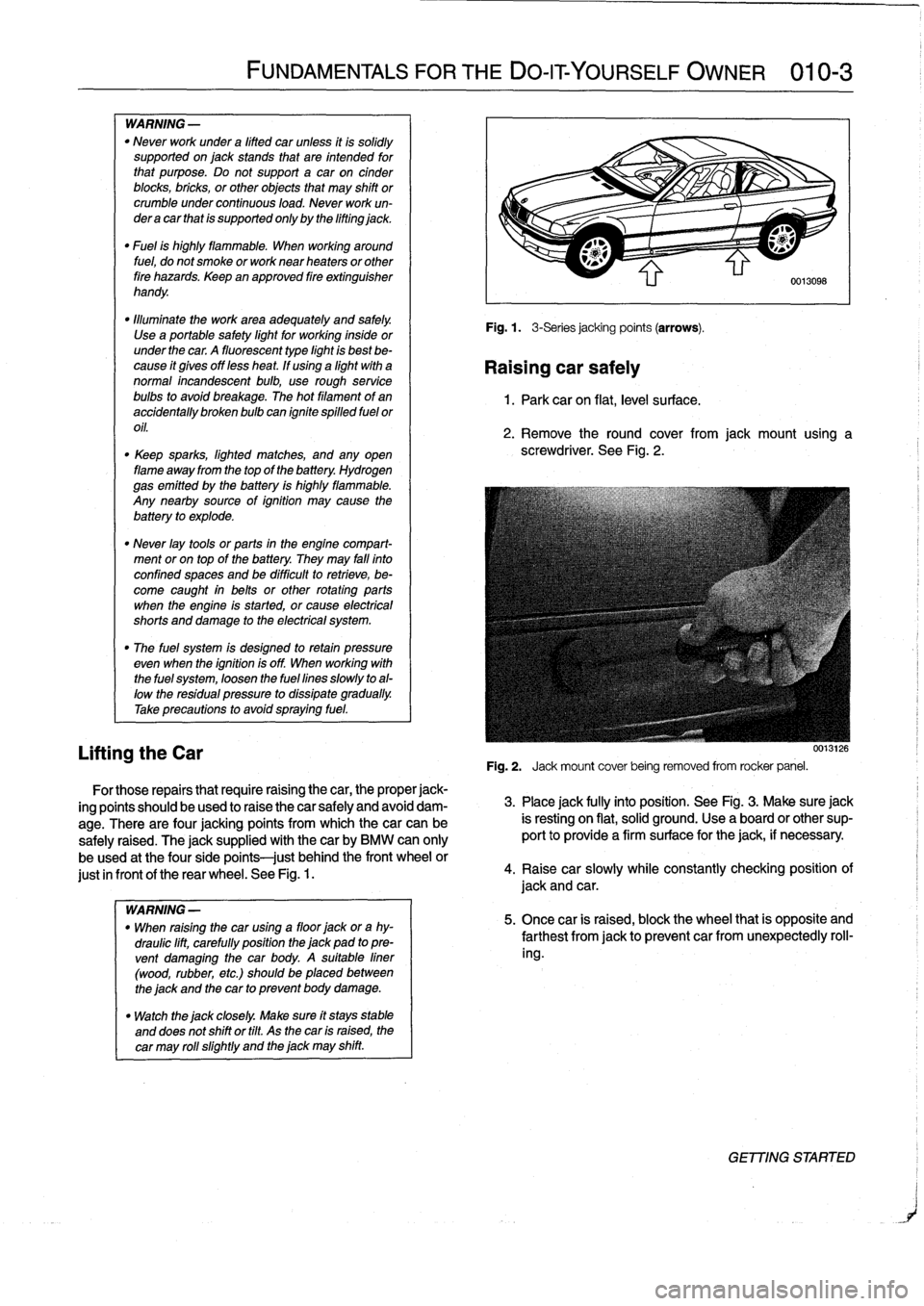
jacking
points
from
which
thecar
can
be
safely
raised
.
The
jacksupplied
with
thecar
by
BMW
can
only
be
used
at
the
fourside
points
just
behindthe
front
wheel
or
just
in
frontof
the
rear
wheel
.
See
Fig
.
1.
WARNING
-
"
When
raising
the
car
using
a
floor
jack
ora
hy-
draulic
lift,
carefully
position
the
jack
pad
topre-
vent
damaging
the
car
body
.
A
suitable
liner
(wood,
rubber,
etc
.)
should
be
placed
between
the
jack
and
the
car
to
prevent
body
damage
.
"
Watch
the
jack
closely
.
Make
sure
ft
stays
stable
and
does
not
shift
or
tilt
.
As
the
car
is
raised,
the
car
may
rol¡
slightly
and
the
jack
may
shift
.
Fig
.
1
.
3-Seriesjacking
points
(arrows)
.
Raising
car
safely
1
.
Park
car
on
flat,
leve¡
su
rface
.
2
.
Remove
the
round
cover
from
jack
mount
using
a
screwdriver
.
See
Fig
.
2
.
0013126
Fig
.
2
.
Jack
mount
cover
being
removed
from
rocker
panel
.
3
.
Place
jack
fully
into
position
.
See
Fig
.
3
.
Make
sure
jack
is
resting
on
flat,
solid
ground
.
Use
a
board
or
other
sup-
port
to
provide
a
firm
surface
for
the
jack,
if
necessary
.
4
.
Raisecar
slowly
while
constantly
checking
position
of
jack
and
car
.
5
.
Once
car
is
raised,
block
the
wheel
that
is
opposite
and
farthest
from
jackto
prevent
car
fromunexpectedly
roll-
ing
.
GET77NG
STARTER
Page 13 of 759
FUNDAMENTALS
FOR
THEDO-ITYOURSELF
OWNER
010-
5
WARNING
-
Avoid
getting
tools
or
clothing
near
the
battery
.
Bat-tery
electrolyte
is
a
corrosive
acid
.
Be
careful
with
brake
fluid,
as
it
can
damage
the
cars
paint
Finally,
keep
rubber
parts
such
as
hoses
and
bolts
free
from
oil
orgasoline,
as
they
will
cause
the
material
to
soften
and
fail
prematurely
.
Non-reusable
Fasteners
Many
fasteners
usedon
the
cars
coveredby
this
manual
mustbe
replaced
with
new
osesonce
they
are
removed
.
These
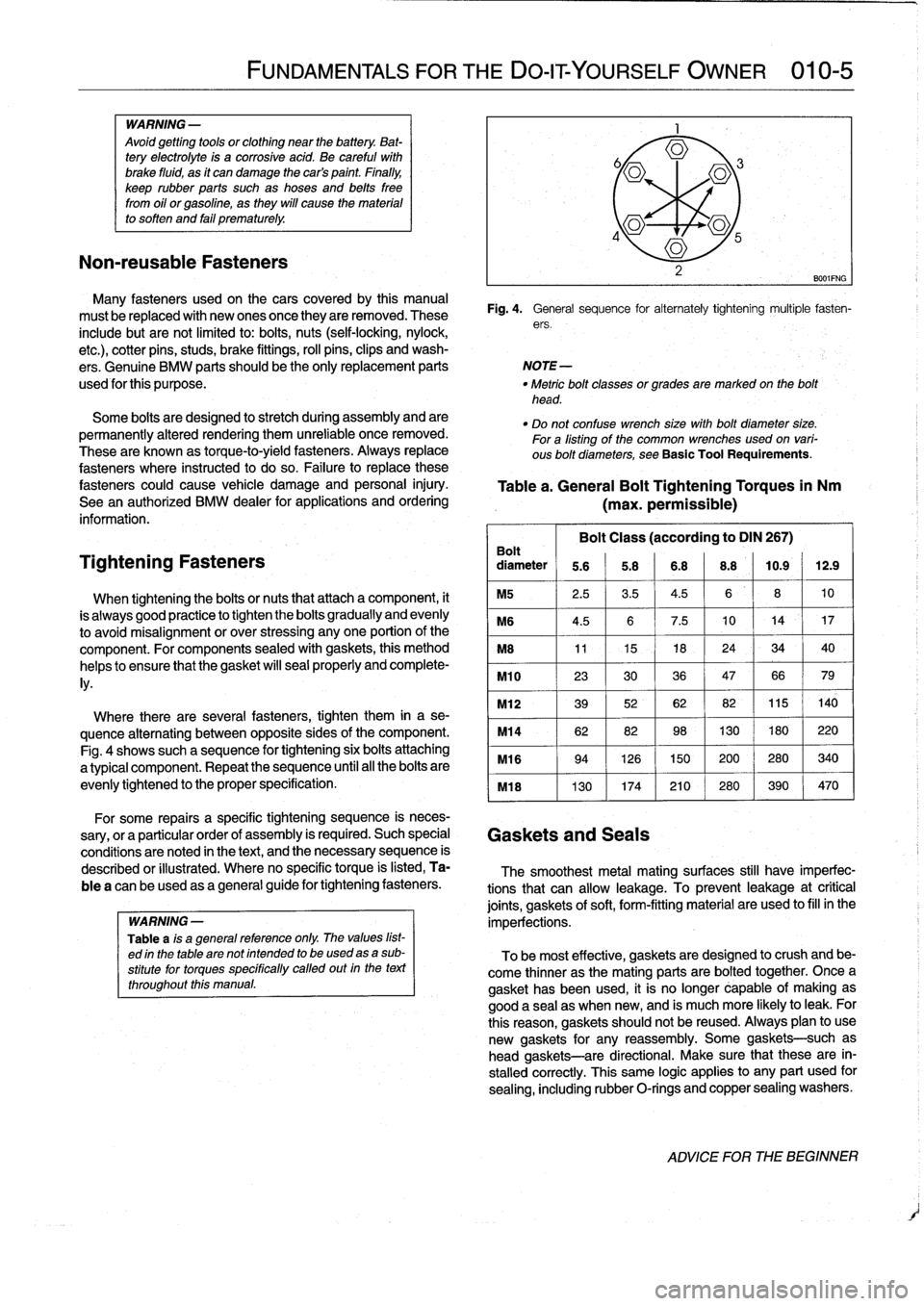
Fig
.
4
.
General
sequence
for
alternately
tightening
multiple
fasten-
include
butarenot
limited
to
:
bolts,
nuts
(self-locking,
nylock,
ers
.
etc
.),
cotterpins,
studs,
brake
fittings,
rol¡
pins,clips
and
wash-
ers
.
Genuine
BMW
parts
should
be
the
only
replacement
parts
NOTE-
used
for
this
purpose
.
"
Metric
bolt
classes
or
grades
are
markedon
the
bolt'
head
.
Some
bolts
are
designed
to
stretch
during
assembly
and
are
permanently
altered
rendering
them
unreliable
once
removed
.
These
are
known
as
torque-to-yield
fasteners
.
Always
replace
fasteners
where
instructed
to
doso
.
Failure
to
replace
these
fasteners
could
cause
vehicle
damage
and
personal
injury
.
See
an
authorized
BMW
dealer
for
applications
and
ordering
information
.
Tightening
Fasteners
When
tighteningthe
bolts
ornuts
that
attach
acomponent,
it
is
always
good
practice
to
tighten
the
bolts
gradually
and
evenly
to
avoid
misalignment
or
over
stressing
anyone
portion
of
the
component
.
For
components
sealed
with
gaskets,
this
method
helps
to
ensure
that
thegasket
will
seal
properly
and
complete-
ly
.
Where
there
are
severa¡
fasteners,
tighten
them
in
a
se-
quence
alternating
between
opposite
sides
of
the
component
.
Fig
.
4
shows
such
a
sequence
for
tightening
six
bolts
attaching
a
typical
component
.
Repeat
the
sequence
until
al¡
the
bolts
are
evenly
tightened
to
theproper
specification
.
"
Do
not
confuse
wrench
sizewithbolt
diameter
size
.
Fora
listing
of
the
common
wrenches
used
on
vari-
ous
bolt
diameters,
see
Basic
Tool
Requirements
.
Table
a
.
General
Bolt
Tightening
Torques
in
Nm
(max
.
permissible)
Bolt
Class
(according
to
DIN
267)
Bolt
diameter
5
.6
5
.8
6
.8
8
.8
10
.9
12
.9
M5
2
.5
3
.5
4
.5
6810
M6
4
.5
6
7
.5
10
14
`
17
M8
11
15
-
18
24
34
40
M10
233036476679
M12
3952
62
82115140
M14
6282
98
130
180220
M16
9426150
200280340
M18
130174210280
390
470
For
some
repairs
a
specific
tightening
sequence
is
neces-
sary,
or
a
particular
order
of
assembly
is
required
.
Such
special
Gaskets
and
Seals
conditions
are
noted
in
the
text,
and
the
necessary
sequence
is
described
or
illustrated
.
Where
no
specific
torque
is
listed,
Ta-
The
smoothest
metal
mating
surfaces
still
have
imperfec
blea
can
be
used
as
a
general
guide
for
tightening
fasteners
.
tions
that
can
allow
leakage
.
To
prevent
leakage
atcritica¡
joints,
gaskets
of
soft,
form-fitting
material
are
used
to
fill
in
the
WARNING
-
imperfections
.
Table
ais
a
general
reference
only
.
The
values
list-
ed
in
the
table
are
not
intended
to
be
used
asa
sub-
To
be
most
effective,
gaskets
are
designed
to
crush
and
be-
stitutefor
torques
specifically
called
out
in
the
text
come
thinner
as
the
mating
parts
are
bolted
together
.
Once
a
throughout
this
manual
.
gasket
has
been
used,
it
is
no
longer
capable
of
makingas
good
a
sea¡
as
when
new,
and
is
muchmore
likely
toleak
.
For
this
reason,
gaskets
should
not
be
reused
.
Always
plan
to
use
new
gaskets
for
any
reassembly
.
Some
gaskets-such
as
head
gaskets-are
directional
.
Make
sure
that
these
are
in-
stalled
correctly
.
This
same
logic
applies
to
any
part
used
for
sealing,
including
rubber
O-rings
and
copper
sealing
washers
.
ADVICE
FOR
THE
BEGINNER
Page 20 of 759
010-12
FUNDAMENTALSFOR
THE
DO-IT
YOURSELF
OWNER
Jump
Starting
Car
Cars
with
discharged
or
dead
batteries
can
be
jump-started
using
the
good
battery
from
another
car
.
When
jump-starting
the
engine,
always
note
the
following
warnings
.
WARNING
-
"
Battery
acid
(electrolyte)
can
cause
severe
burns,
and
will
damage
the
car
and
clothing
.
lf
electrolyte
is
spilled,
wash
the
surface
with
large
quantities
of
water
.
lfit
gets
finto
eyes,
flush
them
with
water
for
severa¡
minutes
and
cal¡
a
doctor
.
"
Batteries
produce
explosive
and
noxious
gas-
ses
.
Keep
sparks
and
flames
away
.
Do
not
smoke
near
batteries
.
"
Do
not
jump-start
the
engine
if
you
suspect
that
the
battery
is
frozen
.
Trapped
gas
may
explode
.
Allow
the
battery
to
thaw
first
.
"
Do
not
quick-charge
the
battery
(for
boost
start-
ing)for
longer
than
one
minute,
and
donot
ex-
ceed
15
volts
at
the
battery
with
the
boosting
cables
attached
.
Wait
at
least
one
minutebefore
boosting
the
battery
a
second
time
.
"
Some
electrical
system
'comfort"
features
may
not
function
correctly
once
battery
power
is
restored
.
For
example,
the
front
window
one-touch-up
func-
tion
may
be
disabled
.
Some
electrical
systems
will
need
to
be
reinitialized
Consult
the
appropriate
re-
pairgroup
formore
specific
information
.
1
.
Place
cars
close
together,
but
do
not
allow
them
to'touch
each
other
.
Turn
off
the
engine
of
thecar
with
the
good
battery
.
2
.
Connect
oneend
of
the
positive
(+)
cable
to
the
positive
(+)
post
of
the
good
battery
.
Remove
the
coverfromthe
positive
(B+)
junction
post
in
the
engine
compartment
of
the
dead
car
and
connect
the
other
end
of
the
posi-
tive
(+)
cable
to
the
junction
post
.
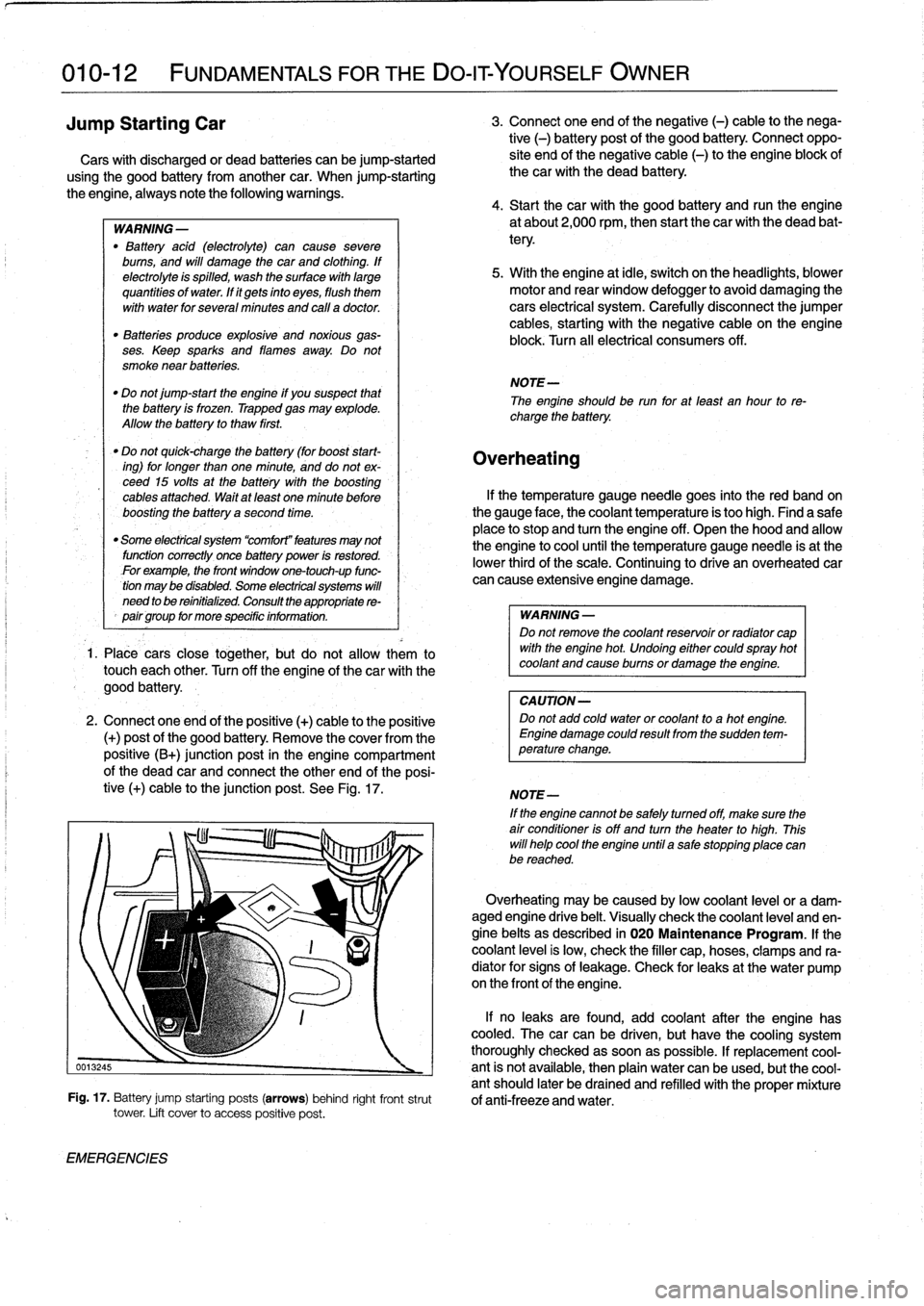
See
Fig
.
17
.
EMERGENCIES
3
.
Connect
one
end
of
the
negative
(-)
cable
to
the
nega-
tive
(-)
battery
post
of
the
good
battery
.
Connect
oppo-
site
end
of
the
negative
cable
(-)
to
the
engine
block
of
thecar
with
the
dead
battery
.
4
.
Start
thecar
with
the
good
battery
and
runthe
engine
at
about2,000
rpm,
then
start
the
car
with
the
dead
bat-
tery
.
5
.
With
the
engine
at
¡dle,
switch
on
the
headlights,
blower
motor
and
rear
window
defogger
to
avoid
damaging
the
cars
electrical
system
.
Carefully
disconnect
the
jumper
cables,
starting
with
the
negative
cable
on
the
engine
block
.
Turn
all
electrical
consumers
off
.
NOTE-
The
engineshould
be
run
for
at
least
an
hour
to
re-
charge
the
battery
.
Overheating
lf
the
temperature
gauge
needle
goes
into
the
red
band
on
the
gauge
face,
the
coolant
temperature
is
too
high
.
Find
a
safe
place
to
stop
and
turn
the
engine
off
.
Open
the
hood
and
allow
the
engine
to
cool
until
the
temperature
gauge
needle
is
at
the
lower
thirdof
the
scale
.
Continuing
to
drive
an
overheated
car
can
cause
extensive
engine
damage
.
WARNING
-
Do
not
remove
the
coolant
reservoir
or
radíator
cap
with
the
engine
hot
.
Undoing
either
couldspray
hot
coolant
and
cause
burns
or
damage
the
engine
.
CAUTION-
Do
not
add
cold
water
or
coolant
to
a
hot
engine
.
Engine
damage
could
result
from
the
sudden
tem-
perature
change
.
NOTE-
If
the
enginecannot
be
safely
tumed
off,
make
sure
the
air
condifioner
isoff
and
turn
the
heater
to
high
.
This
will
helo
cool
the
engine
until
a
salestopping
place
canbe
reached
.
Overheating
may
be
caused
bylow
coolant
leve¡
or
a
dam-aged
engine
drive
belt
.
Visually
check
the
coolant
leve¡
and
en-
gine
belts
as
described
in
020
Maintenance
Program
.
lf
the
coolant
leve¡
is
low,
check
the
filler
cap,hoses,
clamps
and
ra-
diator
for
signs
of
leakage
.
Check
for
leaks
at
the
water
pump
on
the
frontof
theengine
.
lf
no
leaks
are
found,
add
coolant
after
the
engine
has
cooled
.
The
carcan
be
driven,
but
have
the
cooling
system
thoroughly
checked
assoonas
possible
.
lf
replacement
cool
0013245
-
ant
is
not
available,
then
plain
water
canbe
used,
butthe
cool-
antshould
later
be
drained
and
refilled
with
theproper
mixture
Fig
.
17
.
Battery
jump
starting
posts
(arrows)
behind
right
frontstrut
of
anti-freeze
and
water
.
tower
.
Lift
cover
to
access
positive
post
.
Page 21 of 759
If
steam
is
coming
from
the
engine
compartment
thenthere
is
With
the
engine
and
ignition
off,
check
for
loose
or
corroded
most
likely
a
burst
coolant
hose
or
a
large
leak
in
the
cooling
battery
cables
or
wires
at
the
battery
or
thealtemator
.
Discon-
system
.
To
find
the
leak,
look
for
signs
of
coolant
leakage
on
necting,
cleaning,
and
reinstalling
corroded
wires
and
connec-
hoses,
at
hose
connections,
or
on
the
radiator
.
Let
theengine
tors
may
solve
the
problem
.
Also
check
drive
belt
tension
as
cool
thoroughly,
then
add
coolant
or
water
to
fill
the
system
and
described
in
020
Maintenance
Program
.
start
the
engine
.
If
a
great
deal
of
water
or
coolant
flows
out
of
the
hole,
then
thecarshouldnot
be
driven
until
repairs
are
made
.
lf
there
is
slight
seepage,
then
it
may
be
possible
to
drive
TOWi
ng
a
short
distance,
adding
coolant
as
needed
.
The
cars
covered
by
this
manual
should
be
towed
witha
tow
truck
using
wheel
lift
or
flat
bed
equipment
.
Do
not
tow
thecar
on
all
four
wheels
except
for
very
short
distances
to
move
it
to
a
safe
place
.
If
thered
engine
oil
pressure
warning
light
illuminates,
imme-
diately
stop
thecar
and
turn
off
the
engine
.
Have
the
vehicle
A
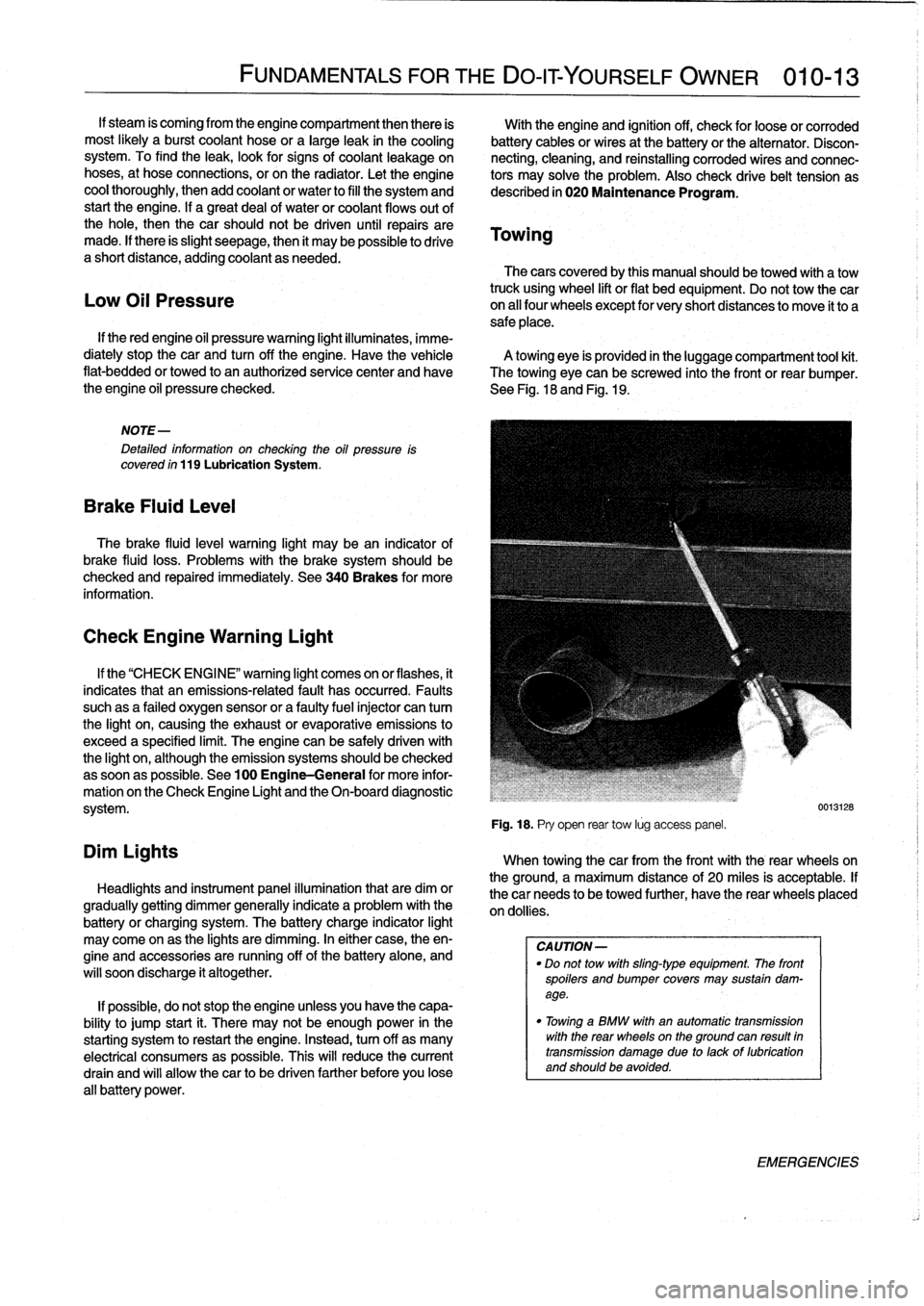
towing
eye
is
provided
in
the
luggage
compartment
tool
kit
.
flat-bedded
or
towed
to
an
authorized
service
center
and
have
The
towing
eye
can
be
screwed
into
the
front
or
rear
bumper
.
the
engine
oil
pressure
checked
.
See
Fig
.
18
and
Fig
.
19
.
Low
Oil
Pressure
NOTE-
Detafed
information
on
checking
the
oil
pressure
is
covered
ín
119
Lubrication
System
.
Brake
Fluid
Leve¡
The
brake
fluid
leve¡
warning
light
may
bean
indicator
of
brake
fluid
loss
.
Problems
with
the
brakesystem
should
be
checked
and
repaired
immediately
.
See
340Brakes
for
more
information
.
Check
Engine
Warning
Light
Dim
Lights
FUNDAMENTALS
FOR
THE
DO-IT
YOURSELF
OWNER
010-13
If
the
"CHECK
ENGI
NE"
warning
light
comes
on
or
flashes,
it
indicates
that
an
emissions-related
fault
has
occurred
.
Faults
suchas
a
failed
oxygen
sensor
or
a
faultyfuelinjector
can
tum
the
light
on,
causing
the
exhaust
or
evaporative
emissions
to
exceed
a
specified
limit
.
The
engine
can
be
safely
driven
with
the
light
on,
although
the
emission
systems
should
be
checked
assoonas
possible
.
See
100
Engine-General
for
more
infor-
mation
on
the
Check
Engine
Light
and
the
On-board
diagnostic
system
.
Headlights
and
instrument
panel
illuminationthat
are
dim
or
gradually
getting
dimmer
generally
indicate
a
problem
with
the
battery
or
charging
system
.
The
battery
charge
indicator
light
may
come
on
as
the
lights
are
dimming
.
In
either
case,
theen-
gine
and
accessories
are
running
off
of
the
battery
alone,
and
will
soon
discharge
it
altogether
.
If
possible,
do
not
stop
the
engine
unless
you
have
the
capa-
bility
to
jump
start
¡t
.
There
may
not
be
enough
power
in
the
starting
system
torestart
the
engine
.
Instead,turn
off
as
many
electrical
consumers
as
possible
.
This
will
reduce
the
current
drain
and
will
allow
thecar
to
be
driven
farther
before
you
lose
all
battery
power
.
Fig
.
18
.
Pry
open
rear
tow
lúg
access
panel
.
When
towingthecar
from
the
front
with
the
rear
wheelson
the
ground,
a
maximum
distance
of
20
miles
is
acceptable
.
If
thecar
needs
to
be
towed
further,
have
the
rear
wheels
placed
on
dollies
.
CA
UTION-
"
Do
not
tow
with
sling-type
equipment
The
front
spoilers
andbumper
covers
may
sustain
dam-
age
.
"
Towínga
BMW
with
an
automatic
transmission
with
the
rear
wheelson
the
ground
can
resuft
in
transmission
damage
due
to
lackof
lubrication
and
should
be
avoided
.
0013128
EMERGENCIES
Page 22 of 759
010-14
FUNDAMENTALS
FOR
THE
DO-ITYOURSELF
OWNER
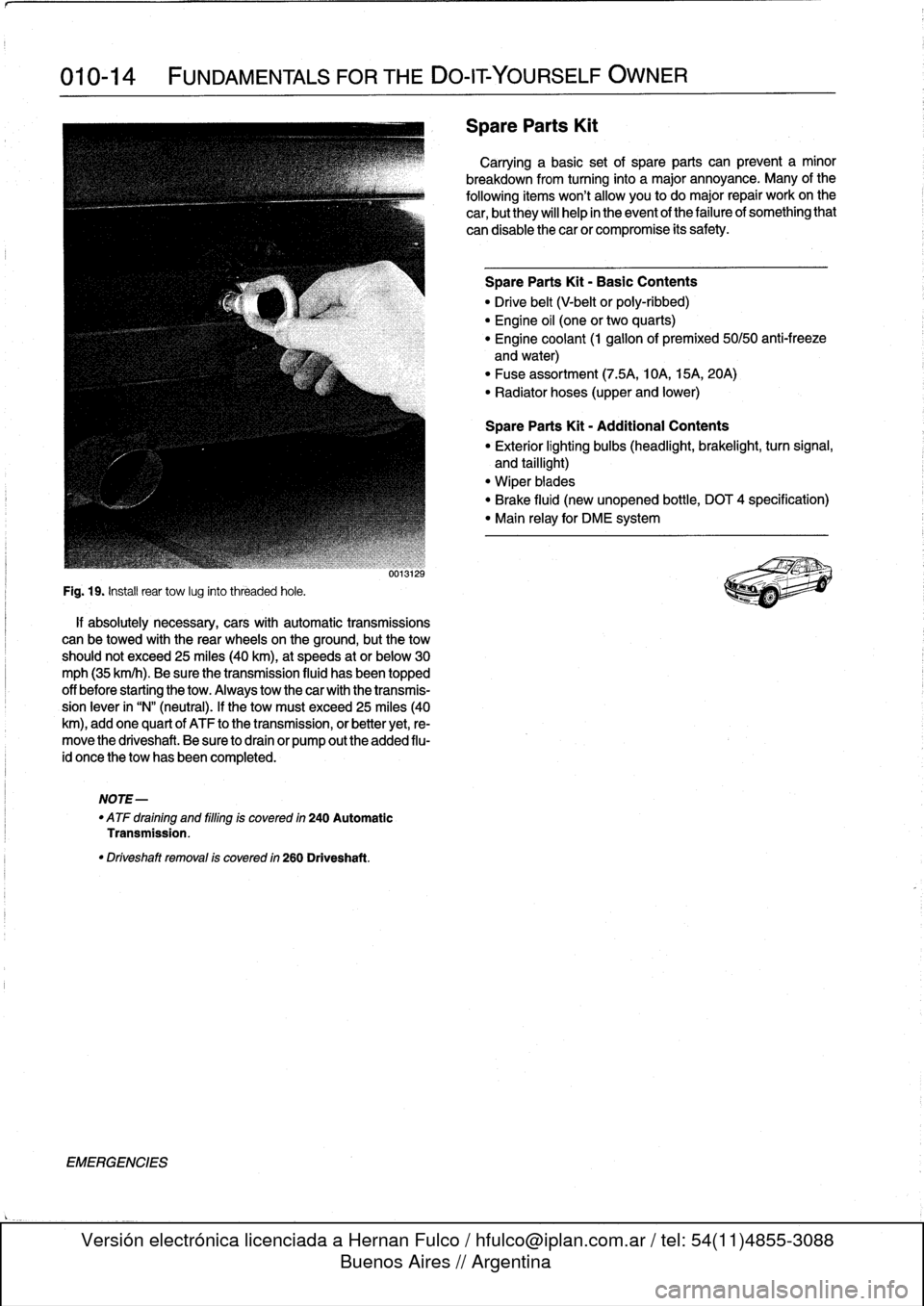
Fig
.
19
.
Instaf
rear
tow
lug
into
threaded
hole
.
if
absolutely
necessary,
cars
with
automatic
transmissions
can
be
towed
with
the
rear
wheels
on
the
ground,
butthe
tow
should
not
exceed
25
miles
(40
km),at
speeds
at
or
below30
mph
(35
km/h)
.
Be
sure
the
transmission
fluid
hasbeen
topped
off
before
starting
the
tow
.
Always
tow
thecar
with
the
transmis-
sion
lever
in
"N"
(neutral)
.
If
the
tow
must
exceed25
miles
(40
km),
add
one
quart
of
ATF
to
the
transmission,
or
better
yet,
re-
move
the
driveshaft
.
Be
sure
to
drain
or
pump
outthe
added
flu-
id
once
the
tow
has
been
completed
.
NOTE-
"
ATF
draining
and
filling
is
covered
in
240
Automatic
Transmission
.
"
Driveshaft
removal
is
covered
in
260
Driveshaft
.
EMERGENCIES
úo1W¿b
Spare
Parts
Kit
Carrying
a
basic
set
of
spare
parts
can
prevent
a
minor
breakdown
from
turning
into
a
major
annoyance
.
Many
of
the
following
itemswon't
allow
you
todo
major
repair
workon
the
car,
but
they
will
help
in
the
event
of
the
failure
of
something
that
can
disable
thecar
or
compromise
its
safety
.
Spare
Parts
Kit
-
Basic
Contents
"
Drive
belt
(V-belt
or
poly-ribbed)
"
Engine
oil
(one
or
two
quarts)
"
Engine
coolant
(1
gallonof
premixed
50/50
anti-freeze
and
water)
"
Fuse
assortment
(7
.5A,
10A,
15A,
20A)
"
Radiator
hoses
(upper
and
lower)
Spare
Parts
Kit
-
Additional
Contents
"
Exterior
lighting
bulbs
(headlight,
brakelight,
turn
signal,
and
taillight)
"
Wiper
biades
"
Brake
fluid
(new
unopened
bottle,
DOT
4
specification)
"
Main
relay
for
DME
system
Page 26 of 759
020-
4
MAINTENANCE
PROGRAM
L
~
~
c
.c
a
a>
mL
~
~L
L
w
a
£
'S
d
E
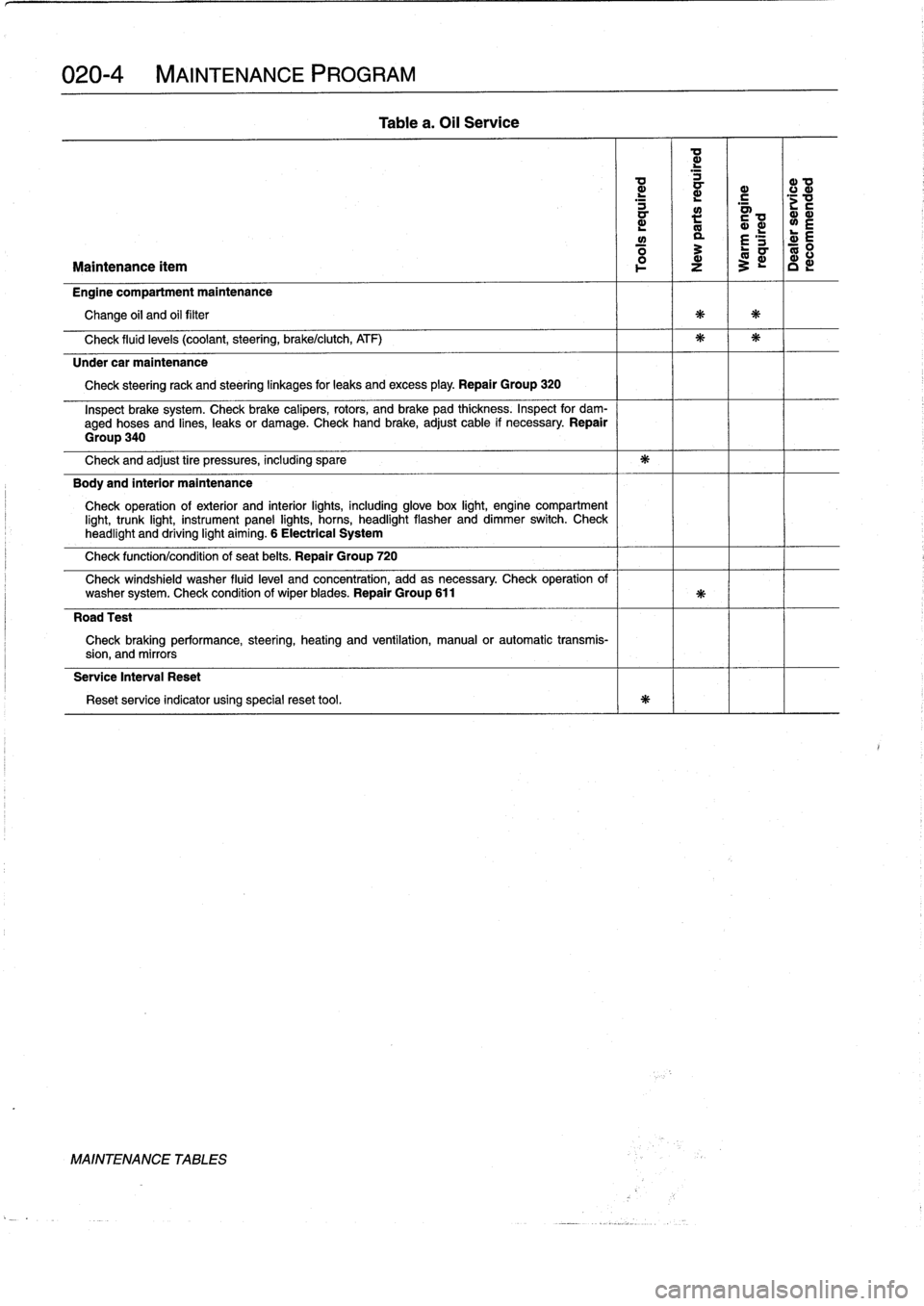
Maintenance
ítem
z
3
c
Engine
compartment
maintenance
Change
oil
and
oil
filter
Check
fluid
levels
(coolant,steering,
brake/clutch,
ATF)
Under
car
maintenance
Check
steeringrack
and
steeringlinkages
for
leaks
andexcess
play
.
Repair
Group
320
Inspect
brake
system
.
Check
brake
calipers,
rotors,
and
brake
pad
thíckness
.
Inspect
for
dam-
aged
hoses
and
lines,
leaks
or
damage
.
Check
hand
brake,adjust
cable
if
necessary
.
Repair
Group
340
Check
and
adjust
tire
pressures,
including
spare
Body
and
interior
maintenance
Check
operation
of
exterior
and
interior
lights,
including
glove
box
light,
engine
compartment
light,
trunk
light,
instrument
panel
lights,
horns,
headlight
flasher
anddimmer
switch
.
Check
headlight
and
driving
light
aiming
.
6
Electrical
System
Check
function/condition
of
seat
belts
.
Repair
Group
720
Check
windshield
washer
fluid
level
and
concentration,
add
as
necessary
.
Check
operation
of
washer
system
.
Check
condition
of
wiper
blades
.
Repair
Group
611
Road
Test
Check
braking
performance,
steering,
heating
and
ventilation,
manual
or
automatic
transmis-
sion,
and
mirrors
Service
Interval
Reset
Reset
service
indicator
using
specialreset
tool
.
MAINTENANCE
TABLES
Table
a
.
Oil
Service
Page 27 of 759
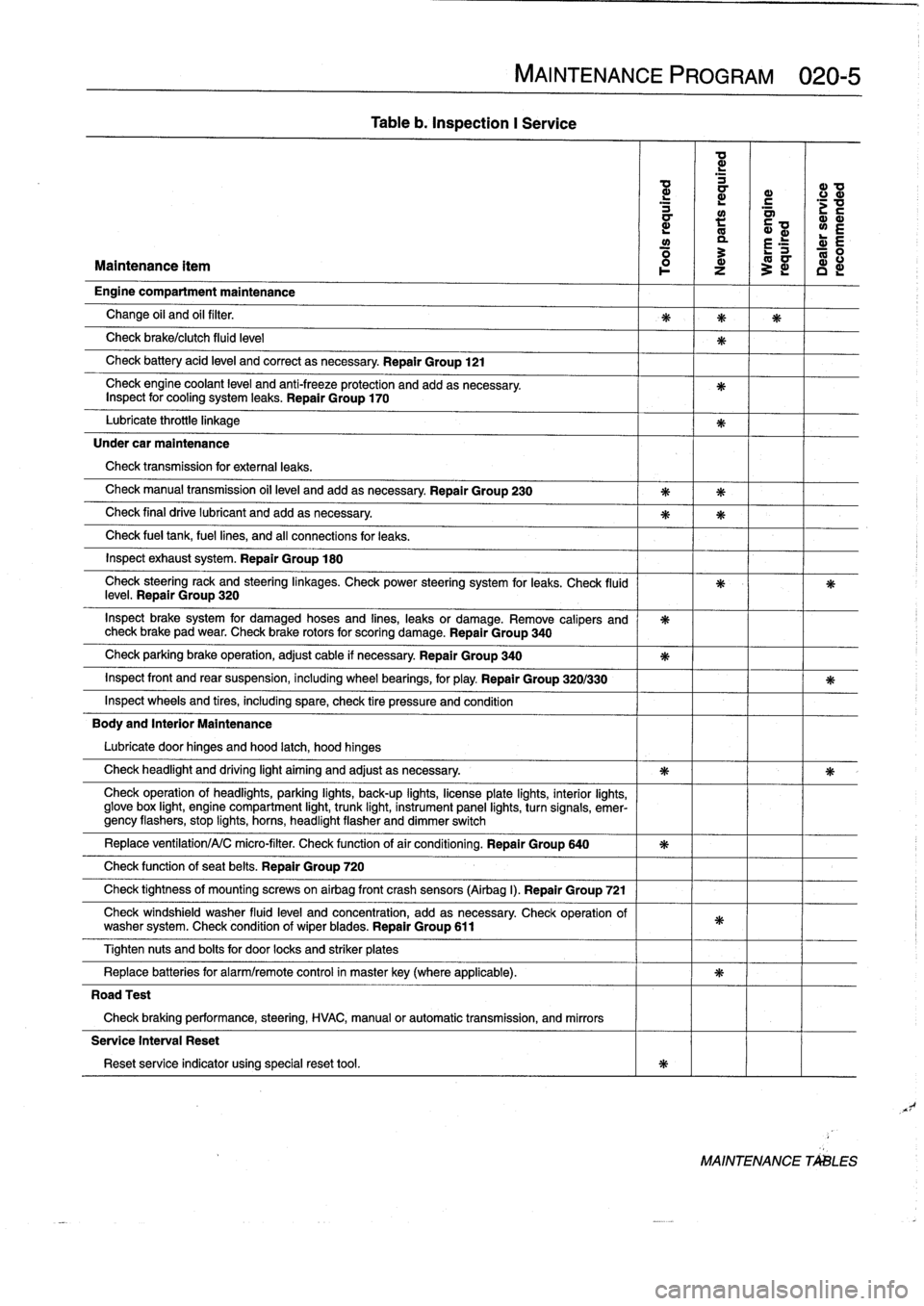
Table
b
.
Inspection
I
Service
MAINTENANCE
PROGRAM
020-5
ad
d
d
ID
a
r
c
d
a~
;v
a
:
Q~
wE
y
a
r
E
R
:
L-
0
Maintenance
ítem
1
z
3
~
c
d
Engine
compartment
maintenance
Change
oil
and
oil
filter
.
Check
brake/clutch
fluid
leve¡
Check
battery
acid
leve¡
and
correct
asnecessary
.
Repair
Group
121
Check
engine
coolant
level
and
anti-freeze
protection
and
addasnecessary
.
Inspect
for
cooling
system
leaks
.
Repair
Group
170
Lubricate
throttie
linkage
Under
car
maintenance
Check
transmission
for
externa¡
leaks
.
Check
manual
transmission
oil
leve¡
andadd
asnecessary
.
Repair
Group
230
Check
final
drive
lubricant
and
addasnecessary
.
Check
fue¡
tank,
fuel
lines,
and
all
connections
for
leaks
.
Inspect
exhaust
system
.
Repair
Group
180
Check
steeringrack
and
steeringlinkages
.
Check
power
steering
system
for
leaks
.
Check
(luid
leve¡
.
Repair
Group
320
Inspect
brake
system
for
damaged
hoses
and
fines,
leaks
or
damage
.
Remove
calipers
and
check
brake
pad
wear
.
Check
brake
rotors
for
scoring
damage
.
Repair
Group
340
Check
parking
brake
operation,
adjust
cable
if
necessary
Repair
Group
340
Inspect
front
and
rear
suspension,
including
wheel
bearings,
for
play
.
Repair
Group
320/330
Inspect
wheelsand
tires,
including
spare,
check
tire
pressure
and
condition
Body
and
Interior
Maintenance
Lubricate
door
hinges
and
hood
latch,
hood
hinges
Check
headlight
and
driving
light
aiming
and
adjust
as
necessary
.
Check
operation
of
headlights,
parking
lights,
back-up
fights,
licenseplate
lights,
interior
lights,
glove
box
light,
engine
compartment
light,
trunk
light,
instrument
panel
lights,
turnsignals,
emer-gency
flashers,
stop
fights,
horas,
headlight
flasher
and
dimmer
switch
Replace
ventilation/A/C
micro-filter
.
Check
functionof
air
conditioning
.
Repair
Group
640
Check
function
of
seat
belts
.
Repair
Group
720
Check
tightness
of
mountfng
screws
on
airbag
front
crash
sensors
(Airbag
I)
.
Repair
Group
721
Check
windshield
washer
fluid
leve¡
and
concentration,
add
as
necessary
Check
operation
of
washer
system
.
Check
condition
of
wiperblades
.
Repair
Group
611
Tighten
nuts
and
bolts
for
door
locks
and
striker
plates
Replace
batteries
for
alarm/remote
control
in
masterkey(where
applicable)
.
Road
Test
Check
braking
performance,
steering,
HVAC,
manual
or
automatic
transmission,
and
mirrors
Service
Interval
Reset
Reset
service
indicator
using
specialreset
tool
.
MAINTENANCE
TALES
Page 28 of 759
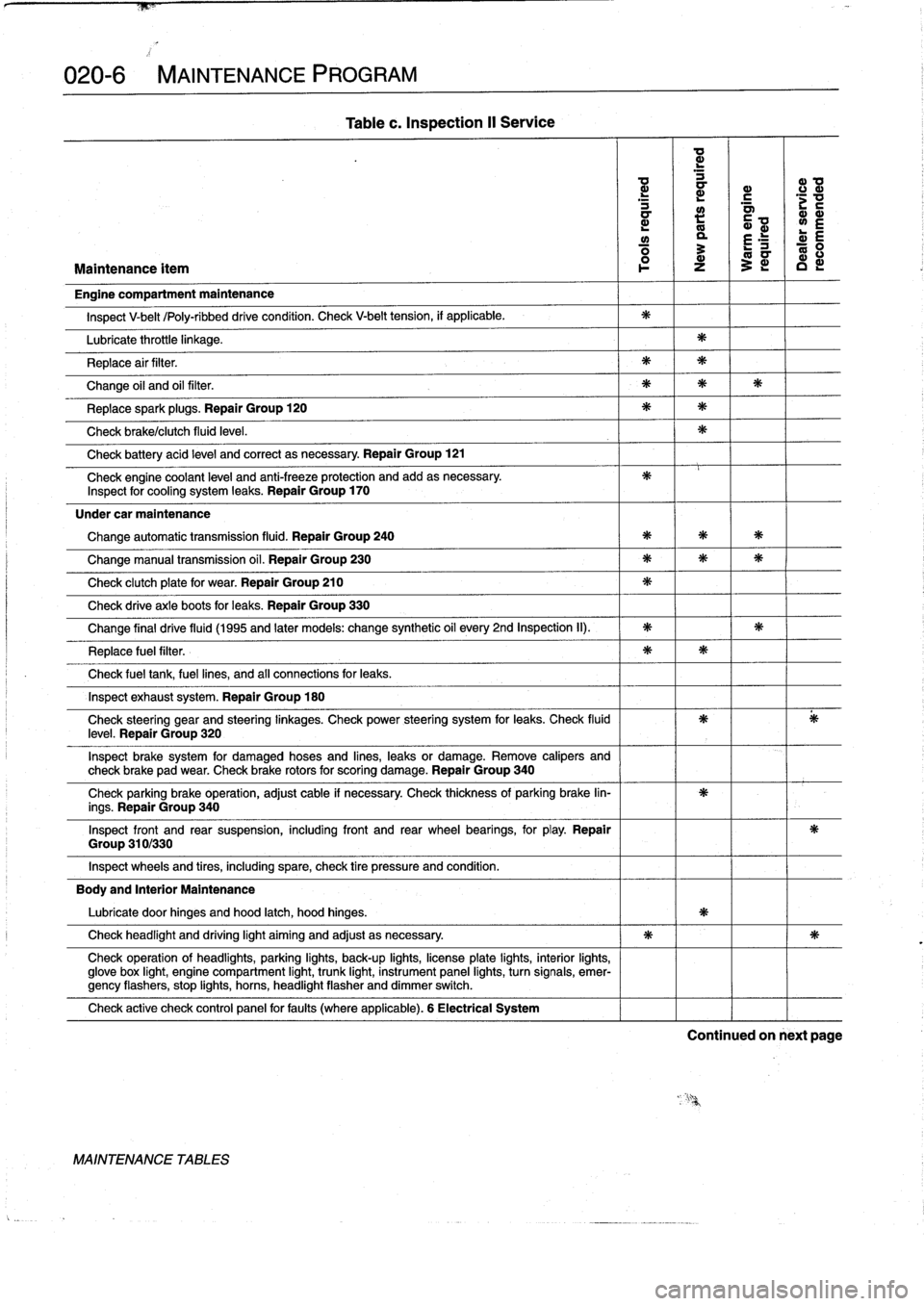
020-6
MAINTENANCE
PROGRAM
Group
310/330
Table
c
.
Inspection
II
Service
a
d
d
a
a>
0
d
a
r
.c
mm
L
m
y
L
E
ó
3
E
ó
Maintenance
ítem
l
o-
z
~
c
Engine
compartment
maintenance
Inspect
V-belt
/Poly-ribbeddrive
condition
.
Check
V-belt
tension,
if
applicable
.
Lubricate
throttle
linkage
.
Replace
air
filter
.
Change
oil
and
oil
filter
.
Replacespark
plugs
.
Repair
Group
120
Check
brake/clutch
fluid
leve¡
.
Check
battery
acid
leve¡
and
correct
asnecessary
.
Repair
Group
121
Check
engine
coolant
leve¡
and
anti-freeze
protection
and
add
asnecessary
.
Inspect
for
cooling
system
leaks
.
Repair
Group
170
Under
car
maintenance
Change
automatic
transmission
fluid
.
Repair
Group
240
Change
manual
transmission
oil
.
Repair
Group
230
Check
clutch
plate
for
wear
.
Repair
Group
210
Check
drive
axle
boots
for
leaks
.
Repair
Group
330
Change
final
drive
fluid
(1995
and
later
models
:
change
synthetic
oil
every
2nd
Inspection
II)
.
Replace
fuel
filter
.
Check
fuel
tank,
fuel
lines,
and
af
connections
for
leaks
.
Inspect
exhaust
system
.
Repair
Group
180
Check
steering
gear
and
steering
¡inkages
.
Check
power
steering
system
for
leaks
.
Check
fluidleve¡
.
Repair
Group
320
Inspect
brake
system
for
damaged
hoses
and
lines,
leaks
or
damage
.
Remove
calipers
and
check
brake
pad
wear
.
Check
brake
rotors
for
scoring
damage
.
Repair
Group
340
Check
parking
brake
operation,
adjust
cable
if
necessary
.
Check
thickness
of
parking
brake
lin-
ings
.
Repair
Group
340
Inspect
front
and
rear
suspension,
including
front
and
rear
wheel
bearings,
for
play
.
Repair
Inspect
wheels
and
tires,
including
spare,
check
tire
pressure
and
condition
.
Body
and
Interior
Maintenance
Lubricate
door
hinges
and
hood
latch,
hood
hinges
.
Check
headlight
and
driving
light
aiming
and
adjust
asnecessary
.
Check
operation
of
headlights,
parking
lights,
back-up
lights,
licenseplate
lights,
interior
lights,
glove
box
light,
engine
compartment
light,
trunk
light,
instrument
panel
lights,
turn
signals,
emer-gency
flashers,
stop
lights,
horns,
headlight
flasher
anddimmer
switch
.
Check
active
check
control
panel
forfauits
(where
applicable)
.
6
Electrical
System
MAINTENANCE
TABLES
Continued
on
next
page