maintenance BMW 328I 2000 User Guide
[x] Cancel search | Manufacturer: BMW, Model Year: 2000, Model line: 328I, Model: BMW 328I 2000Pages: 189, PDF Size: 1.81 MB
Page 131 of 189
131n
IndexDataTechnologyRepairsCar careControlsOverview
The BMW Maintenance System has
been designed as a reliable means of
providing maximum driving and operat-
ing safety Ð and as cost-effectively as
possible for you. Technical innovations
have made it possible to reduce main-
tenance costs significantly compared to
earlier models.
Please keep in mind that regular main-
tenance is not only necessary for the
safety of your vehicle, but also plays a
significant role in maintaining the resale
value of the vehicle. 460us112
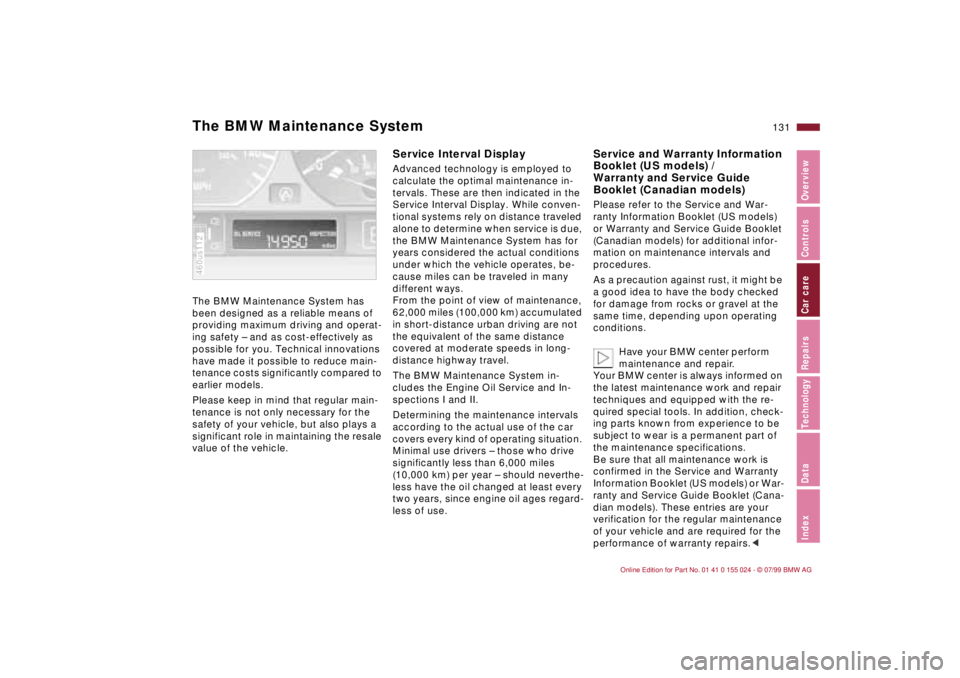
Service Interval DisplayAdvanced technology is employed to
calculate the optimal maintenance in-
tervals. These are then indicated in the
Service Interval Display. While conven-
tional systems rely on distance traveled
alone to determine when service is due,
the BMW Maintenance System has for
years considered the actual conditions
under which the vehicle operates, be-
cause miles can be traveled in many
different ways.
From the point of view of maintenance,
62,000 miles (100,000 km) accumulated
in short-distance urban driving are not
the equivalent of the same distance
covered at moderate speeds in long-
distance highway travel.
The BMW Maintenance System in-
cludes the Engine Oil Service and In-
spections I and II.
Determining the maintenance intervals
according to the actual use of the car
covers every kind of operating situation.
Minimal use drivers Ð those who drive
significantly less than 6,000 miles
(10,000 km) per year Ð should neverthe-
less have the oil changed at least every
two years, since engine oil ages regard-
less of use.
Service and Warranty Information
Booklet (US models) /
Warranty and Service Guide
Booklet (Canadian models) Please refer to the Service and War-
ranty Information Booklet (US models)
or Warranty and Service Guide Booklet
(Canadian models) for additional infor-
mation on maintenance intervals and
procedures.
As a precaution against rust, it might be
a good idea to have the body checked
for damage from rocks or gravel at the
same time, depending upon operating
conditions.
Have your BMW center perform
maintenance and repair.
Your BMW center is always informed on
the latest maintenance work and repair
techniques and equipped with the re-
quired special tools. In addition, check-
ing parts known from experience to be
subject to wear is a permanent part of
the maintenance specifications.
Be sure that all maintenance work is
confirmed in the Service and Warranty
Information Booklet (US models) or War-
ranty and Service Guide Booklet (Cana-
dian models). These entries are your
verification for the regular maintenance
of your vehicle and are required for the
performance of warranty repairs.<
The BMW Maintenance System
Page 133 of 189

133n
IndexDataTechnologyRepairsCar careControlsOverview
Caring for your carExterior finish To provide effective corrosion protec-
tion, multilayer paintwork is applied at
the factory. Cataphoretic immersion
priming techniques are supplemented
using special body-cavity protectants,
with the application of specially-devel-
oped and extensively tested materials.
A layer of flexible PVC is first applied
to the undercarriage. Following this, a
comprehensive undercoating treat-
ment with a wax-based protectant is
applied. Regular maintenance makes
an important contribution to maintaining
the safety and value of your vehicle.
Increasing awareness of the effects of
harmful environmental factors on vehi-
cle finishes have urged paint and vehi-
cle manufacturers to initiate ongoing
programs designed to further improve
the durability of their finishes. Despite
this, environmental factors that occur
locally or regionally can have negative
effects on the finish of your vehicle.
These should guide you in determining
the frequency and extent of your efforts
to maintain the vehicle finish.
Depending upon material and type of
impact (perforation of paint layer), phys-
ical stresses from sand, road salt, gravel, etc., can cause corrosion to
start extending beneath the finish, start-
ing at the point of impact.
Road dirt, tar spots, dead insects, ani-
mal droppings (strong alkali effect) and
tree excretions (resins and pollen) all
contain substances capable of causing
damage when allowed to remain on the
finish of your vehicle for any period of
time. This includes spots, etching, flak-
ing, and separations in the top coat.
In industrial areas, deposits of flue dust,
lime, oily soot, precipitation containing
sulfur-dioxide (acid rain) and other envi-
ronmental pollutants will damage the
car's finish unless adequate care is pro-
vided Ð even though this is generally
limited to the outside horizontal sur-
faces.
In coastal regions, high levels of atmo-
spheric salt and humidity promote cor-
rosion.
In tropical zones, temperatures of over
105 7 (40 6) in the shade prevail, in
addition to heavy ultraviolet radiation
and high humidity. Under those condi-
tions, light paints can reach tempera-
tures up to 175 7 (80 6) and dark
paints up to 250 7 (120 6).
Caring for the vehicle finish Regular washing is a preventive mea-
sure against long-term effects from
substances that are harmful to the vehi-
cle's finish, especially if you drive your
vehicle in areas with high levels of air
pollution or aggressive natural sub-
stances (tree resins, pollen).
Nevertheless, you should immediately
remove especially aggressive sub-
stances. Failure to do so can lead to
changes in the paint's chemical struc-
ture or to discoloration. Gasoline spilled
during refueling, oil, grease and brake
fluid should always be cleaned away
immediately, as should bird droppings.
Any contamination remaining on the
surface of the vehicle will be especially
conspicuous after washing. Use clean-
ing fluid or alcohol with a clean cloth or
cotton pad to remove. Remove tar spots
with tar remover. After cleaning, the
affected areas should be waxed to
ensure continued protection.
Use cleaning and car-care
products that you can obtain at
your BMW center.<
Page 141 of 189
Overview
Controls and features
Operation, care
and maintenance
Owner service procedures
Technical data
Index Advanced technology
141n
IndexDataTechnologyRepairsCar careControlsOverview
Replacement procedures:
Onboard tool kit142
Windshield wiper blades142
Lamps and bulbs142
Changing a wheel149
Battery152
Fuses154
Microfilter155
In case of electrical
malfunction:
Fuel filler door156
Sliding/Tilt sunroof156
Assistance, giving and
receiving:
Jump-starting157
Towing the vehicle158
Repairs
Page 153 of 189
153n
IndexDataTechnologyRepairsCar careControlsOverview
BatteryBattery careThe battery is absolutely maintenance-
free, that is, the original electrolyte will
normally last for the service life of the
battery under moderate climatic condi-
tions.
For all questions that regard the
battery, please consult your BMW
center. Since the battery is mainte-
nance-free, the following is for your
information only.
comply with the corresponding precau-
tions whenever you work with or near
the battery.
Before handling the battery,
please read the following infor-
mation.
Wear eye protection. Do not
allow particles containing bat-
tery acid or lead to come into
contact with your eyes, your skin, or
your clothing.
Battery acid is extremely corro-
sive. Wear eye protection and
protective gloves. Do not tip the
battery. Battery acid can leak from the
ventilation openings.
Do not allow children access to
batteries and battery acid.
Never allow sparks or open
flame in the vicinity of the bat-
tery. Avoid sparks from electri-
cal cables or electrical equipment. Turn
the key to position 0 in the steering lock
when disconnecting or connecting the
battery. Do not short-circuit the battery
terminals. This creates a risk of injury
from high-energy sparks.
A highly-explosive gas is gener-
ated when the battery is charged.
If battery acid is splashed into
your eyes, rinse them thor-
oughly with clear water for at
least 15 minutes. Consult a physician
immediately. If your skin or clothing are
splashed by acid, rinse immediately
with ample clear water. If electrolyte is
accidentally swallowed, consult a phy-
sician immediately.
In order to protect the battery
case from ultraviolet radiation,
do not place it in direct sunlight.
A discharged battery can freeze. Store
the battery in areas where temperature
remains above freezing.
Removal and installation
Do not disconnect the battery
when the engine is running. If you
do so, the ensuing voltage surge will
damage the vehicle's onboard electron-
ics.
Do not make any modifications in the
wires to the positive terminal. If you do
so, the protective function of the safety
battery terminal is no longer ensured.
Repair and disposal must be performed
by trained technicians only.<
When removing the battery, disconnect
the cable on the negative terminal first,
then the cable on the positive terminal.
Loosen the center adjusting screw on
the battery retaining strap (use the
screwdriver included with the onboard
tool kit) and disconnect the strap.
When installing a battery, connect the
positive terminal first, then connect the
negative terminal.
When installing a battery, be sure
that it is mounted properly and
that the retaining bracket is installed
with the center adjustment screw. If this
is not done, the battery will not be ade-
quately secured in case of an acci-
dent.<
Page 161 of 189
Overview
Controls and features
Operation, care
and maintenance
Owner service procedures
Technical data
Index Advanced technology
161n
IndexDataTechnologyRepairsCar careControlsOverview
Adaptive Transmission Control
(ATC)162
Airbags163
Dynamic Stability Control
(DSC)163
Radio reception164
Safety belt tensioner164
Interior rearview mirror
with automatic dimming
feature165
Rain sensor166
Tire Pressure Control (RDC)167
Self-diagnostics168
Xenon lamps169
Technol-
Page 168 of 189
168n
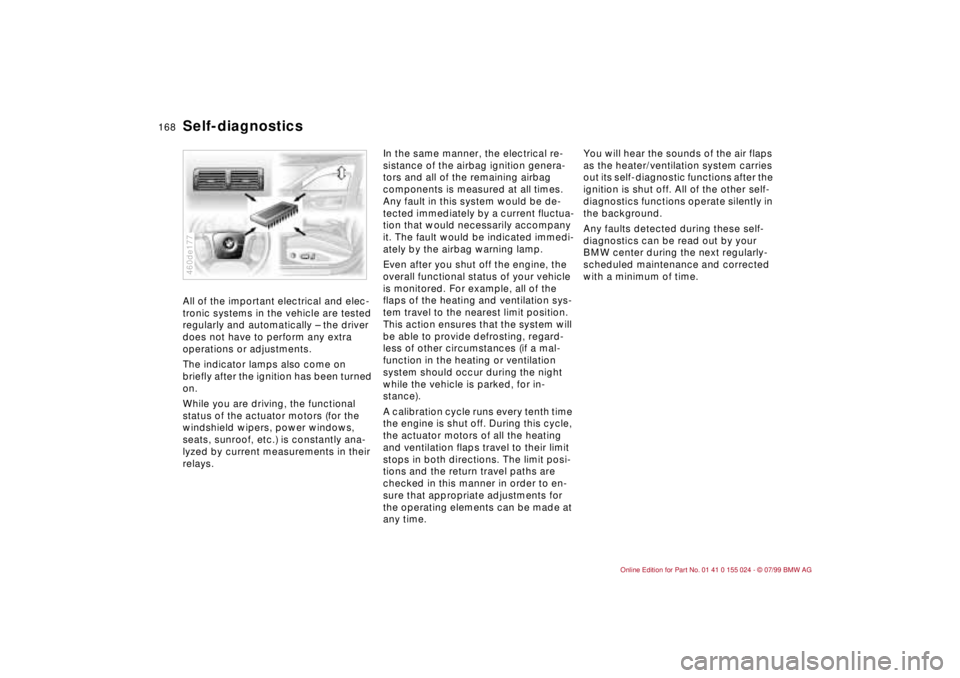
Self-diagnostics All of the important electrical and elec-
tronic systems in the vehicle are tested
regularly and automatically Ð the driver
does not have to perform any extra
operations or adjustments.
The indicator lamps also come on
briefly after the ignition has been turned
on.
While you are driving, the functional
status of the actuator motors (for the
windshield wipers, power windows,
seats, sunroof, etc.) is constantly ana-
lyzed by current measurements in their
relays.460de177
In the same manner, the electrical re-
sistance of the airbag ignition genera-
tors and all of the remaining airbag
components is measured at all times.
Any fault in this system would be de-
tected immediately by a current fluctua-
tion that would necessarily accompany
it. The fault would be indicated immedi-
ately by the airbag warning lamp.
Even after you shut off the engine, the
overall functional status of your vehicle
is monitored. For example, all of the
flaps of the heating and ventilation sys-
tem travel to the nearest limit position.
This action ensures that the system will
be able to provide defrosting, regard-
less of other circumstances (if a mal-
function in the heating or ventilation
system should occur during the night
while the vehicle is parked, for in-
stance).
A calibration cycle runs every tenth time
the engine is shut off. During this cycle,
the actuator motors of all the heating
and ventilation flaps travel to their limit
stops in both directions. The limit posi-
tions and the return travel paths are
checked in this manner in order to en-
sure that appropriate adjustments for
the operating elements can be made at
any time.You will hear the sounds of the air flaps
as the heater/ventilation system carries
out its self-diagnostic functions after the
ignition is shut off. All of the other self-
diagnostics functions operate silently in
the background.
Any faults detected during these self-
diagnostics can be read out by your
BMW center during the next regularly-
scheduled maintenance and corrected
with a minimum of time.
Page 171 of 189
Overview
Controls and features
Operation, care
and maintenance
Technical data
Index Advanced technology
171n
IndexDataTechnologyRepairsCar careControlsOverview
Engine data172
Dimensions173
Weights174
Capacities175
Electrical system176
Ribbed V-belt176
Data
Owner service procedures
Page 179 of 189
Overview
Controls and features
Operation, care
and maintenance
Owner service procedures
Technical data
Index Advanced technology
179n
IndexDataTechnologyRepairsCar careControlsOverview
Everything from A to Z180
Owner service procedures186
Index
Page 182 of 189

Everything from A to ZGlove compartment lamp
bulb replacement148
Gross vehicle weight174HHandbrake63
Handsfree system95
Hazard warning flashers25
Hazard warning triangle25
Head restraint48
Headlamp covers,
care132, 143
Headlamp flasher83
Headlamp washer
system124, 175
Headlamp washers70
Heated seats91
Heavy loads99
Height173
HiFi system Ð harman
kardon92
High beams23, 68, 83
bulb replacement143
Hood release120
Horn17
Hubcap150IIce warning76
Icy roads76
Identification, tires116Ignition key32
Ignition lock61
Indicator lamps20
Inflated pressure27, 113
Inflation pressure
monitoring80, 167
INSPECTION74
Installing a child restraint
system60
Instrument cluster18
Instrument lighting82
Instrument panel18
Interaxle tire rotation115
Interface socket96
for Onboard
Diagnostics139
Interference
cellular phones112
Interior lamps36, 83
bulb replacement147
remote control36
Interior motion sensor42
Interior rearview mirror52
automatic dimming
feature53, 165
Interlock61
Intermittent wipe68
JJack149
Jump-starting157
KKey Memory53
Keys32
with remote control32LLAMPS ON warning82
Lashing eyes99
Leather care136
Length173
License plate lamp
bulb replacement147
Light switch82
Light-alloy wheels118
Lighter96
Load-securing devices99
Louvers86
Low beam headlamps82
Low beams
bulb replacement143
Lug bolts150
Lug wrench149
Luggage compartment41
capacity174
floor mat41
floor panel41
remote control37
Luggage compartment
lamps
bulb replacement148Luggage compartment
lid39
emergency release39
securing separately39
Luggage compartment
lighting39
Luggage rack100
Lumbar support49
MM+S tires117
Maintenance74, 131
Malfunction displays75
Manual transmission64
Manually controlled
recirculated-air89
Memory50
MFL (Multifunction steering
wheel)24
Microfilter90, 155
Mirror memory50
Mirrors52
Mobile phones112
Modifications,
technical6, 138
Multifunction steering wheel
(MFL)24NNeckrest48
Page 186 of 189

Owner service proceduresAActivated-charcoal filter,
changing155
Adding brake fluid129
Adding engine coolant128
Adding engine oil125BBackup lamps
bulb replacement145
Battery
add distilled water153
charging154
Brake lamps
bulb replacement145
Brakes, brake faults109CChanging a tire149
Changing a wheel149
Check Control75
Checking air pressure27
Checking engine oil
level125
Checking oil level125DDefrosting the windows89
Difficult steering111
Doors, emergency
operation34
EElectrical accessories,
failure154
Electrical malfunction
fuel filler door156
sliding/tilt sunroof156
Emergency operation
doors34
fuel filler door156
sliding/tilt sunroof156
Engine oil
add125
quality126
specifications126
viscosity126FFailure messages75
Fault displays75
First aid25
First-aid kit25
Fittings, towing and
tow-starting158
Flat tire149
Footwell lamps
bulb replacement148
Front fog lamps
bulb replacement145
Fuses, replacing154GGlove compartment lamp
bulb replacement148
HHazard warning flashers25
Hazard warning triangle25
Headlamp cover, care143
High beams
bulb replacement143IIndicator lamps20
Inflated pressure27, 113
Interior lamps
bulb replacement147
Interior motion sensor,
switching off43JJack149LLicense plate lamp
bulb replacement147
Low beams
bulb replacement143
Lug wrench149
Luggage compartment
lamps
bulb replacement148
Luggage compartment lid,
emergency release39
MMaintenance131
Malfunction displays75
Microfilter, changing155OOil
quality126
specifications126
viscosity126
Onboard tool kit142PPressure, tires27RRear lamps145
Releasing the fuel filler door
following an electrical
malfunction156
Releasing the hood120
Removing condensation
from the windows89
Replacement key32
Replacing bulbs142
Replacing lamp bulbs142
Replacing windshield wiper
blades142
Replacing wiper blades142
Return used batteries154
Owner service procedures