light BMW 330Ci CONVERTIBLE 2001 E46 Service Manual
[x] Cancel search | Manufacturer: BMW, Model Year: 2001, Model line: 330Ci CONVERTIBLE, Model: BMW 330Ci CONVERTIBLE 2001 E46Pages: 215, PDF Size: 2.1 MB
Page 126 of 215

126n
Brake systemBrake fluid level
The brake warning lamp comes
on with the parking brake
released:
The brake fluid level is too low in the
reservoir (refer to page 148).
If the brake fluid level is too low and
brake pedal travel has become notice-
ably longer, there may be a defect in
one of the hydraulic circuits of the
brake system.
Brake warning lamp for Cana-
dian models.
Proceed to the nearest BMW
center. Higher brake application
pressure may be necessary under these
conditions, and brake pedal travel may
be significantly longer. Please
remember to adapt your driving style
accordingly.<
Brake pads
The brake pads warning lamp
lights up:
Only the minimum pad thick-
ness still remains on the brake pads.
Proceed to the nearest BMW center
as soon as possible to have the pads
replaced.
For your own safety: use only
brake pads that BMW has
approved for your particular vehicle
model. BMW cannot evaluate non-
approved brake pads to determine if
they are suited for use, and therefore
cannot ensure the operating safety of
the vehicle if they are installed.<
Page 130 of 215
130n
Hardtop
*
It is not necessary to remove the fabric
top even in the winter, when the
hardtop is generally in constant use.
But you can remove it at any time
without difficulty. Before the fabric top
is stored in the convertible top well, it
must be absolutely dry in order to avoid
water spots and mildew from forming.
The hardtop offers reading lamps and
clothing hooks that can be used by
pressing lightly. In addition, a roof-rack
assembly is possible. In this regard,
please contact your BMW center.
When hanging clothing from the
hooks, be sure that they do not
obstruct the driver's vision. Do not hang
heavy objects on the hooks. If you do
so, they could cause personal injury
during braking or evasive maneuvers.<
Two persons are required for installa-
tion or removal. Work with extreme
caution in order to avoid paint damage
and damage to the body or hardtop.
To facilitate hardtop installation or
removal, you can obtain a specially
designed hardtop lift
* or hardtop cart
*
at your BMW center.
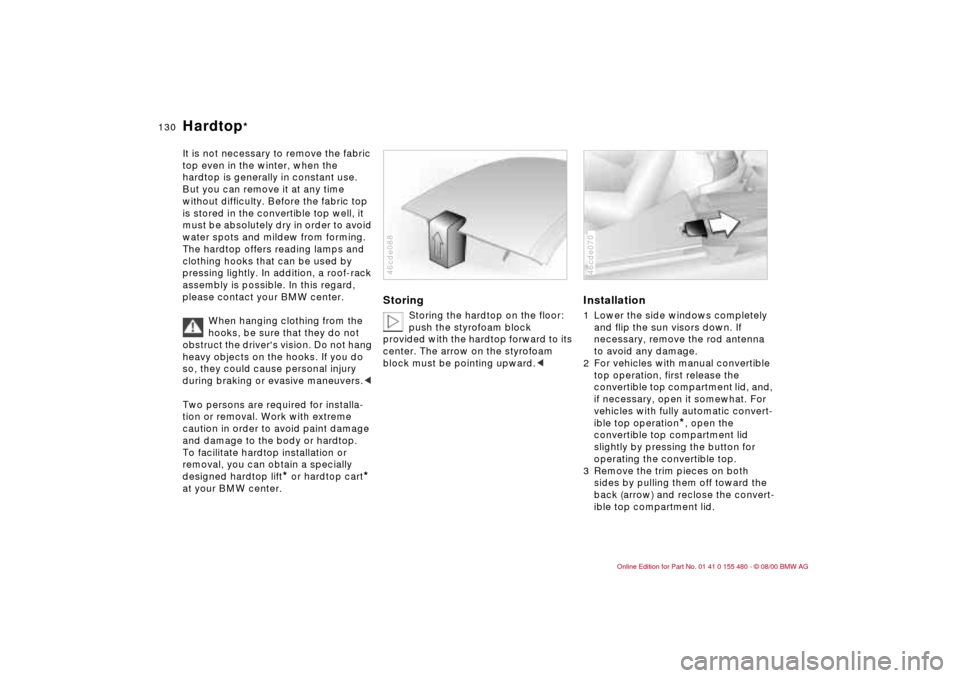
Storing
Storing the hardtop on the floor:
push the styrofoam block
provided with the hardtop forward to its
center. The arrow on the styrofoam
block must be pointing upward.<
46cde088
Installation1 Lower the side windows completely
and flip the sun visors down. If
necessary, remove the rod antenna
to avoid any damage.
2 For vehicles with manual convertible
top operation, first release the
convertible top compartment lid, and,
if necessary, open it somewhat. For
vehicles with fully automatic convert-
ible top operation
*, open the
convertible top compartment lid
slightly by pressing the button for
operating the convertible top.
3 Remove the trim pieces on both
sides by pulling them off toward the
back (arrow) and reclose the convert-
ible top compartment lid.
46cde070
Page 131 of 215
131n
IndexDataTechnologyRepairsCar careControlsOverview
Hardtop
*
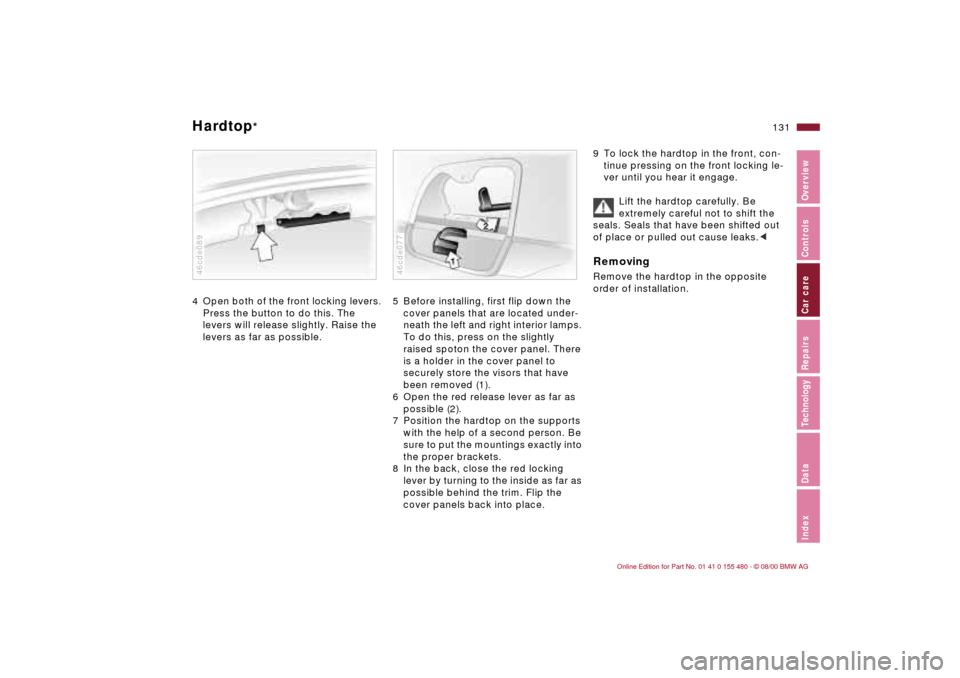
4 Open both of the front locking levers.
Press the button to do this. The
levers will release slightly. Raise the
levers as far as possible.46cde089
5 Before installing, first flip down the
cover panels that are located under-
neath the left and right interior lamps.
To do this, press on the slightly
raised spoton the cover panel. There
is a holder in the cover panel to
securely store the visors that have
been removed (1).
6 Open the red release lever as far as
possible (2).
7 Position the hardtop on the supports
with the help of a second person. Be
sure to put the mountings exactly into
the proper brackets.
8 In the back, close the red locking
lever by turning to the inside as far as
possible behind the trim. Flip the
cover panels back into place.46cde077
9 To lock the hardtop in the front, con-
tinue pressing on the front locking le-
ver until you hear it engage.
Lift the hardtop carefully. Be
extremely careful not to shift the
seals. Seals that have been shifted out
of place or pulled out cause leaks.cRemovingRemove the hardtop in the opposite
order of installation.
Page 135 of 215

135n
IndexDataTechnologyRepairsCar careControlsOverview
Wheel and tire combinations The right choice Use only BMW-approved tires, begin-
ning on page 137.
Due to the high speeds this vehicle can
reach, the use of specific brands,
specifications and sizes is mandatory.
Consult any BMW center for details.
Comply with local/national regulations.
The correct wheel/tire combina-
tion has an effect on the different
systems such as ABS, ATC, ASC+T/
DSC
and ADB/DBC whose functioning
would be otherwise impaired if the
incorrect wheel/tire combinations were
used.
For this reason, use only tires of the
same manufacture and tread configura-
tion. In the event of a flat tire, for
example, remount the approved wheel/
tire combination as soon as possible.<
Codes on the tires and wheels The tire codes will aid you in selecting
the correct tire.
The codes on radial tires:
The speed rating indicates the approved
maximum speed for the tire.
Summer tires:
S = up to112 mph (180 km/h)
T = up to 118 mph (190 km/h)
H = up to 130 mph (210 km/h)
V = up to 150 mph (240 km/h)
W = up to 167 mph (270 km/h)
Y = up to 187 mph (300 km/h)
ZR = over 150 mph (240 km/h) Example:
Nominal width
in mm
Aspect ratio in X
Radial tire ID code
Rim diameter in inches
Load rating
(not on ZR tires)
Speed rating
(before R on ZR tires)
225/50 R
1692W
Winter tires and all-season tires:
Q M+S = up to 100 mph (160 km/h)
T M+S = up to 118 mph (190 km/h)
H M+S = up to 130 mph (210 km/h)
Codes stamped on light-alloy wheels:
Protect tire valve from dirt by using
screw-on valve stem caps. Dirt in the
valves frequently leads to slow leaks. Example:
Rim width
in inches
Code letter for
flange type
Symbol for full-drop
center rim
Rim diameter in inches
Hump on the 2 rim shoulders
7 x 16 H 2
J
Page 136 of 215

136n
Winter tiresChoosing the right tireBMW recommends winter tires (M+S
radial tires) for driving in adverse winter
road conditions. So-called all-season
tires with the M+S identification mark
do indeed possess better winter trac-
tion than summer tires that have the H,
V, W, Y and ZR speed ratings, but they
generally fail to provide the same levels
of performance as winter tires.
In the interest of safe tracking and
steering response, install winter tires
made by the same manufacturer having
the same tread configuration on all four
wheels.
Mount only winter tires which have
been approved by BMW. Any BMW
center will be glad to provide you with
information on the best winter tires for
every particular driving condition.
Do not exceed specified
maximum speeds
Never exceed the maximum speed
for which the tires are rated.
Unprofessional attempts by laymen to
service tires can lead to damage and
accidents.
Have this work performed by skilled
professionals only. Any BMW center
has the required technical knowledge
and the proper equipment and will be
happy to assist you.<
Tire condition, tire pressureWinter tires display a perceptible loss in
their ability to cope with winter driving
conditions once the tread wears to
below 0.16 in (4 mm), and therefore in
the interest of safety, should be
replaced.
Comply with the specified tire inflation
pressures Ð and be sure to have the
wheel and tire assemblies balanced
every time you change the tires.
StorageAlways store tires in a cool, dry place.
Store them away from light whenever
possible. Protect the tires against
contact with oil, grease and fuel.Snow chains
*
Use narrow-link BMW snow chains
on
winter tires only in pairs and only on the
rear wheels. Comply with all manufac-
turer's safety precautions when
mounting the chains.
Page 137 of 215

137n
IndexDataTechnologyRepairsCar careControlsOverview
Approved wheel and tire specifications Tire specifications Steel wheel Light-alloy wheel
BMW 325Ci
All season tires
205/55 R 16 91 H M+S 7Jx16 7Jx16
205/50 R 17 93 V M+S extra load 7Jx17 7Jx17
Summer tires
205/55 R 16 91 V
225/50 R 16 92 W
225/50 ZR 16Ð 7Jx16
205/50 R 17 93 W extra load Ð 7Jx17
225/45 R 17 91 W Ð 8Jx17
Front: 225/45 ZR 17
Rear: 245/40 ZR 17Ð
Ð7.5Jx17
8.5Jx17
Winter tires
205/55 R 16 91 Q M + S
225/50 R 16 92 Q M + S7Jx16 7Jx16
205/50 R 17 93 Q M+S extra load 7Jx17 7Jx17
225/45 R 17 91 Q M + S Ð 8Jx17
Space-saver spare tire
T 115/90 R 16 92 M 3.0Bx16 Ð
T 125/90 R 16 98 M 3.5Bx16 Ð
T 125/80 R 17 99 M 3.5Bx17 Ð
Observe the specifications for tires and wheels in the vehicle documents.
If sizes not approved by the manufacturer are mounted, an entry in the
vehicle documents may be necessary.
Light-alloy wheels are the only wheels
permissible for summer tires.Snow chains
** * *
You cannot mount snow chains with the
following tires:
225/50 R 16 92 W
225/50 R 16 92 Q M+S
225/50 ZR 16
225/45 R 17 91 W
225/45 R 17 91 Q M+S
225/40 ZR 17Mixed tiresFor details concerning tire makes for
mixed tires, refer to the vehicle docu-
ments.
Page 138 of 215

138n
Approved wheel and tire specificationsTire specifications Steel wheel Light-alloy wheel
BMW 330Ci
All season tires
205/50 R 17 93 V M+S extra load 7Jx1717 7Jx17
Summer tires
205/50 R 17 93 W extra load Ð 7Jx17
225/45 R 17 91 W Ð 8Jx17
Front: 225/45 ZR 17
Rear: 245/40 ZR 17Ð
Ð7.5Jx17
8.5Jx17
Winter tires
205/50 R 17 93 Q/V M+S extra load 7Jx17 7Jx17
225/45 R 17 91 Q M + S Ð 8Jx17
Space-saver spare tire
T 125/80 R 17 99 M 3.5Bx17 Ð
Observe the specifications for tires and wheels in the vehicle's documents.
If you install tire sizes not approved by the manufacturer, an entry in the
vehicle documents may be necessary.
Light-alloy wheels are the only wheels
permissible for summer tires.Snow chainsYou cannot mount snow chains with the
following tires:
225/45 R 17 91 W
225/45 R 17 91 Q M+S
245/40 ZR 17Mixed tiresFor details concerning tire makes for
mixed tires, refer to the vehicle docu-
ments.
Page 148 of 215
148n
Coolant Brake fluidAdding coolant Wait until the engine cools before
removing the cap from the expansion
tank. The needle of the coolant temper-
ature gauge in the instrument cluster
must be located in the blue zone. If it
is not, there is a danger of scalding.
1 Turn the cap slightly counterclock-
wise in order to allow accumulated
pressure to escape. Then open.
2 If the coolant is low, slowly add
coolant until the correct level is
reached Ð do not overfill.
The coolant is a mixture of water and
extended-duty antifreeze with corrosion
inhibitor. Always maintain the
prescribed all-season 50:50 mixture
ratio for year-round protection against
internal corrosion. No other additives
are required.
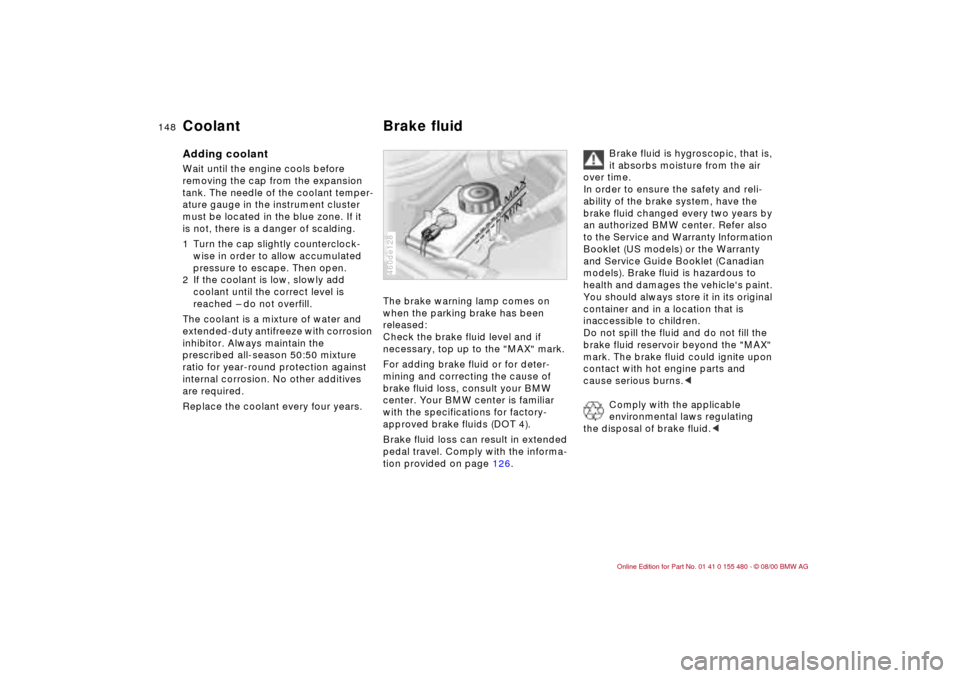
Replace the coolant every four years.The brake warning lamp comes on
when the parking brake has been
released:
Check the brake fluid level and if
necessary, top up to the "MAX" mark.
For adding brake fluid or for deter-
mining and correcting the cause of
brake fluid loss, consult your BMW
center. Your BMW center is familiar
with the specifications for factory-
approved brake fluids (DOT 4).
Brake fluid loss can result in extended
pedal travel. Comply with the informa-
tion provided on page 126.
460de128
Brake fluid is hygroscopic, that is,
it absorbs moisture from the air
over time.
In order to ensure the safety and reli-
ability of the brake system, have the
brake fluid changed every two years by
an authorized BMW center. Refer also
to the Service and Warranty Information
Booklet (US models) or the Warranty
and Service Guide Booklet (Canadian
models). Brake fluid is hazardous to
health and damages the vehicle's paint.
You should always store it in its original
container and in a location that is
inaccessible to children.
Do not spill the fluid and do not fill the
brake fluid reservoir beyond the "MAX"
mark. The brake fluid could ignite upon
contact with hot engine parts and
cause serious burns.<
Comply with the applicable
environmental laws regulating
the disposal of brake fluid.<
Page 151 of 215

151n
IndexDataTechnologyRepairsCar careControlsOverview
Washing your vehicle You can have your BMW washed in
an automatic car wash, even when it
is new. Car wash systems that do not
employ brushes are preferable, refer to
page 157.
Wipe away tough dirt and loosen and
remove dead insects before washing
the vehicle.
In order to avoid spots, do not wash the
vehicle when the hood is warm, or
during or immediately after exposure to
strong sunlight.
When using an automatic car wash, be
sure that:
>The car wash system is suited for the
dimensions of your vehicle.
>No damage will occur on vehicles
with attached body accessories (such
as spoilers or antennas). Consult the
car wash operator if necessary.
>The wheels and tires of your vehicle
cannot be damaged by the convey-
ance devices of the car wash system.
>The vehicle is cleaned with minimum
brush pressure, and that ample water
is available for washing and rinsing.Vehicles with rain sensor:
Clean the windshield regularly. Wax
from automatic car washes or insects
can cause malfunctions in the function
of the rain sensor.
Deactivate the rain sensor when
going through car washes (refer to
page 77) Ñ otherwise, the wipers could
be damaged if they inadvertently start
working.<
Parts of the vehicle that are inaccessi-
ble to the automatic washer Ð such as
door sills, door and hood edges, etc. Ð
should be cleaned by hand.
In the winter months, it is especially
important to be sure that the vehicle is
washed on a regular basis. Large quan-
tities of dirt and road salt are difficult to
remove, and they also damage the
vehicle.
If spray wands or high-pressure
washers are used, be sure to
maintain an adequate distance between
the spray source and the vehicle's sur-
face. Inadequate distance and exces-
sive pressure can damage or weaken
the finish, making it more susceptible to
subsequent attack. In addition,
moisture could penetrate to vehicle
components, leading to long-term
damage.<
When cleaning the headlamps,
please observe the following: do
not wipe dry with a cloth (scratches).
Never use abrasives or strong solvents
to clean the covers. Remove dirt and
contamination (such as insects) by
soaking with BMW Car Shampoo and
then rinsing with plenty of water.
Always use a deicer spray to remove
accumulated ice and snow Ð never use
a scraper.<
After washing the vehicle, apply
the brakes briefly to dry them.
Braking efficiency might otherwise be
reduced by the moisture and the brake
rotors could also be corroded.<
Caring for your vehicle
Page 152 of 215

152n
Caring for your vehicleExterior finish To provide effective corrosion protec-
tion, multilayer paintwork is applied at
the factory. Cataphoretic immersion
priming techniques are supplemented
using special body-cavity protectants,
with the application of specially-devel-
oped and extensively tested materials.
A layer of flexible PVC is first applied to
the undercarriage. Following this, a
comprehensive undercoating treat-
ment with a wax-based protectant is
applied. Regular maintenance makes
an important contribution to maintaining
the safety and value of your vehicle.
Increasing awareness of the effects
of harmful environmental factors on
vehicle finishes have led paint and
vehicle manufacturers to initiate
ongoing programs designed to further
improve the durability of their finishes.
Despite this, environmental factors that
occur locally or regionally can have
negative effects on the finish of your
vehicle. Use the factors to determine
the frequency and extent of your efforts
to maintain the vehicle finish.Depending upon material and type of
impact (perforation of paint layer),
physical stresses from sand, road salt,
gravel, etc., can cause corrosion to
start extending beneath the finish,
starting at the point of impact.
Road dirt, tar spots, dead insects,
animal droppings (strong alkali effect)
and tree excretions (resins and pollen)
all contain substances capable of caus-
ing damage when allowed to remain on
the finish of your vehicle for any period
of time. This includes spots, etching,
flaking, and separations in the top coat.
In industrial areas, deposits of flue dust,
lime, oily soot, precipitation containing
sulfur-dioxide (acid rain) and other
environmental pollutants will damage
the vehicle's finish unless adequate
care is provided Ð even though this is
generally limited to the outside
horizontal surfaces.In coastal regions, high levels of
atmospheric salt and humidity promote
corrosion.
In tropical zones, temperatures of over
105 7 (+40 6) in the shade prevail, in
addition to heavy ultraviolet radiation
and high humidity. Under these condi-
tions, light paints can reach tempera-
tures of up to 175 7 (+80 6) and dark
paints up to 250 7 (+120 6).