flat tire BMW 330Ci COUPE 2001 E46 Owner's Manual
[x] Cancel search | Manufacturer: BMW, Model Year: 2001, Model line: 330Ci COUPE, Model: BMW 330Ci COUPE 2001 E46Pages: 203, PDF Size: 2.03 MB
Page 10 of 203

Contents
Overview
Controls and features
Cockpit16
Instrument cluster18
Indicator and warning lamps20
Multifunction steering wheel
(MFL)24
Hazard warning flashers25
Warning triangle25
First-aid kit25
Refueling26
Fuel specifications27
Tire inflation pressure28
Opening and closing:
Keys32
Electronic vehicle
immobilizer33
Central locking system34
Opening and closing Ð from the
outside34
Opening and closing Ð from the
inside38
Luggage compartment lid39
Luggage compartment41
Alarm system42
Electric power windows44
Sliding/Tilt sunroof45
Adjusting:
Seats47
Seat and mirror memory51
Steering wheel52
Mirrors52
Car Memory, Key Memory54
Passenger safety systems:
Safety belts55
Airbags57
Transporting children safely60
Driving:
Steering/Ignition lock63
Starting the engine63
Switching off the engine64
Parking brake65
Manual transmission66
Automatic transmission with
Steptronic67
Turn signal indicator/Headlamp
flasher70
Washer/Wiper system70
Rear window defroster72
Cruise control73
Everything under control:
Odometer75
Tachometer75
Energy Control75
Fuel gauge76
Temperature gauge76
Service Interval Display76
Check Control77
Computer77
Technology for driving comfort
and safety:
Park Distance Control (PDC)81
Automatic Stability Control plus
Traction (ASC+T)82
Dynamic Stability Control
(DSC)83
Tire Pressure Control (RDC)85
Contents
Page 11 of 203

11n
Controls and features
Operation, care and maintenance
Lamps:
Side lamps/Low beams87
Instrument panel lighting87
High beams/Parking lamps88
Fog lamps88
Interior lamps88
Controlling the climate
for pleasant driving:
Air conditioner90
Automatic climate control96
Seat heating101
Roller sun blind101
Interior convenience:
HiFi system101
Glove compartment102
Storage facilities102
Cellular phone104
Ashtray, front104
Cigarette lighter105
Ashtray, rear105
Clothes hooks105
Loading and transporting:
Through-loading system106
Ski bag107
Cargo loading108
Roof-mounted luggage rack109
Special operating instructions:
Break-in procedures112
Driving notes113
Catalytic converter113
Antilock Brake System
(ABS)115
Disc brakes117
Brake system118
Winter operation119
Power steering121
Cellular phones121
Radio reception121
Wheels and tires:
Tire inflation pressure122
Tire condition122
Tire replacement123
Tire rotation124
Wheel and tire
combinations125
Winter tires126
Snow chains126
Approved wheel and tire
specifications127
Under the hood:
Hood130
Engine compartment132
Washer fluids134
Washer nozzles134
Engine oil135
Coolant137
Brake fluid138
Vehicle Identification
Number139
Care and maintenance:
The BMW Maintenance
System140
Caring for your vehicle141
Airbags146
Vehicle storage147
Laws and regulations:
Technical modifications148
California Proposition
65 Warning148
ODB interface socket149
Page 15 of 203
Overview
Controls and features
Operation, care
and maintenance
Owner service procedures
Technical data
Index Advanced technology
15n
IndexDataTechnologyRepairsCar careControlsOverview
Cockpit16
Instrument cluster18
Indicator and warning lamps20
Multifunction steering wheel
(MFL)24
Hazard warning flashers25
Warning triangle25
First-aid kit25
Refueling26
Fuel specifications27
Tire inflation pressure28
Overview
Page 22 of 203

22n
Indicator and warning lampsYellow: check as soon as possible
Antilock Brake System (ABS) l
ABS has been deactivated in
response to system malfunction.
Conventional braking efficiency is avail-
able without limitations. Please have
the system inspected by your BMW
center.
For additional information, refer to
page 116.
ABS warning lamp for Canadian
models.
Engine oil level
Lights up while driving:
The oil level is at the absolute
minimum; therefore, add engine oil as
soon as possible. Do not drive more
than 30 miles (50 km) until you do.
For additional information, refer to
page 135.
Engine oil level
Comes on after the engine has
been shut off: add more engine
oil the next time you stop for gas.
For additional information, refer to
page 135.
Brake pads l
Have the brake pads checked.
For additional information, refer
to page 118.
Tire Pressure Control (RDC) l
Check tire inflation pressure:
refer to pages 27, 85.
Automatic Stability Control plus
Traction (ASC+T)/Dynamic
Stability Control (DSC)
l
Indicator lamp flashes:
The system is active and governs drive
force and braking force.
The indicator lamp stays lit:
ASC+T has been switched off by
means of the switch or it is defective,
or, the DSC has been turned off, ADB is
operational.
Please consult the nearest BMW center
in the event of a malfunction.
For additional information, refer to
page 82.
Automatic Stability Control plus
Traction (ASC+T)/Dynamic
Stability Control (DSC) and
brake warning lamp l
The indicator lamps remain on:
The DSC and ADB are switched
off by means of the switch or are defec-
tive.
Please consult the nearest BMW
center.
For additional information, refer to
page 82.
Indicator and warning lamps
DSC and ADB for Canadian
models.
Add washer fluid
The washer fluid is too low. Top
off the fluid at the earliest
opportunity.
For additional information, refer to
page 134.
Service Engine Soon l
If the indicator lamp comes on
either continuously or intermit-
tently, this indicates a fault in the emis-
sions-related electronic systems.
Although the vehicle remains opera-
tional, you should have the systems
checked by your BMW center at the
earliest possible opportunity.
For additional information, refer to
page 149.
Service Engine Soon warning
lamp for Canadian models.
Page 27 of 203
27n
IndexDataTechnologyRepairsCar careControlsOverview
Fuel specifications Tire inflation pressure The engine uses lead-free gasoline
only.
Required fuel:
>Premium Unleaded Gasoline,
min. 91 AKI.
AKI = Anti Knock Index
Do not use leaded fuels. The use
of leaded fuels will cause perma-
nent damage to the system's oxygen
sensor and the catalytic converter.<
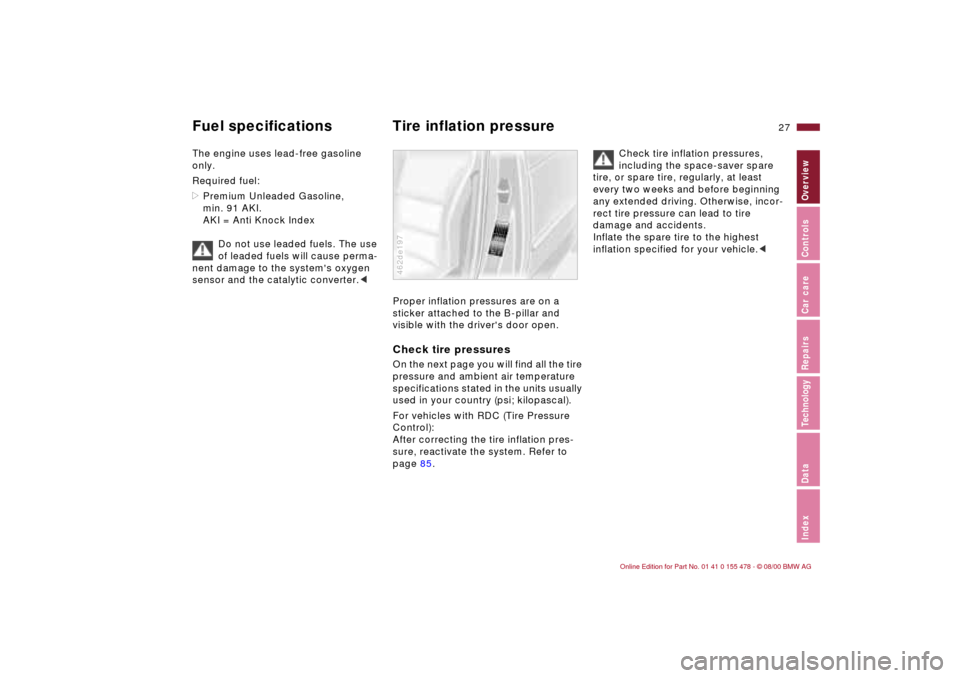
Proper inflation pressures are on a
sticker attached to the B-pillar and
visible with the driver's door open.Check tire pressuresOn the next page you will find all the tire
pressure and ambient air temperature
specifications stated in the units usually
used in your country (psi; kilopascal).
For vehicles with RDC (Tire Pressure
Control):
After correcting the tire inflation pres-
sure, reactivate the system. Refer to
page 85.462de197
Check tire inflation pressures,
including the space-saver spare
tire, or spare tire, regularly, at least
every two weeks and before beginning
any extended driving. Otherwise, incor-
rect tire pressure can lead to tire
damage and accidents.
Inflate the spare tire to the highest
inflation specified for your vehicle.<
Page 28 of 203

28n
Tire inflation pressure Comply with tire approval
specificationsThe inflation pressures in the table
apply to tires from BMW-approved
manufacturers. Your BMW center is
familiar with these manufacturers.
Higher pressures may be specified for
tires made by other manufacturers. You
will find a list of approved tires begin-
ning on page 127.
Your vehicle is equipped with tires that
meet US and European standards. We
recommend the exclusive use of BMW-
approved tires.BMW Tires
All pressure specifications in
the table are indicated in psi
(kilopascal) for cold tires
(cold = ambient temperature)
325CiAll summer tires 30 (210) 35 (240) 35 (240) 42 (290)
All winter tires 33 (230) 38 (260) 38 (260) 45 (310)
330Ci All summer and winter tires 33 (230) 38 (260) 38 (260) 45 (310)
All Space-saver spare tire 61 (420)
For all-season tires, use the same tire inflation pressure as for summer tires.
When using extra load tires (205/50 R 17), the inflation pressure increases
by 3 psi (20 kilopascal) for summer tires.
330Ci: when using 225/45 R 17 91 W tires, the air pressure decreases by
3 psi (20 kilopascal).
Page 85 of 203
85n
StichworteDatenTechnikSelbsthilfeWartungBedienung†berblick
Tire Pressure Control (RDC)
*
The concept
RDC monitors the tire pressures at all
four wheels, even when the vehicle is
moving. The system provides an alert
whenever the inflation pressure drops
significantly below the specified pres-
sure in one or more tires.
In order for the system to "learn" the
correct tire inflation pressure, check the
inflation pressure in all tires according
to the inflation pressure table (page 28)
and make corrections as necessary.
Then activate the system.
This indicator lamp in the instru-
ment cluster will inform you if
the tire pressure is not correct.
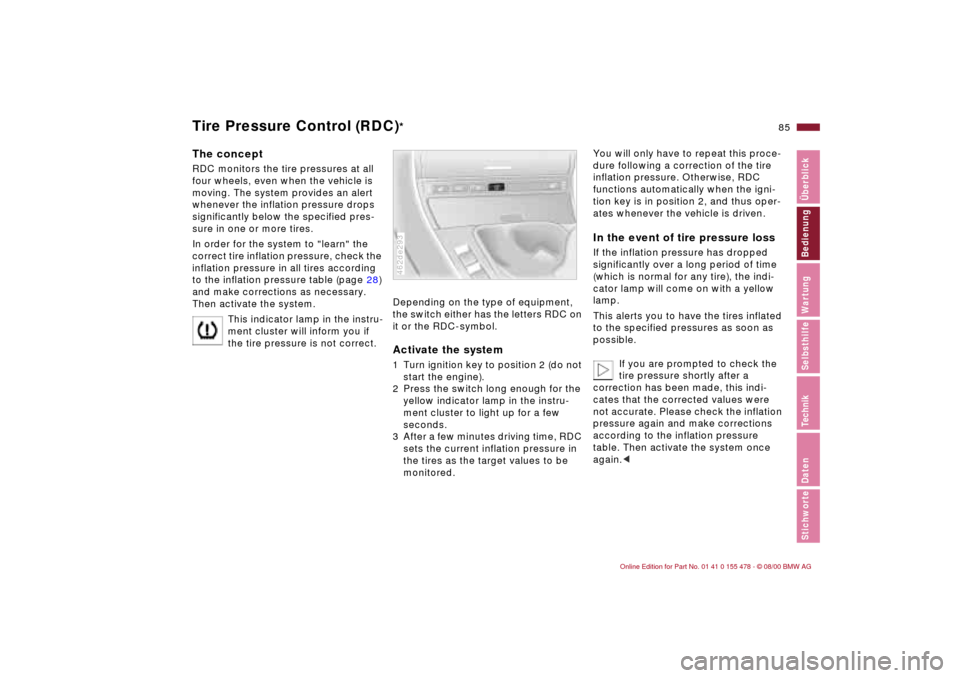
Depending on the type of equipment,
the switch either has the letters RDC on
it or the RDC-symbol.
Activate the system
1 Turn ignition key to position 2 (do not
start the engine).
2 Press the switch long enough for the
yellow indicator lamp in the instru-
ment cluster to light up for a few
seconds.
3 After a few minutes driving time, RDC
sets the current inflation pressure in
the tires as the target values to be
monitored.462de293
You will only have to repeat this proce-
dure following a correction of the tire
inflation pressure. Otherwise, RDC
functions automatically when the igni-
tion key is in position 2, and thus oper-
ates whenever the vehicle is driven.
In the event of tire pressure loss
If the inflation pressure has dropped
significantly over a long period of time
(which is normal for any tire), the indi-
cator lamp will come on with a yellow
lamp.
This alerts you to have the tires inflated
to the specified pressures as soon as
possible.
If you are prompted to check the
tire pressure shortly after a
correction has been made, this indi-
cates that the corrected values were
not accurate. Please check the inflation
pressure again and make corrections
according to the inflation pressure
table. Then activate the system once
again.
<
Page 86 of 203

86n
Tire Pressure Control (RDC)
*
In the event of a flat tire
If there is a tire failure with loss of pres-
sure, the indicator lamp comes on with
a red lamp. In addition, an acoustic
signal is sounded.
If this occurs, reduce vehicle speed
immediately to stop the vehicle in a safe
location. Avoid hard brake applications.
Do not oversteer. Replace the wheel
and flat tire.
The space-saver spare tire is
provided for temporary use only in
the event of tire pressure loss. It does
not have RDC electronics and is not
monitored. A full-size spare tire that has
the same dimensions as the tires
already mounted on the vehicle is
equipped with the necessary RDC elec-
tronics, and will be also monitored once
the tires have been mounted and the
system activated.
<
RDC cannot alert you to severe
and sudden tire damage caused
by external factors.
<
Have the tires changed by your
BMW center.
Your BMW center has been trained to
work with the RDC system and is
equipped with the necessary special
tools.
<
System interference
Local devices using the same radio
frequency can interfere with the RDC.
The yellow indicator lamp will come on
during the malfunction.
The indicator lamp also comes on
>
in the event of a system fault.
>
if a wheel is mounted without the
appropriate electronics.
>
if, in addition to the spare tire, addi-
tional wheels with RDC electronics
are on board.
Please contact your BMW center for
additional information.
Page 111 of 203
Overview
Controls and features
Operation, care
and maintenance
Owner service procedures
Technical data
Index Advanced technology
111n
IndexDataTechnologyRepairsCar careControlsOverview
Special operating instructions:
Break-in procedures112
Driving notes113
Catalytic converter113
Antilock Brake System
(ABS)115
Disc brakes117
Brake system118
Winter operation119
Power steering121
Cellular phones121
Radio reception121
Wheels and tires:
Tire inflation pressure122
Tire condition122
Tire replacement123
Tire rotation124
Wheel and tire
combinations125
Winter tires126
Snow chains126
Approved wheel and tire
specifications127Under the hood:
Hood130
Engine compartment132
Washer fluids134
Washer nozzles134
Engine oil135
Coolant137
Brake fluid138
Vehicle Identification
Number139
Care and maintenance:
The BMW Maintenance
System140
Caring for your vehicle141
Airbags146
Vehicle storage147
Laws and regulations:
Technical modifications148
California Proposition
65 Warning148
OBD interface socket149
Car care
Page 122 of 203
122n
Information for your safetyThe factory-approved radial tires are
matched to the vehicle and have been
selected to provide optimum safety and
driving comfort on your vehicle.
It is not merely the tire's service life, but
also driving comfort and Ð above all else
Ð driving safety that depend on the con-
dition of the tires and the maintenance
of the specified tire pressure.
Incorrect inflation pressure is a frequent
cause of tire damage. It also signifi-
cantly influences the roadholding ability
of your BMW.
Be sure to check the tire inflation
pressure Ð including the space-
saver spare tire or the spare tire Ð on a
regular basis, at least twice a month
and before doing any extended driving.
Refer to page 27. If this is not done, in-
correct tire pressures can cause driving
instability and tire damage, ultimately
resulting in an accident.<
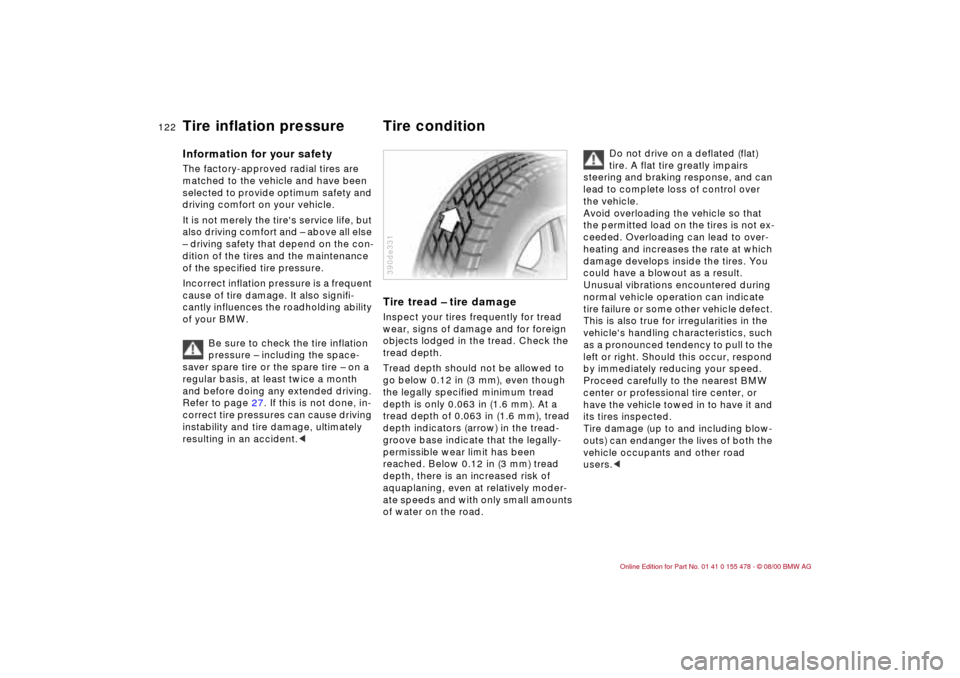
Tire tread Ð tire damageInspect your tires frequently for tread
wear, signs of damage and for foreign
objects lodged in the tread. Check the
tread depth.
Tread depth should not be allowed to
go below 0.12 in (3 mm), even though
the legally specified minimum tread
depth is only 0.063 in (1.6 mm). At a
tread depth of 0.063 in (1.6 mm), tread
depth indicators (arrow) in the tread-
groove base indicate that the legally-
permissible wear limit has been
reached. Below 0.12 in (3 mm) tread
depth, there is an increased risk of
aquaplaning, even at relatively moder-
ate speeds and with only small amounts
of water on the road.390de331
Do not drive on a deflated (flat)
tire. A flat tire greatly impairs
steering and braking response, and can
lead to complete loss of control over
the vehicle.
Avoid overloading the vehicle so that
the permitted load on the tires is not ex-
ceeded. Overloading can lead to over-
heating and increases the rate at which
damage develops inside the tires. You
could have a blowout as a result.
Unusual vibrations encountered during
normal vehicle operation can indicate
tire failure or some other vehicle defect.
This is also true for irregularities in the
vehicle's handling characteristics, such
as a pronounced tendency to pull to the
left or right. Should this occur, respond
by immediately reducing your speed.
Proceed carefully to the nearest BMW
center or professional tire center, or
have the vehicle towed in to have it and
its tires inspected.
Tire damage (up to and including blow-
outs) can endanger the lives of both the
vehicle occupants and other road
users.<
Tire inflation pressure Tire condition