Ems BMW 330Ci COUPE 2002 E46 Owner's Guide
[x] Cancel search | Manufacturer: BMW, Model Year: 2002, Model line: 330Ci COUPE, Model: BMW 330Ci COUPE 2002 E46Pages: 147, PDF Size: 2.2 MB
Page 108 of 147
108n
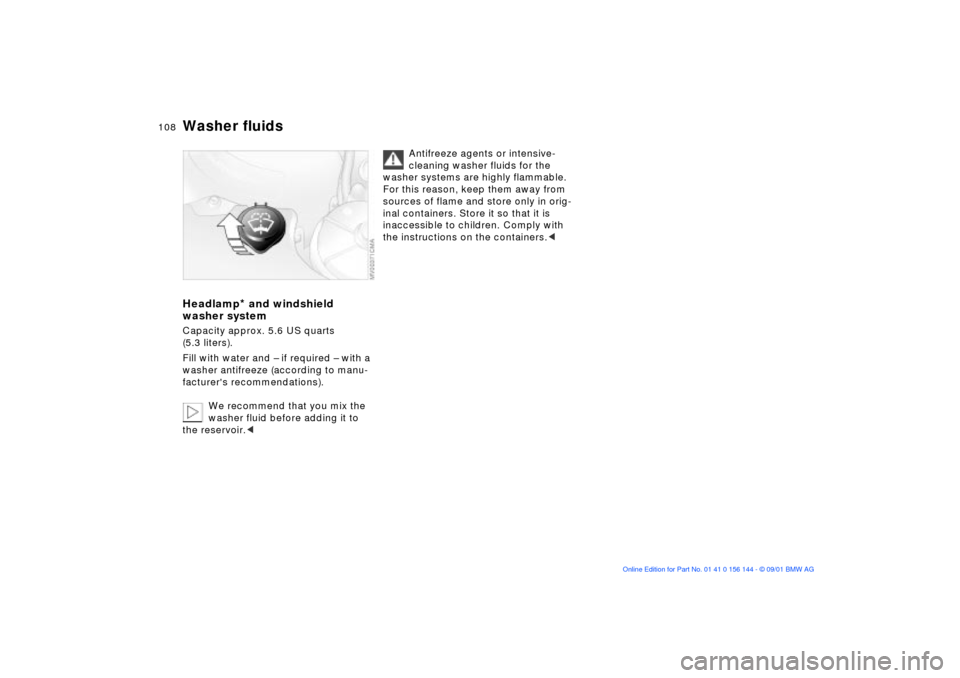
Washer fluidsHeadlamp
* and windshield
washer system
Capacity approx. 5.6 US quarts
(5.3 liters).
Fill with water and Ð if required Ð with a
washer antifreeze (according to manu-
facturer's recommendations).
We recommend that you mix the
washer fluid before adding it to
the reservoir.<
Antifreeze agents or intensive-
cleaning washer fluids for the
washer systems are highly flammable.
For this reason, keep them away from
sources of flame and store only in orig-
inal containers. Store it so that it is
inaccessible to children. Comply with
the instructions on the containers.<
Page 113 of 147
113n
OverviewControlsMaintenanceRepairsDataIndex
The BMW Maintenance System has
been designed as a reliable means of
providing maximum driving and oper-
ating safety Ð and as cost-effectively as
possible for you.
Please keep in mind that regular main-
tenance is not only necessary for the
safety of your vehicle, but also plays a
significant role in maintaining the resale
value of the vehicle.
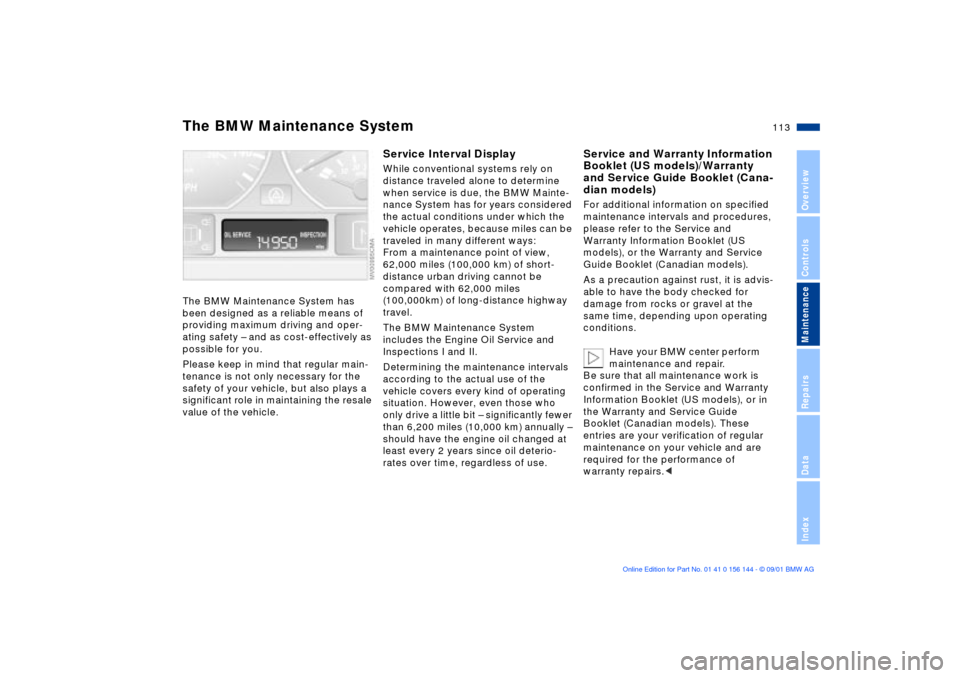
Service Interval DisplayWhile conventional systems rely on
distance traveled alone to determine
when service is due, the BMW Mainte-
nance System has for years considered
the actual conditions under which the
vehicle operates, because miles can be
traveled in many different ways:
From a maintenance point of view,
62,000 miles (100,000 km) of short-
distance urban driving cannot be
compared with 62,000 miles
(100,000km) of long-distance highway
travel.
The BMW Maintenance System
includes the Engine Oil Service and
Inspections I and II.
Determining the maintenance intervals
according to the actual use of the
vehicle covers every kind of operating
situation. However, even those who
only drive a little bit Ð significantly fewer
than 6,200 miles (10,000 km) annually Ð
should have the engine oil changed at
least every 2 years since oil deterio-
rates over time, regardless of use.
Service and Warranty Information
Booklet (US models)/Warranty
and Service Guide Booklet (Cana-
dian models)For additional information on specified
maintenance intervals and procedures,
please refer to the Service and
Warranty Information Booklet (US
models), or the Warranty and Service
Guide Booklet (Canadian models).
As a precaution against rust, it is advis-
able to have the body checked for
damage from rocks or gravel at the
same time, depending upon operating
conditions.
Have your BMW center perform
maintenance and repair.
Be sure that all maintenance work is
confirmed in the Service and Warranty
Information Booklet (US models), or in
the Warranty and Service Guide
Booklet (Canadian models). These
entries are your verification of regular
maintenance on your vehicle and are
required for the performance of
warranty repairs.<
The BMW Maintenance System
Page 115 of 147
115n
OverviewControlsMaintenanceRepairsDataIndex
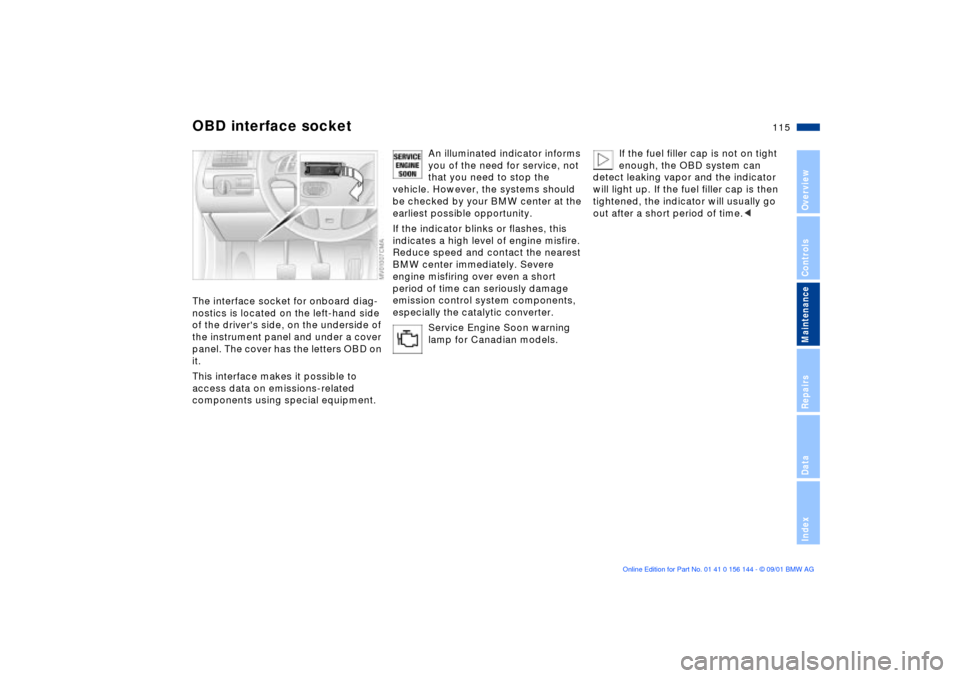
OBD interface socketThe interface socket for onboard diag-
nostics is located on the left-hand side
of the driver's side, on the underside of
the instrument panel and under a cover
panel. The cover has the letters OBD on
it.
This interface makes it possible to
access data on emissions-related
components using special equipment.
An illuminated indicator informs
you of the need for service, not
that you need to stop the
vehicle. However, the systems should
be checked by your BMW center at the
earliest possible opportunity.
If the indicator blinks or flashes, this
indicates a high level of engine misfire.
Reduce speed and contact the nearest
BMW center immediately. Severe
engine misfiring over even a short
period of time can seriously damage
emission control system components,
especially the catalytic converter.
Service Engine Soon warning
lamp for Canadian models.
If the fuel filler cap is not on tight
enough, the OBD system can
detect leaking vapor and the indicator
will light up. If the fuel filler cap is then
tightened, the indicator will usually go
out after a short period of time.<
Page 125 of 147
125n
OverviewControlsMaintenanceRepairsDataIndex
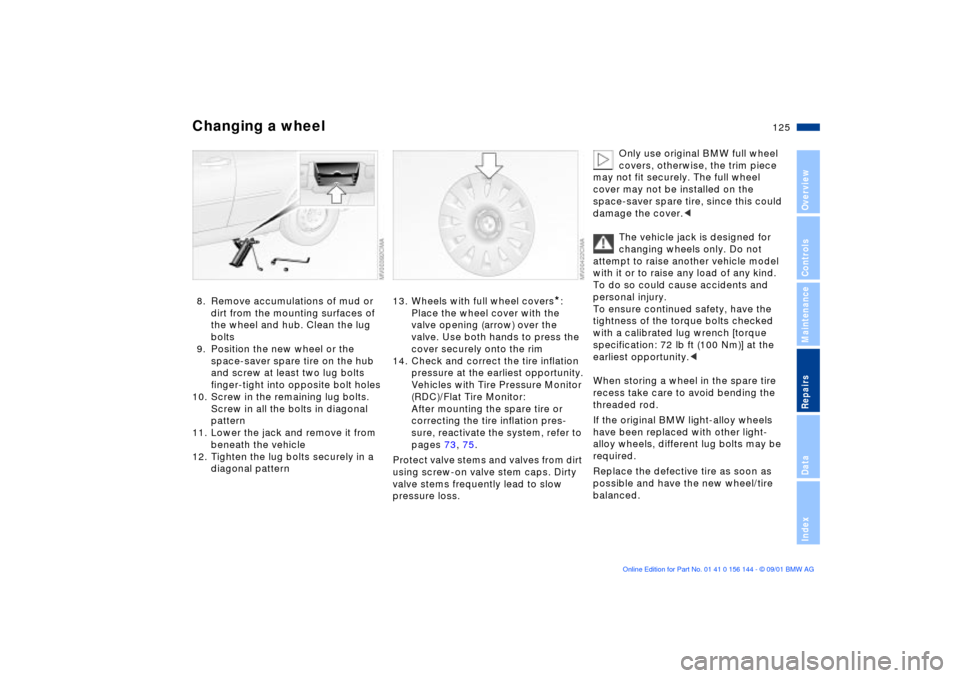
Changing a wheel8. Remove accumulations of mud or
dirt from the mounting surfaces of
the wheel and hub. Clean the lug
bolts
9. Position the new wheel or the
space-saver spare tire on the hub
and screw at least two lug bolts
finger-tight into opposite bolt holes
10. Screw in the remaining lug bolts.
Screw in all the bolts in diagonal
pattern
11. Lower the jack and remove it from
beneath the vehicle
12. Tighten the lug bolts securely in a
diagonal pattern
13. Wheels with full wheel covers
*:
Place the wheel cover with the
valve opening (arrow) over the
valve. Use both hands to press the
cover securely onto the rim
14. Check and correct the tire inflation
pressure at the earliest opportunity.
Vehicles with Tire Pressure Monitor
(RDC)/Flat Tire Monitor:
After mounting the spare tire or
correcting the tire inflation pres-
sure, reactivate the system, refer to
pages 73, 75.
Protect valve stems and valves from dirt
using screw-on valve stem caps. Dirty
valve stems frequently lead to slow
pressure loss.
Only use original BMW full wheel
covers, otherwise, the trim piece
may not fit securely. The full wheel
cover may not be installed on the
space-saver spare tire, since this could
damage the cover.<
The vehicle jack is designed for
changing wheels only. Do not
attempt to raise another vehicle model
with it or to raise any load of any kind.
To do so could cause accidents and
personal injury.
To ensure continued safety, have the
tightness of the torque bolts checked
with a calibrated lug wrench [torque
specification: 72 lb ft (100 Nm)] at the
earliest opportunity.<
When storing a wheel in the spare tire
recess take care to avoid bending the
threaded rod.
If the original BMW light-alloy wheels
have been replaced with other light-
alloy wheels, different lug bolts may be
required.
Replace the defective tire as soon as
possible and have the new wheel/tire
balanced.
Page 127 of 147
127n
OverviewControlsMaintenanceRepairsDataIndex
Battery FusesMaintenanceThe battery is absolutely maintenance-
free, that is, the original electrolyte will
normally last for the service life of the
battery under moderate climatic condi-
tions.
Please consult your BMW center
whenever you have any questions
concerning the battery. Since the
battery is absolutely maintenance-free,
the following is for your information
only.<
Never disconnect the battery
when the engine is running; the
ensuing voltage surge would seriously
damage the vehicle's onboard elec-
tronic systems.<
Charging the batteryWhen charging the battery in the
vehicle, leave the engine off at all times.
Connect the charge cables to the termi-
nals in the engine compartment. For
terminal locations, refer to Jump-
starting on page 128.
Return used batteries to a recycling
point or your BMW center. Maintain
the battery in an upright position for
transport and storage. Secure the
battery against falling over in transit.<
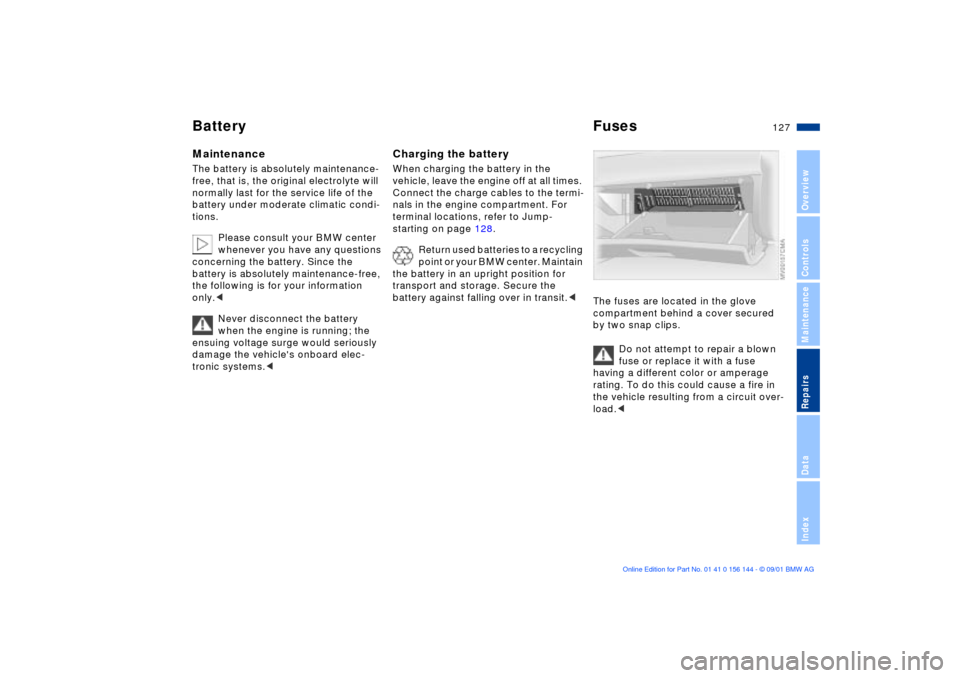
The fuses are located in the glove
compartment behind a cover secured
by two snap clips.
Do not attempt to repair a blown
fuse or replace it with a fuse
having a different color or amperage
rating. To do this could cause a fire in
the vehicle resulting from a circuit over-
load.<
Page 139 of 147

Everything from A to Z
139n
OverviewControlsMaintenancRepairsDataIndex
C
California Proposition
65 Warning114
Canned beverage holder88
Capacities135
Car care, refer to the "Caring
for your vehicle" manual
Car keys28
Car wash systems, refer to
the "Caring for your
vehicle" manual
Care of upholstery materials,
refer to the "Caring for your
vehicle" manual
Cargo loading93
CBC (Cornering Brake
Control)18, 71
Cellular phone89
refer also to the separate
"Owner's Manual"
Center (high-mount) brake
lamp122
Center 3-point belt in the
rear91
Center armrest87
Central locking system28
button32 Changing a wheel123
Check Control66
Check engine oil level109
Checking tire inflation
pressure24
Child restraint
installation52
Child-restraint anchorage
points51
Clean the headlamps61
Cleaning windshield61
Clock66
refer also to the "Radio
Owner's Manual" or to the
"Onboard Computer
Owner's Manual"
Clothes hooks90
Cockpit14
Coin box88
Compartments87
Compression132
Computer refer also to the "Onboard
Computer Owner's
Manual"
Configuring individual
settings with Vehicle and
Key Memory53
Consumption68
display65
Convenience operation via
the door lock
sliding/tilt sunroof31
windows31
Coolant111
Coolant temperature
gauge65
Cooling system,
capacity135
Copyright4
Cornering Brake Control
(CBC)18, 71
Correct sitting posture40
Cover, sun blinds86
Cruise control62
Cruising range68
Cup holder, refer to
beverage holder88
Curb weight134 Current check indicator17
D
Dash lighting78
Dashboard14
Data
dimensions133
engine132
technical132
weights134
Daytime driving lamp77
DBC (Dynamic Brake
Control)19, 72
Deep water99
Defrost setting82, 84
Defrost windows82, 84
Defrostable rear
window81, 85
Digital clock66
Dimensions133
Dipstick, engine oil109
Displacement132
Display lighting78
Displays15
Distance warning69