pressure BMW 330Ci COUPE 2002 E46 Owner's Guide
[x] Cancel search | Manufacturer: BMW, Model Year: 2002, Model line: 330Ci COUPE, Model: BMW 330Ci COUPE 2002 E46Pages: 147, PDF Size: 2.2 MB
Page 101 of 147
101n
OverviewControlsMaintenanceRepairsDataIndex
Information for your safetyThe factory-approved radial tires are
matched to the vehicle and have been
selected to provide optimum safety and
driving comfort.
It is not merely the tire's service life, but
also driving comfort and Ð above all else
Ð driving safety that depend on the
condition of the tires and the mainte-
nance of the specified tire inflation
pressure.
Incorrect tire inflation pressure is
a frequent cause of tire damage. It
also significantly influences the road-
holding ability of your BMW.
Be sure to check the tire inflation pres-
sure, including the space-saver spare
tire or the spare tire, on a regular basis,
at least twice a month and before every
extended journey, refer to page 24. If
this is not done, incorrect tire pressures
can cause driving instability and tire
damage, ultimately resulting in acci-
dents.<
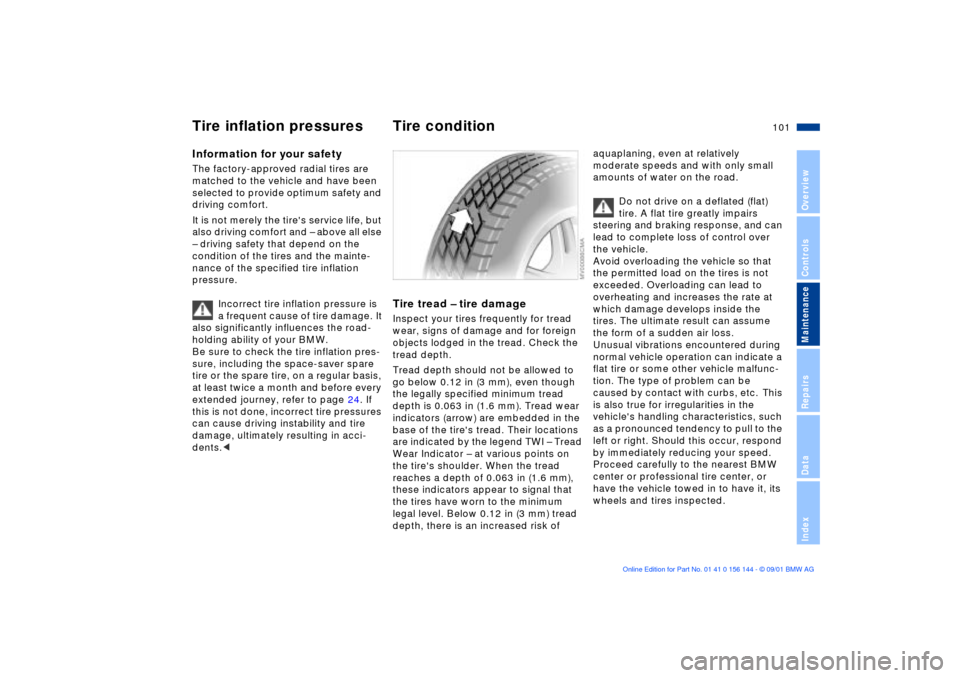
Tire tread Ð tire damageInspect your tires frequently for tread
wear, signs of damage and for foreign
objects lodged in the tread. Check the
tread depth.
Tread depth should not be allowed to
go below 0.12 in (3 mm), even though
the legally specified minimum tread
depth is 0.063 in (1.6 mm). Tread wear
indicators (arrow) are embedded in the
base of the tire's tread. Their locations
are indicated by the legend TWI Ð Tread
Wear Indicator Ð at various points on
the tire's shoulder. When the tread
reaches a depth of 0.063 in (1.6 mm),
these indicators appear to signal that
the tires have worn to the minimum
legal level. Below 0.12 in (3 mm) tread
depth, there is an increased risk of
aquaplaning, even at relatively
moderate speeds and with only small
amounts of water on the road.
Do not drive on a deflated (flat)
tire. A flat tire greatly impairs
steering and braking response, and can
lead to complete loss of control over
the vehicle.
Avoid overloading the vehicle so that
the permitted load on the tires is not
exceeded. Overloading can lead to
overheating and increases the rate at
which damage develops inside the
tires. The ultimate result can assume
the form of a sudden air loss.
Unusual vibrations encountered during
normal vehicle operation can indicate a
flat tire or some other vehicle malfunc-
tion. The type of problem can be
caused by contact with curbs, etc. This
is also true for irregularities in the
vehicle's handling characteristics, such
as a pronounced tendency to pull to the
left or right. Should this occur, respond
by immediately reducing your speed.
Proceed carefully to the nearest BMW
center or professional tire center, or
have the vehicle towed in to have it, its
wheels and tires inspected.
Tire inflation pressures
Tire condition
Page 103 of 147

103n
OverviewControlsMaintenanceRepairsDataIndex
Tire replacementunder the Federal Motor Vehicle Safety
Standard No. 109. Grades B and A
represent higher levels of performance
on the laboratory test wheel than the
minimum required by law.
The temperature grade for this tire
is established for a tire that is
properly inflated and not overloaded.
Excessive speed, underinflation, or
excessive loading, either separately or
in combination, can cause heat buildup
and possible tire failure.< Uniform Tire Quality Grading Quality grades can be found where
applicable on the tire sidewall between
tread shoulder and maximum section
width. For example:
Tread wear 200
Traction AA
Temperature A
Do not use retreaded tires, since
driving safety may be impaired.
This is due to the possible variations in
casing structures and, in some cases,
to their extreme age, which can lead to
a decrease in their durability.<
Tire ageThe date on which the tire was manu-
factured is indicated by the code on the
sidewall:
DOT ... 4101 indicates that the tire was
manufactured in week 41 of the year
2001.
BMW recommends the replacement of
all tires when the tires are no more than
6 years old, even if a tire life of 10 years
is possible.
Safety tires
*
Safety tires consists of self-contained
tires and special rims. The tire rein-
forcement ensures that the tire retains
some residual safety in the event of
pressure drop and driving remains
possible to a restricted degree. The
vehicle is equipped with Tire Pressure
Monitor (RDC) or Flat Tire Monitor,
which indicate a flat tire.
For additional information on Tire Pres-
sure Monitor (RDC) or Flat Tire Monitor
refer to pages 73 bzw. 75.
Safety tires are only possible in
conjunction with Tire Pressure
Monitor (RDC) or Flat Tire Monitor.<
Page 105 of 147

105n
OverviewControlsMaintenanceRepairsDataIndex
Winter tiresChoosing the right tireBMW recommends winter tires (M+S
radial tires) for operation under
inclement winter driving conditions.
While all-season tires (M+S designa-
tion) provide better winter traction than
summer tires with the load ratings H, V,
W, Y and ZR, they generally do not
achieve the performance of winter tires.
In the interest of safe tracking and
steering response, install winter tires
made by the same manufacturer having
the same tread configuration on all four
wheels.Never exceed the maximum
speed for which the winter tires
are rated.
Unprofessional attempts by laymen to
service tires can lead to damage and
accidents.
Have this work performed by trained
professionals only. Any BMW center
has the required technical knowledge
and the proper equipment and will be
happy to assist you.<
Tire condition, tire pressureOnce the tire wears to below 0.16 in
(4 mm), winter tires display a percep-
tible decrease in their ability to cope
with winter driving conditions, and
should be replaced in the interest of
safety.
Comply with the specified tire inflation
pressures Ð and be sure to have the
wheel and tire assemblies balanced
every time you change the tires.
StorageAlways store tires in a cool, dry place.
Store them away from light whenever
possible. Protect the tires against
contact with oil, grease and fuel.Snow chains
*
BMW narrow-link snow chains are
intended for mounting on summer or
winter tires in pairs at the rear wheels
only. Comply with all manufacturer's
safety precautions when mounting the
chains.
You cannot mount snow chains on the
following tires:
225/50 R 16 92
225/45 R 17 91
245/40 ZR 17
Page 111 of 147
111n
OverviewControlsMaintenanceRepairsDataIndex
Coolant
Do not add coolant to the cooling
system when the engine is hot. If
you attempt to do so, escaping coolant
can cause burns.
To avoid the possibility of damage later
on, never use anything other than
factory-approved, nitrite and amino-
free extended-duty antifreeze with
corrosion inhibitor. Your BMW center is
familiar with the official specifications.
Antifreeze and anti-corrosion agents
are hazardous to health. You should
always store them in their original
container and in a location which is out
of reach of children.
Extended-duty antifreeze with corro-
sion inhibitor contains the flammable
substance ethylene glycol. For this
reason, do not spill extended-duty anti-
freeze with corrosion inhibitor on hot
engine parts. It could ignite and cause
serious burns.<
Checking coolant levelCorrect coolant level for cold engine
(approx. 68 7 or +20 6):
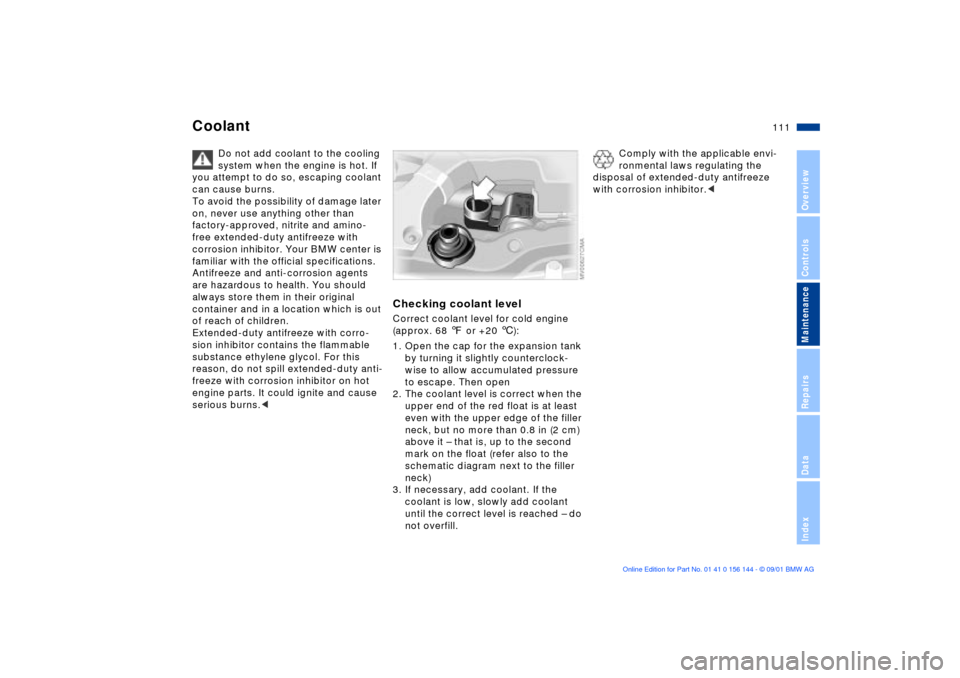
1. Open the cap for the expansion tank
by turning it slightly counterclock-
wise to allow accumulated pressure
to escape. Then open
2. The coolant level is correct when the
upper end of the red float is at least
even with the upper edge of the filler
neck, but no more than 0.8 in (2 cm)
above it Ð that is, up to the second
mark on the float (refer also to the
schematic diagram next to the filler
neck)
3. If necessary, add coolant. If the
coolant is low, slowly add coolant
until the correct level is reached Ð do
not overfill.
Comply with the applicable envi-
ronmental laws regulating the
disposal of extended-duty antifreeze
with corrosion inhibitor.<
Page 118 of 147
118n
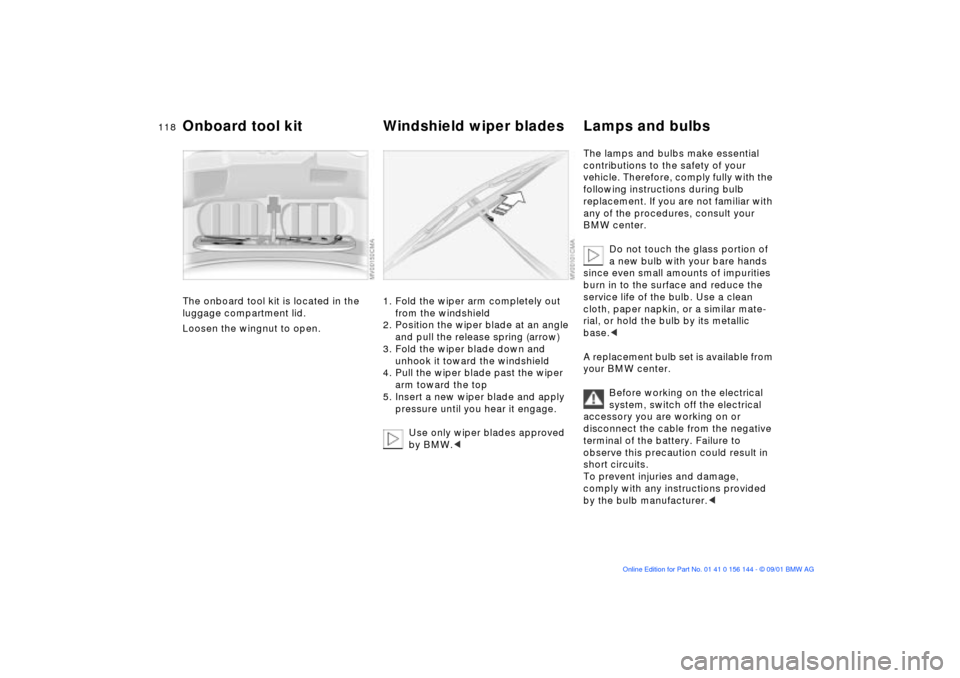
The onboard tool kit is located in the
luggage compartment lid.
Loosen the wingnut to open.
1. Fold the wiper arm completely out
from the windshield
2. Position the wiper blade at an angle
and pull the release spring (arrow)
3. Fold the wiper blade down and
unhook it toward the windshield
4. Pull the wiper blade past the wiper
arm toward the top
5. Insert a new wiper blade and apply
pressure until you hear it engage.
Use only wiper blades approved
by BMW.<
The lamps and bulbs make essential
contributions to the safety of your
vehicle. Therefore, comply fully with the
following instructions during bulb
replacement. If you are not familiar with
any of the procedures, consult your
BMW center.
Do not touch the glass portion of
a new bulb with your bare hands
since even small amounts of impurities
burn in to the surface and reduce the
service life of the bulb. Use a clean
cloth, paper napkin, or a similar mate-
rial, or hold the bulb by its metallic
base.<
A replacement bulb set is available from
your BMW center.
Before working on the electrical
system, switch off the electrical
accessory you are working on or
disconnect the cable from the negative
terminal of the battery. Failure to
observe this precaution could result in
short circuits.
To prevent injuries and damage,
comply with any instructions provided
by the bulb manufacturer.<
Onboard tool kit Windshield wiper blades Lamps and bulbs
Page 120 of 147
120n
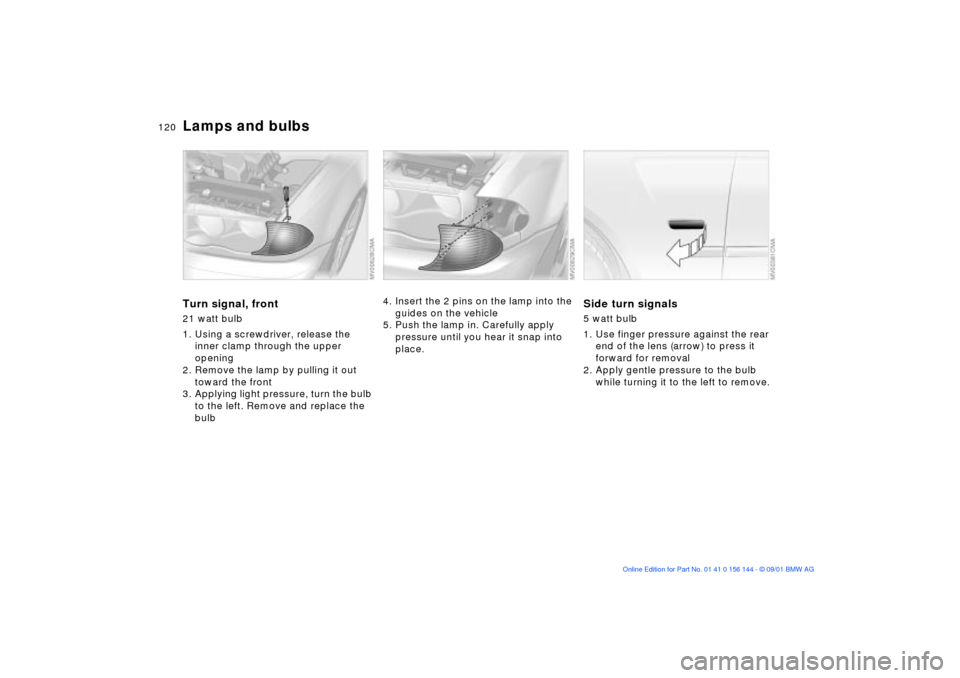
Lamps and bulbsTurn signal, front21 watt bulb
1. Using a screwdriver, release the
inner clamp through the upper
opening
2. Remove the lamp by pulling it out
toward the front
3. Applying light pressure, turn the bulb
to the left. Remove and replace the
bulb
4. Insert the 2 pins on the lamp into the
guides on the vehicle
5. Push the lamp in. Carefully apply
pressure until you hear it snap into
place.
Side turn signals5 watt bulb
1. Use finger pressure against the rear
end of the lens (arrow) to press it
forward for removal
2. Apply gentle pressure to the bulb
while turning it to the left to remove.
Page 121 of 147
121n
OverviewControlsMaintenanceRepairsDataIndex
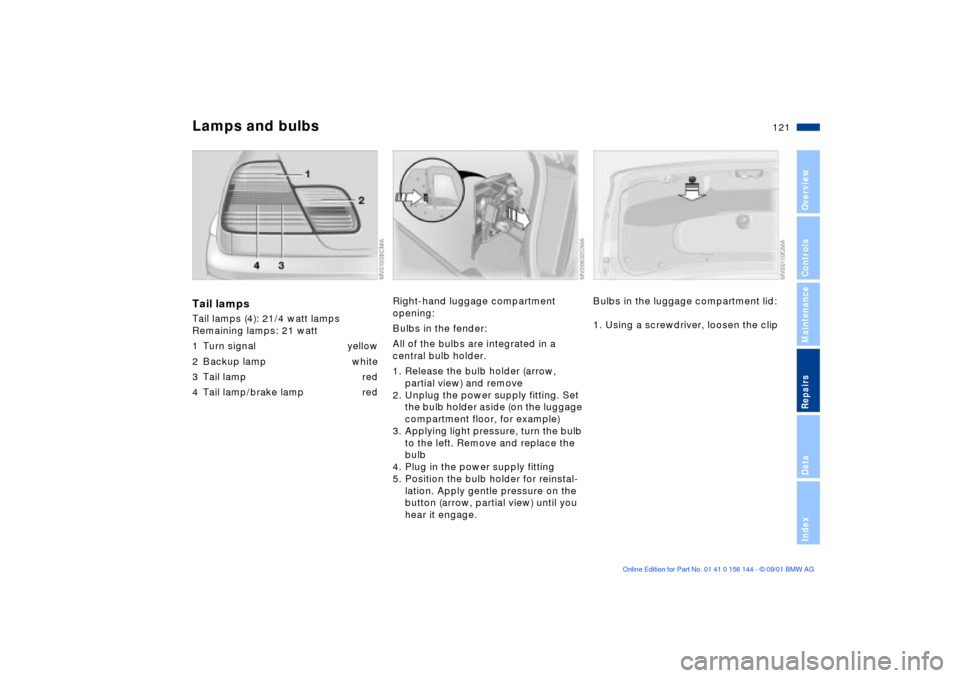
Lamps and bulbsTail lampsTail lamps (4): 21/4 watt lamps
Remaining lamps: 21 watt
1 Turn signal yellow
2 Backup lamp white
3 Tail lamp red
4 Tail lamp/brake lamp red
Right-hand luggage compartment
opening:
Bulbs in the fender:
All of the bulbs are integrated in a
central bulb holder.
1. Release the bulb holder (arrow,
partial view) and remove
2. Unplug the power supply fitting. Set
the bulb holder aside (on the luggage
compartment floor, for example)
3. Applying light pressure, turn the bulb
to the left. Remove and replace the
bulb
4. Plug in the power supply fitting
5. Position the bulb holder for reinstal-
lation. Apply gentle pressure on the
button (arrow, partial view) until you
hear it engage.
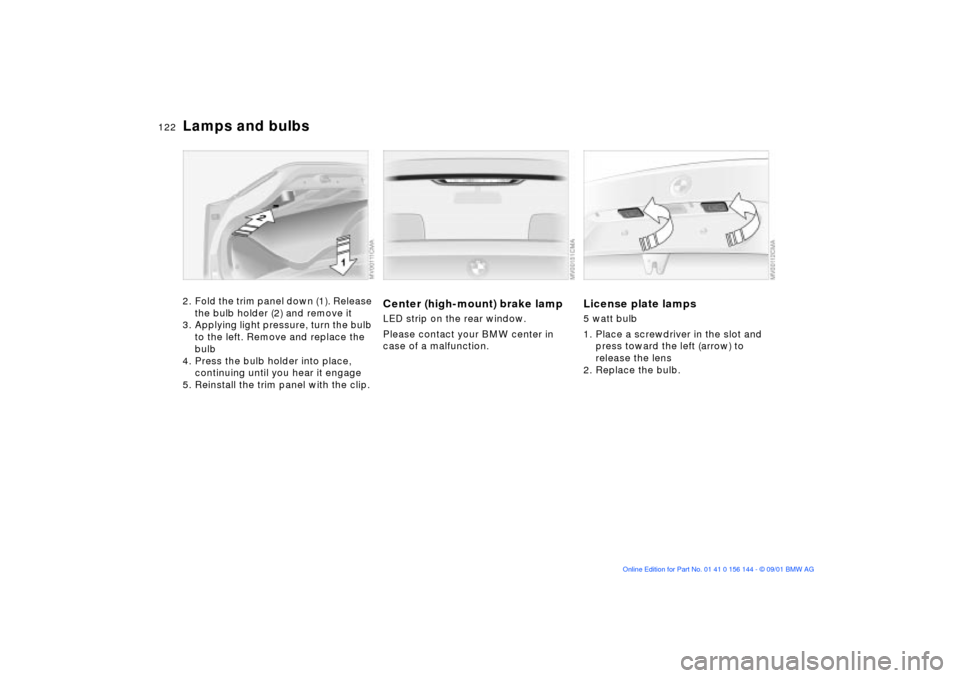
Bulbs in the luggage compartment lid:
1. Using a screwdriver, loosen the clip
Page 122 of 147
122n
Lamps and bulbs2. Fold the trim panel down (1). Release
the bulb holder (2) and remove it
3. Applying light pressure, turn the bulb
to the left. Remove and replace the
bulb
4. Press the bulb holder into place,
continuing until you hear it engage
5. Reinstall the trim panel with the clip.
Center (high-mount) brake lampLED strip on the rear window.
Please contact your BMW center in
case of a malfunction.
License plate lamps5 watt bulb
1. Place a screwdriver in the slot and
press toward the left (arrow) to
release the lens
2. Replace the bulb.
Page 125 of 147
125n
OverviewControlsMaintenanceRepairsDataIndex
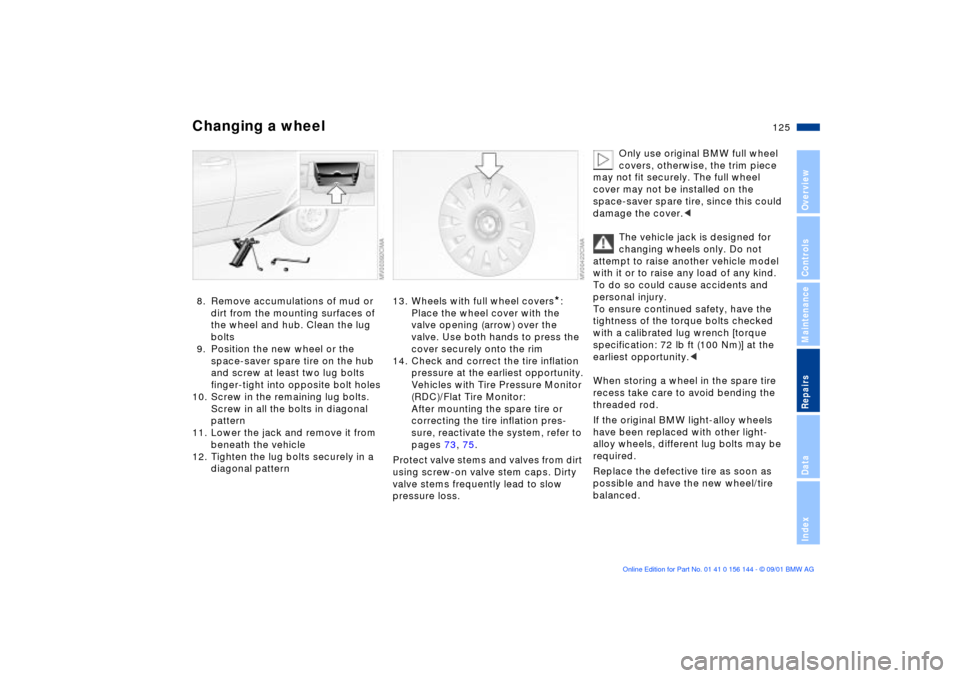
Changing a wheel8. Remove accumulations of mud or
dirt from the mounting surfaces of
the wheel and hub. Clean the lug
bolts
9. Position the new wheel or the
space-saver spare tire on the hub
and screw at least two lug bolts
finger-tight into opposite bolt holes
10. Screw in the remaining lug bolts.
Screw in all the bolts in diagonal
pattern
11. Lower the jack and remove it from
beneath the vehicle
12. Tighten the lug bolts securely in a
diagonal pattern
13. Wheels with full wheel covers
*:
Place the wheel cover with the
valve opening (arrow) over the
valve. Use both hands to press the
cover securely onto the rim
14. Check and correct the tire inflation
pressure at the earliest opportunity.
Vehicles with Tire Pressure Monitor
(RDC)/Flat Tire Monitor:
After mounting the spare tire or
correcting the tire inflation pres-
sure, reactivate the system, refer to
pages 73, 75.
Protect valve stems and valves from dirt
using screw-on valve stem caps. Dirty
valve stems frequently lead to slow
pressure loss.
Only use original BMW full wheel
covers, otherwise, the trim piece
may not fit securely. The full wheel
cover may not be installed on the
space-saver spare tire, since this could
damage the cover.<
The vehicle jack is designed for
changing wheels only. Do not
attempt to raise another vehicle model
with it or to raise any load of any kind.
To do so could cause accidents and
personal injury.
To ensure continued safety, have the
tightness of the torque bolts checked
with a calibrated lug wrench [torque
specification: 72 lb ft (100 Nm)] at the
earliest opportunity.<
When storing a wheel in the spare tire
recess take care to avoid bending the
threaded rod.
If the original BMW light-alloy wheels
have been replaced with other light-
alloy wheels, different lug bolts may be
required.
Replace the defective tire as soon as
possible and have the new wheel/tire
balanced.
Page 126 of 147

126n
Changing a wheelAlways use BMW-approved balance
weights on black-finished aluminum-
alloy wheels. Never allow anyone to
attempt to balance these wheels using
conventional rim-clip balance weights.Driving with the space-saver
spare tireDrive cautiously. Do not exceed a
speed of 50 mph (80 km/h).
You can anticipate changes in vehicle
handling such as delayed braking
response, longer braking distances and
sacrifices in roadholding.
The changes in handling characteristics
will be even more pronounced if winter
tires are mounted.
Only one space-saver spare tire
may be mounted at a time. Rein-
stall wheels and tires of the same size
and specification as soon as possible.
Maintain correct tire pressures. Refer to
page 25.<
Safety tires
*
Safety tires consists of self-contained
tires and special rims. The tire rein-
forcement ensures that the tire retains
some residual safety in the event of
pressure drop and driving remains
possible to a restricted degree. The
vehicle is equipped with Tire Pressure
Monitor (RDC) or Flat Tire Monitor,
which indicate a flat tire.Flat tireIf there is a tire failure, the red warning
lamp symbol lights up. A supplemen-
tary gong is also heard.
For additional information on Tire Pres-
sure Monitor (RDC) or Flat Tire Monitor
refer to pages 73 bzw. 75.
Reduce vehicle speed carefully to
under 50 mph (80 km/h), avoiding hard
brake applications and steering maneu-
vers.
With the safety tires, you can drive
another approx. 155 miles (250 km) to
reach a safe parking location, a service
station or the nearest BMW center.
With a low vehicle load, this can also be
considerably more than 155 miles
(250 km).Safety tires are only possible in
conjunction with Tire Pressure
Monitor (RDC) or Flat Tire Monitor.<
If the defective wheel can not be seen
as such immediately from the outside,
check the tire inflation pressure at all
four wheels.
Have the tires changed by your
BMW center. For safety reasons,
do not have a safety tire repaired. Your
BMW center has the information
needed for working with safety tires
and is equipped with the necessary
special tools.<
If appropriate, please consult your
BMW center to reequip your
vehicle from summer to winter tires Ð or
vice versa.<