Lamp control BMW 528i 1997 E39 Owner's Guide
[x] Cancel search | Manufacturer: BMW, Model Year: 1997, Model line: 528i, Model: BMW 528i 1997 E39Pages: 1002
Page 692 of 1002
Downloaded from www.Manualslib.com manuals search engine
320-34
I Steerins and Wheel Alignment
Front toe and toe difference angle
Toe is the difference in the distance between the front of the
front wheels and the rear of the front wheels. It is adjusted by
altering the length of the tie rods.
Toe difference angle determines the progressively different
paths taken by the front wheels as the car is turning. In
V-8
models, it is set by the pitman arm adjustment, but depends
on accurate setting of the toe.
Toe adjustments should only be made on specialized align-
ment equipment and only with the car in normal loaded posi-
tion, described below.
- Set front wheel toe at tie rod ends:
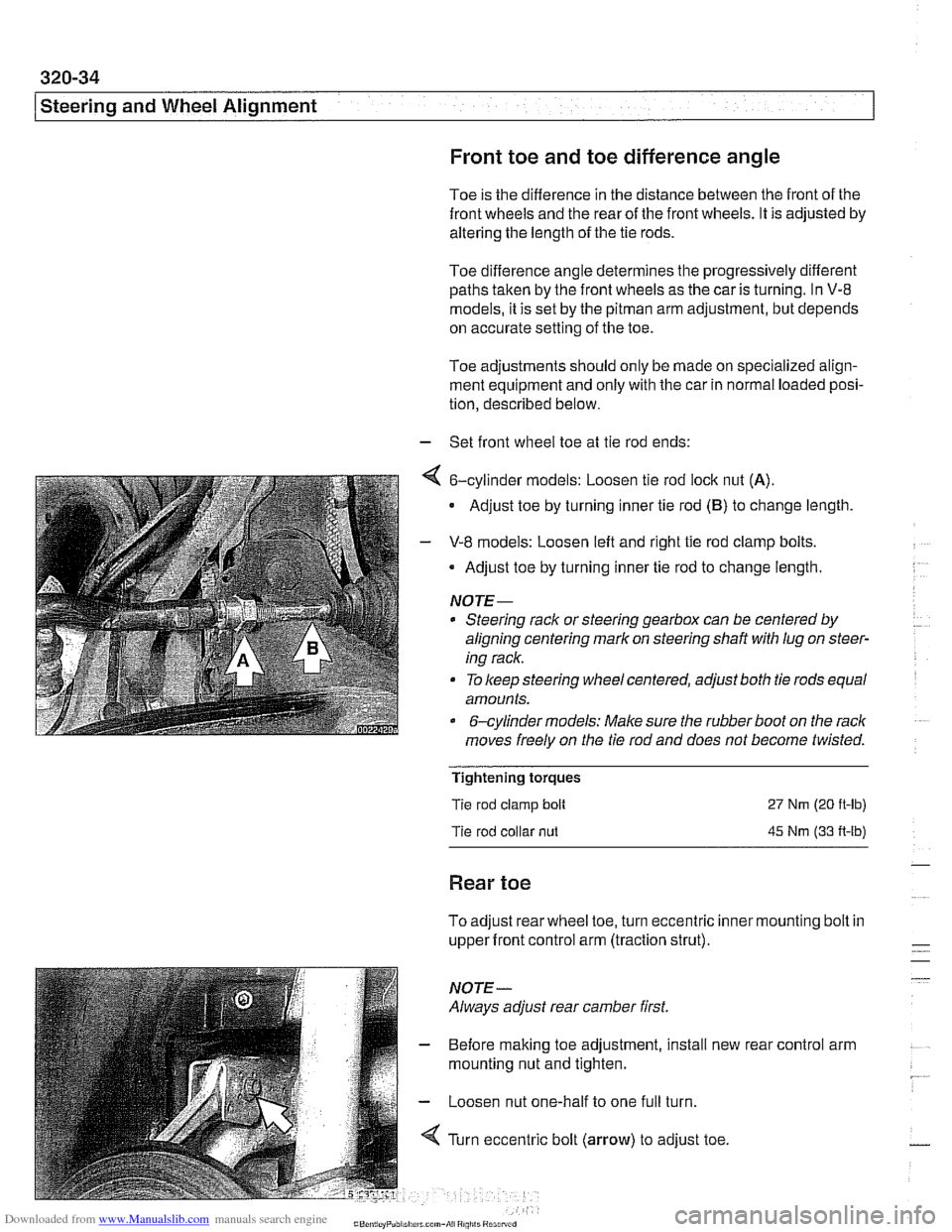
4 6-cylinder models: Loosen tie rod lock nut (A).
Adjust toe by turning inner tie rod (B) to change length
- V-8 models: Loosen left and right tie rod clamp bolts.
Adjust toe by turning inner tie rod to change length.
NOTE-
* Steering rack or steering gearbox can be centered by
aligning centering mark on steering shaft
with lug on steer-
ing rack.
To keep steering wheel centered, adjust both tie rods equal
amounts.
&cylinder models: Make sure the rubber boot on the rack
moves freely on the tie rod and does not become twisted.
Tightening torques
Tie rod clamp bolt
Tie rod collar
nut
27 Nm (20 ft-lb)
45 Nm (33 A-lb)
Rear toe
To adjust rear wheel toe, turn eccentric inner mounting bolt in
upper front control arm (traction strut).
NOTE-
Always adjust rear camber first.
- Before making toe adjustment, install new
mounting nut and tighten.
- Loosen nut one-half to one full turn.
4 Turn eccentric bolt (arrow) to adjust toe. rear
control arm
Page 771 of 1002
Downloaded from www.Manualslib.com manuals search engine
Brakes
Brakes, bleeding
The procedure below requires a BMW Service Tester (DIS-
pluslGTl/MoDiC).
- Determine type of traction control (ASC, DSC with precharge
pump, DSC without precharge pump). Be sure to use correct
specification brake fluid, according to application table below.
Brake fluid applications
ABS I ASC and ABS / DSC models DOT 4 brake fluid
with precharge pump (to 911998)
ABS I DSC models without precharge DOT 4 low viscosity
pump (911998 and later) brake
fluid
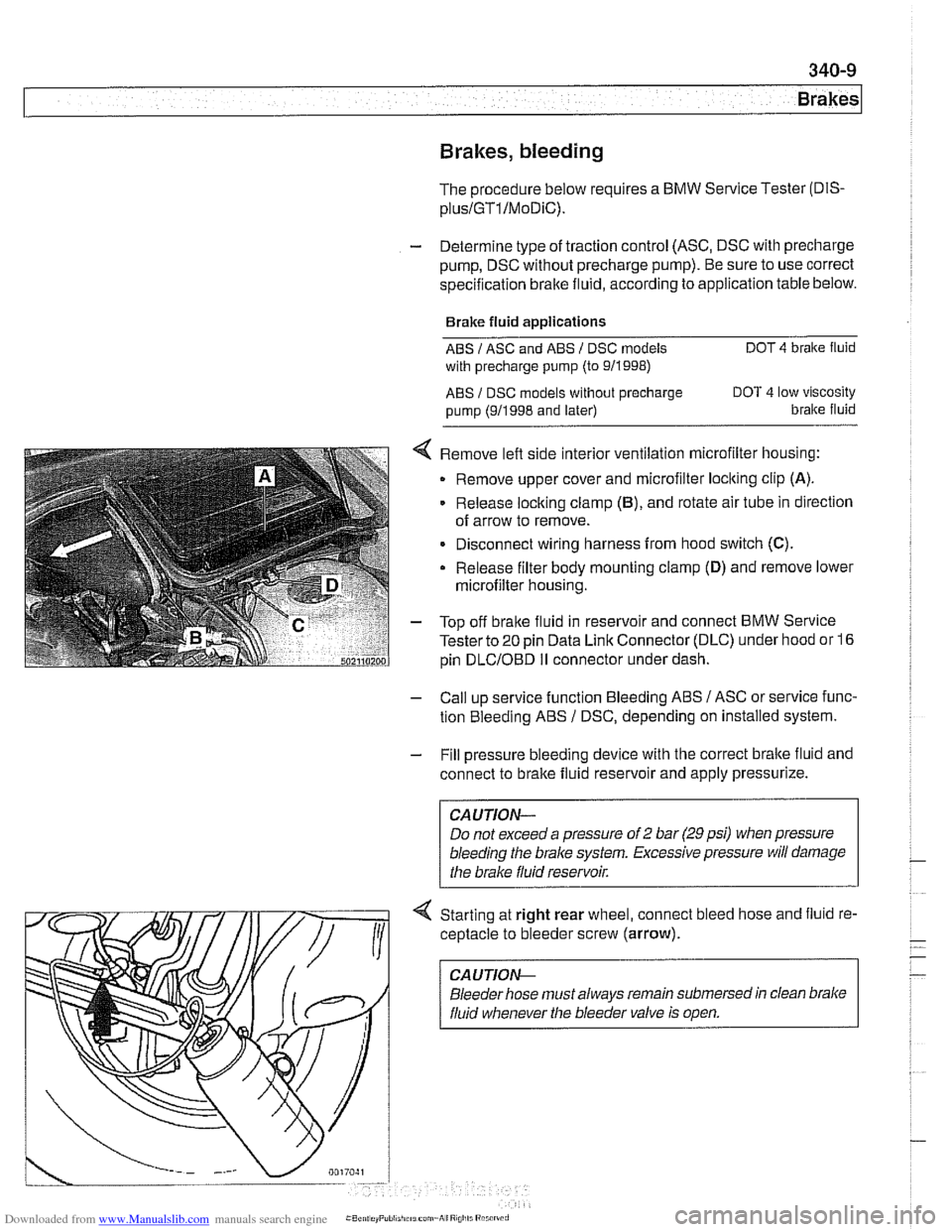
< Remove left side interior ventilation microfilter housing:
Remove upper cover and microfilter loclting clip
(A).
Release locking clamp (B), and rotate air tube in direction
of arrow to remove.
Disconnect wiring harness from hood switch
(C).
Release filter body mounting clamp (D) and remove lower
microfilter housing.
- Top off bralte fluid in reservoir and connect BMW Service
Tester to
20 pin Data Link Connector (DLC) under hood or 16
pin
DLCIOBD I1 connector under dash.
- Call up service function Bleeding ABS / ASC or service func-
tion Bleeding ABS
/ DSC, depending on installed system.
- Fill pressure bleeding device with the correct brake fluid and
connect to brake fluid reservoir and apply pressurize.
Do not exceed a pressure of
2 bar (29 psi) when pressure
bleeding the
brake system. Excessive pressure will damage
4 Starting at right rear wheel, connect bleed hose and fluid re-
ceptacle to bleeder screw (arrow).
CA UTlON-
Bleeder hose must always remain submersed in clean brake
fluid whenever the bleeder valve is open.
Page 782 of 1002
Downloaded from www.Manualslib.com manuals search engine
Brakes
- Pump brake pedal a few times to reduce vacuum in brake
booster. This makes removal of
check valve easier.
- Remove or loosen hose clamp(s) at check valve.
- Disconnect hoses. Remove valve to test or replace.
NOTE-
If valve is pressed into grommet in vacuum booster, pry it out
carefully.
- Reinstall valve using new hose clamps
NOTE-
Install the valve so that the molded arrow is pointing toward
the intake manifold.
Brake booster, removing and installing
CAUTIO&
All E39 vehicles sold in the USA are equipped with Antiloclc
Braking System (ABS) and either Automatic Stability Control
(ASC) or Dynamic Stability Control (DSC). In order for the
bralchg and stability controls to work properk if brake fluid
lines are disconnected and reconnected,
male sure that the
brake system is bled by an authorized BMW dealer or other
qualified repair facility using the BMW Service Tester: See
Brake Bleeding earlier in this group.
- Disconnect negative (-) cable from battery.
I CAUTION- I
Prior to disconnecting the battery read the battery discon-
nection cautions given in
001 General Cautions and
I Warnings. I
- Remove bralte master cylinder as described earlier.
- Disconnect engine vacuum hose from bralte booster.
Page 922 of 1002
Downloaded from www.Manualslib.com manuals search engine
l Seats
This repair group covers removal and installation of the front
and rear seat.
SeatIMirrorlSteering Column Memory
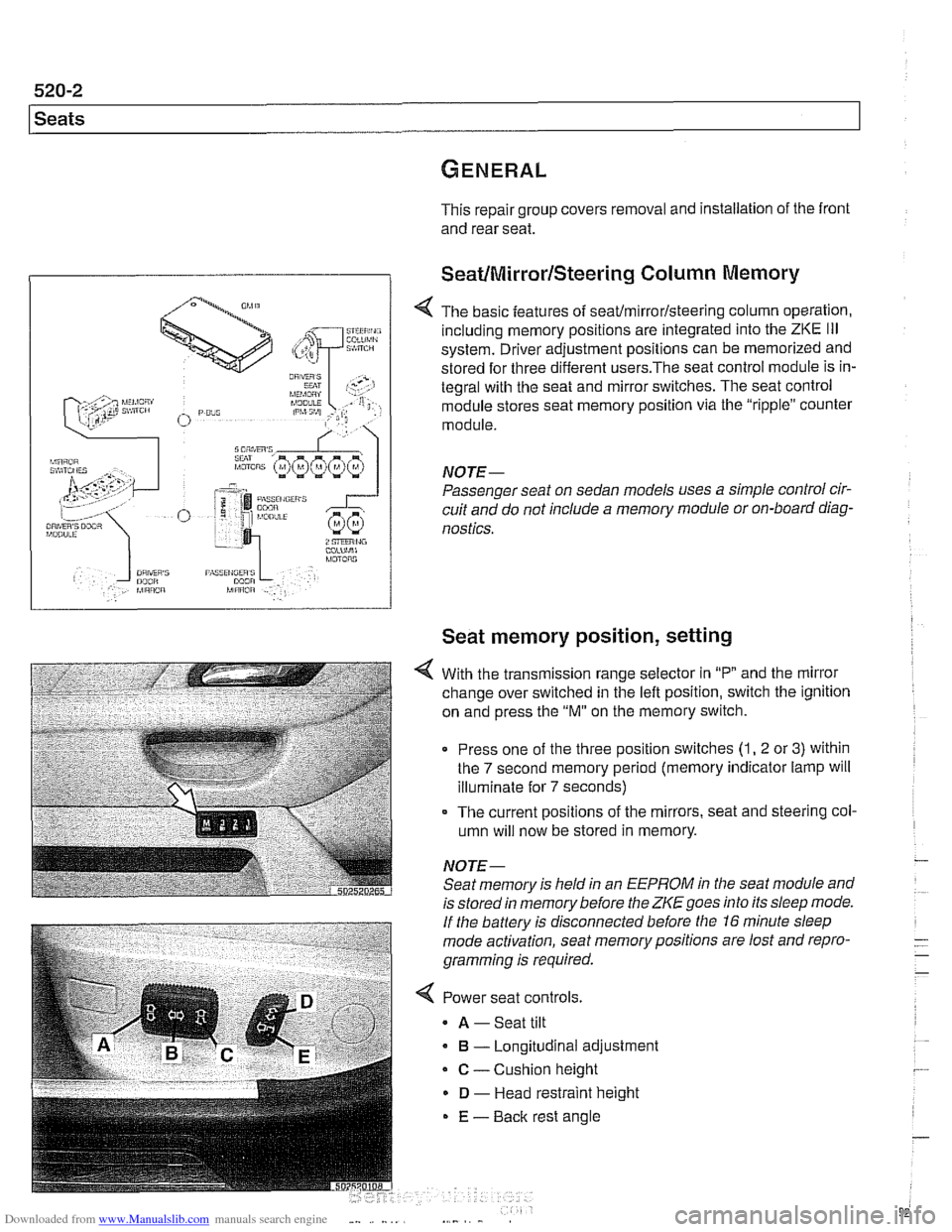
< The basic features of seaffmirrorlsteering column operation,
including memory positions are integrated into the
ZKE Ill
system. Driver adjustment positions can be memorized and
stored for three different
users.The seat control module is in-
tegral with the seat and mirror switches. The seat control
module stores seat memory position via the "ripple" counter
module.
NOTE-
Passenger seat on sedan models uses a simple control cir-
cuit and do not include a memory module or on-board diag-
nostics.
Seat memory position, setting
With the transmission range selector in "P and the mirror
change over switched in the left position, switch the ignition
on and press the
"M" on the memory switch.
Press one of the three position switches
(1, 2 or 3) within
the
7 second memory period (memory indicator lamp will
illuminate for
7 seconds)
- The current positions of the mirrors, seat and steering col-
umn will now be stored in memory.
NOTE- Seat memory is held in an
EEPROM in the seat module and
is stored in memory before the
ZKE goes into its sleep mode.
If the battery is disconnected before the 16 minute sleep
mode activation, seat memorypositions are lost and repro-
gramming is required.
< Power seat controls.
A -Seat tilt
B - Longitudinal adjustment
C - Cushion height
D - Head restraint height
E - Back rest angle
Page 989 of 1002
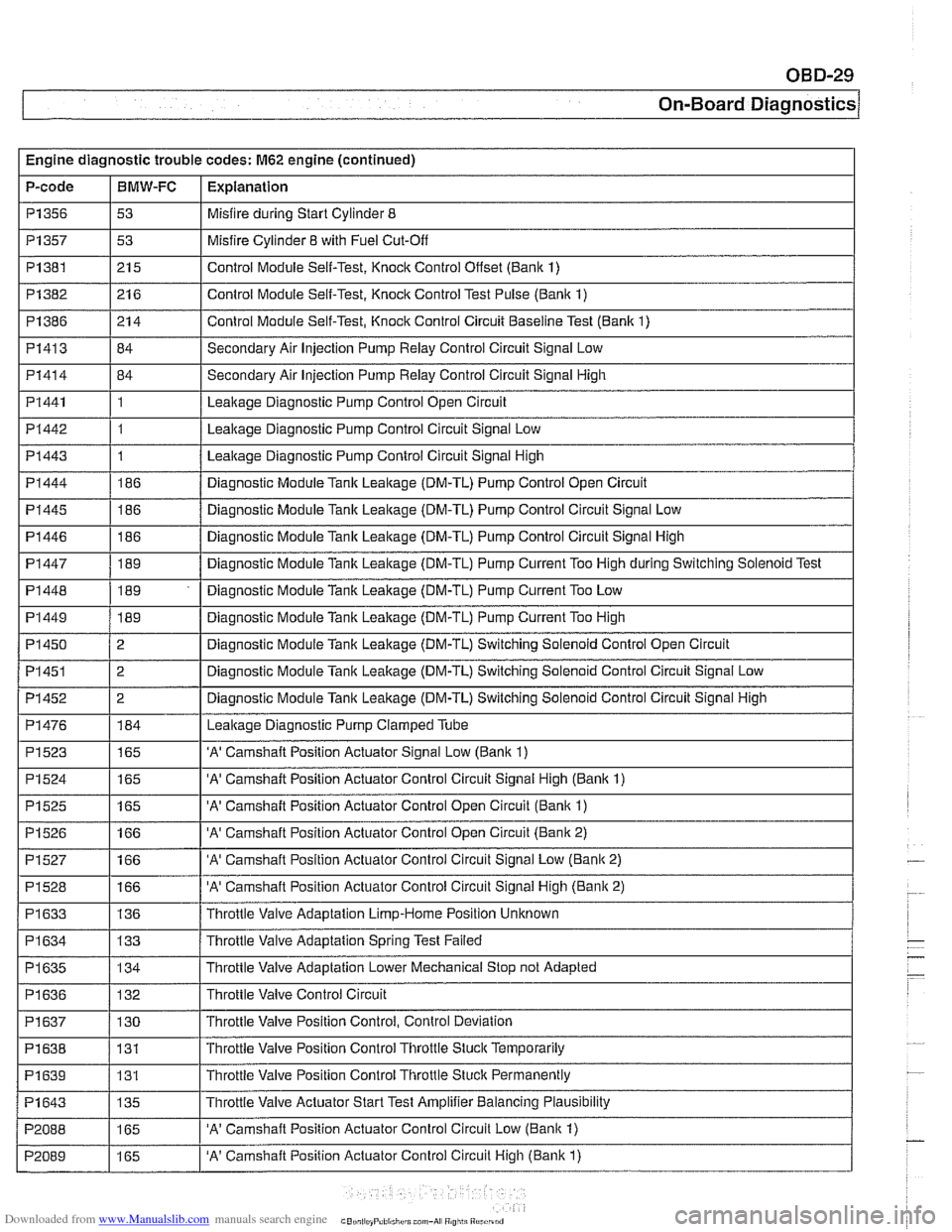
Downloaded from www.Manualslib.com manuals search engine
On-Board ~ia~nosticsl
Engine diagnostic trouble codes: M62 engine (continued)
P-code
I I -
I I - -.
PI445 1186 / Diagnostic Module Tank Leakage (DM-TL) Pump Control Circuit Signal Low
PI357
PI382
PI386
PI413
PI414
PI441
PI442
PI443
PI444
P1356 1 53 I Misfire during Start Cylinder 8
BMW-FC
I P1523
I
I - -
1165 I 'A' Camshaft Position Actuator Signal Low (Banlc 1)
Explanation
P1381 1215 I Control Module Self-Test, Knock Control Onset (Bank 1)
53
21 6
21 4
84
84
1
1
1
186
PI 446
PI 447
PI 448
PI449
PI 450
PI451
PI452
PI476
Misfire Cylinder 8 with Fuel Cut-Off
Control Module Self-Test, Knock Control Test Pulse (Bank 1)
Control Module Self-Test, Knock Control Circuit Baseline Test (Bank 1)
Secondary Air Injection Pump Relay Control Circuit Signal Low
Secondary Air Injection Pump
Relay Control Circuit Signal High
Leakage Diagnostic Pump Control Open Circuit
Leakage Diagnostic Pump Control Circuit Signal Low
Leakage Diagnostic Pump Control Circuit Signal High
Diagnostic Module Tank Leakage (DM-TL) Pump Control Open Circuit
186
189
189
189
2
2
2
184
P1524
P1525
P1526
PI527
PI528
PI633
PI 634
PI 635
I I
PI 638 / 131 I Throttle Valve Position Control Throttle Stuck Temporarily
. -
Diagnostic Module Tank Leakage (DM-TL) Pump Control Circuit Signal High
Diagnostic Module
Tank Leakage (DM-TL) Pump Current Too High during Switching Solenoid Test
Diagnostic Module Tank Leakage (DM-TL) Pump Current Too Low
Diagnostic Module
Tank Leakage (DM-TL) Pump Current Too High
Diagnostic Module Tank Leakage (DM-TL) Switching Solenoid Control Open Circuit
Diagnostic Module
Tank Leakage (DM-TL) Switching Solenoid Control Circuit Signal Low
Diagnostic Module
Tank Leakage (DM-TL) Switching Solenoid Control Circuit Signal High
Leakaqe Diaqnostic Pump Clamped Tube
I I
165
165
166
166
166
136
133
134
'A' Camshaft Position Actuator Control Circuit Signal High (Banlc 1)
'A' Camshaft Position Actuator Control Open Circuit (Bank 1)
'A' Camshaft Position Actuator Control Open Circuit (Bank 2)
'A' Camshaft Position Actuator Control Circuit Signal Low (Bank 2)
'A' Camshaft Position Actuator Control Circuit Signal High (Bank 2)
Throttle Valve Adaptation Limp-Home Position Unknown
Throttle Valve Adaptation Spring Test Failed
Throttle Valve Adaptation Lower Mechanical Stop not Adapted
Throttle Valve Control Circuit
PI 636
PI639
P1643
P2088
P2089
PI 637 / 130 I Throttle Valve Position Control, Control Deviation
132
131
135
165
165 Throttle
Valve Position Control Thronle Stuck Permanently
Throttle Valve Actuator Start Test Amplifier Balancing Plausibility
'A' Camshaft Position Actuator Control Circuit Low (Banlc 1)
'A' Camshaft Position Actuator Control Circuit High (Bank 1)