Air BMW 528i 1998 E39 User Guide
[x] Cancel search | Manufacturer: BMW, Model Year: 1998, Model line: 528i, Model: BMW 528i 1998 E39Pages: 1002
Page 14 of 1002
Downloaded from www.Manualslib.com manuals search engine
.
General
WARNING-
Never run the engine in tile work area unless it is well-ven-
tilated. The exhaust should be vented to the outside. Car-
bon monoxide (CO) in exhaust kills.
Remove all neckties,
scarfs, loose clothing, or jewelry
when working near a running engine or power tools.
Tuck in shirts. Tie long hair and secure it under a cap.
Severe injury can result from these things being
caugiit
in rotating parts.
Remove rings, watches, and bracelets. Aside from the
dangers of moving parts, metallic jewelry conducts
electricity and may cause shorts, sparks, burns, or
damage to the electricalsystem when accidentally con-
tacting the battery or other electrical terminals.
Disconnect the battery negative
(-) cable whenever
working on or near the fuel system or anything that is
electrically powered. Accidental electrical contact may
damage the electrical system or cause a fire.
Fuelis highly flammable. When working around fuel, do
not
smoke or work near heaters or other fire hazards.
Keep an approved fire extinguisher handy.
The fuel system is designed to retain pressure even
when the ignition is off When worlcing with the
fuelsys-
tem, loosen the fuel lines slowly to allow the residual
pressure to dissipate gradually. Take precautions to
avoid spraying fuel.
. Illuminate the worlc area adequately and safely Use a
portable safety light for worlcing inside or under the car.
A fluorescent type
light is best because it gives off less
heat. If using a light with a normal incandescent bulb,
use rough service bulbs to avoid
breakage. The hot fil-
ament of an accidentally broken bulb can ignite spilled
fuel or oil.
Keep sparks, lighted matches, and any open flame
away from the top of the battery. Hydrogen gas
emitted
by the battery is highly flammable. Any nearby source
of ignition may cause the battery to explode.
Never lay
tools or parts in the engine compartment or
on top of the battery. They may
fallinto confinedspaces
and be difficult to retrieve, become caught in belts or
other rotating parts when the engine is started, or
cause electrical shorts and damage to the electrical
system.
Page 15 of 1002
Downloaded from www.Manualslib.com manuals search engine
General
Much of the necessary maintenance and minor repairthat an
automobile will need can be done with ordinary tools. Below
you'll find important information on how to work safely, a dis-
cussion of what tools will be needed and how to use them.
Safety
Although an automobile presents many hazards, common
sense and good equipment can help ensure safety. Many ac-
cidents happen because of carelessness. Pay attention and
stick to the safety rules in this manual.
Lifting the car
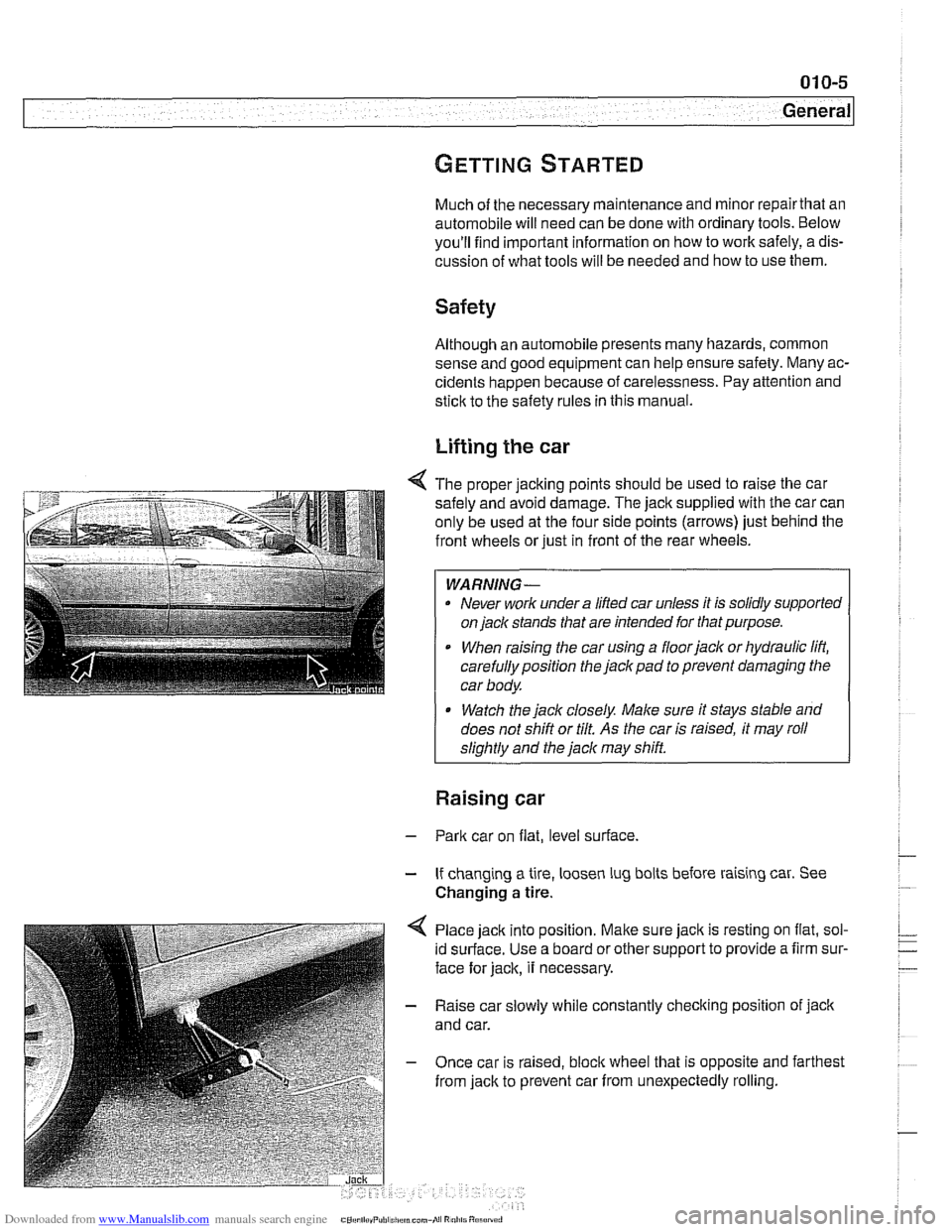
4 The proper jacking points should be used to raise the car
safely and avoid damage. The
jack supplied with the car can
only be used at the four side points (arrows) just behind the
front wheels or just in front of the rear wheels.
WARNING-
. Never work under a lifted car unless it is solidly supported
on
jack stands that are intended for that purpose.
When raising the car using a floorjack or hydraulic lift,
carefully position the jack pad to prevent damaging the
car body.
* Watch the jack closely. Male sure it stays stable and
does not shift or tilt.
As the car is raised, it may roll
sliahtlv and the
jack mav shift.
Raising car
- Park car on flat, level surface.
- If changing a tire, loosen lug bolts before raising car. See
Changing
a tire.
Place jack into position.
Malte sure jack is resting on flat, sol-
id surface. Use a board or other support to provide a firm sur-
face for jack, it necessary.
- Raise car slowly while constantly checking position of jack
and car.
- Once car is raised, bloclc wheel that is opposite and farthest
from jack to prevent car from unexpectedly rolling.
Page 17 of 1002
Downloaded from www.Manualslib.com manuals search engine
General
ADVICE FOR THE BEGINNER
The tips that follow are general advice to help the do-it-your-
self BMW owner
periorm repairs and maintenance taslts
more easily and more professionally.
Planning ahead
Know what the whole job requires before starting. Read the
procedure thoroughly, from beginning to end, in
orderto know
just what to expect and what parts will have to be replaced.
Workshop practices
Keeping things organized, neat, and clean is essential to do-
ing a good job. When working under the hood, iender covers
will protectthe finish from scratches and otherdamage. Make
sure the car finish is clean so that dirt under the cover does
not scratch the iinish.
Any repair job will be less troublesome if the parts are clean
For cleaning old parts, there are many solvents and parts
cleaners commercially available.
For cleaning parts prior to assembly, commercially available
aerosol cans of parts cleaner or brake cleaner are handy to
use, and the cleaner will evaporate completely.
WARNING-
Most solvents used for cleaning parts are highly flammable
as well as toxic, especially in aerosol form. Use with extreme
care. Do not smoke. Do not use these products indoors or
near any source of heat, sparks or flame.
Non reusable fasteners
Many fasteners used on the cars covered by this manual
must be replaced with new ones once they are removed.
These include but are not limited to: bolts, nuts (self-locking,
nylock, etc.), roll pins, clips and washers. Genuine BMW
parts should be the only replacement parts used for this pur-
pose.
Some bolts are designed to stretch during assembly and are
permanently altered, rendering them unreliable once re-
moved. These are known as torque-to-yield fasteners. Al-
ways replace fasteners where instructed to do so. Failure to
replace these fasteners could cause personal injury
orvehi-
cle damage. See an authorized BMW dealer for applications
and ordering information.
Page 18 of 1002
Downloaded from www.Manualslib.com manuals search engine
General Tightening fasteners
When tightening the bolts ornuts on acomponent, it is always
good practice to tighten the bolts gradually and evenly to
avoid misalignment or over-stressing any one portion of the
component. For components sealed with gaskets, this meth-
od helps to ensure that the
gasket will seal properly.
WARNING
-
Table a: General bolt tightening torques in Nm (max.
permissible) is
a general reference only The values listedin
the table are not intended to be usedas a substitute for tor-
ques specifically called out in the text or in manufacturer's in-
formation.
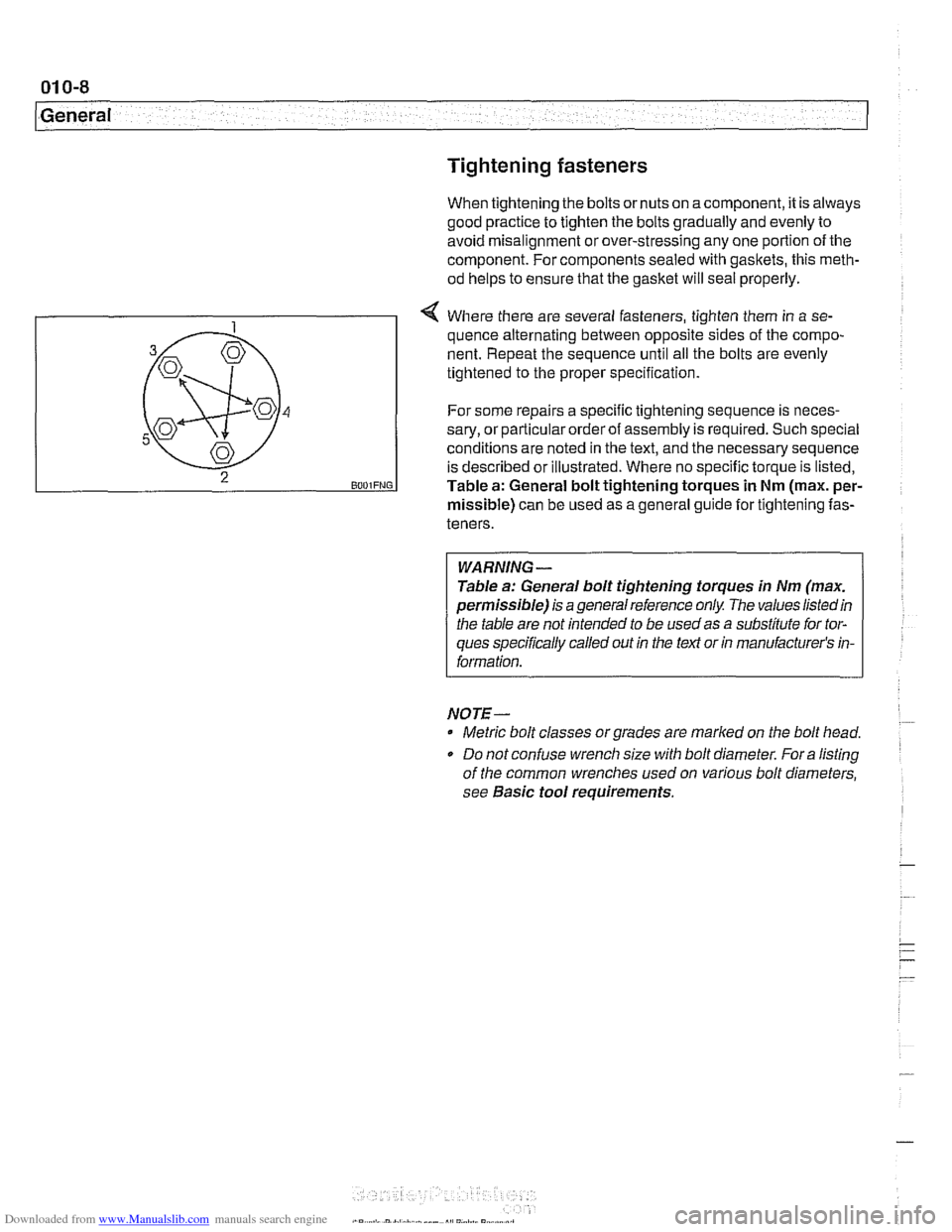
4 Where there are several fasteners, tighten them in a se-
NOTE-
* Metric bolt classes or grades are rnarlced on the bolt head.
* Do not confuse wrench size with bolt diameter. Fora listing
of the common wrenches used on various bolt
diameters,
see Basic tool requirements.
2 BOO~FNG
quence alternating between opposite sides of the compo-
nent. Repeat the sequence until all the bolts are evenly
tightened to the proper specification.
For some repairs a specific tightening sequence is
neces-
sary, or particular order of assembly is required. Such special
conditions are noted in the text, and the necessary sequence
is described or illustrated. Where no specific torque is listed,
Table
a: General bolt tightening torques in Nm (max. per-
missible) can be used as a general guide for tightening fas-
teners.
Page 20 of 1002
Downloaded from www.Manualslib.com manuals search engine
01 0-1 0
General
Electrical testing
Many electrical problems can be understood and solved with
only a little fundamental knowledge of how electrical circuits
function.
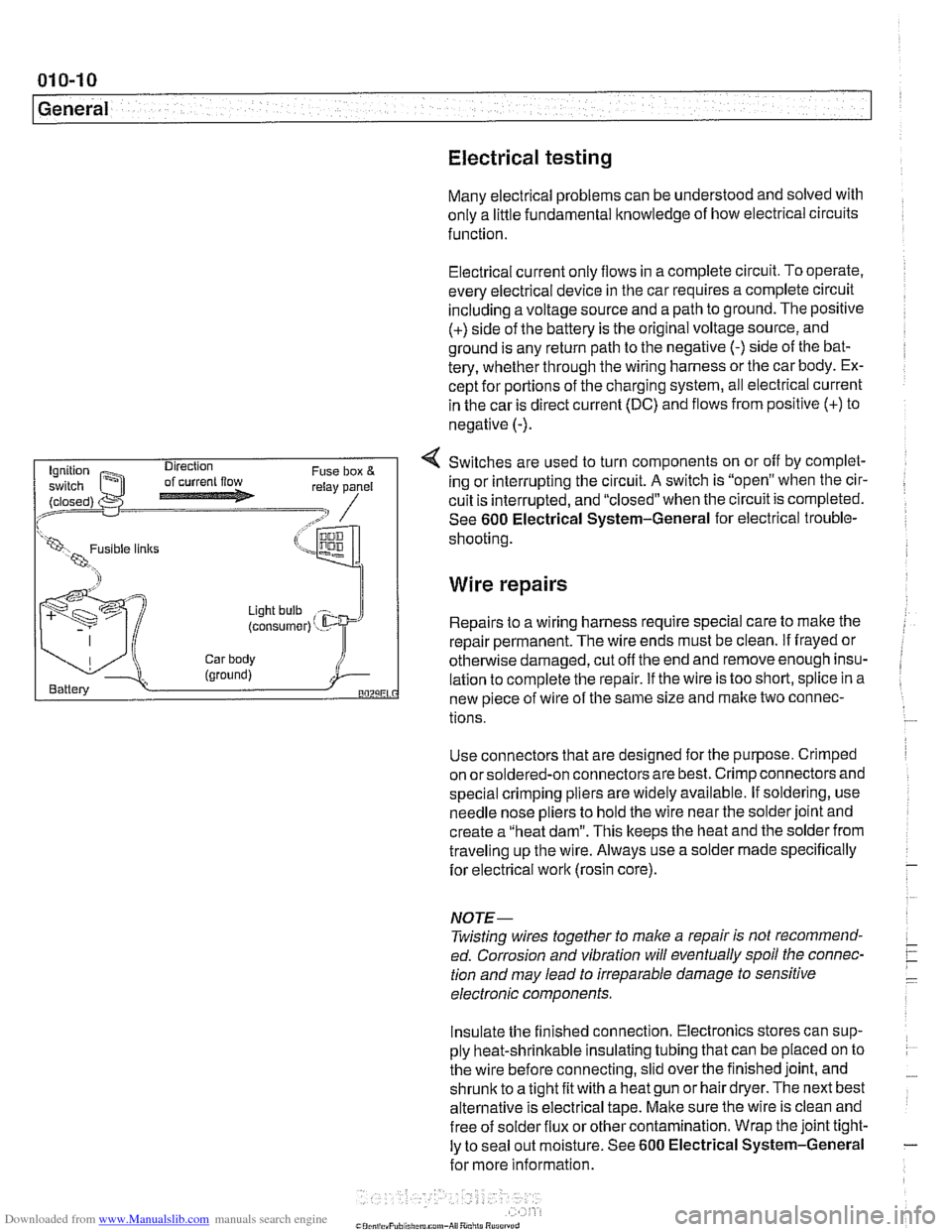
Electrical current
only flows in a complete circuit. To operate.
every electrical device in the car requires a complete circuit
including a voltage source and a path to ground. The positive
(+) side of the battery is the original voltage source, and
ground is any return path to the negative
(-) side of the bat-
tery, whether through the wiring harness or the car body. Ex-
cept for portions of the charging system, all electrical current
in the car is direct current (DC) and flows from positive
(+) to
negative
(-).
4 Switches are used to turn components on or off by complet-
ing or interrupting the circuit.
A switch is "open" when the cir-
cuit is interrupted, and "closed" when the circuit is completed.
See
600 Electrical System-General for electrical trouble-
(LW, 1 shooting
Wire repairs
Light bulb
(consumer) ' - Repairs to a wiring harness require special care to make the
repair permanent. The wire ends must be clean.
if frayed or
Car body otherwise damaged, cut off the end and remove enough insu- (ground) i Battery lation to complete the repair. if the wire is too short, splice in a BOZLiEL new piece of wire of the same size and make two connec-
tions.
Use connectors that are designed for the purpose. Crimped
on orsoldered-on connectors are best. Crimp connectors and
special crimping pliers are widely available. If soldering, use
needle nose pliers to hold the wire near the solder joint and
create a "heat dam". This keeps the heat and the solder from
traveling up the wire. Always use a solder made specifically
for electrical
work (rosin core).
NOJE-
Twisting wires together to make a repair is not recommend-
ed. Corrosion and vibration will eventually spoil the connec-
tion and may lead to irreparable damage to sensitive
electronic components.
Insulate the finished connection. Electronics stores can sup-
ply heat-shrinkable insulating tubing that can be placed on to
the wire before connecting, slid over the finished joint, and
shrunic to a tight fit with a heat gun or hair dryer. The next best
alternative is electrical tape. Make sure the wire is clean and
free of
solder flux or other contamination. Wrap the joint tight-
ly to seal out moisture. See
600 Electrical System-General
for more information.
Page 21 of 1002
Downloaded from www.Manualslib.com manuals search engine
- - ..
General
Many of the maintenance and repair tasks in this manual call
forthe installation of new parts, orthe use of new gaskets and
other materials when reinstalling parts. Most often, the parts
that will be needed should be on hand before beginning the
job. Read the introductorytext and the complete procedure
to
determine which parts will be needed.
NOTE-
For some biggerjobs, partial disassembly and inspection is
required to determine a complete parts list. Read the proce-
dure carefully and, if necessary, male other arrangements to
get the necessary parts while your car is disassembled.
Genuine BMW parts
Genuine BMW replacement parts from an authorized BMW
dealer are designed and manufactured to the same high stan-
dards as the original parts. They will be the correct material.
manufactured to same specifications, and guaranteed to fit
and work as intended. Most genuine BMW parts carry a limit-
ed warranty.
Many independent repair shops make a point of using genu-
ine
BMW parts, even though they may at times be more ex-
pensive than parts from other sources. They know the value
of doing the job right with ihe right parts. Parts from other
sources can be as good as BMW parts, particularly if manu-
factured by one of
BMW's or~ginal equipment suppliers, but it
is often difficult to know.
BMW is constantly updating and improving their cars, often
malting improvements during a given model year. BMW may
recommend a newer, improved part as a replacement, and
your authorized dealer's parts department will know about it
and provide it. The BMW parts organization is best equipped
to deal with your BMW parts needs.
Non returnable parts
Some parts cannot be returned, even for credit. The best ex-
ample is electrical parts, which are almost universally consid-
ered non returnable. Buy electrical parts carefully, and be as
sure as possible that a replacement is needed, especially for
expensive parts such as electronic control units. It may be
wise to let an authorized BMW dealer or other qualified shop
confirm your diagnosis before replacing an expensive non re-
turnable
Dart.
Page 23 of 1002
Downloaded from www.Manualslib.com manuals search engine
BMW dealers are uniquely qualified to provide service for
BMW cars. Their authorized relationship with the large BMW
service organization means that they have access to special
tools and equipment, together with the latest and most accu-
rate repair information.
The BMW dealer's service technicians are highly trained and
very capable. Authorized BMW dealers are committed to sup-
porting the BMW product. On the other hand, there are many
independent shops that provide quality repairwork.
Checking
with other BMW owners for recommendations on service fa-
cilities is good way to learn of reputable BMW shops in your
area.
Most maintenance can be accomplished with a small selec-
tion of tools. Tools range in quality from inexpensive junk,
which may break at first use, to very expensive and
well-
made tools for the professional. The best tools for most do-it-
yourself BMW owners lie somewhere in between.
Many reputable tool manufacturers offer good quality, moder-
ately priced tools with a lifetime guarantee. These are your
best buy. They cost a little more, but they are good quality
tools that will do what
Is expected of them. Sears' Craftsman@
line is one such source of good quality tools.
Some of the repairs covered in this manual require the use of
special tools, such as a custom puller or specialized electrical
test equipment. These special tools are called out in the text
and can be purchased through an authorized BMW dealer.
As an alternative, some special tools mentioned may be pur-
chased from the following tool manufacturers and/or distribu-
tors:
Specialty tool suppliers
Assenmacher Specialty Tools
6440 Odeli Place
Boulder. CO 80301
Baum Tools Unlimited, Inc.
P.O. Box 5867
Sarasota.
FL 34277-5867
Page 24 of 1002
Downloaded from www.Manualslib.com manuals search engine
01 0-1 4
General
Specialty tool suppliers
Peake Research, Automotive Products Division
P.O. Box 28776
San Jose, CA 95159
408-369-0406
[email protected]
http://www.peakeresearch.com
Basic tool requirements
The basic hand tools described below can be used to accom-
plish most of the simple maintenance and repair tasks.
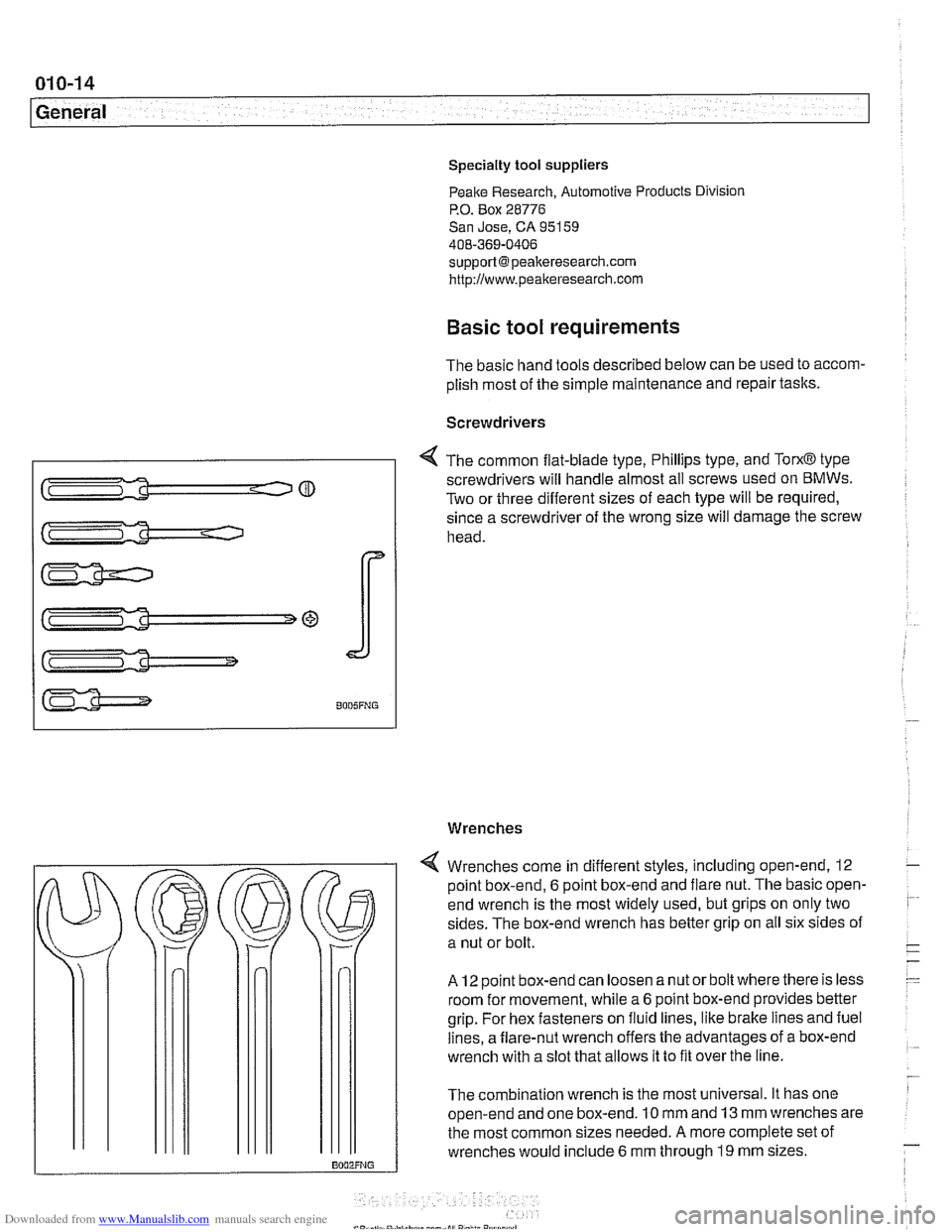
Screwdrivers
4 The common flat-blade type, Phillips type, and TorxO type
screwdrivers will handle almost all screws used on
BMWs.
Two or three different sizes of each type will be required,
since a screwdriver of the wrong size will damage the screw
head.
Wrenches
4 Wrenches come in different styles, including open-end. 12
point box-end,
6 point box-end and flare nut. The basic open-
end wrench is the most widely used, but grips on only two
sides. The box-end wrench has better grip on all six sides of
a nut or bolt.
A 12 point box-end can loosen a nut or bolt where there is less
room for movement, while
a 6 point box-end provides better
grip. For hex fasteners on fluid lines, like brake lines and fuel
lines, a flare-nut wrench offers the advantages of a box-end
wrench with a slot that allows it to fit over the line.
The combination wrench is the most universal. It has one
open-end and one box-end. 10 mm and 13 mm wrenches are
the most common sizes needed.
A more complete set of
wrenches would include
6 mm through 19 mm sizes.
Page 27 of 1002
Downloaded from www.Manualslib.com manuals search engine
.
General
Torque wrench
A torque wrench is used to precisely tighten threaded fasten-
ers to a predetermined value. Many of the repair procedures
in this manual include BMW-specified torque values
in New-
ton-meters (Nm) and the equivalent values in foot-pounds
(ft-
Ib).
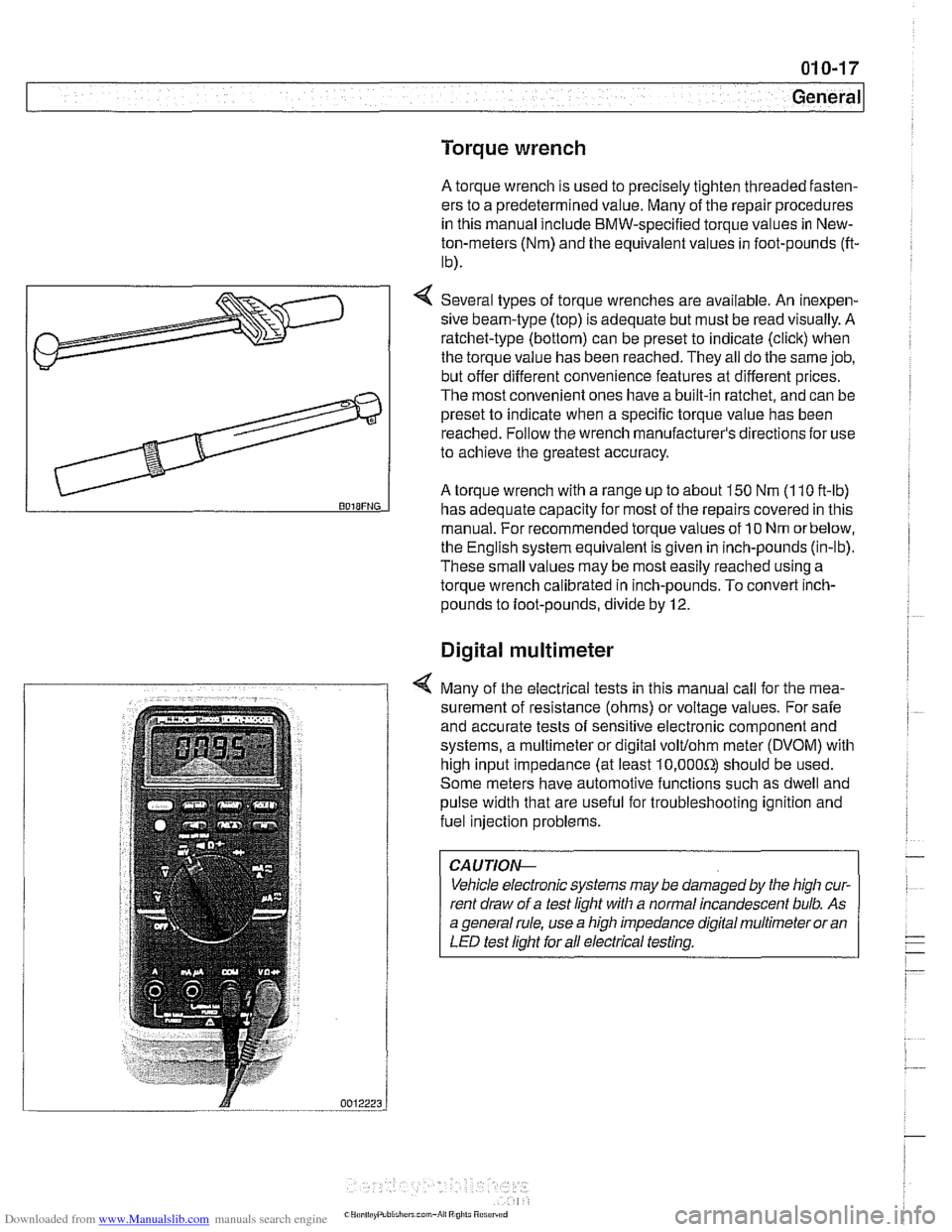
4 Several types of torque wrenches are available. An inexpen-
sive beam-type (top) is adequate but must be read visually. A
ratchet-type (bottom) can be preset to indicate (click) when
the torque value has been reached. They all do the same job,
but offer different convenience features at different prices.
The most convenient ones have a built-in ratchet, and can be
preset to indicate when a specific torque value has been
reached. Follow the wrench manufacturer's directions
for use
to achieve the greatest accuracy.
A torque wrench with a range up to about 150 Nm (1 10 ft-lb) BOIBFNG has adequate capacity for most of the repairs covered in this
manual. For recommended torque values of
10 Nm orbelow,
the English system equivalent is given in inch-pounds (in-lb).
These small values may be most easily reached using a
torque wrench calibrated in inch-pounds. To convert
inch-
pounds to foot-pounds, divide by 12.
Digital multimeter
4 Many of the electrical tests in this manual call for the mea-
surement of resistance (ohms) or voltage values. For safe
and accurate tests of sensitive electronic component and
systems, a multimeter or digital
volt/ohm meter (DVOM) with
high input impedance (at least
10,000Sr) should be used.
Some meters have automotive functions such as dwell and
pulse width that are useful for troubleshooting ignition and
fuel injection problems.
CAUTIOI\C
Vehicle electronic systems may be damaged by the high cur-
rent draw of a test light with a normal incandescent bulb. As
a general rule, use a high impedance digital multimeter or an
LED test light for all electrical testing.
Page 28 of 1002
Downloaded from www.Manualslib.com manuals search engine
-
General
BMW special tools
Many repairs covered in this manual call for the use of BMW
special tools. Many of the BMW special tools mentioned in
this manual are simply the best thing to use to do the job cor-
rectly. In these cases, the tool is identified with a
BMW parl
number. See your authorized BMW dealer parts department
for information on how to order special tools.
There are some jobs for which expensive special tools are es-
sential, and not a cost-effective purchase for a one time repair
by the do-it-yourself owner. This manual includes such re-
pairs for the benefit of those with the necessary experience
and access to tools. For the do-it-yourselfer, the need for spe-
cial tools is noted in the text, and whether or not BMW dealer
service is recommended.
Changing a tire
- Stop car on as flat a surface as possible, in a place where you
can be easily seen by other drivers. Avoid stopping just over
the crest of a hill.
WARNING -
If a tire goes flat while driving, pull well off the road. Changing
a tire on a busy slreet or liigliway is very dangerous. If
nec-
essag drive a short distance on the flat tire to get to a safe
place. It is much better to ruin a tire or rim than to
risk being
hit.
-
- Turn on emergency flashers, and set out flares or emergency
markers well behind car.
Choclc wheel (wheel chock located
in trunk) diagonally opposite to the one being changed. Pas-
sengers should get out of car and stand well away from road.
- Take jaclc and tools from tool area beneath trunk mat. Re-
move spare tire from tire storage tray.
- Loosen wheel bolts while car is on ground, but leave them a
little snug.
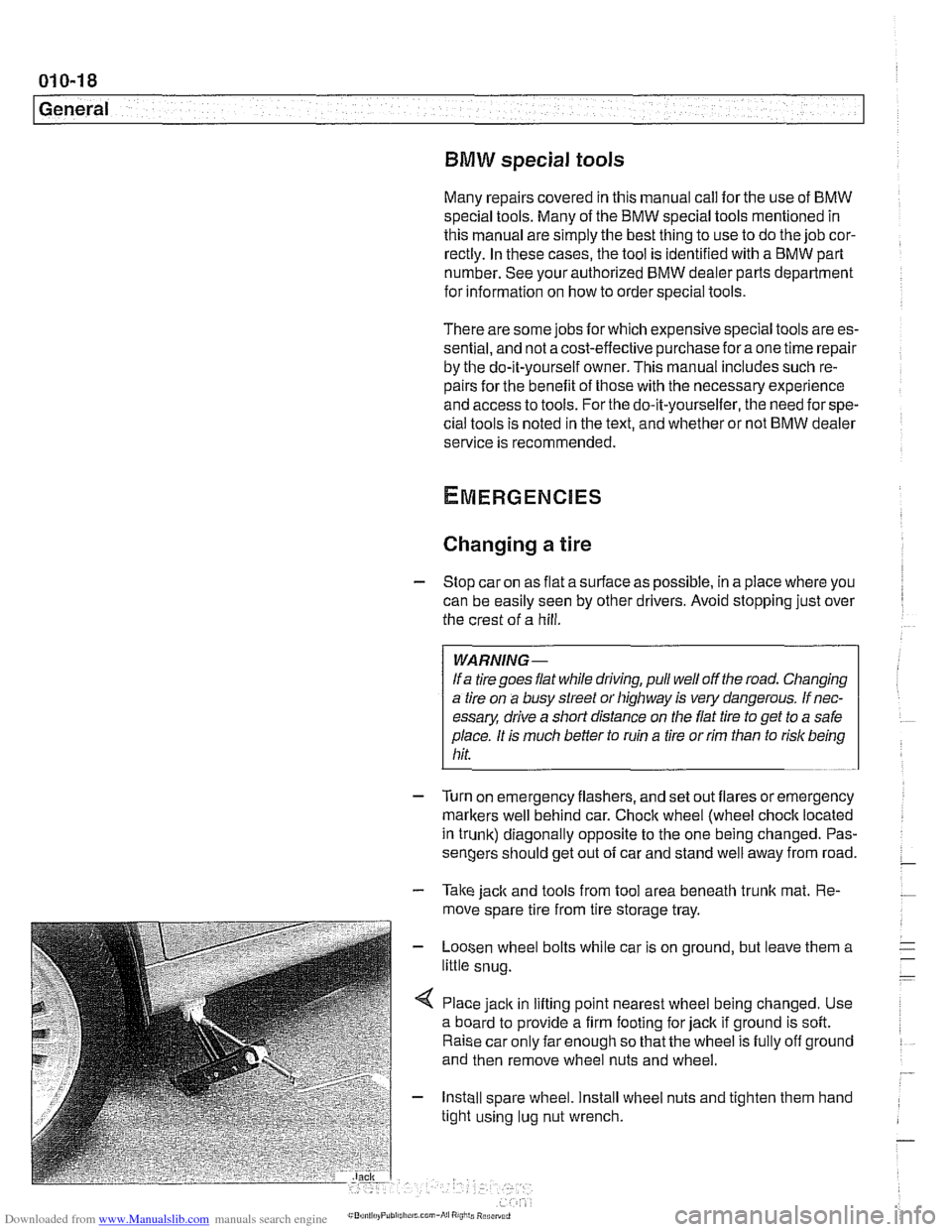
< Place jack in lifting point nearest wheel being changed. Use
a board to provide a firm footing for jack if ground is soft.
Raise car only far enough so that the wheel is fully off ground
and then remove wheel nuts and wheel.
- Install spare wheel. Install wheel nuts and tighten them hand
tight using lug nut wrench.