open BMW 528i 2001 E39 Owners Manual
[x] Cancel search | Manufacturer: BMW, Model Year: 2001, Model line: 528i, Model: BMW 528i 2001 E39Pages: 1002
Page 725 of 1002
Downloaded from www.Manualslib.com manuals search engine
Rear Suspension
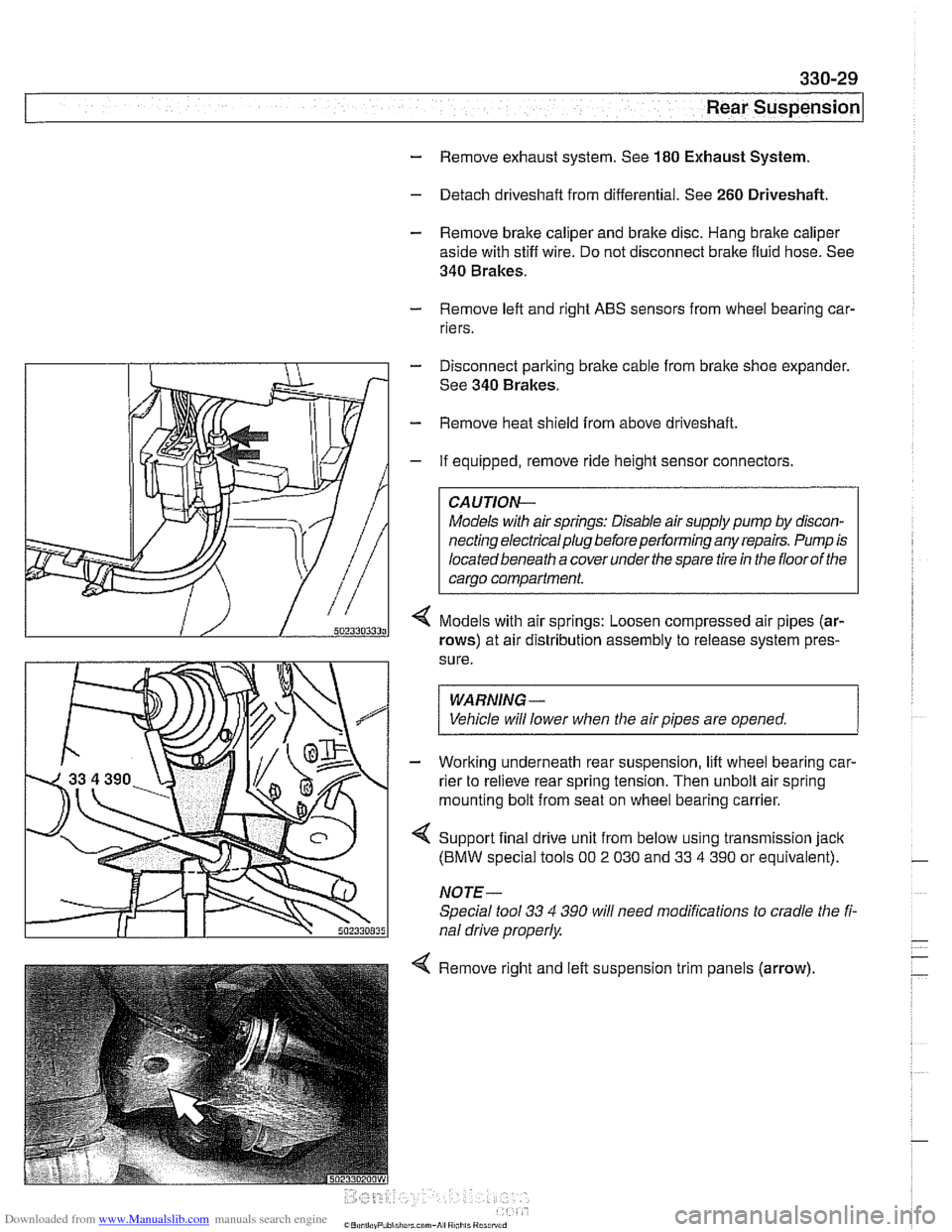
- Remove exhaust system. See 180 Exhaust System.
- Detach driveshaft from differential. See 260 Driveshaft.
- Remove brake caliper and brake disc. Hang brake caliper
aside with stiff wire. Do not disconnect brake fluid hose. See
340 Brakes.
- Remove left and right ABS sensors from wheel bearing car-
riers.
Disconnect parking brake cable from brake shoe expander.
See 340 Brakes.
Remove heat shield from above driveshaft
If equipped, remove ride height sensor connectors
CAUTION-
Models with air springs: Disable air supply pump by discon-
necting electrical plug before performing any repairs. Pump is
locatedbeneath a coverunder
thespare tire in the floorof the
carqo compartment.
Models with air springs: Loosen compressed air pipes (ar-
rows) at air distribution assembly to release system pres-
sure.
WARNING -
Vehicle will lower when the air pipes are opened. 1
- Working underneath rear suspension, lift wheel bearing car-
rier to relieve rear spring tension. Then unbolt air spring
mounting bolt from seat on wheel bearing carrier.
4 Support final drive unit from below using transmission jack
(BMW special tools 00 2 030 and 33 4 390 or equivalent).
NOTE-
Special tool 33 4 390 will need modifications to cradle the fi-
nal drive properly
4 Remove right and left suspension trim panels (arrow),
Page 742 of 1002
Downloaded from www.Manualslib.com manuals search engine
Rear Suspension
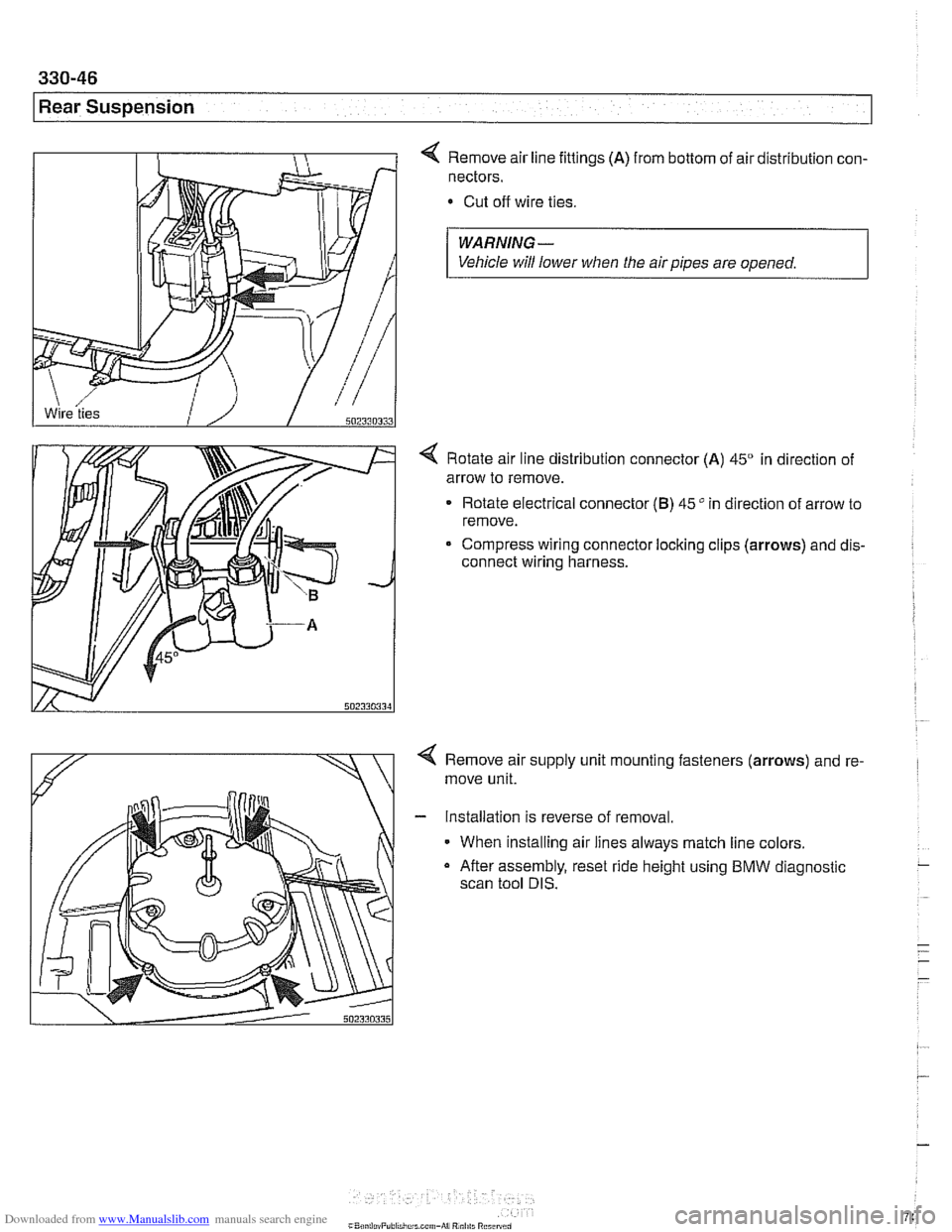
4 Remove air line fittings (A) from bottom of air distribution con-
nectors.
Cut off wire ties.
WARNING-
Vehicle will lower when the air pipes are opened.
4 Rotate air line distribution connector (A) 45" in direction of
arrow to remove.
Rotate electrical connector
(B) 45" in direction of arrow to
remove.
Compress wiring connector locking clips
(arrows) and dis-
connect wiring harness.
< Remove air supply unit mounting fasteners (arrows) and re-
move unit.
- Installation is reverse of removal.
When installing air lines always match line colors.
a After assembly, reset ride height using BMW diagnostic
scan tool DIS.
Page 769 of 1002
Downloaded from www.Manualslib.com manuals search engine
Brakes
Warnings and cautions
WARNING-
. E39 cars require special BMWsen/ice equipment toprop-
erly bleed the brake hydraulic system. See Bleeding
Brakes for additional information.
Semi-metallic and metallic brake friction materials in
brake pads or shoes may produce dangerous dust.
Brake fluid is poisonous, corrosive and dangerous to
the environment. Wear safety glasses and rubber
gloves when worliing with
bralie fluid. Do not siphon
brake fluid with your mouth. Dispose of brake fluid
properly
Do not reuse self-locking nuts, bolts or fasteners. They
are designed to be used only once and may fail if re-
used. Always replace them with new self-locliing fas-
teners.
CAUTlOI\C
Immediately clean bralie fluid spilled on painted surfaces
and wash with water, as
bralie fluid will remove paint.
Always use new brake fluid from a fresh, unopened
container.
Brake fluid will absorb moisture from the air.
This can lead to corrosion problems in the
braking sys-
tem, and will also lower the fluid boiling point.
. Plug open lines and brake fluid ports to prevent con-
tamination.
Only tighten brake hoses on front wheels
with wheels
in straight ahead position.
If carrying out electric welding
worlc, be sure to discon-
nect electrical harness connector from electronic con-
trol module.
Do not expose electronic control modules to high sus-
tained heat, such as in a paint drying booth. Maximum
heat exposure:-95°C (203
OF) for short periods of time-
85'C (185°F) for Ions periods of time (approx. 2 hours)
Page 770 of 1002
Downloaded from www.Manualslib.com manuals search engine
340-8
1 Brakes
Brake bleeding is usually done for one of two reasons: either
to replace old brake fluid as part of routine maintenance or to
expel trapped air in the system that resulted
from opening the
brake hydraulic system during repairs.
Read the
Warnings listed below before beginning the bleed-
ing procedure an on any
E39 car. If air enters the ACS or DSC
hydraulic unit, the factory BMW Service Tester MUST be
used in conjunction with a bralte pressure bleeder before the
vehicle is driven.
The BMW
ServiceTester (DISpluslGT1iMoDiC) must be
used to bleed the braltes if:
Any hydraulic brake system components are replaced, in-
cluding bralte lines.
Air has enter the
ABSIASC or ABSlDSC hydraulic unit.
WARNING -
* The ASC and DSC systems use electronic controls and a
sophisticated hydraulic unit Once air enters the hydraulic
unit, it is very difficult to remove using traditional methods.
For this reason, pressure
brake bleeding should be done
in conjunction with the BMW
Sewice Tester (DIS-
plus/GTl/MoDiC). The tester electrically cycles the hy-
draulic unit solenoids in the hydraulic unit while
pressurized brake fluid is forced through the system.
When flushing the brake fluid from the system, use ex-
treme care to not let the
brale fluid reservoir run dry If
air enters the hydraulic unit, the BMW Service Tester
MUST be used to bleed the brale system before the
vehicle is driven.
Always use new brake fluid from an unopened container. It is
important to bleed the entire system when any part of the hy-
draulic system has been opened. Be sure to have the special
equipment needed before beginning the job.
When bleeding the
braltes, start atthe wheel farthest from the
master cylinder and progress in the following order:
right rear brake
left rear brake
* right front brake
left front brake
Page 771 of 1002
Downloaded from www.Manualslib.com manuals search engine
Brakes
Brakes, bleeding
The procedure below requires a BMW Service Tester (DIS-
pluslGTl/MoDiC).
- Determine type of traction control (ASC, DSC with precharge
pump, DSC without precharge pump). Be sure to use correct
specification brake fluid, according to application table below.
Brake fluid applications
ABS I ASC and ABS / DSC models DOT 4 brake fluid
with precharge pump (to 911998)
ABS I DSC models without precharge DOT 4 low viscosity
pump (911998 and later) brake
fluid
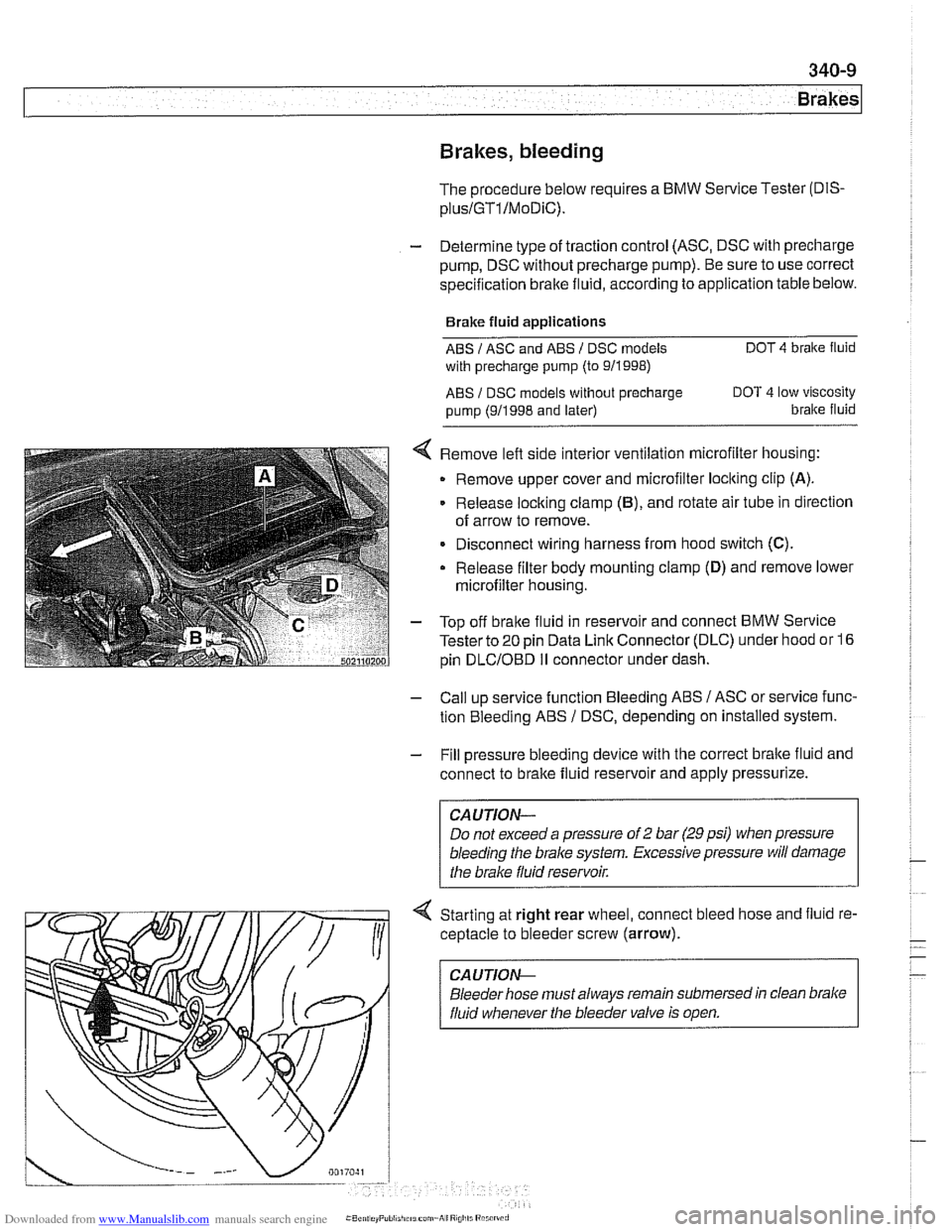
< Remove left side interior ventilation microfilter housing:
Remove upper cover and microfilter loclting clip
(A).
Release locking clamp (B), and rotate air tube in direction
of arrow to remove.
Disconnect wiring harness from hood switch
(C).
Release filter body mounting clamp (D) and remove lower
microfilter housing.
- Top off bralte fluid in reservoir and connect BMW Service
Tester to
20 pin Data Link Connector (DLC) under hood or 16
pin
DLCIOBD I1 connector under dash.
- Call up service function Bleeding ABS / ASC or service func-
tion Bleeding ABS
/ DSC, depending on installed system.
- Fill pressure bleeding device with the correct brake fluid and
connect to brake fluid reservoir and apply pressurize.
Do not exceed a pressure of
2 bar (29 psi) when pressure
bleeding the
brake system. Excessive pressure will damage
4 Starting at right rear wheel, connect bleed hose and fluid re-
ceptacle to bleeder screw (arrow).
CA UTlON-
Bleeder hose must always remain submersed in clean brake
fluid whenever the bleeder valve is open.
Page 772 of 1002
Downloaded from www.Manualslib.com manuals search engine
Brakes
- Open bleeder screw. Carry out bleeding procedure with
BMW Service Tester until clear, bubble-free fluid flows.
Models with DSC: After BMW Service Tester bleeding rou-
tine has finished, press brake pedal to floor
5 times until
clear, bubble-free fluid runs out. Close right rear bleeder
valve.
Models with ASC: Close right rear bleeder valve.
- Repeat procedure at left rear brakes.
- Repeat BMW Service Tester bleeding at right front brakes.
Models with DSC: After
BMW Service Tester bleeding rou-
tine has finished, press brake pedal to floor
5 times until
clear, bubble-free fluid runs out. Close right front bleeder
valve.
Models with ASC: After BMW Service Tester bleeding rou-
tine has finished, press brake pedal to floor
12 times until
clear, bubble-free fluid runs out. Close right front bleeder
valve.
- Repeat procedure at left front brakes.
- Remove brake bleeding apparatus and disconnect BMW
Service Tester. Top up brake fluid. Check to make sure
brake 1
fluid reservoir cap seal is intact.
Tightening torques Bleeder screws (wrench size)
- 7 rnrn screw
3.5 - 5 Nrn (2.5 - 3.7 ft-lb)
11 rnrn screw 12-16Nrn(9-12ft-lb)
Page 774 of 1002
Downloaded from www.Manualslib.com manuals search engine
340-1 2
Brakes Brake pads, checking and replacing
Brake pads can be replaced without disconnecting the brake
fluid hose from the caliper or having to bleed the brakes. The
rotors can be replaced without disassembling wheel hub and
bearing. Always machine or replace rotors in pairs. Replace
pads in sets.
Front and rear brake pad replacement procedures are identical.
WARNING -
* Altllough semi-metallic andmetallic brale friction materials
in brake pads or shoes no longer contain asbestos, they
produce dangerous dust.
Treat all
brale dust as a hazardous material.
Do not create dust by grinding, sanding, or cleaning
brake friction surfaces with compressed air.
CAUTION--
Pressing caliper piston in may cause brake fluid reservoir to
overflow To prevent this, use a clean syringe to first remove
some fluid
from reservoir.
Raise car and remove wheels,
WARNING-
Make sure that the car is firmly supported on jack stands de-
signed for the purpose. Place jack stands beneath structural
chassis points. Do not place jack stands under suspension
parts.
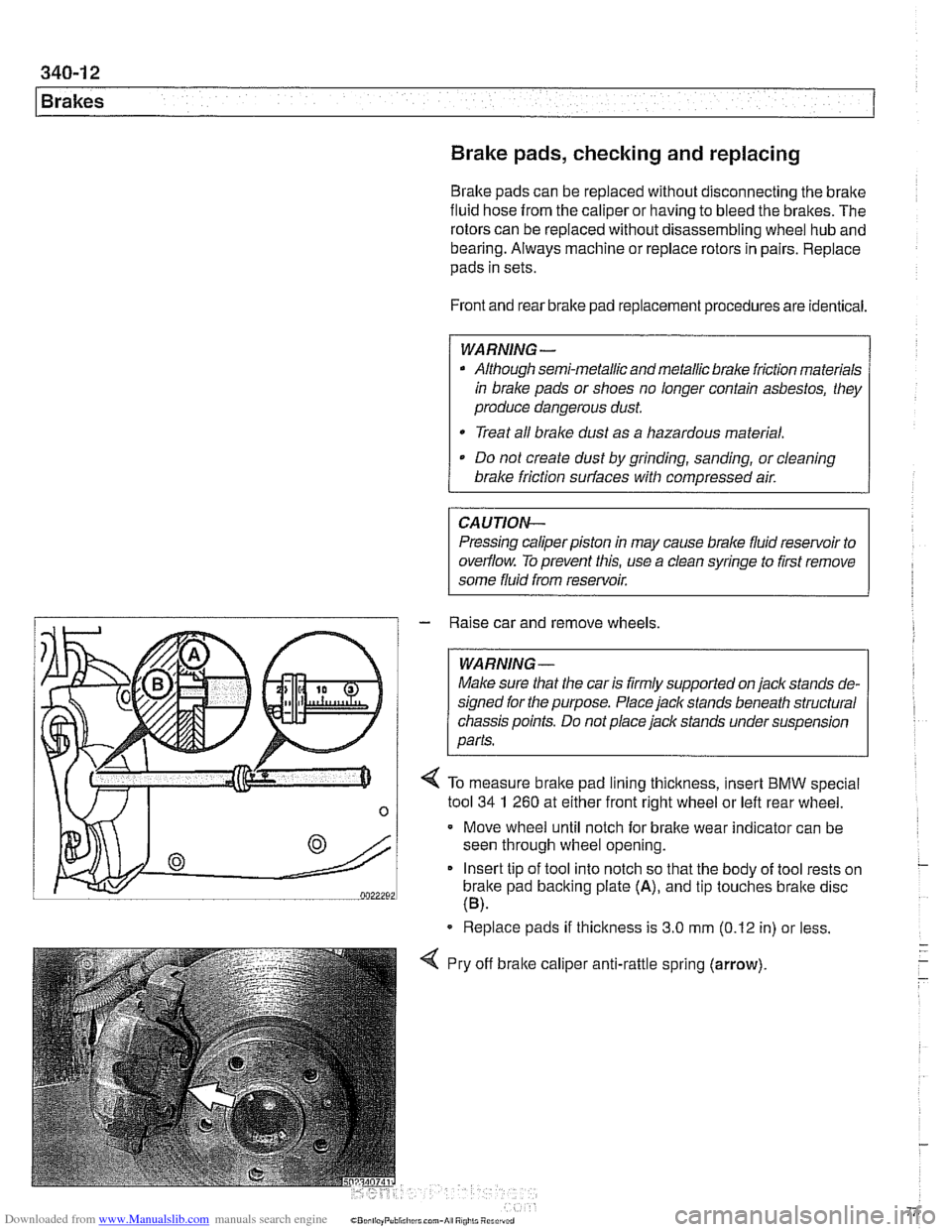
/ 4 To measure brake pad lining thickness, insert BMW special
n 1 tool 34 1 260 at either frontilght wheel or left rear wheel -
Move wheel until notch for brake wear indicator can be
seen through wheel opening.
Insert tip of tool into notch so that the body of tool rests on
brake pad backing plate
(A), and tip touches bralte disc
(B).
Replace pads if thickness is 3.0 mm (0.12 in) or less.
Pry off
bralte calipe~ , anti-rattle spring (arrow).
Page 776 of 1002
Downloaded from www.Manualslib.com manuals search engine
340-1 4
Brakes
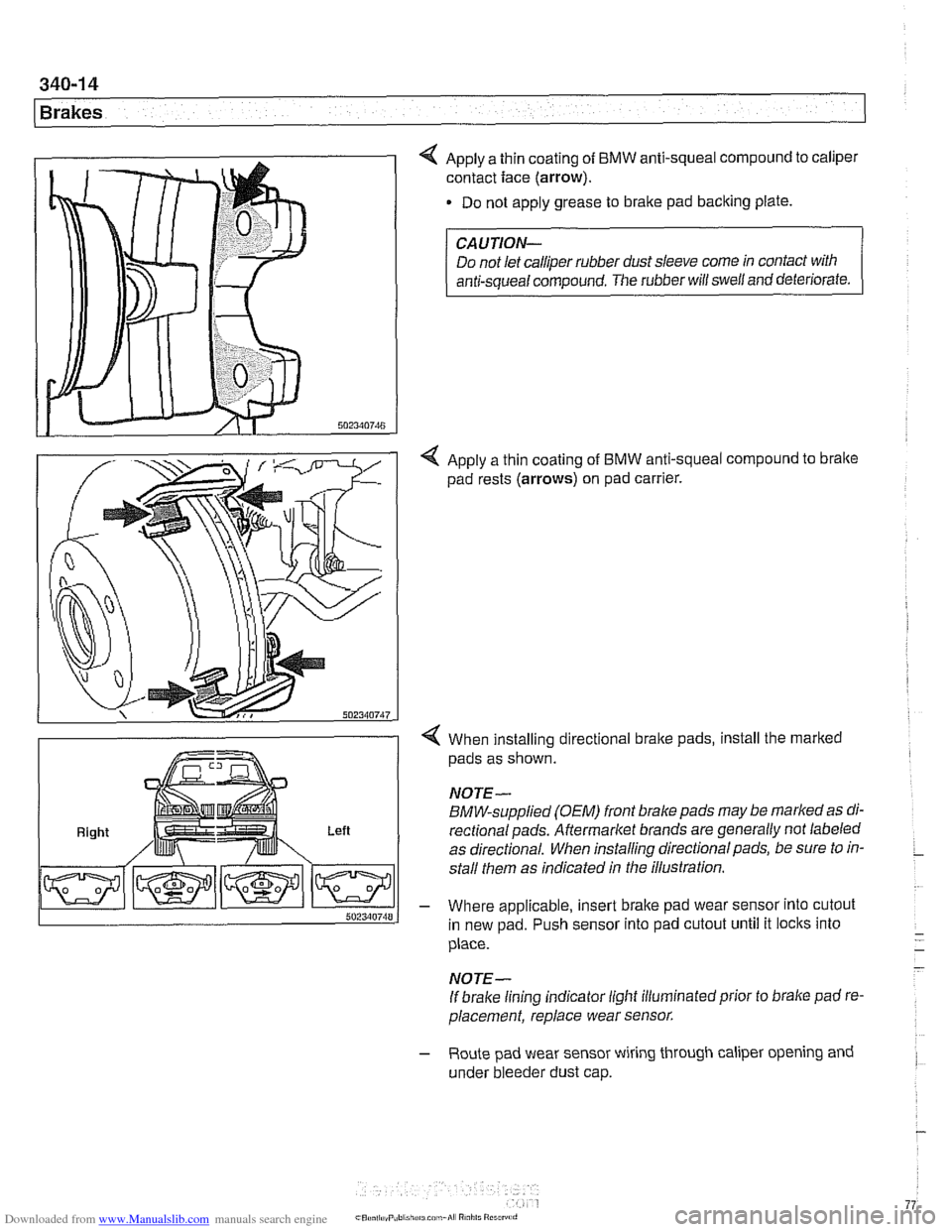
4 Apply a thin coating of BMW anti-squeal compound to caliper
contact face
(arrow).
Do not apply grease to brake pad backing plate.
Right Left
CAUTION-
Do not let calliper rubber dust sleeve come in contact with
anti-squeal compound. The rubber will swell and deteriorate.
4 Apply a thin coating of BMW anti-squeal compound to bralte
pad rests (arrows) on pad carrier.
4 When installing directional brake pads, install the marked
pads as shown.
NOTE-
BMW-supplied (OEM) front brake pads may be marked as di-
rectionalpads. Aftermarket brands are generally not labeled
as directional. When installing directional pads, be sure to in-
stall them as indicated in the illustration.
- Where applicable, insert brake pad wear sensor into cutout
in new pad. Push sensor into pad cutout until it locks into
place.
- -
- NOTE-
If brake lining indicator light illuminatedprior to brake pad re-
placement, replace wear sensor.
- Route pad wear sensor wiring through caliper opening and
under bleeder dust cap.
Page 779 of 1002
Downloaded from www.Manualslib.com manuals search engine
Brakes
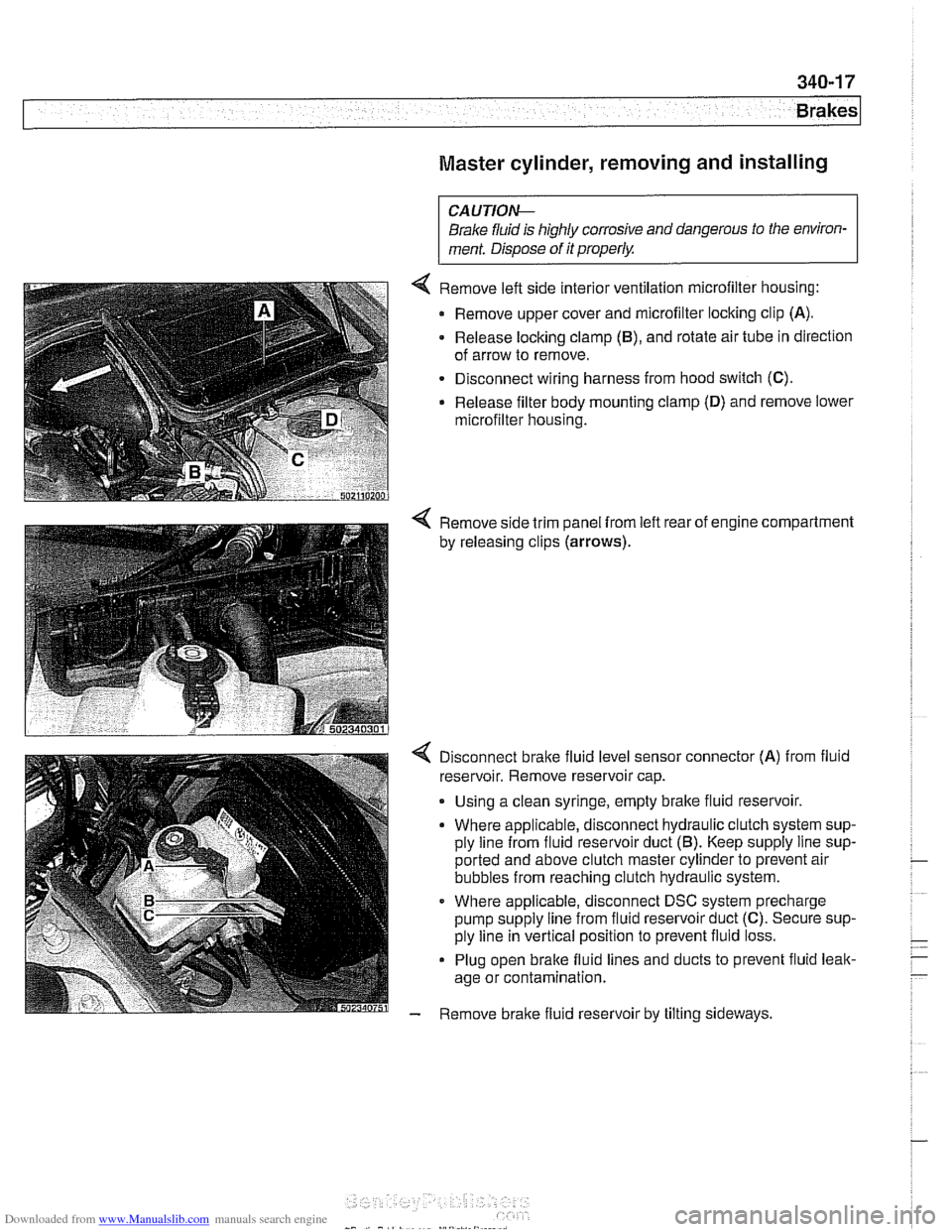
Master cylinder, removing and installing
CAUTlOI\C
Brake fluid is highly corrosive and dangerous to the environ-
ment. Dispose of it properly.
4 Remove left side interior ventilation microfilter housing:
Remove upper cover and microfilter locking clip
(A).
- Release locking clamp (B), and rotate air tube in direction
of arrow to remove.
Disconnect wiring harness from hood switch
(C).
Release filter body mounting clamp (D) and remove lower
microfilter housing.
4 Remove side trim panel from left rear of engine compartment
by releasing clips
(arrows).
4 Disconnect bralte fluid level sensor connector (A) from fluid
reservoir. Remove reservoir cap.
. Using a clean syringe, empty bralte fluid reservoir.
Where applicable, disconnect hydraulic clutch system sup-
ply line from fluid reservoir duct
(5). Keep supply line sup-
ported and above clutch master cylinder to prevent air
bubbles from reaching clutch hydraulic system.
Where applicable, disconnect DSC system precharge
pump supply line from fluid reservoir duct
(C). Secure sup-
ply line in vertical position to prevent fluid loss.
Plug open brake fluid lines and ducts to prevent fluid leak-
age or contamination.
- Remove brake fluid reservoir by tilting sideways.
Page 780 of 1002
Downloaded from www.Manualslib.com manuals search engine
.- -
Brakes
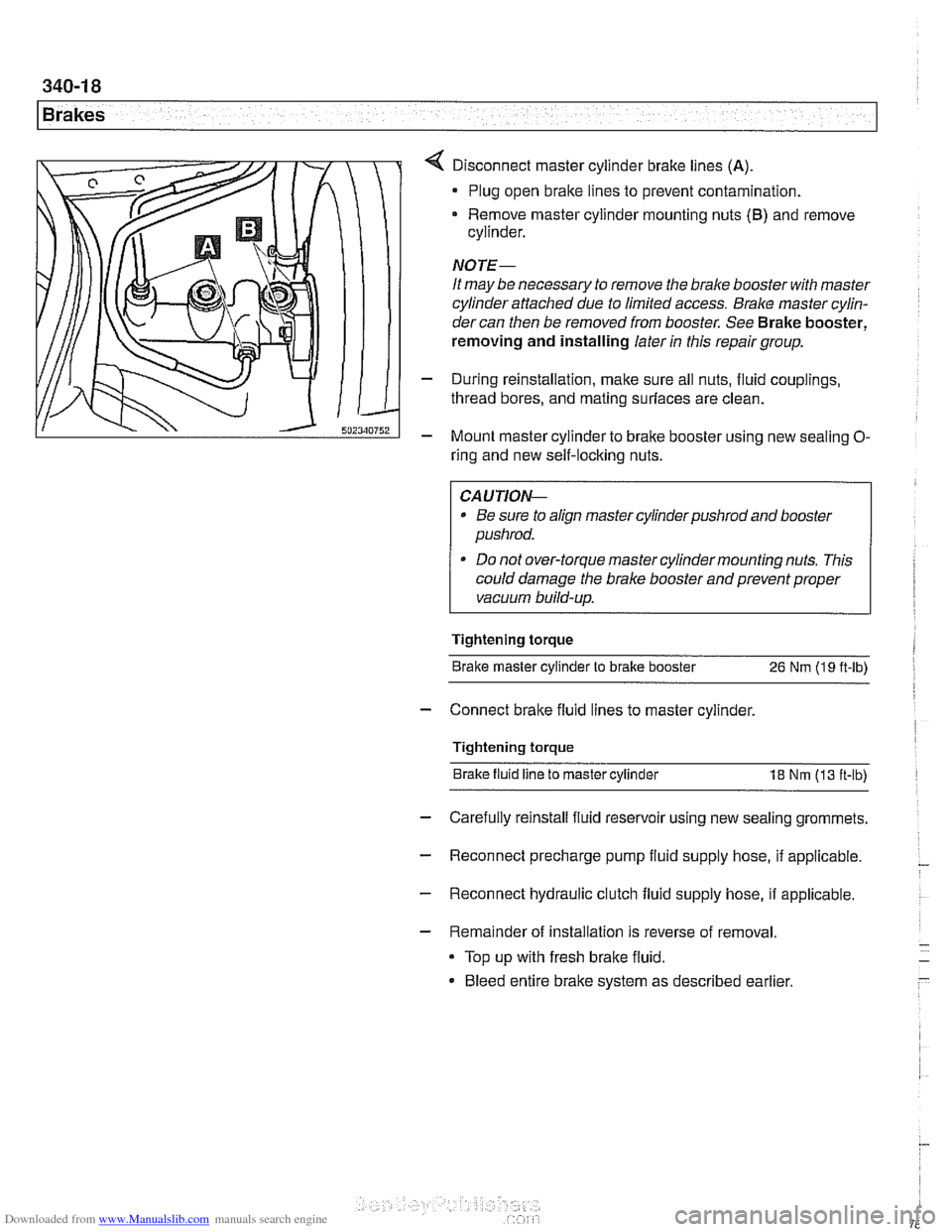
Disconnect master cylinder brake lines (A)
Plug open brake lines to prevent contamination.
Remove master cylinder mounting nuts
(6) and remove
cylinder.
NOTE-
It may be necessary to remove the brake booster with master
cylinder attached due to limited access.
Bralce master cylin-
dercan then be removed from booster. See Brake booster,
removing and installing later
in this repair group.
- During reinstallation, make sure all nuts, fluid couplings,
thread bores, and mating surfaces are clean.
- Mount master cylinder to bralte booster using new sealing O-
ring and new self-locking nuts.
CAUTIOI\C
* Be sure to align master cylinderpushrod and booster
pushrod.
* Do not over-torque master cylinder mounting nuts. This
could damage the brake booster and prevent proper
vacuum build-up.
Tightening torque Brake master cylinder to brake booster
26 Nm (19 ft-lb)
- Connect bralte fluid lines to master cylinder.
Tightening torque Brake fluid line to master cylinder
18 Nm (13 ft-lb)
- Carefully reinstall fluid reservoir using new sealing grommets.
- Reconnect precharge pump fluid supply hose, if applicable. -
- Reconnect hydraulic clutch fluid supply hose, if applicable.
- Remainder of installation is reverse of removal.
Top up with fresh brake fluid.
Bleed entire brake system as described earlier