fuel pressure BMW 530i 1998 E39 Service Manual
[x] Cancel search | Manufacturer: BMW, Model Year: 1998, Model line: 530i, Model: BMW 530i 1998 E39Pages: 1002
Page 487 of 1002
Downloaded from www.Manualslib.com manuals search engine
.- .
Fuel Tank and Fuel Pump
- To reinstall:
Use new sealing ring at tank collar.
* Align tab of sending unit with matching recess in opening
of tank.
Be sure that fuel line connections point in same direction
as they came out.
Reconnect harness connector and hose.
Fill tank and check for leaks by running engine.
Install access cover and its mounting fasteners.
CAUTIOI\C
After finishing repairs but before starting engine, be sure
there is at least
5 liters (1.5 gallons) of fuel in the tank. The
NOTE-
It is common practice to replace the fuel filter when the fuel
pump
unit is replaced. See 020 Maintenance.
Tightening torque
Tank collar locking ring to tank 35 Nm (26 lb-ft)
Fuel level sender (left side),
removing and installing
The procedure for removing and replacing the left side fuel
level sender is
simllar to that used for the r~ght side. There is
no fuel pump on the left side.
- Remove rear seat lower cushion by lifting off catches at front.
- Expose left side access cover:
- Peel forward lip of carpet.
Release rubber grommet from center of access cover
insulation.
Peel back insulation at
perforations to expose fuel tank
access cover.
Remove cover to expose electrical harness connector.
WARNING-
Fuel may be spilled. Do not smoke or work near heaters or
other fire hazards.
When disconnecting fuel hose, wrap shop rag around
end of hose to prevent spray of fuel under pressure.
Page 494 of 1002
Downloaded from www.Manualslib.com manuals search engine
Fuel Tank and Fuel Pump 1
Activated carbon canister I fuel tank leak
detection unit
(LDP or DMTL), removing . . -
and installing
- Raise rear end of car and support safely.
CAUTION-
Make sure the car is stable and well supported at all times.
Use a professional automotive lift
orjack stands designed for
the purpose.
A floor jack is not adequate support.
- Remove left rear wheel and inner fender panel
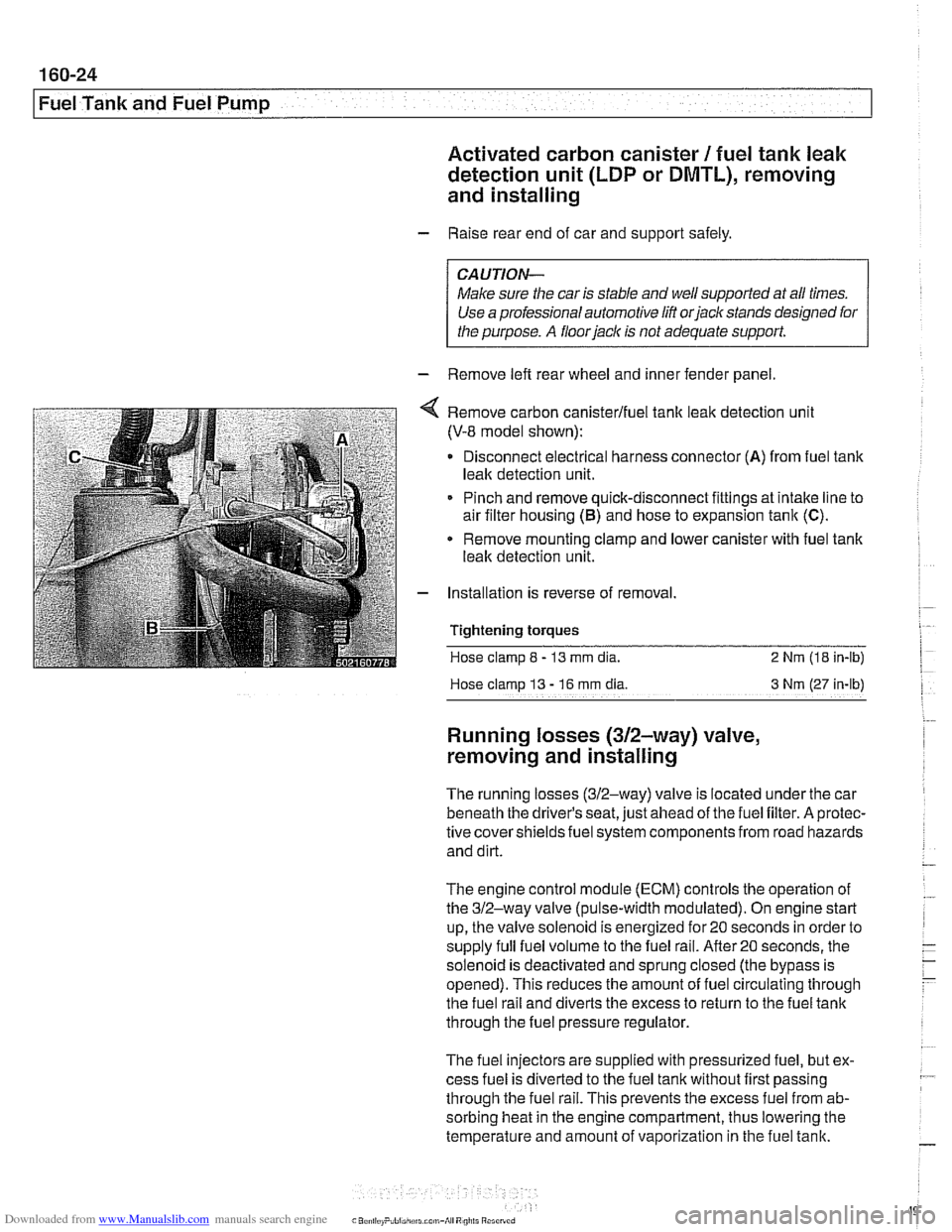
Remove carbon canisterlfuel tank leak detection unit
(V-8 model shown):
Disconnect electrical harness connector
(A) from fuel tank
leak detection unit.
Pinch and remove quick-disconnect fittings at intake line to
air filter housing
(5) and hose to expansion tank (C).
* Remove mounting clamp and lower canister with fuel tank
leak detection unit.
Installation is reverse of removal.
Tightening
torques
Hose clamp 8 - 13 mm dia. 2 Nrn (18 in-lb)
Hose clamp
13 - 16 rnm dia 3 Nm (27 in-lb)
Running losses (312-way) valve,
removing and installing
The running losses (312-way) valve is located under the car
beneath the driver's seat, just ahead of the fuel filter. A protec-
tive covershieldsfuel system components from road hazards
and dirt.
The engine control module
(ECM) controls the operation of
the 312-way valve (pulse-width modulated). On engine start
up, the valve solenoid is energized for 20 seconds in order to
supply full fuel volume to the fuel rail.
After20 seconds, the
solenoid is deactivated and sprung closed (the bypass is
opened). This reduces the amount of fuel circulating through
the fuel rail and diverts the excess to return to the fuel tank
through the fuel pressure regulator.
The fuel injectors are supplied with pressurized fuel, but ex-
cess fuel is diverted to the fuel tank without first passing
through the fuel rail. This prevents the excess fuel from ab-
sorbing heat in the engine compartment, thus lowering the
temperature and amount of vaporization in the fuel tank.
Page 495 of 1002
Downloaded from www.Manualslib.com manuals search engine
160-25
Fuel Tank and Fuel pump1
The 312-way valve is also activated briefly if an engine misfire
is detected. This provides full fuel flow through the fuel rail to
determine if the misfire was caused by a lean fuel condition.
The valve is monitored by the ECM forfaults.
- Using BMW or compatible scan tool, read out fault memory.
See
OBD On-Board Diagnostics.
- Turn off ignition.
- Raise car and support safely.
CA UTIOW
Male sure the car is stable and well suppodedat all times.
Use a professional automotive lift
orjack stands designed for
the purpose.
A floor jack is not adequate support.
- Worlting under car beneath driver's seat, remove protective
panel from fuel filter and 312-way valve.
- Clamp off fuel lines at 312-way valve.
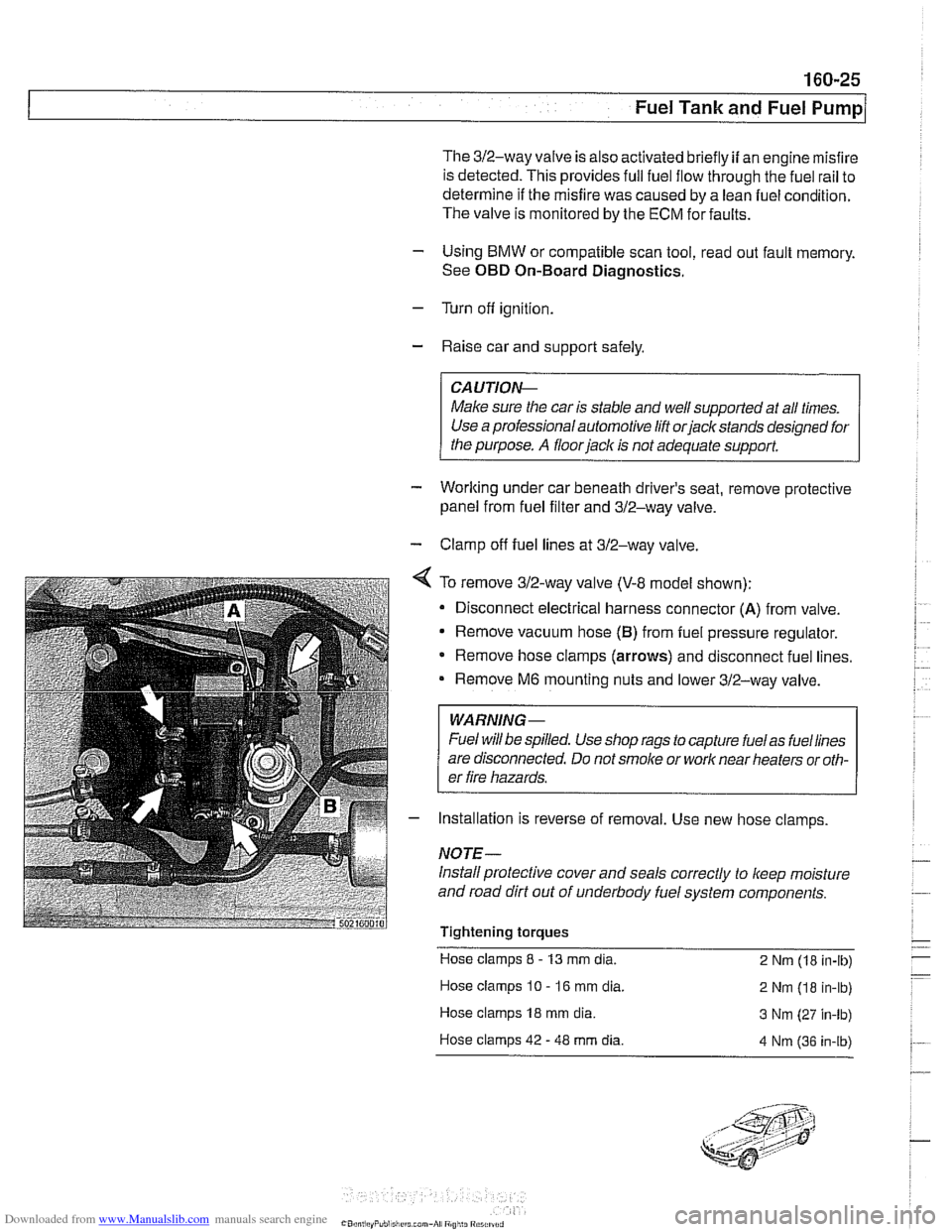
4 To remove 312-way valve (V-8 model shown):
Disconnect electrical harness connector
(A) from valve.
Remove vacuum hose
(B) from fuel pressure regulator.
* Remove hose clamps (arrows) and disconnect fuel lines.
Remove
M6 mounting nuts and lower 312-way valve.
WARNING-
Fuel will be spilled. Use shop rags to capture fuelas fuellines
are disconnected. Do not
smoke or work near heaters or oth-
er fire hazards.
- Installation is reverse of removal. Use new hose clamps
NOTE-
Install protective cover and seals correctly to keep moisture
and road dirt out of underbody fuel system components.
Tightening torques Hose clamps
8 - 13 mm dia.
2 Nm (18 in-lb)
Hose clamps
10 - 16 mm dia.
2 Nm (18 in-lb)
Hose clamps
18 mm dia. 3 Nm (27 in-lb)
Hose clamps 42
- 48 mm dia. 4 Nm 136 in-ib)
Page 634 of 1002
Downloaded from www.Manualslib.com manuals search engine
300-1 4
I Susoension. Steerina and Brakes - General
DSC system I
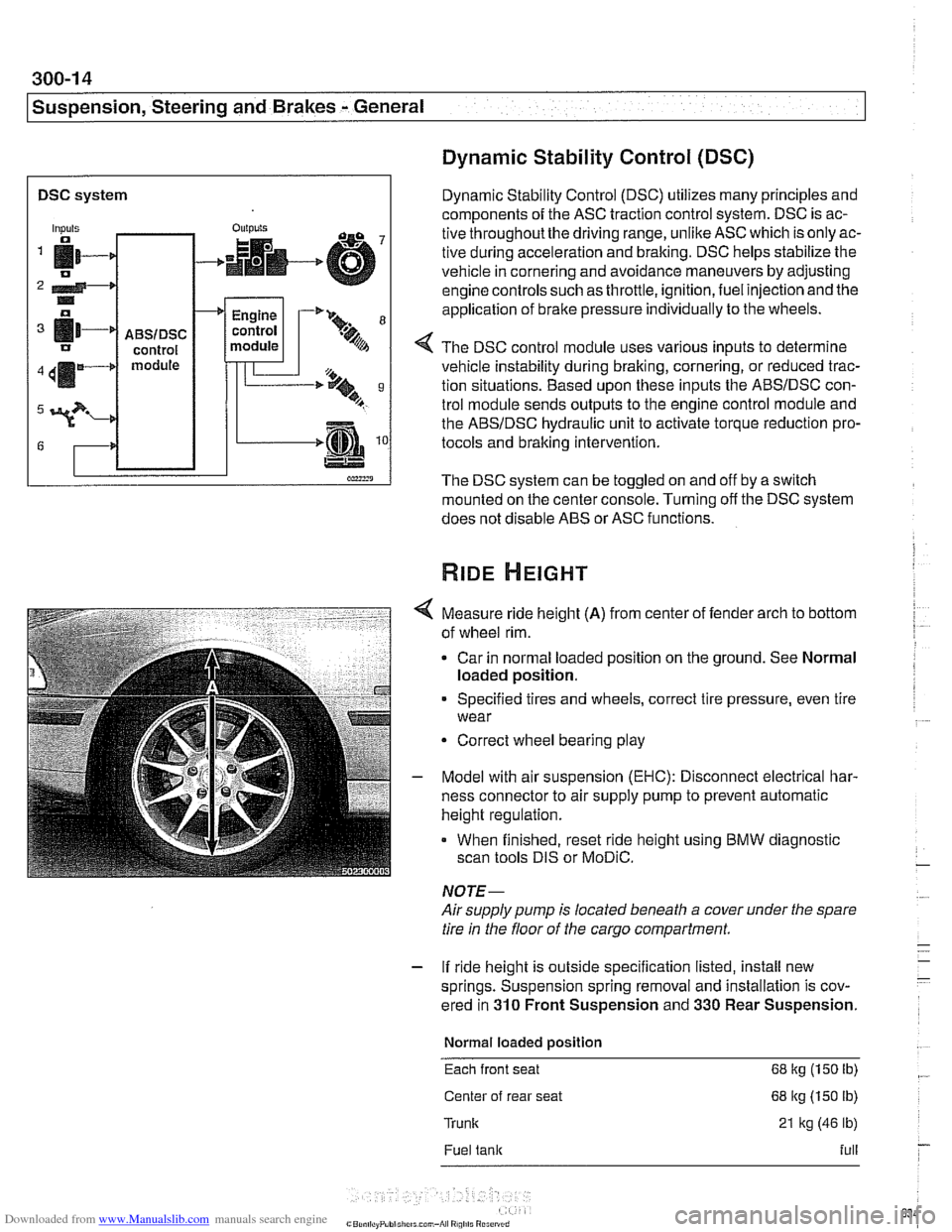
Dynamic Stability Control (DSC)
Dynamic Stability Control (DSC) utilizes many principles and
components of the ASC traction control system. DSC is ac-
tive throughoutthe driving range, unlike ASC which is only ac-
tive during acceleration and braking. DSC helps stabilize the
vehicle in cornering and avoidance maneuvers by adjusting
engine controls such as throttle, ignition, fuel injection and the
application of
brake pressure individually to the wheels.
Inputs
fi- 0
2 4-* .. o
[11-' IJ
411m4
3?-
G
4 The DSC control module uses various inputs to determine
vehicle instability during braking, cornering, or reduced trac-
tion situations. Based upon these inputs the ABSIDSC con-
trol module sends outputs to the engine control module and
the ABSIDSC hydraulic unit to activate torque reduction pro-
tocols and braking intervention.
-
ABSIDSC control module
OUI~YIS
4
The DSC system can be toggled on and off by a switch
mounted on the center console. Turning off the DSC system
does not disable ABS or ASC functions.
+
Measure ride height (A) from center of fender arch to bottom
of wheel rim.
Car in normal loaded position on the ground. See Normal
loaded position.
Engine
control
module
Specified tires and wheels, correct tire pressure, even tire
wear
-'* 9-
.%A
Correct wheel bearing play
T'== ..t, 9 B
-.m
Model with air suspension (EHC): Disconnect electrical har-
ness connector to air supply pump to prevent automatic
height regulation.
When finished, reset ride height using BMW diagnostic
scan tools DIS or
MoDiC.
NOTE-
Airsupply pump is located beneath a cover under the spare
tire in the floor of the cargo compartment.
- If ride height is outside specification listed, install new
springs. Suspension spring removal and installation is cov-
ered in
310 Front Suspension and 330 Rear Suspension.
Normal loaded position
Each front seat 68 kg (150 Ib)
Center of rear seat 68 kg (150 lb)
Trunk 21 kg (46 lb)
Fuel tank full
Page 693 of 1002
Downloaded from www.Manualslib.com manuals search engine
Steering and Wheel Alignment
- Tighten nut while counterholding adjusting bolt,
- Tighten nut only after car has been lowered to ground and
suspension has settled.
Preparing for alignment
- The following conditions are necessary prior to wheel align-
ment:
Correct wheels and tires are installed, in good condition,
and are at the correct inflation pressures.
All steering and suspension parts and bushings are un-
damaged and show no signs of abnormal wear. Wheel
bearings are in good condition.
Ride height is in accordance with specifications. See
300
Suspension, Steering and Brakes-General.
Car is in normal loaded position. See below.
* Cars with air suspension: Remove air suspension power
fuse.
Normal loaded position
Each front seat
68 Kg (I50 lb)
Center of rear seat
Trunlc
Fuel tank
68 Kg (150 lb)
21 Kg (46 lb)
Full
Alignment specifications tables
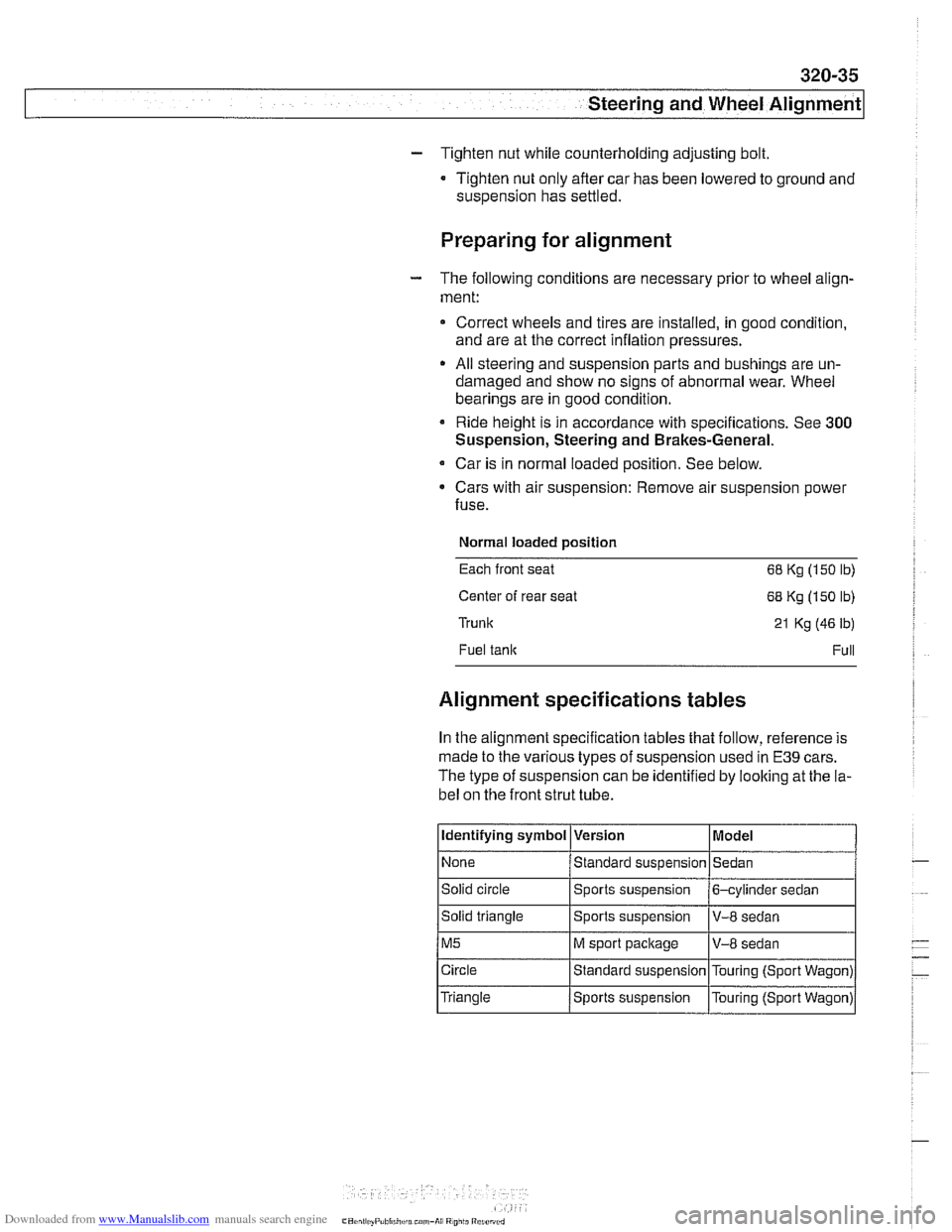
In the alignment specification tables that follow, reference is
made to the various types of suspension used in
E39 cars.
The type of suspension can be identified by loolting at the la-
bel on the front strut tube.
Identifying symbol
None
Solid circle
Solid triangle
M5
Circle
Triangle Version
Standard suspension
Sports
suspension
Sports suspension
M sport package
Standard suspension
Sports suspension Model
Sedan
6-cylinder sedan
V-8 sedan
V-8 sedan
Touring (Sport Wagon)
Touring (Sport Wagon)
Page 962 of 1002
Downloaded from www.Manualslib.com manuals search engine
OED-2
On-Board Diagnostics
Specialized OED II scan tool equipment is needed to access
the fault memory and
OED I1 data.
The extra hardware needed to operate the OED
I1 system
consists mainly of the following:
* Additional oxygen sensors downstream of the catalytic
converters.
Fuel tank pressure sensor and device to pressurize
fuel
storage system.
Several engine and performance monitoring devices
Standardized 16-pin
OED II connector under the
dashboard.
Upgraded components for the federally required reliability
mandate.
Malfunction indicator light (MIL)
OED II software illuminates the malfunction indicator light
(MIL) when emission levels exceed 1.5 times Federal
standards.
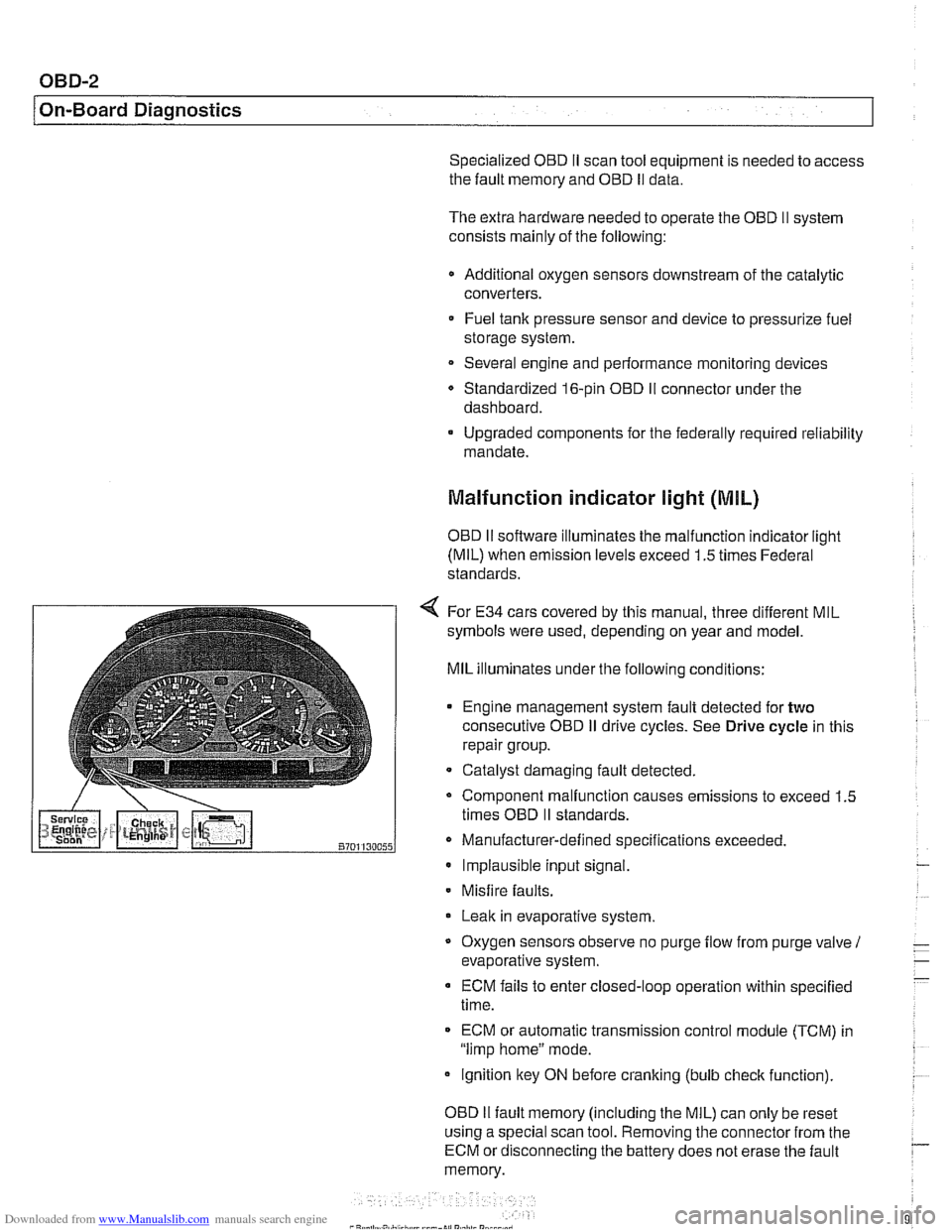
4 For E34 cars covered by this manual, three different MIL
symbols were used, depending on year and model.
MIL illuminates under the following conditions:
Engine management system fault detected for
two
consecutive OED iI drive cycles. See Drive cycle in this
repair group.
- Catalyst damaging fault detected.
Component malfunction causes emissions to exceed 1.5
times OED
II standards.
Manufacturer-defined specifications exceeded. Implausible input signal.
Misfire
faults.
Leak in evaporative system,
Oxygen sensors observe no purge
flow from purge valve 1
evaporative system.
ECM fails to enter closed-loop operation within specified
time.
ECM or automatic transmission control
module (TCM) in
"limp home" mode.
ignition key ON before cranking (bulb
check function).
OED
II fault memory (including the MIL) can only be reset
using a special scan tool. Removing the connector from the
ECM or disconnecting the battery does not erase the fault
memory.
Page 968 of 1002
Downloaded from www.Manualslib.com manuals search engine
OBD-8
I On-Board Diagnostics
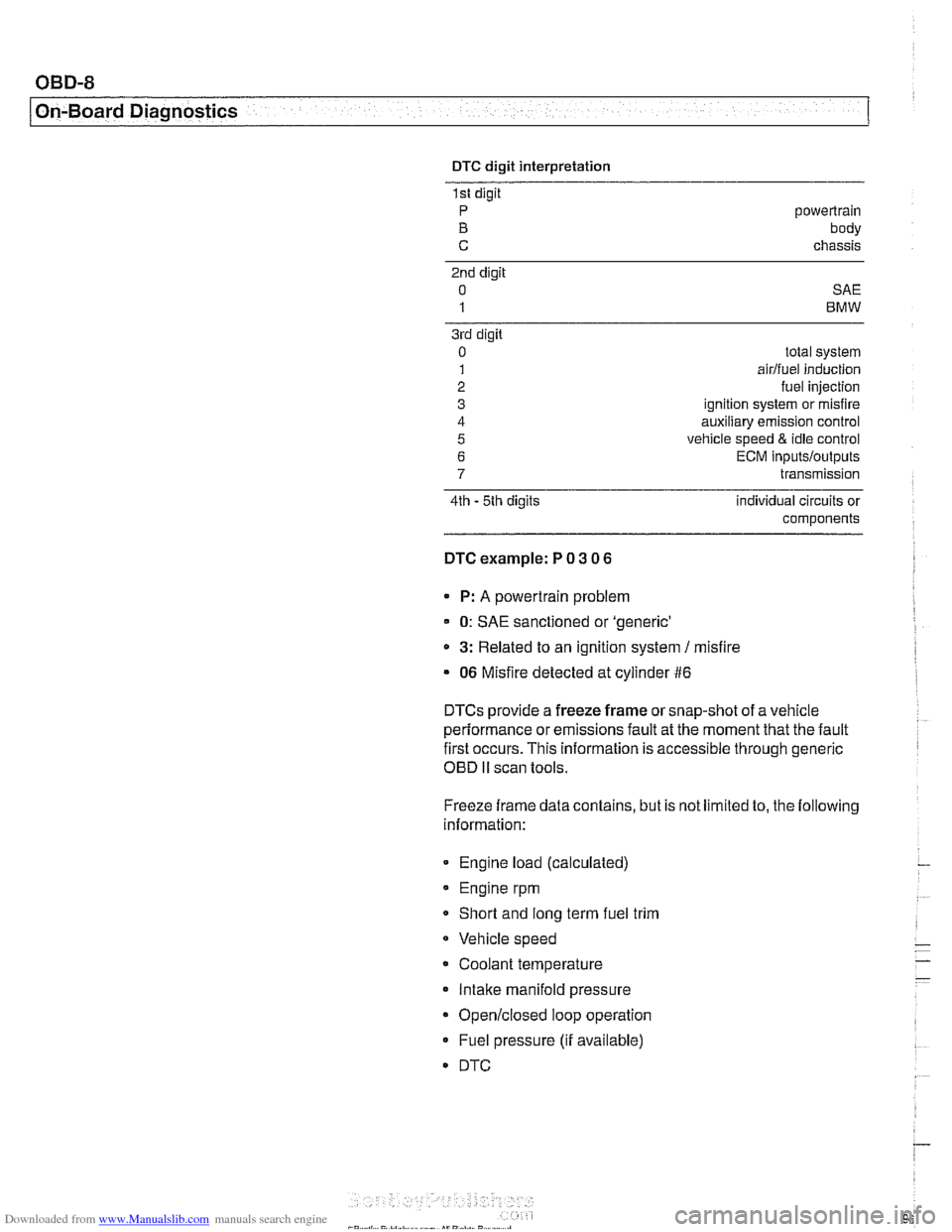
DTC digit interpretation
1st digit
P powertrain
B body
C chassis
2nd digit
0 SAE
1 BMW
3rd digit
0
1
2
3
4
5
6
7
4th - 5th digits total
system
airlfuei induction
fuel injection
ignition system or misfire
auxiliary emission control
vehicle speed
& idle control
ECM
inputs/outputs
transmission
individual circuits or
components
DTC example: P 0 3 0 6
P: A powertrain problem
0: SAE sanctioned or 'generic'
a 3: Related to an ignition system / misfire
06 Misfire detected at cylinder #6
DTCs provide a freeze frame or snap-shot of a vehicle
performance or emissions fault at the moment that the fault
first occurs. This information is accessible through generic
OED I1 scan tools.
Freeze frame data contains, but is not limited to, the following
information:
Engine load (calculated)
Engine rpm
Short and
long term fuel trim
Vehicle speed
Coolant temperature Intake manifold pressure
Open/closed loop operation
Fuel pressure (if available)
DTC
Page 981 of 1002
Downloaded from www.Manualslib.com manuals search engine
OBD-21
On-Board
~ia~nosticsl
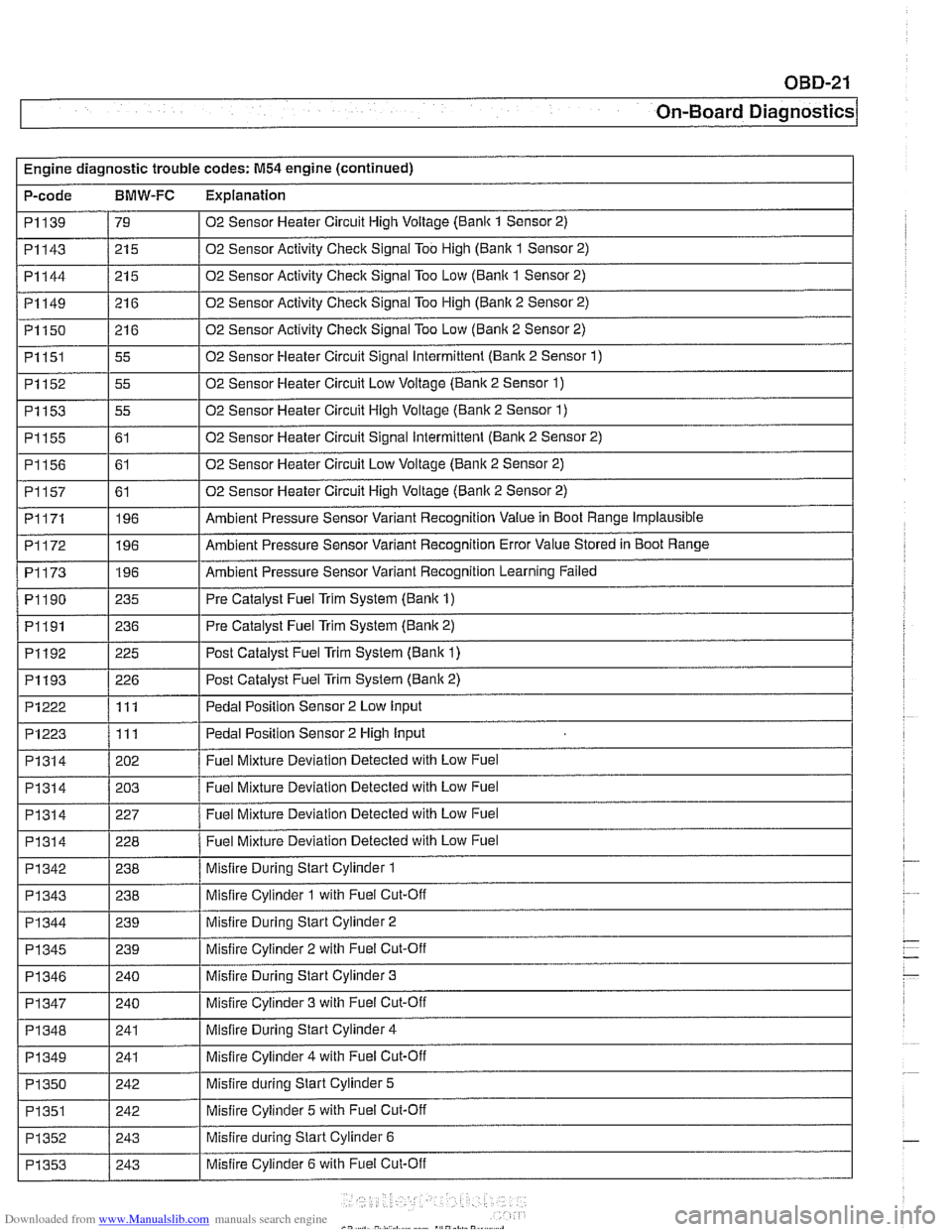
Engine diagnostic trouble codes: M54 engine (continued)
P-code
BMW-FC Explanation
I I
PI314 / 202 / Fuel Mixture Deviation Detected with Low Fuel
I I
02 Sensor Heater Circuit High Voltage (Bank 1 Sensor 2)
02 Sensor Activity Check Signal Too High (Banlc 1 Sensor 2)
02 Sensor Activity Check Signal Too Low (Bank 1 Sensor 2)
02 Sensor Activity Check Signal Too High (Banlc 2 Sensor 2)
02 Sensor Activity Check Signal Too Low (Bank 2 Sensor 2)
02 Sensor Heater Circuit Signal Intermittent (Bank 2 Sensor
1)
02 Sensor Heater Circuit Low Voltage (Bank 2 Sensor 1)
02 Sensor Heater Circuit High Voltage (Bank 2 Sensor 1)
02 Sensor Heater Circuit Signal Intermittent (Banlc 2 Sensor 2)
02 Sensor Heater Circuit Low Voltage (Bank 2 Sensor 2)
02 Sensor Heater Circuit High Voltage (Bank 2 Sensor 2)
Ambient Pressure Sensor Variant Recognition Value in Boot Range Implausible
Ambient Pressure Sensor Variant Recognition Error Value Stored in Boot Range
Ambient Pressure Sensor Variant Recognition Learning Failed
Pre Catalyst Fuel Trim System (Bank 1)
Pre Catalyst Fuel Trim System (Bank 2)
PI139
PI143
PI144
PI149
PI150
PI151
PI152
PI153
PI155
P1156
PI157
PI171
PI172
PI173
PI 190
PI191
79
21 5
21 5
21 6
21 6
55
55
55
61
61
61 196
196
196
235
236
Pedal Position Sensor 2 Low
Input PI222
-~~~~~~~~~ PI314
PI314
PI314
PI342 - PI343
PI 344
PI192
PI193
PI223 /I11 I Pedal Position Sensor 2 High Input
111
PI 345
PI 346
PI 347
PI348
PI 349
PI350
PI351
PI352
PI353
225 Post Catalyst Fuel Trim System (Bank 1)
226 Post Catalyst Fuel Trim Svstem (Bank 2)
203
227
228
238
238
239 Fuel Mixture Deviation Detected with Low Fuel
Fuel Mixture Deviation Detected with Low Fuel
Fuel Mixture Deviation Detected with Low Fuel
Misfire During Start Cylinder 1
Misfire Cylinder 1 with Fuel Cut-Off
Misfire Durina Start Cylinder 2
239
240
240
241
241
242
242
243
243
-
Misfire Cylinder 2 with Fuel Cut-Off
Misfire During Start Cylinder 3
Misfire Cylinder 3 with Fuel Cut-Off
Misfire During Start Cylinder 4
Misfire Cylinder 4 with Fuel Cut-Off
Misfire during Start Cylinder 5
Misfire Cylinder 5 with Fuel Cut-Off
Misfire during Start Cylinder 6
Misfire Cylinder 6 with Fuel Cut-Off
Page 987 of 1002
Downloaded from www.Manualslib.com manuals search engine
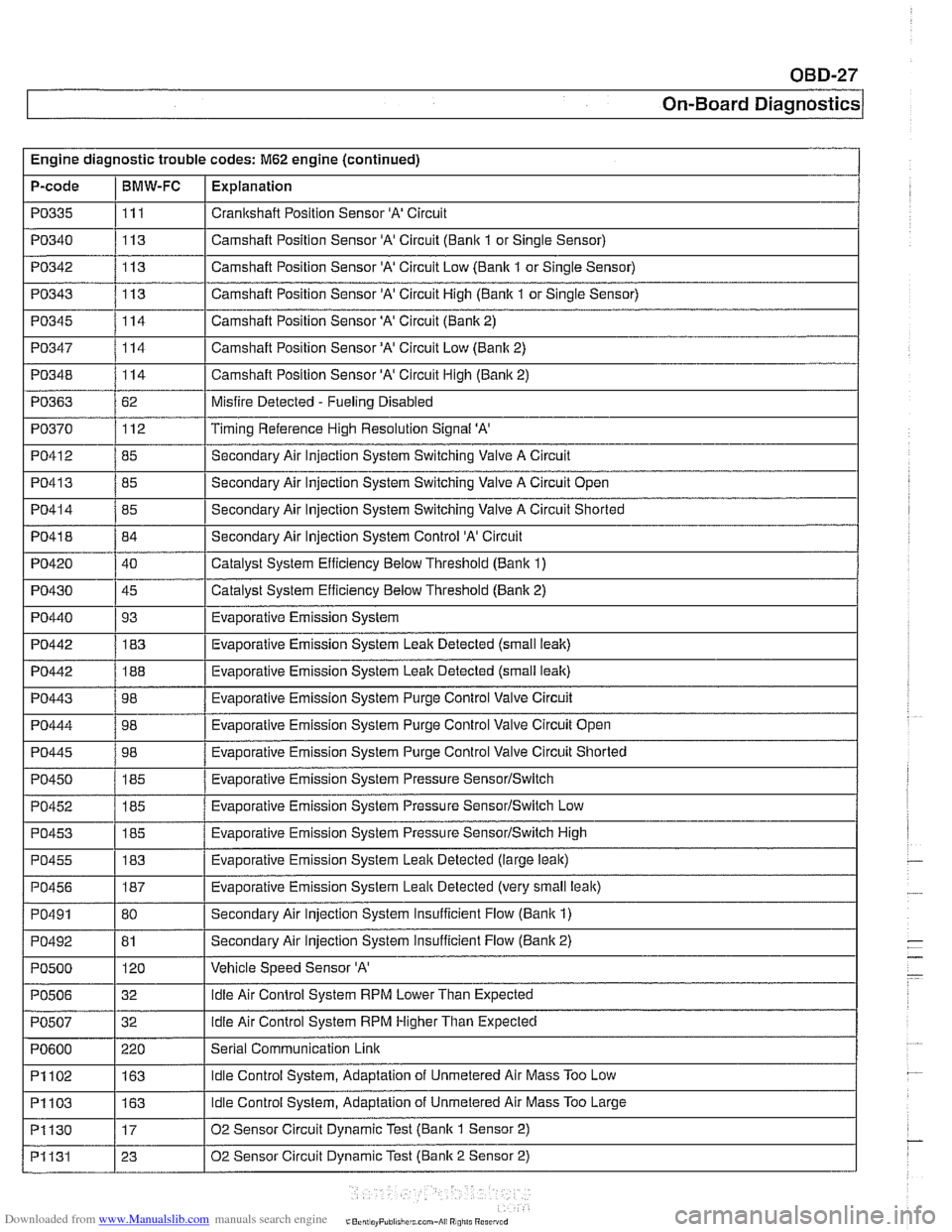
On-Board ~ia~nosticsl
I I
PO340 1113 I Camshaft Position Sensor 'A' Circuit (Bank 1 or Single Sensor)
Engine
diagnostic trouble codes:
M62 engine (continued)
P-code
PO342
PO343
PO345
PO347
PO348
PO363
PO370
PO41 2
PO335 I111 I Crankshaft Position Sensor 'A' Circuit
BMW-FC
I I -
I I -
PO445 1 98 1 Evaporative Emission System Purge Control Valve Circuit Shorted
Explanation
113
113
114
114
114
62 112
85
PO41 3
PO41 8
PO420
PO430
PO440
PO442
PO442
PO443
PO444
Camshaft Position Sensor 'A' Circuit Low (Bank 1 or Single Sensor)
Camshaft Position Sensor
'A' Circuit High (Bank 1 or Single Sensor)
Camshaft Position Sensor
'A' Circuit (Bank 2)
Camshaft Position
Sensor'A' Circuit Low (Bank 2)
Camshaft Position Sensor 'A' Circuit High
(Banic 2)
Misfire Detected
- Fueling Disabled
Timing Reference High Resolution Signal
'A'
Secondary Air lniection System Switchinq Valve A Circuit
PO41 4 / 85 I Secondary Air Injection System Switching Valve A Circuit Shorted
85
84
40
45 93 183
188
98
98
PO450
PO452
PO453
PO455
PO456
PO491
PO492
PO500
PO506
I I
PI102 1163 I Idle Control System, Adaptation of Unmetered Air Mass Too Low
Secondary
Air Injection System Switching Valve A Circuit Open
Secondary Air Injection System Control
'A' Circuit
Catalyst System Efficiency Below Threshold (Bank 1)
Catalyst System Efficiency
Below Threshold (Bank 2)
Evaporative Emission System
Evaporative Emission System Leak Detected (small
leak)
Evaporative Emission System Leak Detected (small leak)
Evaporative Emission System Purge Control Valve Circuit
Evaporative Emission System Purqe Control Valve Circuit Open
I
I
185
185
185
183
187
80
81 120
32
PO507
Evaporative Emission System Pressure SensorISwitch
Evaporative Emission System Pressure SensorISwitch Low
Evaporative Emission System Pressure
SensorISwitch High
Evaporative Emission System
Leaic Detected (large leak)
Evaporative Emission System
Leal$ Detected (very small leak)
Secondary Air Injection System Insufficient Flow (Bank
1)
Secondary Air Injection System insufficient Flow (Bank 2)
Vehicle Speed Sensor
'A'
idle Air Control System RPM Lower Than Expected
PI103
PI130
PI131
PO600 1 220 I Serial Communication Link
32
idle Air
Control System RPM Higher Than Expected
163
17
23
Idle Control System, Adaptation of Unmetered Air Mass Too Large
02 Sensor Circuit Dynamic Test (Bank
1 Sensor 2)
02 Sensor Circuit Dynamic Test (Bank 2 Sensor 2)
Page 992 of 1002
Downloaded from www.Manualslib.com manuals search engine
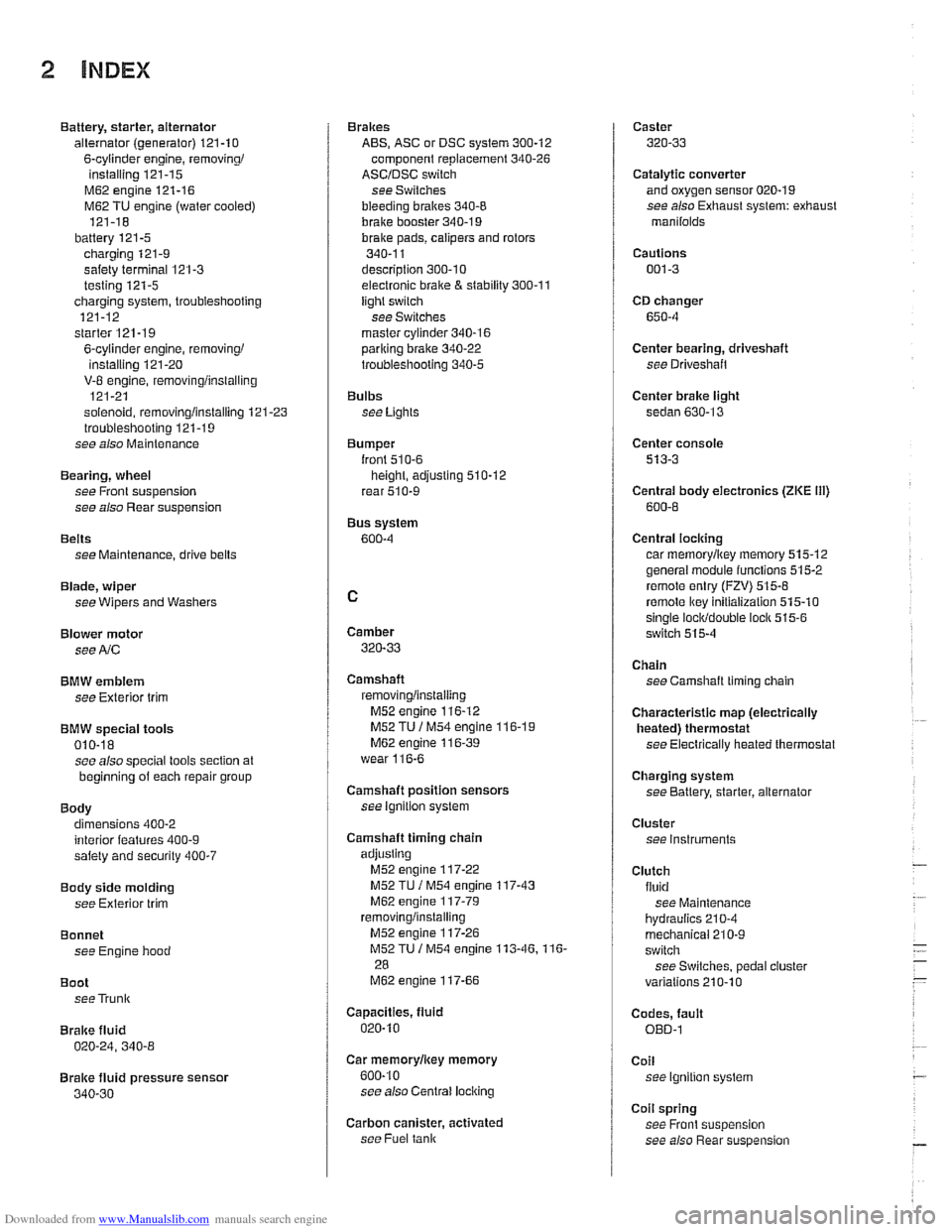
2 INDEX
Battery, starter, alternator
alternator (generator)
121-10
6-cylinder engine, removingi
installing 121-15
M62 engine 121-16
M62 TU engine (water cooled)
121-18
battery
121-5 charging 121-9
safety terminal 121-3
testing 121-5 charging system, troubleshooting
121-12
starter
121-1 9
6-cylinder engine, removingi instaliinq 121-20 . V-8 engine, rernovinglinsialiing
121-21
solenoid, removinglinstalling
121-23 troubleshooting 121-19
see also Maintenance
Bearing, wheel
see Front suspension
see also Rear suspension
Belts see Maintenance, drive belts
Blade, wiper
see Wipers and Washers
Blower motor see
A/C
BMW emblem
see Exterior trim
BMW special tools 010-18 see also special tools section at
beginning
of each repair group
Body dimensions 400-2
interior features
400-9 salety and security 400-7
Body side molding
see Exterior trim
Bonnet see Engine hood
Boot see Trunk
Brake fluid
020-24, 340-8
Brake fluid pressure sensor
340-30
Brakes
ABS, ASC or DSC system
300-12
component replacement 340-26
ASCIDSC switch
see Switches
bleeding
bralces 340-8
brake booster 340-1 9 bralce Dads. caiioers and rotors ,., 340-1 1
descriotion 300-10
e~ectrdnic brake & stability 300-11
light switch
see Switches
master cylinder
340-16 pariking brake 340-22
troubleshooting 340-5
Bulbs see Lights
Bumper
lront 510-6 height, adjusting 510-12
rear 510-9
Bus system
600-4
Camber
320-33
Camshaft
removingiinslaiiing
M52 engine 116-12
M52 TU
/ M54 engine 116-1 9 M62 engine 11 6-39
wear
116-6
Camshaft position sensors
see ignition system
Camshaft timing chain
adjusting M52 engine
117-22
M52 TU I M54 engine 117-43
M62 engine 117-79 removinglinstalling
M52 engine 117-26
M52TU 1 M54 engine 113-46.116-
28
M62 engine 117-66
Capacities, fluid
020.10
Car rnemorvlicev memorv . . 600-10
see also Centrai
lociking
Carbon canister, activated
see Fuel
tank
Caster
320-33
Catalytic converter and oxygen sensor 020-19
see also Exhaust system: exhaust
manilolds
Cautions
001-3
CD changer
650-4
Center bearing, driveshaft
see Driveshait
Center brake light
sedan
630-13
Center console
513-3
Centrai body electronics (ZKE 111)
600-6
Central locking
car memoryiey memory 515.12 general module iunctions 515-2
remote entry (FZV) 515-8
remote lkey initialization 515-10 single lociddouble ioclk 515-6
switch 515-4
Chain
see Camshaft liming chain
Characteristic map (electrically heated) thermostat
see Electrically heated thermostat
Charging system
see Battery, starter, alternator
Cluster see instruments
Clutch fluid see Maintenance
hydraulics
210-4
mechanical 210-9
switch
see Switches, pedal ciuster
variations
210.10
Codes, fault OED-1
Coil
see Ignition system
Coil spring
see Front suspension
see also Rear
suspe nsion