Air BMW 540I 1997 E39 Central Body Electronics ZKE Manual
[x] Cancel search | Manufacturer: BMW, Model Year: 1997, Model line: 540i, Model: BMW 540i 1997 E39Pages: 80, PDF Size: 4.14 MB
Page 4 of 80
4
Central Body Electronics ZKE III
System Components
General Module (GM): The GM is reponsible
for the operation and central coordination of
body electronics. The GM is a micro-computer
that is the central component (heart) of the
Central Body Electronics. The GM is located be-
hind the glove box.
The main objectives for using the GM are:
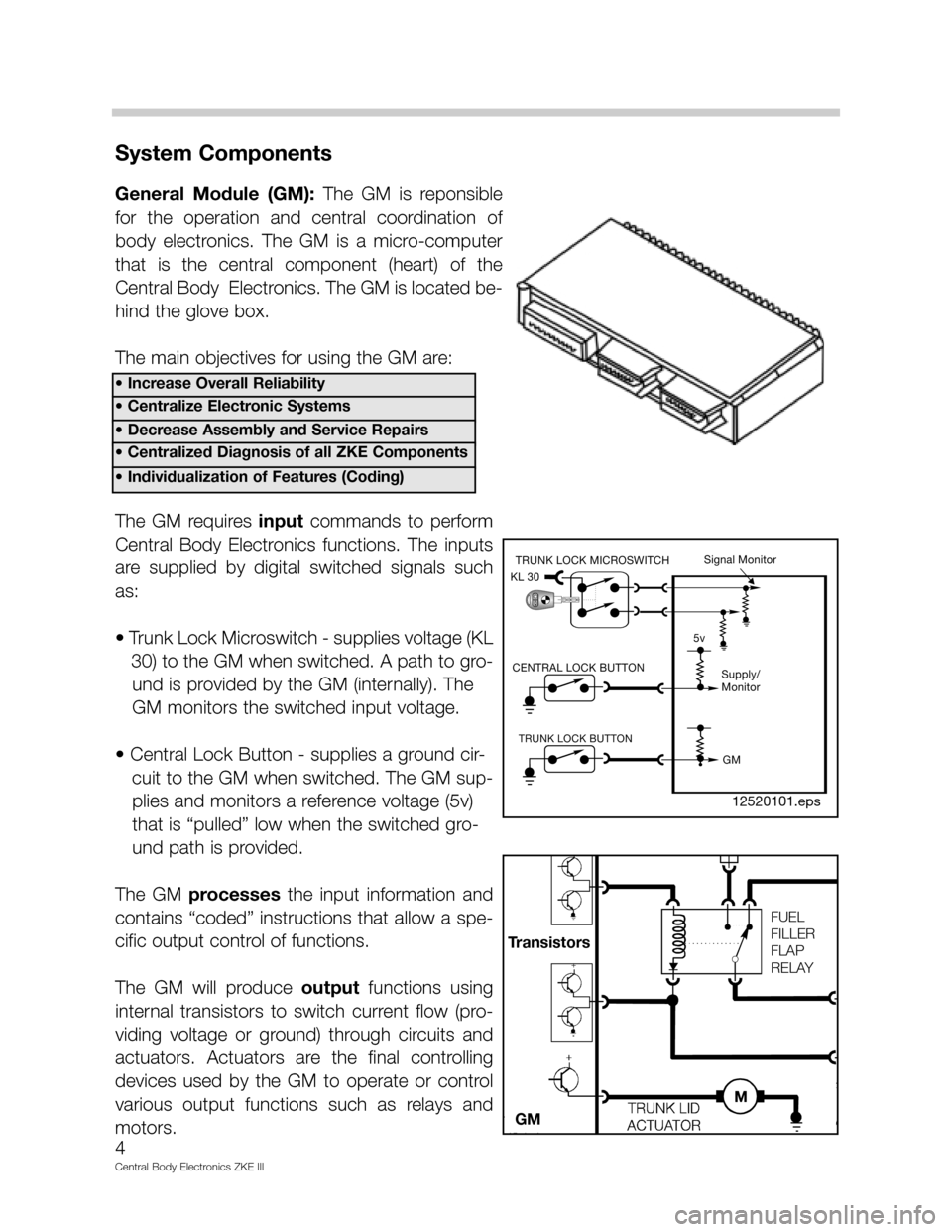
The GM requires inputcommands to perform
Central Body Electronics functions. The inputs
are supplied by digital switched signals such
as:
• Trunk Lock Microswitch - supplies voltage (KL
30) to the GM when switched. A path to gro-
und is provided by the GM (internally). The
GM monitors the switched input voltage.
• Central Lock Button - supplies a ground cir-
cuit to the GM when switched. The GM sup-
plies and monitors a reference voltage (5v)
that is “pulled” low when the switched gro-
und path is provided.
The GM processesthe input information and
contains “coded” instructions that allow a spe-
cific output control of functions.
The GM will produce outputfunctions using
internal transistors to switch current flow (pro-
viding voltage or ground) through circuits and
actuators. Actuators are the final controlling
devices used by the GM to operate or control
various output functions such as relays and
motors.
• Increase Overall Reliability
• Centralize Electronic Systems
• Decrease Assembly and Service Repairs
• Centralized Diagnosis of all ZKE Components
• Individualization of Features (Coding)
CENTRAL LOCK BUTTONCENTRAL LOCK BUTTON
TRUNK LOCK BUTTONTRUNK LOCK BUTTON
KL 30KL 30
TRUNK LOCK MICROSWITCHTRUNK LOCK MICROSWITCHSignal Monitor
5v
Supply/
Monitor
GM
FUEL
FILLER
FLAP
RELAY
Transistors
GM
12520101.eps
Page 8 of 80
Fused Power Distribution Centers
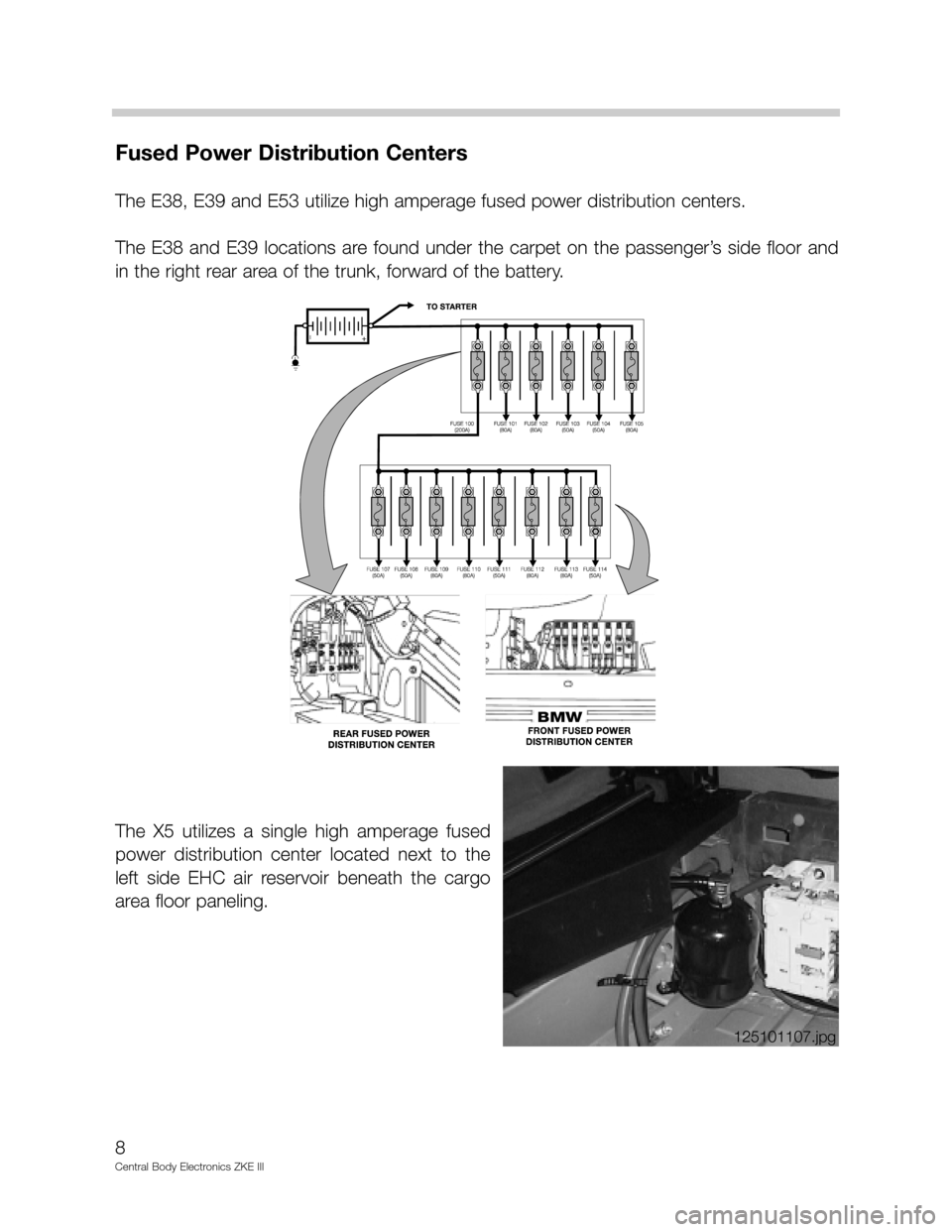
The E38, E39 and E53 utilize high amperage fused power distribution centers.
The E38 and E39 locations are found under the carpet on the passenger’s side floor and
in the right rear area of the trunk, forward of the battery.
The X5 utilizes a single high amperage fused
power distribution center located next to the
left side EHC air reservoir beneath the cargo
area floor paneling.
8
Central Body Electronics ZKE III
125101107.jpg
Page 13 of 80
13
Central Body Electronics ZKE III
Principle of Operation
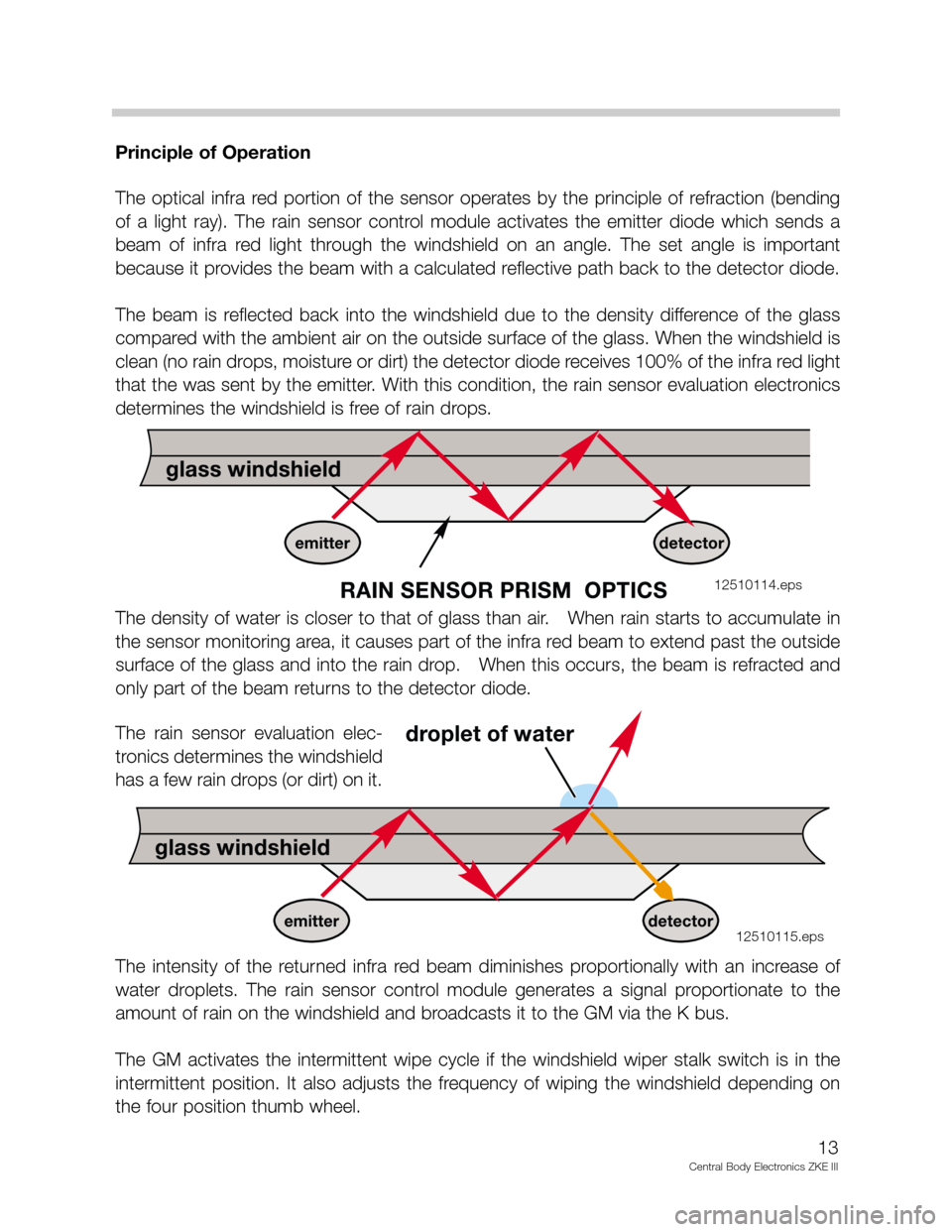
The optical infra red portion of the sensor operates by the principle of refraction (bending
of a light ray). The rain sensor control module activates the emitter diode which sends a
beam of infra red light through the windshield on an angle. The set angle is important
because it provides the beam with a calculated reflective path back to the detector diode.
The beam is reflected back into the windshield due to the density difference of the glass
compared with the ambient air on the outside surface of the glass. When the windshield is
clean (no rain drops, moisture or dirt) the detector diode receives 100% of the infra red light
that the was sent by the emitter. With this condition, the rain sensor evaluation electronics
determines the windshield is free of rain drops.
The density of water is closer to that of glass than air. When rain starts to accumulate in
the sensor monitoring area, it causes part of the infra red beam to extend past the outside
surface of the glass and into the rain drop. When this occurs, the beam is refracted and
only part of the beam returns to the detector diode.
The rain sensor evaluation elec-
tronics determines the windshield
has a few rain drops (or dirt) on it.
The intensity of the returned infra red beam diminishes proportionally with an increase of
water droplets. The rain sensor control module generates a signal proportionate to the
amount of rain on the windshield and broadcasts it to the GM via the K bus.
The GM activates the intermittent wipe cycle if the windshield wiper stalk switch is in the
intermittent position. It also adjusts the frequency of wiping the windshield depending on
the four position thumb wheel.
12510114.eps
12510115.eps
Page 63 of 80
Passenger’s Seat (without memory)
Principle of Operation
The passenger seat control switch is purely a mechanical switching module that activates
the passenger seat motors without position monitoring capabilities. Due to the limited op-
eration requirements, the passenger seat control switch is not equipped with on board
diagnostics.
The Passenger Seat control switch is equipped with an overload protection function. If
excessive amperage is drawn due to a defective motor or a switch is stuck driving a motor
to the end limit, the function activates opening the motor control circuit.
Passenger Seat Motors: Each motor is individually controlled by the Seat Control Switch.
Each position motor is connected to the seat position switch by a two wire circuit provid-
ing motor activation in both directions (no position recognition).
Passenger Seat Adjustment: Operation of the passenger seat is always possible regard-
less of the ignition key position. Moving a position switch operates a the motor control con-
tacts directly, the switch applies voltage and ground path directly to operate the motor.
Reversing the switch simply changes the motor polarity. More than one passenger seat
motor can be run simultaneously.
Optional Seat Back Lumbar Support
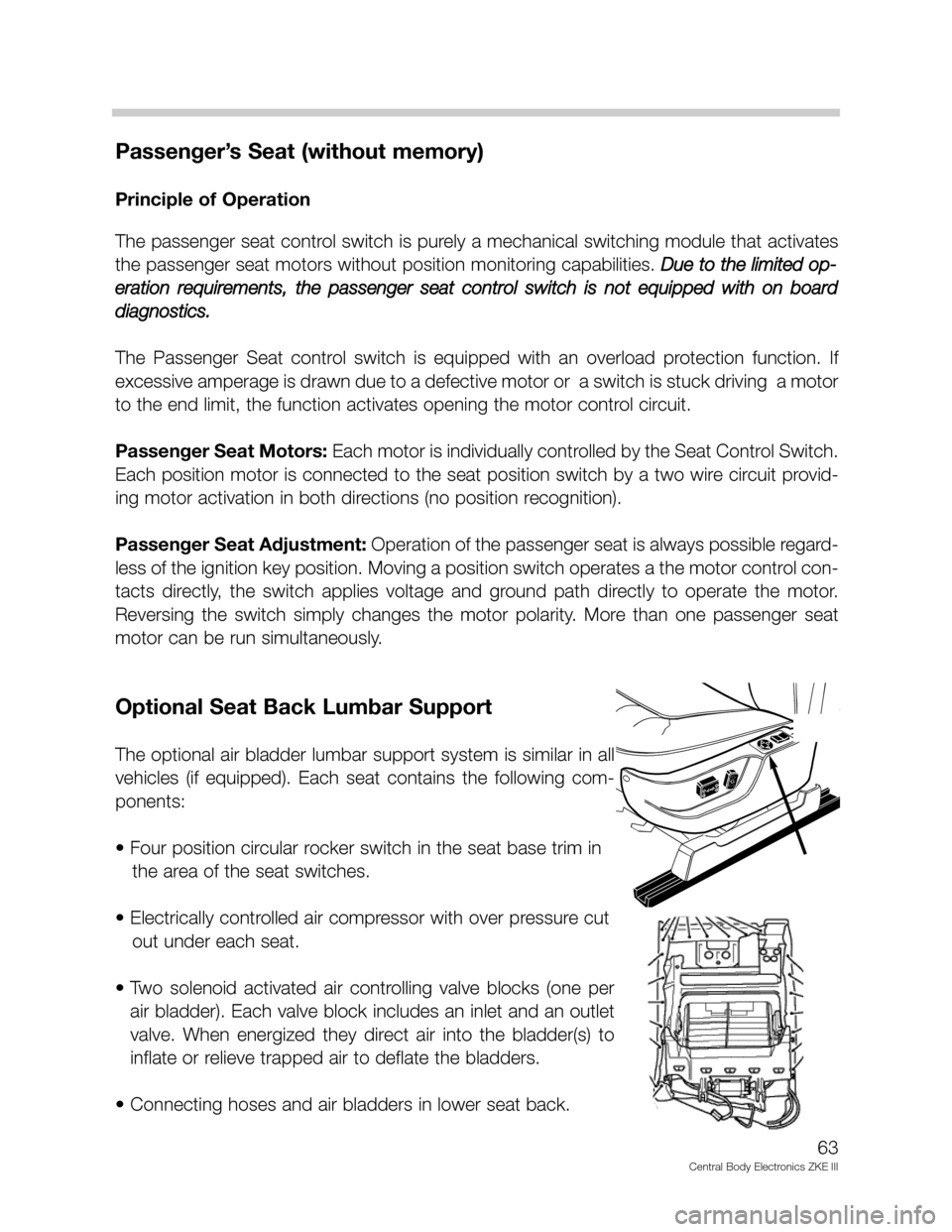
The optional air bladder lumbar support system is similar in all
vehicles (if equipped). Each seat contains the following com-
ponents:
• Four position circular rocker switch in the seat base trim in
the area of the seat switches.
• Electrically controlled air compressor with over pressure cut
out under each seat.
• Two solenoid activated air controlling valve blocks (one per
air bladder). Each valve block includes an inlet and an outlet
valve. When energized they direct air into the bladder(s) to
inflate or relieve trapped air to deflate the bladders.
• Connecting hoses and air bladders in lower seat back.
63
Central Body Electronics ZKE III
Page 64 of 80
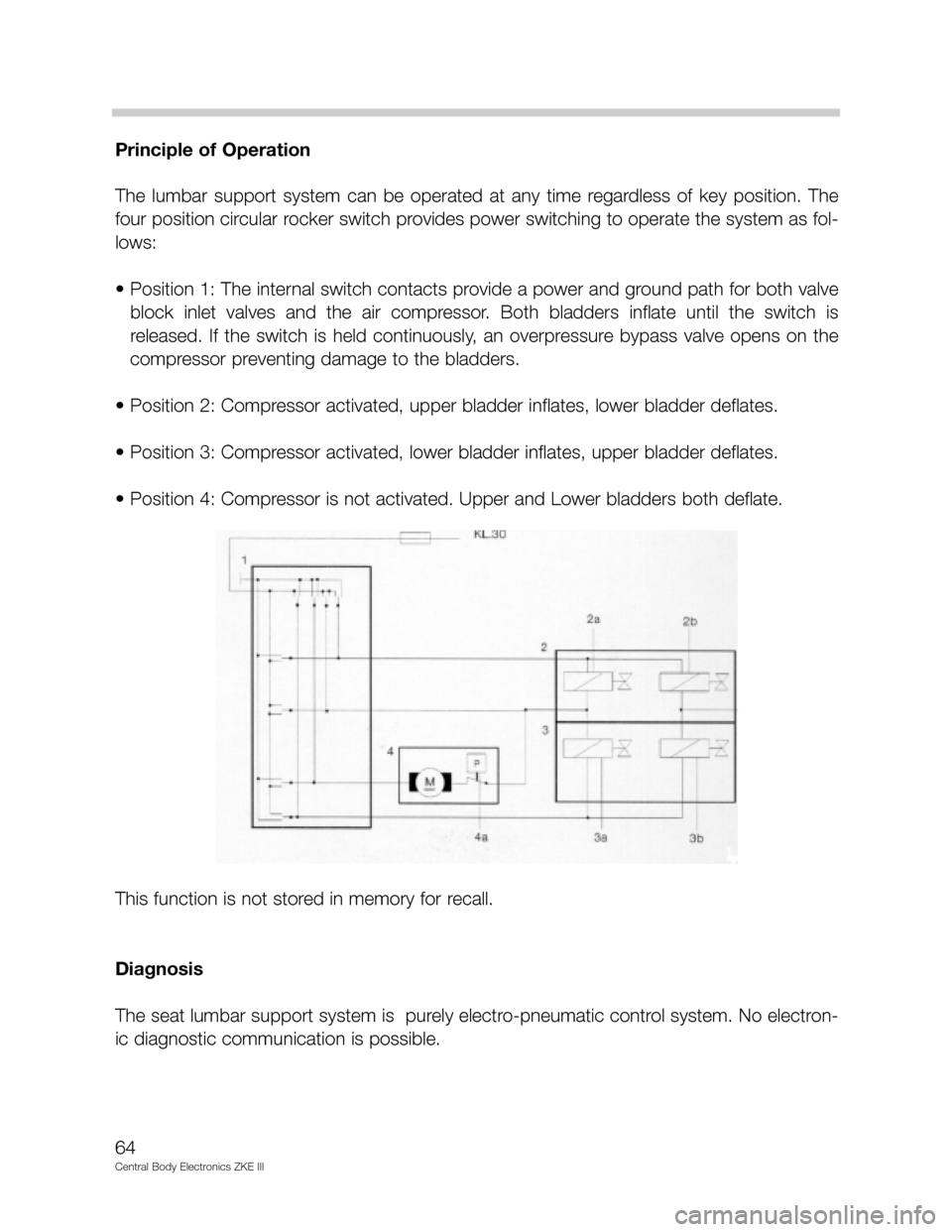
Principle of Operation
The lumbar support system can be operated at any time regardless of key position. The
four position circular rocker switch provides power switching to operate the system as fol-
lows:
• Position 1: The internal switch contacts provide a power and ground path for both valve
block inlet valves and the air compressor. Both bladders inflate until the switch is
released. If the switch is held continuously, an overpressure bypass valve opens on the
compressor preventing damage to the bladders.
• Position 2: Compressor activated, upper bladder inflates, lower bladder deflates.
• Position 3: Compressor activated, lower bladder inflates, upper bladder deflates.
• Position 4: Compressor is not activated. Upper and Lower bladders both deflate.
This function is not stored in memory for recall.
Diagnosis
The seat lumbar support system is purely electro-pneumatic control system. No electron-
ic diagnostic communication is possible.
64
Central Body Electronics ZKE III