Head BMW 540i 1998 E39 Workshop Manual
[x] Cancel search | Manufacturer: BMW, Model Year: 1998, Model line: 540i, Model: BMW 540i 1998 E39Pages: 1002
Page 719 of 1002
Downloaded from www.Manualslib.com manuals search engine
330-23
Rear Suspension
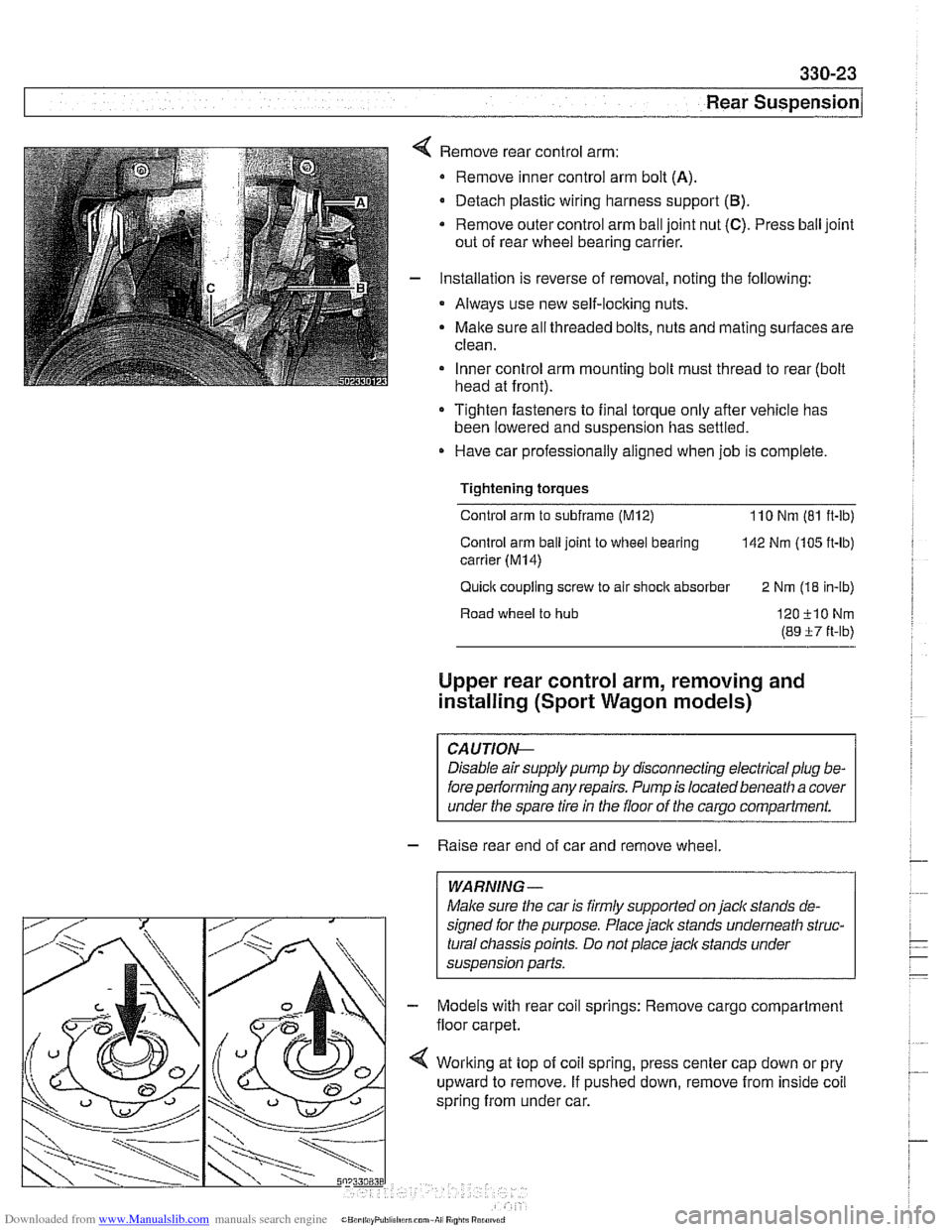
Remove rear control arm:
Remove inner control arm bolt
(A).
Detach plastic wiring harness support (B).
* Remove outer control arm ball joint nut (C). Press ball joint
out of rear wheel bearing carrier.
Installation is reverse of removal, noting the following:
Always use new self-locking nuts.
Malte sure all threaded bolts, nuts and mating surfaces are
clean.
Inner control arm mounting bolt must thread to rear (bolt
head at front).
Tighten fasteners to final torque only afler vehicle has
been lowered and suspension has settled.
Have car professionally aligned when job is complete.
Tightening
torques
Control arm to subframe (M12) 110 Nm (81 ft-ib)
Control arm
ball joint to wheel bearing 142 Nm (105 ft-lb)
carrier
(M14)
Quick coupling screw to air shock absorber
2 Nm (18 in-lb)
Road wheel
to hub 120-flONm
(89 i7 ft-lb)
Upper rear control arm, removing and
installing (Sport Wagon models)
CAUTIOG
Disable air supply pump by disconnecting electrical plug be-
fore
perlorming any repairs. Pump is located beneath a cover
under the spare tire in the floor of the
carqo compartment.
- Raise rear end of car and remove wheel.
WARNING -
Make sure the car is firmly supported on jaclc stands de-
signed for the purpose.
Place jaclc stands underneath struc-
tural chassis points. Do not place jack stands under
suspension parts.
Models with rear coil springs: Remove cargo compartment
floor carpet.
Worlting at top of coil spring, press center cap down or pry
upward to remove. If pushed down, remove from inside coil
spring from under car.
Page 721 of 1002
Downloaded from www.Manualslib.com manuals search engine
330-25
Rear Suspension
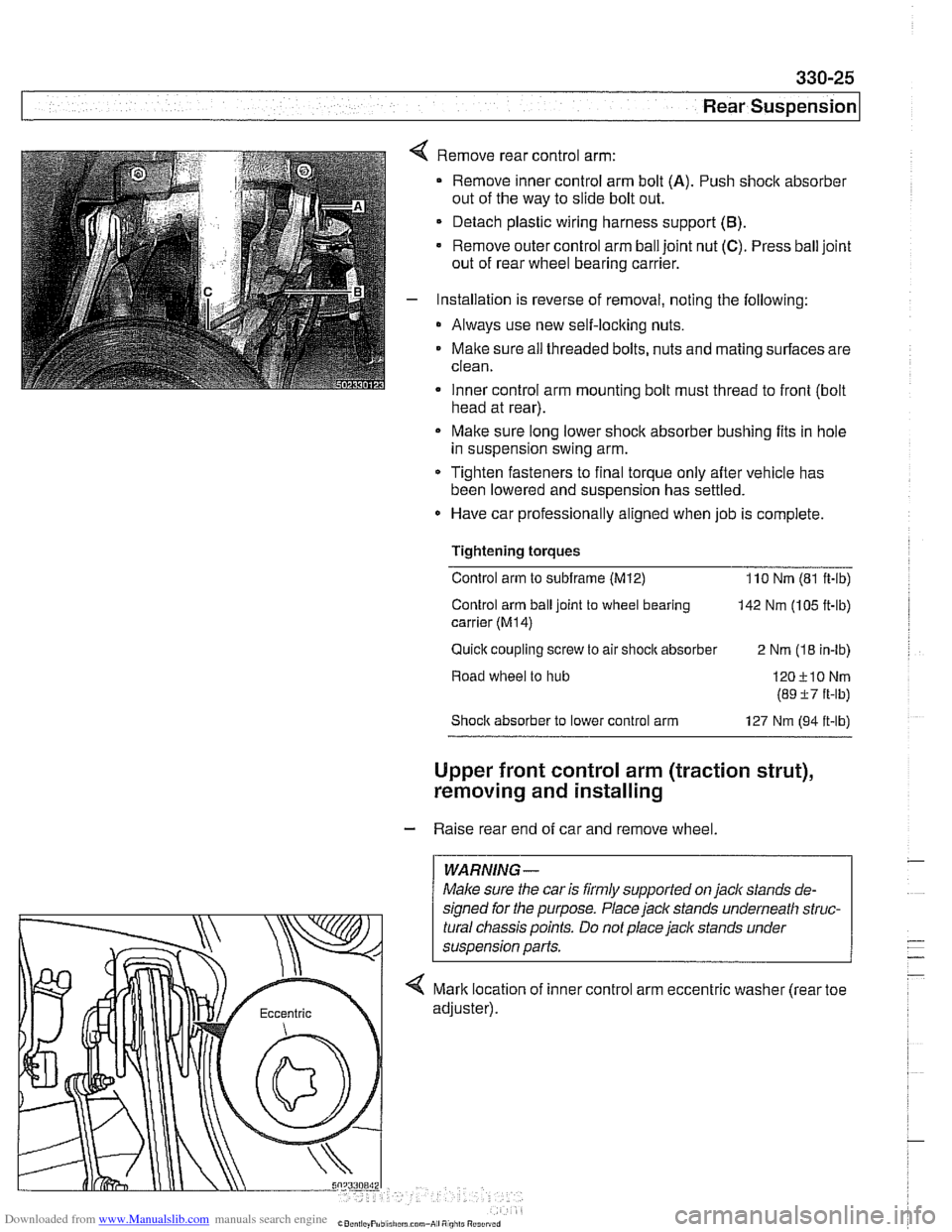
Remove rear control arm:
Remove inner control arm bolt
(A). Push shock absorber
out of the way to slide bolt out.
Detach plastic wiring harness support
(B).
Remove outer control arm ball joint nut (C). Press ball joint
out of rear wheel bearing carrier.
Installation is reverse of removal, noting the following:
* Always use new self-locking nuts.
Maite sure
ail threaded bolts, nuts and mating surfaces are
clean.
Inner control arm mounting bolt must thread to front
(bolt . head at rear).
Make sure long lower shock absorber bushing fits in hole
in suspension swing arm.
* Tighten fasteners to final torque only after vehicle has
been lowered and suspension has settled.
Have car professionally aligned when job is complete.
Tightening torques Control arm to
subframe (M12) 110 Nm (81 ft-ib)
Control arm ball joint to wheel bearing
142 Nm (105 ft-lb)
carrier
(M14)
Quick coupling screw to air shocit absorber
2 Nm (18 in-lb)
Road wheel to hub
Shoclc absorber to lower control arm 127 Nm (94 it-lb)
Upper front control arm (traction strut),
removing and installing
- Raise rear end of car and remove wheel.
WARNING-
Maice sure the car is firmly supported on jack stands de-
signed for the purpose. Place
jack stands underneath struc-
tural chassis points. Do not place jack stands under
< Mark location of inner control arm eccentric washer (rear toe
Page 743 of 1002
Downloaded from www.Manualslib.com manuals search engine
330-47
Rear suspension/
Ride height sensor, removing and installing
Hall effect sensors for vehicle height detection are mounted
on the
left and right sides of the rear suspension. A coupling
rod mounted between the rear suspension arm and the sen-
sor arm is used to send a varying voltage signal to the
EHC
control module.
Raise car and support safely.
WARNING-
Male sure the car is firmly supported on jaclc stands de-
signed
for the purpose. Place jaclc stands underneath struc-
tural chassis points. Do not place jaclc stands under
sus~ension Darts.
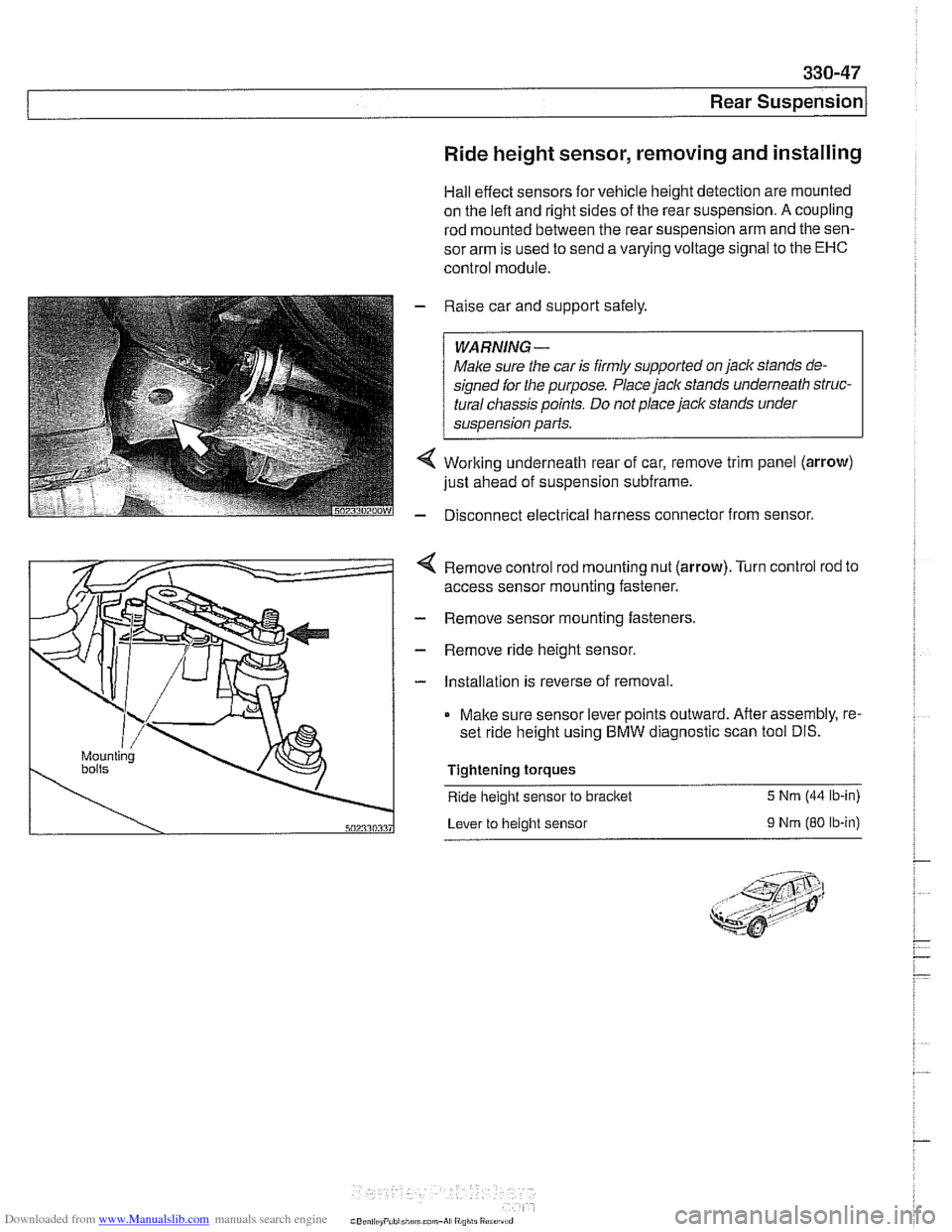
Working underneath rear of car, remove trim panel (arrow)
just ahead of suspension subframe.
Disconnect electrical harness connector from sensor.
4 Remove control rod mounting nut (arrow).Turn control rod to
access sensor mounting fastener.
- Remove sensor mounting fasteners.
- Remove ride height sensor.
- Installation is reverse of removal.
Make sure sensor lever points outward. After assembly, re-
set ride height using BMW diagnostic scan tool DIS.
Tightening torques
Ride
height sensor to bracket 5 Nrn (44 lb-in)
Lever to height sensor
9 Nrn (80 ib-in)
Page 769 of 1002
Downloaded from www.Manualslib.com manuals search engine
Brakes
Warnings and cautions
WARNING-
. E39 cars require special BMWsen/ice equipment toprop-
erly bleed the brake hydraulic system. See Bleeding
Brakes for additional information.
Semi-metallic and metallic brake friction materials in
brake pads or shoes may produce dangerous dust.
Brake fluid is poisonous, corrosive and dangerous to
the environment. Wear safety glasses and rubber
gloves when worliing with
bralie fluid. Do not siphon
brake fluid with your mouth. Dispose of brake fluid
properly
Do not reuse self-locking nuts, bolts or fasteners. They
are designed to be used only once and may fail if re-
used. Always replace them with new self-locliing fas-
teners.
CAUTlOI\C
Immediately clean bralie fluid spilled on painted surfaces
and wash with water, as
bralie fluid will remove paint.
Always use new brake fluid from a fresh, unopened
container.
Brake fluid will absorb moisture from the air.
This can lead to corrosion problems in the
braking sys-
tem, and will also lower the fluid boiling point.
. Plug open lines and brake fluid ports to prevent con-
tamination.
Only tighten brake hoses on front wheels
with wheels
in straight ahead position.
If carrying out electric welding
worlc, be sure to discon-
nect electrical harness connector from electronic con-
trol module.
Do not expose electronic control modules to high sus-
tained heat, such as in a paint drying booth. Maximum
heat exposure:-95°C (203
OF) for short periods of time-
85'C (185°F) for Ions periods of time (approx. 2 hours)
Page 778 of 1002
Downloaded from www.Manualslib.com manuals search engine
1 Brakes
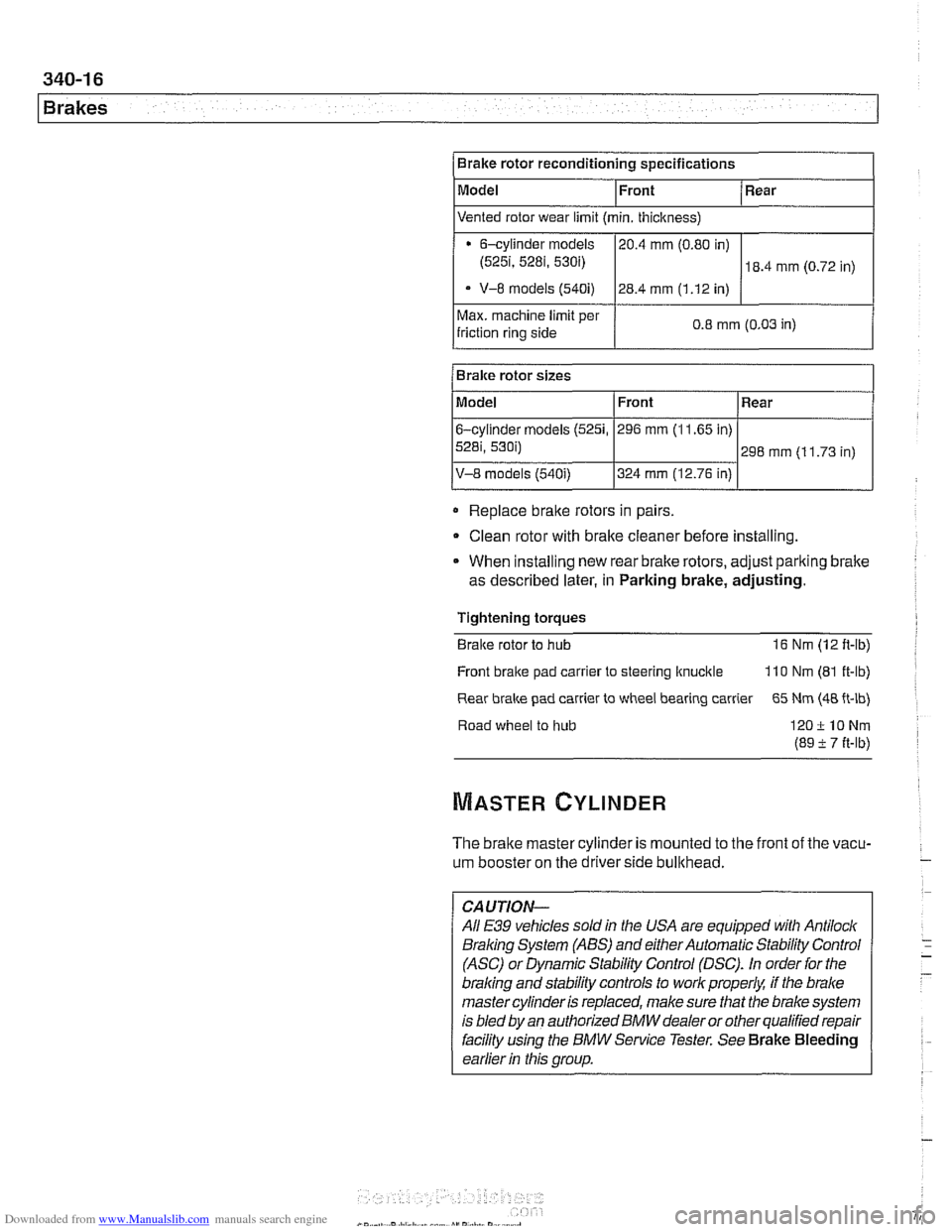
Max. machine limit per
friction ring side 0.8 mm (0.03
in) I
Brake rotor reconditioning specifications
Model
Replace
braite rotors in pairs
Bralre rotor sizes
Clean rotor with brake cleaner before installing.
Front
Model
6-cylinder
models (5251,
5281, 530i)
V-8 models (540i)
* When installing new rear brake rotors, adjust pariting brake
as described later, in Parking brake, adjusting. Rear
Vented rotor wear limit (min. thickness)
Tightening torques
Braite rotor to hub 16 Nm (12 ft-lb)
6-cylinder models
(525i, 5281, 530i)
- V-8 models (540i)
Front
296 mm (1 1.65 in)
324 mm (12.76 in)
Front bralte pad
carrler to steering ltnucitle 110 Nm (81 ft-lb)
Rear
298 mm (1 1.73 in)
Rear
brake pad carrier to wheel bearing carrier 65 Nm (48 ft-lb)
20.4
mm (0.80 in)
28.4 mm (1.12 in)
Road wheel to hub
120ilONm
(89 -t 7 it-lb)
18.4 mm (0.72 in)
The brake master cylinder is mounted to the front of the vacu-
um booster on the driverside bullthead.
-
CAUTION-
All E39 vehicles soldin the USA are equipped with Antilock
Braling System (ABS) and either Automatic Stability Control
(ASC) or Dynamic Stability Control (DSC).
In order for the
braling and stability controls to work properk if the brake
master cylinder is replaced, make sure that the brake system
is bled
by an authorized BMW dealer or other qualified repair
facility
using the BMW Service Tester. See Brake Bleeding
earlier
in this group.
Page 781 of 1002
Downloaded from www.Manualslib.com manuals search engine
Brakes
The brake booster is mounted to the bulkhead on driver's side
of the engine compartment, directly behind the brake master
cylinder. Intake manifold vacuum acts on a large diaphragm
in the brake booster to reduce brake pedal effort.
Brake booster check valve
The checlc valve in the bralte booster vacuum line prevents
contamination from engine backfires and other sources from
entering the bralte booster.
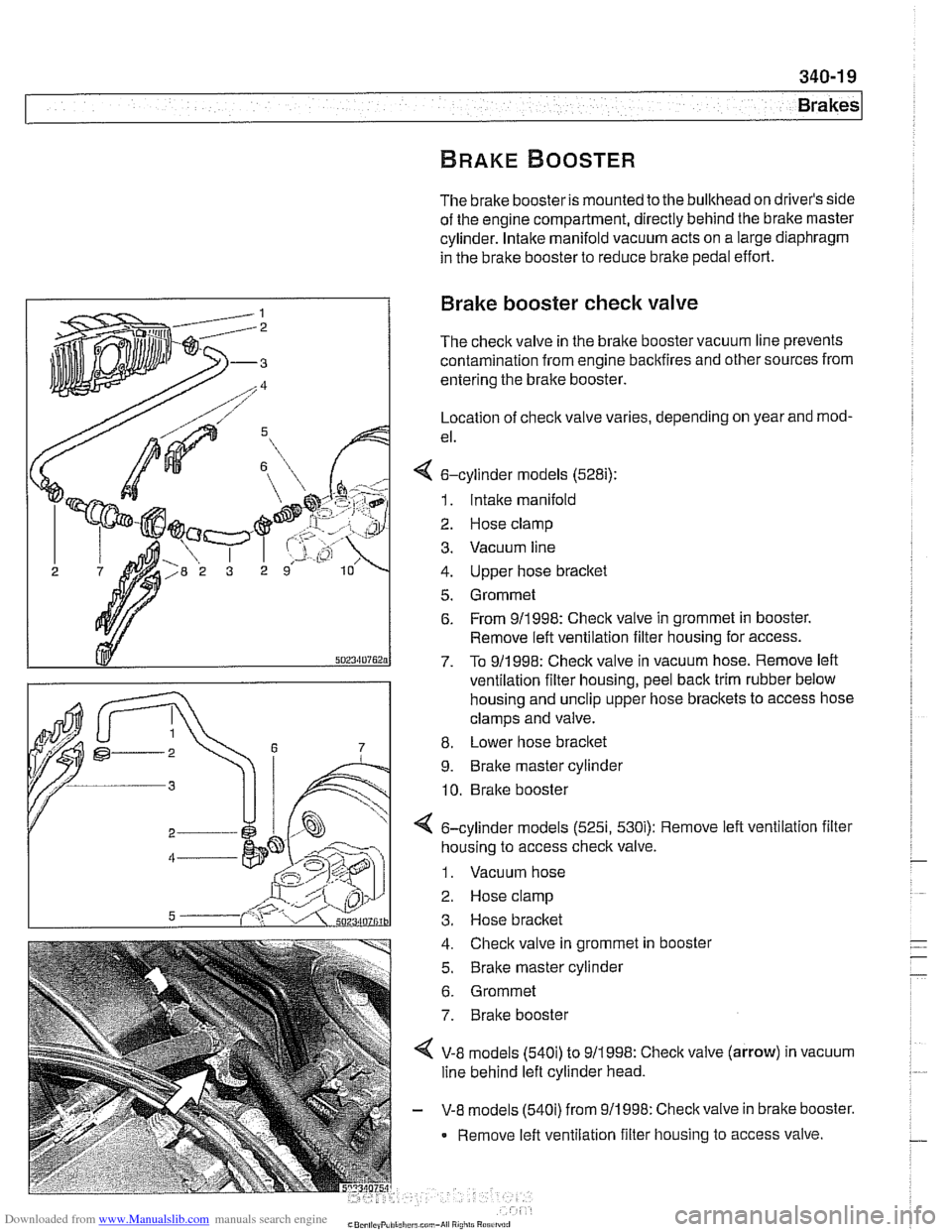
Location of
check valve varies, depending on year and mod-
el.
4 6-cylinder models (528i):
1. Intake manifold
2 Hose clamp
3. Vacuum line
4. Upper hose bracket
5. Grommet 6. From 911998: Check valve in grommet in booster.
Remove left ventilation filter housing for access.
7. To 911 998: Check valve in vacuum hose. Remove left
ventilation filter housing, peel back trim rubber below
housing and
unclip upper hose brackets to access hose
clamps and valve.
8. Lower hose
bracket
9. Brake master cylinder
10. Brake booster
< 6-cylinder models (525i, 530i): Remove left ventilation filter
housing to access
checlc valve.
1. Vacuum hose
2. Hose clamp
3. Hose bracket
4. Check valve in grommet in booster
5.
Braite master cylinder
6. Grommet
7. Brake booster
4 V-8 models (540i) to 911998: Check valve (arrow) in vacuum
line behind left cylinder head.
- V-8 models (540i) from 911998: Checkvalve in brake booster.
Remove left ventilation filter housing to access valve.
Page 783 of 1002
Downloaded from www.Manualslib.com manuals search engine
1 Brakes
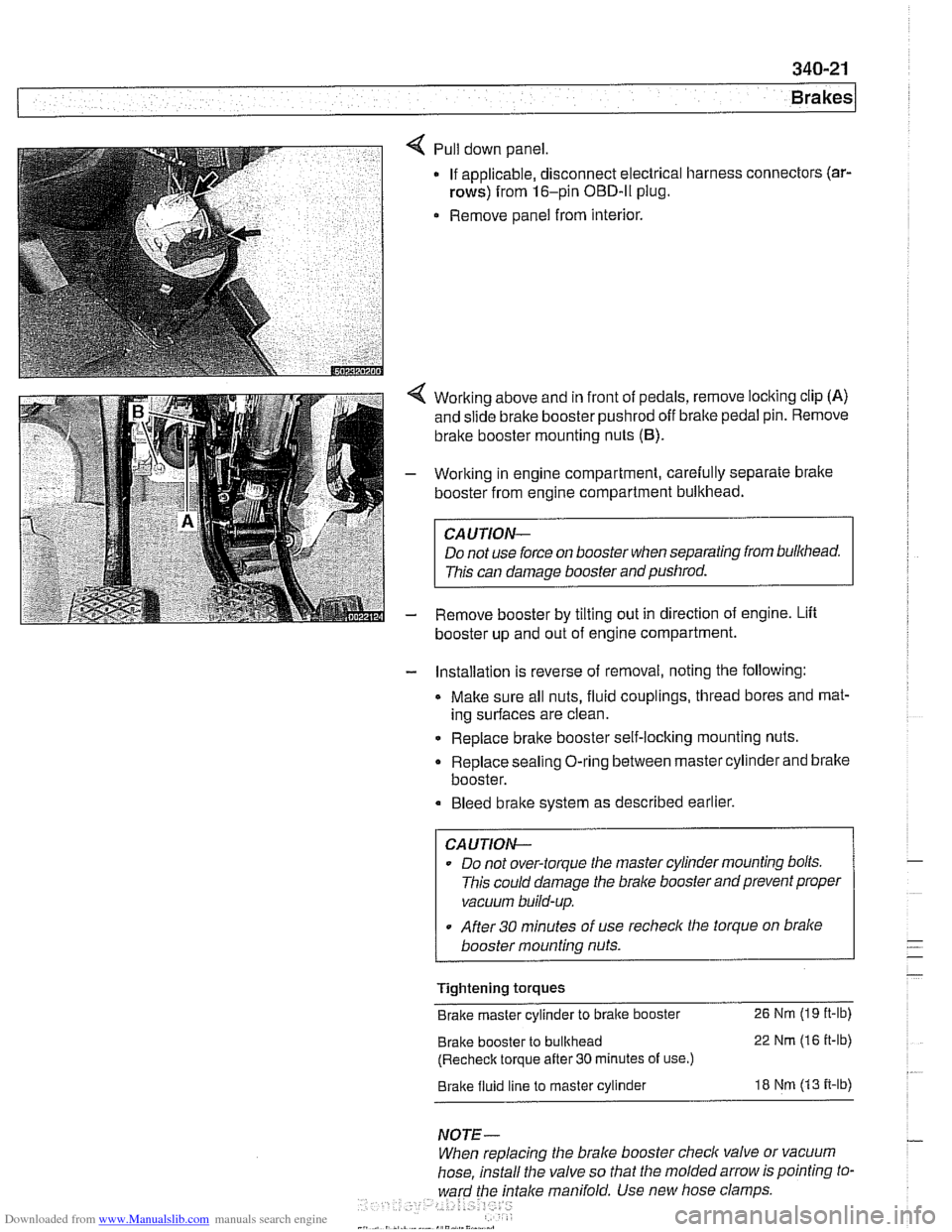
Pull down panel
If applicable, disconnect electrical harness
rows) from 16-pin OBD-ll plug.
Remove panel from interior. connectors
(ar-
Working
above and in front of pedals, remove locking clip (A)
and slide brake booster pushrod off bralte pedal pin. Remove
brake booster mounting nuts
(6).
Working in engine compartment, carefully separate bralte
booster from engine compartment bulkhead.
CAUTION-
Do not use force on booster when separating from bulkhead.
This can damage booster and pushrod.
Remove booster by tilting out in direction of engine. Lift
booster up and out of engine compartment.
- Installation is reverse of removal, noting the following:
Make sure all nuts, fluid couplings, thread bores and mat-
ing surfaces are clean.
Replace bralte booster self-locking mounting nuts.
Replace sealing O-ring between master cylinder and bralte
booster.
Bleed bralte system as described earlier.
CAUTION--
Do not over-torque tlie master cylinder mounting bolts.
This could damage the
bralce booster and prevent proper
vacuum build-up.
After
30 minutes of use recheclc the torque on bralce
booster mounting nuts.
Tightening torques
Brake master cylinder to brake booster
26 Nm (19 it-lb)
Brake booster to bulkhead 22 Nm (16 it-lb)
(Recheck torque after
30 minutes of use.)
Brake fluid line to master cylinder 18 Nm (13 it-lb)
NOTE-
When replacing the brake booster check valve or vacuum
hose, install the valve so that the molded arrow is pointing to-
ward the
fntalce manifold. Use new hose clamps
Page 797 of 1002
Downloaded from www.Manualslib.com manuals search engine
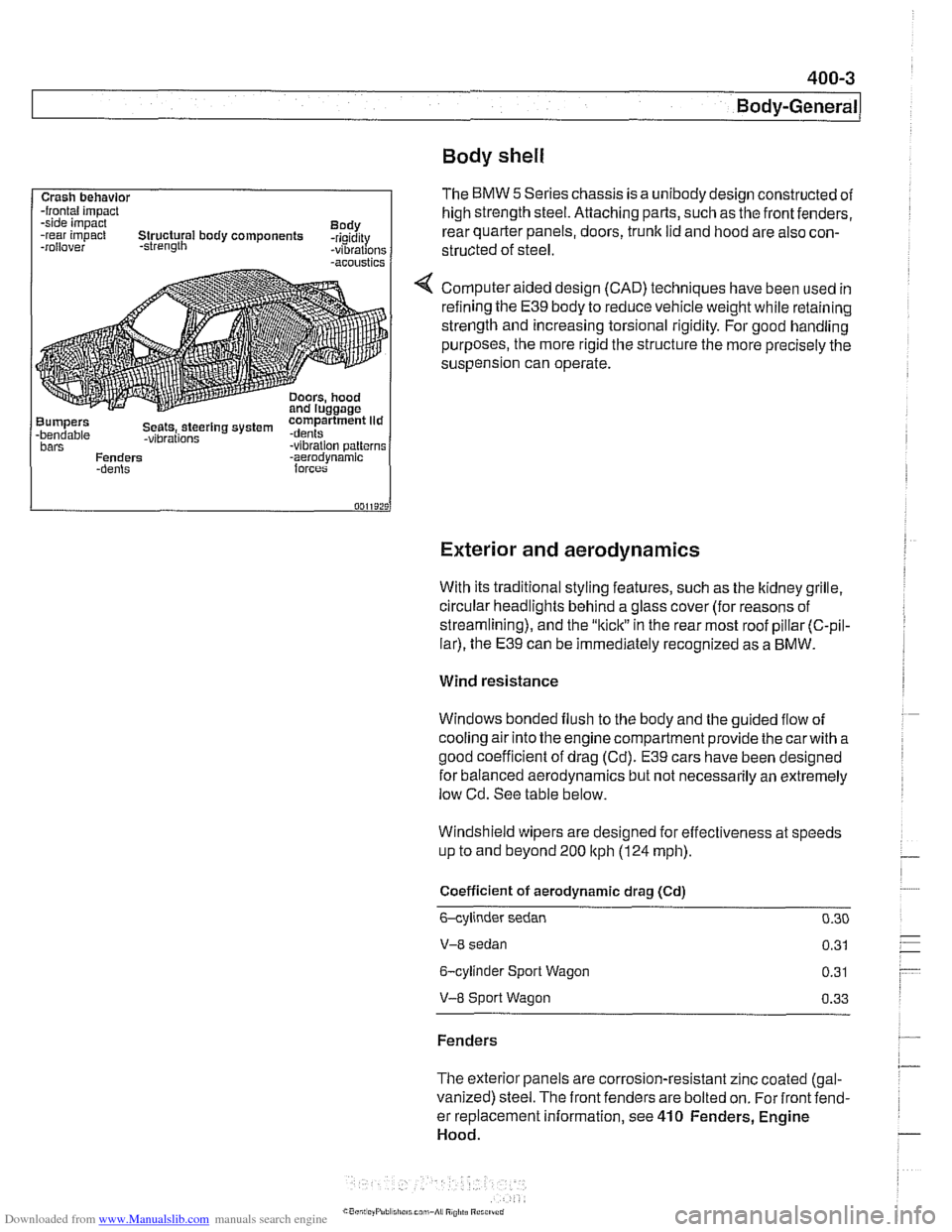
Body shell
Exterior and aerodynamics
Crash behavlor -frontal impact
-side impact
Body
-rear impact Structural body components -rigidity
-rollover -strength -vibrations -acoustics
Bumpers compartment lid -bendable Seets,.steerlng system .dents -vibrations bars -vibration patterns
Fenders -aerodvnamic
With its traditional styling features, such as the ltidney grille.
circular headlights behind a glass cover (for reasons of
streamlining), and the
"kiclt" in the rear most roof pillar (C-pil-
lar), the E39 can be immediately recognized as a BMW.
The BMW 5 Series chassis is a unibody design constructed of
high strength steel. Attaching parts, such as the front fenders,
rear quarter panels, doors,
trunk lid and hood are also con-
structed of
steel.
Computer aided design (CAD) techniques have been used in
refining the
E39 body to reduce vehicle weight while retaining
strength and increasing torsional rigidity. For good handling
purposes, the more rigid the structure the more precisely the
suspension can operate.
Wind resistance
Windows bonded flush to the body and the guided flow of
cooling air into the engine compartment provide the
carwith a
good coefficient of drag (Cd).
E39 cars have been designed
for balanced aerodynamics but not necessarily an extremely
low Cd. See table below.
Windshield wipers are designed for effectiveness at speeds
up to and beyond 200
ltph (124 mph).
Coefficient of aerodynamic drag (Cd)
6-cylinder sedan 0.30
V-8 sedan 0.31
6-cylinder Sport Wagon 0.31
V-8 Sport Wagon 0.33
Fenders
The exterior panels are corrosion-resistant zinc coated (gal-
vanized) steel. The front fenders are bolted on. For front fend-
er replacement information, see
410 Fenders, Engine
Hood.
Page 801 of 1002
Downloaded from www.Manualslib.com manuals search engine
Body-General
SAFETY AND SECURITY FEATURES
A number of new or improved safety and security features are
incorporated in
E39 cars.
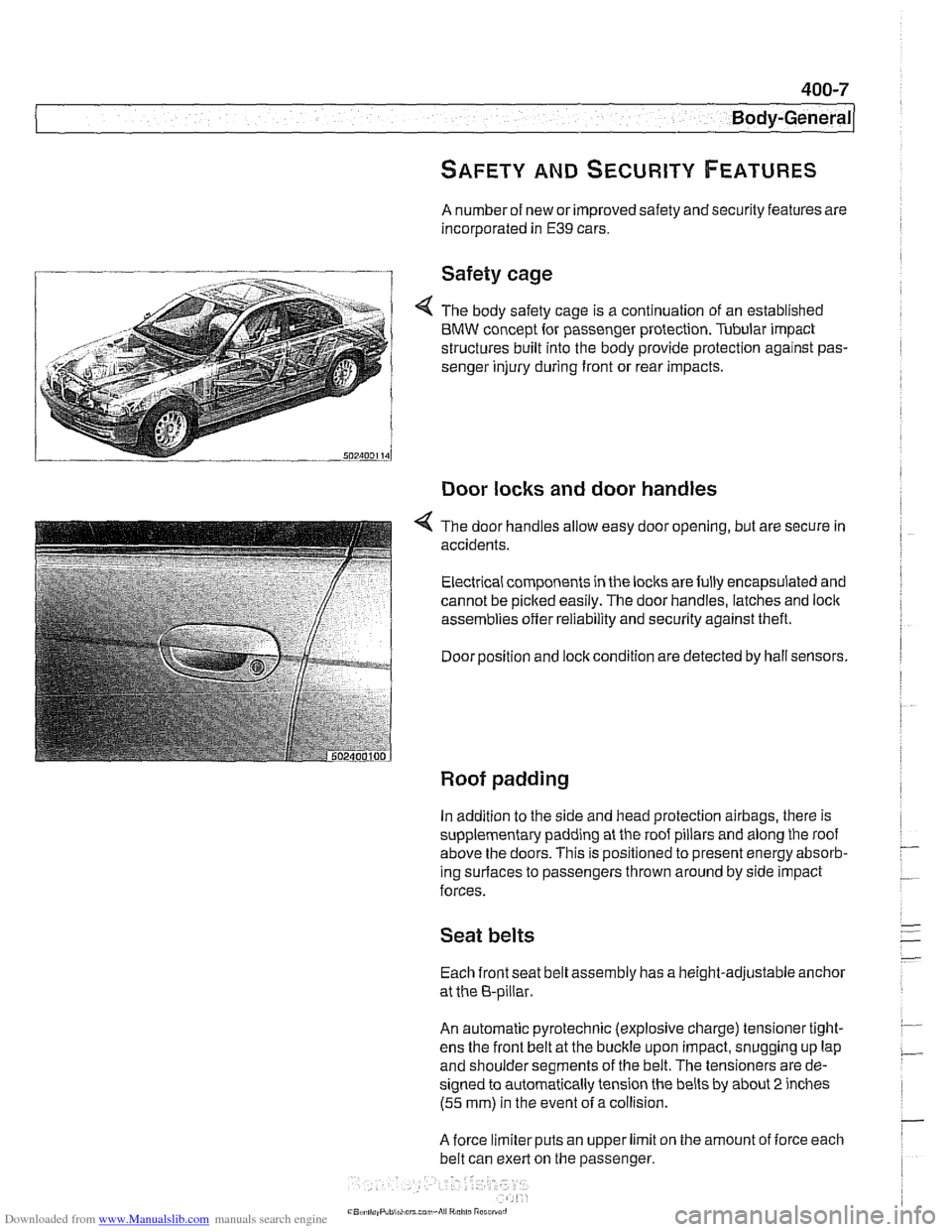
Safety cage
4 The body safety cage is a continuation of an established
BMW concept for passenger protection. Tubular impact
structures built into the body provide protection against pas-
senger injury during front or rear impacts.
Door locks and door handles
4 The door handles allow easy door opening, but are secure in
accidents.
Electrical components in the locks are fully encapsulated and
cannot be picked easily. The door handles, latches and
loclc
assemblies offer reliability and security against theft.
Door position and
loclc condition are detected by hall sensors.
Roof padding
In addition to the side and head protection airbags, there is
supplementary padding at the roof pillars and along the roof
above the doors. This is positioned to present energy absorb-
ing
surlaces to passengers thrown around by side impact
forces.
Seat belts
Each front seat belt assembly has a height-adjustable anchor
at the 8-pillar.
An automatic pyrotechnic (explosive charge) tensioner tight-
ens the front belt at the buckle upon impact, snugging up lap
and shoulder segments of the belt. The tensioners are de-
signed to automatically tension the belts by about
2 inches
(55 mm) in the event ofa collision.
A force limiter puts an upper limit on the amount of iorce each
belt can exert on the passenger.
Page 802 of 1002
Downloaded from www.Manualslib.com manuals search engine
400-8
Body-General
Airbags
Front airbags, s~de a~rbags, pyrotechnic seat belt tensioners
and the Battery Safety Terminal (BST) are integrated into the
Supplemental Restraint System (SRS) and its variants.
NOTE-
The BMW SRS system is called Multiple Restra~nt System
(MRS). Over the years,
E39 cars were equipped with MRS,
MRS
11, MRS 111. Each version offers varied features and im-
provements over the previous system.
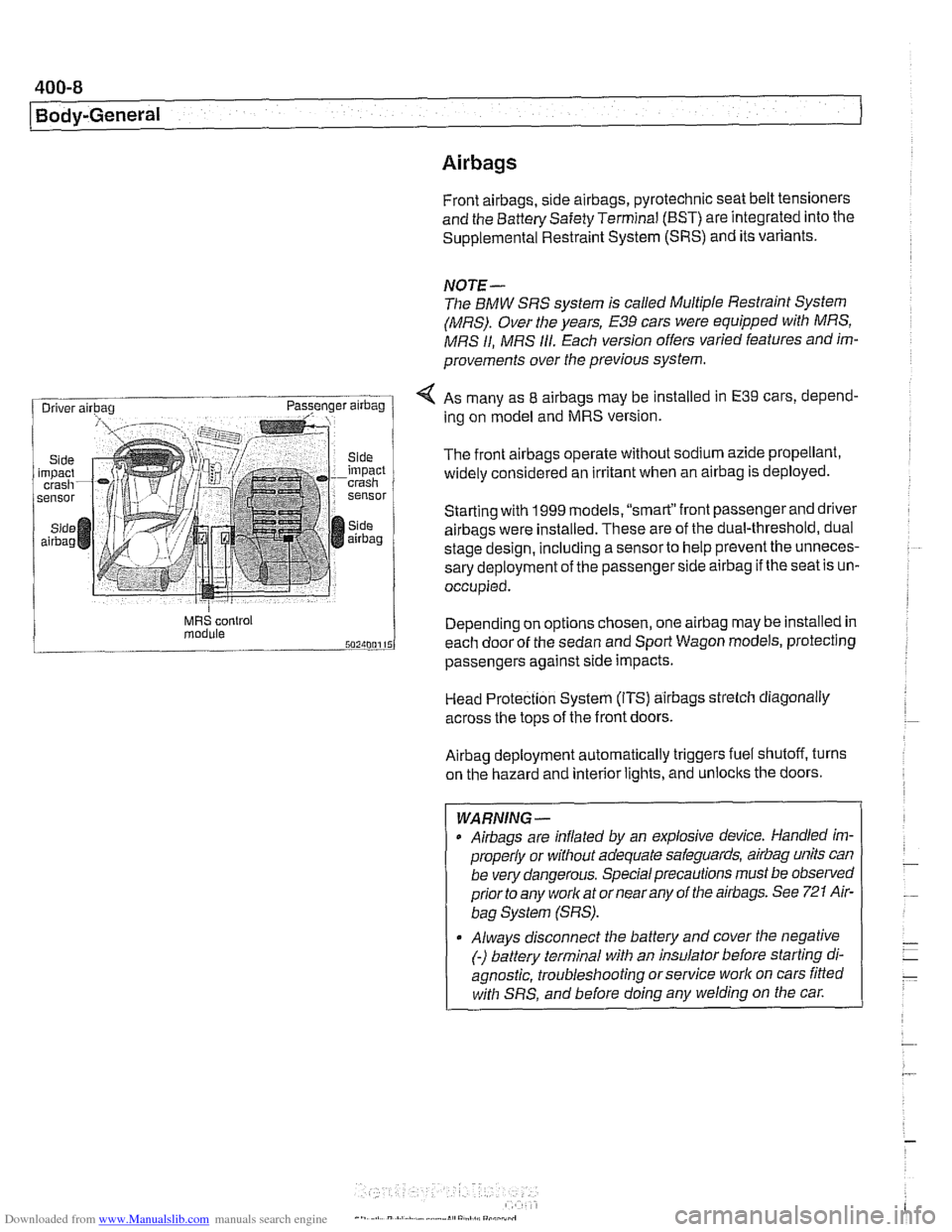
< As many as 8 airbags may be installed in E39 cars, depend-
ing on model and MRS version.
The front
airbags operate without sodium azide propellant,
widely considered an irritant when an
airbag is deployed.
Starting with
1999 models. "smart"front passenger and driver
airbags were installed. These are of the dual-threshold, dual
stage design, including a
sensorto help prevent the unneces-
sary deployment of the passenger side
airbag if the seat is un-
occupied.
MRS control Depend~ng on options chosen, one airbag may be installed in module each door of the sedan and Sport Wagon models, protecting
passengers against
s~de impacts.
Head Protection System (ITS)
airbags strelch diagonally
across the tops of the front doors.
Airbag deployment automatically triggers fuel shutoff, turns
on the hazard and interior lights, and unlocks the doors.
- -
WARNING -
Airbags are inflated by an explosive device. Handled im-
properly or without adequate safeguards,
airbag units can
be very dangerous. Special precautions must be observed
prior to any worlc at or near any of the airbags. See
721 Air-
bag System (SRS).
Always disconnect the battery and cover the negative
(-) battery terminal with an insulator before starting di-
agnostic, troubleshooting or service work on cars fitted
with SRS, and before doing any welding on the
car.