M62 BMW 540i 1999 E39 Repair Manual
[x] Cancel search | Manufacturer: BMW, Model Year: 1999, Model line: 540i, Model: BMW 540i 1999 E39Pages: 1002
Page 523 of 1002
Downloaded from www.Manualslib.com manuals search engine
180 Exhaust System
General Exhaust System
. . . . . . . . . . . . . . . . .
Exhaust system, removing and installing
Muffler, replacing..
. . . . . . . . . . . . . . . . .
Exhaust Manifolds . . . . . . . . . . . . . . .
Exhaust manifolds, removing
and installing (M52 engine)
. . . . . . . . . .
Exhaust manifolds, removing and
installing (M52
TU and M54 engines) . . .
Exhaust manifolds, removing
and installing (M62 engine)
. . . . . . . . . .
Oxygen Sensors. . . . . . . . . . . . . . . . . . . . 180-9
Oxygen sensors (precatalyst),
replacing
(M52 TU and M54) . . . . . . . . . . . . 180-9
Oxygen sensors (post-catalyst),
replacing (M52
TU and M54) . . . . . . . . . . . . 180-9
Oxygen sensor, replacing
(M52 and M62 engine) . . . . . . . . . . . . . . . 180-10
Exhaust System Diagrams . . . . . . . . . 180-1 1
M52 engine (528i 1997-1 998) . . . . . . . . . . 180-1 1
M52
TU and M54 engines
(528i 1999-2000 and 5251 2001-2003) . . . 180-1 2
M54 engine
(530i 2001-2003) . . . . . . . . . . 180-1 3
M62 engine
(540i 1997-1 998) . . . . . . . . . . 180-1 4
M62
TU engine (540i 1999-2003 . . . . . . . 180-1 5
Page 529 of 1002
Downloaded from www.Manualslib.com manuals search engine
1 Exhaust ~vsteml
NOTE-
The front exhaust manifold must be removed before the rear
manifold.
- Installation is reverse of removal.
Coat exhaust mounting studs with CRC or equivalent cop-
per paste.
Use new gasltets and self-locking nuts.
Tightening torques Exhaust manifold to cylinder head 20 Nm
(15 ft-lb)
Front exhaust pipe to manifold 30 Nm
(22 ft-lb)
Oxygen sensor to manifold 50
Nrn (37 ft-lb)
Exhaust manifolds, removing and installing
(M62 engine)
Always use new retaining nuts and gasltets when removing
and installing the exhaust manifolds.
NOTE-
Access to manifolds is extremely limited. If removing exhaust
manifolds as part of additional engine worlc (such as cylinder
head removal), it may be easier to first remove engine.
- With exhaust system cold, raise and support car for access
to exhaust system.
WARNING -
Do not work undera lifted car unless it is solidly supported on
jaclt stands designed for the purpose. Never worlc undera car
that is supportedsolely
by a jack.
- Remove exhaust system. See Exhaust system, removing
and installing.
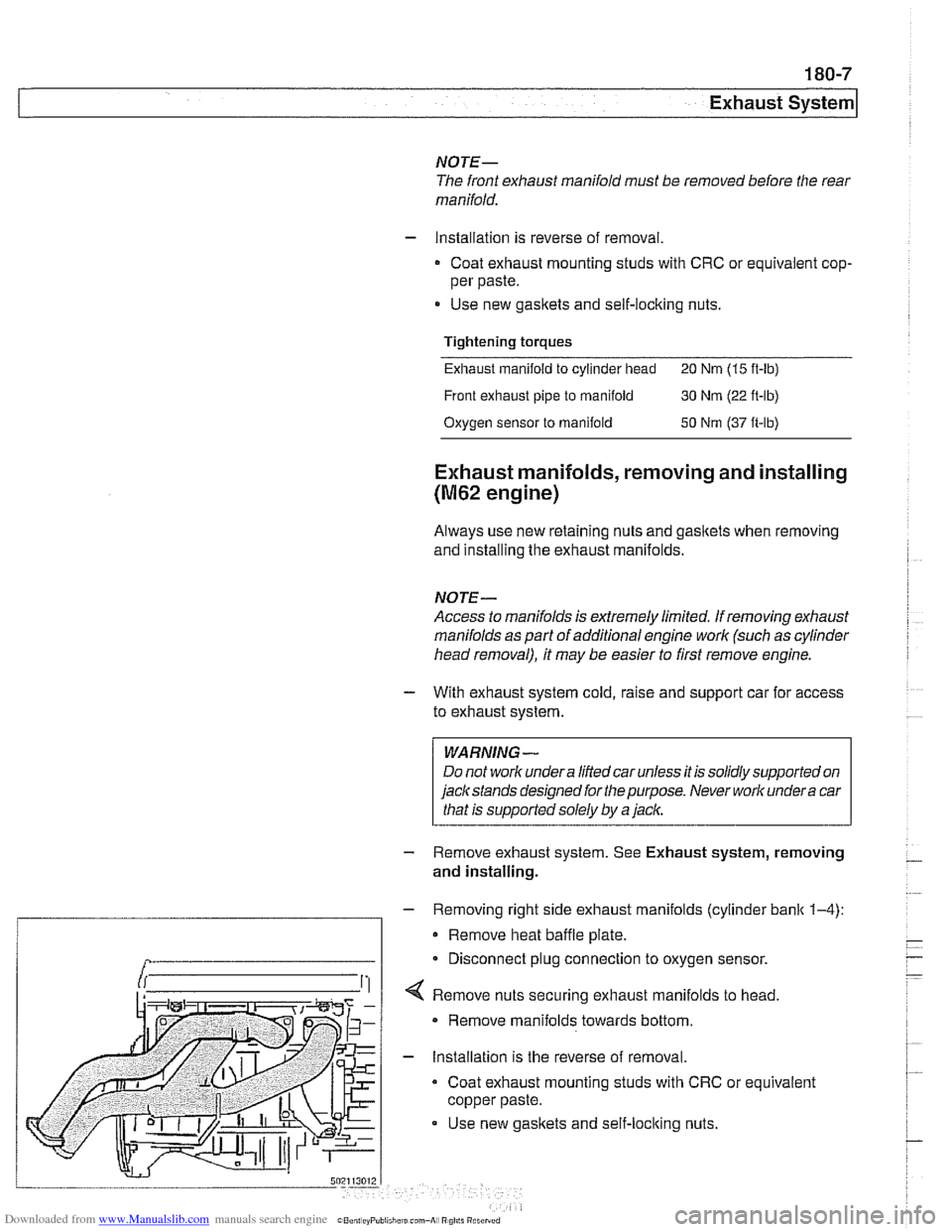
- Removing right side exhaust manifolds (cylinder bank 1-4):
Remove heat baffle plate.
Disconnect plug connection to oxygen sensor.
securing exhaust manifolds to head.
Remove manifolds towards bottom.
- Installation is the reverse of removal.
Coat exhaust mounting studs with CRC or equivalent
copper paste.
Use new gasltets and self-loclting nuts.
Page 532 of 1002
Downloaded from www.Manualslib.com manuals search engine
Exhaust System
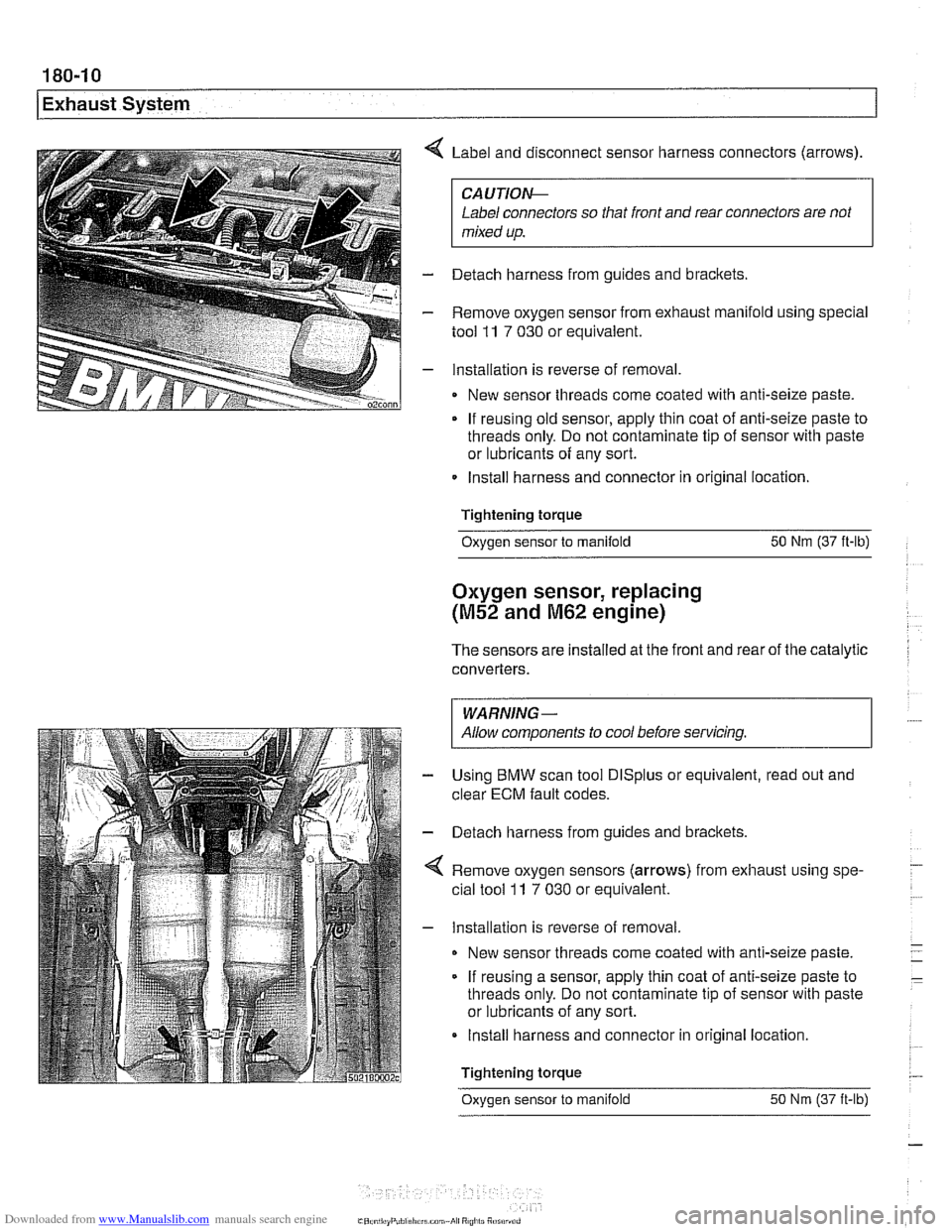
Label and disconnect sensor harness connectors (arrows).
CAUTlOI\C
Label connectors so that front and rear connectors are not
mixed up.
- Detach harness from guides and brackets.
- Remove oxygen sensor from exhaust manifold using special
tool
11 7 030 or equivalent.
- Installation is reverse of removal
New sensor threads come coated with anti-seize paste.
If reusing old sensor, apply thin coat of anti-seize paste to
threads only. Do not contaminate tip of sensor with paste
or lubricants of any sort.
Install harness and connector in original location.
Tightening torque
Oxygen sensor to manifold 50 Nm (37 ft-lb)
Oxygen sensor, replacing
(M52 and M62 engine)
The sensors are installed at the front and rear of the catalytic
converters.
I WARNING- I
I Allow components to cool before servicing. I
Using BMW scan tool DlSplus or equivalent, read out and
clear
ECM fault codes.
Detach harness from guides and brackets.
Remove oxygen sensors (arrows) from exhaust using spe-
cial tool
ll 7 030 or equivalent.
Installation is reverse of removal
New sensor threads come coated with anti-seize paste.
If reusing a sensor, apply thin coat of anti-seize paste to
threads only. Do not contaminate tip of sensor with paste
or lubricants of any sort.
Install harness and connector in original location.
Tightening torque
Oxvaen sensor to manifold 50 Nm (37 it-lb)
Page 536 of 1002
Downloaded from www.Manualslib.com manuals search engine
I Exhaust System
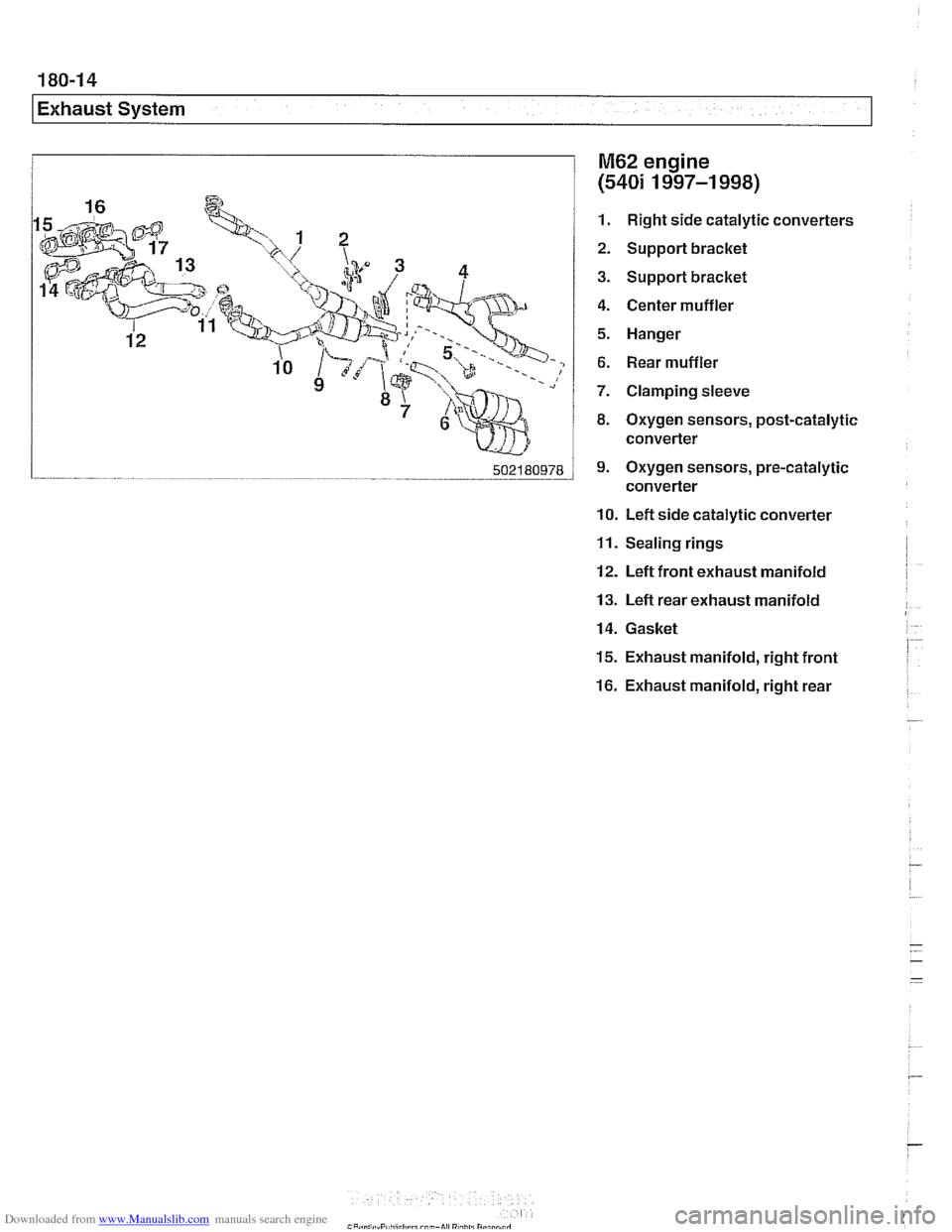
M62 engine
(540i 1997-1 998)
1. Right side catalytic converters
2. Support bracket
3. Support bracket
4. Center muffler
5. Hanger
6. Rear muffler
7. Clamping sleeve
8. Oxygen sensors, post-catalytic
converter
9. Oxygen sensors, pre-catalytic
converter
10. Left side catalytic converter
11. Sealing rings
12. Left front exhaust manifold
13. Left rear exhaust manifold
14. Gasket
15. Exhaust manifold, right front
16. Exhaust manifold, right rear
Page 537 of 1002
Downloaded from www.Manualslib.com manuals search engine
Exhaust systeml
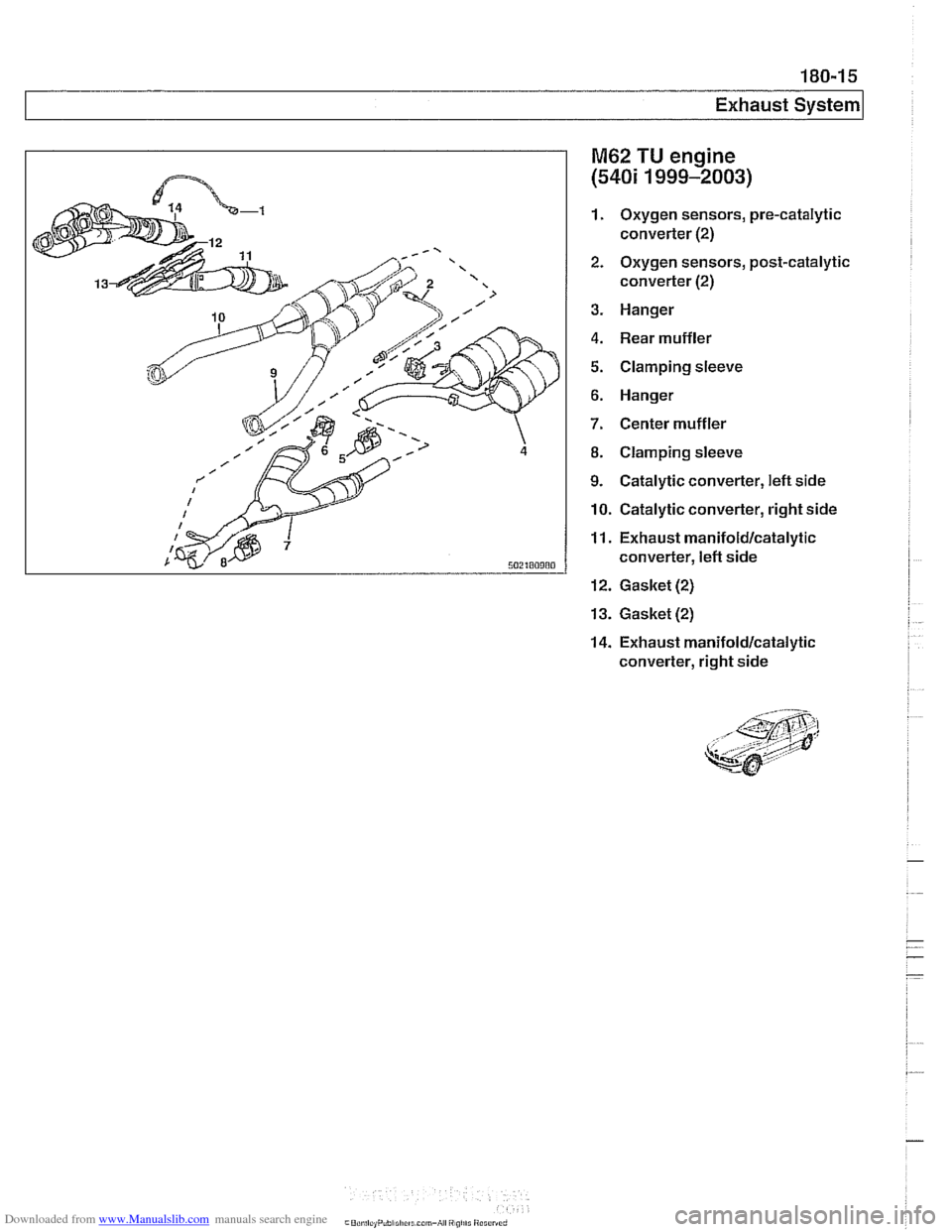
M62 TU engine
(540i 1999-2003)
1. Oxygen sensors, pre-catalytic
converter
(2)
2.
Oxygen sensors, post-catalytic
converter
(2)
3.
Hanger
4. Rear muffler
5. Clamping sleeve
6. Hanger
7. Center muffler
8. Clamping sleeve
9. Catalytic converter, left side
10. Catalytic converter, right side
11. Exhaust manifoldlcatalytic
converter,
left side
12. Gasket (2)
13.
Gasket (2)
14.
Exhaust manifoldlcatalytic
converter, right side
Page 541 of 1002
Downloaded from www.Manualslib.com manuals search engine
Different automatic transmissions are used, depending on
model and model year
and/orproduction date. All of the auto-
matic transmissions are electrohydraulically controlled with
five forward speeds. Automatic transmission applications are
given in the table below.
Automatic transmission applications Model Year Engine Transmission
526 from 911 999 M52 TU ASS 360R
5251 from 312001 M54 ASS 3252
5301 to 312001 M54 ASS 390R
530i from 312001 M54 ASS 3252
540i
from 111 997 M62 TU ASS 4402
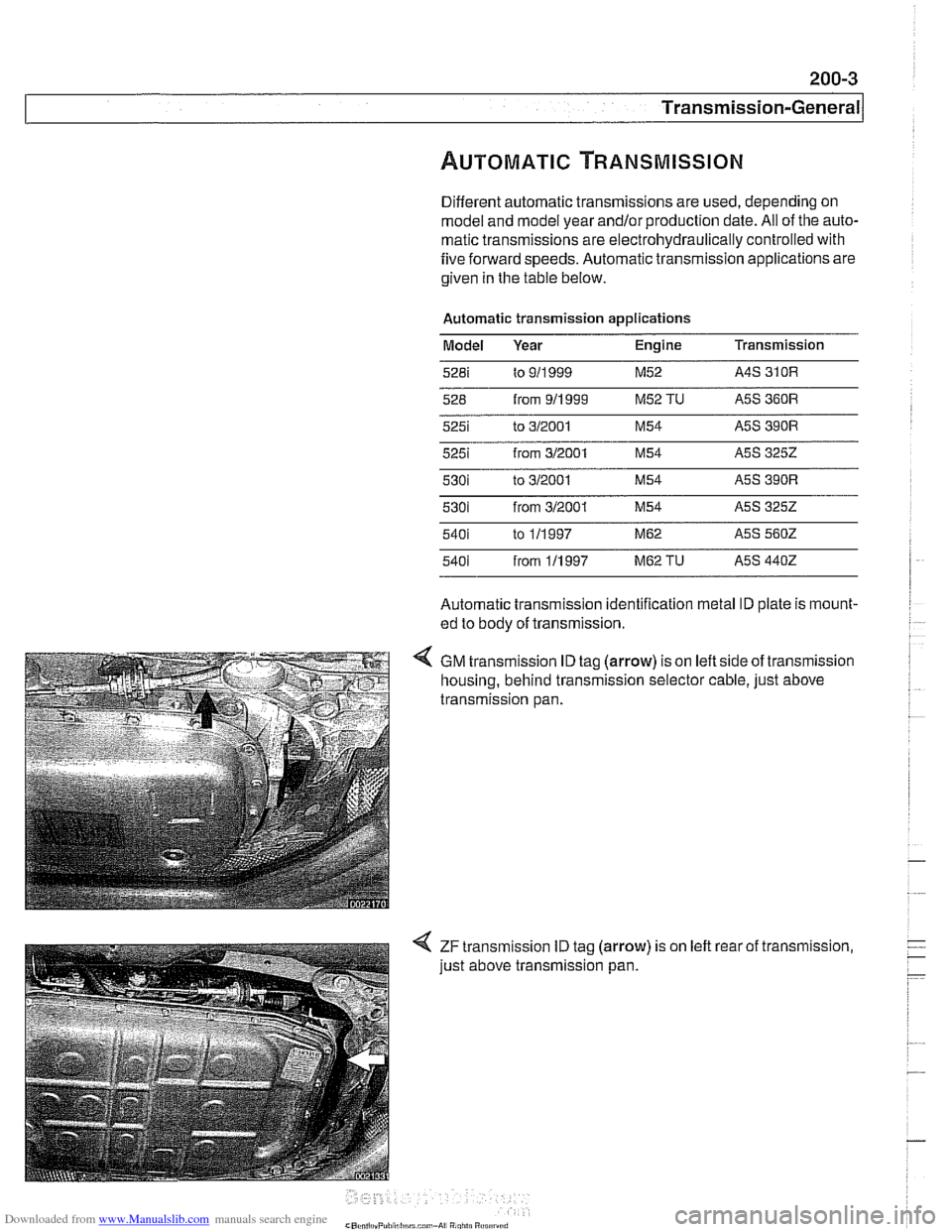
Automatic transmission identification metal ID plate is mount-
ed to body of transmission.
4 GM transmission ID tag (arrow) is on left side of transmission
housing, behind transmission selector cable, just above
transmission pan.
< ZF transmission ID tag (arrow) is on left rear of transmission,
just above transmission pan.
Page 569 of 1002
Downloaded from www.Manualslib.com manuals search engine
230-5
Manual Transmission
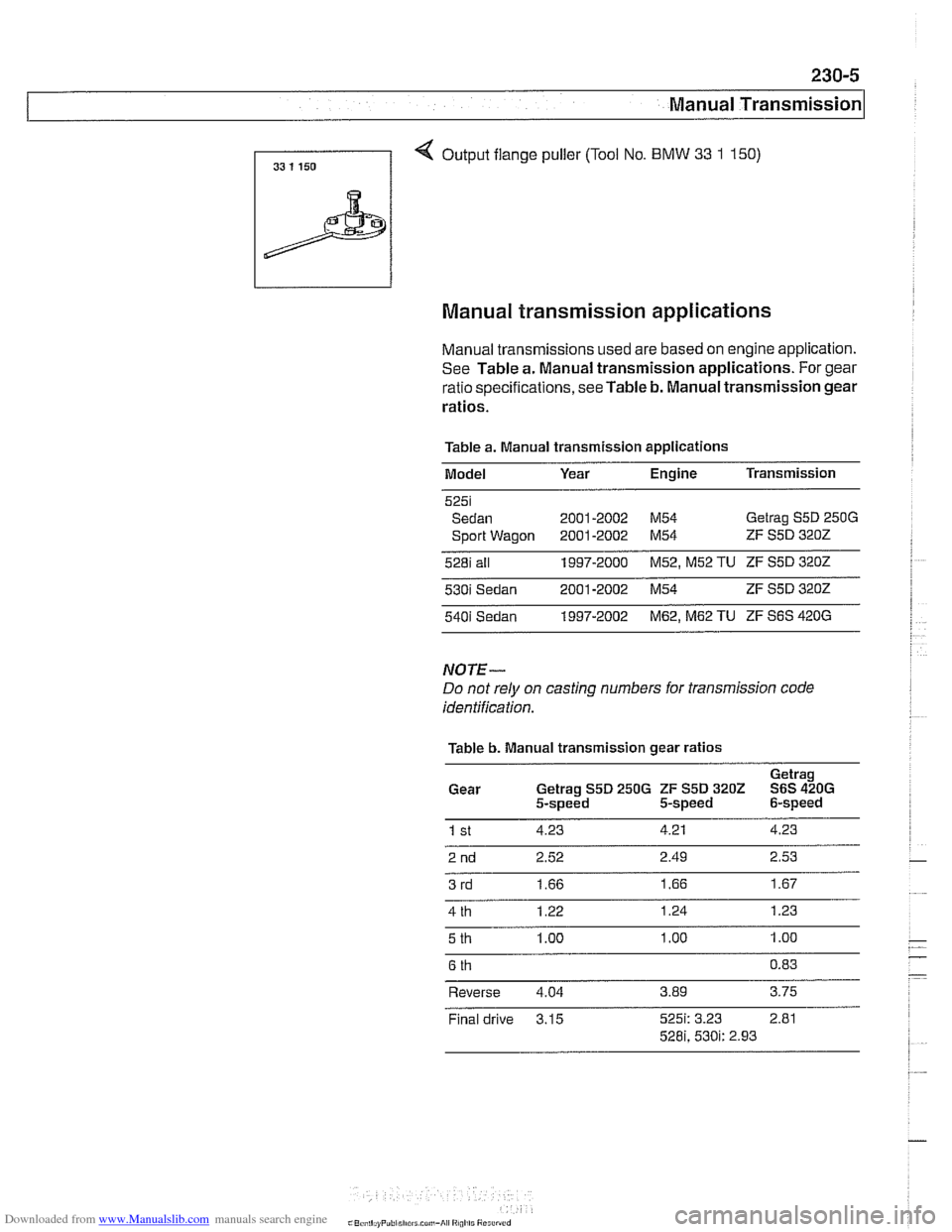
Manual transmission applications
Manual transmissions used are based on engine application.
See Table a. Manual transmission applications. For gear
ratio specifications,
seeTable b. Manual transmission gear
ratios.
Table a. Manual transmission applications
Model Year Engine Transmission
5251
Sedan 2001 -2002 M54 Getrag S5D 250G
Sport Wagon 2001-2002
M54 ZF S5D 3202
5281 all 1997-2000 M52, M52 TU ZF S5D 3202
530i Sedan 2001
-2002 M54 ZF
S5D 3202
540i Sedan
1997-2002 M62, M62 TU ZF S6S 420G
NOTE-
Do not rely on casting numbers for transmission code
identification.
Table b. Manual transmission gear ratios
-
Getrag Gear Getrag S5D 250G ZF S5D 3202 S6S 420G 5-speed 5-speed 6-speed
6 th 0.83
Reverse 4.04 3.89 3.75
Final drive 3.15
523: 3.23 2.81
5281 530i: 2.93
Page 588 of 1002
Downloaded from www.Manualslib.com manuals search engine
Automatic Transmission
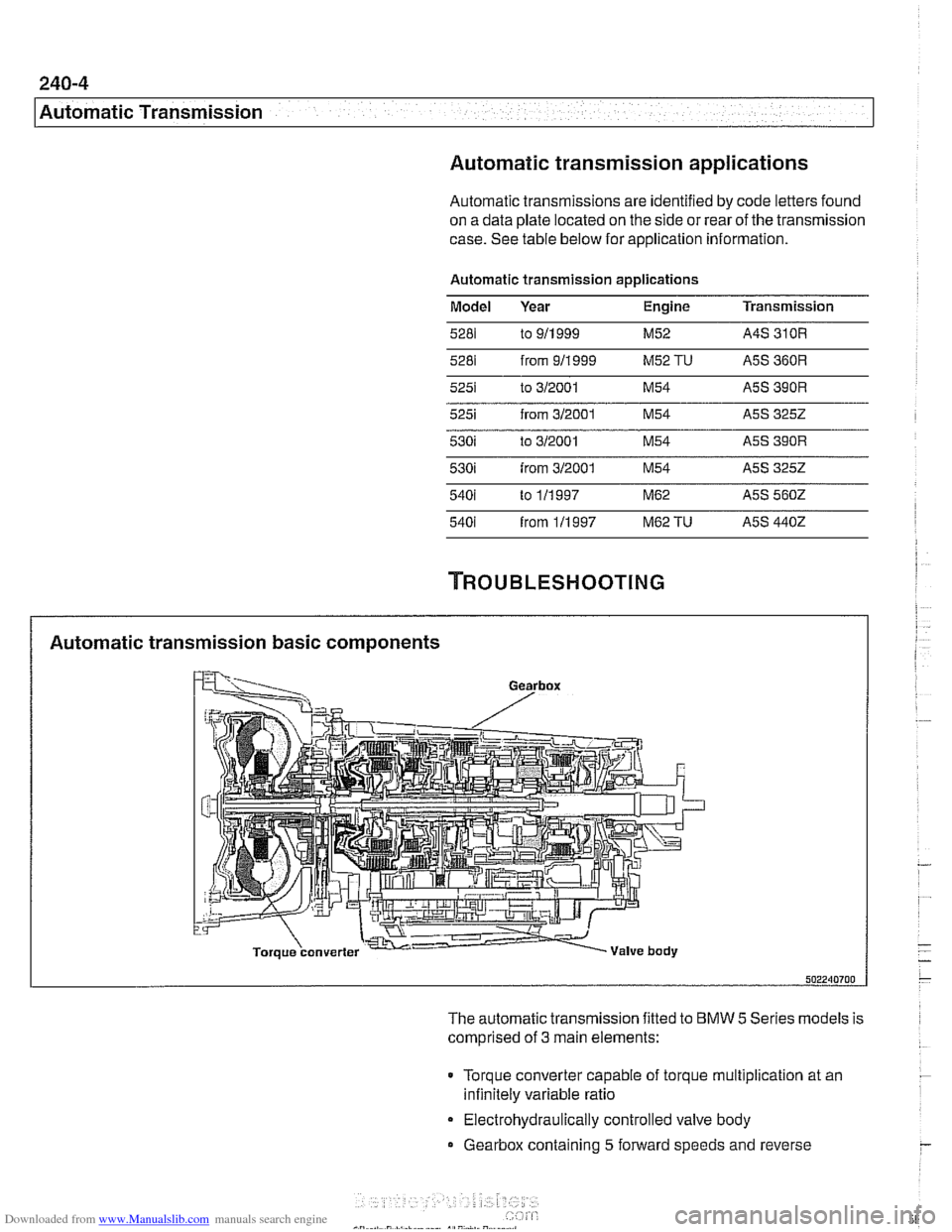
Automatic transmission applications
Automatic transmissions are identified by code letters found
on a data plate located on the side or rear of the transmission
case. See table below for application information.
Automatic transmission applications
Model Year Engine Transmission
5281 to 911999 M52 A4S 310R
5281 from 911999
M52 TU A5S 360R
5251 to 312001 M54 A5S 390R
5251 from 312001 M54 ASS 3252
530i to 312001 M54
ASS 390R
530i from 312001 M54
A5S 3252
540i from 111997 M62
TU A5S 4402
Automatic transmission basic components
The automatic transmission fitted to BMW 5 Series models is
comprised of
3 main elements:
0 Torque converter capable of torque multiplication at an
infinitely variable ratio
Electrohydraulically controlled valve body
0 Gearbox containing 5 forward speeds and reverse
Page 798 of 1002
Downloaded from www.Manualslib.com manuals search engine
400-4
I Bodv-General
Bumpers
The front and rear bumpers are clad in high quality
deform-
able plastic and, at solid barrier impact speeds of 4 kph (2.5
mph), provide protection with virtually no damage to the
bumper
orthe vehicle. In addition to hydraulic dampeners.
which absorb the initial impact energy, these bumpers are
backed by compressible tubes. These deform in a controlled
manner at impact speeds greaterthan that
forwhich bumpers
and hydraulic dampeners are designed. This helps avoid ex-
pensive damage to the body at impact speeds up to 14 kph (9
mph).
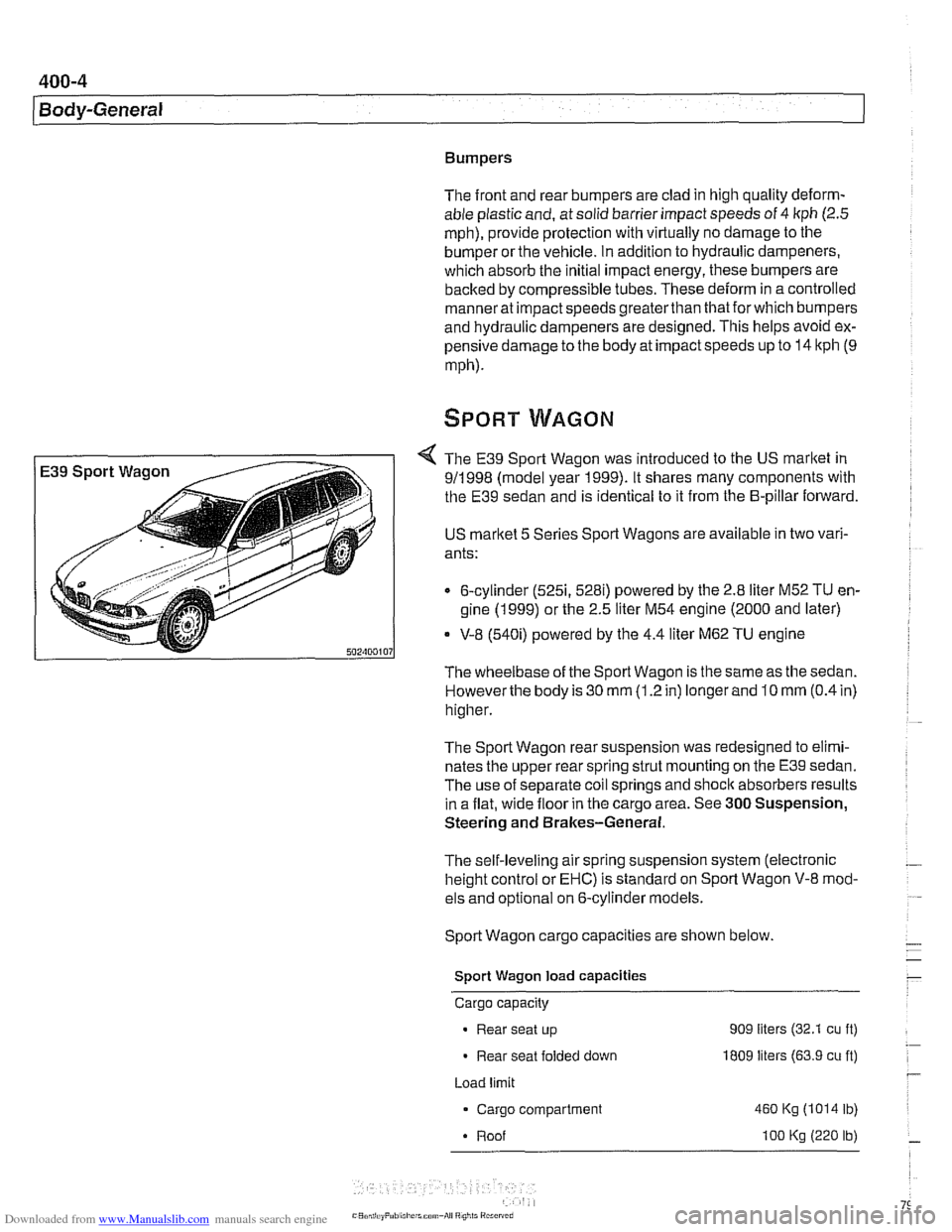
The E39 Sport Wagon was introduced to the US market in
911 998 (model year 1999). It shares many components with
the E39 sedan and is identical to it from the B-pillar forward.
US
marltet 5 Series Sport Wagons are available in two vari-
ants:
6-cylinder
(5251, 528i) powered by the 2.8 liter M52 TU en-
gine (1 999) or the 2.5 liter M54 engine (2000 and later)
* V-8 (540i) powered by the 4.4 liter M62 TU engine
The wheelbase of the Sport Wagon is the same as the sedan.
Howeverthe body is 30
mm (1.2 in) longer and 10 mm (0.4 in)
higher.
The Sport Wagon rear suspension was redesigned to elimi-
nates the upper rear spring strut mounting on the E39 sedan.
The use of separate coil springs and
shoclc absorbers results
in a flat, wide floor in the cargo area. See
300 Suspension,
Steering and Brakes-General.
The self-leveling air spring suspension system (electronic
height control or EHC) is standard on Sport Wagon V-8 mod-
els and optional on 6-cylinder models.
Sport Wagon cargo capacities are shown below.
Sport Wagon load capacities
Cargo capacity
Rear seat up 909 liters (32.1 cu ft)
Rear seat folded down I809 liters (63.9 cu ft)
Load limit
Cargo compartment
460 Kg (1014 lb)
Roof
I00 Kg (220 lb)
Page 961 of 1002
Downloaded from www.Manualslib.com manuals search engine
OBD On-Board Diagnostics
I I
General ........................... OBD-1 Diaqnostic Trouble Codes (DTCs) . . OBD-9
On-Board Diagnostics (OBD I!) ..... OBD-I
Malfunction Indicator Light (MIL)
........ OBD-2
Scan tools and scan tool display.
........ OBD-3
Diagnostic monitors
.................. OED-4
Drive cycle
......................... OED-6
Readiness codes
.................... OBD-6
Diagnostic trouble codes
(DTCs) ........ OBD-7
-
Automatic transmission diagnostic
trouble codes
....................... OBD-9
Engine diagnostic trouble
codes: M52 engine.
................. OED-13
Engine diagnostic trouble
codes: M54 engine.
................. OBD-17
Engine diagnostic trouble
codes: M62 engine.
................. OBD-24
This chapter outlines the fundamentals and equipment
requirements of On-Board Diagnostics
I1 (OBD 11) standards
as they apply to BMW vehicles. Also covered here is a listing
of BMW and OBD
I1 diagnostic trouble codes (DTCs).
ON-BOARD DIAGNOSTICS (QBD !I)
OBD II standards were developed by the SAE (Society of
Automotive Engineers) and CARB (California Air Resources
Board).
OED I1 is the second generation of on-board self-
diagnostic equipment requirements. These standards were
originally mandated for California vehicles. Since
1996 they
have been applied
toall passengervehicles sold in the United
States.
On-board diagnostic capabilities are incorporated into the
hardware and soflwareof the enginecontrol module
(ECM) to
monitor virtually every component that can affect vehicle
emissions. The
OED I1 system works to ensure that
emissions remain as clean as possible over the life of the
vehicle.
Each emission-influencing component is checked by a
diagnostic routine (called a monitor) to verify that it is
functioning properly.
If a problem or malfunction is detected,
the
diagnostic executive built into the OBD I1 system
illuminates a malfunction indicator light (MIL) on the
instrument panel.
The OBD
I1 system also stores diagnostic trouble codes
(DTCs) about the detected malfunction in the ECM so that a
repair technician can accurately find and fix the problem.