Aid BMW 540i 1999 E39 Workshop Manual
[x] Cancel search | Manufacturer: BMW, Model Year: 1999, Model line: 540i, Model: BMW 540i 1999 E39Pages: 1002
Page 75 of 1002
Downloaded from www.Manualslib.com manuals search engine
110-3
Engine Removal and lnstallationl
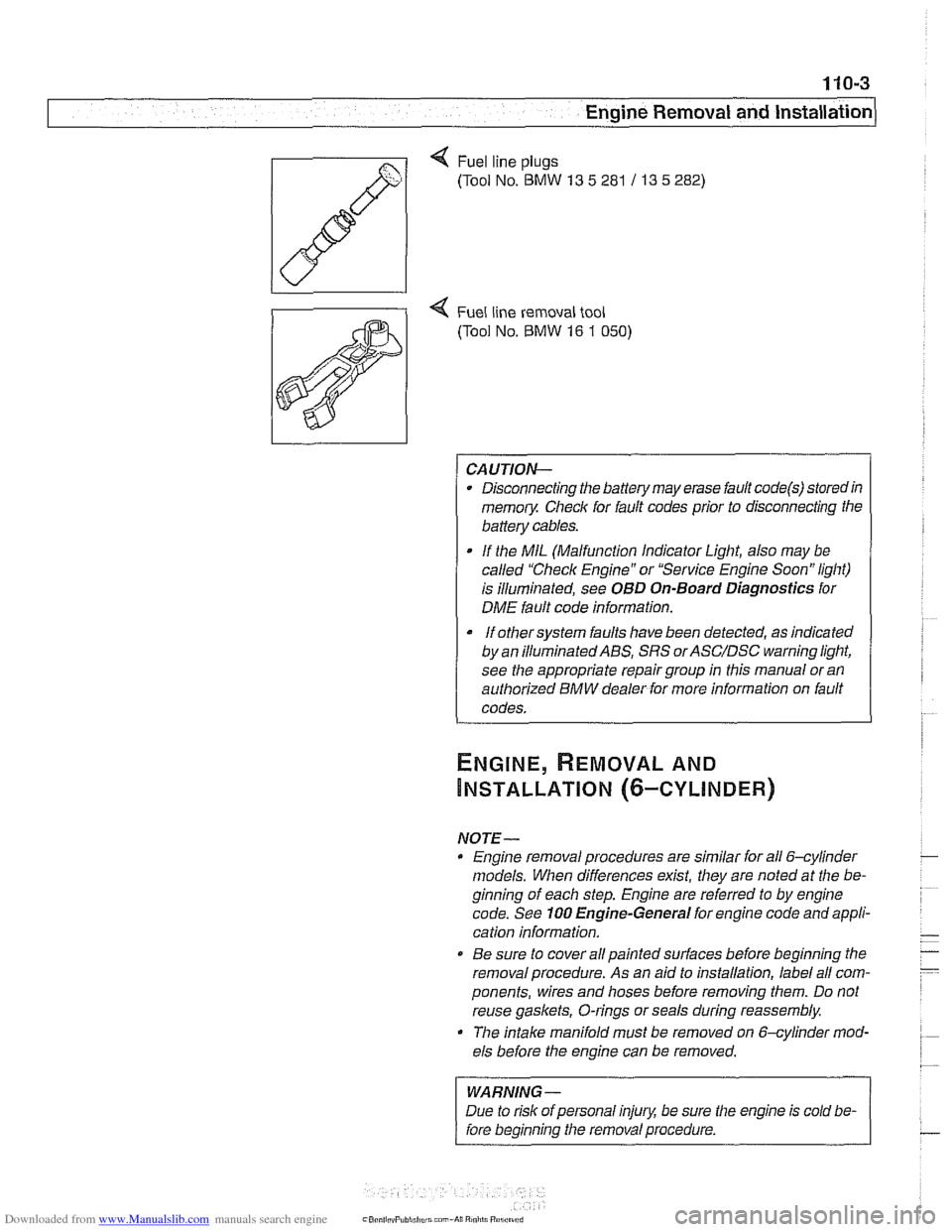
Q Fuel line plugs
(Tool No.
BMW 13 5 281 / 13 5 282)
4 Fuel line removal tool
(Tool No.
BMW 16 1 050)
CAUTION-
Disconnecting the battery may erase fault code@) storedin
memoiy Check for fault codes prior to disconnecting the
battery cables.
If the MIL (Malfunction Indicator Light, also may be
called "Check Engine" or "Service Engine Soon" light)
is illuminated, see
OBD On-Board Diagnostics for
DME fault code information.
It orhersysrem faults have been detected, as indicated I
by an ~llum~nated ABS, SRS orASC/DSC ~arning light,
see the appropriate repair group in this manual or an
authorized BMW dealer for more information on fault
codes.
NOTE- Engine removal procedures are similar for all 6-cylinder
models. When differences
exist, they are noted at the be-
ginning of each step. Engine are referred to by engine
code. See
100 Engine-General for engine code and appli-
cation information.
@ Be sure to cover all painted surfaces before beginning the
removal procedure. As an aid to installation, label all com-
ponents, wires and hoses before removing them. Do not
reuse
gaskets, O-rings or seals during reassembly.
The
intake manifold must be removed on &cylinder mod-
els before the engine can be removed.
WARNING-
Due to risk of personal injury, be sure the engine is cold be-
fore beginning the removal procedure.
Page 88 of 1002
Downloaded from www.Manualslib.com manuals search engine
110-16
Engine Removal and Installation
ENGINE, REMOVAL AND
INSTALLATION (V-8 MODELS)
NOTE-
Engine removal procedures are similar for all V-8 models.
When differences exist, they are noted at the beginning of
each step. Engine are referred to by engine code. If neces-
sary, See
100 Engine-General for engine code andappli-
cation information.
Be sure to cover all painted surfaces before beginning the
removal procedure. As an aid to installation, label all com-
ponents, wires and hoses before removing them. Do not
reuse gaskets, O-rings or seals during reassembly
WARNING
-
Due to risk ofpersonal injury, be sure the engine is cold be-
fore beginning the
removal procedure.
- Disconnect negative (-) cable from battery.
Prior to disconnecting the battery, read the battery discon-
nection cautions given in
001 General Cautions and
Warnings.
- Remove engine hood or place hood in service position. See
410 Fenders, Engine Hood.
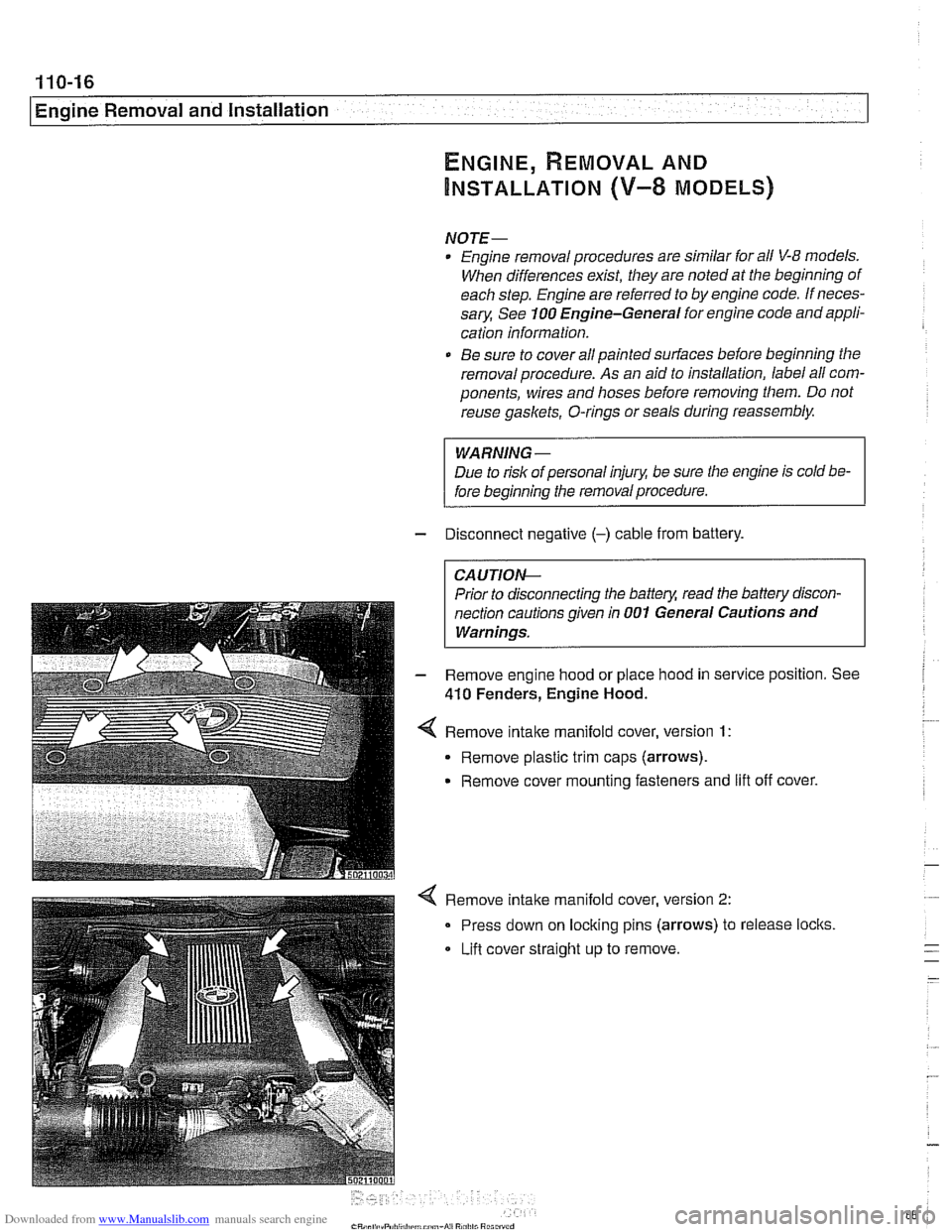
Remove
intake manifold cover, version 1:
Remove plastic trim caps (arrows).
Remove cover mounting fasteners and
lift off cover.
Remove intake manifold cover, version
2:
Press down on locking pins (arrows) to release locks
Lifl cover straight
up to remove.
Page 232 of 1002
Downloaded from www.Manualslib.com manuals search engine
1 16-56
Cylinder Head and Valvetrain
This section covers valve removal and reconditioning, includ-
ing valve guides, seats, springs, and valve stem oil seals.
Valves, leak test
To test the valves for leakage, the cylinder head must be dis-
assembled with camshafts and camshaft carriers removed.
With valve assemblies and spark plugs installed, place the
cylinder head on a workbench with the combustion chamber
facing upward. Fill each combustion chamber with a thin non-
flammable liquid. After fifteen minutes,
check the level of the
fluid. If the fluid level in any cylinder drops, that cylinder is not
sealing properly.
Valves, removing and installing
- Remove cylinder head as described in 113 Cylinder Head
Removal and Installation.
CAUTIOI\C
(M52 TU/M54 engines only) Do not let the hydraulic lifters
fall out as the camshaft carrier is removed. Special suction
cups are available from
BMW to hold the hydraulic lifters in
place during carrier removal.
* Hydraulic cam lifters should be stored m an uprfght po-
sition. If necessary, use a magnetic tool to
aidin remov-
al of the lifters.
- Remove valves using a valve spring compressor.
CAUTIOI\C
Label each valve assembly as it is removed so it can be in-
stalled in its original position.
-
- Remove and discard valve stem oil seals from valve guides.
See Valve stem oil seals later in this section.
- Valve installation is reverse of removal. Remove carbon de- - -
posits from the valves using a wire brush or wire wheel. -
-
Valve specifications are listed in Table c. Valve specifica-
tions.
Page 313 of 1002
Downloaded from www.Manualslib.com manuals search engine
Camshaft Timing Chain
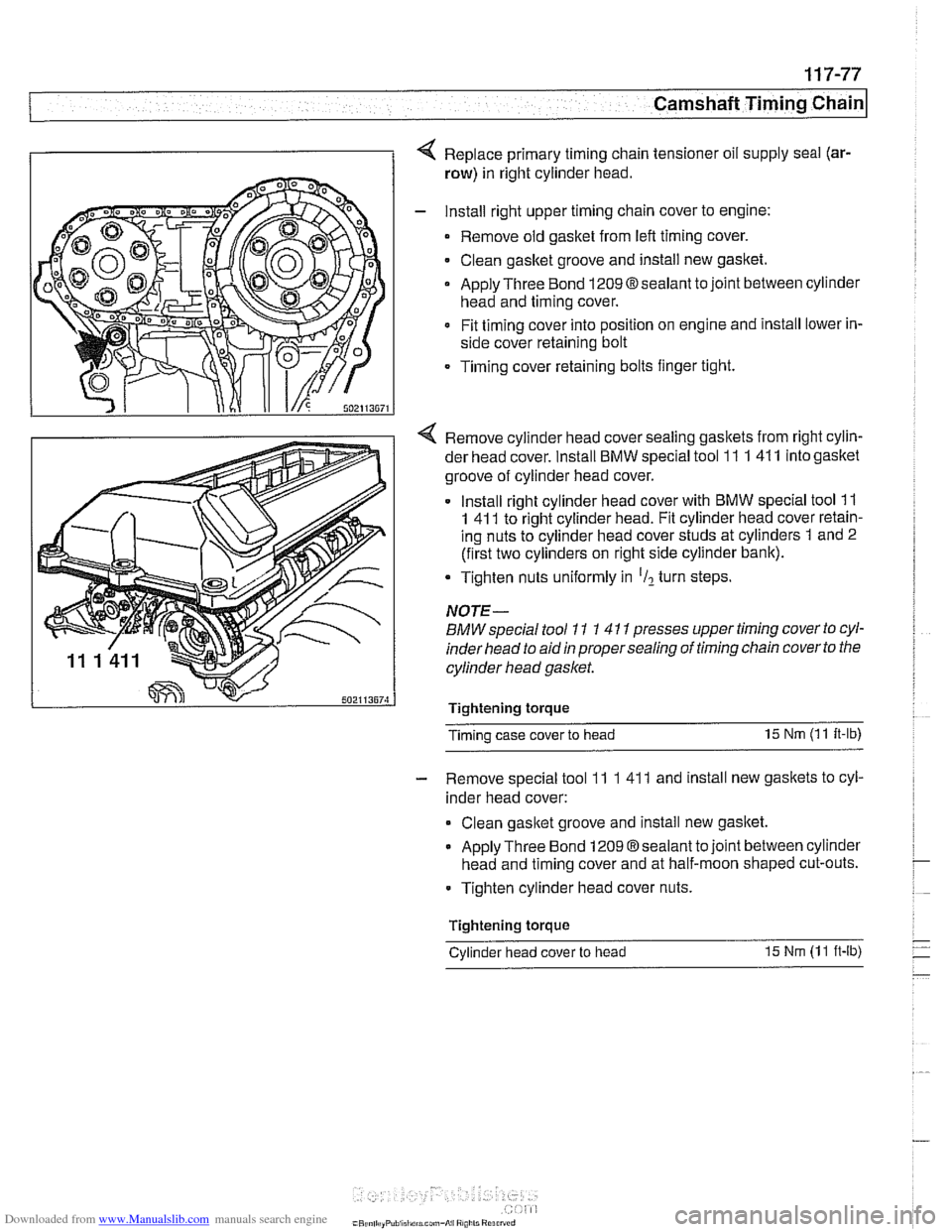
4 Replace primary timing chain tensioner oil supply seal (ar-
row) in right cylinder head.
- Install right upper timing chain cover to engine:
Remove old gasket from
left timing cover.
Clean gasket groove and install new gasket.
Apply Three Bond
1209Osealant to joint between cylinder
head and timing cover.
Fit timing cover into position on engine and install lower in-
side cover retaining bolt
Timing cover retaining bolts finger tight.
4 Remove cylinder head cover sealing gaskets from right cylin-
der head cover. Install
BMW special tool 11 1 41 1 into gasltet
groove of cylinder head cover.
Install right cylinder head cover with
BMW special tool 11
1 41 1 to right cylinder head. Fit cylinder head cover retain-
ing nuts to cylinder head cover studs at cylinders 1 and 2
(first two cylinders on right side cylinder bank).
Tighten nuts uniformly in
'Il turn steps.
NOTE-
BMW special tool 11 1 4 11 presses upper timing cover to cyl-
inder head to aid
in proper sealing of timing chain cover to the
cylinder head gasket.
Tightenlng torque
Timing case cover to head 15
Nm (1 1
It-lb)
- Remove special tool 11 1 41 1 and install new gaskets to cyl-
inder head cover:
Clean gasltet groove and install new gasltet.
Apply Three Bond 1209 Osealant to joint between cylinder
head and timing cover and at half-moon shaped cut-outs.
Tighten cylinder head cover nuts.
Tightenlng torque
-
Cylinder head cover to head 15 Nm (1 1 ft-lb)
Page 575 of 1002
Downloaded from www.Manualslib.com manuals search engine
230-1 1
Manual ~ransmissionl
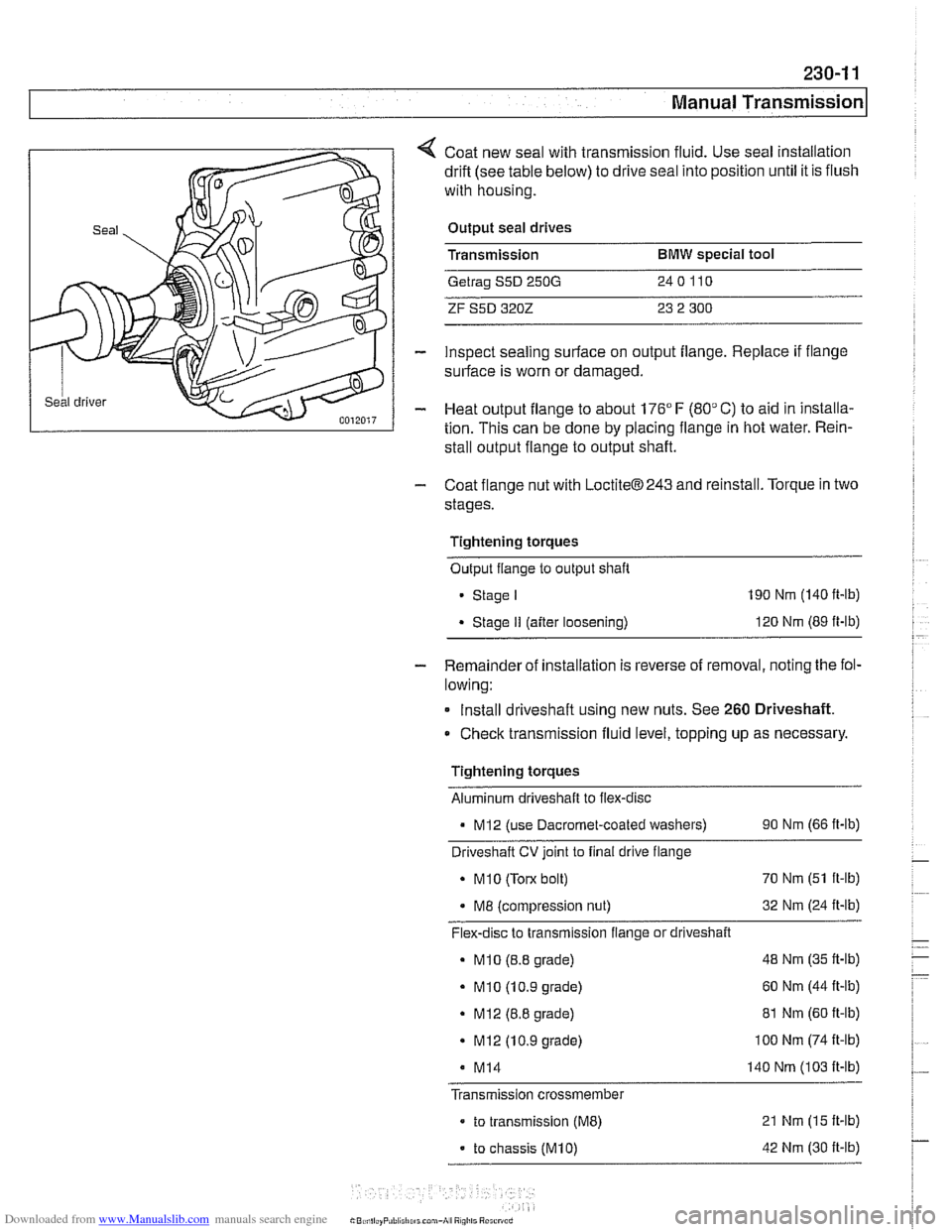
Coat new seal with transmission fluid. Use seal installation
drift (see table below) to drive seal into position until it is flush
with housing.
Output seal drives
Transmission
BMW special tool
Getrag S5D 250G 240110
ZF S5D 3202 23 2 300
inspect sealing surface on output flange. Replace if flange
surface is worn or damaged.
Heat output flange to about 176"
F (80" C) to aid in installa-
tion. This can be done by placing flange in hot water. Rein-
stall output flange to output shaft.
- Coat flange nut with LoctiteB243 and reinstall. Torque in two
stages.
Tightening torques Output flange to output shaft
Stage I 190 Nm (140 ft-lb)
Stage II (after loosening) 120
Nm (89 ft-lb)
- Remainder of installation is reverse of removal, noting the fol-
lowing:
Install driveshaft using new nuts. See
260 Driveshaft.
Check transmission fluid level, topping up as necessary
Tightening torques Aluminum driveshaft to flex-disc
- MI2 (use Dacromet-coated washers) 90 Nm (66 ft-lb)
Driveshaft
CV joint to final drive flange
. MI0 (Torx bolt) 70
Nm (51 ft-lb)
. M8 (compression nut) 32
Nm (24 ft-lb)
Flex-disc to transmission flange or driveshaft
- MI0 (8.8 grade) 48
Nm (35 ft-lb)
- MI0 (10.9 grade) 60
Nm (44 It-lb)
. MI2 (8.8 grade) 81 Nm (60 ft-lb)
. MI2 (10.9 grade) I00 Nm (74 It-lb)
M14 140 Nm (103 It-lb)
Transmission crossmember
- to transmission (ME) 21 Nm (15 It-lb)
- to chassis (M10) 42 Nm (30 It-lb)
Page 797 of 1002
Downloaded from www.Manualslib.com manuals search engine
Body shell
Exterior and aerodynamics
Crash behavlor -frontal impact
-side impact
Body
-rear impact Structural body components -rigidity
-rollover -strength -vibrations -acoustics
Bumpers compartment lid -bendable Seets,.steerlng system .dents -vibrations bars -vibration patterns
Fenders -aerodvnamic
With its traditional styling features, such as the ltidney grille.
circular headlights behind a glass cover (for reasons of
streamlining), and the
"kiclt" in the rear most roof pillar (C-pil-
lar), the E39 can be immediately recognized as a BMW.
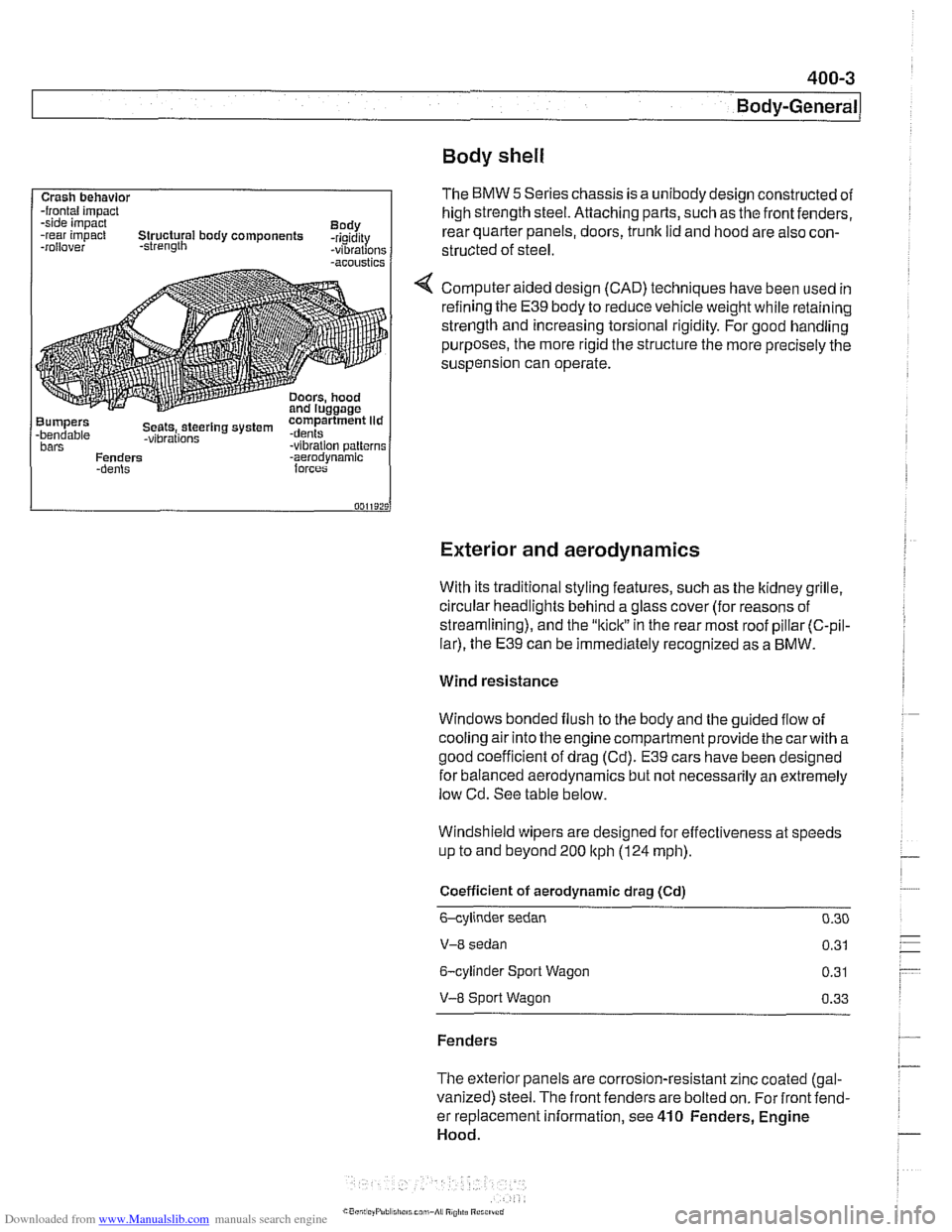
The BMW 5 Series chassis is a unibody design constructed of
high strength steel. Attaching parts, such as the front fenders,
rear quarter panels, doors,
trunk lid and hood are also con-
structed of
steel.
Computer aided design (CAD) techniques have been used in
refining the
E39 body to reduce vehicle weight while retaining
strength and increasing torsional rigidity. For good handling
purposes, the more rigid the structure the more precisely the
suspension can operate.
Wind resistance
Windows bonded flush to the body and the guided flow of
cooling air into the engine compartment provide the
carwith a
good coefficient of drag (Cd).
E39 cars have been designed
for balanced aerodynamics but not necessarily an extremely
low Cd. See table below.
Windshield wipers are designed for effectiveness at speeds
up to and beyond 200
ltph (124 mph).
Coefficient of aerodynamic drag (Cd)
6-cylinder sedan 0.30
V-8 sedan 0.31
6-cylinder Sport Wagon 0.31
V-8 Sport Wagon 0.33
Fenders
The exterior panels are corrosion-resistant zinc coated (gal-
vanized) steel. The front fenders are bolted on. For front fend-
er replacement information, see
410 Fenders, Engine
Hood.