ground BMW 540i 2000 E39 Owners Manual
[x] Cancel search | Manufacturer: BMW, Model Year: 2000, Model line: 540i, Model: BMW 540i 2000 E39Pages: 1002
Page 634 of 1002
Downloaded from www.Manualslib.com manuals search engine
300-1 4
I Susoension. Steerina and Brakes - General
DSC system I
Dynamic Stability Control (DSC)
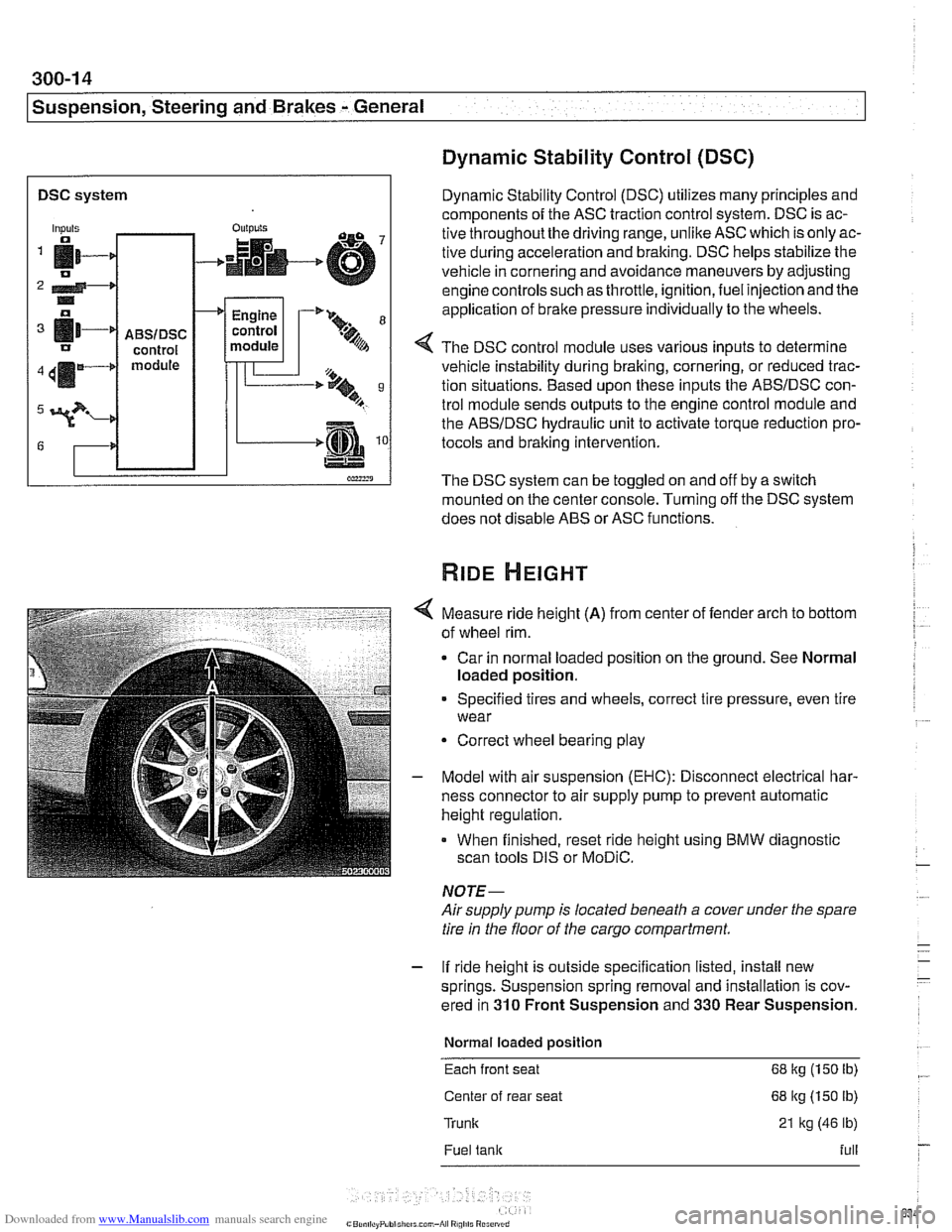
Dynamic Stability Control (DSC) utilizes many principles and
components of the ASC traction control system. DSC is ac-
tive throughoutthe driving range, unlike ASC which is only ac-
tive during acceleration and braking. DSC helps stabilize the
vehicle in cornering and avoidance maneuvers by adjusting
engine controls such as throttle, ignition, fuel injection and the
application of
brake pressure individually to the wheels.
Inputs
fi- 0
2 4-* .. o
[11-' IJ
411m4
3?-
G
4 The DSC control module uses various inputs to determine
vehicle instability during braking, cornering, or reduced trac-
tion situations. Based upon these inputs the ABSIDSC con-
trol module sends outputs to the engine control module and
the ABSIDSC hydraulic unit to activate torque reduction pro-
tocols and braking intervention.
-
ABSIDSC control module
OUI~YIS
4
The DSC system can be toggled on and off by a switch
mounted on the center console. Turning off the DSC system
does not disable ABS or ASC functions.
+
Measure ride height (A) from center of fender arch to bottom
of wheel rim.
Car in normal loaded position on the ground. See Normal
loaded position.
Engine
control
module
Specified tires and wheels, correct tire pressure, even tire
wear
-'* 9-
.%A
Correct wheel bearing play
T'== ..t, 9 B
-.m
Model with air suspension (EHC): Disconnect electrical har-
ness connector to air supply pump to prevent automatic
height regulation.
When finished, reset ride height using BMW diagnostic
scan tools DIS or
MoDiC.
NOTE-
Airsupply pump is located beneath a cover under the spare
tire in the floor of the cargo compartment.
- If ride height is outside specification listed, install new
springs. Suspension spring removal and installation is cov-
ered in
310 Front Suspension and 330 Rear Suspension.
Normal loaded position
Each front seat 68 kg (150 Ib)
Center of rear seat 68 kg (150 lb)
Trunk 21 kg (46 lb)
Fuel tank full
Page 649 of 1002
Downloaded from www.Manualslib.com manuals search engine
Front Suspension
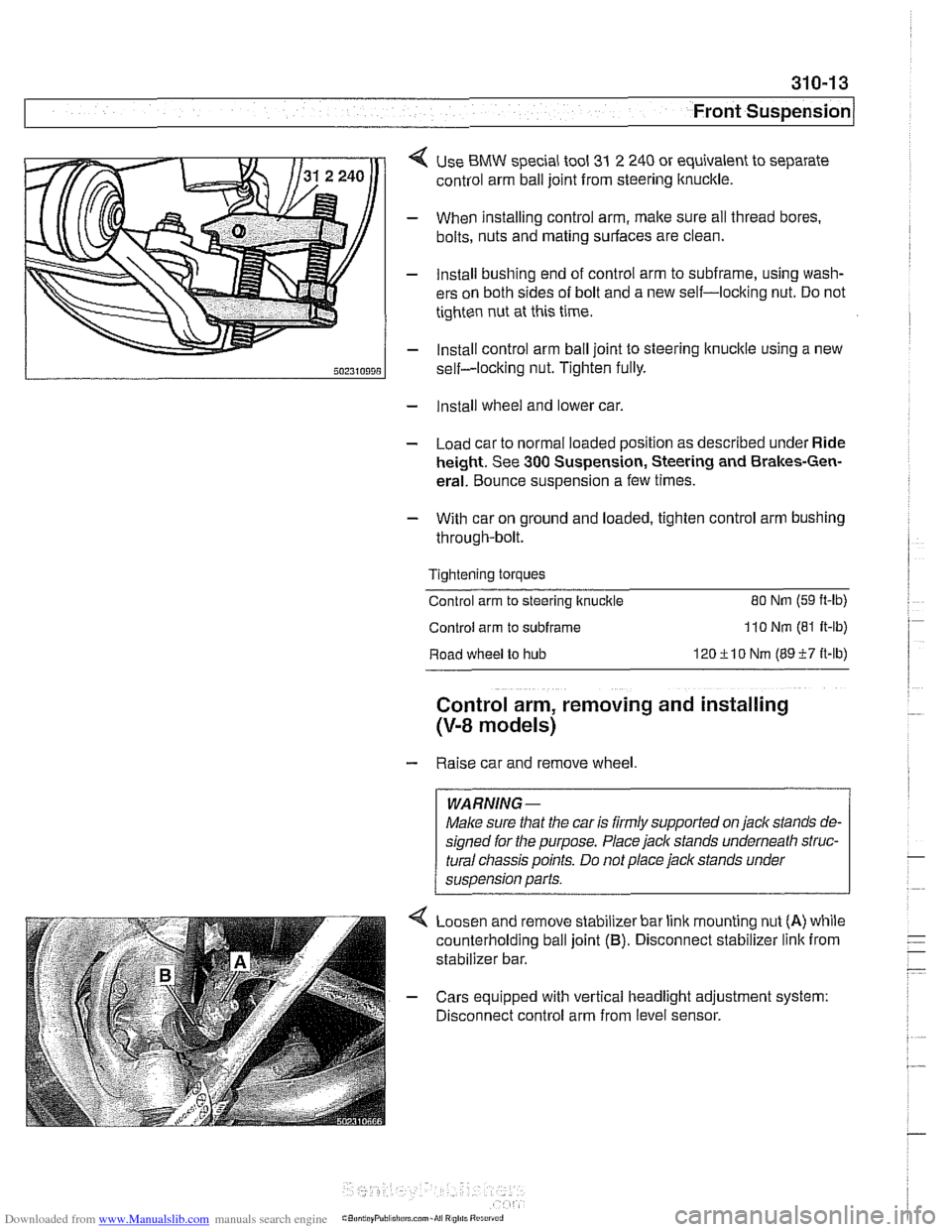
< Use BMW special tool 31 2 240 or equivalent to separate
control arm ball joint from steering ltnuckle.
- When installing control arm, make sure all thread bores.
bolts, nuts and mating surfaces are clean.
- Install bushing end of control arm to subframe, using wash-
ers on both sides of bolt and a new self-locking nut. Do not
tighten nut at this time.
- Install control arm ball joint to steering lknucltle using a new
self-locking nut. Tighten fully.
- Install wheel and lower car.
- Load car to normal loaded position as described under Ride
height. See
300 Suspension, Steering and Brakes-Gen-
eral. Bounce suspension a few times.
- With car on ground and loaded, tighten control arm bushing
through-bolt.
Tightening torques
Control arm to steering ltnuckle
80 Nm (59 ft-lb)
Control arm to subframe 110 Nm (81 It-lb)
Road wheel to hub 120ilO Nm (8957 it-lb)
Control arm, removing and installing
(V-8 models)
- Raise car and remove wheel
WARNING-
Make sure that the car is firmly supported on jack stands de-
signed for the purpose. Place jack stands underneath struc-
tural
cliassis points. Do not place jack stands under
suspension parts.
Loosen and remove stabilizer bar link mounting nut
(A) while
counterholding ball joint
(B). Disconnect stabilizer link from
stabilizer bar.
- Cars equipped with vertical headlight adjustment system:
Disconnect control arm from level sensor.
Page 651 of 1002
Downloaded from www.Manualslib.com manuals search engine
310-1 5
Front ~us~ension/
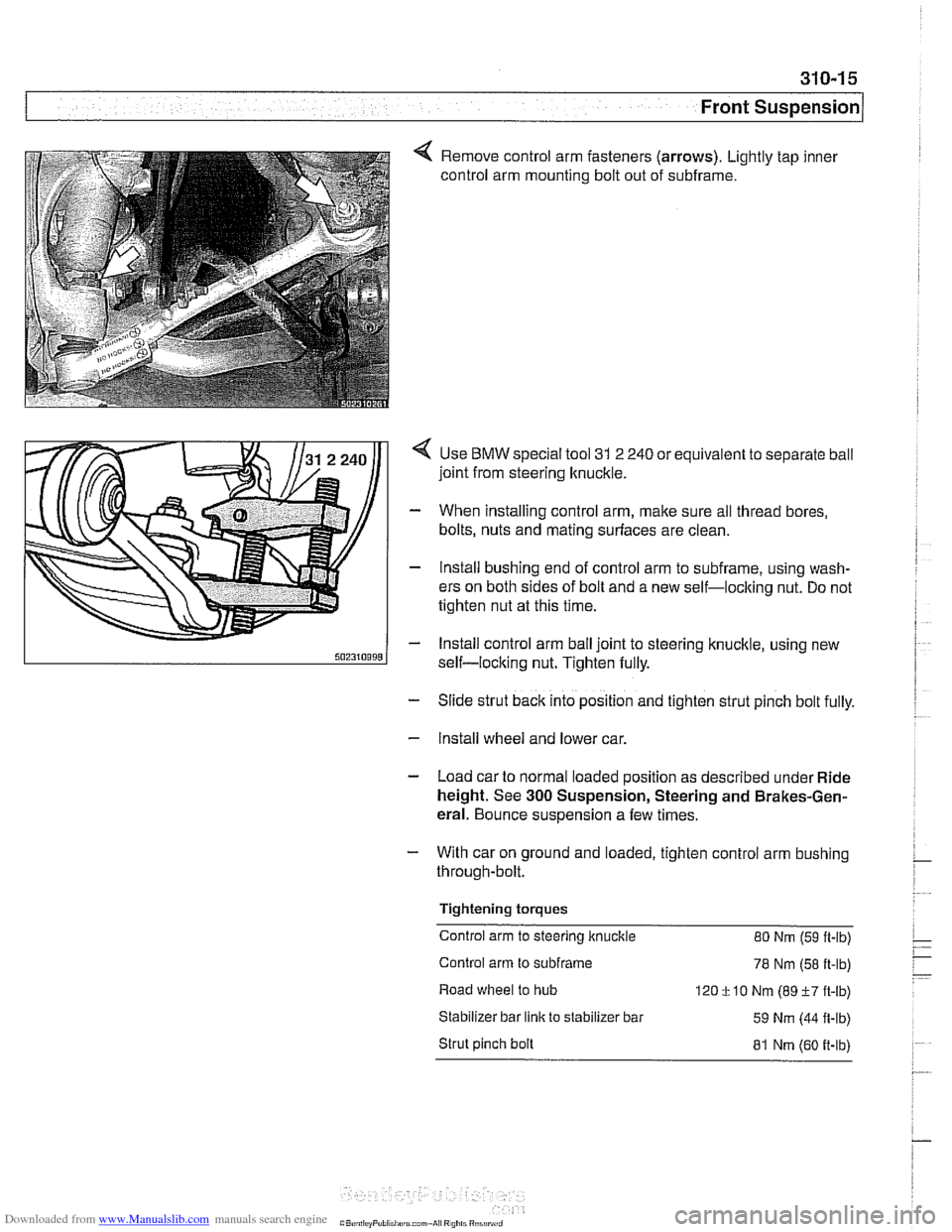
4 Remove control arm fasteners (arrows). Lightly tap inner
control arm mounting bolt out of subframe.
Use
BMW special tool 31 2 240 or equivalent to separate ball
joint from steering knuckle.
When installing control arm, make sure all thread bores,
bolts, nuts and mating surfaces are clean.
lnstall bushing end of control arm to subframe, using wash-
ers on both sides of bolt and a new self-loclting nut. Do not
tighten nut at this time.
lnstall control arm ball joint to steering knuckle, using new
self-locking nut. Tighten fully.
- Slide strut back into position and tighten strut pinch bolt fully.
- Install wheel and lower car.
- Load car to normal loaded position as described under Ride
height. See
300 Suspension, Steering and Brakes-Gen-
eral. Bounce suspension a few times.
- With car on ground and loaded, tighten control arm bushing
through-bolt.
Tightening torques
Control arm to steering knuckle 80 Nm
(59 ft-lb)
Control arm to
subframe 78 Nm (58 ft-lb)
Road wheel to hub
120
f 10 Nm (89 +7 ft-lb)
Stabilizer bar
link to stabilizer bar
59 Nm (44 fl-lb)
Strut pinch bolt
81 Nm (60 it-lb)
Page 653 of 1002
Downloaded from www.Manualslib.com manuals search engine
31 0-1 7
Front ~uspensionl
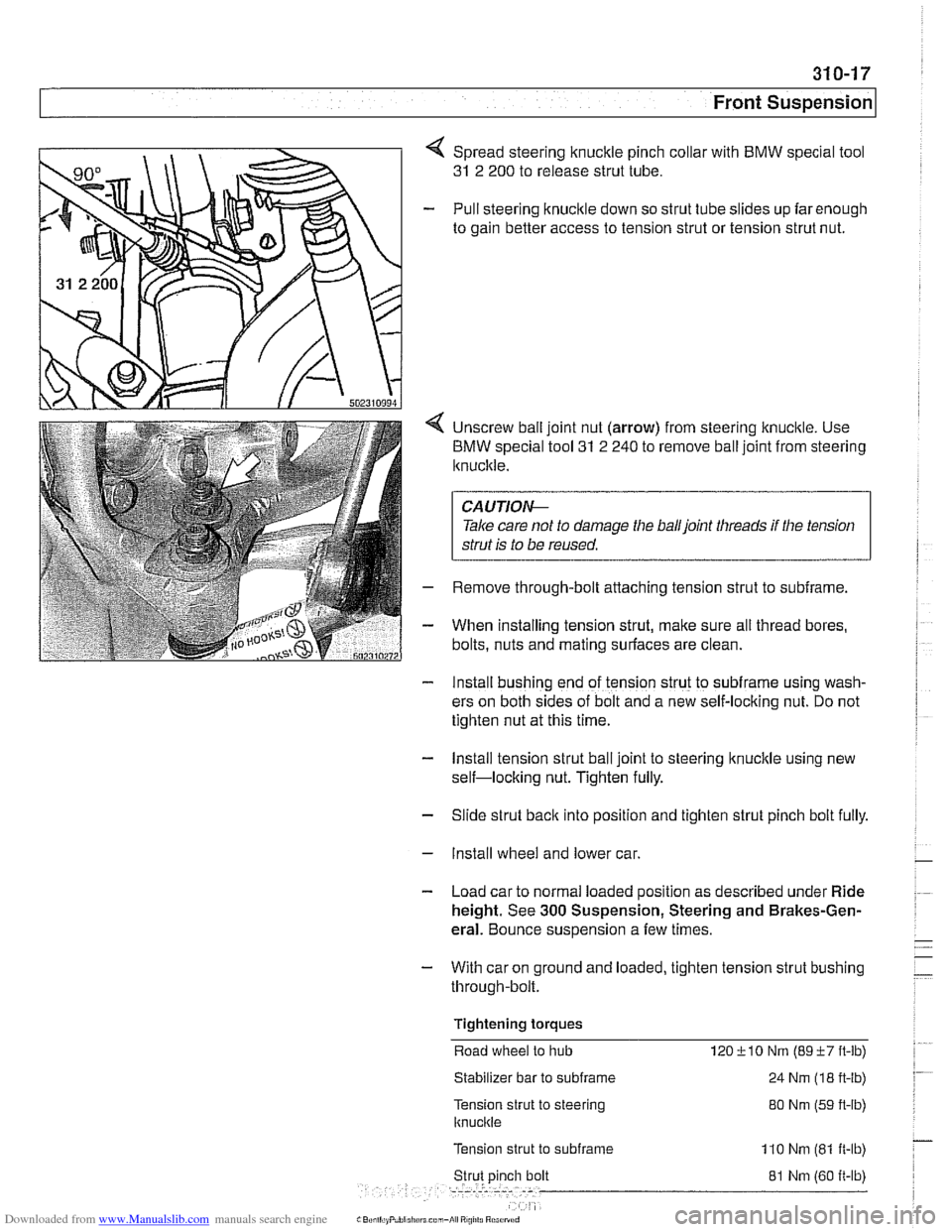
< Spread steering knuckle pinch collar with BMW special tool
31 2 200 to release strut tube.
- Pull steering knuckle down so strut tube slides up farenough
to gain better access to tension strut or tension strut nut.
4 Unscrew ball joint nut (arrow) from steering knuckle. Use
BMW special tool
31 2 240 to remove ball joint from steering
Iknucltle.
CAUTION--
Tale care not to damage the balljoint threads if the tension
strut
is to be reused.
- Remove through-bolt attaching tension strut to subframe.
- When installing tension strut, make sure all thread bores,
bolts, nuts and mating
suriaces are clean.
- Install bushing end of tension strut to subframe using wash-
ers on both sides of bolt and a new self-locking nut. Do not
tighten nut at this time.
- Install tension strut ball joint to steering knuckle using new
self-locking nut. Tighten fully.
- Slide strut back into position and tighten strut pinch bolt fully.
- Install wheel and lower car.
- Load car to normal loaded position as described under Ride
height. See
300 Suspension, Steering and Brakes-Gen-
eral. Bounce suspension a few times.
- With car on ground and loaded, tighten tension strut bushing
through-bolt.
Tightening torques Road
wheel to hub 120-i-10 Nm (89+7ft-lb)
Stabilizer bar to subframe 24 Nm (1 8 ft-lb)
Tension strut to steering
knucltle
80 Nm (59 ft-lb)
Tension strut
to subframe 110 Nm (81 ft-lb)
81 Nm (60 it-lb)
L BcniliiyFlrblrillirn con,-*I R!,illJ Rci,:n>d
Page 654 of 1002
Downloaded from www.Manualslib.com manuals search engine
31 0-1 8
I~ront Suspension Tension strut bushing, replacing
- Raise car and remove wheel.
WARNING-
Make sure that the caris firmly supported on jack stands de-
signed for the purpose. Place jack stands underneath struc-
tural chassis points. Do
not place jack stands under
suspension parts.
- Remove tension strut from car as described earlier.
- Using a service press and appropriate press tools (BMW
special tools 31 2 26112621263 or equivalent), press bushing
out of tension strut.
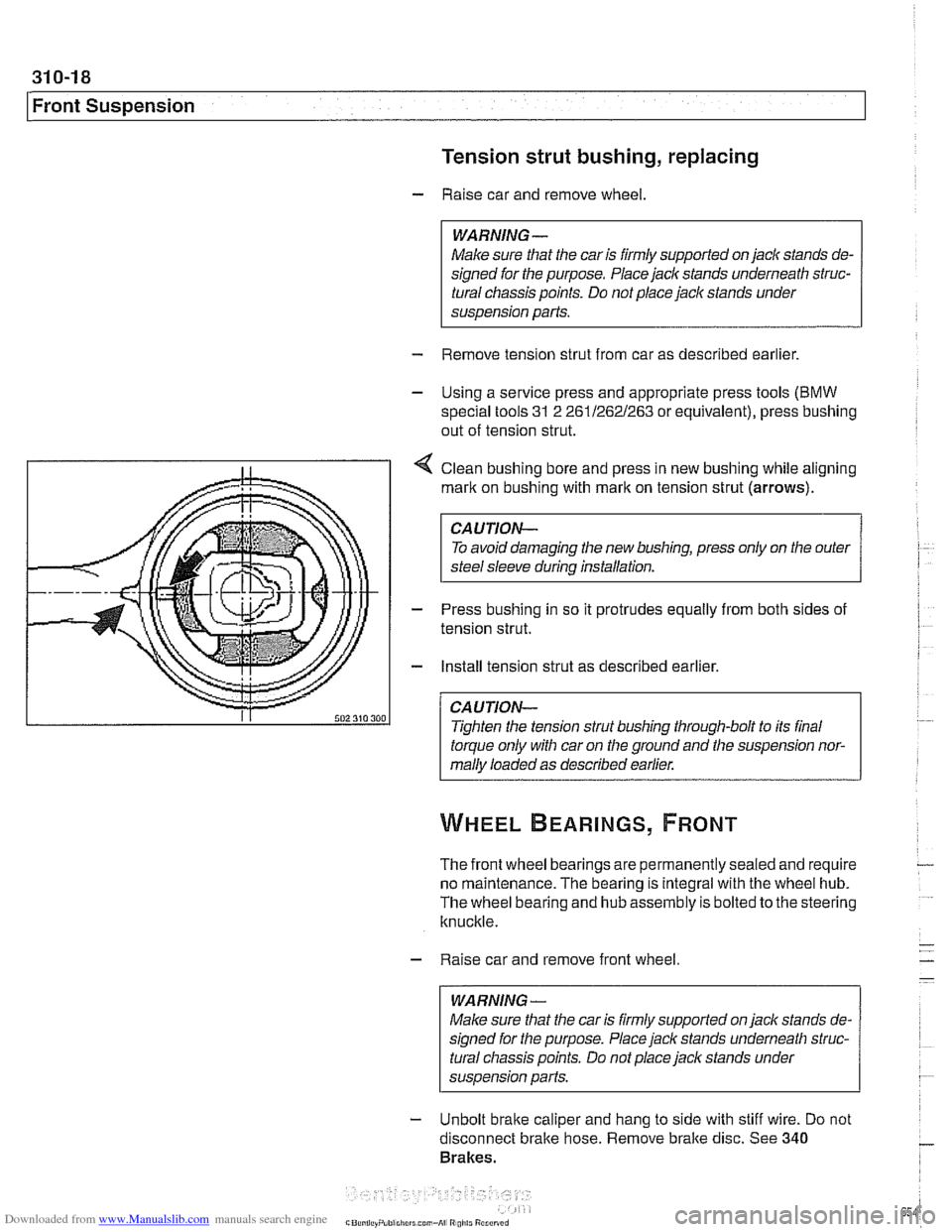
4 Clean bushing bore and press in new bushing while aligning
mark on bushing with
rnarlt on tension strut (arrows).
CAUTION-
To avoid damaging the new bushing, press only on the outer
steel sleeve during installation.
- Press bushing in so it protrudes equally from both sides of
tension strut.
- Install tension strut as described earlier.
CAUTION-
Tighten the tension strut bushing through-bolt to its final
torque only with car on the ground and the suspension nor-
mally loaded as described earlier.
The front wheel bearings are permanently sealed and require
no maintenance. The bearing is integral with the wheel hub.
The wheel bearing and hub assembly is bolted to the steering
knuckle.
- Raise car and remove front wheel
WARNING-
Make sure that the car is firmly supported on jack stands de-
signed for the purpose. Place jack stands underneath struc-
tural chassis points. Do not place
jack stands under
susoension Darts.
- Unbolt brake caliper and hang to side with stiff wire. Do not
disconnect bralte hose. Remove bralte disc. See
340
Brakes.
Page 688 of 1002
Downloaded from www.Manualslib.com manuals search engine
I Steering and Wheel Alignment
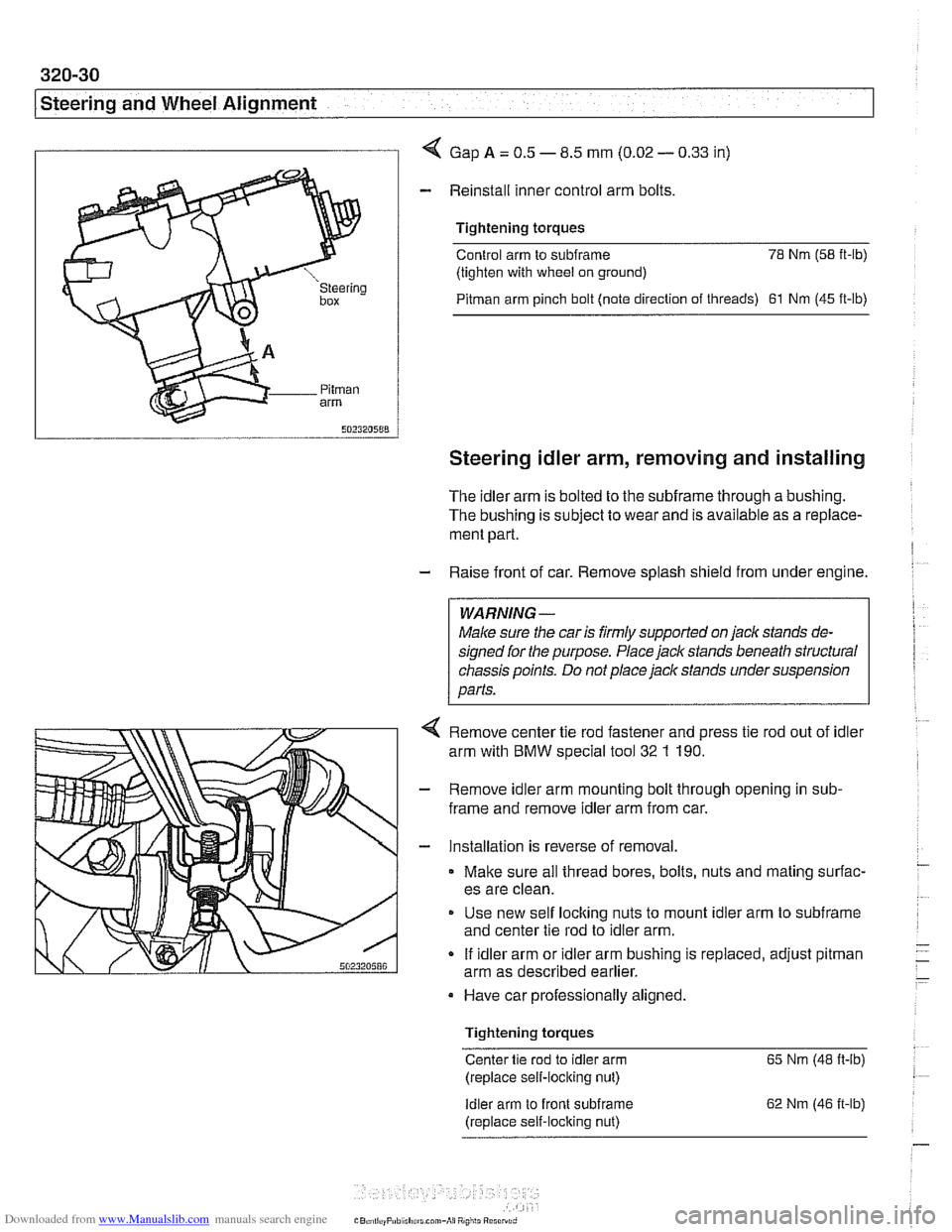
I I 4 Gap A = 0.5 - 8.5 mm (0.02 - 0.33 in)
- Reinstall inner control arm bolts
Tightening torques
Control arm to
subframe 78 Nm (58 it-lb)
(tighten with wheel on ground)
Pitman arm pinch bolt (note direction of threads) 61 Nm (45 ft-lb)
Steering idler arm, removing and installing
The idler arm is bolted to the subframe through a bushing.
The bushing is subject to wear and is available as a replace-
ment part.
- Raise front of car. Remove splash shield from under engine.
WARNING -
Male sure the car is firmly supported on jaclc stands de-
signed for the purpose. Place jack stands beneath structural
chassis points. Do not place jack stands under suspension
parts.
4 Remove center tie rod fastener and press tie rod out of idler
arm with
BMW special tool 32 1 190.
- Remove idler arm mounting bolt through opening in sub-
frame and remove idler arm from car.
- Installation is reverse of removal.
Make sure all thread bores, bolts, nuts and mating surfac-
es are clean.
Use new self
loclting nuts to mount idler arm to subframe
and center tie rod to idler arm.
If idler arm or idler arm bushing is replaced, adjust
pitman
arm as described earlier.
Have car professionally aligned.
Tightening torques
Center tie rod to idler arm 65 Nm (48 ft-ib)
(replace self-locking nut)
Idler arm to front subirame
(replace self-locking nut) 62
Nm (46 it-lb)
Page 691 of 1002
Downloaded from www.Manualslib.com manuals search engine
Steerina and Wheel ~lianmentl
Proper handling, stability and driving ease depend upon the
correct alignment of all four wheels. The front axle is aligned
in relation to the rear axle, then the front wheels are aligned in
relation to one another. This is known as a four-wheel or
thrust-axis alignment.
Front and rear alignment specification are given in tables at
the end of this repair group.
BMW E39 cars use a sophisticated multi-link suspension at
the front and rear of the car. Proper alignment requires com-
puterized alignment equipment.
Camber
Front wheel camber is set at the factory and cannot be adjust-
ed. Rear wheel camber is fully adjustable.
Always set rear camber before adjusting toe
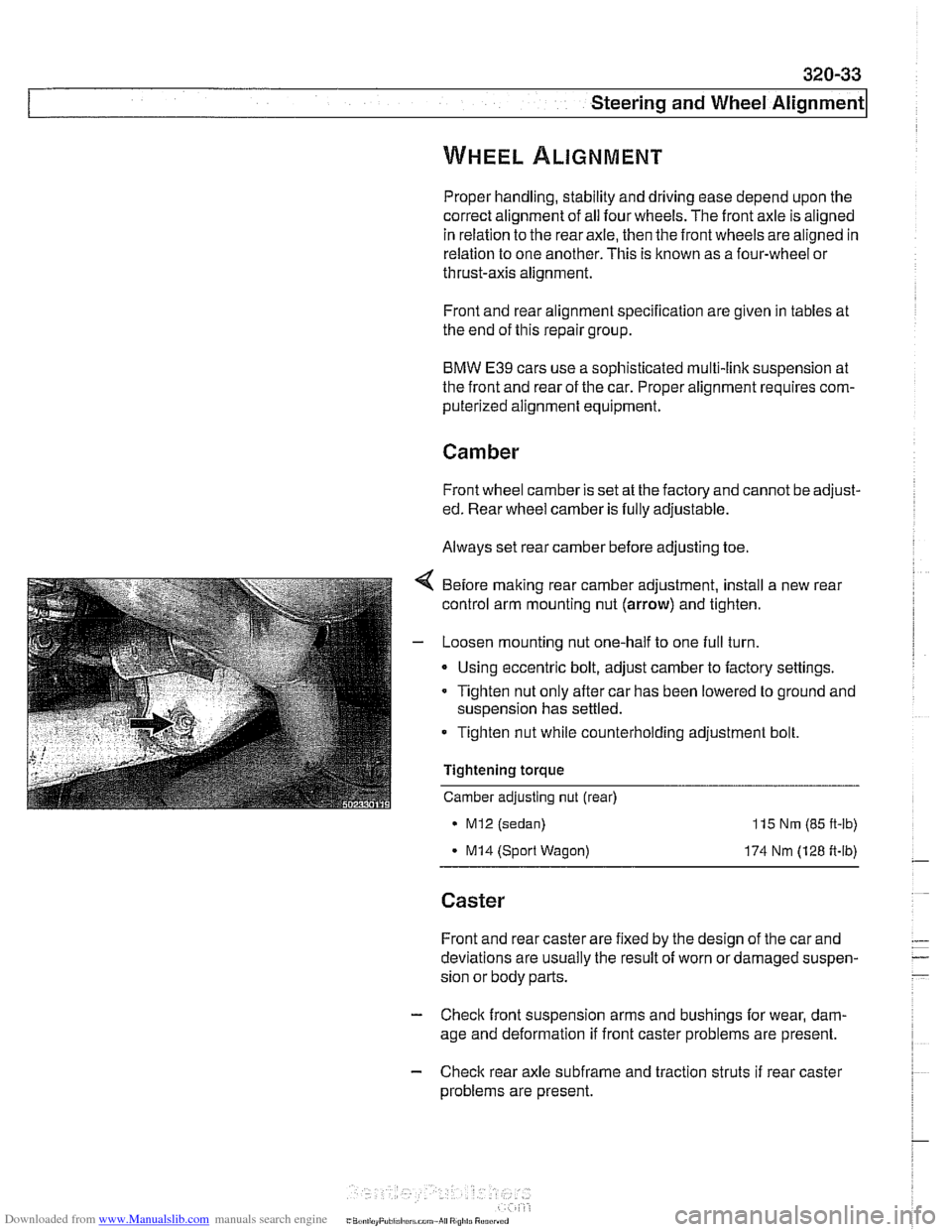
Before making rear camber adjustment, install a new rear
control arm mounting nut
(arrow) and tighten.
- Loosen mounting nut one-half to one full turn.
Using eccentric bolt, adjust camber to factory settings.
Tighten nut only after car has been lowered to ground and
suspension has settled.
Tighten nut while counterholding adjustment bolt.
Tightening torque
Camber adjusting nut (rear)
MI2 (sedan)
- MI4 (Sport Wagon)
115 Nm (85 ft-lb)
174 Nm (128 ft-lb)
Caster
Front and rear caster are fixed by the design of the car and
deviations are usually the result of worn or damaged suspen-
sion or body parts.
- Check front suspension arms and bushings for wear, dam-
age and deformation if front caster problems are present.
- Check rear axle subfrarne and traction struts if rear caster
problems are present.
Page 693 of 1002
Downloaded from www.Manualslib.com manuals search engine
Steering and Wheel Alignment
- Tighten nut while counterholding adjusting bolt,
- Tighten nut only after car has been lowered to ground and
suspension has settled.
Preparing for alignment
- The following conditions are necessary prior to wheel align-
ment:
Correct wheels and tires are installed, in good condition,
and are at the correct inflation pressures.
All steering and suspension parts and bushings are un-
damaged and show no signs of abnormal wear. Wheel
bearings are in good condition.
Ride height is in accordance with specifications. See
300
Suspension, Steering and Brakes-General.
Car is in normal loaded position. See below.
* Cars with air suspension: Remove air suspension power
fuse.
Normal loaded position
Each front seat
68 Kg (I50 lb)
Center of rear seat
Trunlc
Fuel tank
68 Kg (150 lb)
21 Kg (46 lb)
Full
Alignment specifications tables
In the alignment specification tables that follow, reference is
made to the various types of suspension used in
E39 cars.
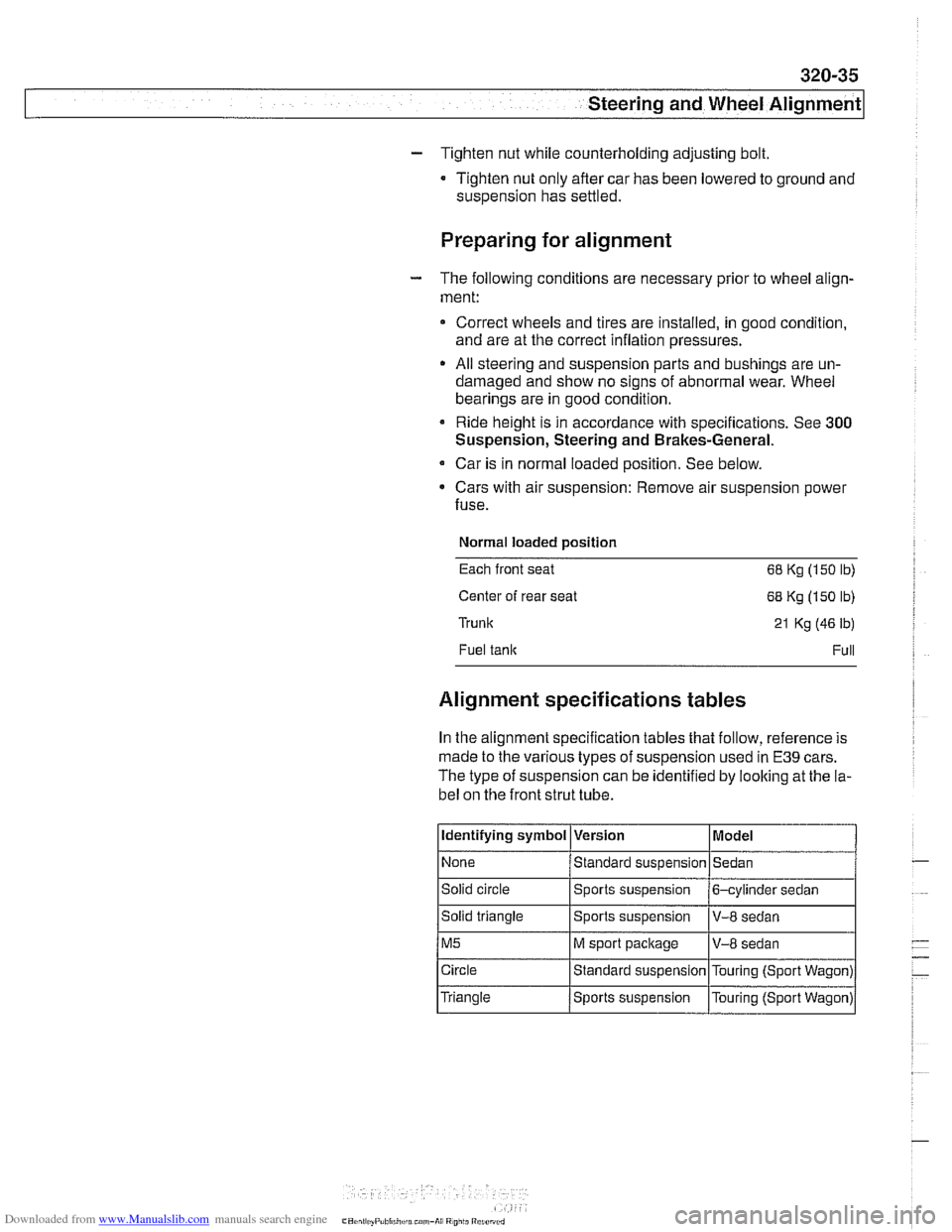
The type of suspension can be identified by loolting at the la-
bel on the front strut tube.
Identifying symbol
None
Solid circle
Solid triangle
M5
Circle
Triangle Version
Standard suspension
Sports
suspension
Sports suspension
M sport package
Standard suspension
Sports suspension Model
Sedan
6-cylinder sedan
V-8 sedan
V-8 sedan
Touring (Sport Wagon)
Touring (Sport Wagon)
Page 706 of 1002
Downloaded from www.Manualslib.com manuals search engine
330-1 0
/Rear Suspension
- Remove rubber protective cap from shock absorber upper
mount.
- Remove shock absorber upper mounting nuts.
- Remove shock absorber lower mounting bolt. Lower shock
absorber out of wheel housing.
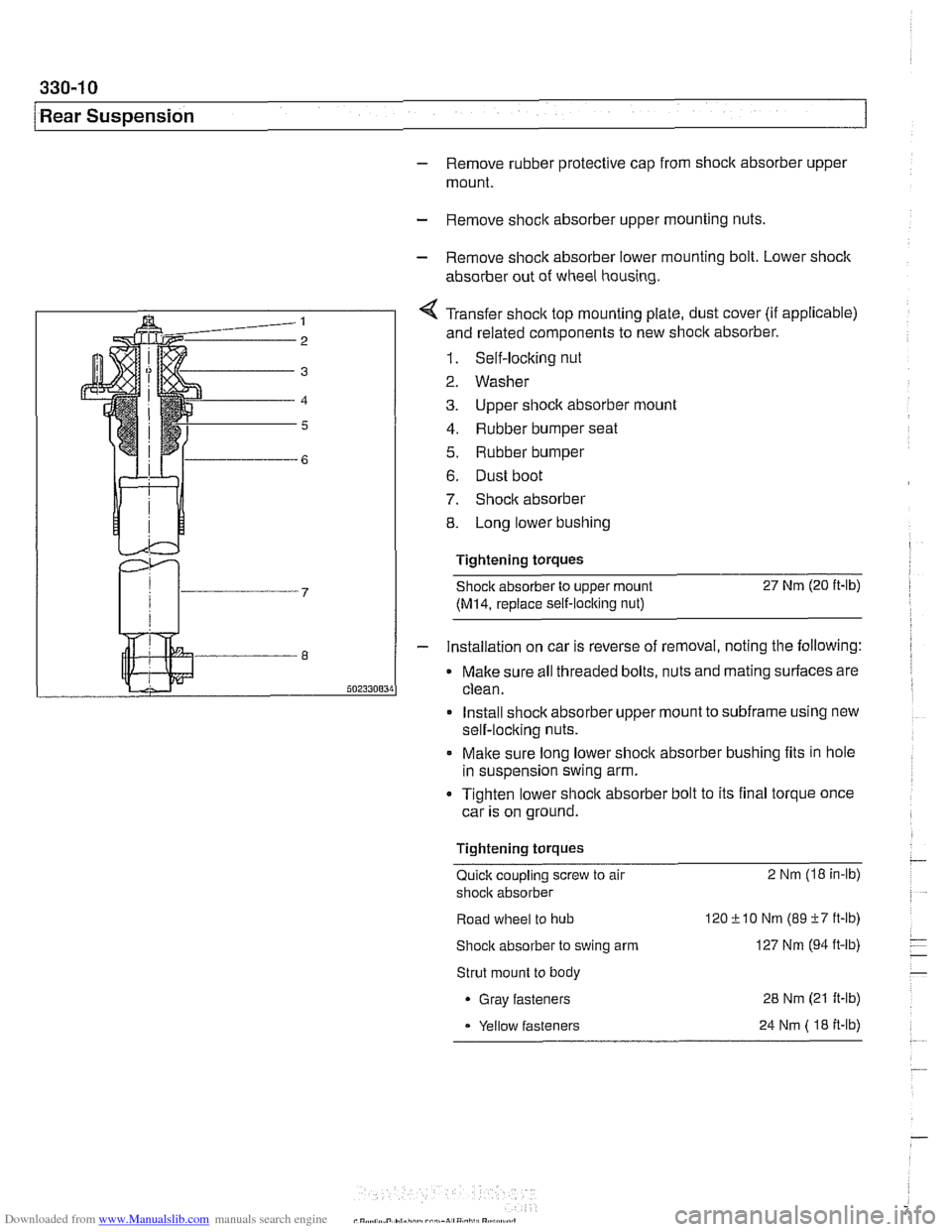
< Transfer shock top mounting plate, dust cover (if applicable)
and related components to new shoclc absorber.
1. Self-locking nut
2. Washer
3. Upper siioclc absorber mount
4. Rubber bumper seat
5. Rubber bumper
6. Dust boot
7. Shock absorber
8. Long lower bushing
Tightening torques
Shock absorber to upper mount
27 Nm (20 it-lb)
(M14, replace self-locking nut)
- Installation on car is reverse of removal, noting the following:
Make sure all threaded bolts, nuts and mating surfaces are
clean.
Install shock absorber upper mount to
subframe using new
self-locking nuts.
. Make sure long lower shock absorber bushing fits in hole
in suspension swing arm.
Tighten lower shoclc absorber bolt to its final torque once
car is on ground.
Tightening torques
Quick coupling screw to air 2 Nm (18 in-lb)
shock absorber
Road wheel to
hub 120 &I0 Nm (89 -f7 ft-lb)
Shock absorber to swing arm 127 Nm (94 ft-lb)
Strut mount to body
Gray fasteners
Yellow fasteners
24 Nm ( 18 it-lb)
Page 730 of 1002
Downloaded from www.Manualslib.com manuals search engine
(Rear Suspension
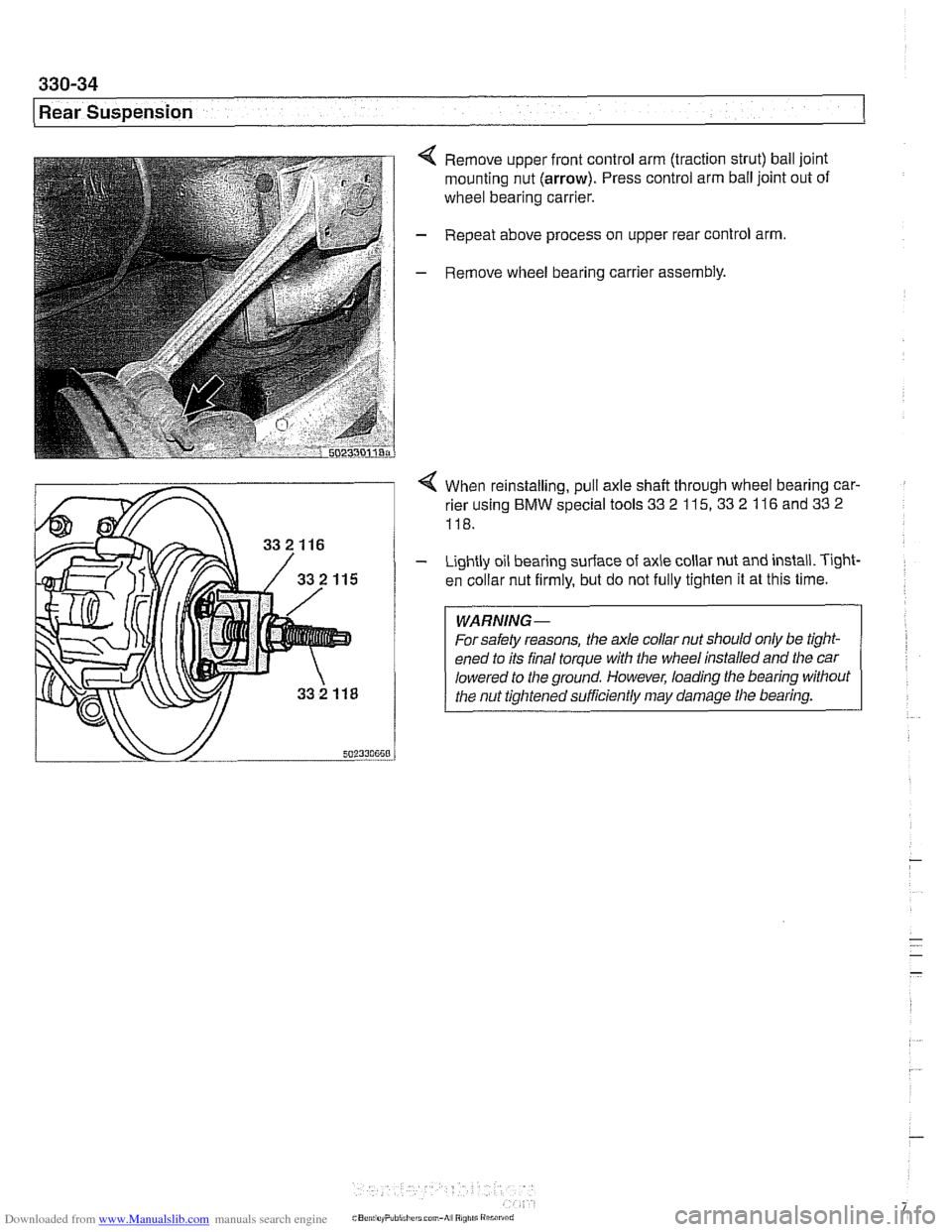
< Remove upper front control arm (traction strut) ball joint
mounting nut
(arrow). Press control arm ball joint out of
wheel bearing carrier.
- Repeat above process on upper rear control arm.
- Remove wheel bearing carrier assembly.
4 When reinstalling, pull axle shaft through wheel bearing car-
rier using
BMW special tools 33 2 115, 33 2 116 and 33 2
118.
- Lightly oil bearing surface of axle collar nut and install. T~ght-
en collar nut firmly, but do not fully tighten it at this time.
WARNING-
For safety reasons, the ale collar nut should only be tight-
ened to its final torque with the wheel installed and the car
lowered to
the ground. However, loading the bearing without
the nut tightened sufficiently may damage tlie bearing.