ESP BMW 540I SEDAN 2000 Owner's Manual
[x] Cancel search | Manufacturer: BMW, Model Year: 2000, Model line: 540I SEDAN, Model: BMW 540I SEDAN 2000Pages: 217, PDF Size: 1.69 MB
Page 105 of 217

105n
RepairsIndexOverview Controls Car care Technology Data
The conceptThe BMW Universal Transmitter re-
places up to three hand-held transmit-
ters that control different devices such
as a garage door opener, alarm sys-
tems or a door locking system. The
BMW Universal Transmitter recognizes
and "learns" the transmitted signal from
each of the original hand-held transmit-
ters.
The signal of an original hand-held
transmitter can be programmed to one
of three channel keys. Following that,
each of the devices can be operated
with the channel key that you have pro-
grammed for it. A transmission of the
signal is indicated by the indicator lamp.
Before you sell your vehicle, the pro-
grammed channel keys should be de-
leted. Refer to page 107 for the de-
scription of this process.
To prevent potential injuries or
damage: During the programming
operation and before every remote trig-
gering of a programmed device using
the BMW Universal Transmitter, be sure
that there are no persons, animals or
objects within the range of movement
of the respective device. Read and
comply with the safety instructions for
the original hand-held transmitter
also.<
To Canadian residents:
During programming, your hand-
held transmitter may automatically stop
transmitting after two seconds. This
may not be long enough to program the
BMW Universal Transmitter. If you are
programming from one of these hand-
held transmitters, the Universal Trans-
mitter's lamp may begin to flash in a se-
ries of double flashes. If this occurs,
continue to hold the button on the Uni-
versal Transmitter while you reactivate
your hand-held transmitter. You may
have to repeat this function several
times while programming.<
Before programming, read the
"User's information" section on
page 107.<
The original hand-held transmitter
If this symbol is depicted on the
packaging or in the user's in-
structions for the original hand-
held transmitter, it may be assumed
that this original hand-held transmitter
is compatible with the BMW Universal
Transmitter.
Checking for the change codeIn order to determine whether the origi-
nal hand-held transmitter is equipped
with a change code system, you may
either refer to the instructions for the
original hand-held transmitter or pro-
gram a channel key as described in the
left column on page 106 under "Pro-
gramming."
Following that, press and hold the pro-
grammed channel key of the BMW Uni-
versal Transmitter. If the indicator lamp
of the BMW Universal Transmitter
flashes rapidly for two seconds and
then stays on continuously, the original
hand-held transmitter is equipped with
a change code system. If the change
code system is available, program the
channel keys as described in the right-
hand column on page 106 under "Pro-
gramming a hand-held transmitter with
change code."
If you have additional questions,
please consult your BMW center
or call 1-800-355-3515.<
BMW Universal Transmitter
*
Page 106 of 217
106n
BMW Universal Transmitter
*
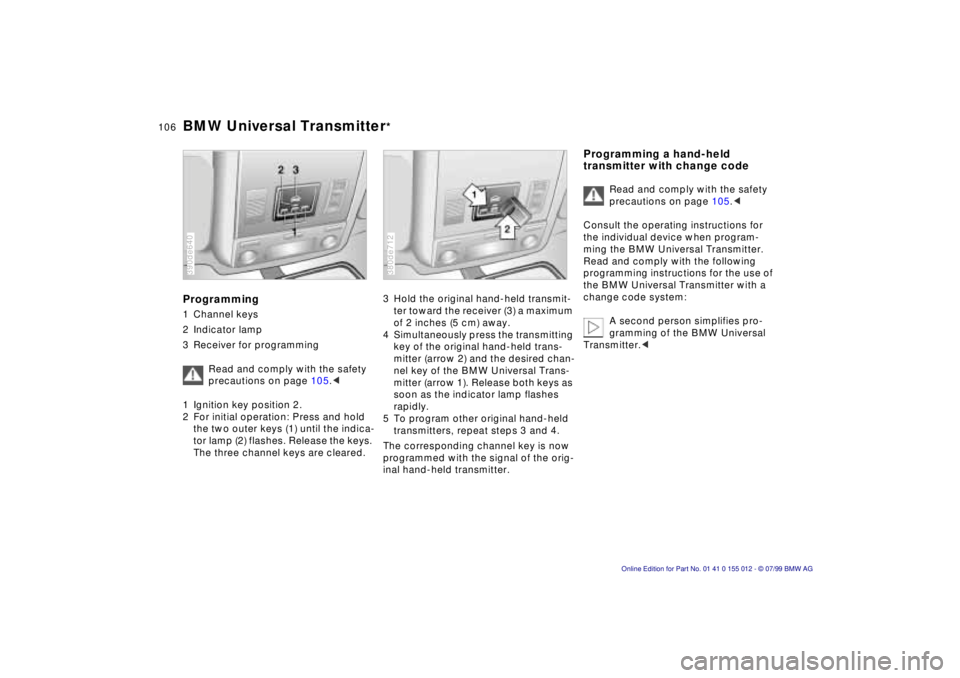
Programming1 Channel keys
2 Indicator lamp
3 Receiver for programming
Read and comply with the safety
precautions on page 105.<
1 Ignition key position 2.
2 For initial operation: Press and hold
the two outer keys (1) until the indica-
tor lamp (2) flashes. Release the keys.
The three channel keys are cleared.390de640
3 Hold the original hand-held transmit-
ter toward the receiver (3) a maximum
of 2 inches (5 cm) away.
4 Simultaneously press the transmitting
key of the original hand-held trans-
mitter (arrow 2) and the desired chan-
nel key of the BMW Universal Trans-
mitter (arrow 1). Release both keys as
soon as the indicator lamp flashes
rapidly.
5 To program other original hand-held
transmitters, repeat steps 3 and 4.
The corresponding channel key is now
programmed with the signal of the orig-
inal hand-held transmitter.380de712
Programming a hand-held
transmitter with change code
Read and comply with the safety
precautions on page 105.<
Consult the operating instructions for
the individual device when program-
ming the BMW Universal Transmitter.
Read and comply with the following
programming instructions for the use of
the BMW Universal Transmitter with a
change code system:
A second person simplifies pro-
gramming of the BMW Universal
Transmitter.<
Page 112 of 217
112n
Through-loading system
*
The backrest of the rear seat is divided
into two portions, one-third and two-
thirds of the seat respectively. For stor-
ing longer objects, you can fold down
either side individually.
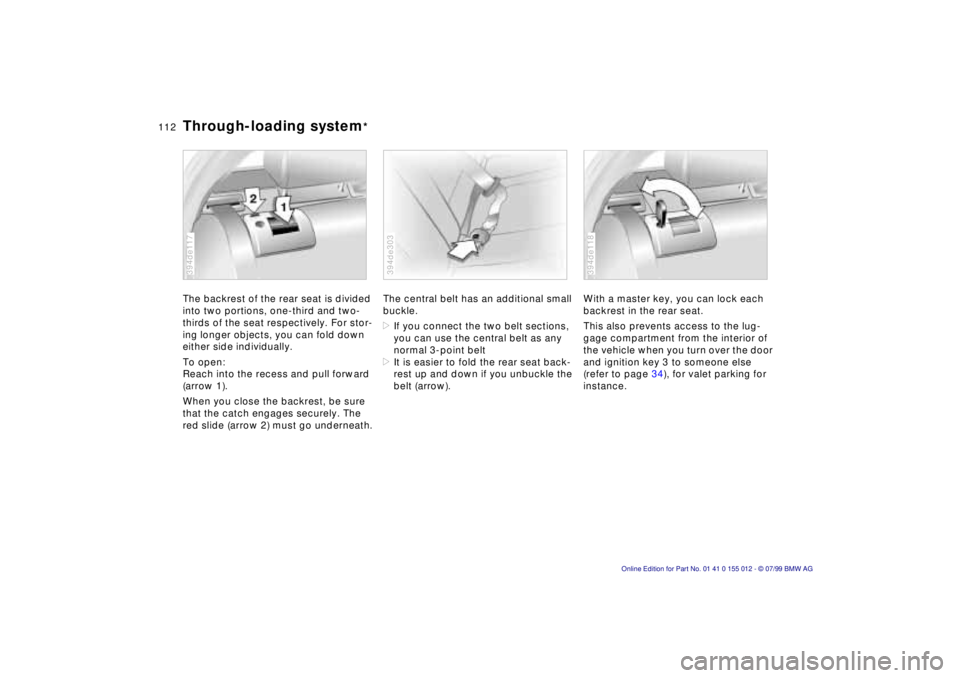
To open:
Reach into the recess and pull forward
(arrow 1).
When you close the backrest, be sure
that the catch engages securely. The
red slide (arrow 2) must go underneath.394de117
The central belt has an additional small
buckle.
>If you connect the two belt sections,
you can use the central belt as any
normal 3-point belt
>It is easier to fold the rear seat back-
rest up and down if you unbuckle the
belt (arrow).394de303
With a master key, you can lock each
backrest in the rear seat.
This also prevents access to the lug-
gage compartment from the interior of
the vehicle when you turn over the door
and ignition key 3 to someone else
(refer to page 34), for valet parking for
instance.394de118
Page 116 of 217
116n
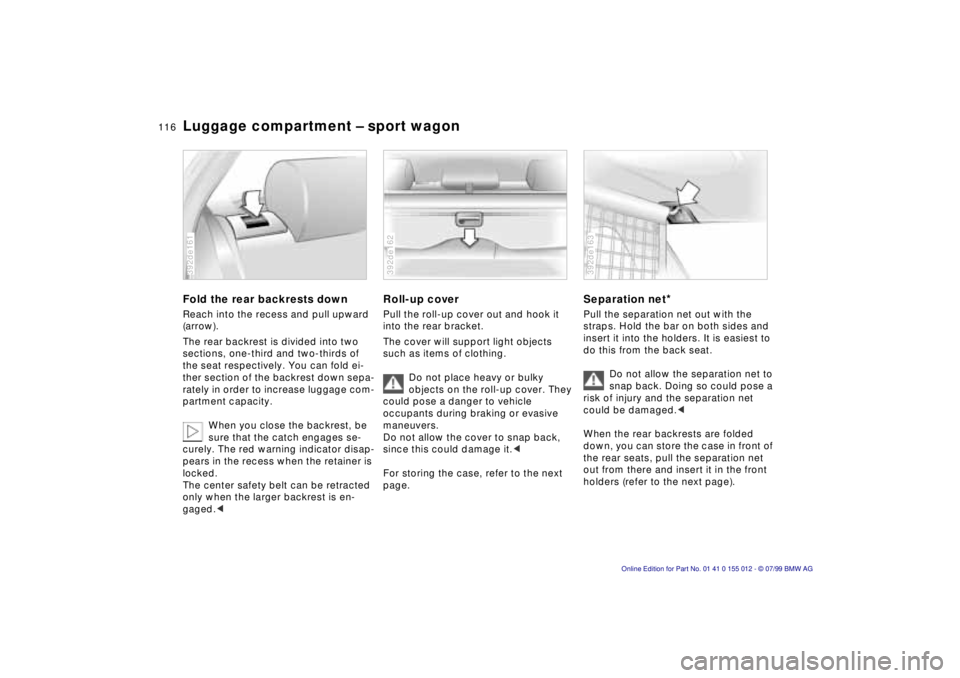
Luggage compartment Ð sport wagonFold the rear backrests downReach into the recess and pull upward
(arrow).
The rear backrest is divided into two
sections, one-third and two-thirds of
the seat respectively. You can fold ei-
ther section of the backrest down sepa-
rately in order to increase luggage com-
partment capacity.
When you close the backrest, be
sure that the catch engages se-
curely. The red warning indicator disap-
pears in the recess when the retainer is
locked.
The center safety belt can be retracted
only when the larger backrest is en-
gaged.<392de161
Roll-up coverPull the roll-up cover out and hook it
into the rear bracket.
The cover will support light objects
such as items of clothing.
Do not place heavy or bulky
objects on the roll-up cover. They
could pose a danger to vehicle
occupants during braking or evasive
maneuvers.
Do not allow the cover to snap back,
since this could damage it.<
For storing the case, refer to the next
page.392de162
Separation net
*
Pull the separation net out with the
straps. Hold the bar on both sides and
insert it into the holders. It is easiest to
do this from the back seat.
Do not allow the separation net to
snap back. Doing so could pose a
risk of injury and the separation net
could be damaged.<
When the rear backrests are folded
down, you can store the case in front of
the rear seats, pull the separation net
out from there and insert it in the front
holders (refer to the next page).392de163
Page 121 of 217

121n
RepairsIndexOverview Controls Car care Technology Data
Roof-mounted luggage rackMounting pointsAccess to the mounting points:
To fold up the cover (arrow), please use
the tool which is provided with the lug-
gage system.
A special luggage system is available as
an option for your BMW. Please comply
with the precautions included with the
installation instructions.
Because roof racks raise the center of
gravity of the car when loaded, they ex-
ercise a major effect on its handling and
steering response.394de369
You should therefore always remember
not to exceed the approved roof weight,
the approved gross vehicle weight or
the axle weights when loading the rack.
You will find the specifications under
"Technical data" on page 201.
Make sure that the load is not too
heavy, and attempt to distribute it
evenly. Always load the heaviest pieces
first (on the bottom). Be sure that
adequate clearance is maintained for
raising the sliding/tilt sunroof, and that
objects do not project into the opening
path of the luggage compartment lid/
tailgate.
Secure the roof luggage correctly and
tightly to prevent it from shifting or be-
ing lost during driving (danger to follow-
ing traffic).
Drive smoothly. Avoid sudden accelera-
tion and braking maneuvers. Take cor-
ners gently.
The roof load increases aerodynamic
resistance: Increased fuel consumption
and stress on the roof are the immedi-
ate results.
Page 127 of 217

127n
RepairsIndexOverview Controls Car care Technology Data
Antilock Brake System (ABS)The conceptABS enhances active safety by helping
to prevent the wheels from locking un-
der braking. The reason: Locked wheels
are dangerous. When the front wheels
slide, the driver loses steering control
over the vehicle. Traction loss at the
rear wheels can cause the rear end to
break into an uncontrolled skid.
ABS is designed to meet two essential
requirements during every brake appli-
cation:
>To help provide vehicle stability
>To help retain steering and maneu-
vering capability on all types of road
surface (asphalt, cement, dirt, mois-
ture, snow and ice).
The system can achieve the shortest
braking distances possible under most
conditions (on straight-away and in
curves, on asphalt, ice, wet road sur-
faces, etc.).
Braking with ABSThe system becomes operative once
the vehicle exceeds a speed of approx.
6 mph (10 km/h). The ABS is deacti-
vated whenever the vehicle's speed
drops back below approx. 4 mph
(6 km/h). This means that the wheels
can lock in the final phase of a brake
application Ð a factor of no significance
in actual use.
If you are in a situation which requires
full braking, you will exploit the full ben-
efits of the ABS system if you apply
maximum brake pressure ("panic stop").
Since the vehicle maintains steering re-
sponsiveness, you can avoid possible
obstacles with a minimum of steering
effort, despite the full brake application.
The ABS system closed-loop control
circuit cycles in fractions of a second.
A pulsation at the brake pedal indicates
to the driver that ABS is active, that is,
that the vehicle is within its maximum
braking range. In addition, the audible
pulsation that accompanies the control
operation calls the attention of the
driver to the reduced traction between
the tires and the road surface (slippery
road surface), and serves as a reminder
that the speed of the car should be re-
duced to adapt to road conditions.On road surfaces which have a loose
layer on a firm base (on gravel or snow,
for instance), the braking distances with
ABS may be longer than with the
wheels locked. The same applies when
snow chains have been mounted. How-
ever, ABS continues to provide en-
hanced vehicle stability and steering re-
sponse under these conditions.
Page 128 of 217

128n
Antilock Brake System (ABS) Disc brakesInformation for your safetyNot even ABS can suspend the laws of
physics. ABS alone cannot prevent
accidents when the brakes are applied
without an adequate safety interval
between vehicles, if the car is driven at
an excessive rate of speed in curves, or
if aquaplaning occurs. Responsibility for
these types of situations remains in the
hands (and at the feet) of the driver.
You should never allow the added
safety of ABS to lull you into a false
sense of security, or mislead you into
taking increased risks that could affect
your own safety and that of others.
Do not make any modifications to
the ABS system.
Service procedures on ABS are to be
performed by authorized technicians
only.<
In the event of a fault
If the ABS warning lamp in the
instrument cluster comes on,
refer to page 23. The brake
system then reverts to conven-
tional operation as on vehicles
without ABS. However, have the
brake system checked by your BMW
center as soon as possible. To prevent
undetected defects and cumulative
faults from adversely affecting the brake
system, refer any problems to your
authorized BMW center at the earliest
opportunity.
Disc brakes furnish optimum decelera-
tion and braking control and greater
fade resistance under heavy use.
When the vehicle is driven only occa-
sionally, during extended periods when
the vehicle is not used at all, and in
operating conditions where brake appli-
cations are less frequent, there is an
increased tendency for corrosion of the
rotors and accumulation of contamina-
tion on the brake pads. This occurs
because the minimal pressure which
must be exerted by the pads during
brake applications to clean the rotors is
not reached.
If the brake rotors are corroded, they
will tend to respond to braking with a
pulsating effect which even extended
application will fail to cure.
For your own safety: Use only
brake pads that BMW has
approved for your specific vehicle
model. BMW cannot evaluate non-
approved brake pads to determine if
they are suited for use, and therefore
cannot ensure the operating safety of
the vehicle if they are installed.<
Page 131 of 217

131n
RepairsIndexOverview Controls Car care Technology Data
Winter operationRubber seals and components In order to prevent the weather-strip-
ping from freezing, apply BMW rubber
treatment or silicone spray to the seals
on the doors, hood and luggage com-
partment lid/tailgate.
A full range of car-care products is
available from your BMW center.< Snow chainsBMW snow chains
* can be mounted on
both summer and winter tires. Mount
them in pairs on the rear wheels only
and comply with the manufacturer's
safety precautions. Do not exceed a
maximum speed of 30 mph (50 km/h).
For maximum traction, we recommend
that you manually deactivate the
ASC+T/DSC
* when driving with snow
chains mounted. Refer to page 91.
Starting offWe recommend that you use the man-
ual control switch to deactivate ASC+T/
DSC
* when starting off in deep snow or
when rocking the car to free it (refer to
page 91).
Driving on low-traction road
surfacesUse smooth, gentle pressure to control
the accelerator pedal. Avoid excessive
engine speeds and shift to the next
higher gear at an early point. Adapt
your speed and driving style when ap-
proaching grades or slopes. Maintain
an adequate distance between yourself
and the car ahead.BrakesWinter road conditions substantially
reduce the amount of traction available
between the tires and the road surface.
The resulting increases in braking dis-
tance are considerable and should be
kept in mind at all times.
ABS is intended to prevent the wheels
from locking during brake applications,
thus helping to maintain vehicle stability
and steering response. If the ABS does not respond in a critical
braking situation and the wheels lock:
Reduce the pressure on the brake
pedal until the wheels just start to roll
again while still maintaining enough
force to continue braking.
Following that, increase pedal pressure
again. Reduce the pressure as the
wheels lock, then reapply pressure.
Repeat this procedure. This type of
staggered braking will reduce the brak-
ing distance, and the vehicle still re-
mains responsive to steering.
You can then attempt to steer around
hazards after you have reduced pres-
sure on the brake pedal.
Do not shift down on slick road
surfaces. Doing so could cause
the rear wheels to lose traction and
skid, which could result in the loss of
vehicle control.<
Depress the clutch during hard
braking on road surfaces which
provide only poor or uneven traction.<
Page 133 of 217

133n
RepairsIndexOverview Controls Car care Technology Data
Cellular phone
*
Radio reception
Mobile communications systems (cellu-
lar phone, radio, etc.) are permitted with
an output up to 10 watts only. Even
these systems may trigger malfunctions
in the operation of your vehicle if they
are not specifically designed for use
with the vehicle. BMW can neither test
nor assume responsibility for every
individual product being offered on the
market. We recommend that you con-
sult your BMW center before purchas-
ing any device of this kind.
To ensure that your BMW continues to
provide reliable and trouble-free opera-
tion, do not use a cellular phone or
other radio device with an antenna
located inside the passenger compart-
ment. The antenna should always be
mounted on the outside of the vehicle.
Before loading the vehicle on a
car-carrier train or driving it
through a car wash, remove the
antenna.<
The reception and sound quality
obtained from mobile radios varies
according to a variety of factors, includ-
ing the broadcast range of the transmit-
ter and the directional orientation of the
antenna. Interference factors such as
high-tension power lines, buildings and
natural obstructions can all lead to
unavoidable reception interference,
regardless of how well the vehicle
sound system is operating.
Climatic factors such as intense solar
radiation, fog, rain and snow can also
interfere with reception.
Cellular phones without official BMW
approval can also generate interfer-
ence. This phenomenon assumes the
form of a low-pitched hum emanating
from the speaker system.
Please refer to the (Supplementary)
Owner's Manual provided with your
sound system for detailed information
on its use.
Page 134 of 217
134n
Information for your safety The factory-approved radial tires are
matched to the car and have been se-
lected to provide optimum safety and
driving comfort on your car.
It is not merely the tire's service life, but
also driving comfort and Ð above all else
Ð driving safety which depend on the
condition of the tires and the mainte-
nance of the specified tire pressure.
Incorrect inflation pressure is a frequent
cause of tire damage. It also signifi-
cantly influences the roadholding ability
of your BMW.
Check tire inflation pressures Ð in-
cluding the spare tire Ð regularly,
at least every two weeks and before be-
ginning a longer trip. If this is not done,
incorrect tire pressures can cause driv-
ing instability and tire damage, ulti-
mately resulting in accidents.<
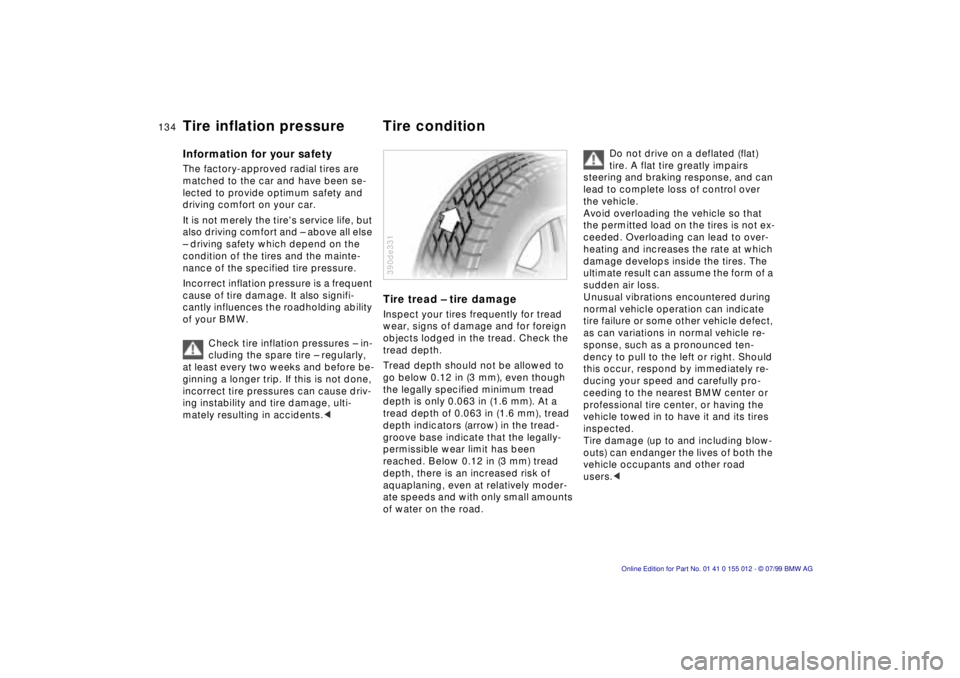
Tire tread Ð tire damageInspect your tires frequently for tread
wear, signs of damage and for foreign
objects lodged in the tread. Check the
tread depth.
Tread depth should not be allowed to
go below 0.12 in (3 mm), even though
the legally specified minimum tread
depth is only 0.063 in (1.6 mm). At a
tread depth of 0.063 in (1.6 mm), tread
depth indicators (arrow) in the tread-
groove base indicate that the legally-
permissible wear limit has been
reached. Below 0.12 in (3 mm) tread
depth, there is an increased risk of
aquaplaning, even at relatively moder-
ate speeds and with only small amounts
of water on the road.390de331
Do not drive on a deflated (flat)
tire. A flat tire greatly impairs
steering and braking response, and can
lead to complete loss of control over
the vehicle.
Avoid overloading the vehicle so that
the permitted load on the tires is not ex-
ceeded. Overloading can lead to over-
heating and increases the rate at which
damage develops inside the tires. The
ultimate result can assume the form of a
sudden air loss.
Unusual vibrations encountered during
normal vehicle operation can indicate
tire failure or some other vehicle defect,
as can variations in normal vehicle re-
sponse, such as a pronounced ten-
dency to pull to the left or right. Should
this occur, respond by immediately re-
ducing your speed and carefully pro-
ceeding to the nearest BMW center or
professional tire center, or having the
vehicle towed in to have it and its tires
inspected.
Tire damage (up to and including blow-
outs) can endanger the lives of both the
vehicle occupants and other road
users.<
Tire inflation pressure Tire condition