warning BMW 540I SEDAN 2000 Owner's Manual
[x] Cancel search | Manufacturer: BMW, Model Year: 2000, Model line: 540I SEDAN, Model: BMW 540I SEDAN 2000Pages: 217, PDF Size: 1.69 MB
Page 129 of 217

129n
RepairsIndexOverview Controls Car care Technology Data
Disc brakesDriving notesWhen driving in wet conditions and in
heavy rain, it is a good idea to apply
light pressure to the brake pedal every
few miles (kilometers). Watch traffic
conditions to ensure that this maneuver
does not endanger other road users.
The heat which is generated by the
brake applications helps to dry the
brake pads and rotors.
Maximum braking force is obtained
while the wheels continue to rotate,
peaking when the wheels remain on the
verge of locking without actually doing
so. ABS maintains this state automati-
cally. If the ABS fails, you should revert
to the staggered braking technique de-
scribed below (refer to page 131).
Extended or steep mountain descents
do not necessarily have to lead to re-
duced braking efficiency. Shift down to
a gear in which only minimal periodic
brake applications are required or move
the selector lever to the appropriate
lower range with automatic transmis-
sion.
You can increase the engine's braking
effect by selecting progressively lower
gears, downshifting as far as 1st gear,
or the 1st or 2nd shift position, on steep
descents.Should engine braking prove inade-
quate, you should still avoid extended,
continuous braking. Instead of main-
taining low to moderate pressure over
an extended period of time, you should
decelerate by applying more substantial
pressure to the brake pedal (watch for
following traffic!), then releasing the
pedal, then repeating the application.
This staggered braking technique al-
lows the brakes to cool in the intervals
between active braking phases, pre-
venting overheating and ensuring that
full braking capacity remains available
at all times.
Do not coast with the clutch de-
pressed or with the transmission
or selector lever in neutral. Do not coast
with the engine shut off. The engine
provides no braking effect when the
clutch is depressed or the transmission
is in neutral, and there is no power-as-
sist for braking or steering when the
engine is not running.
Never allow floor mats, carpets or any
other objects to protrude into the area
around the accelerator, clutch and
brake pedals and obstruct their move-
ment.<
Dynamic Brake Control (DBC)
*
If you apply the brakes rapidly, this sys-
tem automatically produces the maxi-
mum braking force boost and thus
helps to achieve the shortest possible
braking distance during "panic stops."
All of the benefits of the ABS system
are exploited under these circum-
stances.
Do not reduce the pressure on the
brake pedal for the duration of the
brake application. When the brake
pedal is released, the DBC is deacti-
vated.
In the event of a malfunction, the yellow
warning lamp comes on. Conventional
braking efficiency is available without
limitations.
Have the system checked and repaired
at your BMW center as soon as possi-
ble.
For "Information for your safety"
covering the ABS system, refer to
page 128. This information also gener-
ally applies for DBC.<
Page 130 of 217
130n
Brake system Winter operationBrake fluid level
The warning lamp for the brake
hydraulic system comes on, or
the "CHECK BRAKE FLUID"
message appears in the Check
Control.
The brake fluid level is too low in the
reservoir (refer to page 152).
If the brake fluid level is too low and
brake pedal travel has become notice-
ably longer, there may be a defect in
one of the brake system's hydraulic
circuits.
Proceed to the nearest authorized
BMW center. Higher brake appli-
cation pressure may be necessary
under these conditions, and brake
pedal travel may be significantly longer.
Please remember to adapt your driving
style accordingly.<
The warning lamp comes on together
with the "CHECK BRAKE PADS" mes-
sage in the Check Control.
Brake pads
The warning lamp for the brake
pads comes on, or the "CHECK
BRAKE PADS" message ap-
pears in the Check Control:
The brake pads have reached their
minimum pad thickness. Proceed to the
nearest authorized BMW center as
soon as possible to have the pads
replaced.
For your own safety: Use only
brake pads that BMW has
approved for your specific vehicle
model. BMW cannot evaluate non-
approved brake pads to determine if
they are suited for use, and therefore
cannot ensure the operating safety of
the vehicle if they are installed.<
The onset of winter is often accompa-
nied by rapid changes in weather.
Adaptations in driving style should be
accompanied by preparations on the
vehicle itself to ensure that your vehicle
operation through the winter remains
safe and trouble-free.CoolantEnsure that the coolant mixture con-
tains the year-round ratio of 50: 50 of
water and antifreeze/corrosion protec-
tion. This mixture provides protection
against freezing down to approx. -347
(-376). Replace the coolant every four
years.LocksBMW door lock deicer can be used to
free the locks if they are frozen. This
deicer also contains lubricant.
After using deicer, treatment with BMW
lock barrel grease is recommended.
Page 132 of 217

132n
Winter operation Power steering Level control system
*
Skid controlRelease the accelerator pedal and
depress the clutch pedal. Countersteer
carefully and attempt to regain control
of the vehicle.ParkingEngage 1st or reverse gear. If your car
is equipped with an automatic transmis-
sion, place the selector lever in "Park."
On vehicles with manual transmission,
also apply the parking brake when
parking on inclined surfaces. In order to
prevent the parking brake linings from
locking due to frost or corrosion, dry
them by gently applying the parking
brake as the vehicle is coming to a
stop. Make sure that following traffic is
not endangered.
The brake lamps do not come on
when the parking brake is
applied.<
If there is a change in steering behavior,
for instance greater steering effort or if
steering becomes lighter as speed
increases in vehicles equipped with
Servotronic
*:
Contact your BMW center immediately
for an inspection.
If the power steering fails,
increased effort will be required
to steer the vehicle.<
The warning lamp for the level
control system comes on, or the
message "LEVEL CONTROL
INACTIVE" appears in the Check Con-
trol: There is a malfunction in the level
control system.
Stop and inspect the vehicle. If it is
riding significantly lower in the rear than
in the front, or if it is sitting at an incline
(left rear compared to right rear),
consult the nearest authorized BMW
center. Drive with appropriate caution
in the meantime. The vehicle has
reduced ground clearance or driving
comfort is noticeably reduced.
Even if the attitude of the vehicle is
normal, you should consult the nearest
authorized BMW center if the warning
lamp indicates a system fault.
Page 143 of 217
143n
RepairsIndexOverview Controls Car care Technology Data
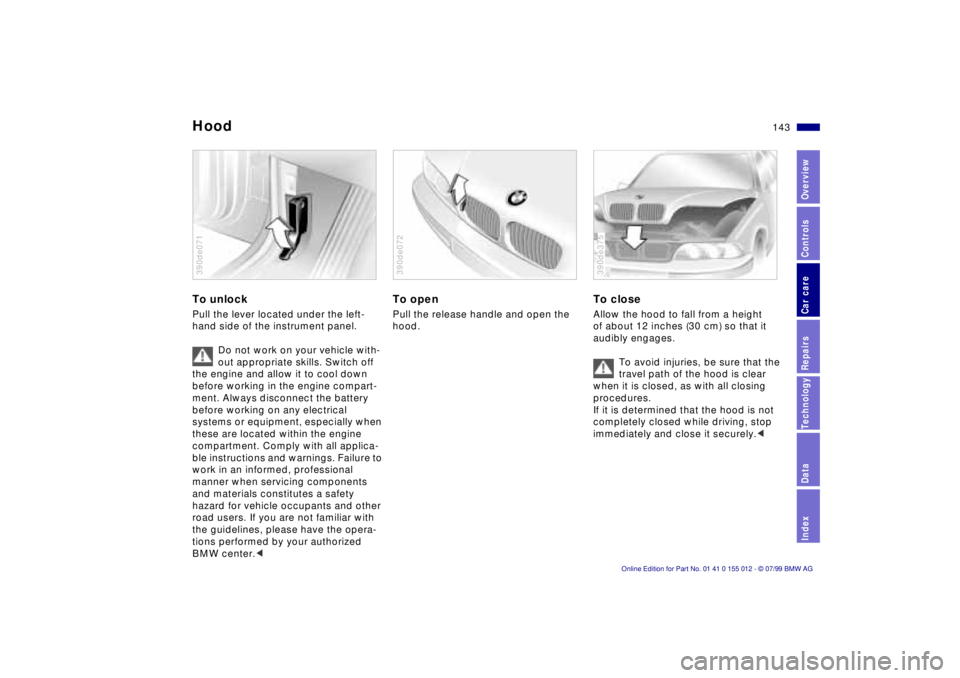
HoodTo unlockPull the lever located under the left-
hand side of the instrument panel.
Do not work on your vehicle with-
out appropriate skills. Switch off
the engine and allow it to cool down
before working in the engine compart-
ment. Always disconnect the battery
before working on any electrical
systems or equipment, especially when
these are located within the engine
compartment. Comply with all applica-
ble instructions and warnings. Failure to
work in an informed, professional
manner when servicing components
and materials constitutes a safety
hazard for vehicle occupants and other
road users. If you are not familiar with
the guidelines, please have the opera-
tions performed by your authorized
BMW center.<390de071
To openPull the release handle and open the
hood.390de072
To closeAllow the hood to fall from a height
of about 12 inches (30 cm) so that it
audibly engages.
To avoid injuries, be sure that the
travel path of the hood is clear
when it is closed, as with all closing
procedures.
If it is determined that the hood is not
completely closed while driving, stop
immediately and close it securely.< 390de375
Page 152 of 217

152n
Coolant Brake fluidAdding coolantWait until the engine cools before re-
moving the cap from the expansion
tank. The needle of the coolant gauge
in the instrument cluster must be lo-
cated in the blue zone; otherwise, there
is a danger of scalding.
1 Start by turning the cap counter-
clockwise. Pause to allow any
accumulated pressure to escape,
then open.
2 If the coolant is low, slowly add
coolant until the correct level is
reached Ð do not overfill.
The coolant is a mixture of water and
extended-duty antifreeze with corrosion
inhibitor. Always maintain the pre-
scribed all-season 50:50 mixture ratio
for year-round protection against inter-
nal corrosion. No other additives are re-
quired.
Replace the coolant every four years.If the indicator lamp for the
brake hydraulic system appears
or if the "CHECK BRAKE FLUID"
warning appears in the Check
Control: The brake fluid level is
too low in the reservoir.
The brake fluid reservoir is located
under the microfilter housing on the
driver's side of the car. Should you de-
termine that the brake fluid is low, refer
the problem to your BMW center, who
can trace and rectify any sources of
leakage when refilling the reservoir.
Your BMW center is familiar with the
specifications for approved brake fluids
(DOT 4).
Brake fluid loss results in extended
pedal travel. For this situation, refer to
the notes on page 130.
Brake fluid is hygroscopic, that is,
it absorbs moisture from the air
over time.
In order to ensure the safety and
reliability of the brake system, have the
brake fluid changed every two years by
an authorized BMW center. Refer also
to the Service and Warranty Information
Booklet (US models) or to the Warranty
and Service Guide Booklet (Canadian
models).
Brake fluid is toxic and damages the
vehicle's paint. You should always store
it in its original container and in a loca-
tion which is out of reach of children.
Do not spill the fluid and do not fill the
brake fluid reservoir beyond the "MAX"
mark. The brake fluid could ignite upon
contact with hot engine parts and cause
serious burns.<
Comply with the applicable
environmental laws regulating the
disposal of brake fluid.<
Page 159 of 217

159n
RepairsIndexOverview Controls Car care Technology Data
Caring for your carLeather careThe leather upholstery
* used by BMW
is a natural product of the highest qual-
ity, processed using state-of-the-art
methods to ensure that it will maintain
its high quality for years to come, pro-
vided that it is properly cared for.
Because this product is manufactured
using natural materials, you must make
allowance for its special characteristics
as well as for the peculiarities of its use
and care.
Regular periodic cleaning and care are
essential, as dust and road dirt act as
abrasives in the pores and creases of
the material. This leads to wear spots
and premature brittleness on the sur-
face of the leather. We therefore sug-
gest that you clean the leather with a
vacuum cleaner or dust cloth at fre-
quent intervals.
For cleaning, use BMW leather cleaning
foam.
Since dirt and grease gradually affect
the protective surface layer of the
leather, the cleaned surfaces should be
treated with a BMW leather care agent.
This also acts as an antistatic agent. For protection against dampness or
moisture, treat the leather with a BMW
impregnating agent.
We recommend that you perform this
procedure twice a year on leather ex-
posed to normal use.
Spills should be wiped up immediately.
Remove grease and oil stains without
rubbing, but rather by dabbing with
spot remover.
If the upholstery is to be exposed to in-
tense sunlight or if the vehicle is to be
stored for an extended period, cover all
leather surfaces (or, better yet, the win-
dows) to prevent fading.
Use cleaning and car-care
products that you can obtain
at your BMW center.<
Cleaning agents can contain sub-
stances that are dangerous or
pose health risks. Therefore, always
comply with the warnings and danger
notices on the package.
Open the doors or windows on your ve-
hicle before cleaning the interior. Never
clean your vehicle with cleaning agents
(or solvents) not specifically intended
for this purpose.<
Page 173 of 217
173n
RepairsIndexOverview Controls Car care Technology Data
Changing tires
Safety measures in the event of a
flat tire or wheel change:
Stop the vehicle as far as possible from
passing traffic. Park on a firm, flat,
surface. Switch on the hazard flashers.
Turn the steering wheel to the straight-
ahead position, remove the key and
engage the steering lock. Shift into 1st
or reverse (selector lever in Park with
automatic transmission) and engage the
parking brake. All passengers should
be outside the car and well away from
your immediate working area (behind a
guardrail, for instance).
If a warning triangle or portable hazard
warning lamp is available, set it up on
the roadside at an appropriate distance
from the rear of the vehicle. Comply
with all safety guidelines and regula-
tions.
Change the wheel only on a level, firm
surface which is not slippery. Avoid
jacking the car on a soft or slippery sup-
port surface (snow, ice, loose gravel,
etc.), since it could slide sideways.
Position the jack on a firm support
surface.
Do not place wooden blocks or similar
objects under the jack. If this is done,
the jack might not be able to reach its
full support capacity because of the
limited height.
Do not lie under the vehicle or start the
engine when the vehicle is supported
by the jack Ð risk of fatal injury.<
What you will needIn order to avoid rattling noises later,
note the position of the tools when you
remove them and return them to their
original position when you are through
using them.
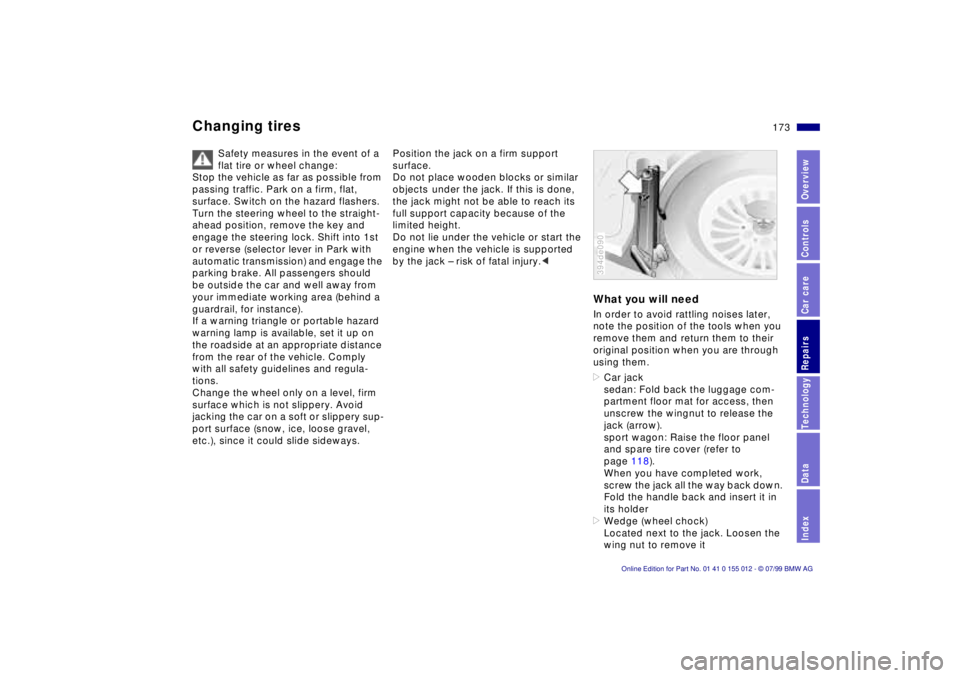
>Car jack
sedan: Fold back the luggage com-
partment floor mat for access, then
unscrew the wingnut to release the
jack (arrow).
sport wagon: Raise the floor panel
and spare tire cover (refer to
page 118).
When you have completed work,
screw the jack all the way back down.
Fold the handle back and insert it in
its holder
>Wedge (wheel chock)
Located next to the jack. Loosen the
wing nut to remove it394de090
Page 184 of 217
184n
Towing the vehicle
The towed vehicle should always
be the lighter of the two vehicles.
If this is not the case, it is no longer
possible to control vehicle response.<
Tow-startingIt is not possible to start the engine of
vehicles equipped with an automatic
transmission by towing or pushing.
For instructions on jump starting, refer
to page 182.
Never attempt to use your vehicle to
push another car, since damage to the
energy-absorbing bumpers could
result.
Towing a vehicle with automatic
transmission1 Place the selector lever in position N
2 Towing speed:
Max. 45 mph (70 km/h)
3 Towing distance:
Max. 95 miles (150 km)
4 Leave the ignition key at position 1 to
ensure that the brake lamps, turn sig-
nals, horn and windshield wipers re-
main operative, and to prevent the
steering lock detent from engaging.
5 Switch on the hazard-warning system
(observe country-specific regula-
tions).
Find some means of identifying the ve-
hicle in tow, for instance, place a sign
or warning triangle in the rear window.
Make sure that the ignition key
remains in position 1 even when
the electrical system has failed to pre-
vent the steering lock from engaging.
The steering and brakes are without
power assist when the engine is off.
This means that increased effort is
required for steering and braking.<
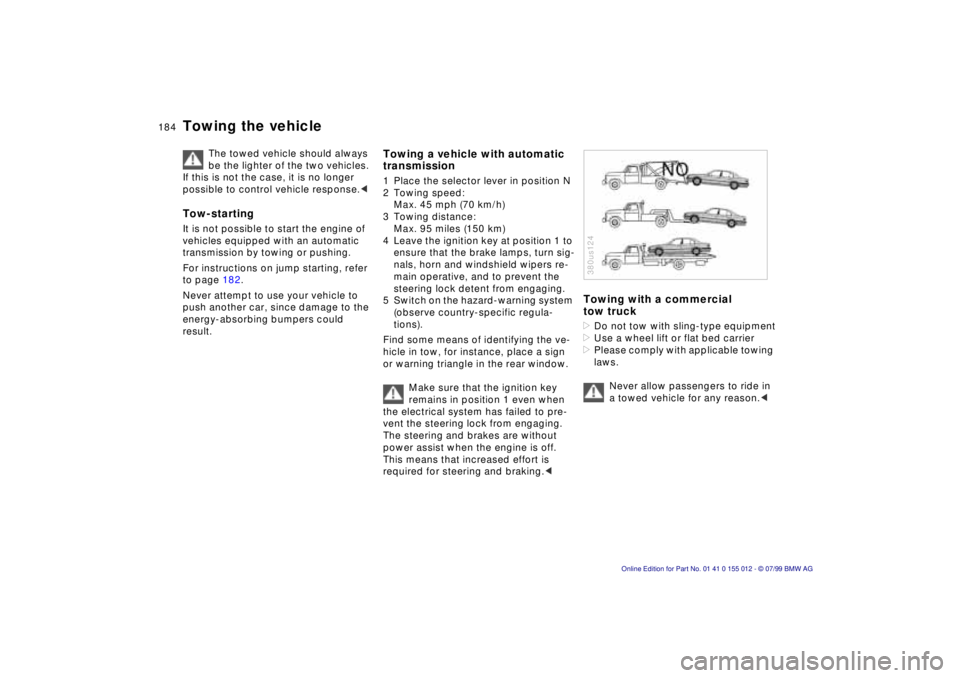
Towing with a commercial
tow truck>Do not tow with sling-type equipment
>Use a wheel lift or flat bed carrier
>Please comply with applicable towing
laws.
Never allow passengers to ride in
a towed vehicle for any reason.<380us124
Page 209 of 217

209n
RepairsIndexOverview Controls Car care Technology Data
Everything from A to Z
Clock, refer to the Radio
Owner's Manual
Cockpit16
Cold start68
Comfort seat51
Compartments108
Compression ratio198
Computer, refer to Onboard
computer88
Consumption display83
Convenience operating
mode of windows and
sliding/tilt sunroof36
Coolant130, 151
Antifreeze130
Capacity203
Temperature gauge84
Cover, sun blinds104
Cruise control80
Cruising range88
Cup holder109
Curb weight201
D
Dashboard16
Data link connector for
Onboard Diagnostics162
Daytime-driving lamp94
DBC (Dynamic Brake
Control)24, 129
Deep water125Defrost windshields101
Digital sound processor192
Dimensions199
Dipstick, engine oil149
Disc brakes124, 128
Disconnect the battery178
Displacement198
Display lighting94
Displays18
Distance warning90
Diversity Antenna
system190
Divided rear-seat
backrest112
Door keys35
Door locks, care130
Doors
Emergency release36
Manual operation36
Unlocking and locking36
Drive belts204
Driving notes125
Driving through water125
DSC (Dynamic Stability
Control)24, 91, 189
Dynamic Brake Control
(DBC)24, 129
Dynamic Stability Control
(DSC)24, 91, 189
E
Electric power seat50
Electric power windows47
Electrical defect
Fuel filler door180
Sliding/Tilt sunroof180
Tailgate181
Electrical heating exterior
mirror55
Electrical steering wheel
adjustment54
Elements of operation16
Emergency operation
Doors36
Fuel filler door180
Luggage compartment lid/
Tailgate41, 181
Sliding/Tilt sunroof180
Energy Control83
Engine
Compartment144
Coolant151
Specifications198
Engine oil
Capacity203
Consumption149
Grades150
Level23
Pressure23
Error indicators85
Exterior finish156
Exterior mirror54
Electrical heating55
F
Failure of an electrical
accessorry180
Failure warnings85
Filler cap cover28
Filling capacities203
First-aid kit27
Fittings, tow-starting and
towing183
Flashlight108
Flat tire134
Footbrake
Footwell lamps96
Forward/Back adjustment,
seat50, 52
Front fog lamps95, 169
bulb replacement169
Front seat adjustment50
Frost protection,
radiator151
Fuel29
Capacity203
Consumption indicator83
Gauge83
Quality29
Reserve203
Fuel filler door release after
electrical fault180
Fuel tank, capacity203
Fuses178
Page 210 of 217

Everything from A to Z
G
Gasoline29
Gasoline gauge83
Glove compartment108
Gross weight201
H
Handbrake23, 69
Handsfree system109
Hazard warning system27
Hazard warning triangle27
Head restraint53
Headlamp cleaning78
Headlamp covers,
care155, 167
Headlamp flasher77
Headlamp washer
system148
Heated seats103
Heated steering wheel103
Heating and ventilation98
Heating while stopped102
Heavy loads120
Height199
Height adjustment
Seats52
Steering wheel54
HiFi system192
High beams24
Bulb replacement167
High Performance Synthetic
Oils150Hood release143
Horn25, 26
Hydraulic Brake Assistant,
refer to DBC24, 129
I
Ice warning82
Identification number of the
vehicle153
Identification, tires137
Ignition key35
Ignition lock67
Independent ventilation104
Indicator77
Indicator lamps22
Inflation pressure30, 134
Monitoring92, 194
INSPECTION84
Instrument cluster18, 20
Instrument lighting94
Instrument panel20
Instrument panel switch77
Instruments18
Integrated rear axle194
Intensive automatic cleaning
unit78
Intensive cleaning
system148
Interaxle tire rotation136
Interference indicators85
Interference with
car phones133Interior lamps96
Remote control38
Interior mirror55
automatic dimming
feature55
Interior motion sensor46
Deactivation46
Interior rearview mirror
with automatic dimming
feature55, 192
Interlock67
Intermittent wiper switch77
J
Jack173
Jump-starting182
K
Key Memory58
Keys35
Kickdown72, 75
L
Lashing eye44, 120
Leather care159
Length199
Level control
system24, 132, 195
Light switch94
Light-alloy wheels138, 140
Lighter110Lights-on warning94
Load-securing devices120
Locking and unlocking the
doors36, 37
Low beams94
Bulb replacement167
Low beams, bulb
replacement167
Low-fuel warning lamp83
Lug bolts174
Lug wrench174
Luggage compartment
Capacity201
Lamps96
Net44
Luggage compartment lid/
Tailgate44
Emergency actuation41
Opening separately41
Remote control39
Luggage space44
Luggage straps44
Lumbar support51
M
M Multifunction steering
wheel (MFL)26
M+S tires138
Magic Eye177
Maintenance84, 154