warning BMW 540I SEDAN 2000 User Guide
[x] Cancel search | Manufacturer: BMW, Model Year: 2000, Model line: 540I SEDAN, Model: BMW 540I SEDAN 2000Pages: 217, PDF Size: 1.69 MB
Page 62 of 217

62n
AirbagsAt all times, occupants should sit
upright and be properly restrained (in-
fants and small children in appropriate
child restraint systems; larger children
and adults using the safety belts). Never
let an occupant's head rest near or on a
side airbag because the inflating airbag
could cause a serious or fatal injury.
Please note that the word "Airbag" im-
printed on the door trim panel indicates
the airbag's location.
Accident research shows that the
safest place for children in an automo-
bile is in the rear seat. However, a child
sitting in the rear seat and not properly
restrained may place his or her head on
or near the side airbag, if so equipped.
For example, a child Ð even though
belted Ð may fall asleep with his or her
head against the side airbag. It may be
difficult for a driver to ensure that chil-
dren in the rear seat will remain prop-
erly positioned at all times and not
place their heads on or near the side
airbag.Therefore, we recommend that the rear
seat side airbags, if provided, be deac-
tivated if you plan to transport children
in the rear seat.
The rear seat side airbags may already
have been deactivated, either at the
time of manufacture or by a BMW cen-
ter. Labels in the rear door opening
should indicate the status of your rear
seat side airbags. If your are uncertain
of their status, or wish to have the air-
bags activated or deactivated, please
contact your BMW center.Even when all these guidelines are
followed, there is still a small residual
risk of injuries to the face, hands and
arms occurring from airbag deploy-
ment in isolated instances. The ignition
and inflation noise may provoke a mild
temporary hearing loss in extremely
sensitive individuals.
Airbag warning information is also
provided on the sun visors.
For additional information concerning
the airbag system, refer to pages 160
and 188.
Page 67 of 217
67n
RepairsIndexOverview Controls Car care Technology Data
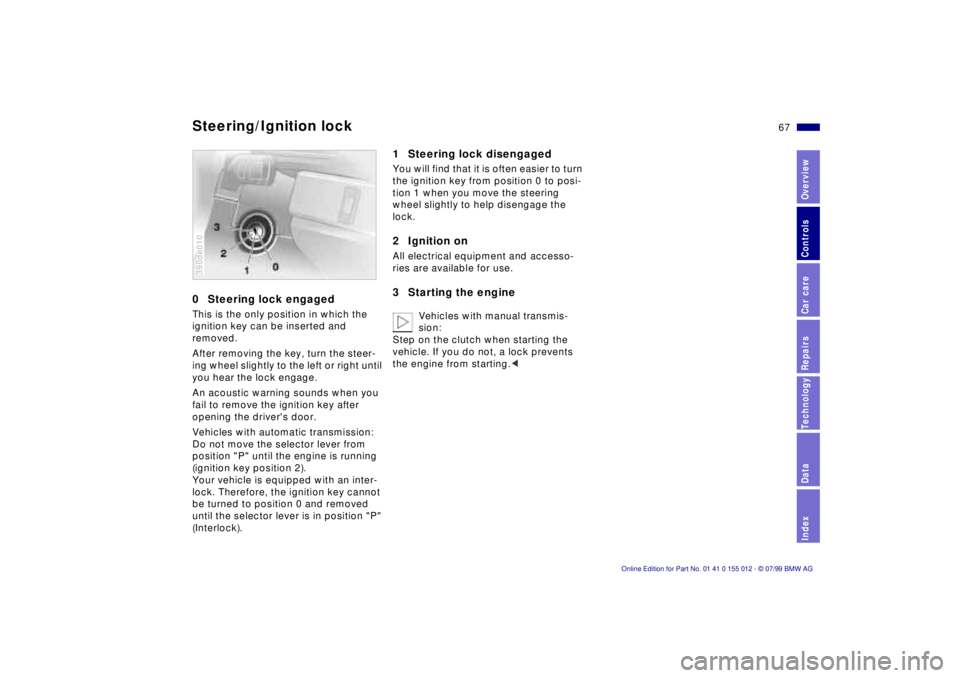
0 Steering lock engagedThis is the only position in which the
ignition key can be inserted and
removed.
After removing the key, turn the steer-
ing wheel slightly to the left or right until
you hear the lock engage.
An acoustic warning sounds when you
fail to remove the ignition key after
opening the driver's door.
Vehicles with automatic transmission:
Do not move the selector lever from
position "P" until the engine is running
(ignition key position 2).
Your vehicle is equipped with an inter-
lock. Therefore, the ignition key cannot
be turned to position 0 and removed
until the selector lever is in position "P"
(Interlock).390de010
1 Steering lock disengagedYou will find that it is often easier to turn
the ignition key from position 0 to posi-
tion 1 when you move the steering
wheel slightly to help disengage the
lock.2 Ignition onAll electrical equipment and accesso-
ries are available for use.3 Starting the engine
Vehicles with manual transmis-
sion:
Step on the clutch when starting the
vehicle. If you do not, a lock prevents
the engine from starting.<
Steering/Ignition lock
Page 82 of 217
82n
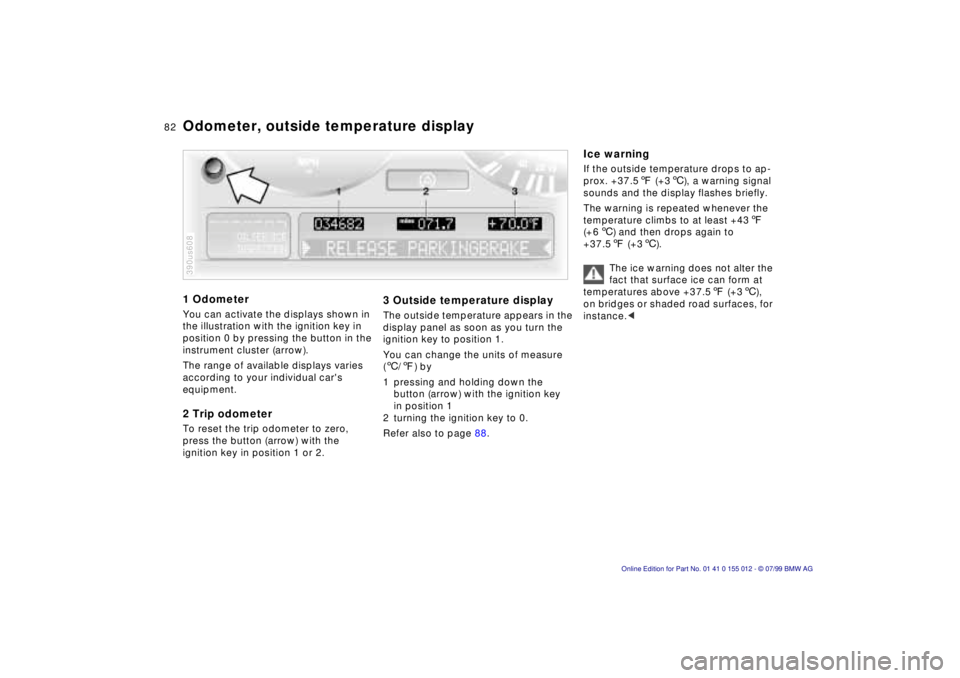
1 OdometerYou can activate the displays shown in
the illustration with the ignition key in
position 0 by pressing the button in the
instrument cluster (arrow).
The range of available displays varies
according to your individual car's
equipment.2 Trip odometerTo reset the trip odometer to zero,
press the button (arrow) with the
ignition key in position 1 or 2.390us608
3 Outside temperature displayThe outside temperature appears in the
display panel as soon as you turn the
ignition key to position 1.
You can change the units of measure
(6/7) by
1 pressing and holding down the
button (arrow) with the ignition key
in position 1
2 turning the ignition key to 0.
Refer also to page 88.
Ice warningIf the outside temperature drops to ap-
prox. +37.57 (+36), a warning signal
sounds and the display flashes briefly.
The warning is repeated whenever the
temperature climbs to at least +437
(+66) and then drops again to
+37.57 (+36).
The ice warning does not alter the
fact that surface ice can form at
temperatures above +37.57 (+36),
on bridges or shaded road surfaces, for
instance.<
Odometer, outside temperature display
Page 84 of 217
84n
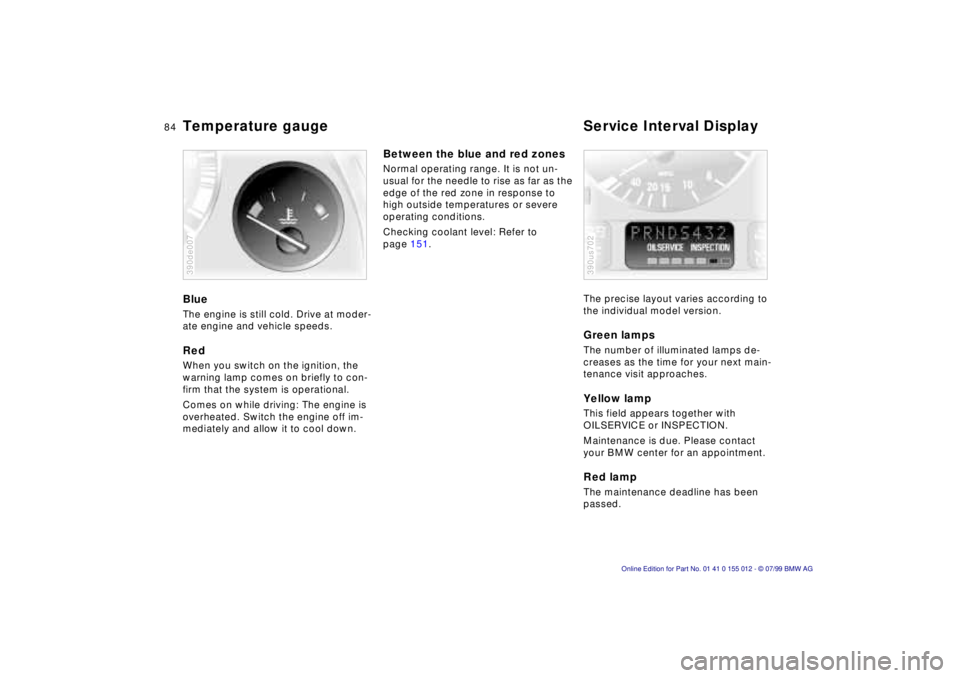
Temperature gauge Service Interval DisplayBlueThe engine is still cold. Drive at moder-
ate engine and vehicle speeds.RedWhen you switch on the ignition, the
warning lamp comes on briefly to con-
firm that the system is operational.
Comes on while driving: The engine is
overheated. Switch the engine off im-
mediately and allow it to cool down.390de007
Between the blue and red zonesNormal operating range. It is not un-
usual for the needle to rise as far as the
edge of the red zone in response to
high outside temperatures or severe
operating conditions.
Checking coolant level: Refer to
page 151.
The precise layout varies according to
the individual model version.
Green lampsThe number of illuminated lamps de-
creases as the time for your next main-
tenance visit approaches.Yellow lampThis field appears together with
OILSERVICE or INSPECTION.
Maintenance is due. Please contact
your BMW center for an appointment.Red lampThe maintenance deadline has been
passed.390us702
Page 85 of 217
85n
RepairsIndexOverview Controls Car care Technology Data
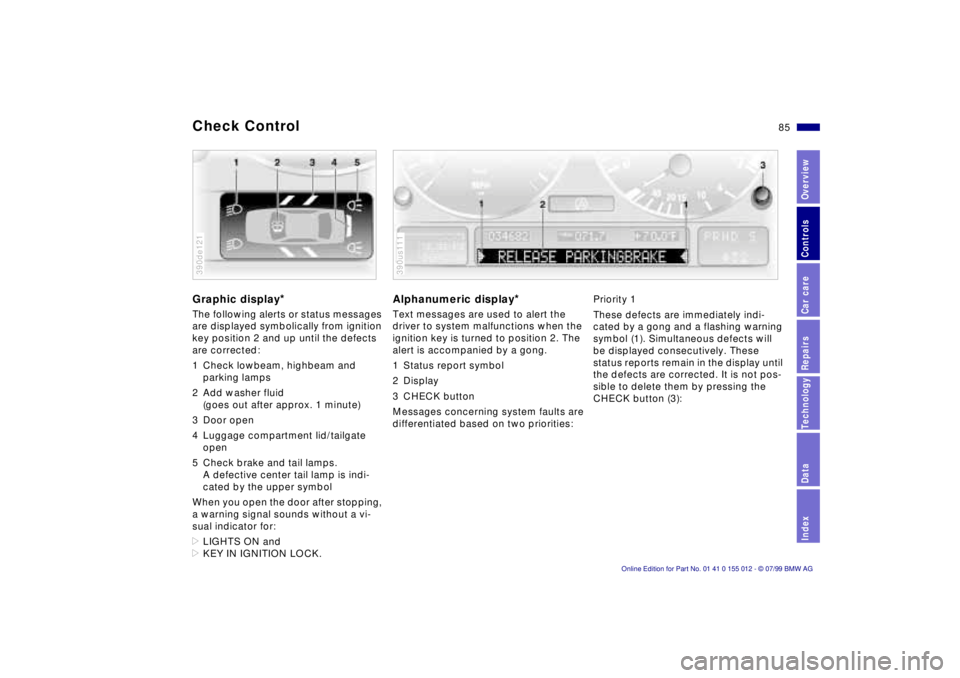
Check ControlGraphic display
*
The following alerts or status messages
are displayed symbolically from ignition
key position 2 and up until the defects
are corrected:
1 Check lowbeam, highbeam and
parking lamps
2 Add washer fluid
(goes out after approx. 1 minute)
3 Door open
4 Luggage compartment lid/tailgate
open
5 Check brake and tail lamps.
A defective center tail lamp is indi-
cated by the upper symbol
When you open the door after stopping,
a warning signal sounds without a vi-
sual indicator for:
>LIGHTS ON and
>KEY IN IGNITION LOCK.390de121
Alphanumeric display
*
Text messages are used to alert the
driver to system malfunctions when the
ignition key is turned to position 2. The
alert is accompanied by a gong.
1 Status report symbol
2 Display
3 CHECK button
Messages concerning system faults are
differentiated based on two priorities:390us111
Priority 1
These defects are immediately indi-
cated by a gong and a flashing warning
symbol (1). Simultaneous defects will
be displayed consecutively. These
status reports remain in the display until
the defects are corrected. It is not pos-
sible to delete them by pressing the
CHECK button (3):
Page 86 of 217

86n
Check Control>RELEASE PARKINGBRAKE
>COOLANT TEMPERATURE
The coolant is overheated. Stop the
vehicle and switch off the engine im-
mediately. Refer to pages 84
and 15 1.
>STOP! ENGINE OILPRESS
The oil pressure is too low. Stop the
vehicle and switch off the engine im-
mediately. Refer to page 22.
>CHECK BRAKE FLUID
Indicates that brake fluid is down to
roughly minimum level. Top up the
brake fluid at the next opportunity.
Refer to page 152. Have the source
of the brake fluid loss diagnosed and
corrected by your BMW center.
>FLAT TIRE
*
Reduce vehicle speed immediately
and stop the vehicle. Avoid hard
brake applications. Do not oversteer.
Refer to page 93.
>LOAD LEVEL INACTIVE
Please consult the nearest authorized
BMW center. Refer to page 132.
>SPEED LIMIT
*
Display if the programmed speed
limit has been exceeded.Priority 2
These displays appear for 20 seconds
when the ignition key is turned to posi-
tion 2. The warning symbols remain
after the message disappears. You can
display the messages again by pressing
the CHECK button (3):
>TRUNKLID OPEN
Message appears only when the
vehicle is initially set in motion.
>DOOR OPEN
This message appears after a minimal
defined road speed has been ex-
ceeded.
>FASTEN SEAT BELTS
*
In addition to this message, a
warning lamp with the safety belt icon
appears and an acoustical signal
sounds.
>WASHER FLUID LOW
Too low; top up fluid at the next
opportunity. Refer to page 148.
>CHECK ENGINE OIL LEV
Add engine oil as soon as possible.
Refer to page 149.
>OUTSIDE TEMP. +207 (Ð56)
This display is only an example. The
current temperature is displayed at
outside temperatures of +37.57
(+36) and below. Refer also to
page 82.>TIRE PRESSURE SET
*
The RDC has imported the current in-
flation pressure in the tires as the tar-
get values which the system will
monitor.
Refer to page 92.
>CHECK TIRE PRESSURE
*
Check and correct the tire inflation
pressure to specifications at the earli-
est opportunity (next stop for fuel).
Refer to page 92.
>TIRE CHECK INACTIVE
*
A temporary interference of the RDC
or a system fault. Refer to page 93.
>CHECK BRAKE LAMPS
A lamp has failed or the electrical cir-
cuit has a fault. Refer to pages 169
and 170 or consult an authorized
BMW center.
>CHECK LOWBEAM LAMPS
CHECK SIDE LAMPS
CHECK REAR LAMPS
CHECK FRONT FOGLAMPS
CHECK LICPLATE LAMP
CHECK HIGHBEAM LAMP
CHECK BACK UP LAMPS
Defective bulb or circuit. Refer to
page 167 or consult an authorized
BMW center.
Page 90 of 217

90n
The PDC assists you when you are
parking. A signal warns you of the real
distance to an obstacle. To do this, four
ultrasonic sensors in the rear bumper
measure the distance from the nearest
object. The monitoring range for the
two corner sensors ends approx. 2 feet
(60 cm) beyond the respective bumper.
The range of the two middle sensors is
approx. 4.9 feet (1.50 meters) outward.
The system starts to operate automati-
cally about one second after you select
reverse with the ignition key in posi-
tion 2. It is similarly deactivated when
you engage reverse gear or move the
selector lever position from the "R" po-
sition.
Acoustical signalsThe distance to the nearest object is in-
dicated by a tone sounding at various
intervals. As the distance between vehi-
cle and object decreases, the intervals
between the tones become shorter. A
continuous tone indicates the presence
of an object less than 1 ft. (30 cm)
away.
The warning signal will be canceled af-
ter approx. 3 seconds if the distance to
the obstruction remains constant during
this time (if you are moving parallel to a
wall, for instance).
System malfunctions will be indicated
by a continuous high-pitched tone
when the system is activated the first
time. Please have the cause checked
and corrected by your authorized BMW
center.The PDC does not remove the
driver's personal responsibility for
evaluating the distance between the ve-
hicle and any obstacles. Even when
sensors are involved, there is a blind
spot in which objects cannot be de-
tected. This applies especially in those
cases where the system approaches
the physical limits of ultrasonic mea-
surement, as occurs with tow bars and
trailer couplings, and in the vicinity of
thin and painted objects.
Certain sources of sound, such as a
loud radio, could drown the PDC signal
tone.<
Keep the sensors clean and free
of ice or snow in order to ensure
that they continue to operate effectively.
Do not apply high pressure spray to the
sensors for a prolonged period of time.
Maintain an adequate distance of more
than approx. 4 inches (10 cm).<
Park Distance Control (PDC)
*
Page 94 of 217
94n
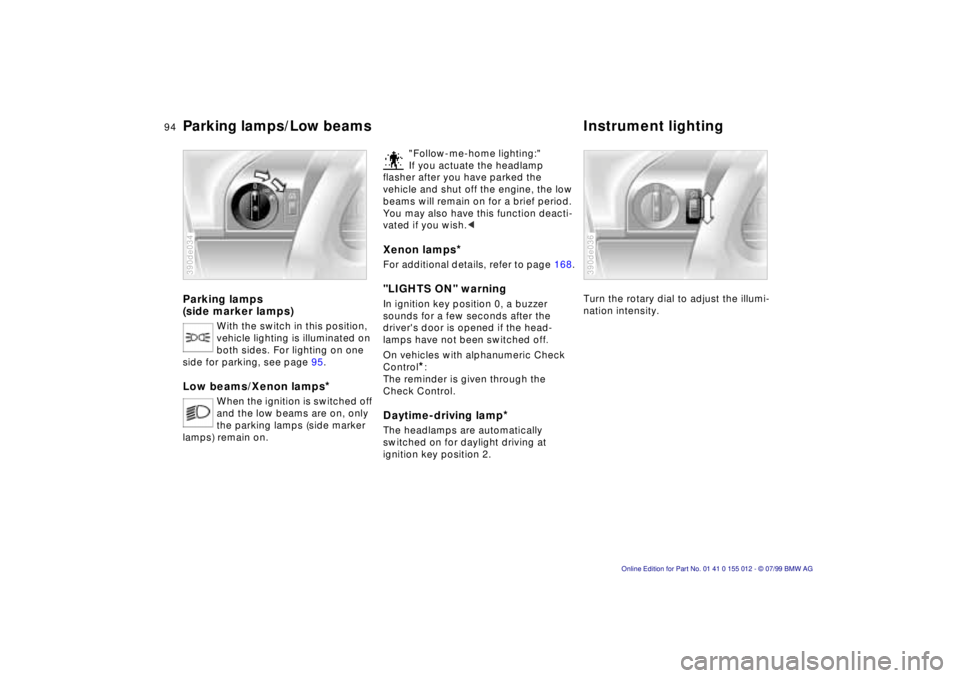
Parking lamps
(side marker lamps)
With the switch in this position,
vehicle lighting is illuminated on
both sides. For lighting on one
side for parking, see page 95.
Low beams/Xenon lamps
*
When the ignition is switched off
and the low beams are on, only
the parking lamps (side marker
lamps) remain on.
390de034
"Follow-me-home lighting:"
If you actuate the headlamp
flasher after you have parked the
vehicle and shut off the engine, the low
beams will remain on for a brief period.
You may also have this function deacti-
vated if you wish.<
Xenon lamps
*
For additional details, refer to page 168."LIGHTS ON" warning In ignition key position 0, a buzzer
sounds for a few seconds after the
driver's door is opened if the head-
lamps have not been switched off
.
On vehicles with alphanumeric Check
Control
*:
The reminder is given through the
Check Control.
Daytime-driving lamp
*
The headlamps are automatically
switched on for daylight driving at
ignition key position 2.
Turn the rotary dial to adjust the illumi-
nation intensity.390de036
Parking lamps/Low beamsInstrument lighting
Page 116 of 217
116n
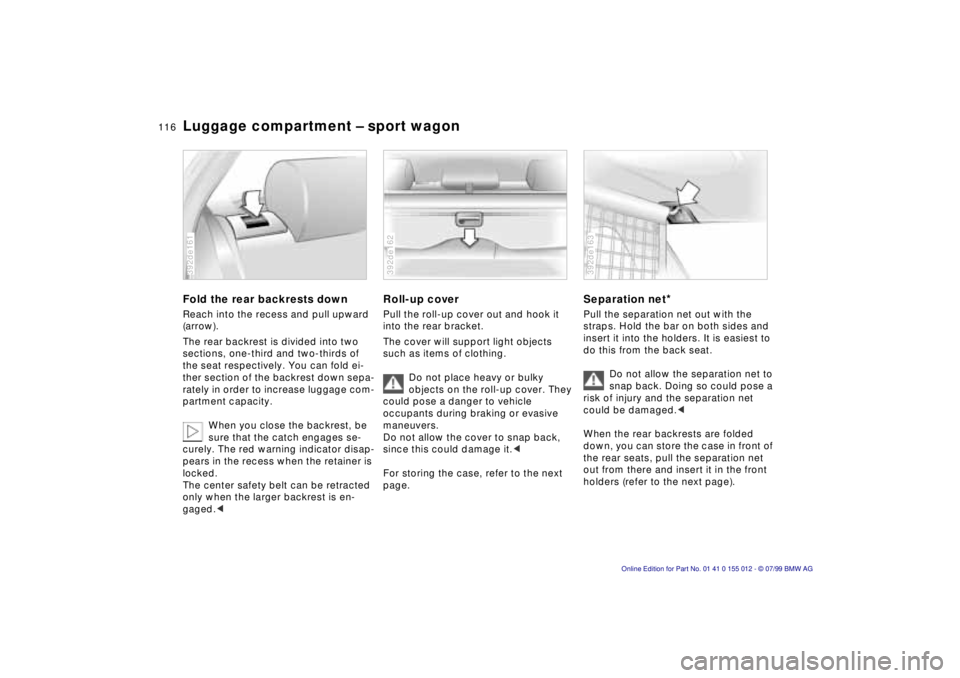
Luggage compartment Ð sport wagonFold the rear backrests downReach into the recess and pull upward
(arrow).
The rear backrest is divided into two
sections, one-third and two-thirds of
the seat respectively. You can fold ei-
ther section of the backrest down sepa-
rately in order to increase luggage com-
partment capacity.
When you close the backrest, be
sure that the catch engages se-
curely. The red warning indicator disap-
pears in the recess when the retainer is
locked.
The center safety belt can be retracted
only when the larger backrest is en-
gaged.<392de161
Roll-up coverPull the roll-up cover out and hook it
into the rear bracket.
The cover will support light objects
such as items of clothing.
Do not place heavy or bulky
objects on the roll-up cover. They
could pose a danger to vehicle
occupants during braking or evasive
maneuvers.
Do not allow the cover to snap back,
since this could damage it.<
For storing the case, refer to the next
page.392de162
Separation net
*
Pull the separation net out with the
straps. Hold the bar on both sides and
insert it into the holders. It is easiest to
do this from the back seat.
Do not allow the separation net to
snap back. Doing so could pose a
risk of injury and the separation net
could be damaged.<
When the rear backrests are folded
down, you can store the case in front of
the rear seats, pull the separation net
out from there and insert it in the front
holders (refer to the next page).392de163
Page 128 of 217
128n
Antilock Brake System (ABS) Disc brakesInformation for your safetyNot even ABS can suspend the laws of
physics. ABS alone cannot prevent
accidents when the brakes are applied
without an adequate safety interval
between vehicles, if the car is driven at
an excessive rate of speed in curves, or
if aquaplaning occurs. Responsibility for
these types of situations remains in the
hands (and at the feet) of the driver.
You should never allow the added
safety of ABS to lull you into a false
sense of security, or mislead you into
taking increased risks that could affect
your own safety and that of others.
Do not make any modifications to
the ABS system.
Service procedures on ABS are to be
performed by authorized technicians
only.<
In the event of a fault
If the ABS warning lamp in the
instrument cluster comes on,
refer to page 23. The brake
system then reverts to conven-
tional operation as on vehicles
without ABS. However, have the
brake system checked by your BMW
center as soon as possible. To prevent
undetected defects and cumulative
faults from adversely affecting the brake
system, refer any problems to your
authorized BMW center at the earliest
opportunity.
Disc brakes furnish optimum decelera-
tion and braking control and greater
fade resistance under heavy use.
When the vehicle is driven only occa-
sionally, during extended periods when
the vehicle is not used at all, and in
operating conditions where brake appli-
cations are less frequent, there is an
increased tendency for corrosion of the
rotors and accumulation of contamina-
tion on the brake pads. This occurs
because the minimal pressure which
must be exerted by the pads during
brake applications to clean the rotors is
not reached.
If the brake rotors are corroded, they
will tend to respond to braking with a
pulsating effect which even extended
application will fail to cure.
For your own safety: Use only
brake pads that BMW has
approved for your specific vehicle
model. BMW cannot evaluate non-
approved brake pads to determine if
they are suited for use, and therefore
cannot ensure the operating safety of
the vehicle if they are installed.<