ESP BMW 540I SEDAN 2001 User Guide
[x] Cancel search | Manufacturer: BMW, Model Year: 2001, Model line: 540I SEDAN, Model: BMW 540I SEDAN 2001Pages: 238, PDF Size: 2.44 MB
Page 57 of 238
IndexDataTechnologyRepairsCar careControlsOverview
57n
Mirrors
The mirror on the passenger's
side features a lens with a more
convex surface than the mirror installed
on the driver's side. When estimating
the distance between yourself and
other traffic, bear in mind that the
objects reflected in the mirror are
closer than they appear. This means
that estimations of the distance to
following traffic should not be regarded
as precise.<
Electric heatersBoth mirrors are heated automatically
with the ignition key in position 2.
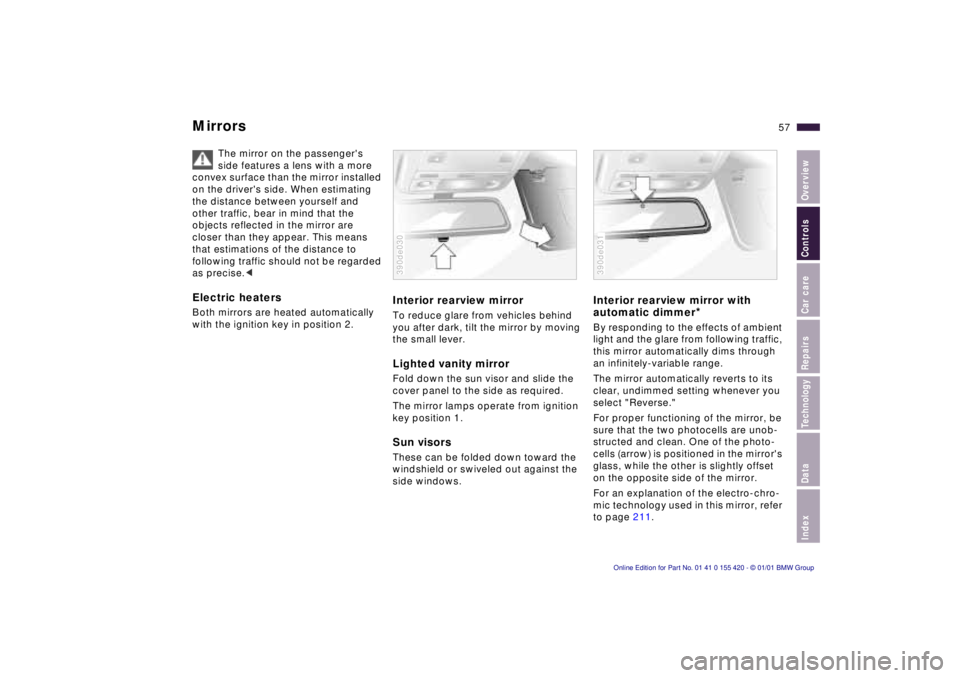
Interior rearview mirrorTo reduce glare from vehicles behind
you after dark, tilt the mirror by moving
the small lever.Lighted vanity mirrorFold down the sun visor and slide the
cover panel to the side as required.
The mirror lamps operate from ignition
key position 1.Sun visorsThese can be folded down toward the
windshield or swiveled out against the
side windows.390de030
Interior rearview mirror with
automatic dimmer
*
By responding to the effects of ambient
light and the glare from following traffic,
this mirror automatically dims through
an infinitely-variable range.
The mirror automatically reverts to its
clear, undimmed setting whenever you
select "Reverse."
For proper functioning of the mirror, be
sure that the two photocells are unob-
structed and clean. One of the photo-
cells (arrow) is positioned in the mirror's
glass, while the other is slightly offset
on the opposite side of the mirror.
For an explanation of the electro-chro-
mic technology used in this mirror, refer
to page 211.390de031
Page 63 of 238
IndexDataTechnologyRepairsCar careControlsOverview
63n
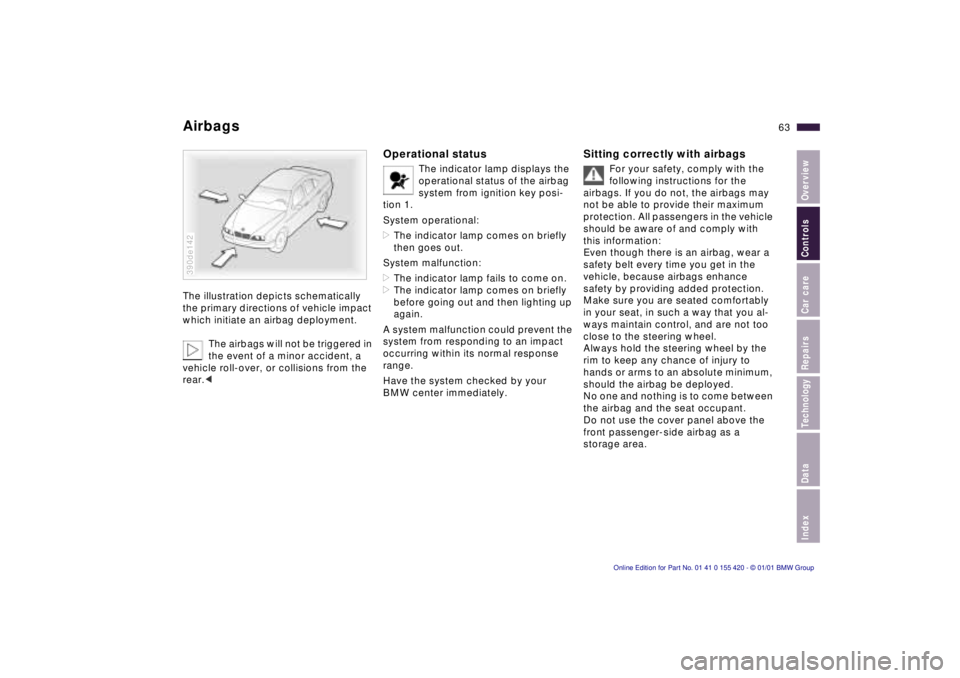
AirbagsThe illustration depicts schematically
the primary directions of vehicle impact
which initiate an airbag deployment.
The airbags will not be triggered in
the event of a minor accident, a
vehicle roll-over, or collisions from the
rear.c390de142
Operational status
The indicator lamp displays the
operational status of the airbag
system from ignition key posi-
tion 1.
System operational:
>The indicator lamp comes on briefly
then goes out.
System malfunction:
>The indicator lamp fails to come on.
>The indicator lamp comes on briefly
before going out and then lighting up
again.
A system malfunction could prevent the
system from responding to an impact
occurring within its normal response
range.
Have the system checked by your
BMW center immediately.
Sitting correctly with airbags
For your safety, comply with the
following instructions for the
airbags. If you do not, the airbags may
not be able to provide their maximum
protection. All passengers in the vehicle
should be aware of and comply with
this information:
Even though there is an airbag, wear a
safety belt every time you get in the
vehicle, because airbags enhance
safety by providing added protection.
Make sure you are seated comfortably
in your seat, in such a way that you al-
ways maintain control, and are not too
close to the steering wheel.
Always hold the steering wheel by the
rim to keep any chance of injury to
hands or arms to an absolute minimum,
should the airbag be deployed.
No one and nothing is to come between
the airbag and the seat occupant.
Do not use the cover panel above the
front passenger-side airbag as a
storage area.
Page 66 of 238
66n
Transporting children safelyCommercially-available child restraint
systems are designed to be secured
with a lap belt or with the lap belt por-
tion of a combination lap/shoulder belt.
Improperly or inadequately installed re-
straint systems can increase the risk of
injury to children. Always read and fol-
low the instructions that come with the
system.380us123
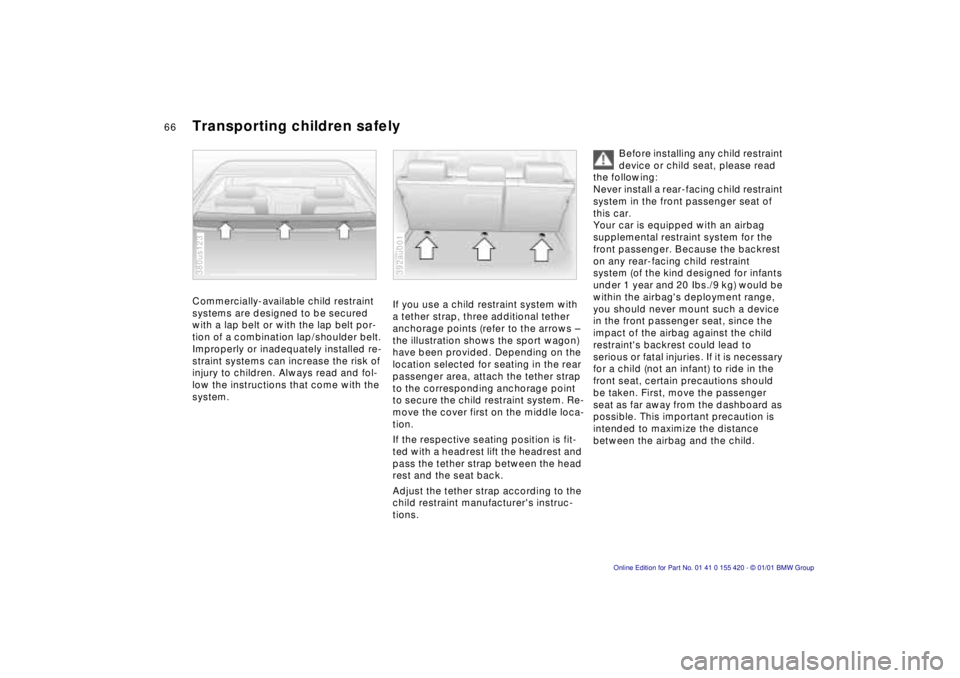
If you use a child restraint system with
a tether strap, three additional tether
anchorage points (refer to the arrows –
the illustration shows the sport wagon)
have been provided. Depending on the
location selected for seating in the rear
passenger area, attach the tether strap
to the corresponding anchorage point
to secure the child restraint system. Re-
move the cover first on the middle loca-
tion.
If the respective seating position is fit-
ted with a headrest lift the headrest and
pass the tether strap between the head
rest and the seat back.
Adjust the tether strap according to the
child restraint manufacturer's instruc-
tions.392au001
Before installing any child restraint
device or child seat, please read
the following:
Never install a rear-facing child restraint
system in the front passenger seat of
this car.
Your car is equipped with an airbag
supplemental restraint system for the
front passenger. Because the backrest
on any rear-facing child restraint
system (of the kind designed for infants
under 1 year and 20 Ibs./9 kg) would be
within the airbag's deployment range,
you should never mount such a device
in the front passenger seat, since the
impact of the airbag against the child
restraint's backrest could lead to
serious or fatal injuries. If it is necessary
for a child (not an infant) to ride in the
front seat, certain precautions should
be taken. First, move the passenger
seat as far away from the dashboard as
possible. This important precaution is
intended to maximize the distance
between the airbag and the child.
Page 70 of 238
70n
Parking brake Manual transmissionThe parking brake is primarily designed
to prevent the vehicle from rolling while
parked. It operates against the rear
wheels.To engageThe lever engages automatically and
the "PARK BRAKE" or "BRAKE" (in
Canada "P") indicator lamp comes on in
the instrument cluster in ignition key
position 2. Refer to pages 22 and 23.To releasePull up slightly on the lever, press the
button and lower the lever.390de042
If, in exceptional circumstances, it
should be necessary to engage
the parking brake while the vehicle is in
motion, do not pull it with excessive
pressure. Keep your thumb pressed
against the release button while care-
fully pulling up the lever to apply mod-
erate pressure.
Excessive pressure can lead to over-
braking and loss of traction (fishtailing)
at the rear.
The brake lamps do not come on when
the parking brake is applied.
Vehicles with manual transmission:
Always engage the parking brake
when parking on slopes and inclined
surfaces, since not even placing the
lever in 1st gear or reverse may not
provide adequate resistance to rolling.
Vehicles with automatic transmission:
Place the selector lever in "Park."<
To avoid corrosion, apply the parking
brake lightly from time to time when
coasting to a standstill (at a traffic sig-
nal, for instance), provided that it is safe
to do so.
BMW 525i, BMW 530iEvery time you shift gears, always
depress the clutch pedal all the way
down, pushing the manual-shift gear
lever into the respective end position.
Depress the clutch even when starting
the engine, otherwise, a lock will pre-
vent the engine from being started.
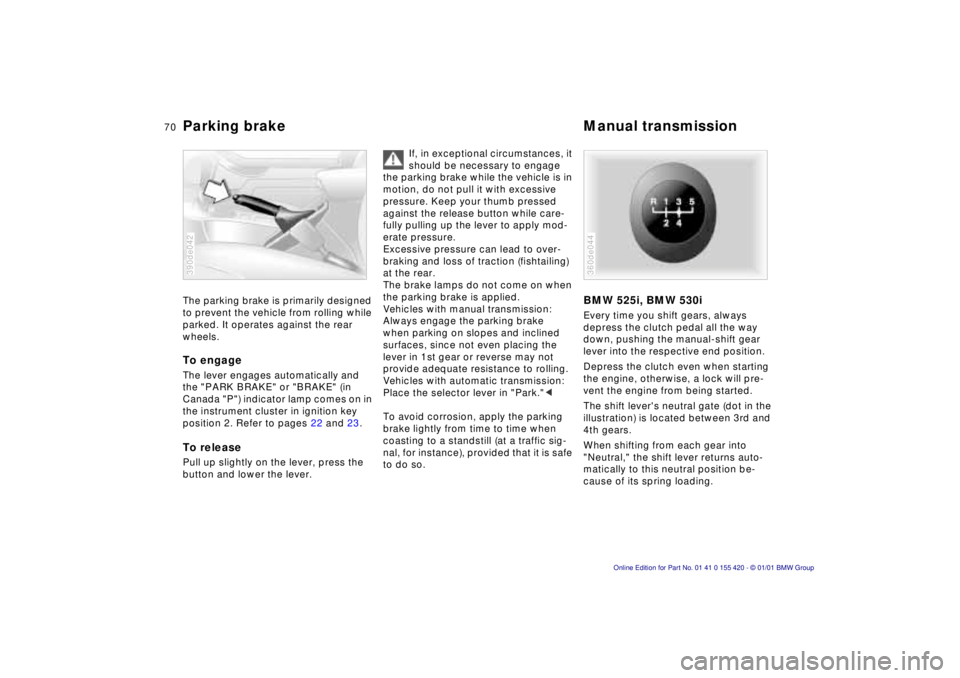
The shift lever's neutral gate (dot in the
illustration) is located between 3rd and
4th gears.
When shifting from each gear into
"Neutral," the shift lever returns auto-
matically to this neutral position be-
cause of its spring loading.360de044
Page 71 of 238
IndexDataTechnologyRepairsCar careControlsOverview
71n
Manual transmissionBMW 540iEvery time you shift gears, always
depress the clutch pedal all the way
down, pushing the manual-shift gear
lever into the respective end position.
Depress the clutch even when starting
the engine, otherwise, a lock will pre-
vent the engine from being started.
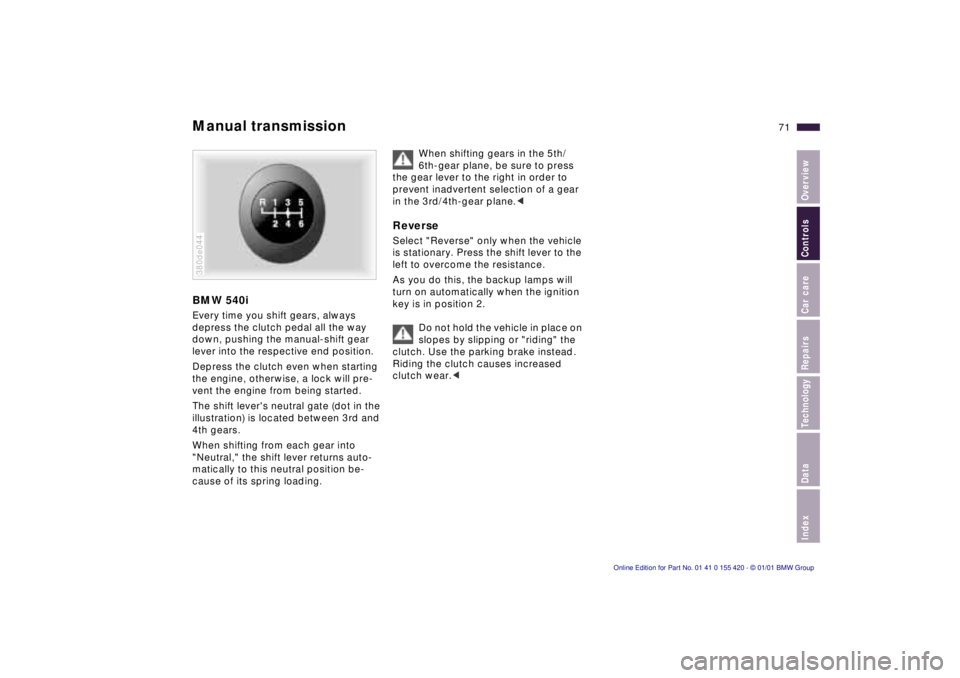
The shift lever's neutral gate (dot in the
illustration) is located between 3rd and
4th gears.
When shifting from each gear into
"Neutral," the shift lever returns auto-
matically to this neutral position be-
cause of its spring loading.380de044
When shifting gears in the 5th/
6th-gear plane, be sure to press
the gear lever to the right in order to
prevent inadvertent selection of a gear
in the 3rd/4th-gear plane.<
ReverseSelect "Reverse" only when the vehicle
is stationary. Press the shift lever to the
left to overcome the resistance.
As you do this, the backup lamps will
turn on automatically when the ignition
key is in position 2.
Do not hold the vehicle in place on
slopes by slipping or "riding" the
clutch. Use the parking brake instead.
Riding the clutch causes increased
clutch wear.<
Page 78 of 238
78n
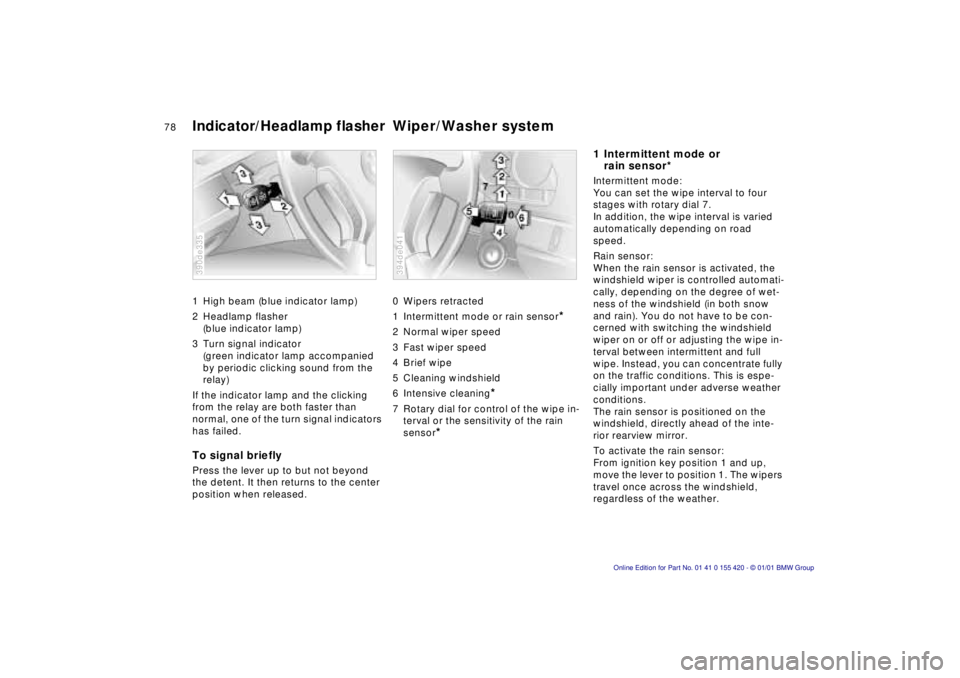
Indicator/Headlamp flasher Wiper/Washer system1 High beam (blue indicator lamp)
2 Headlamp flasher
(blue indicator lamp)
3 Turn signal indicator
(green indicator lamp accompanied
by periodic clicking sound from the
relay)
If the indicator lamp and the clicking
from the relay are both faster than
normal, one of the turn signal indicators
has failed.To signal brieflyPress the lever up to but not beyond
the detent. It then returns to the center
position when released.390de335
0 Wipers retracted
1 Intermittent mode or rain sensor
*
2 Normal wiper speed
3 Fast wiper speed
4 Brief wipe
5 Cleaning windshield
6 Intensive cleaning
*
7 Rotary dial for control of the wipe in-
terval or the sensitivity of the rain
sensor
*
394de041
1 Intermittent mode or
rain sensor*Intermittent mode:
You can set the wipe interval to four
stages with rotary dial 7.
In addition, the wipe interval is varied
automatically depending on road
speed.
Rain sensor:
When the rain sensor is activated, the
windshield wiper is controlled automati-
cally, depending on the degree of wet-
ness of the windshield (in both snow
and rain). You do not have to be con-
cerned with switching the windshield
wiper on or off or adjusting the wipe in-
terval between intermittent and full
wipe. Instead, you can concentrate fully
on the traffic conditions. This is espe-
cially important under adverse weather
conditions.
The rain sensor is positioned on the
windshield, directly ahead of the inte-
rior rearview mirror.
To activate the rain sensor:
From ignition key position 1 and up,
move the lever to position 1. The wipers
travel once across the windshield,
regardless of the weather.
Page 82 of 238

82n
Cruise controlTo interrupt the cruise controlWhen the system is activated, press
button 1. The indicator lamp stays on.
You can use the cruise control again as
desired.
In addition, the system is also automati-
cally deactivated in response to the
following conditions:
>When you apply pressure to the
brake pedal.
>When you apply pressure to the
clutch pedal, and when you move
the automatic transmission selector
lever from "Drive" to "Neutral".
>If you exceed or fall below the
programmed speed for an extended
period (by depressing the accelera-
tor, for example).
To resume the stored settingPress button 4:
The vehicle accelerates to and main-
tains the last speed stored. When you
turn the ignition key to position 0, the
stored speed is deleted from the sys-
tem's memory and the system is deacti-
vated.To deactivate the systemWhen the cruise control has been inter-
rupted, press button 1 again. The indi-
cator lamp goes off and the stored
speed is canceled.
Page 85 of 238
IndexDataTechnologyRepairsCar careControlsOverview
85n
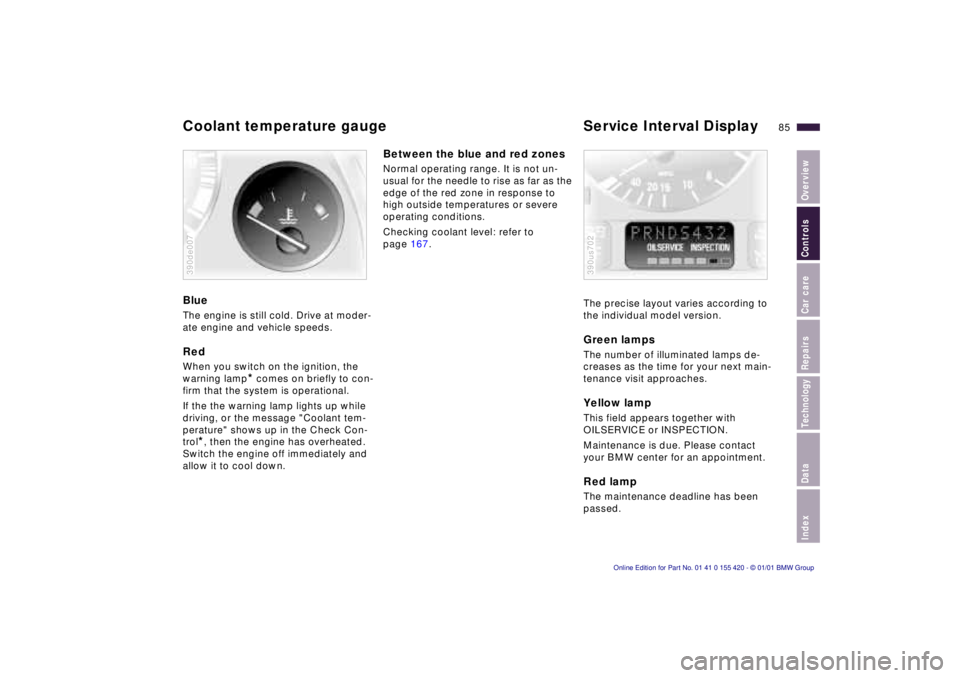
Coolant temperature gauge Service Interval DisplayBlueThe engine is still cold. Drive at moder-
ate engine and vehicle speeds.RedWhen you switch on the ignition, the
warning lamp
* comes on briefly to con-
firm that the system is operational.
If the the warning lamp lights up while
driving, or the message "Coolant tem-
perature" shows up in the Check Con-
trol
*, then the engine has overheated.
Switch the engine off immediately and
allow it to cool down.390de007
Between the blue and red zonesNormal operating range. It is not un-
usual for the needle to rise as far as the
edge of the red zone in response to
high outside temperatures or severe
operating conditions.
Checking coolant level: refer to
page 167.
The precise layout varies according to
the individual model version.
Green lampsThe number of illuminated lamps de-
creases as the time for your next main-
tenance visit approaches.Yellow lampThis field appears together with
OILSERVICE or INSPECTION.
Maintenance is due. Please contact
your BMW center for an appointment.Red lampThe maintenance deadline has been
passed.390us702
Page 101 of 238

IndexDataTechnologyRepairsCar careControlsOverview
101n
Park Distance Control (PDC)
*
The PDC does not remove the
driver's personal responsibility
for evaluating the distance between the
vehicle and any obstacles. Even when
sensors are involved, there is a blind
spot in which objects cannot be de-
tected. This applies especially in those
cases where the system approaches
the physical limits of ultrasonic mea-
surement, as occurs with tow bars and
trailer couplings, and in the vicinity of
thin and painted objects.
Certain sources of sound, such as a
loud radio, could drown the PDC signal
tone.<
Keep the sensors clean and free
of ice or snow in order to ensure
that they continue to operate effectively.
Do not apply high pressure spray to the
sensors for a prolonged period of time.
Maintain an adequate distance of more
than approx. 4 in (10 cm).<
Page 102 of 238
102n
ASC+T/DSC
*
Automatic Stability Control plus
Traction (ASC+T)/Dynamic
Stability Control (DSC)
*
These systems contribute to additional
vehicle stability, especially during
acceleration and when cornering.
The DSC system enhances the benefits
of the ASC+T. In addition to optimizing
vehicle stability and traction during
acceleration or when starting from a
standstill, a further benefit is realized in
cornering. This, of course, is true only
within physically feasible limits.
The system activates automatically
each time you start the engine.
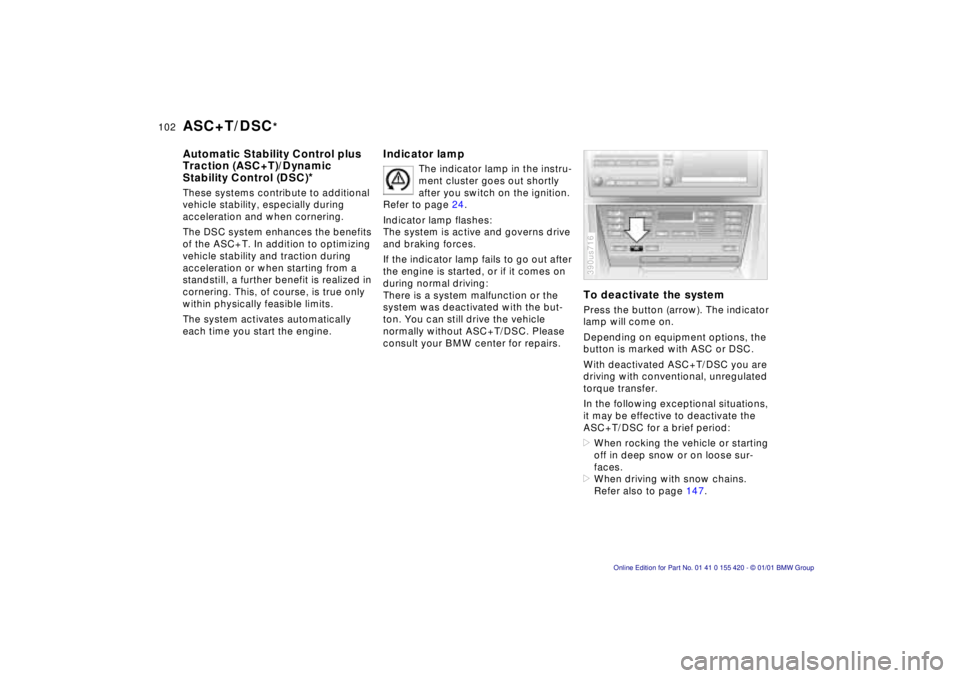
To deactivate the systemPress the button (arrow). The indicator
lamp will come on.
Depending on equipment options, the
button is marked with ASC or DSC.
With deactivated ASC+T/DSC you are
driving with conventional, unregulated
torque transfer.
In the following exceptional situations,
it may be effective to deactivate the
ASC+T/DSC for a brief period:
>When rocking the vehicle or starting
off in deep snow or on loose sur-
faces.
>When driving with snow chains.
Refer also to page 147.390us716
Indicator lamp
The indicator lamp in the instru-
ment cluster goes out shortly
after you switch on the ignition.
Refer to page 24.
Indicator lamp flashes:
The system is active and governs drive
and braking forces.
If the indicator lamp fails to go out after
the engine is started, or if it comes on
during normal driving:
There is a system malfunction or the
system was deactivated with the but-
ton. You can still drive the vehicle
normally without ASC+T/DSC. Please
consult your BMW center for repairs.