ESP BMW 540I SEDAN 2001 Service Manual
[x] Cancel search | Manufacturer: BMW, Model Year: 2001, Model line: 540I SEDAN, Model: BMW 540I SEDAN 2001Pages: 238, PDF Size: 2.44 MB
Page 174 of 238

174nCaring for your car
Window care
You can use window and glass cleaner
to clean inside window surfaces and
mirrors without smearing and streaking.
Never use polishing pastes or abrasive
(quartz) cleansers on mirror lenses.
When caring for break-resistant
security glass
*, observe the fol-
lowing instructions:
The inner surface of the side windows
is coated with a plastic film. For this
reason, do not affix any decals or adhe-
sive stickers on the inside of these win-
dows unless they are to be placed there
permanently.
Wash the glass with clean water. If nec-
essary, you may add a commercially-
available mild household cleaner. Do
not use abrasive cleaners.
If the windows are fogged or iced over,
treat them with an anti-misting cloth or
a deicer spray – do not use an ice
scraper. <
Clean the wiper blades with soapy wa-
ter. The wiper blades should be re-
placed twice a year, before and after
the cold season.
Use only wiper blades which have
been approved by BMW. <
Caring for other vehicle
components and materials
Light-alloy wheels should be treated
with alloy wheel cleaner, especially
during the winter months. However, do
not use aggressive products contain-
ing acids, strong alkalis or abrasives.
Do not use steam cleaners operating at
temperatures above 140 7 (60 6).
(Follow the manufacturer's instruc-
tions.)
If your vehicle has chrome parts
* such
as window moldings, door handles or
other items, clean these parts carefully
with ample clean water, especially if
they have an accumulation of road salt.
Use a chrome polish for an additional
treatment.
Plastic components, vinyl upholstery,
headliners, lamp lenses, the clear cover
of the instrument cluster and compo-
nents with a sprayed dull black surface
can be cleaned with water (add plastic
cleaner as required). Do not allow mois-
ture to soak through the seats or head-
liner. Never use solvents such as lac-
quer thinner, heavy-duty grease
remover, fuels, etc. Rubber components should be cleaned
with water only; a rubber treatment or
silicone spray may also be applied.
The safety belts should be cleaned with
a mild soap and water solution without
being removed from the vehicle. Never
attempt chemical or dry cleaning, as
damage to the belt fabric could result.
After cleaning, never allow the inertia
reel to retract the belts until they are
completely dry. Dirty safety belts pre-
vent the inertia reel mechanism from
retracting the strap properly, and thus
constitute a safety hazard.
Heavily soiled floor carpets and mats
*
can be cleaned with an interior cleaner.
The floor mats can be removed from
the vehicle for cleaning.
Please use only a damp cloth to clean
wooden fascia panels and components.
Follow up by drying with a soft cloth.
Use cleaning and car-care
products that you can obtain
at your BMW center. <
Page 176 of 238
176nAirbags Vehicle storage
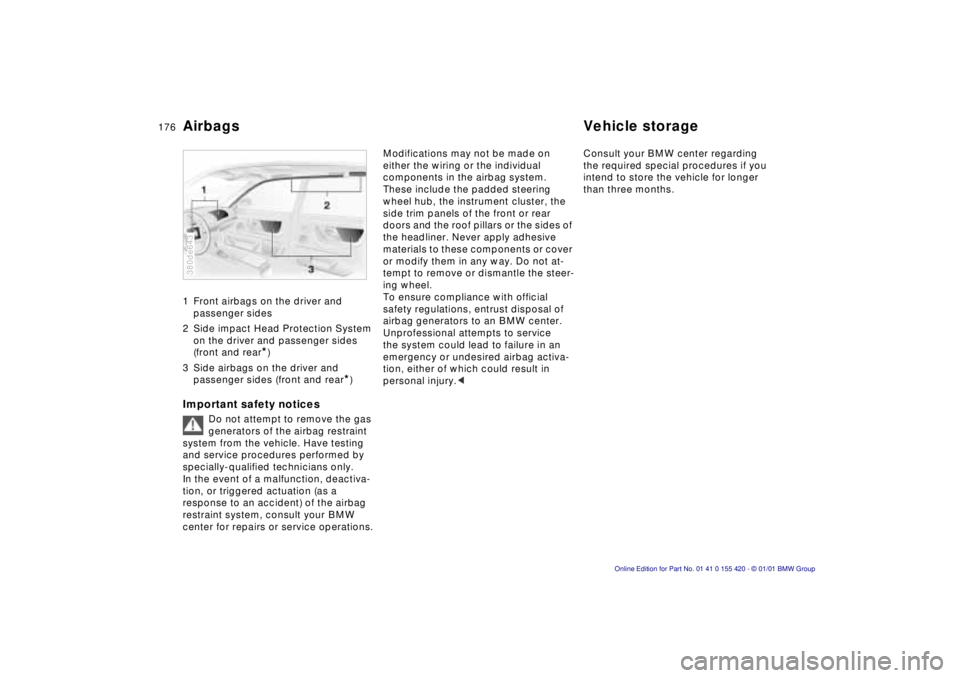
1 Front airbags on the driver and
passenger sides
2 Side impact Head Protection System on the driver and passenger sides
(front and rear
*)
3 Side airbags on the driver and passenger sides (front and rear
*)
Important safety notices
Do not attempt to remove the gas
generators of the airbag restraint
system from the vehicle. Have testing
and service procedures performed by
specially-qualified technicians only.
In the event of a malfunction, deactiva-
tion, or triggered actuation (as a
response to an accident) of the airbag
restraint system, consult your BMW
center for repairs or service operations.
380de643
Modifications may not be made on
either the wiring or the individual
components in the airbag system.
These include the padded steering
wheel hub, the instrument cluster, the
side trim panels of the front or rear
doors and the roof pillars or the sides of
the headliner. Never apply adhesive
materials to these components or cover
or modify them in any way. Do not at-
tempt to remove or dismantle the steer-
ing wheel.
To ensure compliance with official
safety regulations, entrust disposal of
airbag generators to an BMW center.
Unprofessional attempts to service
the system could lead to failure in an
emergency or undesired airbag activa-
tion, either of which could result in
personal injury. < Consult your BMW center regarding
the required special procedures if you
intend to store the vehicle for longer
than three months.
Page 178 of 238
178nOBD interface socket
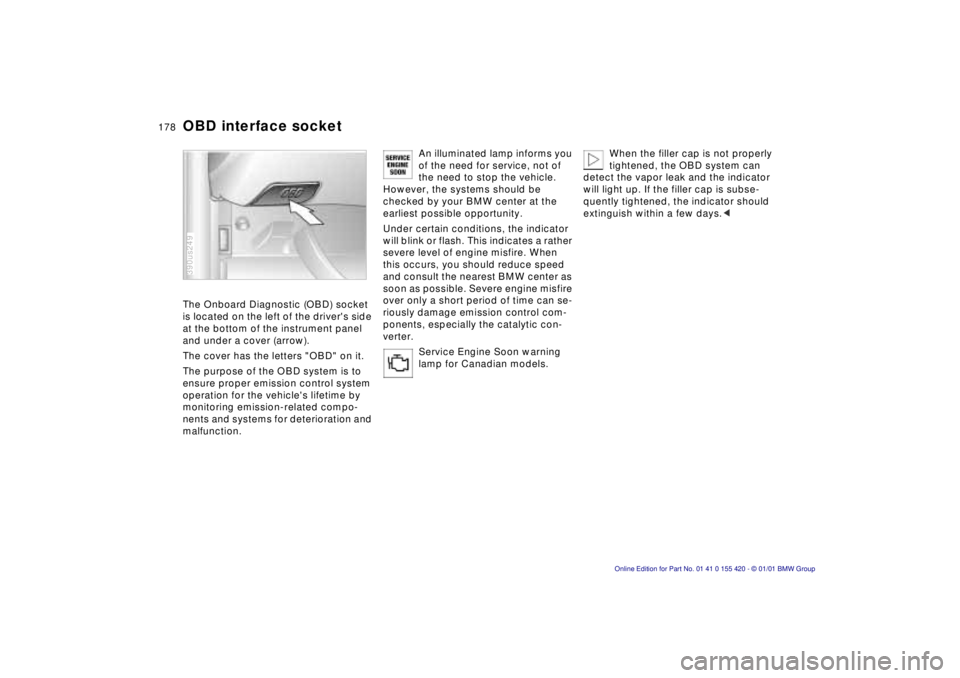
The Onboard Diagnostic (OBD) socket
is located on the left of the driver's side
at the bottom of the instrument panel
and under a cover (arrow).
The cover has the letters "OBD" on it.
The purpose of the OBD system is to
ensure proper emission control system
operation for the vehicle's lifetime by
monitoring emission-related compo-
nents and systems for deterioration and
malfunction.
390us249
An illuminated lamp informs you
of the need for service, not of
the need to stop the vehicle.
However, the systems should be
checked by your BMW center at the
earliest possible opportunity.
Under certain conditions, the indicator
will blink or flash. This indicates a rather
severe level of engine misfire. When
this occurs, you should reduce speed
and consult the nearest BMW center as
soon as possible. Severe engine misfire
over only a short period of time can se-
riously damage emission control com-
ponents, especially the catalytic con-
verter.
Service Engine Soon warning
lamp for Canadian models.When the filler cap is not properly
tightened, the OBD system can
detect the vapor leak and the indicator
will light up. If the filler cap is subse-
quently tightened, the indicator should
extinguish within a few days. <
Page 186 of 238
186nLamps and bulbs
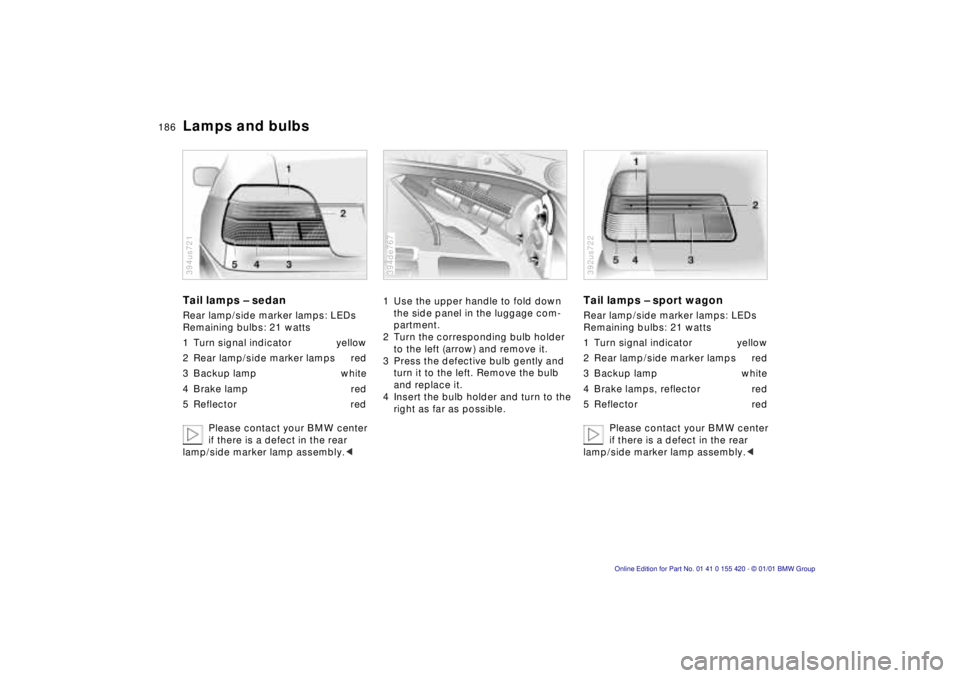
Tail lamps – sedan
Rear lamp/side marker lamps: LEDs
Remaining bulbs: 21 watts
1 Turn signal indicator yellow
2 Rear lamp/side marker lamps red
3 Backup lamp white
4 Brake lamp red
5 Reflector red
Please contact your BMW center
if there is a defect in the rear
lamp/side marker lamp assembly. <
394us721
1 Use the upper handle to fold down
the side panel in the luggage com-
partment.
2 Turn the corresponding bulb holder to the left (arrow) and remove it.
3 Press the defective bulb gently and turn it to the left. Remove the bulb
and replace it.
4 Insert the bulb holder and turn to the right as far as possible.
394de767
Tail lamps – sport wagon
Rear lamp/side marker lamps: LEDs
Remaining bulbs: 21 watts
1 Turn signal indicator yellow
2 Rear lamp/side marker lamps red
3 Backup lamp white
4 Brake lamps, reflector red
5 Reflector red
Please contact your BMW center
if there is a defect in the rear
lamp/side marker lamp assembly. <
392us722
Page 193 of 238
Index
Data
Technology
Repairs
Car care
Controls
Overview
193nChanging a wheel Battery
When storing the wheel, take care to
ensure that you do not damage the
retaining pin in the spare tire recess.
If light-alloy wheels other than original
BMW light-alloy wheels have been
mounted, it may be necessary to use
different lug bolts for those wheels.
Replace the defective tire as soon as
possible and have the new wheel/tire
balanced.
Size 255/40 R17 94 W
* tires on
the rear axle:
In the event of a puncture or other tire
failure, it may be necessary to mount
the spare tire of different size at the
rear. This tire is of full capacity in all
load and speed ranges. Nevertheless,
mount a tire of the correct size as soon
as possible. <
Battery posts, terminals, and re-
lated accessories contain lead
and lead compounds. Wash hands after
handling. <
Installation location
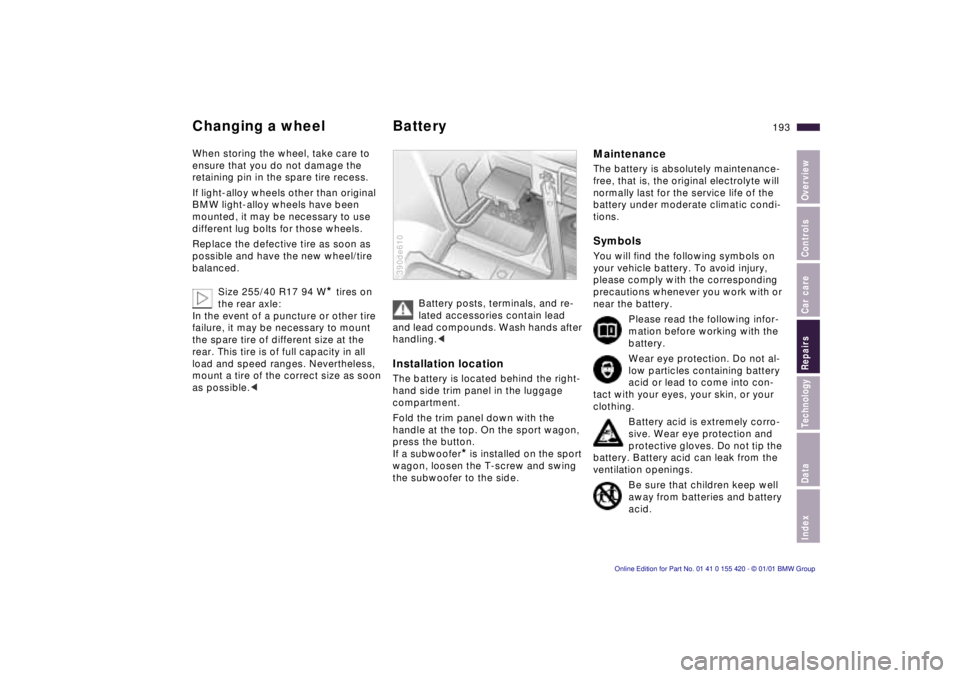
The battery is located behind the right-
hand side trim panel in the luggage
compartment.
Fold the trim panel down with the
handle at the top. On the sport wagon,
press the button.
If a subwoofer
* is installed on the sport
wagon, loosen the T-screw and swing
the subwoofer to the side.
390de610
Maintenance
The battery is absolutely maintenance-
free, that is, the original electrolyte will
normally last for the service life of the
battery under moderate climatic condi-
tions.
Symbols
You will find the following symbols on
your vehicle battery. To avoid injury,
please comply with the corresponding
precautions whenever you work with or
near the battery.
Please read the following infor-
mation before working with the
battery.
Wear eye protection. Do not al-
low particles containing battery
acid or lead to come into con-
tact with your eyes, your skin, or your
clothing.
Battery acid is extremely corro-
sive. Wear eye protection and
protective gloves. Do not tip the
battery. Battery acid can leak from the
ventilation openings.
Be sure that children keep well
away from batteries and battery
acid.
Page 194 of 238
194nBattery
Never allow sparks or open
flame near the battery. Do not
smoke in the vicinity of the
battery. Avoid sparks from electrical
cables or electrical equipment. Turn the
key to position 0 in the steering lock
during the disconnection or connection
of the battery. Never short-circuit the
battery terminals. There is a danger of
injury from powerful sparks.
A highly-explosive gas is
generated when the battery is
charged.
If you happen to get acid in your
eyes, rinse thoroughly for
15 minutes with clear water.
Following that, consult a physician
immediately. If you get acid spray on
your skin or clothing, rinse with plenty
of water. If electrolyte is accidentally
swallowed, consult a physician immedi-
ately.
In order to protect the battery
case from ultraviolet radiation,
do not place it in direct sunlight.
A discharged battery can freeze. Store
the battery in areas where the tempera-
ture remains above freezing.
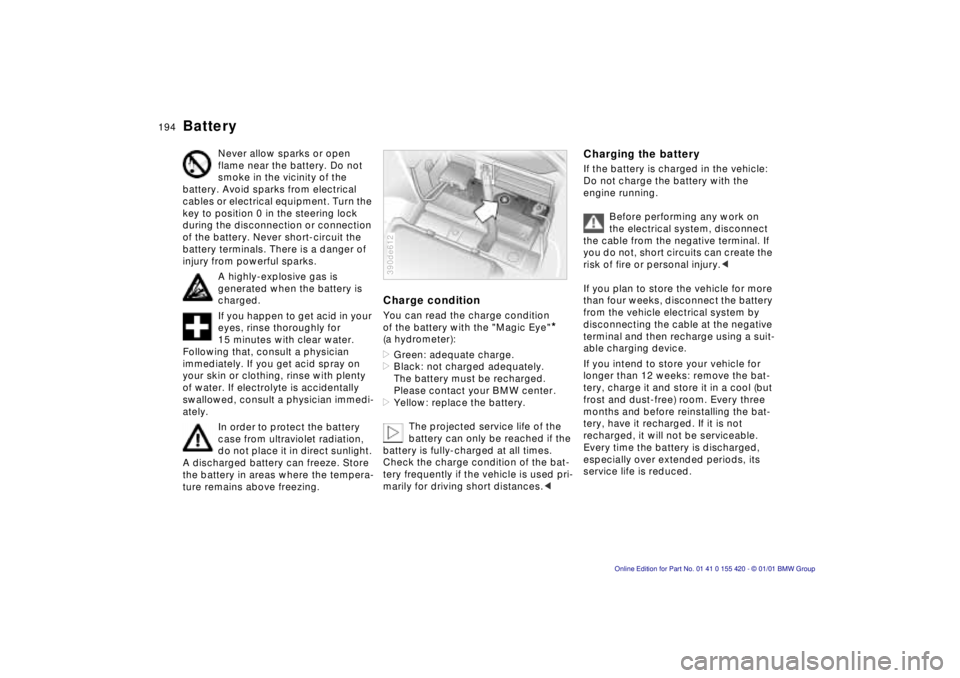
Charge condition
You can read the charge condition
of the battery with the "Magic Eye"
*
(a hydrometer):
> Green: adequate charge.
> Black: not charged adequately.
The battery must be recharged.
Please contact your BMW center.
> Yellow: replace the battery.
The projected service life of the
battery can only be reached if the
battery is fully-charged at all times.
Check the charge condition of the bat-
tery frequently if the vehicle is used pri-
marily for driving short distances. <
390de612
Charging the battery
If the battery is charged in the vehicle:
Do not charge the battery with the
engine running.
Before performing any work on
the electrical system, disconnect
the cable from the negative terminal. If
you do not, short circuits can create the
risk of fire or personal injury. <
If you plan to store the vehicle for more
than four weeks, disconnect the battery
from the vehicle electrical system by
disconnecting the cable at the negative
terminal and then recharge using a suit-
able charging device.
If you intend to store your vehicle for
longer than 12 weeks: remove the bat-
tery, charge it and store it in a cool (but
frost and dust-free) room. Every three
months and before reinstalling the bat-
tery, have it recharged. If it is not
recharged, it will not be serviceable.
Every time the battery is discharged,
especially over extended periods, its
service life is reduced.
Page 196 of 238
196nFuses
When an electrical accessory fails to
operate, switch it off and inspect the
fuse.
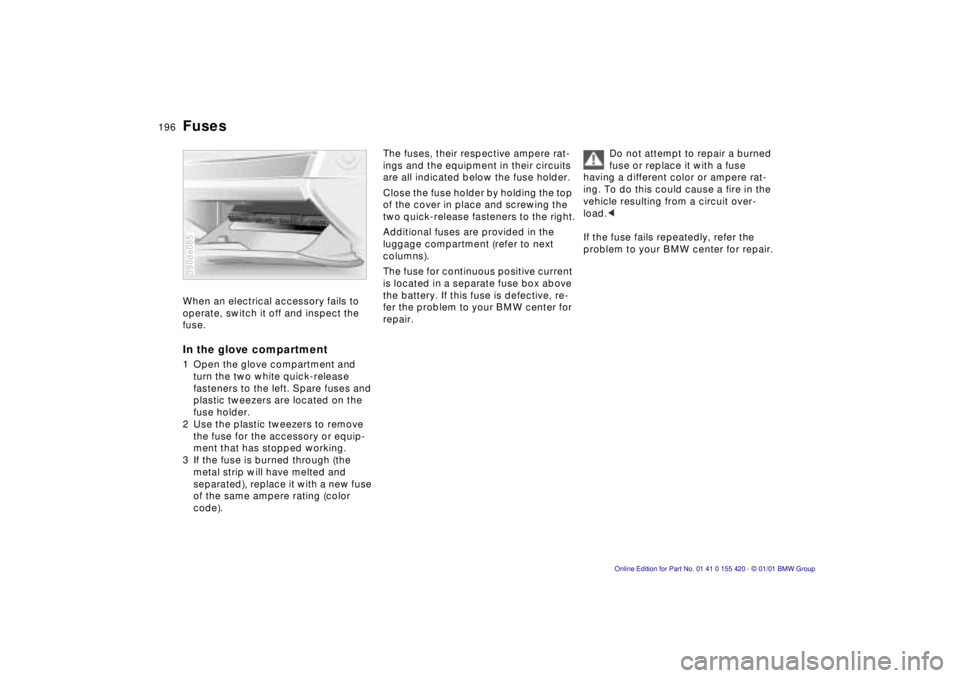
In the glove compartment
1 Open the glove compartment and
turn the two white quick-release
fasteners to the left. Spare fuses and
plastic tweezers are located on the
fuse holder.
2 Use the plastic tweezers to remove the fuse for the accessory or equip-
ment that has stopped working.
3 If the fuse is burned through (the
metal strip will have melted and
separated), replace it with a new fuse
of the same ampere rating (color
code).
390de085
The fuses, their respective ampere rat-
ings and the equipment in their circuits
are all indicated below the fuse holder.
Close the fuse holder by holding the top
of the cover in place and screwing the
two quick-release fasteners to the right.
Additional fuses are provided in the
luggage compartment (refer to next
columns).
The fuse for continuous positive current
is located in a separate fuse box above
the battery. If this fuse is defective, re-
fer the problem to your BMW center for
repair. Do not attempt to repair a burned
fuse or replace it with a fuse
having a different color or ampere rat-
ing. To do this could cause a fire in the
vehicle resulting from a circuit over-
load. <
If the fuse fails repeatedly, refer the
problem to your BMW center for repair.
Page 197 of 238
Index
Data
Technology
Repairs
Car care
Controls
Overview
197nFuses
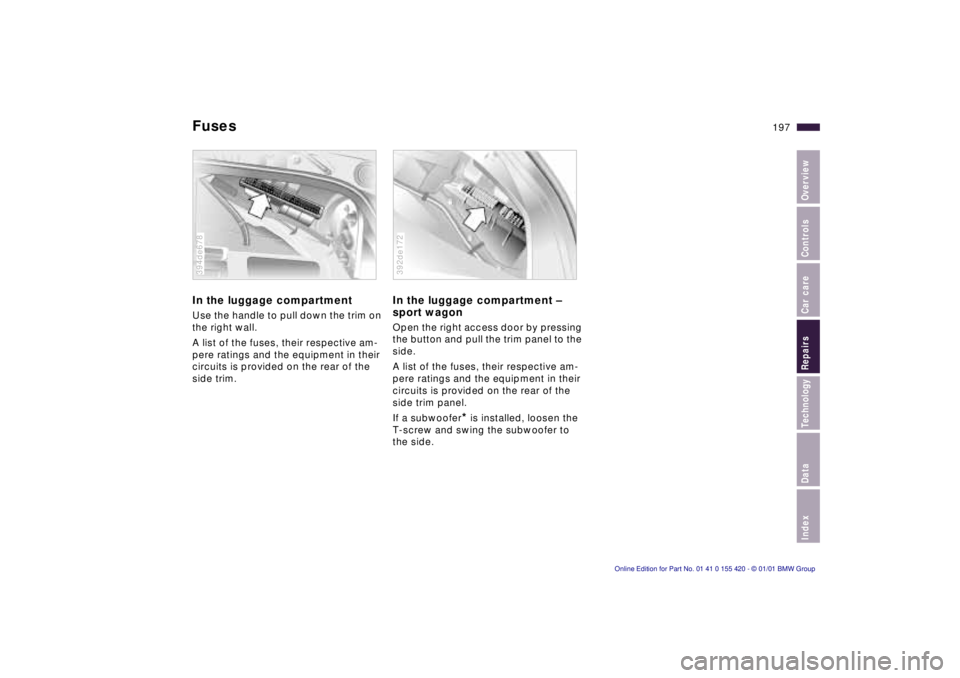
In the luggage compartment
Use the handle to pull down the trim on
the right wall.
A list of the fuses, their respective am-
pere ratings and the equipment in their
circuits is provided on the rear of the
side trim.
394de678
In the luggage compartment –
sport wagon
Open the right access door by pressing
the button and pull the trim panel to the
side.
A list of the fuses, their respective am-
pere ratings and the equipment in their
circuits is provided on the rear of the
side trim panel.
If a subwoofer
* is installed, loosen the
T-screw and swing the subwoofer to
the side.
392de172
Page 202 of 238
202nTowing the vehicle
The towed vehicle should always
be the lighter of the two vehicles.
If this is not the case, it is no longer
possible to control vehicle response. <
Tow-starting
It is not possible to start the engine of
vehicles equipped with an automatic
transmission by towing or pushing.
For instructions on jump starting, refer
to page 200.
Never attempt to use your vehicle to
push another vehicle, since damage to
the energy-absorbing bumpers could
result.
Towing a vehicle with automatic
transmission
1 Place the selector lever in position N.
2 Towing speed: Max. 45 mph (70 km/h).
3 Towing distance: Max. 95 miles (150 km).
4 Leave the ignition key in position 1 to ensure that the brake lamps, turn sig-
nals, horn and windshield wipers re-
main operative, and to prevent the
steering lock detent from engaging.
5 Switch on the hazard warning flash- ers (observe country-specific regula-
tions).
Find some means of identifying the ve-
hicle in tow, for instance, place a sign
or warning triangle in the rear window.
Make sure that the ignition key
remains in position 1 even when
the electrical system has failed to pre-
vent the steering lock from engaging.
The steering and brakes are without
power assist when the engine is off.
This means that increased effort is
required for steering and braking. <
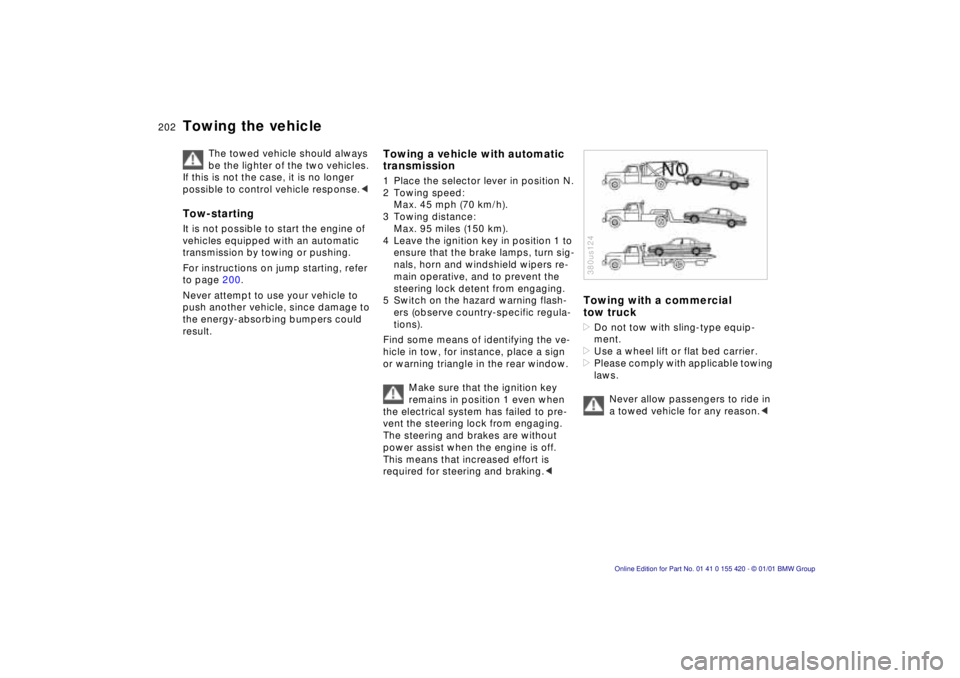
Towing with a commercial
tow truck
> Do not tow with sling-type equip-
ment.
> Use a wheel lift or flat bed carrier.
> Please comply with applicable towing
laws.
Never allow passengers to ride in
a towed vehicle for any reason. <
380us124
Page 208 of 238

208nASC+T/DSC*
Precision sensors monitor the number
of revolutions of the wheels. When
equipped with DSC, they also monitor
steering angle, lateral acceleration,
brake pressure and the movement of
the vehicle around its vertical axis.
If differences in the wheel speeds
occur, the system counteracts the dan-
ger of wheelspin by reducing torque. If
necessary, the system also responds
with additional brake applications at the
rear wheels, and at all 4 wheels with
DSC.
In addition, DSC permanently monitors
the vehicle's current operating condi-
tion and compares it with an ideal con-
dition that is calculated from the sen-
sor's signals. If deviations from this
occur (understeering or oversteering,
for instance), DSC can stabilize the
vehicle in the fraction of a second by
reducing engine output and with the
assistance of braking intervention at in-
dividual wheels. As a result, dangerous
skids can be prevented even as they
are just beginning. You may need some time to become
accustomed to this system intervention.
However, it guarantees optimum drive
force and driving stability.
The braking intervention may be
accompanied by a certain degree of
noise.