engine BMW 540I SEDAN 2001 Repair Manual
[x] Cancel search | Manufacturer: BMW, Model Year: 2001, Model line: 540I SEDAN, Model: BMW 540I SEDAN 2001Pages: 238, PDF Size: 2.44 MB
Page 190 of 238
190nChanging a wheel
Safety measures in the event of a
flat tire or wheel change:
Stop the vehicle as far as possible from
passing traffic. Park on a firm, flat,
surface. Switch on the hazard warning
flashers.
Turn the steering wheel to the straight-
ahead position, remove the key and
engage the steering lock. Shift into 1st
or reverse (selector lever in Park with
automatic transmission) and engage
the parking brake.
All passengers should be outside the
vehicle and well away from your imme-
diate working area (behind a guardrail,
for instance).
If necessary, set up your warning trian-
gle or portable hazard warning lamp on
the roadside at an appropriate distance
from the rear of the vehicle. Comply
with all safety guidelines and regula-
tions.
Change the wheel only on a level, firm
surface which is not slippery. Avoid
jacking the vehicle on a soft or slippery
support surface (snow, ice, loose
gravel, etc.), since it could slide side-
ways.Position the jack on a firm support
surface.
Do not place wooden blocks or similar
objects under the jack. If this is done,
the jack might not be able to reach its
full support capacity because of the
limited height.
Do not lie under the vehicle or start the
engine when the vehicle is supported
by the jack – risk of fatal injury. <
What you will need
In order to avoid rattling noises later,
note the position of the tools when you
remove them and return them to their
original position when you are through
using them.
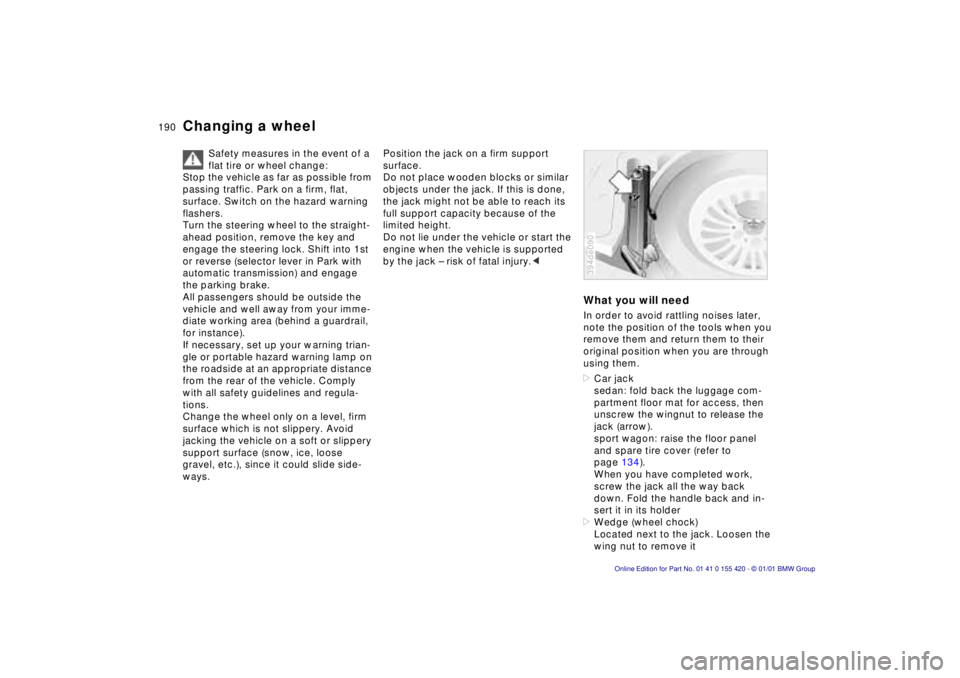
> Car jack
sedan: fold back the luggage com-
partment floor mat for access, then
unscrew the wingnut to release the
jack (arrow).
sport wagon: raise the floor panel
and spare tire cover (refer to
page 134).
When you have completed work,
screw the jack all the way back
down. Fold the handle back and in-
sert it in its holder
> Wedge (wheel chock)
Located next to the jack. Loosen the
wing nut to remove it
394de090
Page 194 of 238
194nBattery
Never allow sparks or open
flame near the battery. Do not
smoke in the vicinity of the
battery. Avoid sparks from electrical
cables or electrical equipment. Turn the
key to position 0 in the steering lock
during the disconnection or connection
of the battery. Never short-circuit the
battery terminals. There is a danger of
injury from powerful sparks.
A highly-explosive gas is
generated when the battery is
charged.
If you happen to get acid in your
eyes, rinse thoroughly for
15 minutes with clear water.
Following that, consult a physician
immediately. If you get acid spray on
your skin or clothing, rinse with plenty
of water. If electrolyte is accidentally
swallowed, consult a physician immedi-
ately.
In order to protect the battery
case from ultraviolet radiation,
do not place it in direct sunlight.
A discharged battery can freeze. Store
the battery in areas where the tempera-
ture remains above freezing.
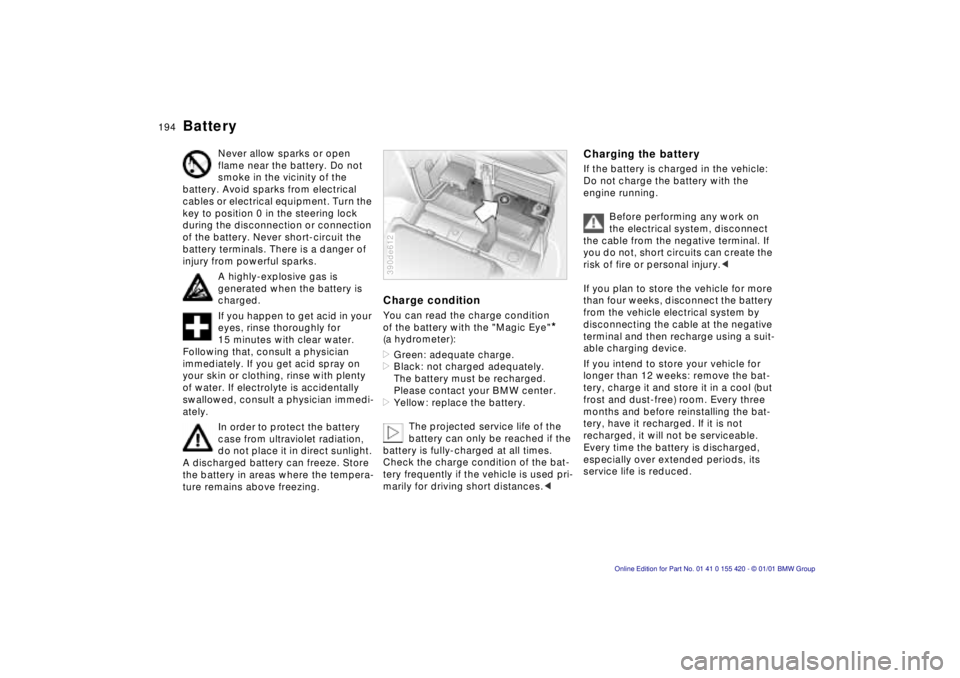
Charge condition
You can read the charge condition
of the battery with the "Magic Eye"
*
(a hydrometer):
> Green: adequate charge.
> Black: not charged adequately.
The battery must be recharged.
Please contact your BMW center.
> Yellow: replace the battery.
The projected service life of the
battery can only be reached if the
battery is fully-charged at all times.
Check the charge condition of the bat-
tery frequently if the vehicle is used pri-
marily for driving short distances. <
390de612
Charging the battery
If the battery is charged in the vehicle:
Do not charge the battery with the
engine running.
Before performing any work on
the electrical system, disconnect
the cable from the negative terminal. If
you do not, short circuits can create the
risk of fire or personal injury. <
If you plan to store the vehicle for more
than four weeks, disconnect the battery
from the vehicle electrical system by
disconnecting the cable at the negative
terminal and then recharge using a suit-
able charging device.
If you intend to store your vehicle for
longer than 12 weeks: remove the bat-
tery, charge it and store it in a cool (but
frost and dust-free) room. Every three
months and before reinstalling the bat-
tery, have it recharged. If it is not
recharged, it will not be serviceable.
Every time the battery is discharged,
especially over extended periods, its
service life is reduced.
Page 195 of 238
Index
Data
Technology
Repairs
Car care
Controls
Overview
195nBattery
Return used batteries to a
recycling point or your authorized
BMW center. Maintain the battery in
an upright position for transport and
storage. Secure the battery against
falling over in transit. <
Removal and installation
Do not disconnect the battery
when the engine is running. Dis-
connecting the battery cable when the
engine is running will cause a voltage
surge which will damage the vehicle's
onboard electronics.
Do not make any modifications in the
wires to the positive terminal. If you do
so, the protective function of the safety
battery terminal is no longer ensured.
Repairs and disposal may only be
performed by specially-trained person-
nel. <
390de611
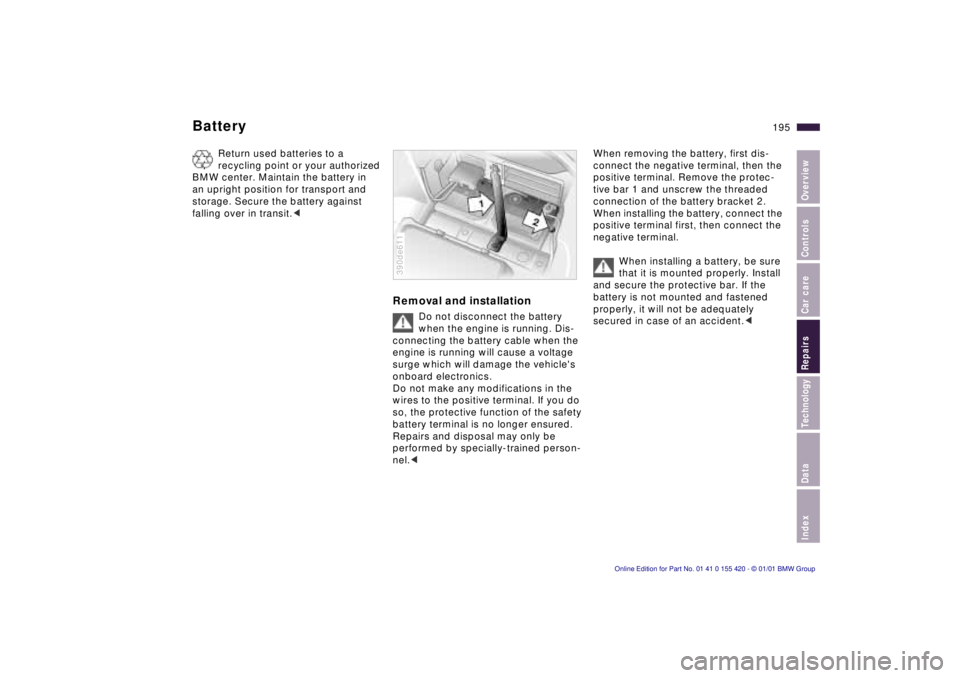
When removing the battery, first dis-
connect the negative terminal, then the
positive terminal. Remove the protec-
tive bar 1 and unscrew the threaded
connection of the battery bracket 2.
When installing the battery, connect the
positive terminal first, then connect the
negative terminal.
When installing a battery, be sure
that it is mounted properly. Install
and secure the protective bar. If the
battery is not mounted and fastened
properly, it will not be adequately
secured in case of an accident. <
Page 200 of 238
200n
Never use spray starter fluids.
If the battery is discharged, the engine
can be started with the use of two
jumper cables and the battery of
another vehicle. Always use jumper
cables with fully insulated handles on
the terminal clamps. Do not touch high-voltage wiring
and cables on a running engine.
There is a risk of fatal injury if you do
this. <
Carefully comply with the following in-
structions to avoid personal injury and
damage to one or both vehicles:
1 Ensure that the battery on the sup- port vehicle is also rated at 12 volts,
and that the capacities of the two
batteries (Ah) are roughly comparable
(printed on casing).
2 Leave the discharged battery connected to the vehicle electrical
system.
3 Make sure that there is no contact between the bodywork of the two
vehicles – short circuit risk.
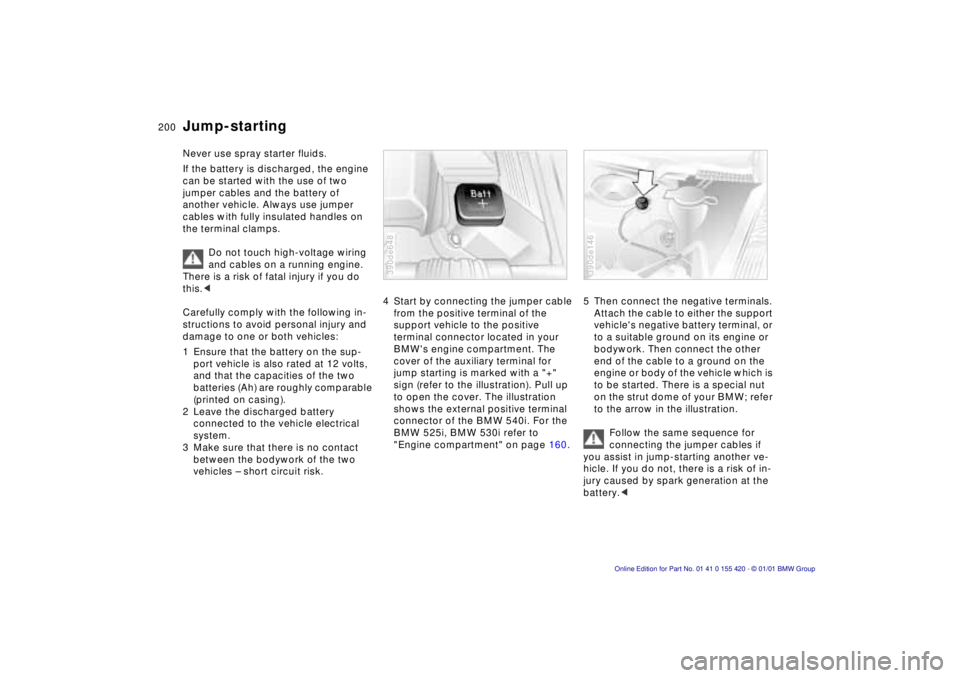
4 Start by connecting the jumper cable from the positive terminal of the
support vehicle to the positive
terminal connector located in your
BMW's engine compartment. The
cover of the auxiliary terminal for
jump starting is marked with a "+"
sign (refer to the illustration). Pull up
to open the cover. The illustration
shows the external positive terminal
connector of the BMW 540i. For the
BMW 525i, BMW 530i refer to
"Engine compartment" on page 160.
390de648
5 Then connect the negative terminals.
Attach the cable to either the support
vehicle's negative battery terminal, or
to a suitable ground on its engine or
bodywork. Then connect the other
end of the cable to a ground on the
engine or body of the vehicle which is
to be started. There is a special nut
on the strut dome of your BMW; refer
to the arrow in the illustration.
Follow the same sequence for
connecting the jumper cables if
you assist in jump-starting another ve-
hicle. If you do not, there is a risk of in-
jury caused by spark generation at the
battery. <
390de146
Jump-starting
Page 201 of 238
Index
Data
Technology
Repairs
Car care
Controls
Overview
201nJump-starting Towing the vehicle
6 Start the engine of the support
vehicle and let it run.
7 Start the engine on the vehicle needing the jump-start, and allow it
to run as usual. If the first start at-
tempt is not successful, wait a few
minutes before another attempt in
order to allow the discharged battery
to recharge.
8 Before disconnecting the jumper cables from your BMW, turn on the
headlamps, the rear window
defroster and the highest blower
speed and allow the engine to run
at least 10 seconds to prevent a volt-
age surge at the voltage regulator.
9 Then disconnect the jumper cables in the opposite order.
Have the battery recharged if neces-
sary.
Tow fitting
The screw-in tow fitting is stored in the
onboard tool kit; be sure that it remains
in the vehicle at all times. This fitting
is designed for installation in the tow
sockets located at the front and rear of
the vehicle, and is intended for towing
on proper road surfaces only.
It should not be used to pull a vehicle
out of deep snow, mud, sand, etc. Al-
ways observe all applicable towing laws
and regulations.
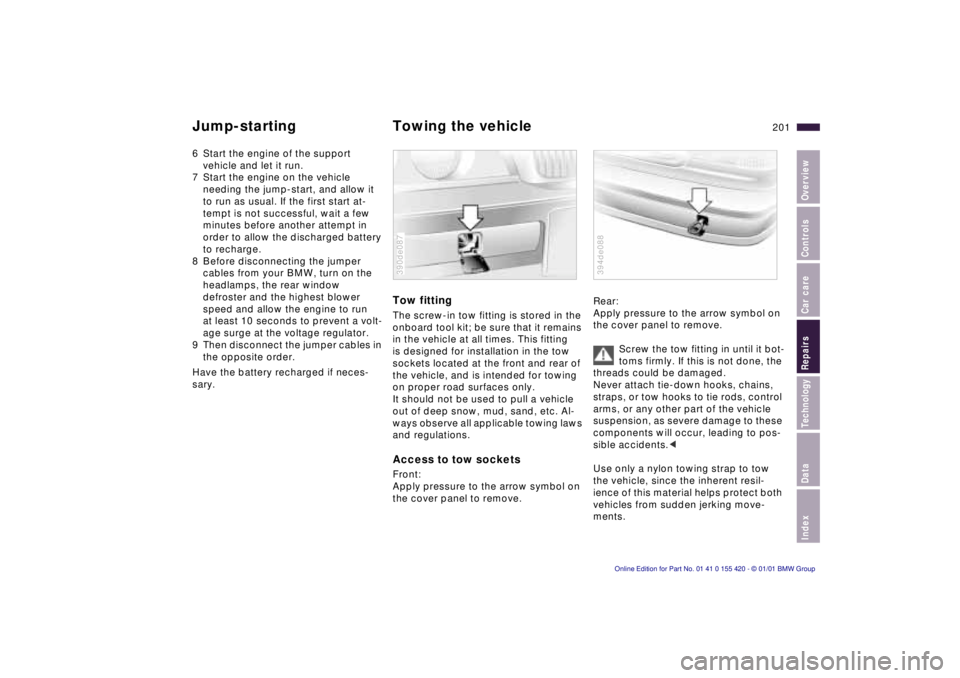
Access to tow sockets
Front:
Apply pressure to the arrow symbol on
the cover panel to remove.
390de087
Rear:
Apply pressure to the arrow symbol on
the cover panel to remove.
Screw the tow fitting in until it bot-
toms firmly. If this is not done, the
threads could be damaged.
Never attach tie-down hooks, chains,
straps, or tow hooks to tie rods, control
arms, or any other part of the vehicle
suspension, as severe damage to these
components will occur, leading to pos-
sible accidents. <
Use only a nylon towing strap to tow
the vehicle, since the inherent resil-
ience of this material helps protect both
vehicles from sudden jerking move-
ments.
394de088
Page 202 of 238
202nTowing the vehicle
The towed vehicle should always
be the lighter of the two vehicles.
If this is not the case, it is no longer
possible to control vehicle response. <
Tow-starting
It is not possible to start the engine of
vehicles equipped with an automatic
transmission by towing or pushing.
For instructions on jump starting, refer
to page 200.
Never attempt to use your vehicle to
push another vehicle, since damage to
the energy-absorbing bumpers could
result.
Towing a vehicle with automatic
transmission
1 Place the selector lever in position N.
2 Towing speed: Max. 45 mph (70 km/h).
3 Towing distance: Max. 95 miles (150 km).
4 Leave the ignition key in position 1 to ensure that the brake lamps, turn sig-
nals, horn and windshield wipers re-
main operative, and to prevent the
steering lock detent from engaging.
5 Switch on the hazard warning flash- ers (observe country-specific regula-
tions).
Find some means of identifying the ve-
hicle in tow, for instance, place a sign
or warning triangle in the rear window.
Make sure that the ignition key
remains in position 1 even when
the electrical system has failed to pre-
vent the steering lock from engaging.
The steering and brakes are without
power assist when the engine is off.
This means that increased effort is
required for steering and braking. <
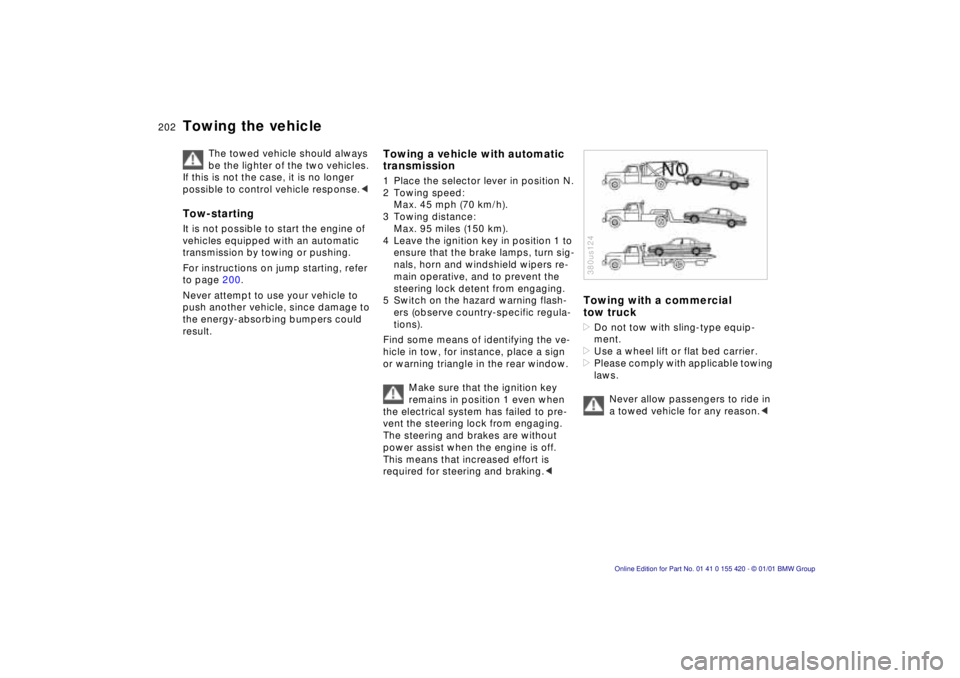
Towing with a commercial
tow truck
> Do not tow with sling-type equip-
ment.
> Use a wheel lift or flat bed carrier.
> Please comply with applicable towing
laws.
Never allow passengers to ride in
a towed vehicle for any reason. <
380us124
Page 207 of 238
Index
Data
Technology
Repairs
Car care
Controls
Overview
207n
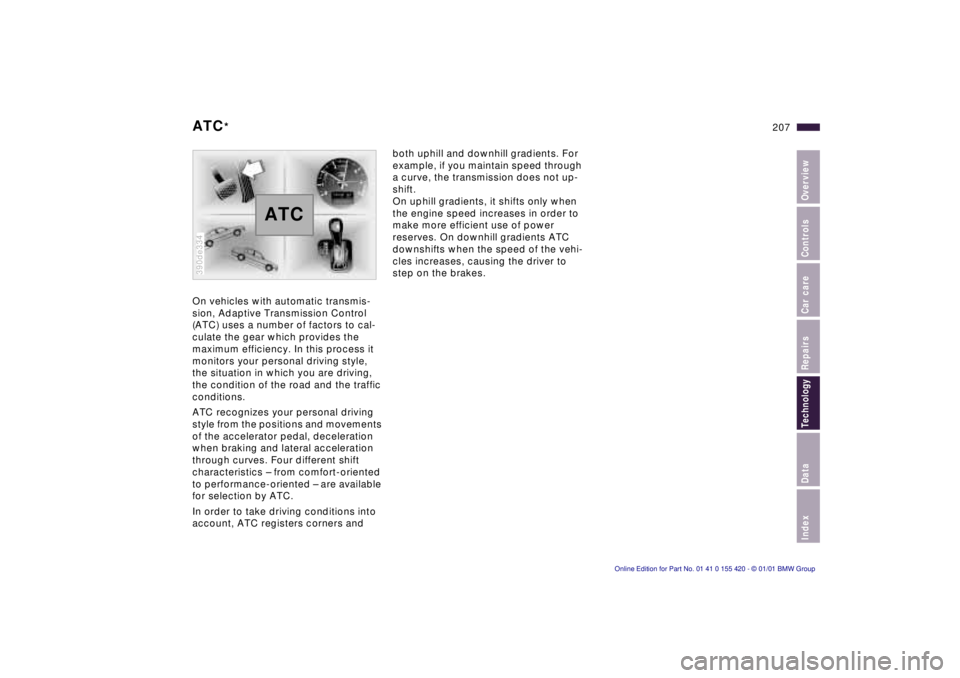
On vehicles with automatic transmis-
sion, Adaptive Transmission Control
(ATC) uses a number of factors to cal-
culate the gear which provides the
maximum efficiency. In this process it
monitors your personal driving style,
the situation in which you are driving,
the condition of the road and the traffic
conditions.
ATC recognizes your personal driving
style from the positions and movements
of the accelerator pedal, deceleration
when braking and lateral acceleration
through curves. Four different shift
characteristics – from comfort-oriented
to performance-oriented – are available
for selection by ATC.
In order to take driving conditions into
account, ATC registers corners and
390de334
ATC
both uphill and downhill gradients. For
example, if you maintain speed through
a curve, the transmission does not up-
shift.
On uphill gradients, it shifts only when
the engine speed increases in order to
make more efficient use of power
reserves. On downhill gradients ATC
downshifts when the speed of the vehi-
cles increases, causing the driver to
step on the brakes.
ATC*
Page 208 of 238

208nASC+T/DSC*
Precision sensors monitor the number
of revolutions of the wheels. When
equipped with DSC, they also monitor
steering angle, lateral acceleration,
brake pressure and the movement of
the vehicle around its vertical axis.
If differences in the wheel speeds
occur, the system counteracts the dan-
ger of wheelspin by reducing torque. If
necessary, the system also responds
with additional brake applications at the
rear wheels, and at all 4 wheels with
DSC.
In addition, DSC permanently monitors
the vehicle's current operating condi-
tion and compares it with an ideal con-
dition that is calculated from the sen-
sor's signals. If deviations from this
occur (understeering or oversteering,
for instance), DSC can stabilize the
vehicle in the fraction of a second by
reducing engine output and with the
assistance of braking intervention at in-
dividual wheels. As a result, dangerous
skids can be prevented even as they
are just beginning. You may need some time to become
accustomed to this system intervention.
However, it guarantees optimum drive
force and driving stability.
The braking intervention may be
accompanied by a certain degree of
noise.
Page 210 of 238
210nBMW active seat*Safety belt tensioner
BMW seats are configured for your
orthopedic well-being. The active seat
is an engineering enhancement of
BMW's seats, designed to ensure less
fatigue during extended trips while
sitting with little movement. The seat is
no longer a passive element between
the road, the running gear and the pas-
senger. Instead, it creates minor and
imperceptible shifts in your weight by
an active change in the contour of the
seat surface. The basic seat position is
not changed as this occurs.
Fluid cushions are located below the
surface of the seat in the seat's
upholstery on the left and right.
380de676
The fluid is circulated slowly back and
forth between the two cushions by
means of a pump. This causes a move-
ment of the spinal column which is
nearly unnoticeable, resulting in an im-
proved flow of blood to the vertebral
discs and the muscles in the area of the
spinal column. Vehicle occupants can
experience less muscle cramping, back
pain in the spine's lumbar region and
fatigue. The active seat thus provides a
significant contribution to your driving
comfort and safety.
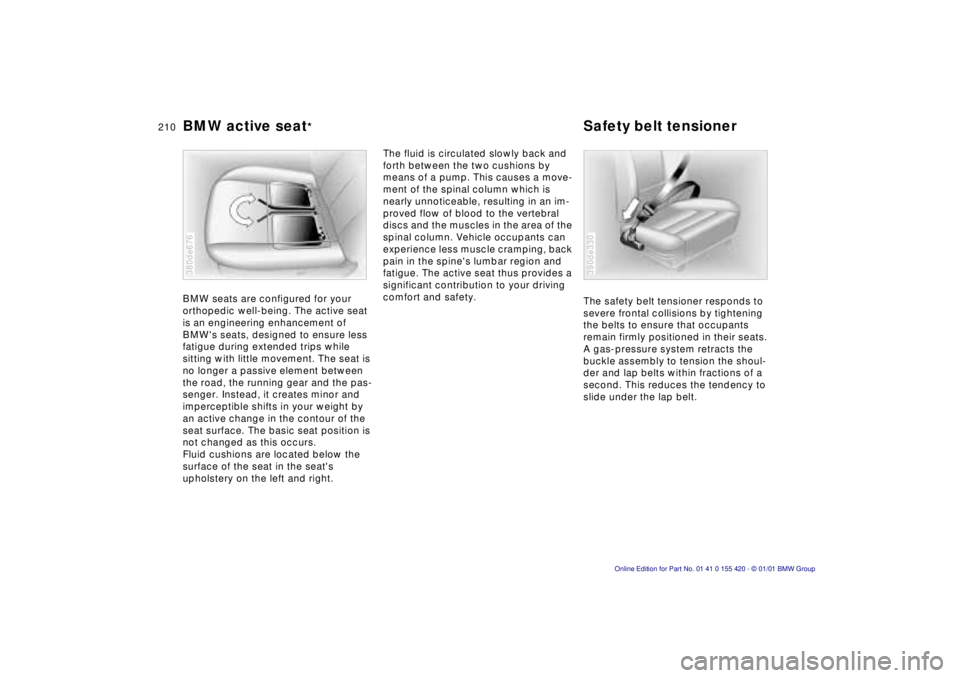
The safety belt tensioner responds to
severe frontal collisions by tightening
the belts to ensure that occupants
remain firmly positioned in their seats.
A gas-pressure system retracts the
buckle assembly to tension the shoul-
der and lap belts within fractions of a
second. This reduces the tendency to
slide under the lap belt.
390de330
Page 217 of 238
Index
Data
Technology
Repairs
Car care
Controls
Overview
Overview
Controls and features Operation, care
and maintenance
Technical data Index
Advanced technology
217
n
Owner service procedures
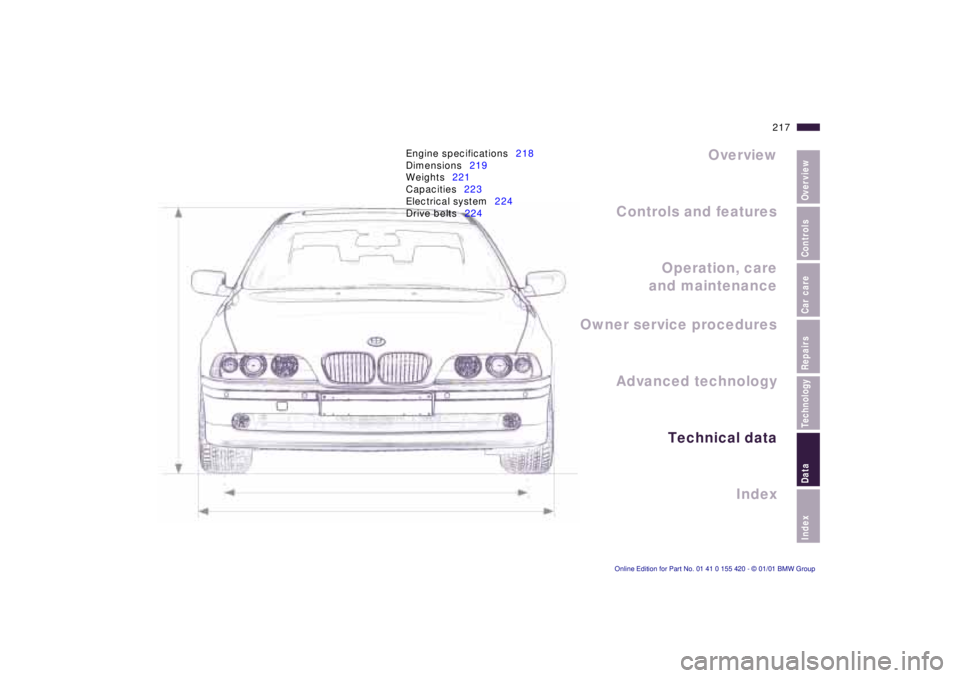
Engine specifications 218
Dimensions 219
Weights 221
Capacities 223
Electrical system 224
Drive belts 224
Data