ECU BMW 740I 1998 User Guide
[x] Cancel search | Manufacturer: BMW, Model Year: 1998, Model line: 740I, Model: BMW 740I 1998Pages: 211, PDF Size: 1.68 MB
Page 55 of 211
54n
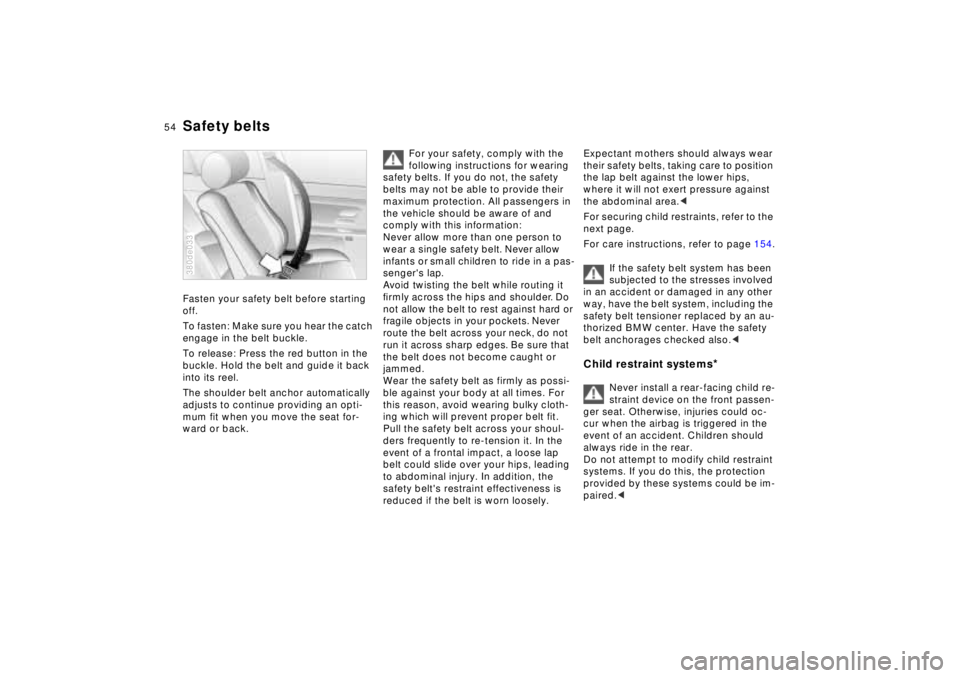
Safety beltsFasten your safety belt before starting
off.
To fasten: Make sure you hear the catch
engage in the belt buckle.
To release: Press the red button in the
buckle. Hold the belt and guide it back
into its reel.
The shoulder belt anchor automatically
adjusts to continue providing an opti-
mum fit when you move the seat for-
ward or back.380de033
For your safety, comply with the
following instructions for wearing
safety belts. If you do not, the safety
belts may not be able to provide their
maximum protection. All passengers in
the vehicle should be aware of and
comply with this information:
Never allow more than one person to
wear a single safety belt. Never allow
infants or small children to ride in a pas-
senger's lap.
Avoid twisting the belt while routing it
firmly across the hips and shoulder. Do
not allow the belt to rest against hard or
fragile objects in your pockets. Never
route the belt across your neck, do not
run it across sharp edges. Be sure that
the belt does not become caught or
jammed.
Wear the safety belt as firmly as possi-
ble against your body at all times. For
this reason, avoid wearing bulky cloth-
ing which will prevent proper belt fit.
Pull the safety belt across your shoul-
ders frequently to re-tension it. In the
event of a frontal impact, a loose lap
belt could slide over your hips, leading
to abdominal injury. In addition, the
safety belt's restraint effectiveness is
reduced if the belt is worn loosely.
Expectant mothers should always wear
their safety belts, taking care to position
the lap belt against the lower hips,
where it will not exert pressure against
the abdominal area.<
For securing child restraints, refer to the
next page.
For care instructions, refer to page 154.
If the safety belt system has been
subjected to the stresses involved
in an accident or damaged in any other
way, have the belt system, including the
safety belt tensioner replaced by an au-
thorized BMW center. Have the safety
belt anchorages checked also.< Child restraint systems
*
Never install a rear-facing child re-
straint device on the front passen-
ger seat. Otherwise, injuries could oc-
cur when the airbag is triggered in the
event of an accident. Children should
always ride in the rear.
Do not attempt to modify child restraint
systems. If you do this, the protection
provided by these systems could be im-
paired.<
Page 58 of 211
57n
RepairsIndexOverview Controls Car care Technology Data
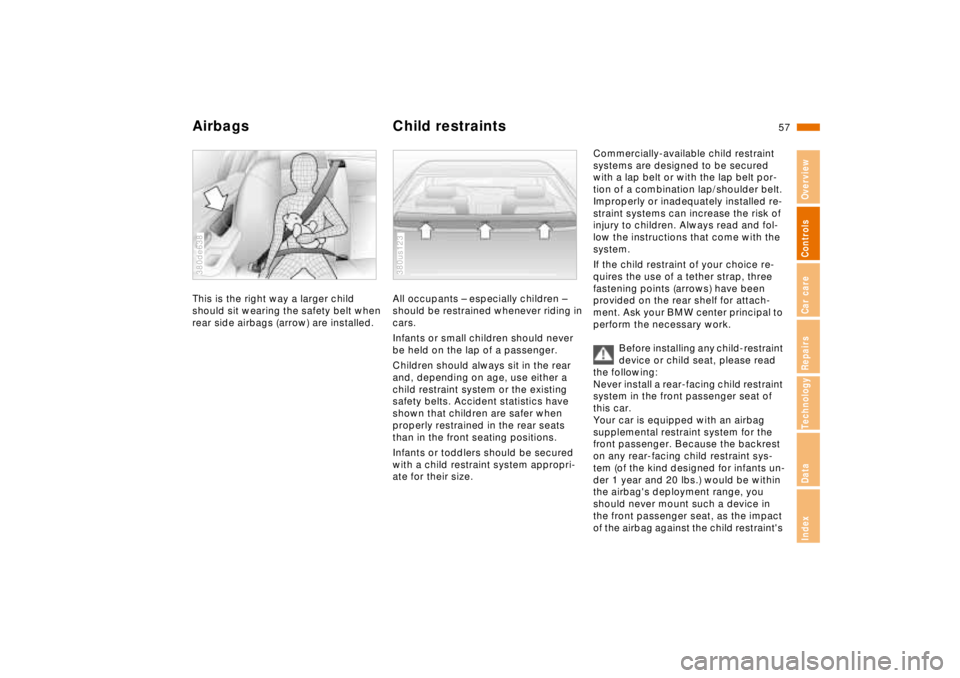
Airbags Child restraintsThis is the right way a larger child
should sit wearing the safety belt when
rear side airbags (arrow) are installed.380de638
All occupants – especially children –
should be restrained whenever riding in
cars.
Infants or small children should never
be held on the lap of a passenger.
Children should always sit in the rear
and, depending on age, use either a
child restraint system or the existing
safety belts. Accident statistics have
shown that children are safer when
properly restrained in the rear seats
than in the front seating positions.
Infants or toddlers should be secured
with a child restraint system appropri-
ate for their size.380us123
Commercially-available child restraint
systems are designed to be secured
with a lap belt or with the lap belt por-
tion of a combination lap/shoulder belt.
Improperly or inadequately installed re-
straint systems can increase the risk of
injury to children. Always read and fol-
low the instructions that come with the
system.
If the child restraint of your choice re-
quires the use of a tether strap, three
fastening points (arrows) have been
provided on the rear shelf for attach-
ment. Ask your BMW center principal to
perform the necessary work.
Before installing any child-restraint
device or child seat, please read
the following:
Never install a rear-facing child restraint
system in the front passenger seat of
this car.
Your car is equipped with an airbag
supplemental restraint system for the
front passenger. Because the backrest
on any rear-facing child restraint sys-
tem (of the kind designed for infants un-
der 1 year and 20 lbs.) would be within
the airbag's deployment range, you
should never mount such a device in
the front passenger seat, as the impact
of the airbag against the child restraint's
Page 59 of 211
58n
Child restraints Child restraint installation Child-safety locksbackrest could lead to serious or fatal
injuries.
If it is necessary for a child (not an in-
fant) to ride in the front seat, certain
precautions should be taken. First,
move the passenger seat as far away
from the dashboard as possible. This
important precaution is intended to
maximize the distance between the air-
bag and the child. Older children should
be tightly secured with the safety belt.
Younger children should be secured in
an appropriate forward-facing child re-
straint system that has first been prop-
erly secured with a safety belt. Never
install a rear-facing child restraint sys-
tem in the front passenger seat.
We strongly urge you to carefully read
and observe the instructions for instal-
lation and use provided by the child re-
straint's manufacturer whenever you
use such a device.
Be sure that all occupants (of all ages)
remain properly and securely restrained
at all times.<
All rear seating positions in your
vehicle meet the recommendations
of SAE J1819, an industry recom-
mended practice for securing child
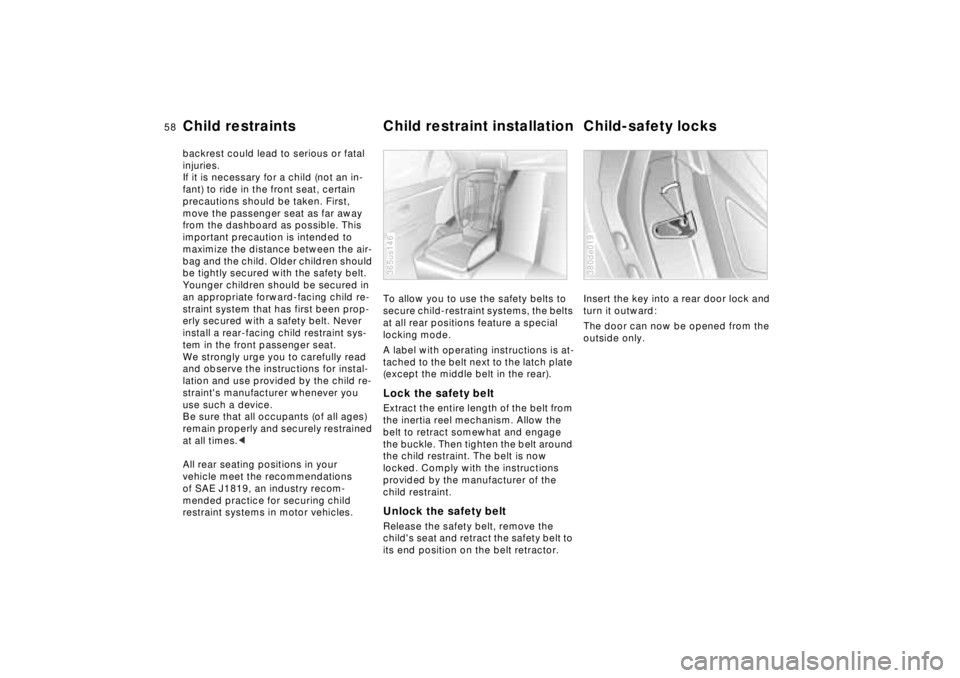
restraint systems in motor vehicles.To allow you to use the safety belts to
secure child-restraint systems, the belts
at all rear positions feature a special
locking mode.
A label with operating instructions is at-
tached to the belt next to the latch plate
(except the middle belt in the rear).
Lock the safety beltExtract the entire length of the belt from
the inertia reel mechanism. Allow the
belt to retract somewhat and engage
the buckle. Then tighten the belt around
the child restraint. The belt is now
locked. Comply with the instructions
provided by the manufacturer of the
child restraint.Unlock the safety beltRelease the safety belt, remove the
child's seat and retract the safety belt to
its end position on the belt retractor.365us146
Insert the key into a rear door lock and
turn it outward:
The door can now be opened from the
outside only.380de019
Page 65 of 211

64n
Automatic transmissionSpecial functionsIn program A, the Adaptive Transmis-
sion Control influences several special
functions in the selection of the drive
gear.
With the system active, some shifts that
would be made in other modes will be
suppressed. The system also reacts to
special situations by executing shifts
that would not occur with a conven-
tional transmission.Control of the winter programA winter program is automatically se-
lected when the vehicle is operated on
slippery road surfaces (snow and ice).
When this program is active, the trans-
mission starts in 2nd gear and shifts
into the higher gears earlier. This pro-
gram improves response under winter
driving conditions by providing en-
hanced traction and vehicle stability.
ATC leaves the winter program when it
registers a high-traction road surface,
when the Sport program is selected and
when ASC+T/DSC is deactivated.
Electronic transmission control
moduleIf the message "TRANS. FAILSAFE
PROG" appears in the Check Control,
there is a fault in the gearshift electronic
system or in the transmission itself.
You can still place the selector lever in
all positions. However, it is possible
that not all gears are available for the
vehicle's forward drive.
If this happens, avoid extreme engine
loads and consult the nearest autho-
rized BMW center.
Do not work in the engine com-
partment when a drive gear (for-
ward or reverse) is engaged. If you do
this, the vehicle could move.<
For towing, tow-starting or jump-start-
ing the vehicle, refer to pages 179, 180.
Page 68 of 211
67n
RepairsIndexOverview Controls Car care Technology Data
Automatic transmission with Steptronic
*
The ATC will execute upshifts or down-
shifts only at appropriate engine and
road speeds. For example, the trans-
mission does not shift down when the
engine speed is too high. The selected
gear will appear briefly in the instrument
cluster, followed by the current gear.
In the manual mode for rapid ac-
celeration – when passing, for ex-
ample – manually or a shifting down to
the kickdown point.<
You can only change from M/S to the
selector lever positions "P," "R" and "N"
via the "D" position.
In the following situations, the Step-
tronic "thinks" for you in the manual
mode:
>In order to prevent engine over-
speeding, the transmission shifts au-
tomatically to the next higher gear
shortly before the RPM cutoff point
>At low speeds, the transmission shifts
down automatically - you do not have
to act
>In the kickdown mode, the transmis-
sion shifts down to the lowest gear
which is possible, depending on the
engine speed.
Electronic transmission control
moduleIf the "TRANS. FAILSAFE PROG" mes-
sage appears in the Check Control,
there is a malfunction in the transmis-
sion system.
You can still place the selector lever in
all positions. However, it is possible
that not all gears are available for the
vehicle's forward drive.
If this happens, avoid extreme engine
loads and consult the nearest autho-
rized BMW center.
Do not work in the engine com-
partment when a drive gear (for-
ward or reverse) is engaged. If you do
this, the vehicle could move.<
For towing, tow-starting and jump-
starting, refer to pages 179, 180.
Page 76 of 211
75n
RepairsIndexOverview Controls Car care Technology Data
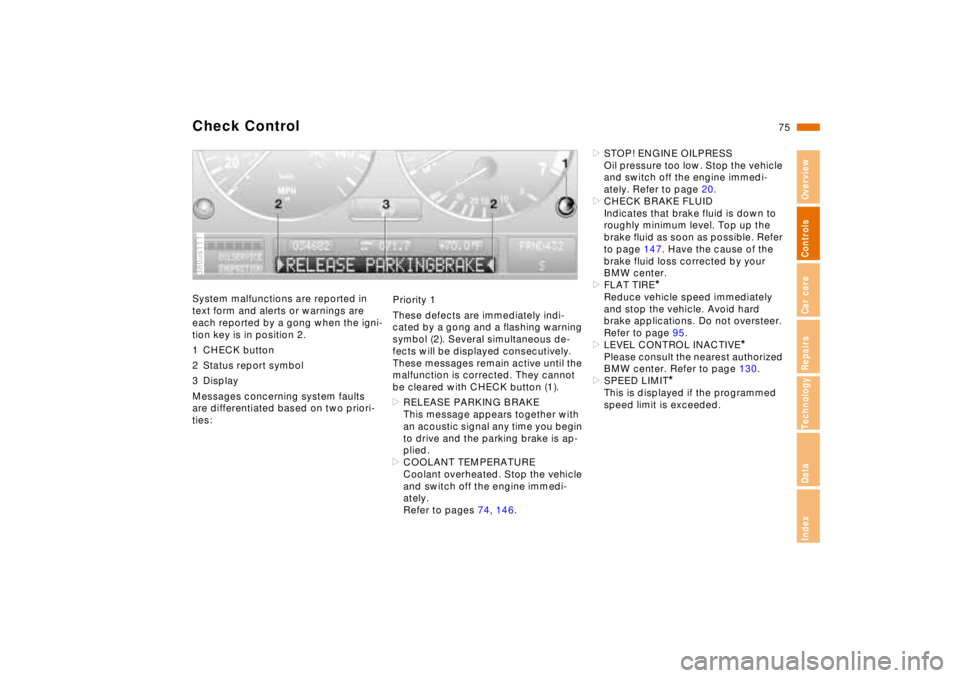
Check ControlSystem malfunctions are reported in
text form and alerts or warnings are
each reported by a gong when the igni-
tion key is in position 2.
1 CHECK button
2 Status report symbol
3 Display
Messages concerning system faults
are differentiated based on two priori-
ties:380us111
Priority 1
These defects are immediately indi-
cated by a gong and a flashing warning
symbol (2). Several simultaneous de-
fects will be displayed consecutively.
These messages remain active until the
malfunction is corrected. They cannot
be cleared with CHECK button (1).
>RELEASE PARKING BRAKE
This message appears together with
an acoustic signal any time you begin
to drive and the parking brake is ap-
plied.
>COOLANT TEMPERATURE
Coolant overheated. Stop the vehicle
and switch off the engine immedi-
ately.
Refer to pages 74, 146.>STOP! ENGINE OILPRESS
Oil pressure too low. Stop the vehicle
and switch off the engine immedi-
ately. Refer to page 20.
>CHECK BRAKE FLUID
Indicates that brake fluid is down to
roughly minimum level. Top up the
brake fluid as soon as possible. Refer
to page 147. Have the cause of the
brake fluid loss corrected by your
BMW center.
>FLAT TIRE
*
Reduce vehicle speed immediately
and stop the vehicle. Avoid hard
brake applications. Do not oversteer.
Refer to page 95.
>LEVEL CONTROL INACTIVE
*
Please consult the nearest authorized
BMW center. Refer to page 130.
>SPEED LIMIT
*
This is displayed if the programmed
speed limit is exceeded.
Page 78 of 211

77n
RepairsIndexOverview Controls Car care Technology Data
Check ControlDisplays after completion of tripAll of the malfunctions registered during
the trip appear consecutively when the
ignition key is turned to position 0.
One of the following displays may ap-
pear:
>LIGHTS ON
>KEY IN IGNITION LOCK
>CHECK ENGINE OIL LEV
Add engine oil at the next opportunity
(next stop for fuel). Refer to page 14 3.
This message appears when you open
the driver's door after parking the vehi-
cle. A supplementary gong is also
heard.
Even if the ignition key has been re-
moved and the display has gone off,
you can still retrieve these messages
with CHECK button (1) for approx. three
minutes after completion of your trip. If
there are multiple messages, continue
to press the CHECK button.
To monitor the Check ControlWith the ignition key in position 2, press
CHECK button (1):
CHECK CONTROL OK appears in the
display.
In this case, there are no faults in the
systems which are monitored.
Page 89 of 211
88n
Onboard computerCodeYou can program a code into the on-
board computer for supplementary pro-
tection against unauthorized attempts
to start the engine or tamper with the
vehicle. This feature provides you with
an extra measure of security extending
beyond that furnished by the vehicle im-
mobilization system (refer to page 31).
The system prevents the engine from
starting.
A code number is used to arm the sys-
tem. The code is then required for sub-
sequent starting attempts. Therefore:
Always remember the code number.
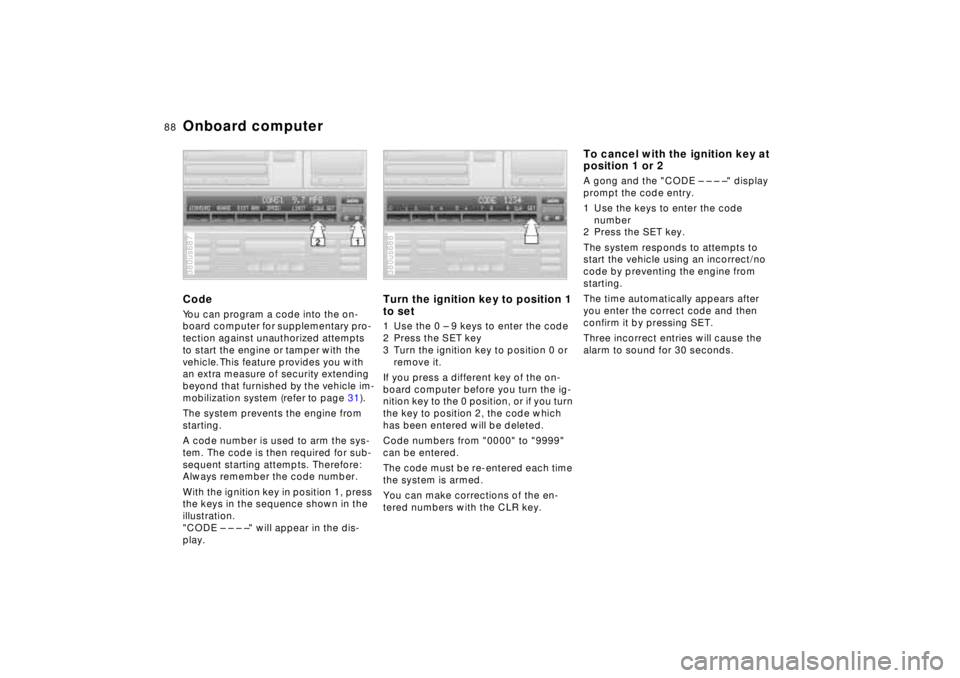
With the ignition key in position 1, press
the keys in the sequence shown in the
illustration.
"CODE – – – –" will appear in the dis-
play.380us687
Turn the ignition key to position 1
to set1 Use the 0 – 9 keys to enter the code
2 Press the SET key
3 Turn the ignition key to position 0 or
remove it.
If you press a different key of the on-
board computer before you turn the ig-
nition key to the 0 position, or if you turn
the key to position 2, the code which
has been entered will be deleted.
Code numbers from "0000" to "9999"
can be entered.
The code must be re-entered each time
the system is armed.
You can make corrections of the en-
tered numbers with the CLR key.380us688
To cancel with the ignition key at
position 1 or 2A gong and the "CODE – – – –" display
prompt the code entry.
1 Use the keys to enter the code
number
2 Press the SET key.
The system responds to attempts to
start the vehicle using an incorrect/no
code by preventing the engine from
starting.
The time automatically appears after
you enter the correct code and then
confirm it by pressing SET.
Three incorrect entries will cause the
alarm to sound for 30 seconds.
Page 118 of 211
117n
RepairsIndexOverview Controls Car care Technology Data
Ski bag
*
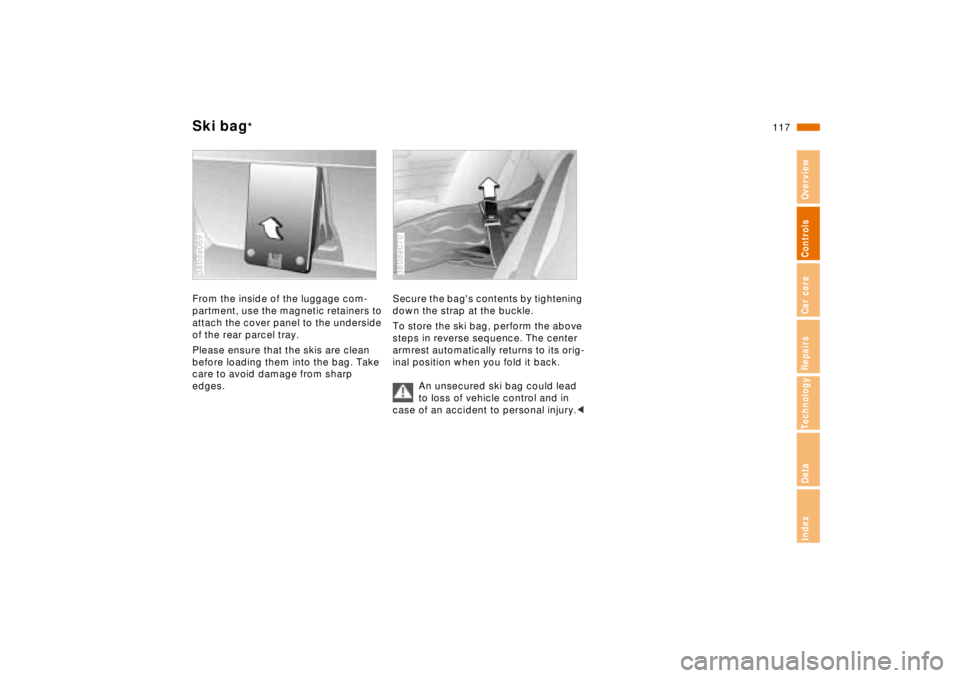
From the inside of the luggage com-
partment, use the magnetic retainers to
attach the cover panel to the underside
of the rear parcel tray.
Please ensure that the skis are clean
before loading them into the bag. Take
care to avoid damage from sharp
edges.380de069
Secure the bag's contents by tightening
down the strap at the buckle.
To store the ski bag, perform the above
steps in reverse sequence. The center
armrest automatically returns to its orig-
inal position when you fold it back.
An unsecured ski bag could lead
to loss of vehicle control and in
case of an accident to personal injury.< 380de070
Page 119 of 211
118n
Cargo loading Roof-mounted luggage rack
*
Securing the load>Secure smaller, light pieces with the
retaining straps or with a luggage
compartment net or elastic straps (re-
fer to page 39)
>For large, heavy pieces, see your
BMW center for load-securing de-
vices
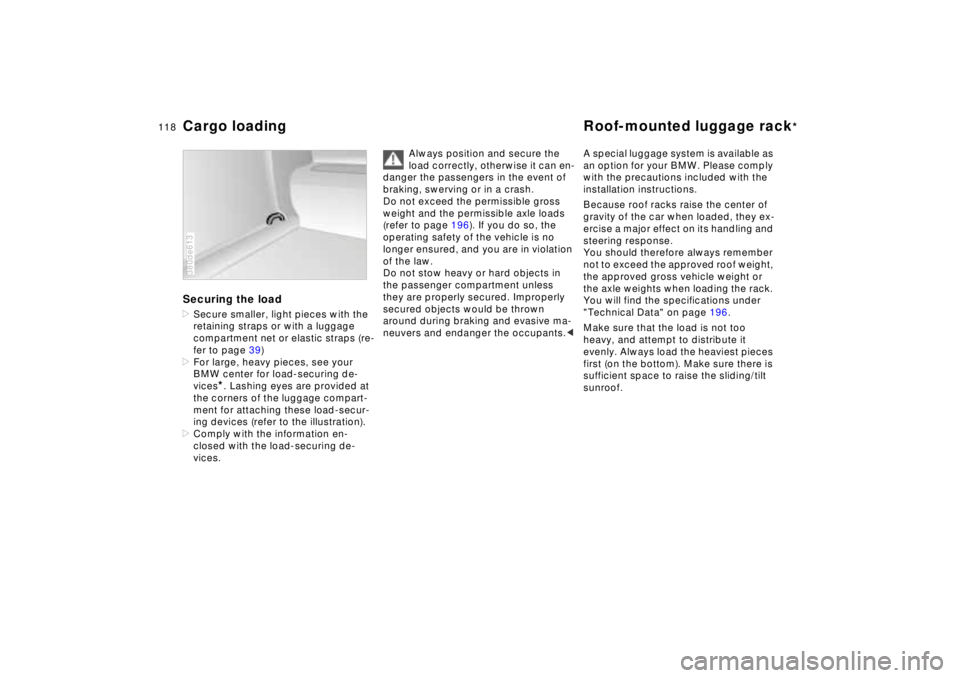
*. Lashing eyes are provided at
the corners of the luggage compart-
ment for attaching these load-secur-
ing devices (refer to the illustration).
>Comply with the information en-
closed with the load-securing de-
vices.
380de613
Always position and secure the
load correctly, otherwise it can en-
danger the passengers in the event of
braking, swerving or in a crash.
Do not exceed the permissible gross
weight and the permissible axle loads
(refer to page 196). If you do so, the
operating safety of the vehicle is no
longer ensured, and you are in violation
of the law.
Do not stow heavy or hard objects in
the passenger compartment unless
they are properly secured. Improperly
secured objects would be thrown
around during braking and evasive ma-
neuvers and endanger the occupants.<
A special luggage system is available as
an option for your BMW. Please comply
with the precautions included with the
installation instructions.
Because roof racks raise the center of
gravity of the car when loaded, they ex-
ercise a major effect on its handling and
steering response.
You should therefore always remember
not to exceed the approved roof weight,
the approved gross vehicle weight or
the axle weights when loading the rack.
You will find the specifications under
"Technical Data" on page 196.
Make sure that the load is not too
heavy, and attempt to distribute it
evenly. Always load the heaviest pieces
first (on the bottom). Make sure there is
sufficient space to raise the sliding/tilt
sunroof.