belt BMW 740I 1998 User Guide
[x] Cancel search | Manufacturer: BMW, Model Year: 1998, Model line: 740I, Model: BMW 740I 1998Pages: 211, PDF Size: 1.68 MB
Page 56 of 211
55n
RepairsIndexOverview Controls Car care Technology Data
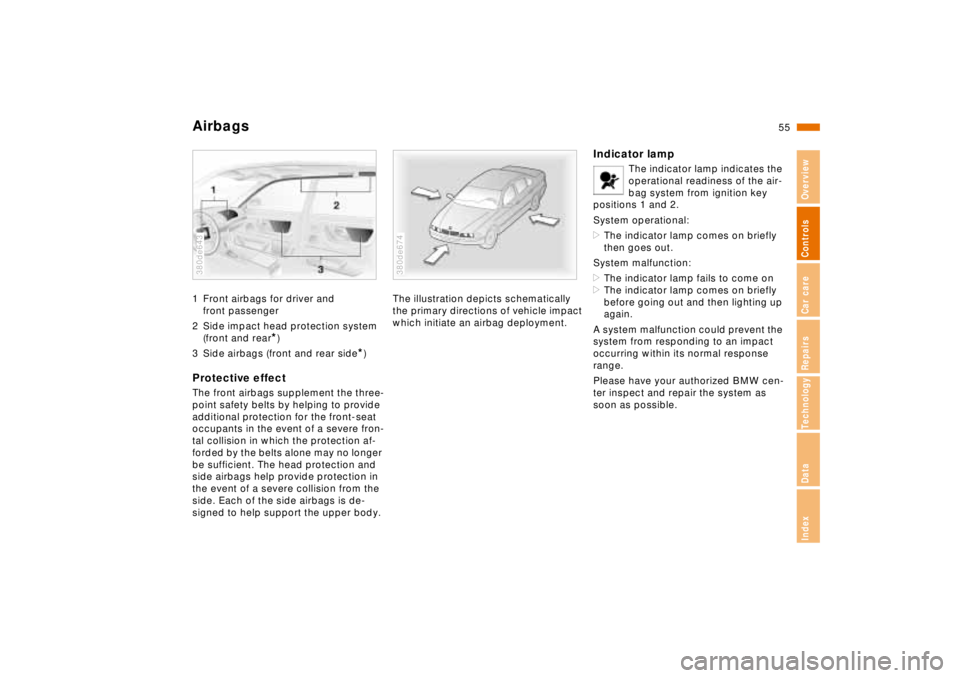
Airbags1 Front airbags for driver and
front passenger
2 Side impact head protection system
(front and rear
*)
3 Side airbags (front and rear side
*)
Protective effectThe front airbags supplement the three-
point safety belts by helping to provide
additional protection for the front-seat
occupants in the event of a severe fron-
tal collision in which the protection af-
forded by the belts alone may no longer
be sufficient. The head protection and
side airbags help provide protection in
the event of a severe collision from the
side. Each of the side airbags is de-
signed to help support the upper body.380de643
The illustration depicts schematically
the primary directions of vehicle impact
which initiate an airbag deployment.380de674
Indicator lamp
The indicator lamp indicates the
operational readiness of the air-
bag system from ignition key
positions 1 and 2.
System operational:
>The indicator lamp comes on briefly
then goes out.
System malfunction:
>The indicator lamp fails to come on
>The indicator lamp comes on briefly
before going out and then lighting up
again.
A system malfunction could prevent the
system from responding to an impact
occurring within its normal response
range.
Please have your authorized BMW cen-
ter inspect and repair the system as
soon as possible.
Page 57 of 211
56n
Airbags
For your safety, comply with the
following instructions for the air-
bags. If you do not, the airbags may not
be able to provide their maximum pro-
tection. All passengers in the vehicle
should be aware of and comply with
this information:
The airbags are supplemental restraint
devices designed to provide extra pro-
tection; they are not a substitute for
safety belts. Wear your safety belt at all
times. The airbags will not be triggered
in the event of a minor accident, a vehi-
cle roll-over, or collisions from the rear.
In these situations, the safety belts pro-
vide optimal protection.
Adjust your seat to a position that pro-
vides maximum distance between you
and the steering wheel, the instrument
panel and the door while still allowing
comfortable and safe access to all vehi-
cle controls.
Hold the steering wheel at the rim
(hands at the "9 o'clock and 3 o'clock"
positions) in order to avoid injuries to
the hands or arms if the airbag is trig-
gered.
Never allow any objects to obstruct the
area between the airbag and the driver/
passenger.
Do not use the cover panel above the
passenger-side airbag as a storage
area.
Do not apply tape or stickers or other
material over the padded steering
wheel hub, the instrument panel, the
side trim panels of the front or rear
doors and the roof pillars or the sides of
the headliner, or modify them in any
other way.
Do not install a rear-facing child-re-
straint device on the front passenger
seat.
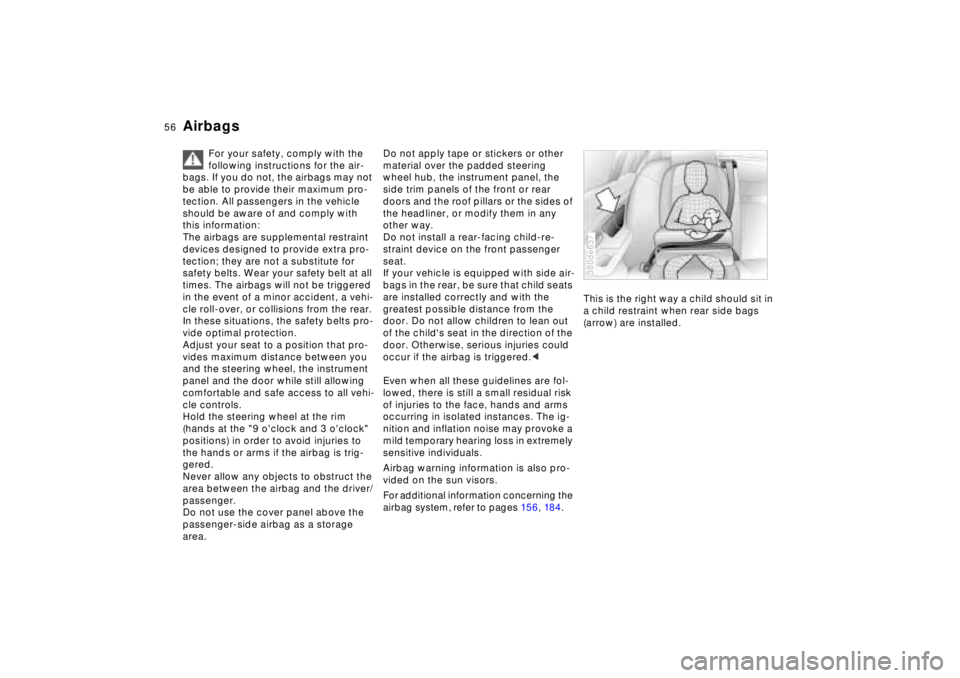
If your vehicle is equipped with side air-
bags in the rear, be sure that child seats
are installed correctly and with the
greatest possible distance from the
door. Do not allow children to lean out
of the child's seat in the direction of the
door. Otherwise, serious injuries could
occur if the airbag is triggered.<
Even when all these guidelines are fol-
lowed, there is still a small residual risk
of injuries to the face, hands and arms
occurring in isolated instances. The ig-
nition and inflation noise may provoke a
mild temporary hearing loss in extremely
sensitive individuals.
Airbag warning information is also pro-
vided on the sun visors.
For additional information concerning the
airbag system, refer to pages 15 6, 18 4.This is the right way a child should sit in
a child restraint when rear side bags
(arrow) are installed.
380de637
Page 58 of 211
57n
RepairsIndexOverview Controls Car care Technology Data
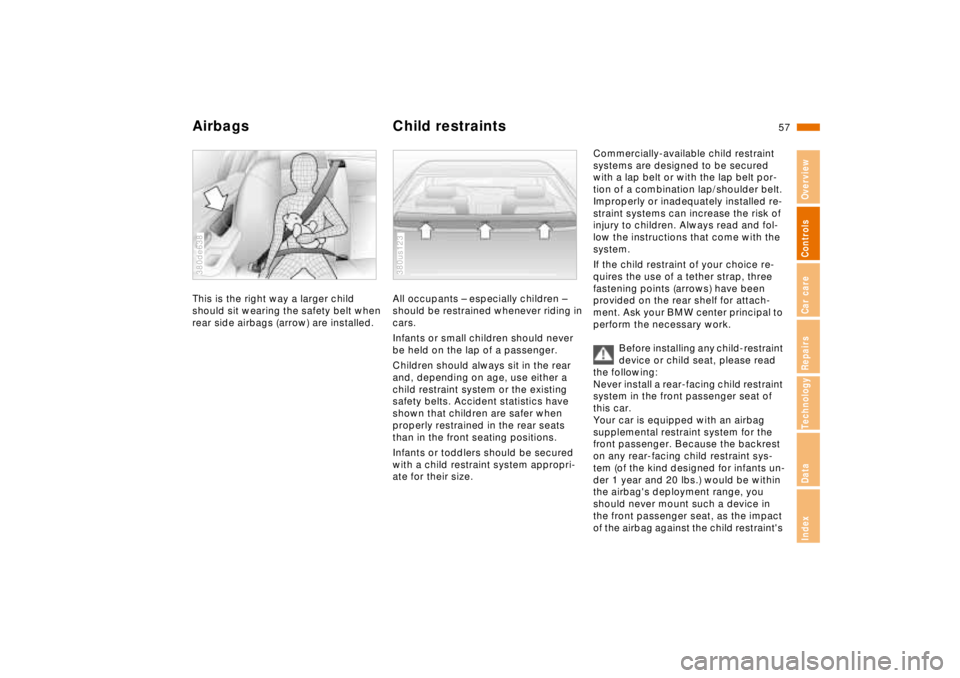
Airbags Child restraintsThis is the right way a larger child
should sit wearing the safety belt when
rear side airbags (arrow) are installed.380de638
All occupants – especially children –
should be restrained whenever riding in
cars.
Infants or small children should never
be held on the lap of a passenger.
Children should always sit in the rear
and, depending on age, use either a
child restraint system or the existing
safety belts. Accident statistics have
shown that children are safer when
properly restrained in the rear seats
than in the front seating positions.
Infants or toddlers should be secured
with a child restraint system appropri-
ate for their size.380us123
Commercially-available child restraint
systems are designed to be secured
with a lap belt or with the lap belt por-
tion of a combination lap/shoulder belt.
Improperly or inadequately installed re-
straint systems can increase the risk of
injury to children. Always read and fol-
low the instructions that come with the
system.
If the child restraint of your choice re-
quires the use of a tether strap, three
fastening points (arrows) have been
provided on the rear shelf for attach-
ment. Ask your BMW center principal to
perform the necessary work.
Before installing any child-restraint
device or child seat, please read
the following:
Never install a rear-facing child restraint
system in the front passenger seat of
this car.
Your car is equipped with an airbag
supplemental restraint system for the
front passenger. Because the backrest
on any rear-facing child restraint sys-
tem (of the kind designed for infants un-
der 1 year and 20 lbs.) would be within
the airbag's deployment range, you
should never mount such a device in
the front passenger seat, as the impact
of the airbag against the child restraint's
Page 59 of 211
58n
Child restraints Child restraint installation Child-safety locksbackrest could lead to serious or fatal
injuries.
If it is necessary for a child (not an in-
fant) to ride in the front seat, certain
precautions should be taken. First,
move the passenger seat as far away
from the dashboard as possible. This
important precaution is intended to
maximize the distance between the air-
bag and the child. Older children should
be tightly secured with the safety belt.
Younger children should be secured in
an appropriate forward-facing child re-
straint system that has first been prop-
erly secured with a safety belt. Never
install a rear-facing child restraint sys-
tem in the front passenger seat.
We strongly urge you to carefully read
and observe the instructions for instal-
lation and use provided by the child re-
straint's manufacturer whenever you
use such a device.
Be sure that all occupants (of all ages)
remain properly and securely restrained
at all times.<
All rear seating positions in your
vehicle meet the recommendations
of SAE J1819, an industry recom-
mended practice for securing child
restraint systems in motor vehicles.To allow you to use the safety belts to
secure child-restraint systems, the belts
at all rear positions feature a special
locking mode.
A label with operating instructions is at-
tached to the belt next to the latch plate
(except the middle belt in the rear).
Lock the safety beltExtract the entire length of the belt from
the inertia reel mechanism. Allow the
belt to retract somewhat and engage
the buckle. Then tighten the belt around
the child restraint. The belt is now
locked. Comply with the instructions
provided by the manufacturer of the
child restraint.Unlock the safety beltRelease the safety belt, remove the
child's seat and retract the safety belt to
its end position on the belt retractor.365us146
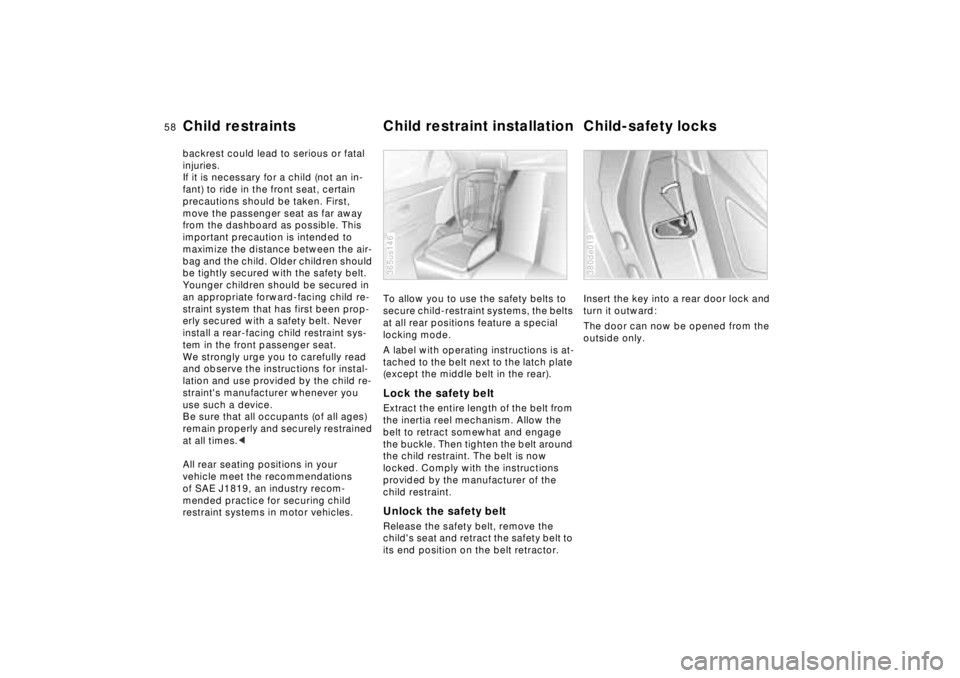
Insert the key into a rear door lock and
turn it outward:
The door can now be opened from the
outside only.380de019
Page 77 of 211

76n
Check ControlPriority 2
These alerts for problems are reported
for 20 seconds when the ignition key is
in position 2. The status reports remain
after the message disappears. You can
view the message again by pressing the
CHECK button.
>TRUNK LID OPEN
This message is given only when ini-
tially starting off.
>DOOR OPEN
This is displayed after a minimum
vehicle speed is exceeded.
>FASTEN SEAT BELTS
*
In addition, the indicator lamp with
the safety belt symbol appears and
an acoustic signal is heard.
>WASHER FLUID LOW
The washer fluid is too low. Top up
the fluid at the earliest opportunity.
Refer to page 142.
>CHECK ENGINE OIL
Add engine oil as soon as possible.
Refer to page 143.
>OUTSIDE TEMPERATURE 247
(–5.06)
This display is only an example. The
current reading appears at an outside
temperature of 37.57 (+36) and
below. Refer also to page 72.>TIRE PRESSURE SET
*
The RDC has imported the current in-
flation pressure in the tires as the tar-
get values which the system will
monitor.
Refer to page 94.
>CHECK TIRE PRESSURE
*
Check and correct the tire inflation
pressure to specifications at the earli-
est opportunity (next stop for fuel).
Refer to page 94.
>TIRE CHECK INACTIVE
*
A temporary interference of the RDC
or a system fault. Refer to page 95
>BRAKE LAMP CIRCUIT
A bulb has failed or the circuit has a
malfunction. Refer to pages 163, 176
or consult an authorized BMW center.
>CHECK LOWBEAMS
CHECK SIDE LAMPS
CHECK REAR LAMPS
CHECK FRONT FOGLAMPS
CHECK LICPLATE LAMP
CHECK TRAILER LIGHTS
CHECK HIGHBEAMS
CHECK BACKUP LAMPS
Defective bulb or circuit. Refer to
pages 163, 176 or consult an autho-
rized BMW center.
>TRANS. FAILSAFE PROG
Please consult the nearest authorized
BMW center. Refer to pages 64, 67.>CHECK BRAKE LININGS
Have the brake pads inspected by
your BMW center. Refer to page 126.
>REMOTE KEY BATTERY
Change the battery. Refer to
page 168.
>CHECK COOLANT LEVEL
The coolant is too low. Top up at the
next opportunity. Refer to page 146.
>ENGINE FAILSAFE PROG
Fault in the Electronic Engine Power
Control EML. When braking, higher
brake application pressure may be
necessary and brake pedal travel may
be significantly longer.
Please have the system inspected by
your authorized BMW center.
Page 137 of 211

136n
Approved wheel and tire specificationsNote the tire and wheel data in the offi-
cial documents of the car. If sizes not
approved by the manufacturer are
mounted, an entry in the vehicle's doc-
uments may be necessary. Comply with
local legislation. Tire specifications Light-alloy wheel
All season tires
235/60 R 16 100 H M+S 7.5Jx16
8Jx16
Summer tires
235/60 R 16 100 W 7.5Jx16
8Jx16
245/55 R 16 100 W 8Jx16
235/50 ZR 18 8Jx18
Rear: 255/45 ZR 18 9Jx18
9.5Jx18
Winter tires (M+S)
215/65 R 16 98 Q 7.5J x 16
235/60 R 16 100 Q 7.5Jx16
8Jx16
245/55 R 16 100 Q 8Jx16
The use of rims and wheel bolts
that do not meet the specifications
of the original factory-installed equip-
ment will affect the safe operation of
your vehicle and may cause an accident
and personal injury.
Never mix tires of different design, such
as steel-belted radials with radial bias-
belted or bias-ply tires, etc. Mixing tire
types will adversely affect roadholding
and can lead to loss of vehicle control.<
Page 155 of 211

154n
Caring for your carCaring for other vehicle
components and materialsLight-alloy wheels should be treated
with alloy wheel cleaner, especially dur-
ing the winter months. However, do not
use aggressive products containing ac-
ids, strong alkalis or abrasives. Do not
use steam cleaners operating at tem-
peratures above 1407 (606). Follow
the manufacturer's instructions.
If your vehicle has chromed parts
* such
as window moldings, door handles or
other parts, clean these parts especially
carefully with ample clean water, espe-
cially if they have an accumulation of
road salt. You may wish to add a car
shampoo supplement to the water. Use
a chrome polish for an additional treat-
ment.
Plastic components, vinyl upholstery,
headliners, lamp lenses, the clear cover
of the instrument panel and compo-
nents with a sprayed dull black surface
can be cleaned with water (add plastic
cleaner as required). Do not allow mois-
ture to soak through the seats or head-
liner. Never use solvents such as lac-
quer thinner, heavy-duty grease
remover, fuels, etc.
Rubber components should be cleaned
with water only; a rubber treatment or
silicone spray may also be applied.Clean the wiper blades with soapy wa-
ter. The wiper blades should be re-
placed twice a year, before and after
the cold season.
Use only wiper blades approved
by BMW.<
The safety belts should be cleaned with
a mild soap and water solution without
being removed from the car. Never at-
tempt chemical or dry cleaning, as
damage to the belt fabric could result.
After cleaning, never allow the inertia
reel to retract the belts until they are
completely dry. Dirty safety belts pre-
vent the inertia reel mechanism from re-
tracting the strap properly, and thus
constitute a safety hazard.
Heavily soiled floor carpets and mats
*
can be cleaned with an interior cleaner.
The floor mats can be removed from the
vehicle for cleaning.
Please use only a damp cloth to clean
wooden fascia panels and components.
Follow up by drying with a soft cloth.
A full range of car-care products is
available from your BMW center.<
Leather careThe leather upholstery used by BMW is
a natural product of the highest quality,
processed using state-of-the-art meth-
ods to ensure that it will maintain its
high quality for years to come, provided
that it is properly cared for.
Because this product is manufactured
using natural materials, you must make
allowance for its special characteristics
as well as for the peculiarities of its use
and care.
Regular periodic cleaning and care are
essential, as dust and road dirt act as
abrasives in the pores and creases of
the material. This leads to wear spots
and premature brittleness on the sur-
face of the leather. We therefore sug-
gest that you clean the leather with a
vacuum cleaner or dust cloth at fre-
quent intervals.
For cleaning, use BMW leather cleaning
foam.
Page 184 of 211
Overview
Controls and features
Operation, care
and maintenance
Owner service procedures
Technical data
Index Advanced technology
183n
RepairsIndexOverview Controls Car care Technology Data
Airbags184
Adaptive Transmission Control
(ATC ) 184
Automatic Stability Control plus
Traction (ASC+T)/Dynamic Sta-
bility Control (DSC) 185
Radio reception186
BMW Active Seat 186
Safety belt tensioner187
DSP sound system 187
Rearview mirror with automatic
dimmer188
Tire Pressure Control (RDC ) 189
Xenon lamps 190
Water and dirt repelling
windshield 191
Page 188 of 211
187n
RepairsIndexOverview Controls Car care Technology Data
BMW Active Seat
*
Safety belt tensioner DSP sound system
*
This causes a movement of the spinal
column which is barely detectable, to-
gether with an improvement in the flow
of blood to the intervertebral disks and
the muscle structure in the area of the
spinal column.
The passengers do not suffer as much
from muscle tension, back pain in the
lumbar region or symptoms of fatigue.
As a result, the Active Seat represents a
significant contribution to driving com-
fort and driving safety.
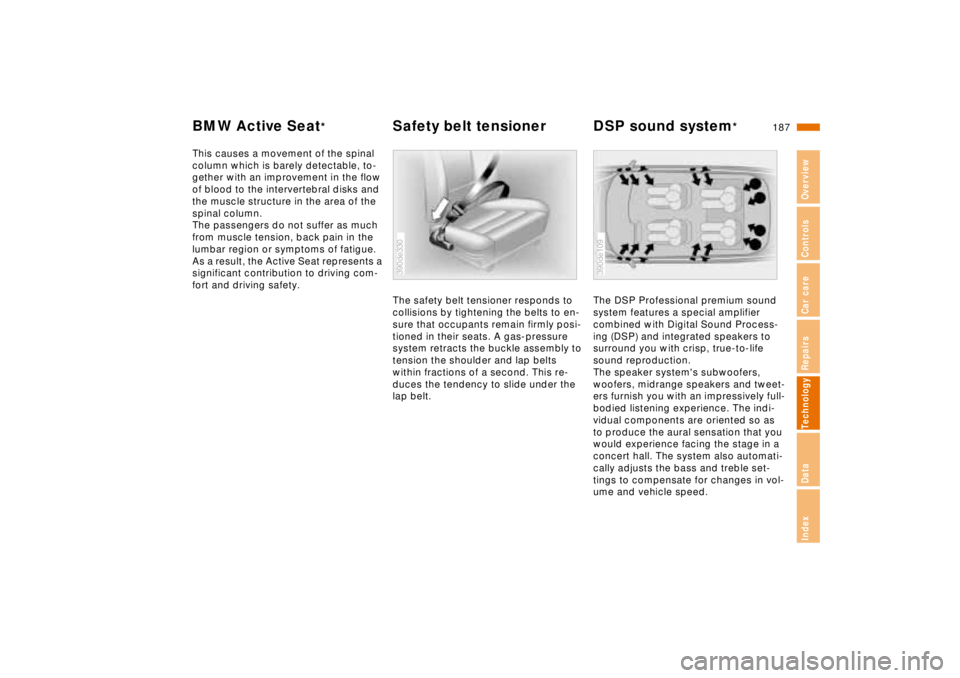
The safety belt tensioner responds to
collisions by tightening the belts to en-
sure that occupants remain firmly posi-
tioned in their seats. A gas-pressure
system retracts the buckle assembly to
tension the shoulder and lap belts
within fractions of a second. This re-
duces the tendency to slide under the
lap belt.
390de330
The DSP Professional premium sound
system features a special amplifier
combined with Digital Sound Process-
ing (DSP) and integrated speakers to
surround you with crisp, true-to-life
sound reproduction.
The speaker system's subwoofers,
woofers, midrange speakers and tweet-
ers furnish you with an impressively full-
bodied listening experience. The indi-
vidual components are oriented so as
to produce the aural sensation that you
would experience facing the stage in a
concert hall. The system also automati-
cally adjusts the bass and treble set-
tings to compensate for changes in vol-
ume and vehicle speed.390de109
Page 194 of 211
Overview
Controls and features
Operation, care
and maintenance
Technical data
Index Advanced technology
193n
RepairsIndexOverview Controls Car care Technology Data
Owner service procedures
Engine specifications194
Dimensions195
Weights196
Capacities197
Electrical system198
Drive belts198