airbag BMW 740I 1998 Owners Manual
[x] Cancel search | Manufacturer: BMW, Model Year: 1998, Model line: 740I, Model: BMW 740I 1998Pages: 211, PDF Size: 1.68 MB
Page 11 of 211

Contents
Overview
Controls and features
Cockpit16
Instrument cluster18
Indicator and warning lamps20
Multifunction steering wheel
(MFL)23
Hazard warning flashers24
Warning triangle24
First-aid kit24
Refueling25
Fuel specifications25
Tire inflation pressure26
Locks and security systems:
Keys30
Electronic vehicle
immobilizer31
Central locking system32
Door locks – outside32
Radio remote control33
Door locks – inside36
Luggage compartment lid37
Luggage compartment39
Alarm system40
Electric power windows42
Security glass43
Sliding/Tilt sunroof44
Adjustments:
Seats46
Steering wheel49
Mirrors50
Seat, mirror and steering wheel
memory51
Car Memory, Key Memory53
Passenger safety systems:
Safety belts54
Airbags55
Child restraints57
Child restraint installation58
Child-safety locks58
Driving:
Steering/Ignition lock59
Starting engine59
Switching off engine60Parking brake61
Automatic transmission62
Automatic transmission with
Steptronic65
Turn signal/Headlamp flasher68
Washer/Wiper system/Rain
sensor68
Rear window defroster70
Cruise control70
Everything under control:
Odometer, outside temperature
display72
Tachometer72
Energy control73
Fuel gauge73
Temperature gauge74
Service Interval Display74
Check Control 75
Multi-Information Display
(MID)78
Digital clock79
Onboard computer84
Technology for safety and
convenience:
Park Distance Control PDC90
Automatic Stability Control plus
Traction (ASC+T)/Dynamic Sta-
bility Control (DSC)92
Electronic Damper Control
(EDC)93
Tire Pressure Control (RDC)94
Page 12 of 211

11n
Controls and features
Operation, care and maintenance
Lamps:
Parking lamps/Low beams96
Instrument panel lighting96
High beams/Parking lamps97
Fog lamps97
Interior lamps97
Reading lamps98
Controlling the climate
for pleasant driving:
Automatic climate control100
Rear passenger-area air
conditioning105
Seat heating106
Steering wheel heating106
Roller sun blind107
Independent ventilation
system107
Cabin convenience:
Integrated Universal
Remote Control108
Glove compartment110
Center armrests111
Additional storage areas113
Cup holder113
Cellular phone113
Ashtray114
Cigarette lighter115
Rear footrests115
Loading and transporting cargo:
Ski bag116
Cargo loading118
Roof-mounted luggage rack118
Special operating instructions:
Break-in procedure122
Driving notes123
Catalytic converter124
Antilock Brake System
(ABS)125
Disc brakes126
Brake system128
Winter operation128
Power steering130
Level control system130
Cellular phone131
Radio reception131
Wheels and tires:
Tire inflation pressure132
Tire condition132
Tire replacement133
Tire rotation133
Wheel and tire
combinations134
Winter tires135
Snow chains135
Approved wheel and tire
specifications136
Under the hood:
Hood137
Engine compartment138
Washer fluids142
Washer nozzles142
Engine oil143
Coolant146
Brake fluid147
Oil for power steering/
Level control system148
Vehicle Identification
Number148
Care and maintenance:
The BMW Maintenance
System149
Caring for your car150
Airbags156
Vehicle storage156
Laws and regulations:
Technical modifications to the
vehicle157
OBD connector158
Page 13 of 211

Contents
Owner service procedures
Advanced technology
Technical data
Replacement procedures:
Onboard tool kit162
Windshield wiper blades162
Lamps and bulbs163
Remote control168
Changing tires170
Battery173
Fuses176
In case of electrical
malfunction:
Fuel filler door178
Sliding/Tilt sunroof178
Assistance, giving and
receiving:
Jump-starting179
Towing the vehicle180Airbags184
Adaptive Transmission Control
(ATC)184
Automatic Stability Control plus
Traction (ASC+T)/Dynamic Sta-
bility Control (DSC)185
Radio reception186
BMW Active Seat186
Safety belt tensioner187
DSP sound system187
Interior rearview mirror with auto-
matic dimming feature188
Tire Pressure Control (RDC)189
Xenon lamps190
Water and dirt repelling
windshield191Engine specifications194
Dimensions195
Weights196
Capacities197
Electrical system198
Drive belts198
Page 20 of 211

19n
RepairsIndexOverview Controls Car care Technology Data
Instrument cluster
1 Fuel gauge with lamp for fuel
reserve range73
2 Turn signal indicators22
3 Speedometer
4 Indicator lamp for high beam
headlamps22
5 Tachometer and
Energy Control72, 73
6 Coolant temperature gauge74
7 Indicator and warning lamps for
>
Parking brake21
>
Hydraulic brake system/Dynamic
Brake Control (DBC)
*
20, 21
>
ABS21
>
Airbag21
>
Please fasten safety belts21
>
Cruise control22
8 Check button75
9 Program display for automatic
transmission64, 67
10 Outside temperature display7211 Indicator lamp for Automatic
Stability Control plus Traction
(ASC+T)/Dynamic Stability
Control (DSC)
*
21
12 Trip odometer72
13 Check Control display75
14 Odometer72
15 Service Interval Display74, 149
16 Reset button for trip odometer72
17 Indicator and warning lamps for
>
Fog lamps22
>
Battery charge current20
>
Engine oil pressure20
>
Check Engine lamp21
You can display the outside tem-
perature and distance driven in
different units of measurement.
<
Page 22 of 211
21n
RepairsIndexOverview Controls Car care Technology Data
Indicator and warning lamps
Red: An important reminder
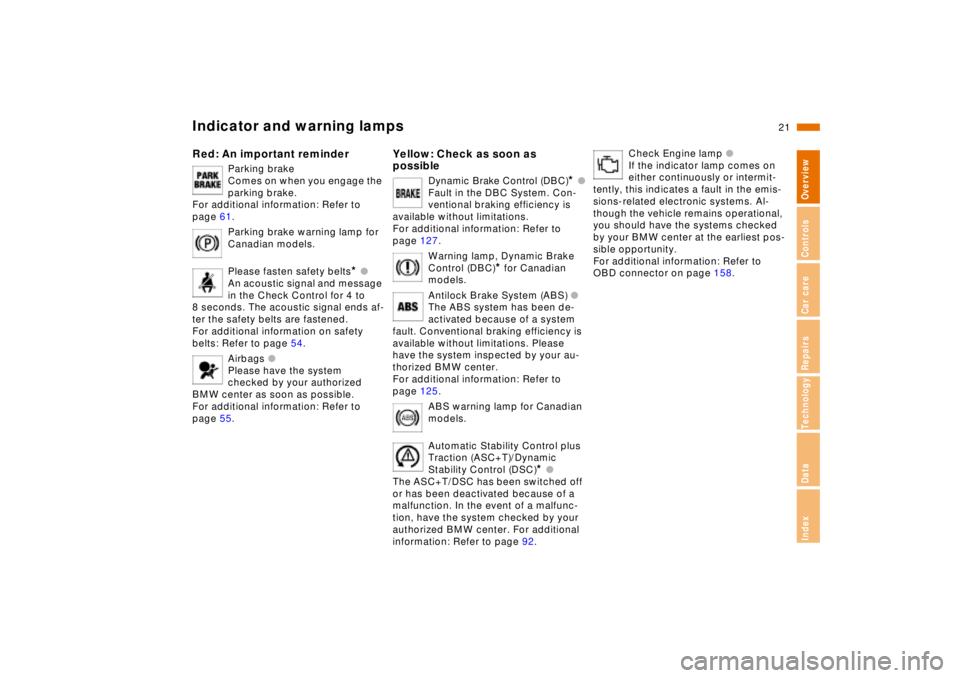
Parking brake
Comes on when you engage the
parking brake.
For additional information: Refer to
page 61.
Parking brake warning lamp for
Canadian models.
Please fasten safety belts
*
l
An acoustic signal and message
in the Check Control for 4 to
8 seconds. The acoustic signal ends af-
ter the safety belts are fastened.
For additional information on safety
belts: Refer to page 54.
Airbags
l
Please have the system
checked by your authorized
BMW center as soon as possible.
For additional information: Refer to
page 55.
Yellow: Check as soon as
possible
Dynamic Brake Control (DBC)
*
l
Fault in the DBC System. Con-
ventional braking efficiency is
available without limitations.
For additional information: Refer to
page 127.
Warning lamp, Dynamic Brake
Control (DBC)
*
for Canadian
models.
Antilock Brake System (ABS)
l
The ABS system has been de-
activated because of a system
fault. Conventional braking efficiency is
available without limitations. Please
have the system inspected by your au-
thorized BMW center.
For additional information: Refer to
page 125.
ABS warning lamp for Canadian
models.
Automatic Stability Control plus
Traction (ASC+T)/Dynamic
Stability Control (DSC)
*
l
The ASC+T/DSC has been switched off
or has been deactivated because of a
malfunction. In the event of a malfunc-
tion, have the system checked by your
authorized BMW center. For additional
information: Refer to page 92.
Check Engine lamp
l
If the indicator lamp comes on
either continuously or intermit-
tently, this indicates a fault in the emis-
sions-related electronic systems. Al-
though the vehicle remains operational,
you should have the systems checked
by your BMW center at the earliest pos-
sible opportunity.
For additional information: Refer to
OBD connector on page 158.
Page 29 of 211
28n
Locks and security systems:
Keys30
Electronic vehicle
immobilizer31
Central locking system32
Door locks – outside32
Radio remote control33
Door locks – inside36
Luggage compartment lid37
Luggage compartment39
Alarm system40
Electric power windows42
Security glass43
Sliding/Tilt sunroof44
Adjustments:
Seats46
Steering wheel49
Mirrors50
Seat, mirror and steering wheel
memory51
Car Memory, Key Memory53
Passenger safety systems:
Safety belts54
Airbags55
Child restraints57
Child restraint installation58
Child-safety locks58
Driving:
Steering/Ignition lock59
Starting engine59
Switching off engine60
Page 55 of 211
54n
Safety beltsFasten your safety belt before starting
off.
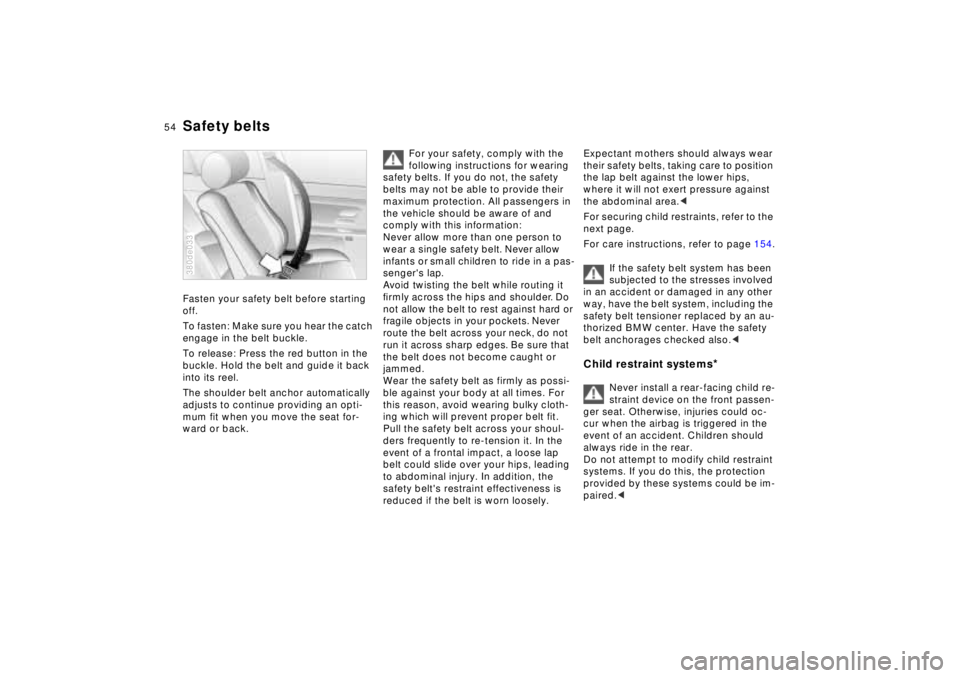
To fasten: Make sure you hear the catch
engage in the belt buckle.
To release: Press the red button in the
buckle. Hold the belt and guide it back
into its reel.
The shoulder belt anchor automatically
adjusts to continue providing an opti-
mum fit when you move the seat for-
ward or back.380de033
For your safety, comply with the
following instructions for wearing
safety belts. If you do not, the safety
belts may not be able to provide their
maximum protection. All passengers in
the vehicle should be aware of and
comply with this information:
Never allow more than one person to
wear a single safety belt. Never allow
infants or small children to ride in a pas-
senger's lap.
Avoid twisting the belt while routing it
firmly across the hips and shoulder. Do
not allow the belt to rest against hard or
fragile objects in your pockets. Never
route the belt across your neck, do not
run it across sharp edges. Be sure that
the belt does not become caught or
jammed.
Wear the safety belt as firmly as possi-
ble against your body at all times. For
this reason, avoid wearing bulky cloth-
ing which will prevent proper belt fit.
Pull the safety belt across your shoul-
ders frequently to re-tension it. In the
event of a frontal impact, a loose lap
belt could slide over your hips, leading
to abdominal injury. In addition, the
safety belt's restraint effectiveness is
reduced if the belt is worn loosely.
Expectant mothers should always wear
their safety belts, taking care to position
the lap belt against the lower hips,
where it will not exert pressure against
the abdominal area.<
For securing child restraints, refer to the
next page.
For care instructions, refer to page 154.
If the safety belt system has been
subjected to the stresses involved
in an accident or damaged in any other
way, have the belt system, including the
safety belt tensioner replaced by an au-
thorized BMW center. Have the safety
belt anchorages checked also.< Child restraint systems
*
Never install a rear-facing child re-
straint device on the front passen-
ger seat. Otherwise, injuries could oc-
cur when the airbag is triggered in the
event of an accident. Children should
always ride in the rear.
Do not attempt to modify child restraint
systems. If you do this, the protection
provided by these systems could be im-
paired.<
Page 56 of 211
55n
RepairsIndexOverview Controls Car care Technology Data
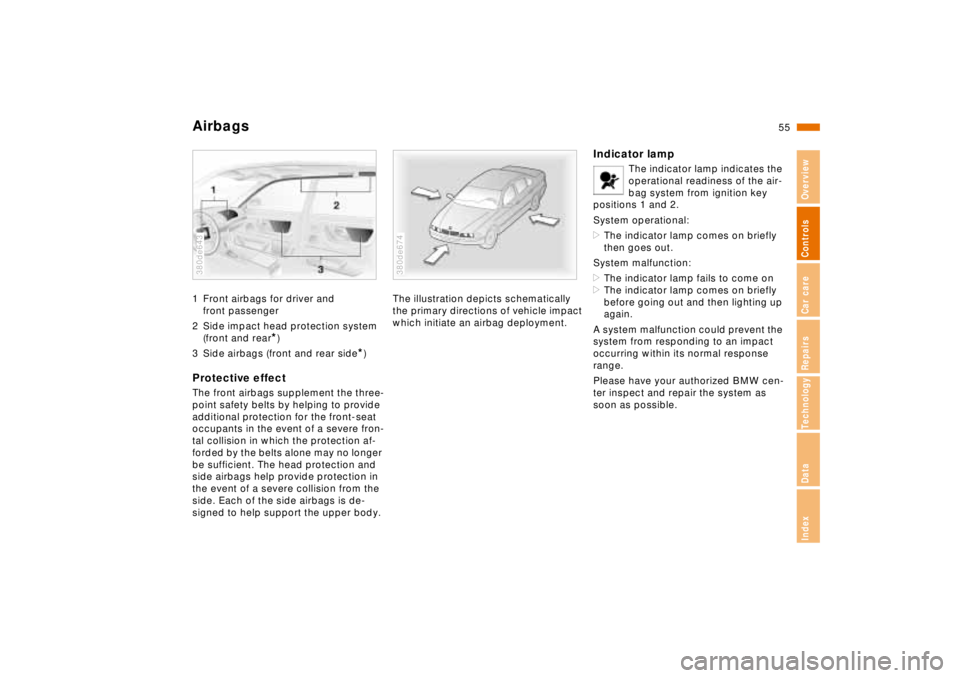
Airbags1 Front airbags for driver and
front passenger
2 Side impact head protection system
(front and rear
*)
3 Side airbags (front and rear side
*)
Protective effectThe front airbags supplement the three-
point safety belts by helping to provide
additional protection for the front-seat
occupants in the event of a severe fron-
tal collision in which the protection af-
forded by the belts alone may no longer
be sufficient. The head protection and
side airbags help provide protection in
the event of a severe collision from the
side. Each of the side airbags is de-
signed to help support the upper body.380de643
The illustration depicts schematically
the primary directions of vehicle impact
which initiate an airbag deployment.380de674
Indicator lamp
The indicator lamp indicates the
operational readiness of the air-
bag system from ignition key
positions 1 and 2.
System operational:
>The indicator lamp comes on briefly
then goes out.
System malfunction:
>The indicator lamp fails to come on
>The indicator lamp comes on briefly
before going out and then lighting up
again.
A system malfunction could prevent the
system from responding to an impact
occurring within its normal response
range.
Please have your authorized BMW cen-
ter inspect and repair the system as
soon as possible.
Page 57 of 211
56n
Airbags
For your safety, comply with the
following instructions for the air-
bags. If you do not, the airbags may not
be able to provide their maximum pro-
tection. All passengers in the vehicle
should be aware of and comply with
this information:
The airbags are supplemental restraint
devices designed to provide extra pro-
tection; they are not a substitute for
safety belts. Wear your safety belt at all
times. The airbags will not be triggered
in the event of a minor accident, a vehi-
cle roll-over, or collisions from the rear.
In these situations, the safety belts pro-
vide optimal protection.
Adjust your seat to a position that pro-
vides maximum distance between you
and the steering wheel, the instrument
panel and the door while still allowing
comfortable and safe access to all vehi-
cle controls.
Hold the steering wheel at the rim
(hands at the "9 o'clock and 3 o'clock"
positions) in order to avoid injuries to
the hands or arms if the airbag is trig-
gered.
Never allow any objects to obstruct the
area between the airbag and the driver/
passenger.
Do not use the cover panel above the
passenger-side airbag as a storage
area.
Do not apply tape or stickers or other
material over the padded steering
wheel hub, the instrument panel, the
side trim panels of the front or rear
doors and the roof pillars or the sides of
the headliner, or modify them in any
other way.
Do not install a rear-facing child-re-
straint device on the front passenger
seat.
If your vehicle is equipped with side air-
bags in the rear, be sure that child seats
are installed correctly and with the
greatest possible distance from the
door. Do not allow children to lean out
of the child's seat in the direction of the
door. Otherwise, serious injuries could
occur if the airbag is triggered.<
Even when all these guidelines are fol-
lowed, there is still a small residual risk
of injuries to the face, hands and arms
occurring in isolated instances. The ig-
nition and inflation noise may provoke a
mild temporary hearing loss in extremely
sensitive individuals.
Airbag warning information is also pro-
vided on the sun visors.
For additional information concerning the
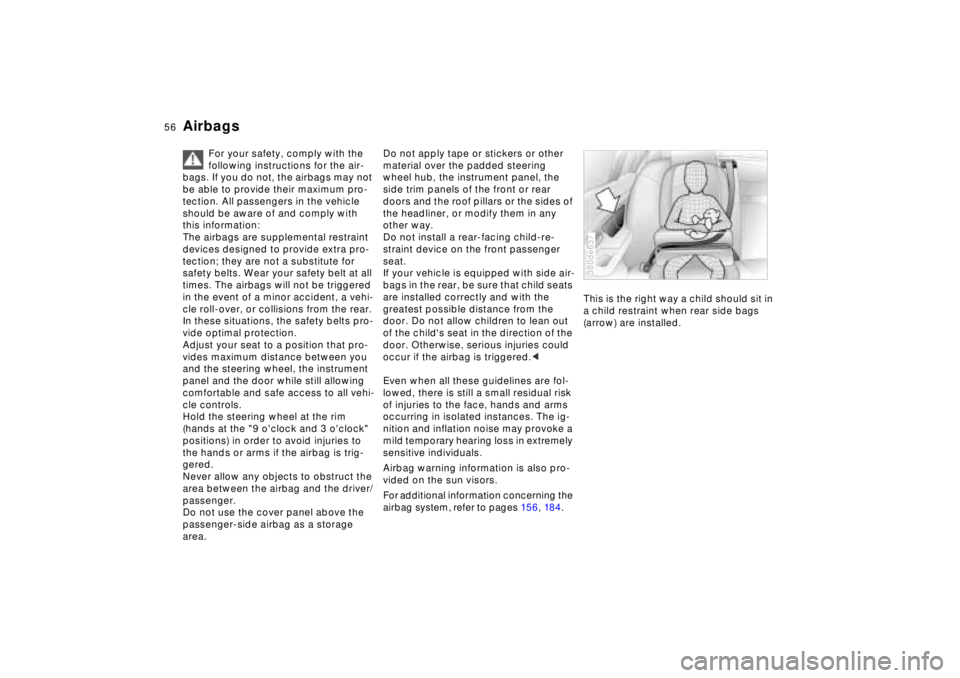
airbag system, refer to pages 15 6, 18 4.This is the right way a child should sit in
a child restraint when rear side bags
(arrow) are installed.
380de637
Page 58 of 211
57n
RepairsIndexOverview Controls Car care Technology Data
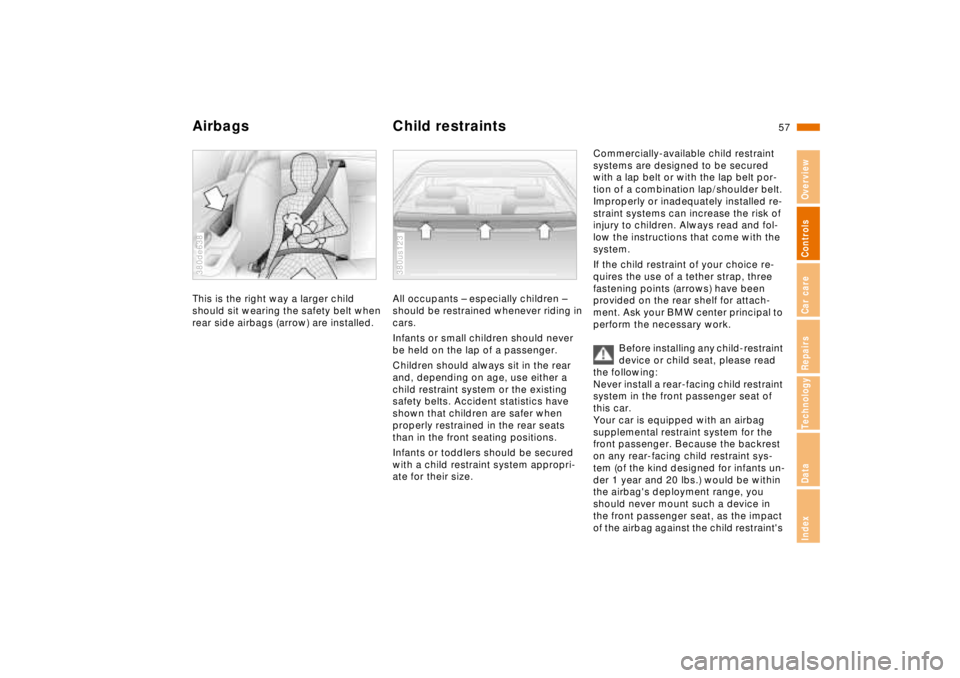
Airbags Child restraintsThis is the right way a larger child
should sit wearing the safety belt when
rear side airbags (arrow) are installed.380de638
All occupants – especially children –
should be restrained whenever riding in
cars.
Infants or small children should never
be held on the lap of a passenger.
Children should always sit in the rear
and, depending on age, use either a
child restraint system or the existing
safety belts. Accident statistics have
shown that children are safer when
properly restrained in the rear seats
than in the front seating positions.
Infants or toddlers should be secured
with a child restraint system appropri-
ate for their size.380us123
Commercially-available child restraint
systems are designed to be secured
with a lap belt or with the lap belt por-
tion of a combination lap/shoulder belt.
Improperly or inadequately installed re-
straint systems can increase the risk of
injury to children. Always read and fol-
low the instructions that come with the
system.
If the child restraint of your choice re-
quires the use of a tether strap, three
fastening points (arrows) have been
provided on the rear shelf for attach-
ment. Ask your BMW center principal to
perform the necessary work.
Before installing any child-restraint
device or child seat, please read
the following:
Never install a rear-facing child restraint
system in the front passenger seat of
this car.
Your car is equipped with an airbag
supplemental restraint system for the
front passenger. Because the backrest
on any rear-facing child restraint sys-
tem (of the kind designed for infants un-
der 1 year and 20 lbs.) would be within
the airbag's deployment range, you
should never mount such a device in
the front passenger seat, as the impact
of the airbag against the child restraint's