flat tire BMW 740I 1998 User Guide
[x] Cancel search | Manufacturer: BMW, Model Year: 1998, Model line: 740I, Model: BMW 740I 1998Pages: 211, PDF Size: 1.68 MB
Page 133 of 211
132n
Tire inflation pressure Tire conditionInformation for your safetyThe factory-approved radial tires are
matched to the car and have been se-
lected to provide optimum safety and
driving comfort on your car.
It is not merely the tire's service life, but
also driving comfort and - above all else
- driving safety which depend on the
condition of the tires and the mainte-
nance of the specified tire pressure.
Incorrect inflation pressure is a frequent
cause of tire damage. They also influ-
ence the roadholding ability of your
BMW.
Check tire inflation pressures – in-
cluding the spare tire – regularly,
at least every two weeks and before be-
ginning a longer trip. If this is not done,
incorrect tire pressures can cause driv-
ing instability and tire damage, ulti-
mately resulting in accidents.<
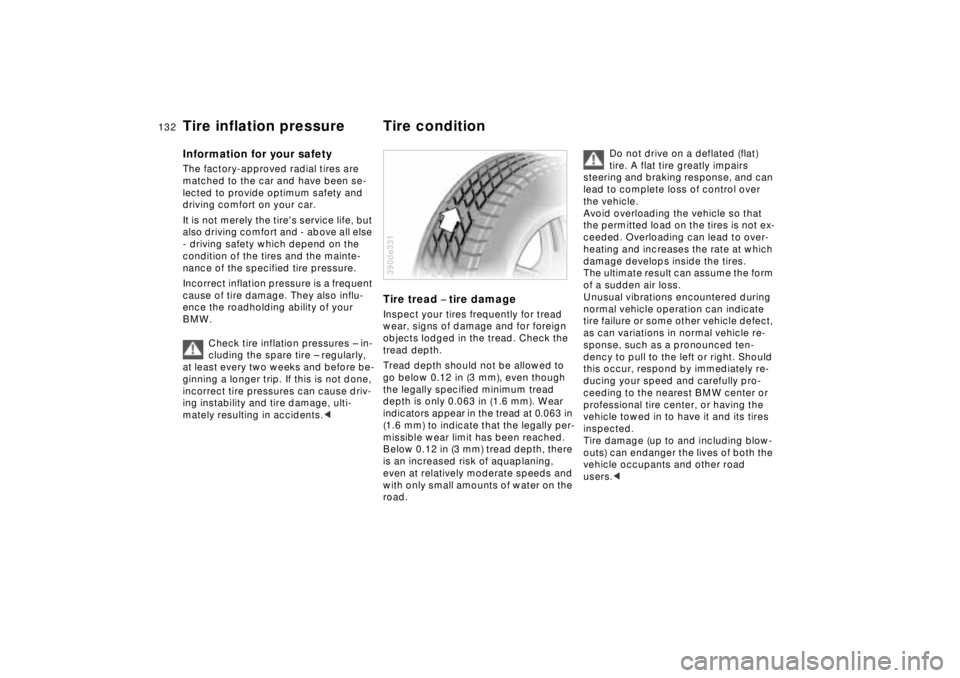
Tire tread
– tire damage
Inspect your tires frequently for tread
wear, signs of damage and for foreign
objects lodged in the tread. Check the
tread depth.
Tread depth should not be allowed to
go below 0.12 in (3 mm), even though
the legally specified minimum tread
depth is only 0.063 in (1.6 mm). Wear
indicators appear in the tread at 0.063 in
(1.6 mm) to indicate that the legally per-
missible wear limit has been reached.
Below 0.12 in (3 mm) tread depth, there
is an increased risk of aquaplaning,
even at relatively moderate speeds and
with only small amounts of water on the
road.390de331
Do not drive on a deflated (flat)
tire. A flat tire greatly impairs
steering and braking response, and can
lead to complete loss of control over
the vehicle.
Avoid overloading the vehicle so that
the permitted load on the tires is not ex-
ceeded. Overloading can lead to over-
heating and increases the rate at which
damage develops inside the tires.
The ultimate result can assume the form
of a sudden air loss.
Unusual vibrations encountered during
normal vehicle operation can indicate
tire failure or some other vehicle defect,
as can variations in normal vehicle re-
sponse, such as a pronounced ten-
dency to pull to the left or right. Should
this occur, respond by immediately re-
ducing your speed and carefully pro-
ceeding to the nearest BMW center or
professional tire center, or having the
vehicle towed in to have it and its tires
inspected.
Tire damage (up to and including blow-
outs) can endanger the lives of both the
vehicle occupants and other road
users.<
Page 135 of 211

134n
Wheel and tire combinationsThe right choiceUse only tires approved by BMW. Refer
to page 136.
Because of the high speeds this vehicle
can reach, the use of specific tire
brands, specifications and dimensions
is mandatory. Consult any BMW center
for details.
Comply with national, state, or provin-
cial regulations.
The correct wheel-tire combina-
tion affects different systems such
as ABS, ATC, ASC+T/DSC. The func-
tion of these systems is impaired if im-
proper wheel-tire combinations are
used.
For this reason, use only tires of the
same brand and tread pattern. In the
event of a flat tire if you have mounted
winter tires, for example, remount the
approved wheel-tire combination as
soon as possible.<
Codes on tires and wheelsThe tire codes will aid you in selecting
the correct tire.
Codes on radial tires:
The speed rating indicates the ap-
proved maximum speed for the tire.
Summer tires:
S = up to 112 mph (180 km/h)
T = up to 118 mph (190 km/h)
H = up to 130 mph (210 km/h)
V = up to 149 mph (240 km/h)
W = up to 167 mph (270 km/h)
ZR = over 149 mph (240 km/h) For example
Nominal width
in mm
Aspect ratio in %
Radial tire code
Rim diameter in inches
Load rating
(not on ZR tires)
Speed rating
(before R on ZR tires)
235/60 R 16 100 W
Winter tires:
Q M+S = up to 100 mph (160 km/h)
T M+S = up to 118 mph (190 km/h)
H M+S = up to 130 mph (210 km/h)
Codes stamped on light-alloy wheels:
Protect valve inserts against dirt using
screw-on valve stem caps. Dirt in the
valves frequently leads to slow leaks.For example
Rim width
in inches
Code letter for
flange type
Symbol for full-drop
center rim
Rim diameter in inches
Hump on the 2 rim shoulders
71/2 x 16 H 2
J
Page 136 of 211

135n
RepairsIndexOverview Controls Car care Technology Data
Winter tires Snow chains
*
Choosing the right tireBMW recommends winter tires (M+S
radial tires) for driving in adverse winter
road conditions. While tires known as
all-season tires (M+S designation) pro-
vide better winter traction than summer
tires with load ratings H, V, W and ZR,
they generally do not achieve the per-
formance of winter tires.
In the interests of sure tracking and safe
steering response at all four wheels,
mount winter tires which are made by
the same manufacturer and which have
the same tread configuration.
Mount only winter tires which have
been approved by BMW. Any BMW
center will be glad to provide you with
information on the best winter tires for
your particular driving conditions.
Do not exceed specified
maximum speeds
Never exceed the maximum
speed for which the tires are
rated.
Unprofessional attempts by laymen to
service tires can lead to damage and
accidents.
Have this work performed by skilled
professionals only. Any BMW center
has the required technical knowledge
and the proper equipment and will be
happy to assist you.<
Tire condition, tire pressureWinter tires display a perceptible loss in
their ability to cope with winter driving
conditions once the tread wears to be-
low 0.16 in (4 mm), and should thus be
replaced.
Comply with the specified tire inflation
pressures - and be sure to have the
wheel and tire assemblies balanced ev-
ery time you change the tires.StorageStore tires in a cool, dry place, away
from light whenever possible. Protect
the tires against contact with oil, grease
and fuel.
Use narrow-link BMW snow chains on
summer or winter tires only in pairs and
only on the rear wheels. Comply with all
manufacturer's safety precautions when
mounting the chains.
Page 171 of 211
170n
Changing tires
Safety measures in the event of a
flat tire or wheel change:
Stop the vehicle as far as possible from
passing traffic. Park on a firm, flat, sur-
face.
Switch on the hazard flashers.
Turn the steering wheel to the straight-
ahead position, remove the key and en-
gage the steering lock. Make sure that
the selector lever is in Park, and engage
the parking brake.
All passengers should be outside the
car and well away from your immediate
working area (for instance, behind a
guardrail).
If a warning triangle or portable hazard
warning lamp is available, set it up on
the roadside at an appropriate distance
from the rear of the vehicle.
Comply with all safety guidelines and
regulations.
Change the wheel only on a level, firm
surface which is not slippery. Avoid
jacking the car on a soft or slippery sup-
port surface (snow, ice, loose gravel,
etc.), since it could slide sideways.
Position the jack on a firm support sur-
face.
Do not place wooden blocks or similar
objects under the jack. If this is done,
the jack might not be able to reach its
full support capacity because of the
limited height. Do not lie under the vehi-
cle or start the engine when the vehicle
is supported by the jack - risk of fatal
injury.<
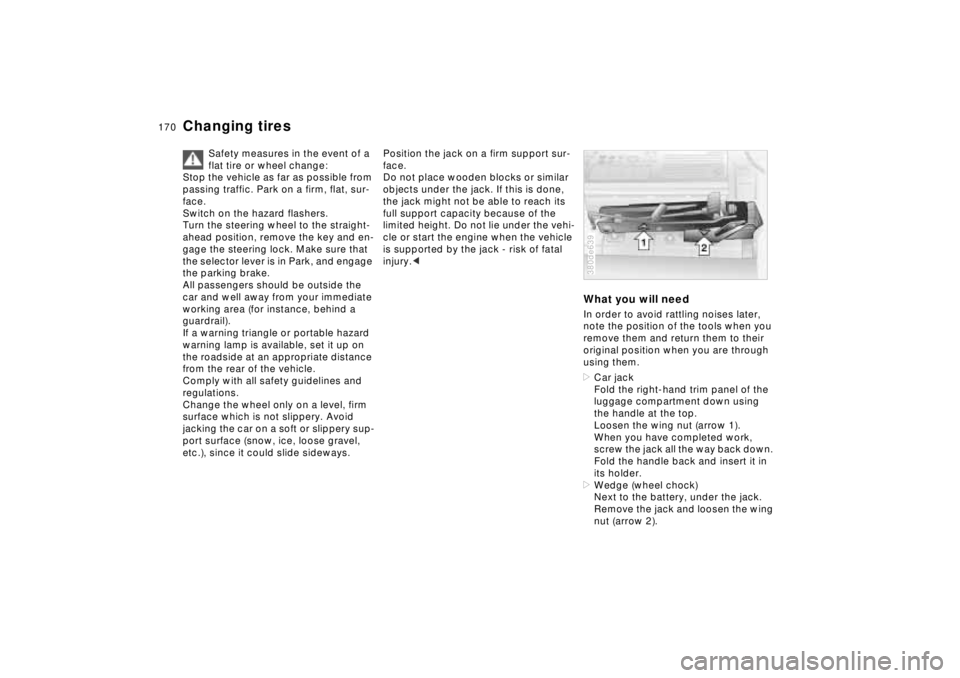
What you will needIn order to avoid rattling noises later,
note the position of the tools when you
remove them and return them to their
original position when you are through
using them.
>Car jack
Fold the right-hand trim panel of the
luggage compartment down using
the handle at the top.
Loosen the wing nut (arrow 1).
When you have completed work,
screw the jack all the way back down.
Fold the handle back and insert it in
its holder.
>Wedge (wheel chock)
Next to the battery, under the jack.
Remove the jack and loosen the wing
nut (arrow 2).380de639
Page 172 of 211
171n
RepairsIndexOverview Controls Car care Technology Data
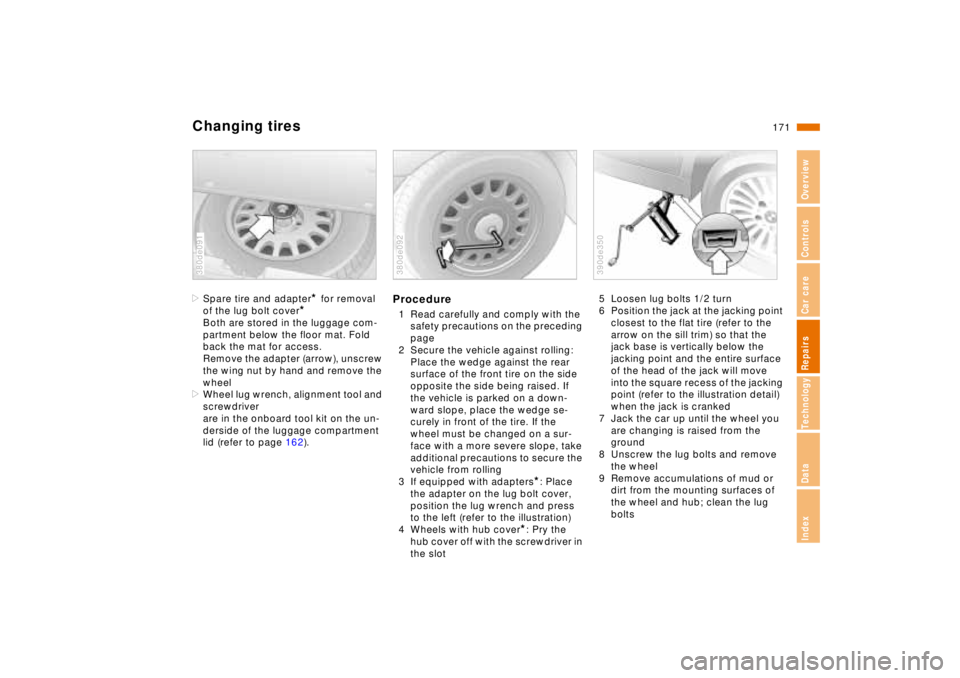
Changing tires>Spare tire and adapter
* for removal
of the lug bolt cover
*
Both are stored in the luggage com-
partment below the floor mat. Fold
back the mat for access.
Remove the adapter (arrow), unscrew
the wing nut by hand and remove the
wheel
>Wheel lug wrench, alignment tool and
screwdriver
are in the onboard tool kit on the un-
derside of the luggage compartment
lid (refer to page 162).
380de091
Procedure1 Read carefully and comply with the
safety precautions on the preceding
page
2 Secure the vehicle against rolling:
Place the wedge against the rear
surface of the front tire on the side
opposite the side being raised. If
the vehicle is parked on a down-
ward slope, place the wedge se-
curely in front of the tire. If the
wheel must be changed on a sur-
face with a more severe slope, take
additional precautions to secure the
vehicle from rolling
3 If equipped with adapters
*: Place
the adapter on the lug bolt cover,
position the lug wrench and press
to the left (refer to the illustration)
4 Wheels with hub cover
*: Pry the
hub cover off with the screwdriver in
the slot
380de092
5 Loosen lug bolts 1/2 turn
6 Position the jack at the jacking point
closest to the flat tire (refer to the
arrow on the sill trim) so that the
jack base is vertically below the
jacking point and the entire surface
of the head of the jack will move
into the square recess of the jacking
point (refer to the illustration detail)
when the jack is cranked
7 Jack the car up until the wheel you
are changing is raised from the
ground
8 Unscrew the lug bolts and remove
the wheel
9 Remove accumulations of mud or
dirt from the mounting surfaces of
the wheel and hub; clean the lug
bolts390de350
Page 185 of 211
184n
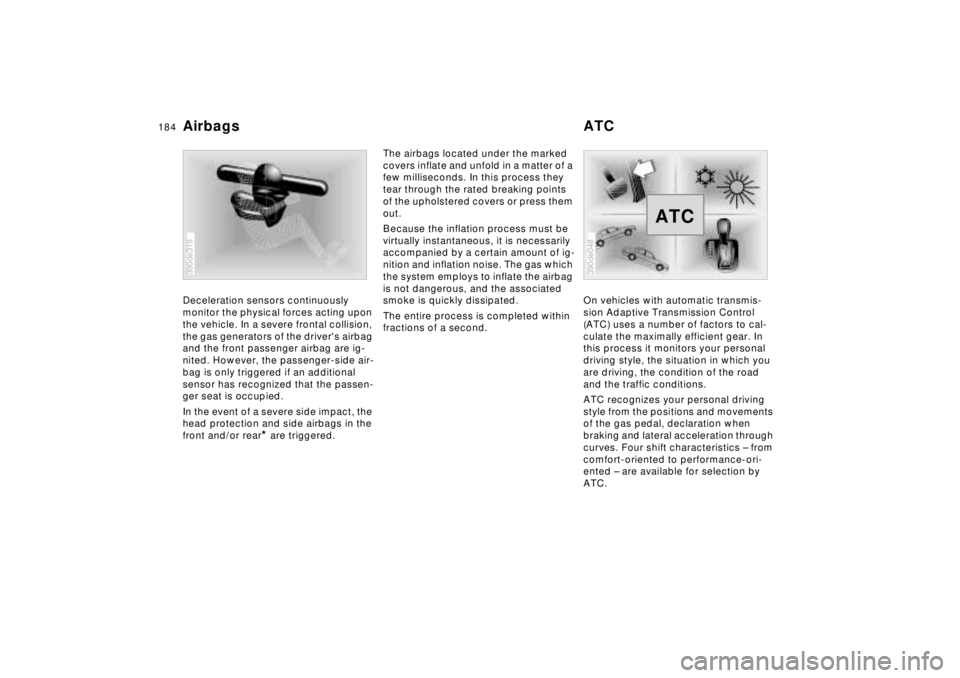
Deceleration sensors continuously
monitor the physical forces acting upon
the vehicle. In a severe frontal collision,
the gas generators of the driver's airbag
and the front passenger airbag are ig-
nited. However, the passenger-side air-
bag is only triggered if an additional
sensor has recognized that the passen-
ger seat is occupied.
In the event of a severe side impact, the
head protection and side airbags in the
front and/or rear
* are triggered.
390de319
The airbags located under the marked
covers inflate and unfold in a matter of a
few milliseconds. In this process they
tear through the rated breaking points
of the upholstered covers or press them
out.
Because the inflation process must be
virtually instantaneous, it is necessarily
accompanied by a certain amount of ig-
nition and inflation noise. The gas which
the system employs to inflate the airbag
is not dangerous, and the associated
smoke is quickly dissipated.
The entire process is completed within
fractions of a second.On vehicles with automatic transmis-
sion Adaptive Transmission Control
(ATC) uses a number of factors to cal-
culate the maximally efficient gear. In
this process it monitors your personal
driving style, the situation in which you
are driving, the condition of the road
and the traffic conditions.
ATC recognizes your personal driving
style from the positions and movements
of the gas pedal, declaration when
braking and lateral acceleration through
curves. Four shift characteristics – from
comfort-oriented to performance-ori-
ented – are available for selection by
ATC.
390de048
ATC
Airbags ATC
Page 204 of 211

RepairsIndexOverview Controls Car care Technology Data
Everything from A to Z
203n
Convenience operating mode
for windows and sliding/tilt
roof32
Convenience operating mode
for windows and sliding/tilt
sunroof33
Convenience starting59
Coolant146
Coolant temperature
gauge74
Coolant, antifreeze128
Cooling system, capacity 197
Cruise control70
Cruising range85
DDaytime-driving light
switch96
DBC (Dynamic Brake
Control)127
Defrosting, windows102
Digital clock79
Digital sound processor187
Dimensions195
Dimming feature, interior
rearview mirror50
Dipstick, engine oil143
Disc brakes126
Disconnect the battery175
Displacement194
Displays18
Distance86Distance warning90
Door key30
Door warning lamps, bulb
replacement167
Doors, emergency release 32
Doors, radio remote
control33
Drink holders113
Drive belts198
Driving notes123
DSC (Dynamic Stability
Control)92
Dynamic Brake Control
(DBC)127
Dynamic Stability Control
(DSC)92
EEDC (Electronic Damper
Control)93
Electric power windows42
Electric rear seat
adjustment48
Electric steering wheel
adjustment49
Electrical accessories,
failure176
Electrical system198
Electronic Damper Control
(EDC)93
Electronic immobilizer31Emergency deactivation of
the alarm system41
Emergency release
doors32
fuel filler door178
luggage compartment
lid37
sliding/tilt sunroof178
Energy Control73
Engine coolant146
Engine data194
Engine oil consumption143
Engine oil pressure20
Engine oil specifications144
Estimated time of arrival87
Exterior door handles,
lighted33
Exterior finish, care151, 152
FFailure messages75
First-aid kit24
Fittings for tow-starting
and towing180
Flashlight111
Flat tires132
Fluid, power steering148
Fog lamps97
bulb replacement165
switch97
Footwell lamps98Footwell lamps, bulb
replacement167
For wheelslip control, refer
to ASC+T/DSC92
Front armrest112
Front seat adjustment46
Fuel25
Fuel consumption
indicator73
Fuel filler door25
Fuel filler door,
manual release after
electrical fault178
Fuel gauge73
Fuel specifications25
Fuel tank capacity197
Fuel, average fuel
consumption85
Fuses176
GGasoline25
Glove compartment110
Glove compartment lamp,
bulb replacement167
Gross vehicle weight196HHand brake, refer to Parking
brake61
Handsfree system113
Hazard warning triangle24
Page 207 of 211

Everything from A to ZStarting assistance179
Starting the engine59
Steering130
Steering lock59
Steering wheel adjustment,
automatic49
Steering wheel lock59
Steering wheel memory51
Steering wheel, heated106
Steptronic65
Stopping the vehicle60
Storage facilities113
Sun visors51
Symbols4,173TTachometer72
Tail lamps166
Tail lamps,
bulb replacement166
Tank capacity197
Technical modifications
6,157
Telephone
Refer to Car telephone 131
Telephone hookup113
Temperature adjustment 103
Temperature display, engine
coolant74
Temperature display,
outside temperature72
Third brake lamp166Tilt alarm41
Tire code134
Tire damage132
Tire failure170
Tire inflation pressure 26, 132
Tire Pressure Control
(RDC)94
Tire replacement133
Tire tread132
Tires, specifications136
Tools162
Topping up the windshield/
washer fluid reservoir142
Torque194
Towing eyes180
Towing the vehicle180
Tow-starting180
Track circle195
Transmission62,65
Tread depth, tires132
Trip odometer72
Trunk lid, refer to luggage
compartment lid37
Turn signal22,68
Turn signals, bulb
replacement165,166
Turning circle195
UUniversal Remote
Control108
Used batteries175
VVanity mirrors51
Vehicle battery173
Vehicle identification148
Vehicle Identification
Number148
Vehicle storage156
Ventilation outlet,
ventilation100
Ventilation, draft-free104
Voice input23WWarning lamp "Please fasten
safety belts"21
Warning lamps20
Warnings75
Washer system68
Washing your car150
Water on the roads
Flooding123
Waxing, finish152
Weights196
Wheel lug wrench171
Wheel rims134
Wheelbase195
Wheels and tires134,136
Width195
Windows, convenience
operating mode32
Windows, radio remote
control33
Windows,demisting102Windshield washer
Reservoir capacity197
Windshield washer nozzle
adjustment142
Windshield wiper blades,
replacing162
Windshield wipers68
Windshield, defrosting69
Winter operation128
Winter tires135
Wiper blades, replacing162
Wipers68
Work in the engine
compartment137
XXenon lamps96,164,190
Page 209 of 211

Owner service procedures from A to ZSSecurity glass, care153
Sliding/tilt sunroof, closing
after electrical fault178
Sliding/tilt sunroof, power
supply interruption45
Snow chains135
Spare tire171
Starting assistance179
Starting problems
59,124,179,180TTail lamps, bulb
replacement166
Tilt sensor alarm system,
deactivation41
Tire damage132
Tire failure170
Tire inflation pressure26
Tools162
Towing180
Towing eyes180
Tow-starting180
Turn signal,
replace the bulb165UUse of antifreeze,
radiator146
WWarning lamps20
Warnings75
Washer fluid reservoir,
filling142
Wheel change170
Windows, demisting102
Windshield washer nozzle
adjustment142
Wiper blades, replacing162
Work in the engine
compartment137
Page 210 of 211
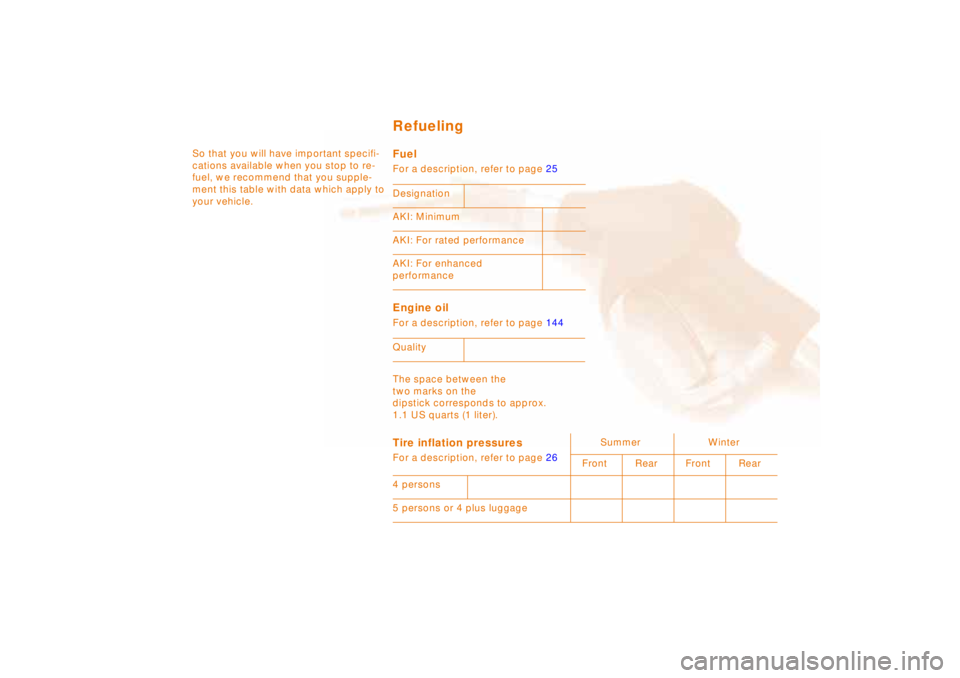
So that you will have important specifi-
cations available when you stop to re-
fuel, we recommend that you supple-
ment this table with data which apply to
your vehicle.
Fuel
For a description, refer to page 25
Engine oil For a description, refer to page 144
The space between the
two marks on the
dipstick corresponds to approx.
1.1 US quarts (1 liter). Designation
AKI: Minimum
AKI: For rated performance
AKI: For enhanced
performance
QualityTire inflation pressures For a description, refer to page 26Summer Winter
Front Rear Front Rear
4 persons
5 persons or 4 plus luggageRefueling