air condition BMW 740I 1998 Owner's Manual
[x] Cancel search | Manufacturer: BMW, Model Year: 1998, Model line: 740I, Model: BMW 740I 1998Pages: 211, PDF Size: 1.68 MB
Page 128 of 211

127n
RepairsIndexOverview Controls Car care Technology Data
Disc brakesDriving notesWhile driving in wet conditions and in
heavy rain, it is a good idea to apply
light pressure to the brake pedal every
few miles. Watch traffic conditions to
ensure that this maneuver does not en-
danger other road users. The heat gen-
erated in this braking process helps dry
the brake pads and rotors.
Maximum braking force is obtained
while the wheels continue to rotate,
peaking when the wheels remain on the
verge of locking without actually doing
so. ABS maintains this state automati-
cally. If the ABS fails, you should revert
to the staggered braking technique de-
scribed below (refer to page 129).
Extended or steep mountain descents
do not necessarily have to lead to re-
duced braking efficiency; downshift to a
gear in which only minimal periodic
brake applications are required - move
the selector lever to the appropriate
lower range.
You can continue to increase the brak-
ing effect of the engine by selecting a
lower gear - you can select transmis-
sion ranges as low as position 2 for ex-
treme conditions.Should engine braking prove inade-
quate, you should still avoid extended,
continuous braking. Instead of main-
taining low to moderate pressure over
an extended period of time, you should
decelerate the vehicle by applying more
substantial force on the pedal (watch
for following traffic!) and then pausing
before repeating the application. This
staggered braking technique allows the
brakes to cool in the intervals between
active braking phases, preventing over-
heating and ensuring that full braking
capacity remains available at all times.
Do not coast with the transmission
selector lever in neutral. Do not
drive with the engine shut off. The en-
gine provides no braking effect when
the transmission is in neutral, and there
is no power-assist for braking or steer-
ing when the engine is shut off.
Never allow floor mats, carpets or any
other objects to protrude into the area
around the accelerator and brake ped-
als and obstruct their movement.<
Dynamic Brake Control (DBC)
*
If you apply the brakes rapidly, this sys-
tem automatically produces the maxi-
mum braking force boost and thus
helps to achieve the shortest possible
braking distance during "panic stops."
All of the benefits of the ABS system
are exploited under these circum-
stances.
Do not reduce the pressure on the
brake pedal for the duration of the
brake application. When the brake
pedal is released, the DBC is deacti-
vated.
In the event of a malfunction, the
warning lamp comes on with a
yellow light. Conventional brak-
ing efficiency is available with-
out limitations.
Have the system checked and
repaired at your BMW center as soon
as possible.
For "Information for your safety"
covering the ABS system, refer to
page 125. This information also gener-
ally applies for DBC.<
Page 129 of 211

128n
Brake system Winter operationBrake fluid level
The warning lamp for the brake
hydraulic system comes on or
the message "Check Brake
Fluid" appears in the Check
Control:
The brake fluid level is too low in the
reservoir. Refer to page 147.
If the brake fluid level is too low and
brake pedal travel has become notice-
ably longer, there may be a defect in
one of the brake system's hydraulic cir-
cuits.
The remaining circuit continues to pro-
vide adequate brake-system perfor-
mance.
Proceed to the nearest authorized
BMW center. Higher brake appli-
cation pressure may be necessary un-
der these conditions, and brake pedal
travel may be significantly longer.
Please remember to adapt your driving
style accordingly.<
The warning lamp also comes on with
the "Check Brake Pads" message in the
Check Control.
Brake padsThe message "Check Brake Pads" ap-
pears in the Check Control:
The brake pads have reached their min-
imum pad thickness. Proceed to the
nearest authorized BMW center as
soon as possible to have the pads re-
placed.
We recommend the use of original
BMW brake pads and compo-
nents, otherwise driving safety can be
impaired.<
The onset of winter is often accompa-
nied by rapid changes in weather. Ad-
aptations in driving style should be ac-
companied by preparations on the
vehicle itself to ensure that your vehicle
operation through the winter remains
safe and trouble-free.CoolantBe sure that the coolant mixture is kept
at the year-round ratio of 50:50 (water
and antifreeze/corrosion protection).
This mixture provides protection
against freezing down to approx. –347
(–376). Replace the coolant every four
years.LocksBMW door lock deicer can be used to
free the locks if they are frozen. This
deicer also contains lubricant.
After using deicer, treatment with BMW
lock barrel grease is recommended.
Page 130 of 211

129n
RepairsIndexOverview Controls Car care Technology Data
Winter operationRubber seals and componentsIn order to prevent the weather-strip-
ping from freezing, apply rubber treat-
ment or a silicone spray to the seals on
the doors, hood and luggage compart-
ment lid.
A full range of car care products is
available from your BMW center.< Snow chainsBMW snow chains
* can be fitted on
both summer and winter tires in re-
sponse to severe winter road condi-
tions. Mount them in pairs on the rear
wheels only, and be sure to comply with
the manufacturer's safety instructions.
Do not exceed a maximum speed of
30 mph (50 km/h). In this situation
(snow chains mounted), deactivate the
ASC+T or DSC
*. Refer to page 92.
Starting offWhen starting off in deep snow or when
rocking the car to free it, we recom-
mend that you switch the ASC+T or
DSC
* off. Refer to page 92.
Driving on low-traction road
surfacesUse smooth, gentle pressure to control
the accelerator pedal. Avoid excessive
engine speeds and shift to the next
higher gear at an early point. Adapt
your speed and driving style when ap-
proaching grades. Maintain an ade-
quate distance between yourself and
the car ahead.BrakesWinter road conditions substantially re-
duce the amount of traction available
between the tires and the road surface;
the resulting increases in braking dis-
tance are considerable and should be
continually borne in mind.
ABS is intended to prevent the wheels
from locking during brake applications,
thus helping to maintain vehicle stability
and steering response. If the ABS does not respond in a critical
braking situation and the wheels lock:
Reduce the pressure on the brake
pedal until the wheels just start to roll
again while still maintaining enough
force to continue braking.
Following that, increase pedal pressure
again. Reduce the pressure as the
wheels lock, then reapply pressure, etc.
This type of staggered braking will re-
duce the braking distance, and the ve-
hicle still remains responsive to steer-
ing.
You can then attempt to steer around
hazards after you have reduced pres-
sure on the brake pedal.
Do not shift down on slick road
surfaces. Doing so could cause
the rear wheels to lose traction and
skid, which could result in the loss of
vehicle control.<
Page 133 of 211
132n
Tire inflation pressure Tire conditionInformation for your safetyThe factory-approved radial tires are
matched to the car and have been se-
lected to provide optimum safety and
driving comfort on your car.
It is not merely the tire's service life, but
also driving comfort and - above all else
- driving safety which depend on the
condition of the tires and the mainte-
nance of the specified tire pressure.
Incorrect inflation pressure is a frequent
cause of tire damage. They also influ-
ence the roadholding ability of your
BMW.
Check tire inflation pressures – in-
cluding the spare tire – regularly,
at least every two weeks and before be-
ginning a longer trip. If this is not done,
incorrect tire pressures can cause driv-
ing instability and tire damage, ulti-
mately resulting in accidents.<
Tire tread
– tire damage
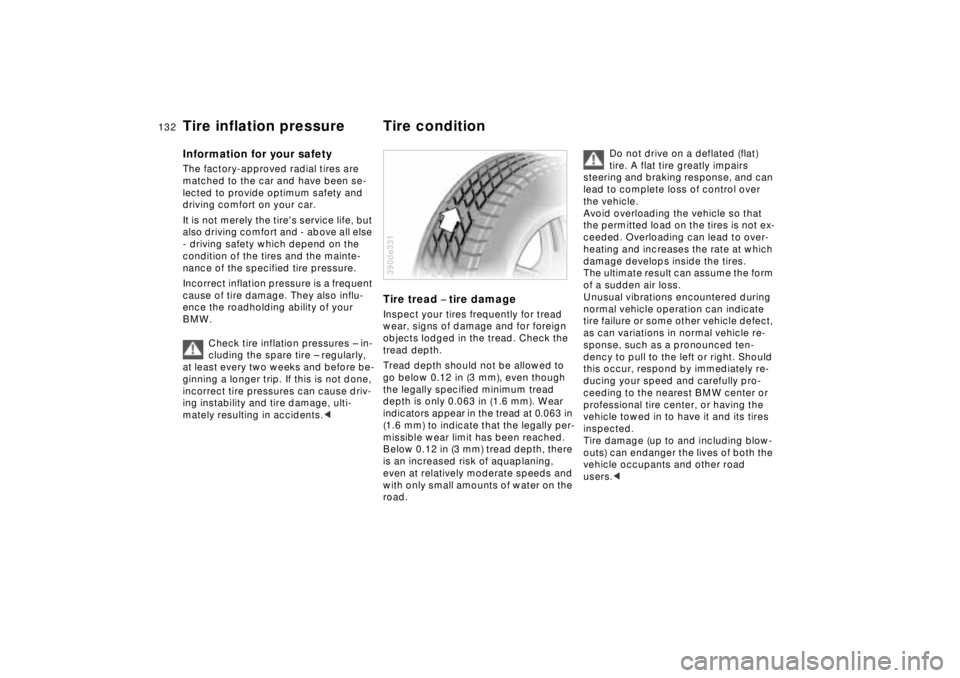
Inspect your tires frequently for tread
wear, signs of damage and for foreign
objects lodged in the tread. Check the
tread depth.
Tread depth should not be allowed to
go below 0.12 in (3 mm), even though
the legally specified minimum tread
depth is only 0.063 in (1.6 mm). Wear
indicators appear in the tread at 0.063 in
(1.6 mm) to indicate that the legally per-
missible wear limit has been reached.
Below 0.12 in (3 mm) tread depth, there
is an increased risk of aquaplaning,
even at relatively moderate speeds and
with only small amounts of water on the
road.390de331
Do not drive on a deflated (flat)
tire. A flat tire greatly impairs
steering and braking response, and can
lead to complete loss of control over
the vehicle.
Avoid overloading the vehicle so that
the permitted load on the tires is not ex-
ceeded. Overloading can lead to over-
heating and increases the rate at which
damage develops inside the tires.
The ultimate result can assume the form
of a sudden air loss.
Unusual vibrations encountered during
normal vehicle operation can indicate
tire failure or some other vehicle defect,
as can variations in normal vehicle re-
sponse, such as a pronounced ten-
dency to pull to the left or right. Should
this occur, respond by immediately re-
ducing your speed and carefully pro-
ceeding to the nearest BMW center or
professional tire center, or having the
vehicle towed in to have it and its tires
inspected.
Tire damage (up to and including blow-
outs) can endanger the lives of both the
vehicle occupants and other road
users.<
Page 134 of 211

133n
RepairsIndexOverview Controls Car care Technology Data
Tire replacement Tire rotationTo maintain good handling and vehicle
response, use only tires of a single
tread configuration from a single manu-
facturer. BMW tests and approves
wheel/tire combinations. Refer to
page 136.
Do not use retreaded tires, since
driving safety may be impaired by
their use. This is due to the possible
variations in casing structures and, in
some cases, to their extreme age,
which can lead to a decrease in their
durability.< Tire ageThe date on which the tire was manu-
factured is indicated by the code on the
sidewall:
DOT ... 178 means that the tires were
manufactured in the 17th week of 1998.
BMW recommends the replacement of
all tires when the tires are no more than
6 years old, even if a tire life of 10 years
is possible.
Spare tires over 6 years old should be
used only in case of emergency. Such a
tire should be replaced by a new tire
immediately, and should not be
mounted together with new tires.
Between the axlesThe tread wear patterns at the front end
differ from those at the rear - the actual
patterns will vary according to individ-
ual driving conditions. In the interests of
safety and maintaining optimal handling
characteristics, tire rotation is not rec-
ommended.
If a proposed interaxle rotation of tires
is based on economic considerations,
one should consider whether the costs
for the rotation are likely to be recap-
tured by any increase in the service life
of the tires which might be realized. Ro-
tation should always be carried out at
short intervals, with a maximum of
3,000 miles (5,000 km). Consult your
authorized BMW center for more infor-
mation.
Should you decide to rotate the tires, it
is essential to comply with the follow-
ing:
Rotate tires on the same side only,
since braking characteristics and road
grip could otherwise be adversely af-
fected.
Following rotation, correct the tire infla-
tion pressure.If different tire sizes are mounted
on the front and rear axles
(page 136), the tires may not be rotated
from one axle to the other.<
Page 136 of 211

135n
RepairsIndexOverview Controls Car care Technology Data
Winter tires Snow chains
*
Choosing the right tireBMW recommends winter tires (M+S
radial tires) for driving in adverse winter
road conditions. While tires known as
all-season tires (M+S designation) pro-
vide better winter traction than summer
tires with load ratings H, V, W and ZR,
they generally do not achieve the per-
formance of winter tires.
In the interests of sure tracking and safe
steering response at all four wheels,
mount winter tires which are made by
the same manufacturer and which have
the same tread configuration.
Mount only winter tires which have
been approved by BMW. Any BMW
center will be glad to provide you with
information on the best winter tires for
your particular driving conditions.
Do not exceed specified
maximum speeds
Never exceed the maximum
speed for which the tires are
rated.
Unprofessional attempts by laymen to
service tires can lead to damage and
accidents.
Have this work performed by skilled
professionals only. Any BMW center
has the required technical knowledge
and the proper equipment and will be
happy to assist you.<
Tire condition, tire pressureWinter tires display a perceptible loss in
their ability to cope with winter driving
conditions once the tread wears to be-
low 0.16 in (4 mm), and should thus be
replaced.
Comply with the specified tire inflation
pressures - and be sure to have the
wheel and tire assemblies balanced ev-
ery time you change the tires.StorageStore tires in a cool, dry place, away
from light whenever possible. Protect
the tires against contact with oil, grease
and fuel.
Use narrow-link BMW snow chains on
summer or winter tires only in pairs and
only on the rear wheels. Comply with all
manufacturer's safety precautions when
mounting the chains.
Page 144 of 211
143n
RepairsIndexOverview Controls Car care Technology Data
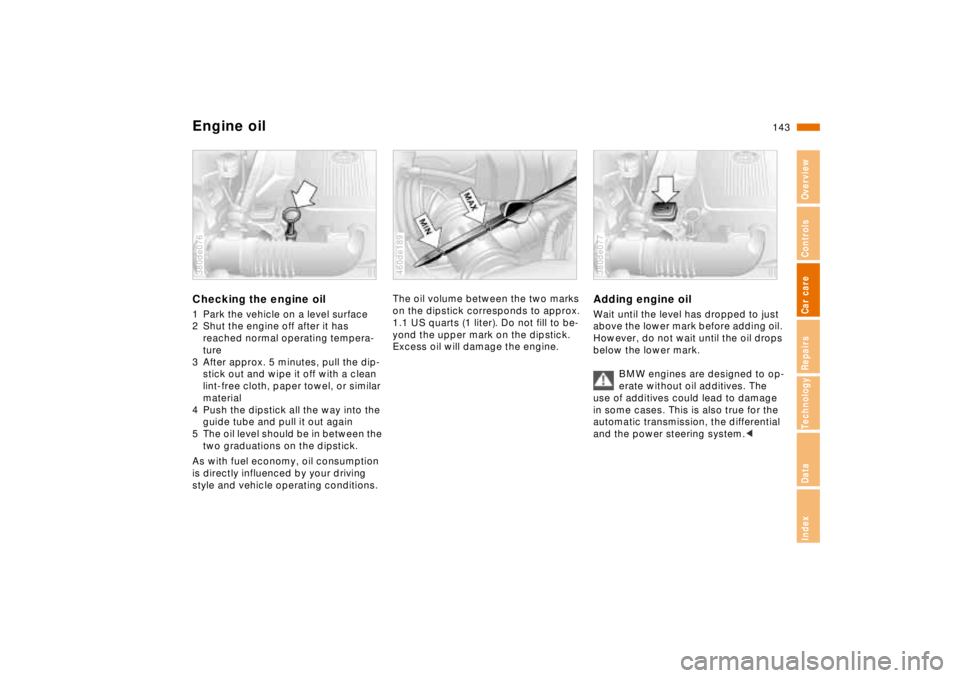
Engine oilChecking the engine oil1 Park the vehicle on a level surface
2 Shut the engine off after it has
reached normal operating tempera-
ture
3 After approx. 5 minutes, pull the dip-
stick out and wipe it off with a clean
lint-free cloth, paper towel, or similar
material
4 Push the dipstick all the way into the
guide tube and pull it out again
5 The oil level should be in between the
two graduations on the dipstick.
As with fuel economy, oil consumption
is directly influenced by your driving
style and vehicle operating conditions.380de076
The oil volume between the two marks
on the dipstick corresponds to approx.
1.1 US quarts (1 liter). Do not fill to be-
yond the upper mark on the dipstick.
Excess oil will damage the engine.460de189
Adding engine oilWait until the level has dropped to just
above the lower mark before adding oil.
However, do not wait until the oil drops
below the lower mark.
BMW engines are designed to op-
erate without oil additives. The
use of additives could lead to damage
in some cases. This is also true for the
automatic transmission, the differential
and the power steering system.< 380de077
Page 145 of 211
144n
Engine oilEngine oil specificationsThe quality of the engine oil selected
has critical significance for the opera-
tion and service life of an engine. Based
on extensive testing, BMW has ap-
proved only certain engine oils.
Use approved "longlife oils" only.
If it should ever occur that it is impossi-
ble to purchase an approved "longlife
oil," you may use small volumes of the
"special oils" approved by BMW for
topping up between oil changes.
You may use oils with the specification
API SH only if the special oils are also
not available.
Call 1-800-831-1117, or ask your
authorized BMW center for de-
tails concerning the specific "longlife
oils" or "special oils" which have been
approved.<
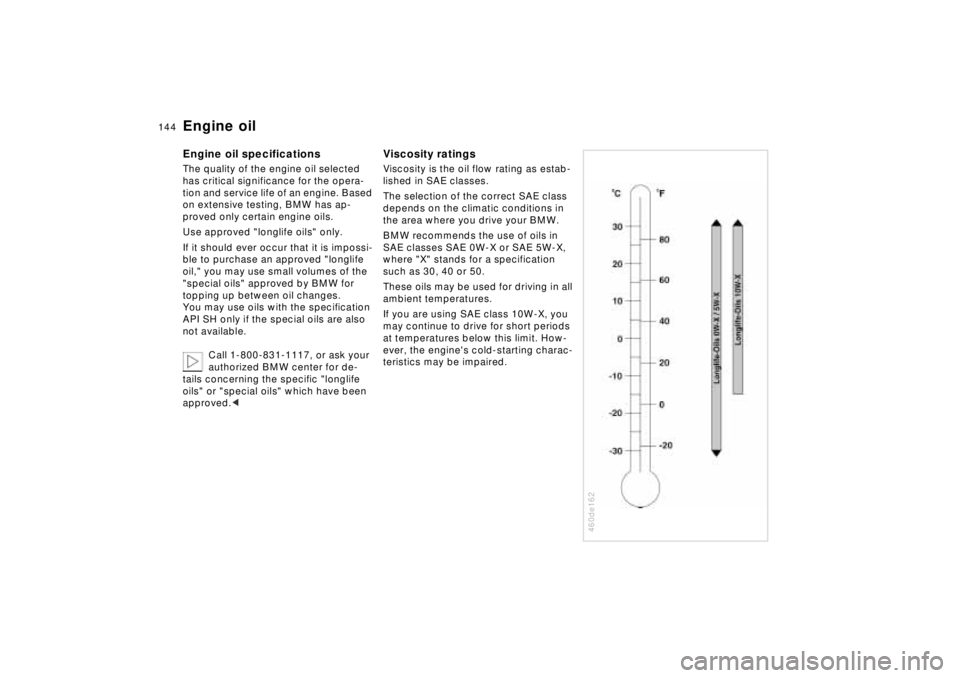
Viscosity ratingsViscosity is the oil flow rating as estab-
lished in SAE classes.
The selection of the correct SAE class
depends on the climatic conditions in
the area where you drive your BMW.
BMW recommends the use of oils in
SAE classes SAE 0W-X or SAE 5W-X,
where "X" stands for a specification
such as 30, 40 or 50.
These oils may be used for driving in all
ambient temperatures.
If you are using SAE class 10W-X, you
may continue to drive for short periods
at temperatures below this limit. How-
ever, the engine's cold-starting charac-
teristics may be impaired.
460de162
Page 150 of 211
149n
RepairsIndexOverview Controls Car care Technology Data
The BMW Maintenance SystemThe BMW Maintenance System has
been designed as a reliable means of
providing maximum driving and operat-
ing safety – and as cost-effectively as
possible for you.
Please keep in mind that regular main-
tenance is not only necessary for the
safety of your vehicle, but also plays a
significant role in maintaining the resale
value of the vehicle.380us008
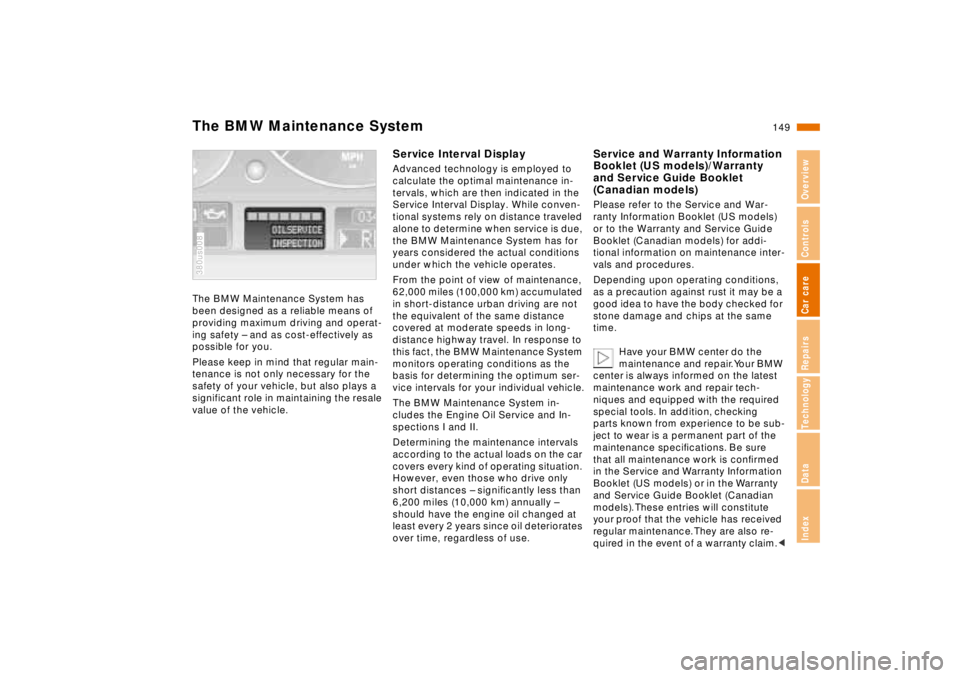
Service Interval DisplayAdvanced technology is employed to
calculate the optimal maintenance in-
tervals, which are then indicated in the
Service Interval Display. While conven-
tional systems rely on distance traveled
alone to determine when service is due,
the BMW Maintenance System has for
years considered the actual conditions
under which the vehicle operates.
From the point of view of maintenance,
62,000 miles (100,000 km) accumulated
in short-distance urban driving are not
the equivalent of the same distance
covered at moderate speeds in long-
distance highway travel. In response to
this fact, the BMW Maintenance System
monitors operating conditions as the
basis for determining the optimum ser-
vice intervals for your individual vehicle.
The BMW Maintenance System in-
cludes the Engine Oil Service and In-
spections I and II.
Determining the maintenance intervals
according to the actual loads on the car
covers every kind of operating situation.
However, even those who drive only
short distances – significantly less than
6,200 miles (10,000 km) annually –
should have the engine oil changed at
least every 2 years since oil deteriorates
over time, regardless of use.
Service and Warranty Information
Booklet (US models)/Warranty
and Service Guide Booklet
(Canadian models)Please refer to the Service and War-
ranty Information Booklet (US models)
or to the Warranty and Service Guide
Booklet (Canadian models) for addi-
tional information on maintenance inter-
vals and procedures.
Depending upon operating conditions,
as a precaution against rust it may be a
good idea to have the body checked for
stone damage and chips at the same
time.
Have your BMW center do the
maintenance and repair. Your BMW
center is always informed on the latest
maintenance work and repair tech-
niques and equipped with the required
special tools. In addition, checking
parts known from experience to be sub-
ject to wear is a permanent part of the
maintenance specifications. Be sure
that all maintenance work is confirmed
in the Service and Warranty Information
Booklet (US models) or in the Warranty
and Service Guide Booklet (Canadian
models). These entries will constitute
your proof that the vehicle has received
regular maintenance. They are also re-
quired in the event of a warranty claim.<
Page 174 of 211
173n
RepairsIndexOverview Controls Car care Technology Data
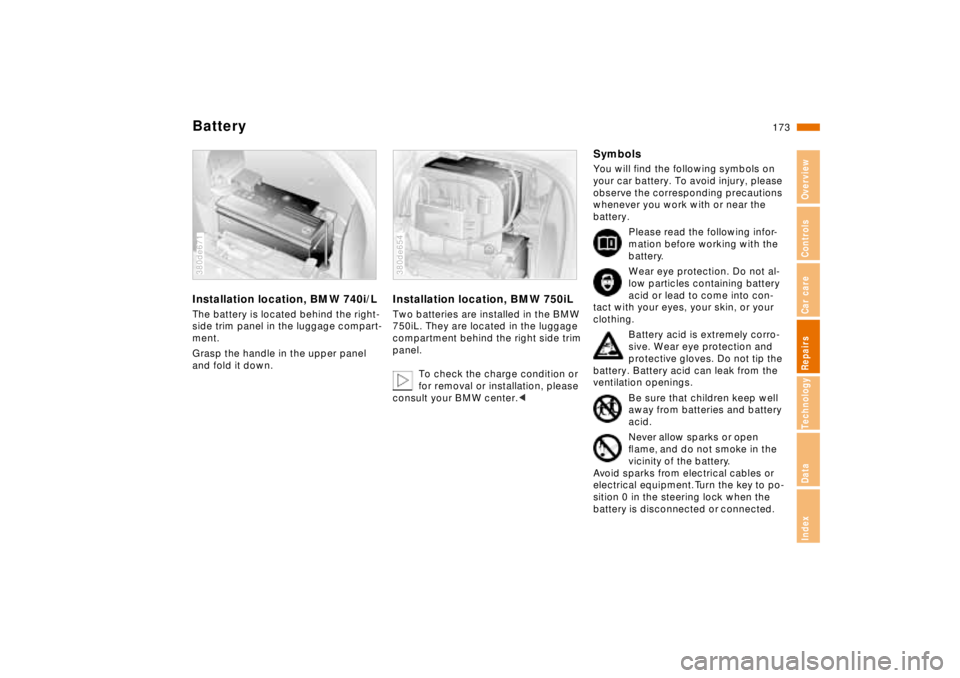
BatteryInstallation location, BMW 740i/LThe battery is located behind the right-
side trim panel in the luggage compart-
ment.
Grasp the handle in the upper panel
and fold it down.380de671
Installation location, BMW 750iLTwo batteries are installed in the BMW
750iL. They are located in the luggage
compartment behind the right side trim
panel.
To check the charge condition or
for removal or installation, please
consult your BMW center.< 380de654
SymbolsYou will find the following symbols on
your car battery. To avoid injury, please
observe the corresponding precautions
whenever you work with or near the
battery.
Please read the following infor-
mation before working with the
battery.
Wear eye protection. Do not al-
low particles containing battery
acid or lead to come into con-
tact with your eyes, your skin, or your
clothing.
Battery acid is extremely corro-
sive. Wear eye protection and
protective gloves. Do not tip the
battery. Battery acid can leak from the
ventilation openings.
Be sure that children keep well
away from batteries and battery
acid.
Never allow sparks or open
flame, and do not smoke in the
vicinity of the battery.
Avoid sparks from electrical cables or
electrical equipment. Turn the key to po-
sition 0 in the steering lock when the
battery is disconnected or connected.