steering wheel BMW 740I 1998 Owner's Manual
[x] Cancel search | Manufacturer: BMW, Model Year: 1998, Model line: 740I, Model: BMW 740I 1998Pages: 211, PDF Size: 1.68 MB
Page 130 of 211

129n
RepairsIndexOverview Controls Car care Technology Data
Winter operationRubber seals and componentsIn order to prevent the weather-strip-
ping from freezing, apply rubber treat-
ment or a silicone spray to the seals on
the doors, hood and luggage compart-
ment lid.
A full range of car care products is
available from your BMW center.< Snow chainsBMW snow chains
* can be fitted on
both summer and winter tires in re-
sponse to severe winter road condi-
tions. Mount them in pairs on the rear
wheels only, and be sure to comply with
the manufacturer's safety instructions.
Do not exceed a maximum speed of
30 mph (50 km/h). In this situation
(snow chains mounted), deactivate the
ASC+T or DSC
*. Refer to page 92.
Starting offWhen starting off in deep snow or when
rocking the car to free it, we recom-
mend that you switch the ASC+T or
DSC
* off. Refer to page 92.
Driving on low-traction road
surfacesUse smooth, gentle pressure to control
the accelerator pedal. Avoid excessive
engine speeds and shift to the next
higher gear at an early point. Adapt
your speed and driving style when ap-
proaching grades. Maintain an ade-
quate distance between yourself and
the car ahead.BrakesWinter road conditions substantially re-
duce the amount of traction available
between the tires and the road surface;
the resulting increases in braking dis-
tance are considerable and should be
continually borne in mind.
ABS is intended to prevent the wheels
from locking during brake applications,
thus helping to maintain vehicle stability
and steering response. If the ABS does not respond in a critical
braking situation and the wheels lock:
Reduce the pressure on the brake
pedal until the wheels just start to roll
again while still maintaining enough
force to continue braking.
Following that, increase pedal pressure
again. Reduce the pressure as the
wheels lock, then reapply pressure, etc.
This type of staggered braking will re-
duce the braking distance, and the ve-
hicle still remains responsive to steer-
ing.
You can then attempt to steer around
hazards after you have reduced pres-
sure on the brake pedal.
Do not shift down on slick road
surfaces. Doing so could cause
the rear wheels to lose traction and
skid, which could result in the loss of
vehicle control.<
Page 136 of 211

135n
RepairsIndexOverview Controls Car care Technology Data
Winter tires Snow chains
*
Choosing the right tireBMW recommends winter tires (M+S
radial tires) for driving in adverse winter
road conditions. While tires known as
all-season tires (M+S designation) pro-
vide better winter traction than summer
tires with load ratings H, V, W and ZR,
they generally do not achieve the per-
formance of winter tires.
In the interests of sure tracking and safe
steering response at all four wheels,
mount winter tires which are made by
the same manufacturer and which have
the same tread configuration.
Mount only winter tires which have
been approved by BMW. Any BMW
center will be glad to provide you with
information on the best winter tires for
your particular driving conditions.
Do not exceed specified
maximum speeds
Never exceed the maximum
speed for which the tires are
rated.
Unprofessional attempts by laymen to
service tires can lead to damage and
accidents.
Have this work performed by skilled
professionals only. Any BMW center
has the required technical knowledge
and the proper equipment and will be
happy to assist you.<
Tire condition, tire pressureWinter tires display a perceptible loss in
their ability to cope with winter driving
conditions once the tread wears to be-
low 0.16 in (4 mm), and should thus be
replaced.
Comply with the specified tire inflation
pressures - and be sure to have the
wheel and tire assemblies balanced ev-
ery time you change the tires.StorageStore tires in a cool, dry place, away
from light whenever possible. Protect
the tires against contact with oil, grease
and fuel.
Use narrow-link BMW snow chains on
summer or winter tires only in pairs and
only on the rear wheels. Comply with all
manufacturer's safety precautions when
mounting the chains.
Page 157 of 211
156n
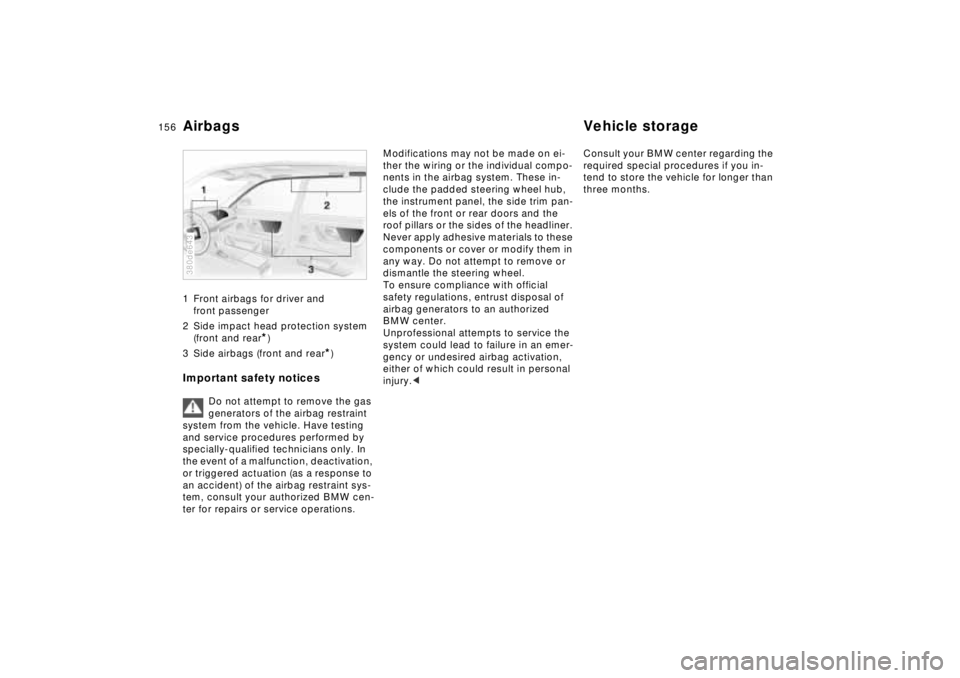
Airbags Vehicle storage1 Front airbags for driver and
front passenger
2 Side impact head protection system
(front and rear
*)
3 Side airbags (front and rear
*)
Important safety notices
Do not attempt to remove the gas
generators of the airbag restraint
system from the vehicle. Have testing
and service procedures performed by
specially-qualified technicians only. In
the event of a malfunction, deactivation,
or triggered actuation (as a response to
an accident) of the airbag restraint sys-
tem, consult your authorized BMW cen-
ter for repairs or service operations.
380de643
Modifications may not be made on ei-
ther the wiring or the individual compo-
nents in the airbag system. These in-
clude the padded steering wheel hub,
the instrument panel, the side trim pan-
els of the front or rear doors and the
roof pillars or the sides of the headliner.
Never apply adhesive materials to these
components or cover or modify them in
any way. Do not attempt to remove or
dismantle the steering wheel.
To ensure compliance with official
safety regulations, entrust disposal of
airbag generators to an authorized
BMW center.
Unprofessional attempts to service the
system could lead to failure in an emer-
gency or undesired airbag activation,
either of which could result in personal
injury.< Consult your BMW center regarding the
required special procedures if you in-
tend to store the vehicle for longer than
three months.
Page 171 of 211
170n
Changing tires
Safety measures in the event of a
flat tire or wheel change:
Stop the vehicle as far as possible from
passing traffic. Park on a firm, flat, sur-
face.
Switch on the hazard flashers.
Turn the steering wheel to the straight-
ahead position, remove the key and en-
gage the steering lock. Make sure that
the selector lever is in Park, and engage
the parking brake.
All passengers should be outside the
car and well away from your immediate
working area (for instance, behind a
guardrail).
If a warning triangle or portable hazard
warning lamp is available, set it up on
the roadside at an appropriate distance
from the rear of the vehicle.
Comply with all safety guidelines and
regulations.
Change the wheel only on a level, firm
surface which is not slippery. Avoid
jacking the car on a soft or slippery sup-
port surface (snow, ice, loose gravel,
etc.), since it could slide sideways.
Position the jack on a firm support sur-
face.
Do not place wooden blocks or similar
objects under the jack. If this is done,
the jack might not be able to reach its
full support capacity because of the
limited height. Do not lie under the vehi-
cle or start the engine when the vehicle
is supported by the jack - risk of fatal
injury.<
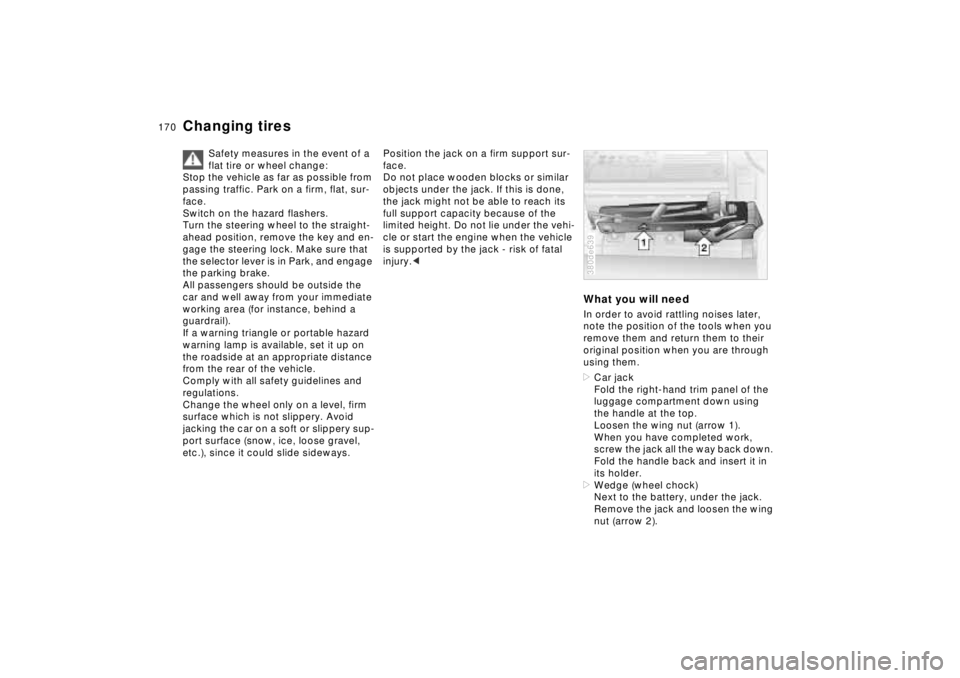
What you will needIn order to avoid rattling noises later,
note the position of the tools when you
remove them and return them to their
original position when you are through
using them.
>Car jack
Fold the right-hand trim panel of the
luggage compartment down using
the handle at the top.
Loosen the wing nut (arrow 1).
When you have completed work,
screw the jack all the way back down.
Fold the handle back and insert it in
its holder.
>Wedge (wheel chock)
Next to the battery, under the jack.
Remove the jack and loosen the wing
nut (arrow 2).380de639
Page 182 of 211
181n
RepairsIndexOverview Controls Car care Technology Data
Towing the vehicle
The towed vehicle should always
be the lighter of the two vehicles.
If this is not the case, it is no longer
possible to control vehicle response.<
Tow-startingIt is not possible to start the engine of
vehicles equipped with automatic trans-
mission by towing or pushing.
For instructions on jump starting, refer
to page 179.
Never attempt to use your vehicle to
push another car, as damage to the
energy-absorbing bumpers could
result.
Towing a vehicle with automatic
transmission1 Place selector lever in position N
2 Towing speed:
Max. 45 mph (70 km/h)
3 Towing distance:
Max. 95 miles (150 km)
4 Leave the ignition key at position 1 to
ensure that the brake lamps, turn sig-
nals, horn and windshield wipers re-
main operative, and to prevent the
steering lock detent from engaging
5 Switch on the hazard-warning system
(observe country-specific regula-
tions).
Find some means of identifying the ve-
hicle in tow, for instance, place a sign
or warning triangle in the rear window.
Make sure that the ignition key re-
mains in position 1 even when the
electrical system has failed to prevent
the steering lock from engaging.
The steering and brakes are without
power assist when the engine is off.
This means that increased effort is re-
quired for steering and braking.<
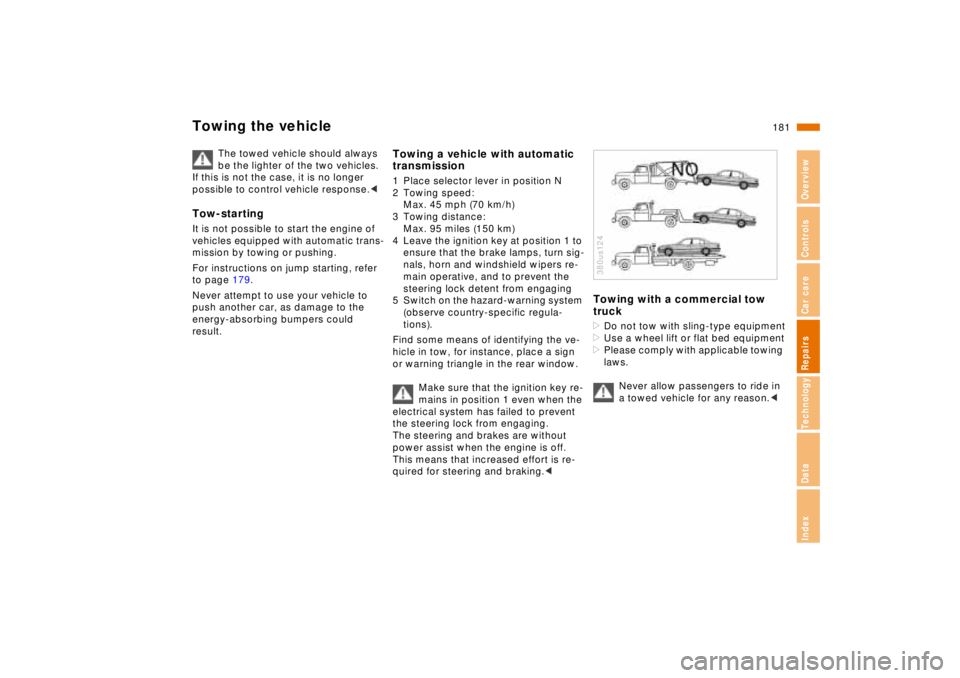
Towing with a commercial tow
truck>Do not tow with sling-type equipment
>Use a wheel lift or flat bed equipment
>Please comply with applicable towing
laws.
Never allow passengers to ride in
a towed vehicle for any reason.< 380us124
Page 186 of 211

185n
RepairsIndexOverview Controls Car care Technology Data
In order to take driving conditions into
account, ATC registers corners and
both uphill and downhill gradients. For
example, if you maintain speed through
a curve, the transmission does not up-
shift.
On uphill gradients, it shifts only when
the engine speed increases in order to
make more efficient use of power re-
serves. On downhill gradients ATC
downshifts when the speed of the vehi-
cles increases causing the driver to
step on the brakes.
With respect to road conditions, ATC
monitors the friction between the tires
and the road. The system responds to
slippery road surfaces (snow and ice)
by activating the winter program.
Second gear is used when moving
away from a standstill, upshifts occur
sooner, and on descents downshifting
does not occur in spite of the applica-
tion of brakes. This enables you to
"feel" the road as you drive and pro-
duces greater dynamic stability. If the
friction between the tires and the road
is adequate, the normal system is again
activated. The system also leaves the
winter program when you shift from
drive position "D" to "S," "3" or "2," or if
the ASC+T/DSC
* is deactivated.By recognizing traffic conditions, ATC
can retain maximum driving comfort.
For instance, the system recognizes
stop-and-go traffic and then proceeds
only in second gear until it encounters
higher starting loads.
Of course the selector lever can still be
used to select specific gear ratios. Per-
formance-oriented driving is enabled by
shifting from drive position "D" to "S,"
"3" or "2." Positions "3" and "2" each
limit upshifts to the next gear. Position
"2" is best for driving on steep mountain
slopes with a heavy load.Precision sensors monitor the number
of revolutions of the wheels. When
equipped with DSC, they also monitor
steering angle, lateral acceleration,
brake pressure and the movement of
the vehicle around its vertical axis.
If differences in the wheel speeds oc-
cur, the system counteracts the danger
of wheelspin by reducing torque. If nec-
essary, the system also responds with
additional applications of the brakes at
the rear wheels.
If the system detects an instability in the
vehicle's condition, the braking action
can also be directed to the front wheels
by the DSC in order to stabilize the ve-
hicle.
You may need some time to become
accustomed to this system intervention.
However, it helps provide optimum pro-
pulsive force and driving stability.
The braking intervention may be ac-
companied by a certain degree of
noise.
ATC ASC+T/DSC
*
Page 203 of 211

Everything from A to ZAABS125
Accessories6
Activated-charcoal filter105
Active seat48
Adaptive Transmission
Control (ATC)63
Adding engine oil143
Adding washer fluid142
Adjust the backrest46
Adjusting steering wheel49
Air distribution102
Air flow103
Air jets100
Air pressure132
Airbags55
Alarm system40
Deactivating in an
emergency41
Antenna diversity186
Antifreeze146
Antifreeze, radiator128, 146
Antilock Brake System
(ABS)125
Anti-theft alarm system
32,40
Approved gross vehicle
weight196
Aquaplaning123,132
Armrest111
ASC+T (Automatic Stability
Control plus Traction)92Ashtray114
AUC (Automatic recirculated-
air control)103
Audio System78
Automatic car washes150
Automatic climate
control100
Automatic climate control,
removing window
condensation102
Automatic recirculated-air
control (AUC)103
Automatic Soft-Close
feature38
Automatic Stability Control
plus Traction (ASC+T)92
Automatic steering wheel
adjustment49
Automatic transmission62
Automatic transmission with
Steptronic65
Automatic windshield
washer69
Average fuel consumption 85
Average speed86
Axle loads196
BBackup lamps, bulb
replacement166
Battery173,198
Battery capacity198Battery change, radio remote
control168
Battery charge current20
Battery, discharged179
Battery, removal and
installation175
Belts54
Beverage holders113
Blower103
Body-cavity protectant151
Brake faults128
Brake fluid147
Brake hydraulic system20
Brake lamps, bulb
replacement166
Brakes126
Break-in procedure122
Break-resistant security
glass, care153
Bulb replacement163
CCar jack170
Car Memory53
Car radio reception131, 186
Car telephone113
Car wash150
Care, exterior152
Care, interior154
Caring for the vehicle
finish152
Caring for your car150Catalytic converter124
Cellular phone131
Center (high-mount) brake
lamp166
Central locking system32
Central locking system,
button36
Changing a wheel170
Charge indicator lamp20
Charging the battery174
Check Control75
CHECK key75
Checking the engine oil143
Checking tire pressure26
Child restraints57
Childproof door locks58
Cigarette lighter115
Clock,
refer to Digital clock79
Code88
Refer to the Radio Owner's
Manuel
Codes, tires134
Coin tray113
Cold start60
Comfort seats47
Connecting a car vacuum
cleaner115
Consumption display73
Contour seat48
Page 204 of 211

RepairsIndexOverview Controls Car care Technology Data
Everything from A to Z
203n
Convenience operating mode
for windows and sliding/tilt
roof32
Convenience operating mode
for windows and sliding/tilt
sunroof33
Convenience starting59
Coolant146
Coolant temperature
gauge74
Coolant, antifreeze128
Cooling system, capacity 197
Cruise control70
Cruising range85
DDaytime-driving light
switch96
DBC (Dynamic Brake
Control)127
Defrosting, windows102
Digital clock79
Digital sound processor187
Dimensions195
Dimming feature, interior
rearview mirror50
Dipstick, engine oil143
Disc brakes126
Disconnect the battery175
Displacement194
Displays18
Distance86Distance warning90
Door key30
Door warning lamps, bulb
replacement167
Doors, emergency release 32
Doors, radio remote
control33
Drink holders113
Drive belts198
Driving notes123
DSC (Dynamic Stability
Control)92
Dynamic Brake Control
(DBC)127
Dynamic Stability Control
(DSC)92
EEDC (Electronic Damper
Control)93
Electric power windows42
Electric rear seat
adjustment48
Electric steering wheel
adjustment49
Electrical accessories,
failure176
Electrical system198
Electronic Damper Control
(EDC)93
Electronic immobilizer31Emergency deactivation of
the alarm system41
Emergency release
doors32
fuel filler door178
luggage compartment
lid37
sliding/tilt sunroof178
Energy Control73
Engine coolant146
Engine data194
Engine oil consumption143
Engine oil pressure20
Engine oil specifications144
Estimated time of arrival87
Exterior door handles,
lighted33
Exterior finish, care151, 152
FFailure messages75
First-aid kit24
Fittings for tow-starting
and towing180
Flashlight111
Flat tires132
Fluid, power steering148
Fog lamps97
bulb replacement165
switch97
Footwell lamps98Footwell lamps, bulb
replacement167
For wheelslip control, refer
to ASC+T/DSC92
Front armrest112
Front seat adjustment46
Fuel25
Fuel consumption
indicator73
Fuel filler door25
Fuel filler door,
manual release after
electrical fault178
Fuel gauge73
Fuel specifications25
Fuel tank capacity197
Fuel, average fuel
consumption85
Fuses176
GGasoline25
Glove compartment110
Glove compartment lamp,
bulb replacement167
Gross vehicle weight196HHand brake, refer to Parking
brake61
Handsfree system113
Hazard warning triangle24
Page 205 of 211

Everything from A to ZHeadlamp flasher68
Headlamp washer
system142
Headlamp washers69
Heated seats106
Heated steering wheel106
Heating and ventilation100
Heating during a stop104
Height195
HiFi system187
High beam headlamps,
bulb replacement164
High beams68
Hood release137
Horn23IIce warning72
Ignition key30
Ignition switch59
Independent ventilation
system107
Indicator lamps20
Inflation pressures26,132
INSPECTION74
Instrument cluster18
Instrument lighting96
Integrated Universal Remote
Control108
Interior door handles,
lighted36,96
Interior lamps32,97Interior lamps, bulb
replacement167
Interior lamps,
radio remote control34
Interior motion sensor40
Interior rearview mirror,
automatic dimming50
Intermittent wipe switch68
JJump starting179KKey Memory53
Keys30
Kickdown63,66LLashing eyes39,118
Leather care154
Length195
Level control system148
License plate lamps, bulb
replacement166
Light switch96
Lighted exterior door handles
32,33
Lighted interior door handles
36,96
LIGHTS ON warning96
Limit87
Loading118Load-securing devices118
Locking and unlocking the
doors32
Locks, care128
Low beam headlamps, bulb
replacement164
Low beams96
Low-fuel warning lamp73
Lug bolts171
Luggage compartment 37, 39
Nets39
Luggage compartment
lamps, bulb
replacement167
Luggage compartment lid 37
Luggage compartment lid,
Automatic Soft-Close38
Luggage compartment lid,
manual operation37
Luggage compartment
nets39
Luggage compartment,
emergency release37
Luggage compartment,
locking separately37
Luggage compartment, radio
remote control34
Luggage rack118
Luggage straps39
Lumbar support47
MMaintenance74,149
Malfunction displays75
Manually controlled
recirculated-air103
Master key30
Memory51,53
MFL (Multi-function steering
wheel)23
Microfilter105
MID (Multi-Information
Display)78
Mirror defrosting50
Mirror memory51
Mirrors50
Modifications,
technical6,157
Multi-function armrest112
Multi-function steering wheel
(MFL)23
Multi-Information Display
(MID)78NNew transmitter, radio
remote control168
Nozzles100OOBD connector158
Odometer72
Oil additives143
Page 207 of 211

Everything from A to ZStarting assistance179
Starting the engine59
Steering130
Steering lock59
Steering wheel adjustment,
automatic49
Steering wheel lock59
Steering wheel memory51
Steering wheel, heated106
Steptronic65
Stopping the vehicle60
Storage facilities113
Sun visors51
Symbols4,173TTachometer72
Tail lamps166
Tail lamps,
bulb replacement166
Tank capacity197
Technical modifications
6,157
Telephone
Refer to Car telephone 131
Telephone hookup113
Temperature adjustment 103
Temperature display, engine
coolant74
Temperature display,
outside temperature72
Third brake lamp166Tilt alarm41
Tire code134
Tire damage132
Tire failure170
Tire inflation pressure 26, 132
Tire Pressure Control
(RDC)94
Tire replacement133
Tire tread132
Tires, specifications136
Tools162
Topping up the windshield/
washer fluid reservoir142
Torque194
Towing eyes180
Towing the vehicle180
Tow-starting180
Track circle195
Transmission62,65
Tread depth, tires132
Trip odometer72
Trunk lid, refer to luggage
compartment lid37
Turn signal22,68
Turn signals, bulb
replacement165,166
Turning circle195
UUniversal Remote
Control108
Used batteries175
VVanity mirrors51
Vehicle battery173
Vehicle identification148
Vehicle Identification
Number148
Vehicle storage156
Ventilation outlet,
ventilation100
Ventilation, draft-free104
Voice input23WWarning lamp "Please fasten
safety belts"21
Warning lamps20
Warnings75
Washer system68
Washing your car150
Water on the roads
Flooding123
Waxing, finish152
Weights196
Wheel lug wrench171
Wheel rims134
Wheelbase195
Wheels and tires134,136
Width195
Windows, convenience
operating mode32
Windows, radio remote
control33
Windows,demisting102Windshield washer
Reservoir capacity197
Windshield washer nozzle
adjustment142
Windshield wiper blades,
replacing162
Windshield wipers68
Windshield, defrosting69
Winter operation128
Winter tires135
Wiper blades, replacing162
Wipers68
Work in the engine
compartment137
XXenon lamps96,164,190