actuator BMW 740IL 1994 E38 Central Body Electronics ZKE Manual
[x] Cancel search | Manufacturer: BMW, Model Year: 1994, Model line: 740IL, Model: BMW 740IL 1994 E38Pages: 80, PDF Size: 4.14 MB
Page 4 of 80
4
Central Body Electronics ZKE III
System Components
General Module (GM): The GM is reponsible
for the operation and central coordination of
body electronics. The GM is a micro-computer
that is the central component (heart) of the
Central Body Electronics. The GM is located be-
hind the glove box.
The main objectives for using the GM are:
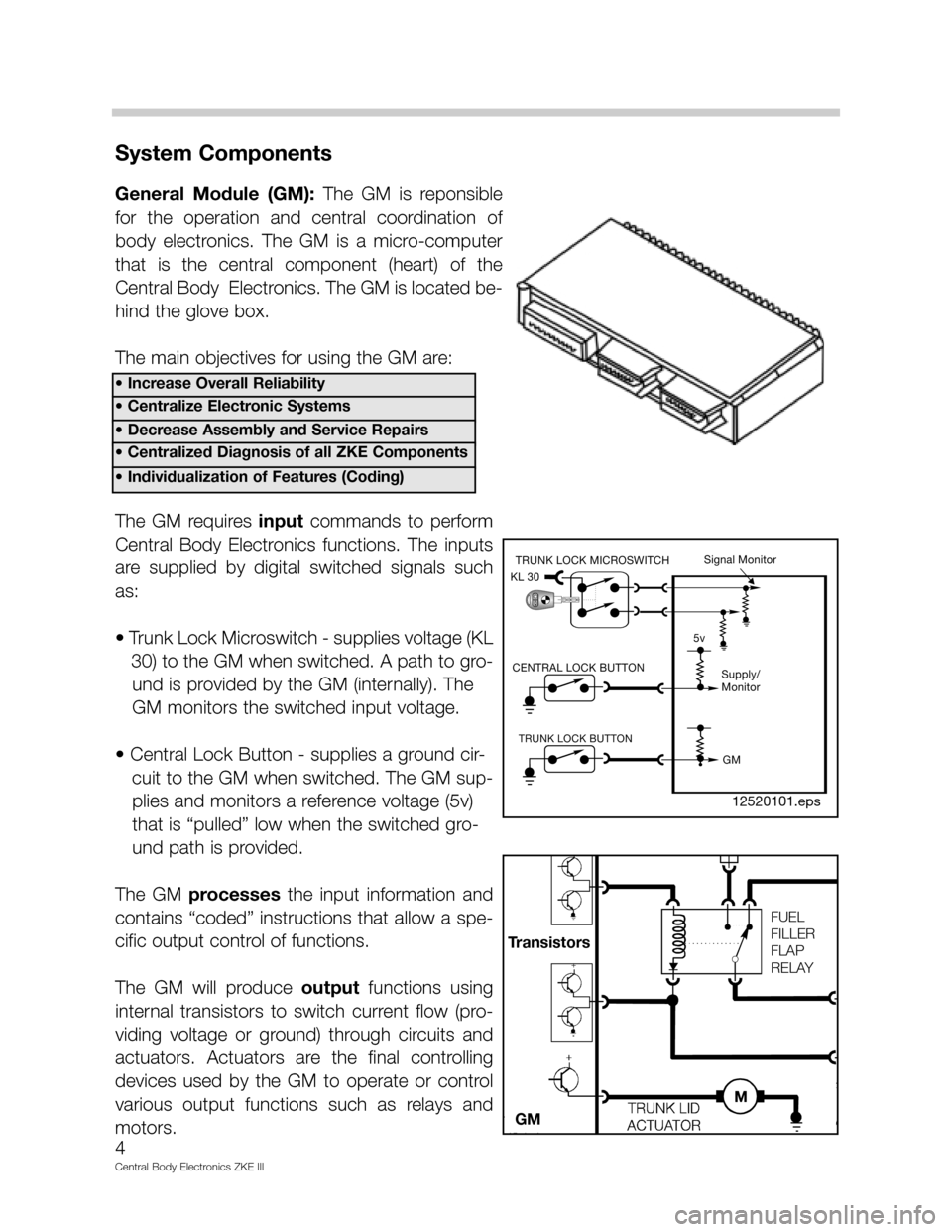
The GM requires inputcommands to perform
Central Body Electronics functions. The inputs
are supplied by digital switched signals such
as:
• Trunk Lock Microswitch - supplies voltage (KL
30) to the GM when switched. A path to gro-
und is provided by the GM (internally). The
GM monitors the switched input voltage.
• Central Lock Button - supplies a ground cir-
cuit to the GM when switched. The GM sup-
plies and monitors a reference voltage (5v)
that is “pulled” low when the switched gro-
und path is provided.
The GM processesthe input information and
contains “coded” instructions that allow a spe-
cific output control of functions.
The GM will produce outputfunctions using
internal transistors to switch current flow (pro-
viding voltage or ground) through circuits and
actuators. Actuators are the final controlling
devices used by the GM to operate or control
various output functions such as relays and
motors.
• Increase Overall Reliability
• Centralize Electronic Systems
• Decrease Assembly and Service Repairs
• Centralized Diagnosis of all ZKE Components
• Individualization of Features (Coding)
CENTRAL LOCK BUTTONCENTRAL LOCK BUTTON
TRUNK LOCK BUTTONTRUNK LOCK BUTTON
KL 30KL 30
TRUNK LOCK MICROSWITCHTRUNK LOCK MICROSWITCHSignal Monitor
5v
Supply/
Monitor
GM
FUEL
FILLER
FLAP
RELAY
Transistors
GM
12520101.eps
Page 6 of 80
6
Central Body Electronics ZKE III
The following is an overview of new or changed features found on the E53 ZKE III variant:
• Passenger’s door module is incorporated into the passenger’s door switchblock.
• Sunroof module (SHD) is located on the P -Bus.
• The Central Locking system uses a door lock actuators with hall effect sensors.
• The GM III is responsible for the Key Memory feature.
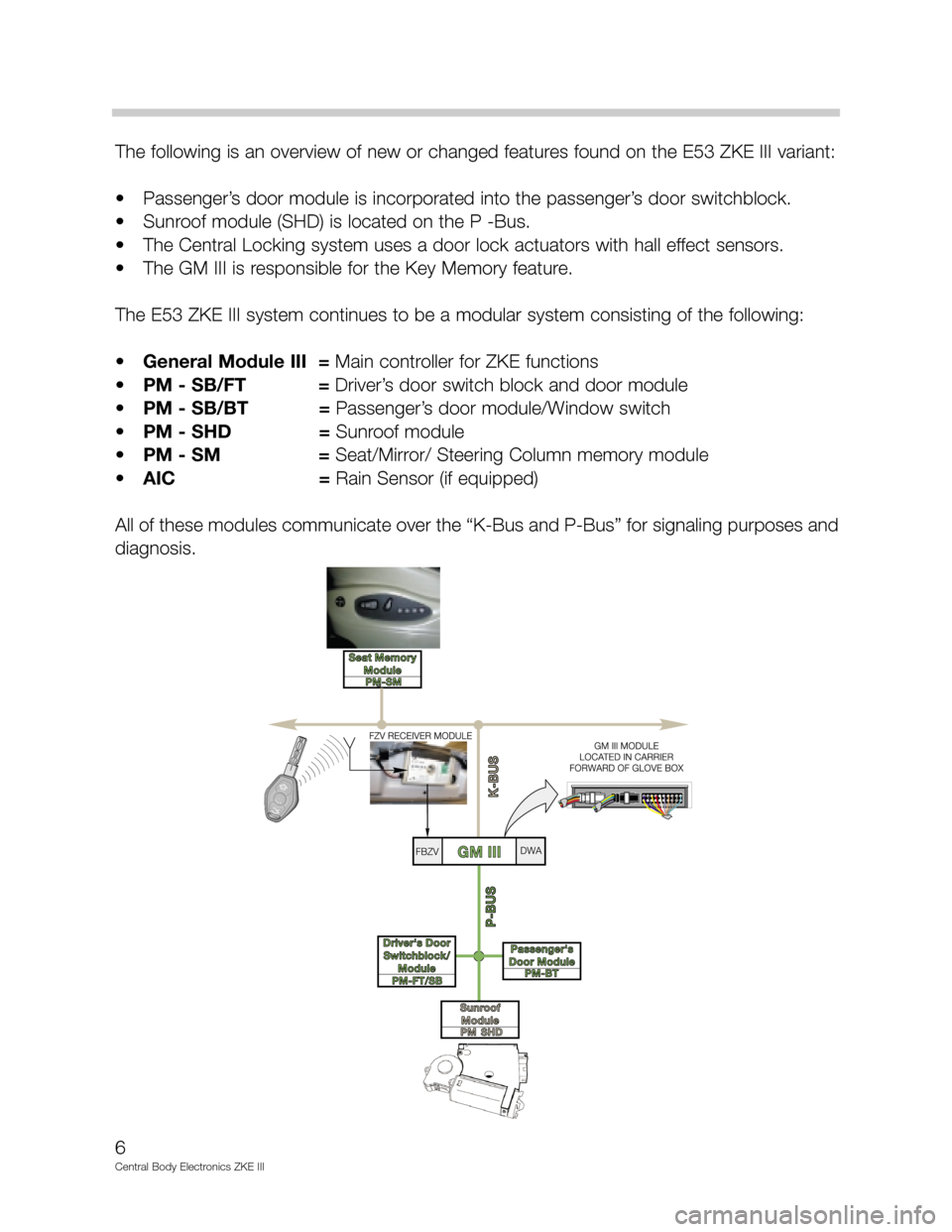
The E53 ZKE III system continues to be a modular system consisting of the following:
•General Module III = Main controller for ZKE functions
•PM - SB/FT = Driver’s door switch block and door module
•PM - SB/BT =Passenger’s door module/Window switch
•PM - SHD =Sunroof module
•PM - SM =Seat/Mirror/ Steering Column memory module
•AIC = Rain Sensor (if equipped)
All of these modules communicate over the “K-Bus and P-Bus” for signaling purposes and
diagnosis.
Page 18 of 80
• A remote luggage compartment button is installed in the left kick panel (center console
in the E53) to open the luggage compartment from inside the vehicle.
• The EWS is interfaced for double lock monitoring and unlock function. With the presence
of an accepted EWS key in the ignition, the vehicle will be unlocked and disarm DWA.
• The automatic locking feature (> 99 MY) activates the door locks when a road speed
signal of 5 MPH and engine RPM is detected via the K-Bus. The factory default setting
of this feature is off (can be encoded on for individual users with Key Memory function).
• In the event of an accident (ignition on), the GM will be signalled to unlock all doors.
Hardware Features:
• The external lock cylinders are located in the
driver’s door and luggage compartment lid
(E53/E39 Sport Wagon does not have a tail-
gate lock cylinder).
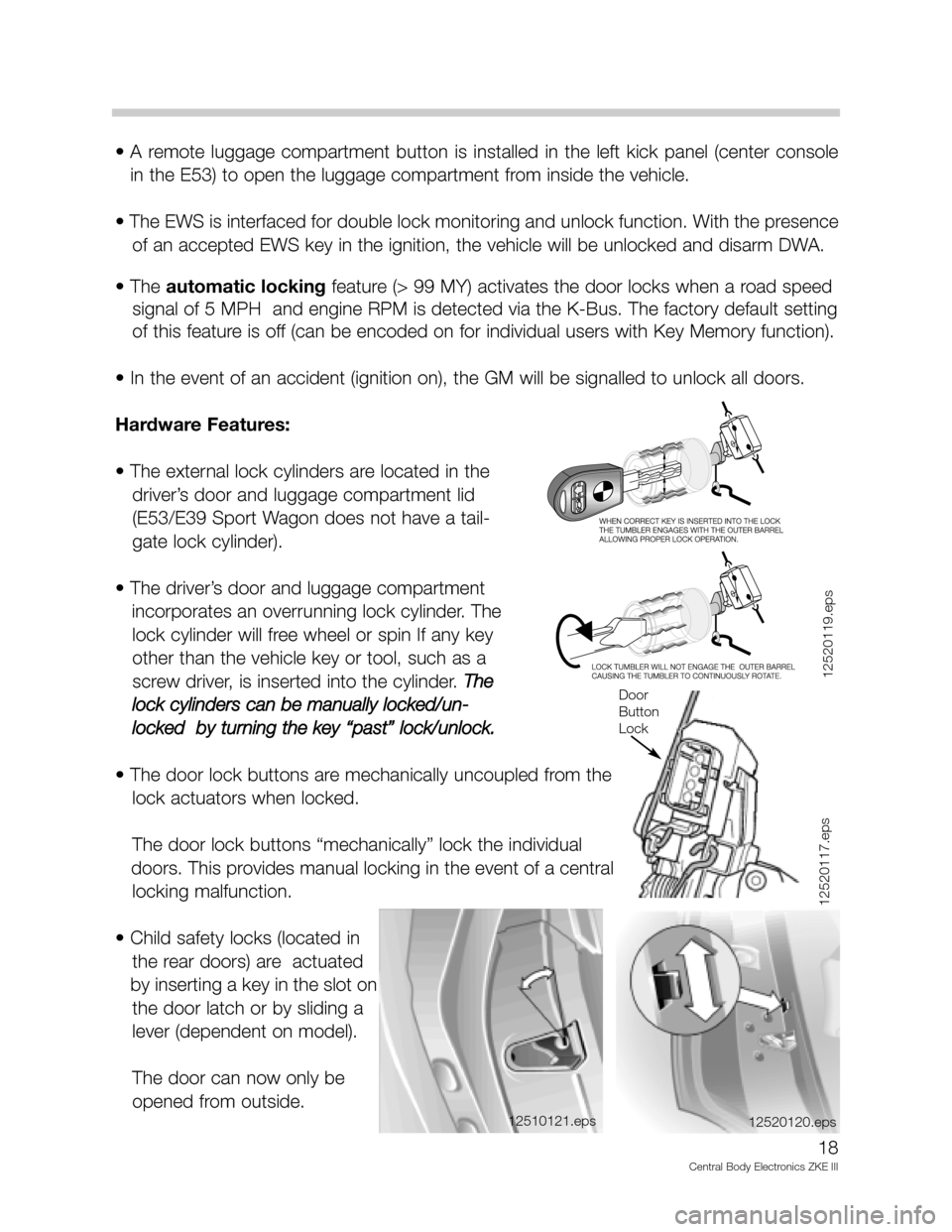
• The driver’s door and luggage compartment
incorporates an overrunning lock cylinder. The
lock cylinder will free wheel or spin If any key
other than the vehicle key or tool, such as a
screw driver, is inserted into the cylinder. The
lock cylinders can be manually locked/un-
locked by turning the key “past” lock/unlock.
• The door lock buttons are mechanically uncoupled from the
lock actuators when locked.
The door lock buttons “mechanically” lock the individual
doors. This provides manual locking in the event of a central
locking malfunction.
• Child safety locks (located in
the rear doors) are actuated
by inserting a key in the slot on
the door latch or by sliding a
lever (dependent on model).
The door can now only be
opened from outside.
18
Central Body Electronics ZKE III
Door
Button
Lock
12520117.eps
12520119.eps
12510121.eps
12520120.eps
Page 20 of 80
System Components
- with the Principle of Operation
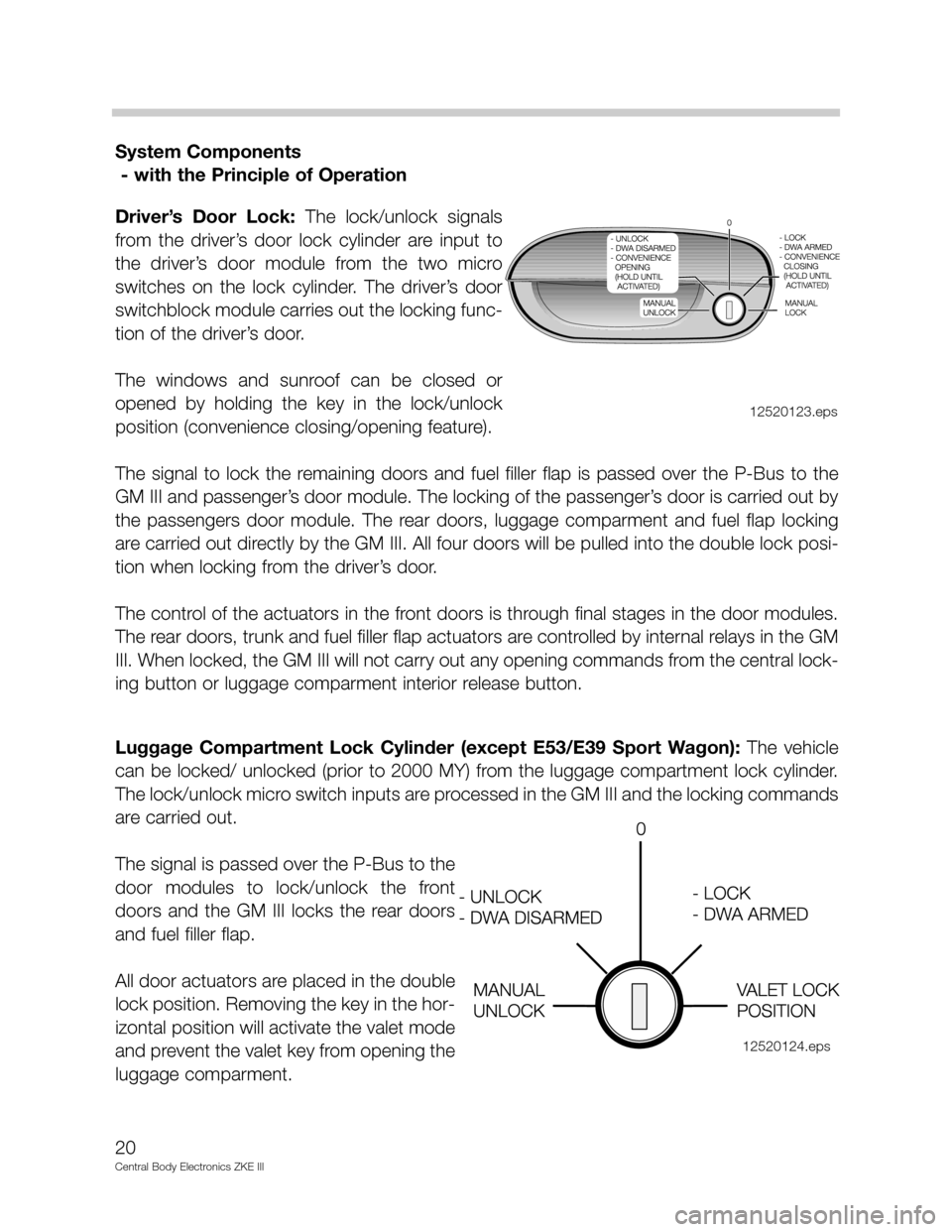
Driver’s Door Lock: The lock/unlock signals
from the driver’s door lock cylinder are input to
the driver’s door module from the two micro
switches on the lock cylinder. The driver’s door
switchblock module carries out the locking func-
tion of the driver’s door.
The windows and sunroof can be closed or
opened by holding the key in the lock/unlock
position (convenience closing/opening feature).
The signal to lock the remaining doors and fuel filler flap is passed over the P-Bus to the
GM III and passenger’s door module. The locking of the passenger’s door is carried out by
the passengers door module. The rear doors, luggage comparment and fuel flap locking
are carried out directly by the GM III. All four doors will be pulled into the double lock posi-
tion when locking from the driver’s door.
The control of the actuators in the front doors is through final stages in the door modules.
The rear doors, trunk and fuel filler flap actuators are controlled by internal relays in the GM
III. When locked, the GM III will not carry out any opening commands from the central lock-
ing button or luggage comparment interior release button.
Luggage Compartment Lock Cylinder (except E53/E39 Sport Wagon): The vehicle
can be locked/ unlocked (prior to 2000 MY) from the luggage compartment lock cylinder.
The lock/unlock micro switch inputs are processed in the GM III and the locking commands
are carried out.
The signal is passed over the P-Bus to the
door modules to lock/unlock the front
doors and the GM III locks the rear doors
and fuel filler flap.
All door actuators are placed in the double
lock position. Removing the key in the hor-
izontal position will activate the valet mode
and prevent the valet key from opening the
luggage comparment.
20
Central Body Electronics ZKE III
12520123.eps
12520124.eps
Page 23 of 80
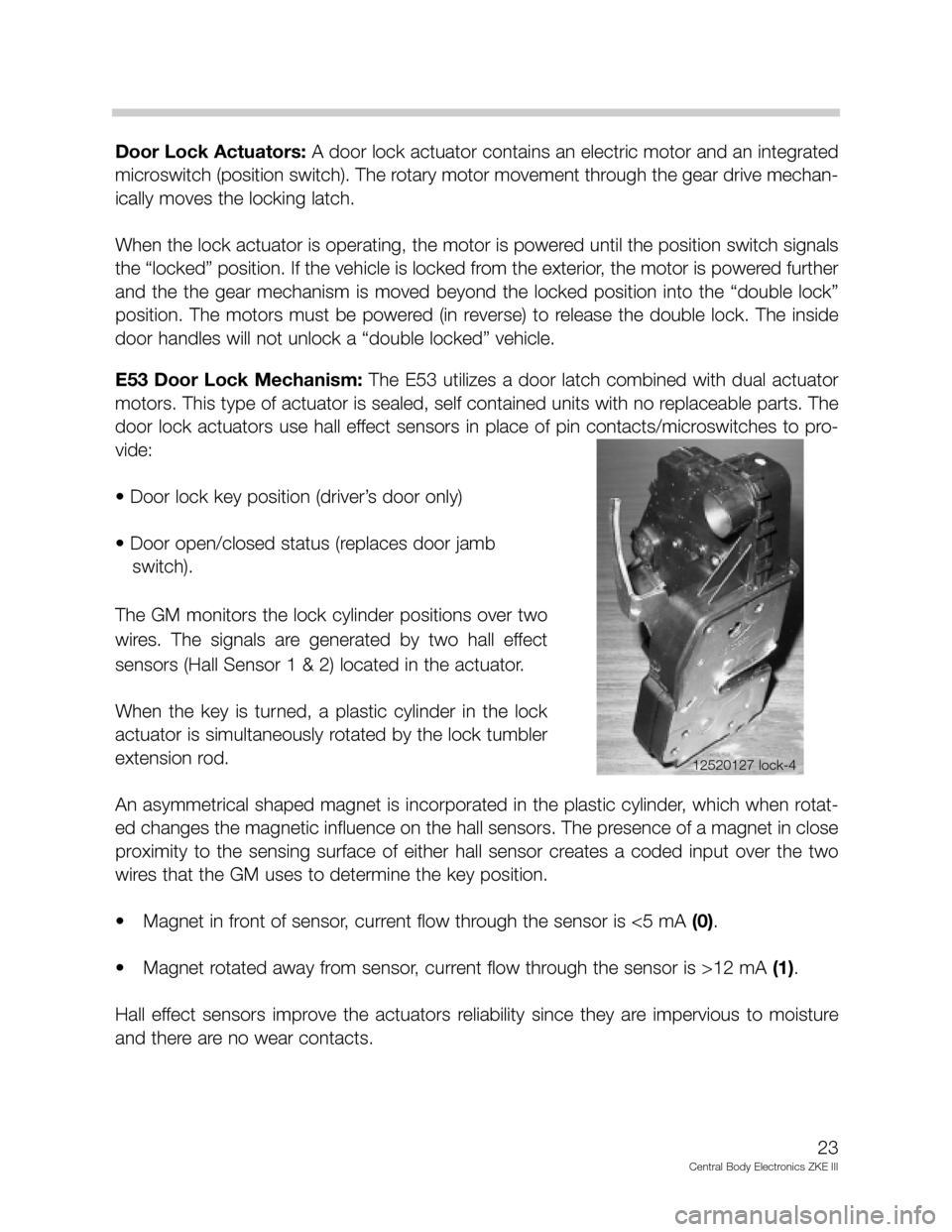
Door Lock Actuators: A door lock actuator contains an electric motor and an integrated
microswitch (position switch). The rotary motor movement through the gear drive mechan-
ically moves the locking latch.
When the lock actuator is operating, the motor is powered until the position switch signals
the “locked” position. If the vehicle is locked from the exterior, the motor is powered further
and the the gear mechanism is moved beyond the locked position into the “double lock”
position. The motors must be powered (in reverse) to release the double lock. The inside
door handles will not unlock a “double locked” vehicle.
E53 Door Lock Mechanism: The E53 utilizes a door latch combined with dual actuator
motors. This type of actuator is sealed, self contained units with no replaceable parts. The
door lock actuators use hall effect sensors in place of pin contacts/microswitches to pro-
vide:
• Door lock key position (driver’s door only)
• Door open/closed status (replaces door jamb
switch).
The GM monitors the lock cylinder positions over two
wires. The signals are generated by two hall effect
sensors (Hall Sensor 1 & 2) located in the actuator.
When the key is turned, a plastic cylinder in the lock
actuator is simultaneously rotated by the lock tumbler
extension rod.
An asymmetrical shaped magnet is incorporated in the plastic cylinder, which when rotat-
ed changes the magnetic influence on the hall sensors. The presence of a magnet in close
proximity to the sensing surface of either hall sensor creates a coded input over the two
wires that the GM uses to determine the key position.
• Magnet in front of sensor, current flow through the sensor is <5 mA (0).
• Magnet rotated away from sensor, current flow through the sensor is >12 mA (1).
Hall effect sensors improve the actuators reliability since they are impervious to moisture
and there are no wear contacts.
23
Central Body Electronics ZKE III
12520127 lock-4
Page 24 of 80
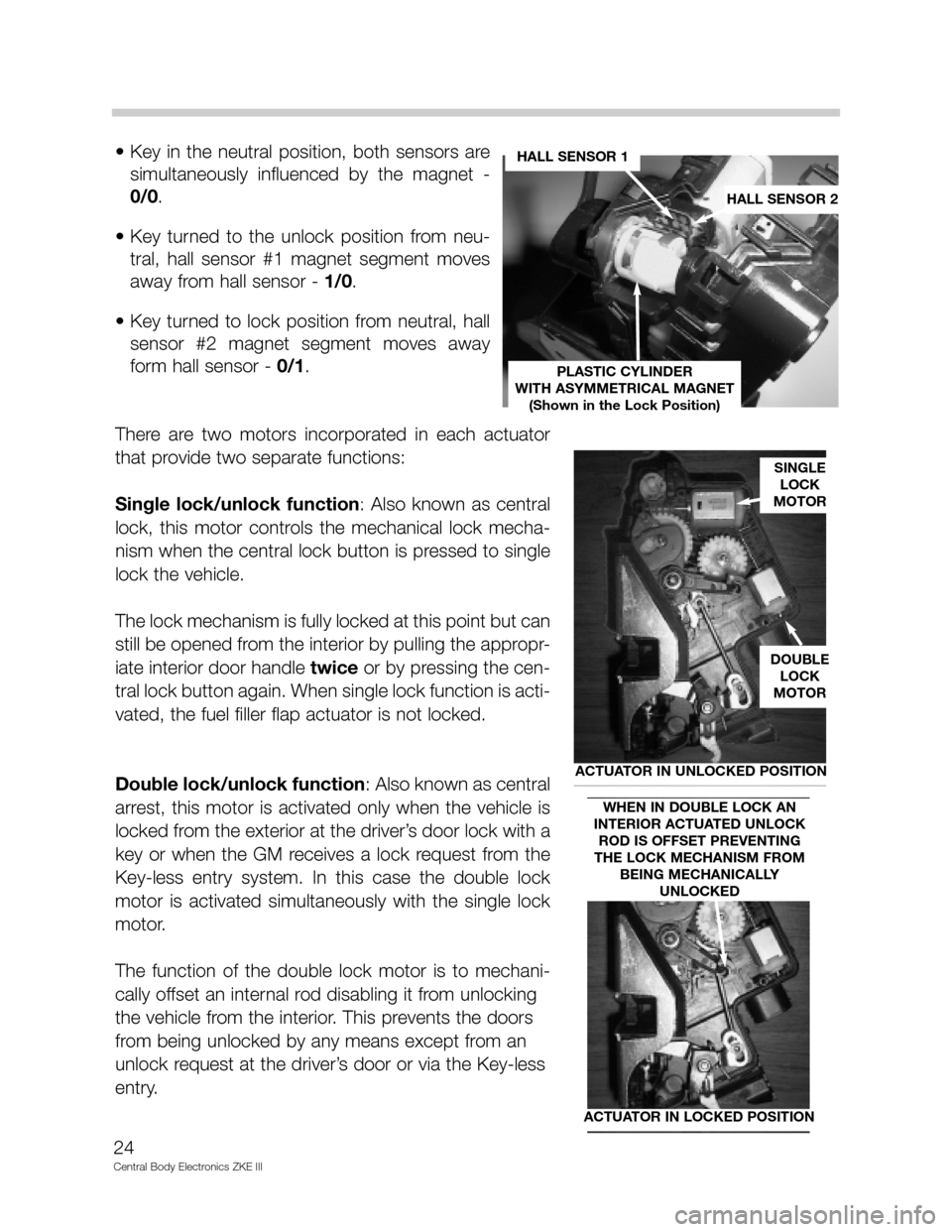
• Key in the neutral position, both sensors are
simultaneously influenced by the magnet -
0/0.
• Key turned to the unlock position from neu-
tral, hall sensor #1 magnet segment moves
away from hall sensor - 1/0.
• Key turned to lock position from neutral, hall
sensor #2 magnet segment moves away
form hall sensor - 0/1.
There are two motors incorporated in each actuator
that provide two separate functions:
Single lock/unlock function: Also known as central
lock, this motor controls the mechanical lock mecha-
nism when the central lock button is pressed to single
lock the vehicle.
The lock mechanism is fully locked at this point but can
still be opened from the interior by pulling the appropr-
iate interior door handle twice or by pressing the cen-
tral lock button again. When single lock function is acti-
vated, the fuel filler flap actuator is not locked.
Double lock/unlock function: Also known as central
arrest, this motor is activated only when the vehicle is
locked from the exterior at the driver’s door lock with a
key or when the GM receives a lock request from the
Key-less entry system. In this case the double lock
motor is activated simultaneously with the single lock
motor.
The function of the double lock motor is to mechani-
cally offset an internal rod disabling it from unlocking
the vehicle from the interior. This prevents the doors
from being unlocked by any means except from an
unlock request at the driver’s door or via the Key-less
entry.
24
Central Body Electronics ZKE III
HALL SENSOR 1
HALL SENSOR 2
PLASTIC CYLINDER
WITH ASYMMETRICAL MAGNET
(Shown in the Lock Position)
SINGLE
LOCK
MOTOR
DOUBLE
LOCK
MOTOR
ACTUATOR IN UNLOCKED POSITION
ACTUATOR IN LOCKED POSITION
WHEN IN DOUBLE LOCK AN
INTERIOR ACTUATED UNLOCK
ROD IS OFFSET PREVENTING
THE LOCK MECHANISM FROM
BEING MECHANICALLY
UNLOCKED
Page 25 of 80
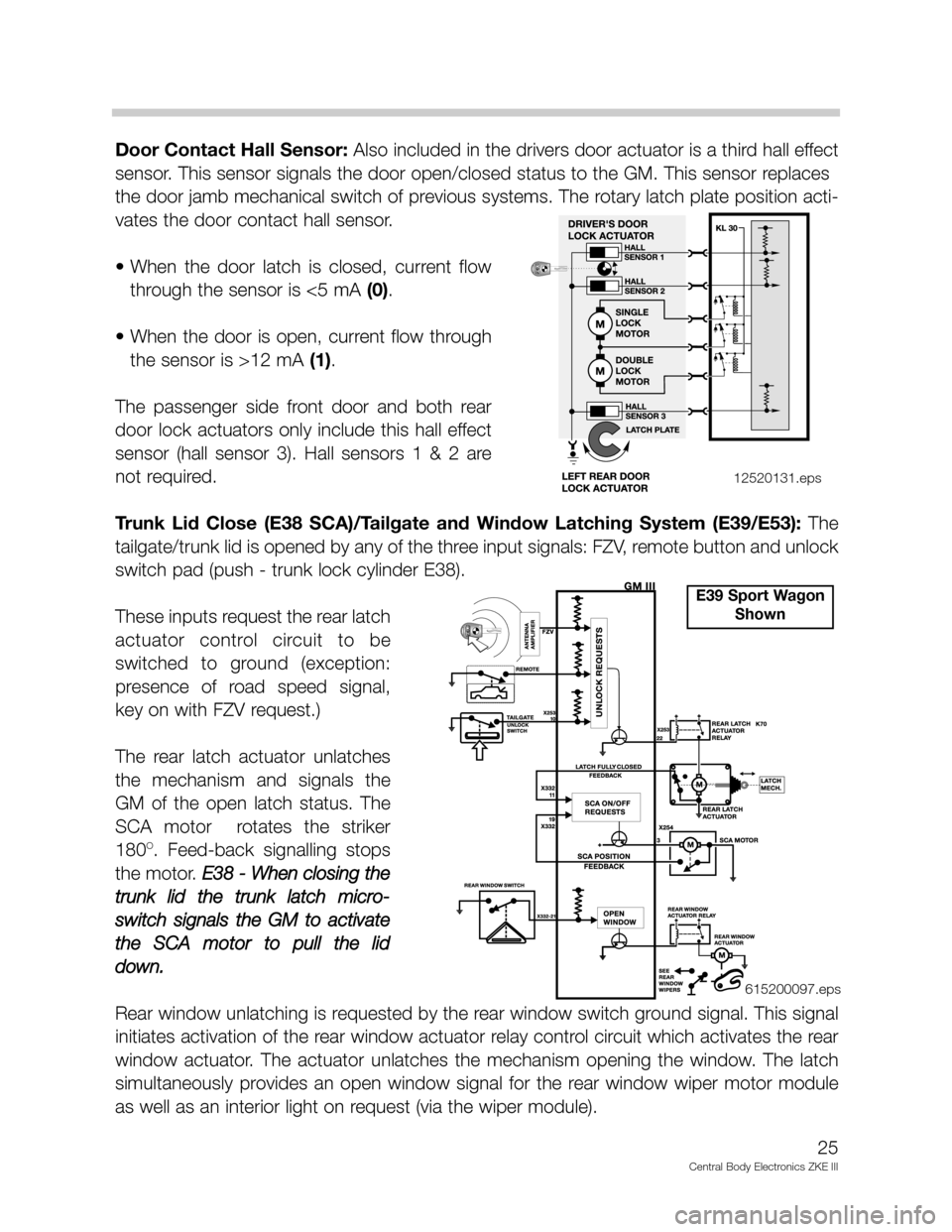
Door Contact Hall Sensor: Also included in the drivers door actuator is a third hall effect
sensor. This sensor signals the door open/closed status to the GM. This sensor replaces
the door jamb mechanical switch of previous systems. The rotary latch plate position acti-
vates the door contact hall sensor.
• When the door latch is closed, current flow
through the sensor is <5 mA (0).
• When the door is open, current flow through
the sensor is >12 mA (1).
The passenger side front door and both rear
door lock actuators only include this hall effect
sensor (hall sensor 3). Hall sensors 1 & 2 are
not required.
Trunk Lid Close (E38 SCA)/Tailgate and Window Latching System (E39/E53): The
tailgate/trunk lid is opened by any of the three input signals: FZV, remote button and unlock
switch pad (push - trunk lock cylinder E38).
These inputs request the rear latch
actuator control circuit to be
switched to ground (exception:
presence of road speed signal,
key on with FZV request.)
The rear latch actuator unlatches
the mechanism and signals the
GM of the open latch status. The
SCA motor rotates the striker
180
O. Feed-back signalling stops
the motor. E38 - When closing the
trunk lid the trunk latch micro-
switch signals the GM to activate
the SCA motor to pull the lid
down.
Rear window unlatching is requested by the rear window switch ground signal. This signal
initiates activation of the rear window actuator relay control circuit which activates the rear
window actuator. The actuator unlatches the mechanism opening the window. The latch
simultaneously provides an open window signal for the rear window wiper motor module
as well as an interior light on request (via the wiper module).
25
Central Body Electronics ZKE III
12520131.eps
E39 Sport Wagon
Shown
615200097.eps
Page 53 of 80
System Components
Door Contacts: As mentioned in the Central Locking Section, the existing door contacts
opened/closed are also an input for the interior lighting function. The E53 uses the Hall
effect sensors for the purpose of monitoring door open/closed status (located directly
behind the rotary latch plate encased in the actuator). The sensor is activated by the rotary
latch plate's position.
• Door closed, the rotary latch plate is in the latched position. Current flow through the
hall sensor is < 5 mA.
• Door open, the rotary latch plate is in the open position. Current flow through the hall
sensor is > 12 mA.
A change in current flow informs the General module when a door is opened or closed.
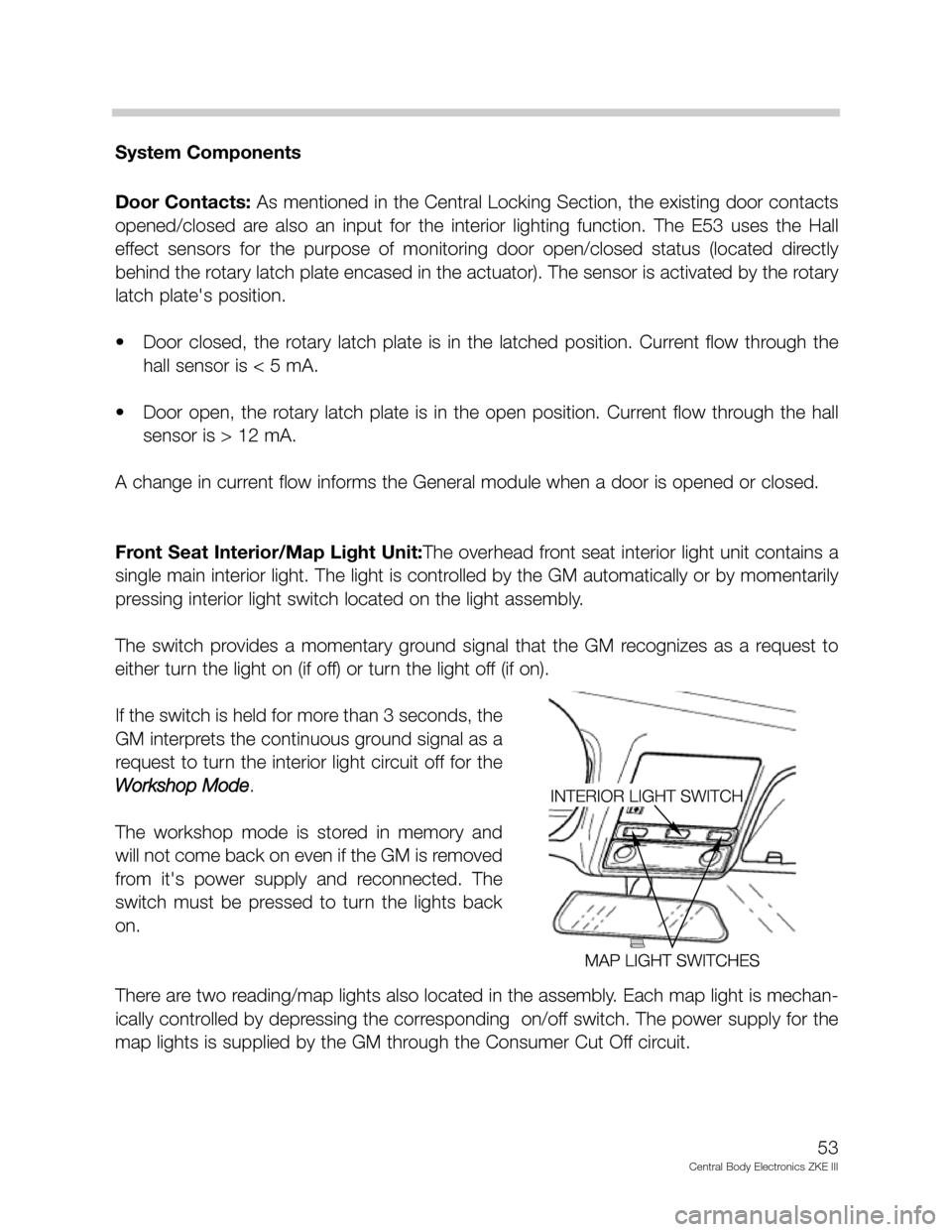
Front Seat Interior/Map Light Unit:The overhead front seat interior light unit contains a
single main interior light. The light is controlled by the GM automatically or by momentarily
pressing interior light switch located on the light assembly.
The switch provides a momentary ground signal that the GM recognizes as a request to
either turn the light on (if off) or turn the light off (if on).
If the switch is held for more than 3 seconds, the
GM interprets the continuous ground signal as a
request to turn the interior light circuit off for the
Workshop Mode
.
The workshop mode is stored in memory and
will not come back on even if the GM is removed
from it's power supply and reconnected. The
switch must be pressed to turn the lights back
on.
There are two reading/map lights also located in the assembly. Each map light is mechan-
ically controlled by depressing the corresponding on/off switch. The power supply for the
map lights is supplied by the GM through the Consumer Cut Off circuit.
53
Central Body Electronics ZKE III