brake BMW ACTIVEHYBRID X6 2010 Owners Manual
[x] Cancel search | Manufacturer: BMW, Model Year: 2010, Model line: ACTIVEHYBRID X6, Model: BMW ACTIVEHYBRID X6 2010Pages: 54, PDF Size: 3.16 MB
Page 15 of 54
Reference
At a glance
Controls
Driving tips
Mobility
13
Functions of the hybrid system
The hybrid system of your BMW ActiveHybrid
X6 offers the following functions.
Electric driving: eDRIVE
Under certain conditions, refer to page15, the
vehicle is powered exclusively by its electric
motors.
Driving with combustion engine: DRIVE
The combustion engine supplies the drive out-
put for moving the vehicle. The high-voltage
battery is charged at the same time.
The hybrid system always starts the combus-
tion engine automatically, refer to page16.
Assisted combustion engine: eBOOST
The combustion engine supplies the main drive
output for moving the vehicle.
In this mode, the electric motors assist the
combustion engine with additional power as
needed.
Energy recovery: CHARGE
When reducing vehicle speed, the kinetic
energy can be converted into electrical energy,
refer to page16.
Start/Stop button, ready
modes
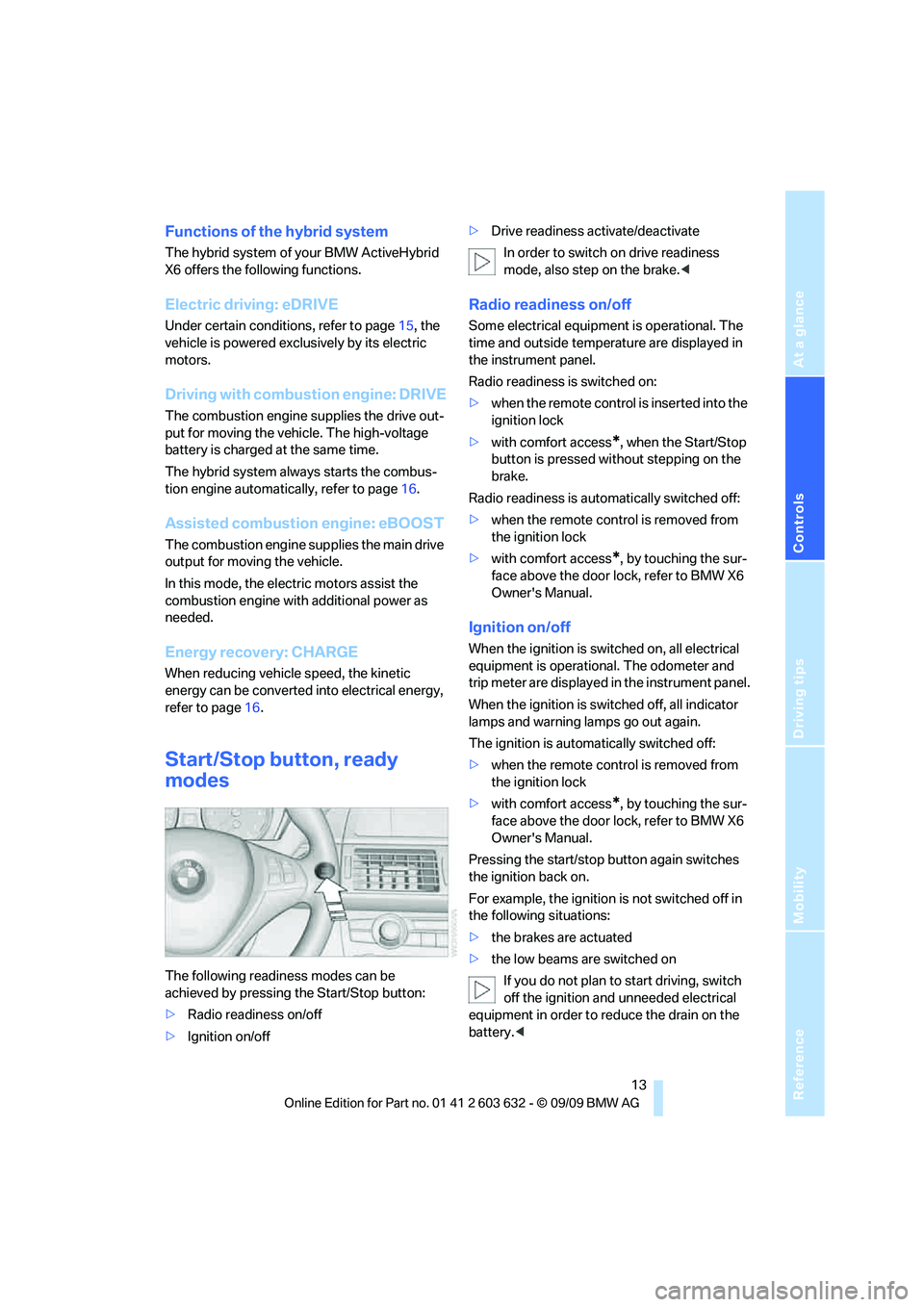
The following readiness modes can be
achieved by pressing the Start/Stop button:
>Radio readiness on/off
>Ignition on/off>Drive readiness activate/deactivate
In order to switch on drive readiness
mode, also step on the brake.<
Radio readiness on/off
Some electrical equipment is operational. The
time and outside temperature are displayed in
the instrument panel.
Radio readiness is switched on:
>when the remote control is inserted into the
ignition lock
>with comfort access
*, when the Start/Stop
button is pressed without stepping on the
brake.
Radio readiness is automatically switched off:
>when the remote control is removed from
the ignition lock
>with comfort access
*, by touching the sur-
face above the door lock, refer to BMW X6
Owner's Manual.
Ignition on/off
When the ignition is switched on, all electrical
equipment is operational. The odometer and
trip meter are displayed in the instrument panel.
When the ignition is switched off, all indicator
lamps and warning lamps go out again.
The ignition is automatically switched off:
>when the remote control is removed from
the ignition lock
>with comfort access
*, by touching the sur-
face above the door lock, refer to BMW X6
Owner's Manual.
Pressing the start/stop button again switches
the ignition back on.
For example, the ignition is not switched off in
the following situations:
>the brakes are actuated
>the low beams are switched on
If you do not plan to start driving, switch
off the ignition and unneeded electrical
equipment in order to reduce the drain on the
battery.<
Page 16 of 54
Driving
14
Drive readiness
With drive readiness activated, the vehicle is
ready to drive.
Switching on drive readiness corresponds to
starting the engine in conventional vehicles.
Drive readiness can take the following forms:
>Electric driving
The combustion engine is not switched on.
>Driving with combustion engine
The vehicle is driven by the combustion
engine.
Drive readiness in detail
Never leave the vehicle unattended with
drive readiness activated; such a vehicle
represents a potential safety hazard.<
Activating drive readiness
1.Close the driver's door.
2.Insert the remote control as far as possible
into the ignition lock. With comfort access
*,
place the remote control into the vehicle,
refer to BMW X6 Owner's Manual.
3.Depress brake pedal.
To initialize the brake system, the
brake pedal travel is longer than usual
during activation of drive readiness. After
the brake pedal is released, the pedal travel
returns to normal.<
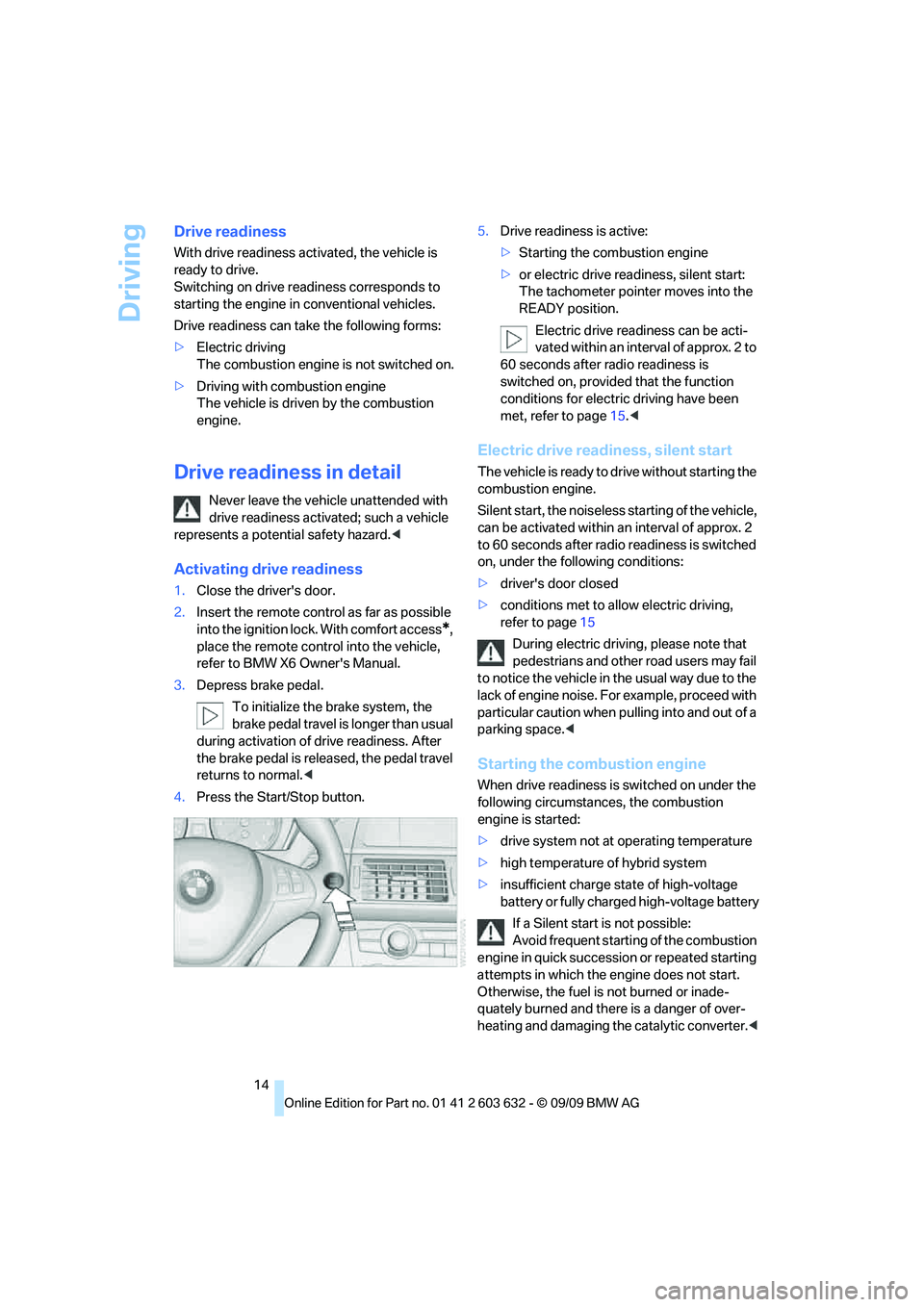
4.Press the Start/Stop button.5.Drive readiness is active:
>Starting the combustion engine
>or electric drive readiness, silent start:
The tachometer pointer moves into the
READY position.
Electric drive readiness can be acti-
vated within an interval of approx. 2 to
60 seconds after radio readiness is
switched on, provided that the function
conditions for electric driving have been
met, refer to page15.<
Electric drive readiness, silent start
The vehicle is ready to drive without starting the
combustion engine.
Silent start, the noiseless starting of the vehicle,
can be activated within an interval of approx. 2
to 60 seconds after radio readiness is switched
on, under the following conditions:
>driver's door closed
>conditions met to allow electric driving,
refer to page15
During electric driving, please note that
pedestrians and other road users may fail
to notice the vehicle in the usual way due to the
lack of engine noise. For example, proceed with
particular caution when pulling into and out of a
parking space.<
Starting the combustion engine
When drive readiness is switched on under the
following circumstances, the combustion
engine is started:
>drive system not at operating temperature
>high temperature of hybrid system
>insufficient charge state of high-voltage
battery or fully charged high-voltage battery
If a Silent start is not possible:
Avoid frequent starting of the combustion
engine in quick succession or repeated starting
attempts in which the engine does not start.
Otherwise, the fuel is not burned or inade-
quately burned and there is a danger of over-
heating and damaging the catalytic converter.<
Page 17 of 54
Reference
At a glance
Controls
Driving tips
Mobility
15
Do not run the combustion engine in
enclosed spaces; otherwise, the inhala-
tion of toxic exhaust gases can cause loss of
consciousness and death. The exhaust gases
contain carbon monoxide, an odorless and col-
orless, but highly toxic gas.
Never leave the vehicle unattended with the
combustion engine running; such a vehicle rep-
resents a potential safety hazard.<
Deactivating drive readiness
When drive readiness is switched off, the
tachometer pointer is in the OFF position.
When leaving the vehicle, always take
along the remote control.
Set the parking brake firmly when parking; oth-
erwise, the vehicle could roll.<
After the vehicle is switched off, audible operat-
ing sounds may issue from the hybrid system,
e.g. the cooling of the high-voltage battery.
Procedure
1.Select transmission position P with the
vehicle stationary.
2.Press the Start/Stop button.
3.Set the parking brake.
4.Remove the remote control from the igni-
tion lock.
Before removing the remote control, first
press it in as far as possible to release the
locking device.
Before driving into a car wash
The vehicle can roll if you proceed according to
the following steps:
1.With comfort access
*: insert the remote
control into the ignition lock.
2.Depress brake pedal.
3.Select transmission position N.
4.Release the parking brake or deactivate
Automatic Hold.
5.Press the Start/Stop button to deactivate
drive readiness.
Transmission position P will be selected:
>automatically after approx. 30 minutes>if you remove the remote control from the
ignition lock
Starting to drive
1.Activate drive readiness.
2.Select transmission position D, M/S, or R.
3.Release the parking brake.
4.Start to drive.
Driving
Electric driving: eDRIVE
Requirements
Electric driving is possible under the following
conditions:
>driving speed:
a maximum of approx. 37 mph/60 km/h
>charge state display of the high-voltage
battery: at least 15%
>transmission in position D or R, refer to
page17
>drive system at operating temperature
>accelerator pedal not pressed down too far
>driver's door closed
Possible driving speed
The possible speed that can be reached in elec-
tric driving depends on the charge state of the
high-voltage battery.
>charge state display 15% to 40%:
maximum driving speed is approx. 25 mph/
40 km/h
>charge state display 40% to 100%:
maximum driving speed is approx. 40 mph/
65 km/h
When accelerating past a speed of 25 mph/
40 km/h, the combustion engine is started
briefly in order to assure smooth acceleration.
Indicators of electric driving in the instrument
panel, refer to page22.
Page 18 of 54

Driving
16
Possible range
The vehicle can travel approx. 1.5 miles/2.5 km
under electric power.
Driving with combustion engine: DRIVE
The combustion engine supplies the drive out-
put for moving the vehicle. The high-voltage
battery is charged at the same time.
Automatic starting while driving
Under the following circumstances, the com-
bustion engine is started automatically while
driving:
>transmission position M/S selected
>driving speed greater than 40 mph/65 km/h
>low charge state or fully charged high-volt-
age battery, e.g. when driving downhill
>to protect the high-voltage system from
overheating, e.g. when driving downhill
>high output request, e.g. by accelerator
pedal position.
Automatic switching off while driving
When decelerating under the conditions for
electric driving, refer to page15, the combus-
tion engine is switched off.
Assisted combustion engine
The combustion engine supplies the main drive
output for moving the vehicle.
The electric motors assist by providing addi-
tional drive output as needed.
eBOOST
When accelerating quickly, e.g. when passing
another vehicle, power from the two electric
motors simultaneously is requested in addition
to that of the combustion engine. To trigger
this, step down hard on the accelerator pedal.
Display in the instrument panel, refer to
page22.
Energy recovery: CHARGE
The hybrid system makes it possible to convert
kinetic energy into electrical current, e.g. during braking. This energy recovery is used to charge
the high-voltage battery. The battery supplies
this stored energy back to the electric motors
as needed.
To recover the braking energy, the following
conditions must be met:
>The vehicle is in motion.
>The selector lever is in the position D, R, or
M/S.
>The high-voltage battery is not completely
charged.
Display of energy recovery in the instrument
panel, refer to page22
Two-Mode Active
Transmission with Steptronic
The Das Two-Mode Active Transmission is an
automatic transmission in which the gears can
be shifted in a fully automatic fashion or can be
shifted manually on demand. The manual shift-
ing is performed using the selector lever or the
shifting paddles of the Steptronic, refer to
page18.
Automatic shifting may be perceptible
when decelerating at a low speed.<
Transmission positions
P R N D M/S + –
Hold the brake pedal down until starting
to drive; otherwise, the vehicle can begin
to roll.<
Displays in instrument panel
P R N D, S1 through S7, M1 through M7
Page 19 of 54
Reference
At a glance
Controls
Driving tips
Mobility
17
The transmission position and the currently
engaged gear are displayed.
Selecting transmission position
>You can select transmission positions D, R
or N only when drive readiness is activated.
>With the vehicle stationary, depress the
brake pedal before shifting out of P or N;
otherwise the shift command will not be
executed: shiftlock.
Hold the brake pedal down until start-
ing to drive; otherwise, the vehicle can
begin to move.<
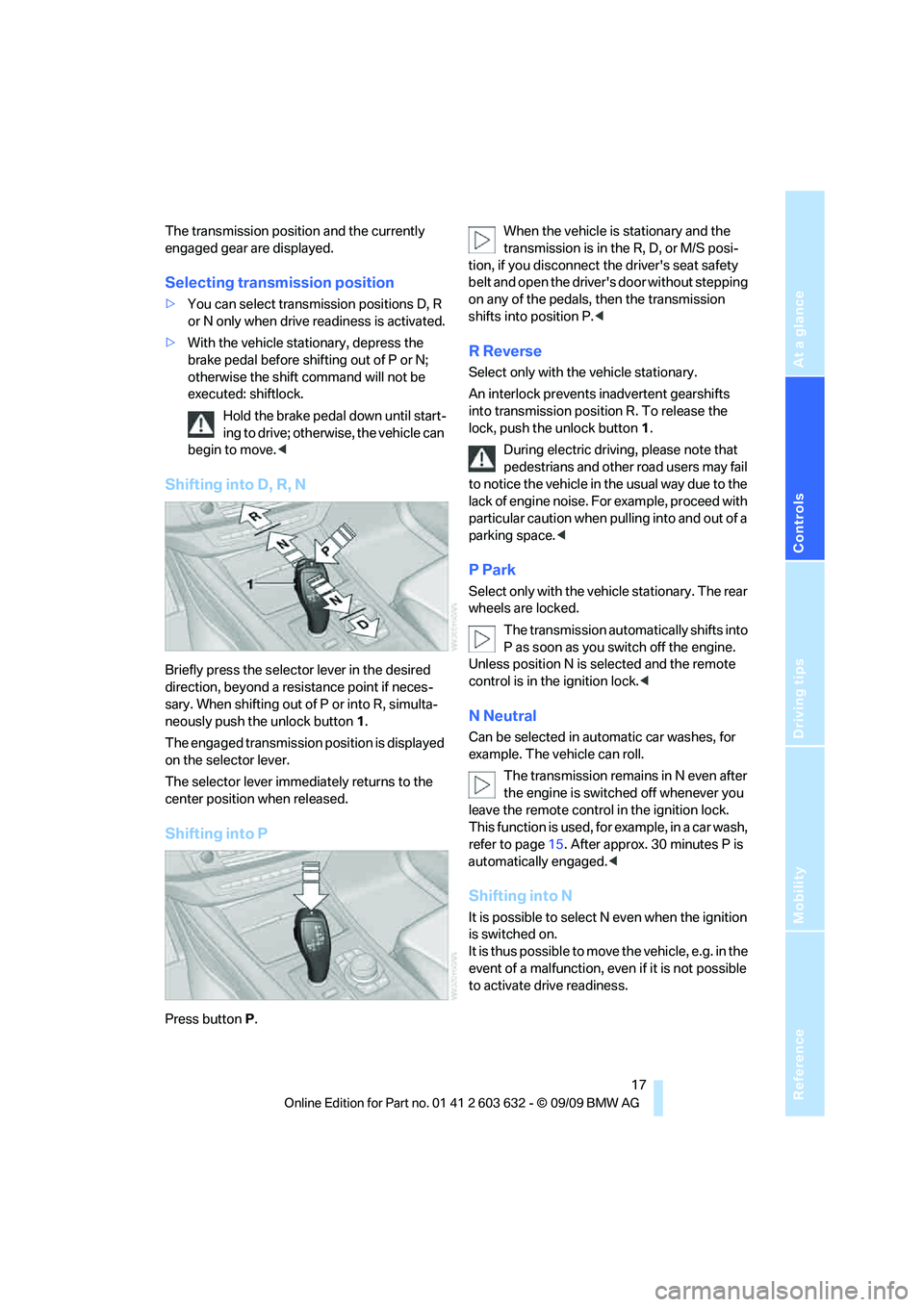
Shifting into D, R, N
Briefly press the selector lever in the desired
direction, beyond a resistance point if neces-
sary. When shifting out of P or into R, simulta-
neously push the unlock button1.
The engaged transmission position is displayed
on the selector lever.
The selector lever immediately returns to the
center position when released.
Shifting into P
Press buttonP.When the vehicle is stationary and the
transmission is in the R, D, or M/S posi-
tion, if you disconnect the driver's seat safety
belt and open the driver's door without stepping
on any of the pedals, then the transmission
shifts into position P.<
R Reverse
Select only with the vehicle stationary.
An interlock prevents inadvertent gearshifts
into transmission position R. To release the
lock, push the unlock button1.
During electric driving, please note that
pedestrians and other road users may fail
to notice the vehicle in the usual way due to the
lack of engine noise. For example, proceed with
particular caution when pulling into and out of a
parking space.<
P Park
Select only with the vehicle stationary. The rear
wheels are locked.
The transmission automatically shifts into
P as soon as you switch off the engine.
Unless position N is selected and the remote
control is in the ignition lock.<
N Neutral
Can be selected in automatic car washes, for
example. The vehicle can roll.
The transmission remains in N even after
the engine is switched off whenever you
leave the remote control in the ignition lock.
This function is used, for example, in a car wash,
refer to page15. After approx. 30 minutes P is
automatically engaged.<
Shifting into N
It is possible to select N even when the ignition
is switched on.
I t i s t h u s p o s s i b l e t o m o v e t h e v e h i c l e , e . g . i n t h e
event of a malfunction, even if it is not possible
to activate drive readiness.
Page 22 of 54
Driving
20 >when braking
>when transmission position N is engaged
>when DTC is activated or DSC is deacti-
vated
>when HDC is activated
>when the parking brake is set
>when driving stability control systems inter-
vene
Accelerating does not deactivate the cruise
control. After releasing the accelerator pedal,
the stored speed is reached and maintained
again.
Warning lamp
The warning lamp lights up if the
cruise control has been deactivated
automatically, e.g. by a control inter-
vention of the DSC. A message appears on the
Control Display.
Resuming stored speed
Briefly press the button, arrow4. The stored
speed is resumed and maintained.
With the ignition switched off, the stored speed
value is deleted and cannot be resumed again.
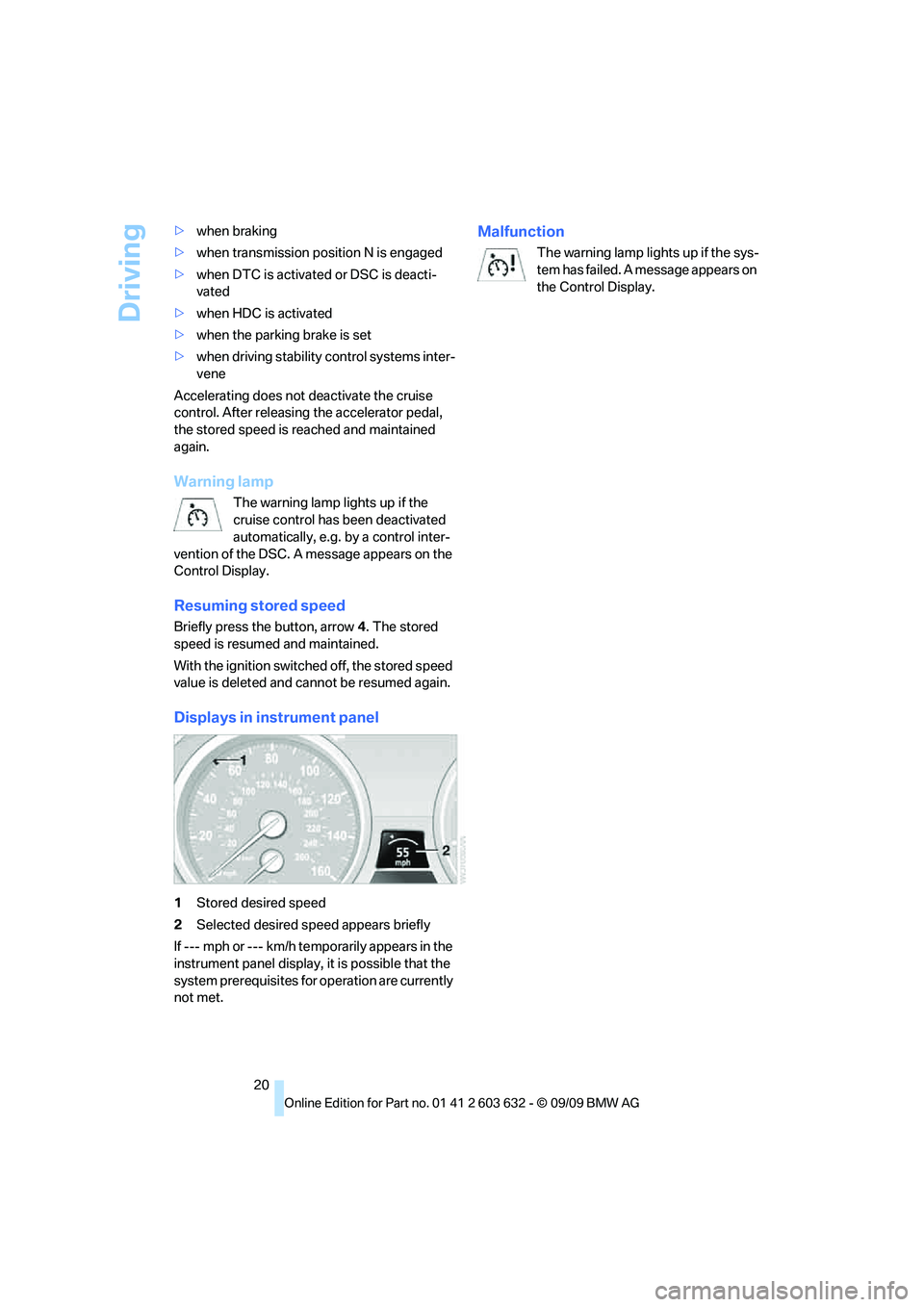
Displays in instrument panel
1Stored desired speed
2Selected desired speed appears briefly
If --- mph or --- km/h temporarily appears in the
instrument panel display, it is possible that the
system prerequisites for operation are currently
not met.
Malfunction
The warning lamp lights up if the sys-
tem has failed. A message appears on
the Control Display.
Page 28 of 54
Things to remember when driving
26
Things to remember when driving
Break-in period
Moving parts need breaking-in time to adjust to
each other. To ensure that your vehicle contin-
ues to provide optimized economy of operation
throughout an extended service life, we request
that you devote careful attention to the follow-
ing section.
Engine and rear axle differential
Always obey all official speed limits.
Up to 1,200 miles/2,000 km
Drive at various engine and vehicle speeds, but
do not exceed:
>4,500 rpm or 100 mph/160 km/h
Avoid full-throttle operation and use of the
transmission's kick-down mode during these
initial miles.
From 1,200 miles/2,000 km
The engine and vehicle speed can gradually be
increased.
Brake system
Brakes require an initial break-in period of
approx. 300 miles/500 km to achieve optimized
contact and wear patterns between brake pads
and rotors. Drive in a reserved manner during
this break-in period.
Following part replacement
Observe the break-in instructions again if com-
ponents mentioned above must be replaced
after subsequent driving operation.
Saving fuel
The fuel consumption of your vehicle depends
on various factors. Through a few simple steps,
your driving style, and regular maintenance, you
can have a positive influence on your fuel con-
sumption and environmental impact.
Removing unnecessary cargo
Additional weight increases fuel consumption.
Removing add-on parts after use
Remove unneeded auxiliary mirrors, roof or rear
luggage racks after use. Add-on parts attached
to the vehicle impede the aerodynamics and
increase the fuel consumption.
Closing windows and glass sunroof*
An open glass sunroof or window likewise
increases air resistance and thus fuel consump-
tion.
Checking tire inflation pressures
regularly
Check and correct the tire inflation pressure as
needed at least twice a month and before long
trips.
An insufficient tire inflation pressure increases
the rolling resistance and thus increases the
fuel consumption and tire wear.
Driving off immediately
Do not allow the engine to warm up by leaving it
running while the vehicle remains stationary.
Instead, begin to drive at a moderate engine
speed. This is the fastest way for the cold
engine to reach its operating temperature.
Thinking ahead when driving
Avoid unnecessary acceleration and braking.
To do so, maintain the appropriate distance
from the vehicle in front of you. An anticipatory
and smooth driving style reduces fuel con-
sumption.
Avoiding high engine speeds
Driving at a low engine speed reduces fuel con-
sumption and minimizes wear.
Page 29 of 54
Reference
At a glance
Controls
Driving tips
Mobility
27
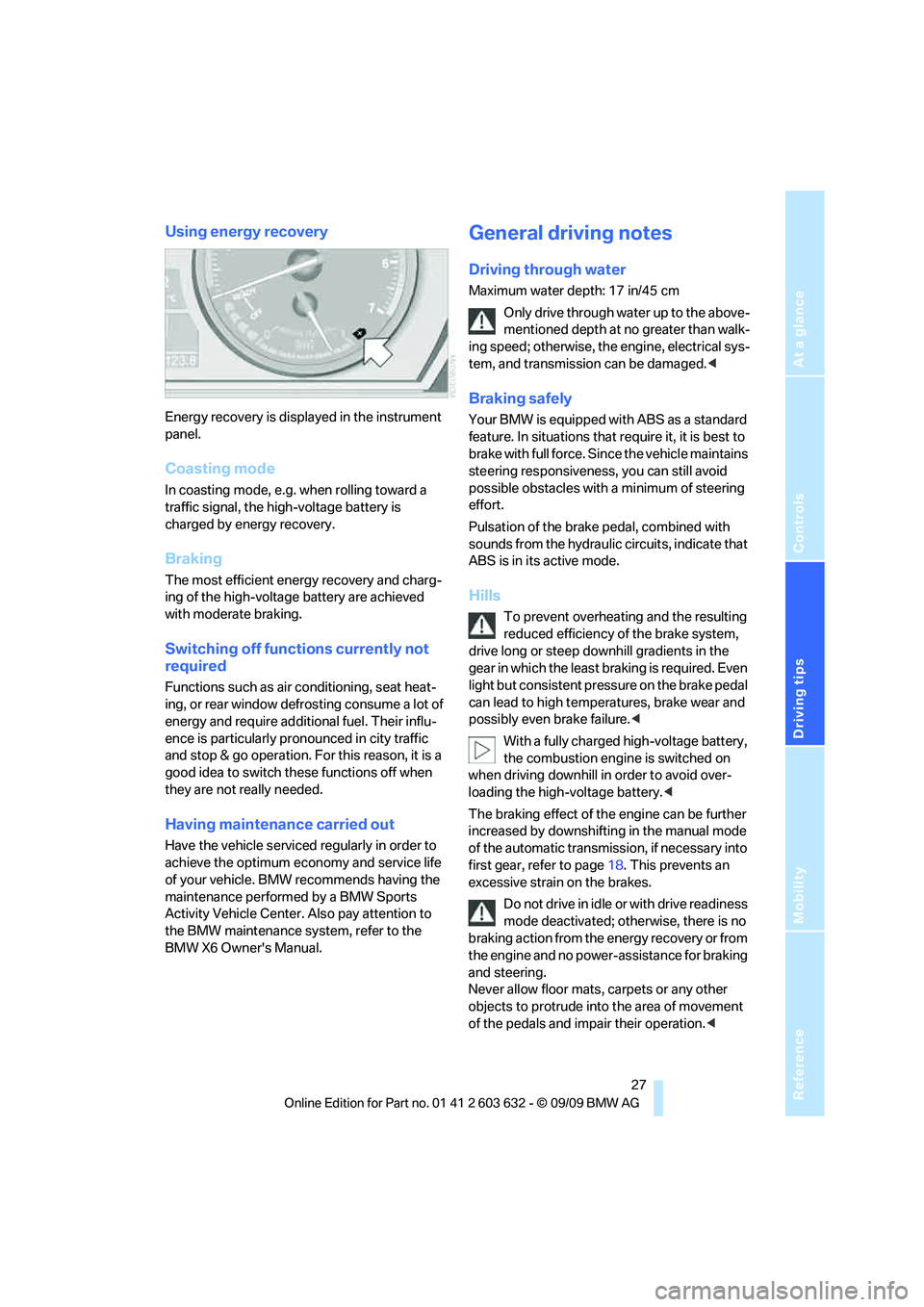
Using energy recovery
Energy recovery is displayed in the instrument
panel.
Coasting mode
In coasting mode, e.g. when rolling toward a
traffic signal, the high-voltage battery is
charged by energy recovery.
Braking
The most efficient energy recovery and charg-
ing of the high-voltage battery are achieved
with moderate braking.
Switching off functions currently not
required
Functions such as air conditioning, seat heat-
ing, or rear window defrosting consume a lot of
energy and require additional fuel. Their influ-
ence is particularly pronounced in city traffic
and stop & go operation. For this reason, it is a
good idea to switch these functions off when
they are not really needed.
Having maintenance carried out
Have the vehicle serviced regularly in order to
achieve the optimum economy and service life
of your vehicle. BMW recommends having the
maintenance performed by a BMW Sports
Activity Vehicle Center. Also pay attention to
the BMW maintenance system, refer to the
BMW X6 Owner's Manual.
General driving notes
Driving through water
Maximum water depth: 17 in/45 cm
Only drive through water up to the above-
mentioned depth at no greater than walk-
ing speed; otherwise, the engine, electrical sys-
tem, and transmission can be damaged.<
Braking safely
Your BMW is equipped with ABS as a standard
feature. In situations that require it, it is best to
brake with full force. Since the vehicle maintains
steering responsiveness, you can still avoid
possible obstacles with a minimum of steering
effort.
Pulsation of the brake pedal, combined with
sounds from the hydraulic circuits, indicate that
ABS is in its active mode.
Hills
To prevent overheating and the resulting
reduced efficiency of the brake system,
drive long or steep downhill gradients in the
gear in which the least braking is required. Even
light but consistent pressure on the brake pedal
can lead to high temperatures, brake wear and
possibly even brake failure.<
With a fully charged high-voltage battery,
the combustion engine is switched on
when driving downhill in order to avoid over-
loading the high-voltage battery.<
The braking effect of the engine can be further
increased by downshifting in the manual mode
of the automatic transmission, if necessary into
first gear, refer to page18. This prevents an
excessive strain on the brakes.
Do not drive in idle or with drive readiness
mode deactivated; otherwise, there is no
braking action from the energy recovery or from
the engine and no power-assistance for braking
and steering.
Never allow floor mats, carpets or any other
objects to protrude into the area of movement
of the pedals and impair their operation.<
Page 30 of 54
Things to remember when driving
28
Corrosion on brake rotors
When the vehicle is driven only occasionally,
during extended periods when the vehicle is not
used at all, and in operating conditions where
brake applications are less frequent, there is an
increased tendency for corrosion to form on
rotors, while contaminants accumulate on the
brake pads. This occurs because the minimum
pressure which must be exerted by the pads
during brake applications to clean the rotors is
not reached.
Should corrosion form on the brake rotors, the
brakes will tend to respond with a pulsating
effect that even extended application will fail to
cure.
Page 42 of 54
Giving and receiving assistance
40 trained personnel. Otherwise, there is the risk of
life-threatening injury by electrocution due to
the high voltage of the hybrid system.<
Hybrid system: Contact with water
The hybrid system is generally safe, even in the
following sample situations:
>Water in the footwell, e.g. when rain show-
ers occur with an open glass roof.
>The vehicle is in water, e.g. in a flood.
>Fluid escapes in the cargo bay.
In these cases, there is no danger of being
injured by electrocution. Other types of damage
to the vehicle are possible.
Hybrid system: Automatic deactivation
In the event of an accident, the hybrid system is
switched off automatically in order to protect
passengers and other road users from injury.
The high-voltage system is automatically
switched off in the following sample situations:
>Sensors of the airbag system detect an
accident
>Obstacles on the road damage the under-
body and high-voltage cables
After an accident, do not touch any
exposed high-voltage components. Oth-
erwise, there is the risk of life-threatening injury
by electrocution due to the high voltage of the
hybrid system.<
Also follow the instructions for what to do after
an accident.
What to do after an accident
If you should get into an accident with your
vehicle, the following safety precautions must
be taken with regard to the hybrid system:
>Secure the accident site.
>Immediately inform the paramedics, police,
o r f ir e d e p a r t m e n t o f t h e f a c t t h a t i t i s a v e h i-
cle equipped with a hybrid system.>Move the selector lever into position P, set
the parking brake, and switch off drive
readiness.
>Do not touch any orange high-voltage
cables and connectors or high-voltage
components. Otherwise, there is the risk of
life-threatening injury by electrocution.
>Do not inhale gases emanating from the
high-voltage battery. Stay away from the
vehicle if necessary.
>Contact a service center in order to ascer-
tain the damage.