steering BMW ACTIVEHYBRID X6 2010 Owners Manual
[x] Cancel search | Manufacturer: BMW, Model Year: 2010, Model line: ACTIVEHYBRID X6, Model: BMW ACTIVEHYBRID X6 2010Pages: 54, PDF Size: 3.16 MB
Page 20 of 54
Driving
18
D Drive, automatic position
Position for normal vehicle operation. All for-
ward gears are shifted automatically. Depend-
ing on operating conditions, the vehicle is
driven electrically or with the combustion
engine.
The fuel consumption is the lowest in transmis-
sion position D.
Kick-down
The kick-down mode provides maximum accel-
eration.
Press the accelerator pedal beyond the
increased resistance at full throttle.
Due to the high power requested, the combus-
tion engine is started and is assisted by the
electric motors as needed.
Sport program and manual mode M/S
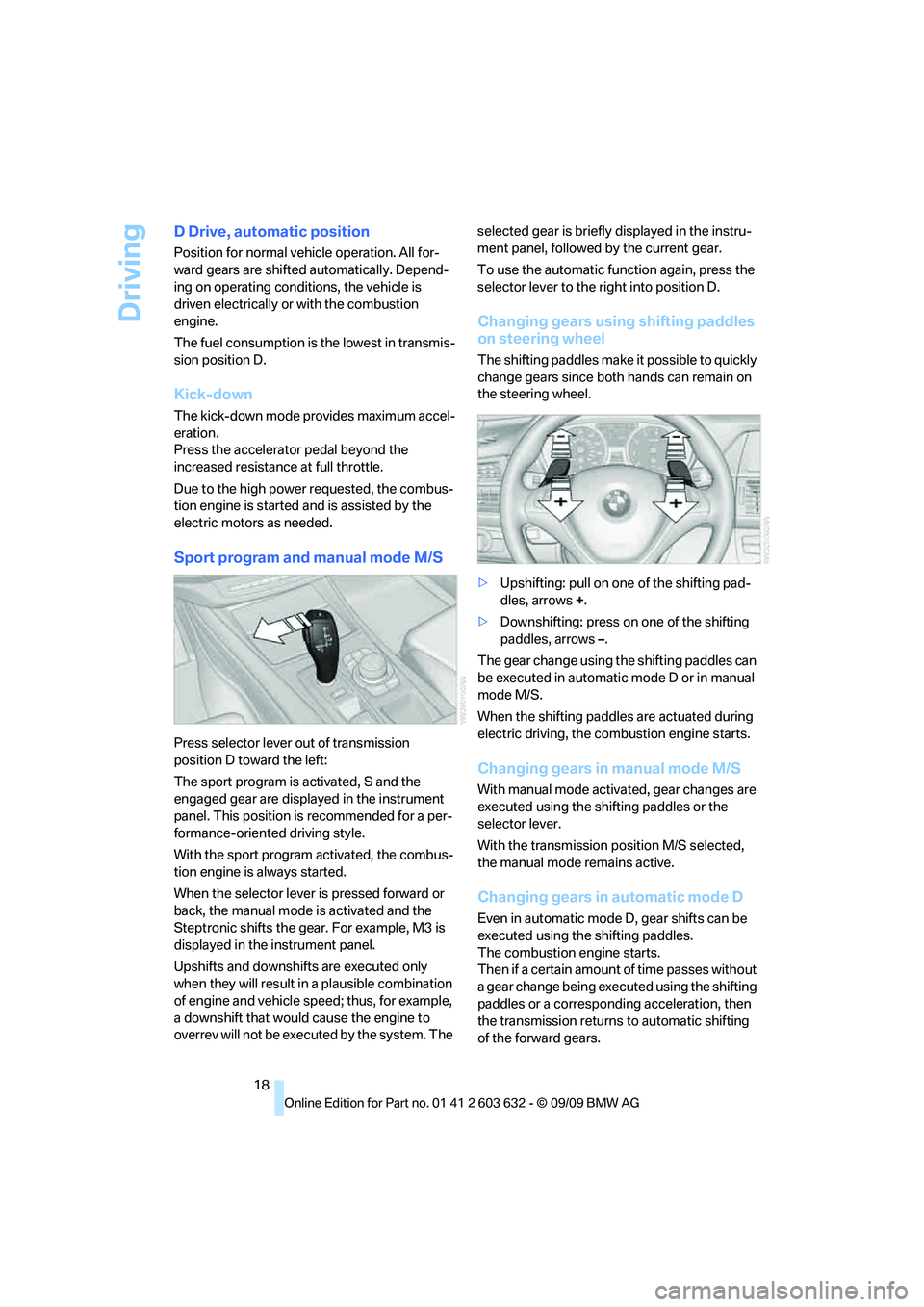
Press selector lever out of transmission
position D toward the left:
The sport program is activated, S and the
engaged gear are displayed in the instrument
panel. This position is recommended for a per-
formance-oriented driving style.
With the sport program activated, the combus-
tion engine is always started.
When the selector lever is pressed forward or
back, the manual mode is activated and the
Steptronic shifts the gear. For example, M3 is
displayed in the instrument panel.
Upshifts and downshifts are executed only
when they will result in a plausible combination
of engine and vehicle speed; thus, for example,
a downshift that would cause the engine to
overrev will not be executed by the system. The selected gear is briefly displayed in the instru-
ment panel, followed by the current gear.
To use the automatic function again, press the
selector lever to the right into position D.
Changing gears using shifting paddles
on steering wheel
The shifting paddles make it possible to quickly
change gears since both hands can remain on
the steering wheel.
>Upshifting: pull on one of the shifting pad-
dles, arrows +.
>Downshifting: press on one of the shifting
paddles, arrows –.
The gear change using the shifting paddles can
be executed in automatic mode D or in manual
mode M/S.
When the shifting paddles are actuated during
electric driving, the combustion engine starts.
Changing gears in manual mode M/S
With manual mode activated, gear changes are
executed using the shifting paddles or the
selector lever.
With the transmission position M/S selected,
the manual mode remains active.
Changing gears in automatic mode D
Even in automatic mode D, gear shifts can be
executed using the shifting paddles.
The combustion engine starts.
Then if a certa in amount of time pas ses witho ut
a gear change being executed using the shifting
paddles or a corresponding acceleration, then
the transmission returns to automatic shifting
of the forward gears.
Page 21 of 54
Reference
At a glance
Controls
Driving tips
Mobility
19
Cruise control
The concept
The cruise control is available for use at speeds
of approx. 20 mph/30 km/h. The vehicle stores
and maintains the speed that you set using the
lever mounted on the steering column.
The cruise control can also be activated
during electric driving, eDRIVE. The
cruise control provides a particularly sensitive
adjustment of the electric drive output.<
Do not use the cruise control under driv-
ing conditions that do not permit a con-
stant speed, e.g. when driving on winding
roads, in heavy traffic or in poor road conditions
such as snow, rain, ice, and loose road surface.
Otherwise you could lose control of the vehicle
and cause an accident.<
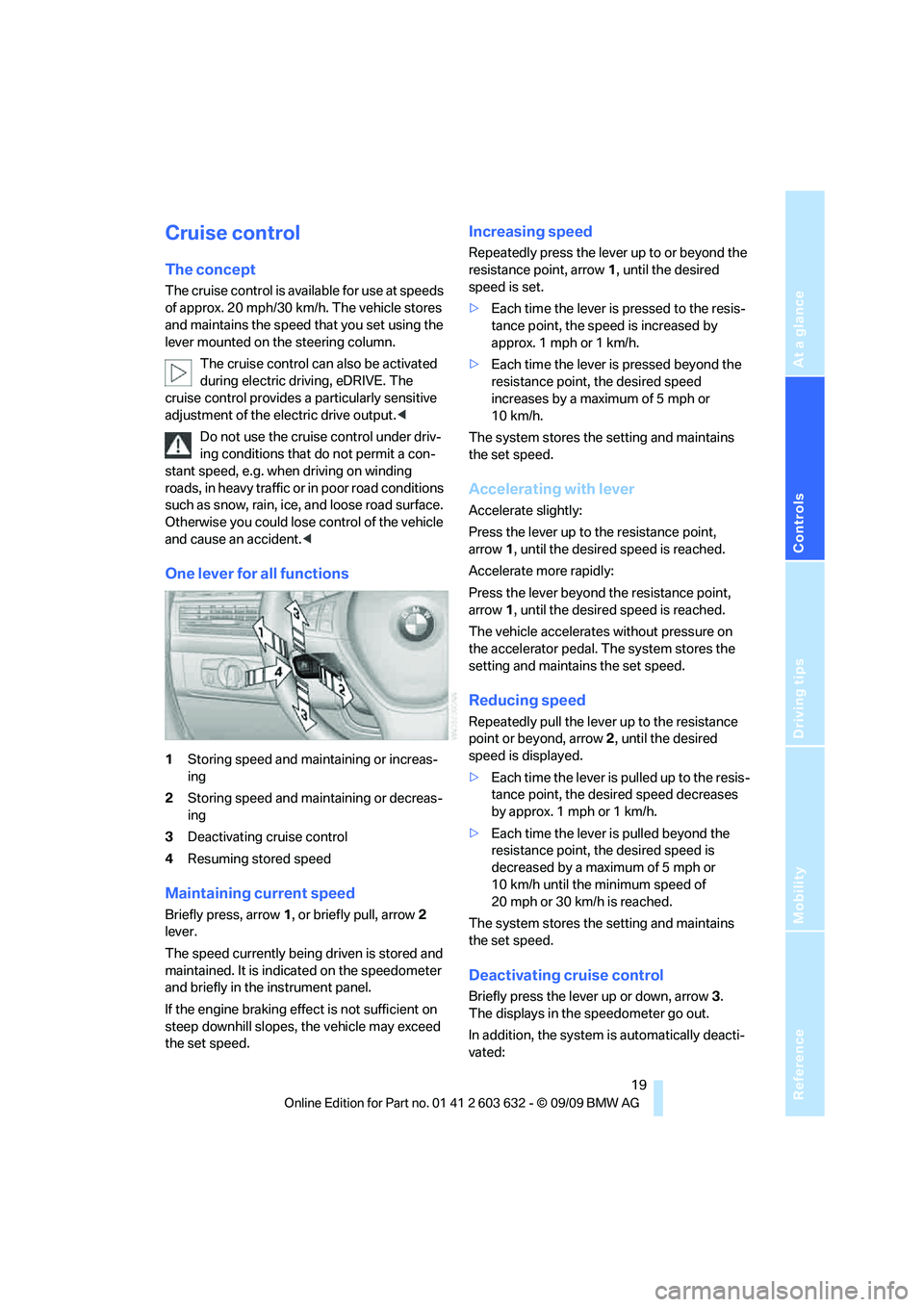
One lever for all functions
1Storing speed and maintaining or increas-
ing
2Storing speed and maintaining or decreas-
ing
3Deactivating cruise control
4Resuming stored speed
Maintaining current speed
Briefly press, arrow1, or briefly pull, arrow2
lever.
The speed currently being driven is stored and
maintained. It is indicated on the speedometer
and briefly in the instrument panel.
If the engine braking effect is not sufficient on
steep downhill slopes, the vehicle may exceed
the set speed.
Increasing speed
Repeatedly press the lever up to or beyond the
resistance point, arrow1, until the desired
speed is set.
>Each time the lever is pressed to the resis-
tance point, the speed is increased by
approx. 1 mph or 1 km/h.
>Each time the lever is pressed beyond the
resistance point, the desired speed
increases by a maximum of 5 mph or
10 km/h.
The system stores the setting and maintains
the set speed.
Accelerating with lever
Accelerate slightly:
Press the lever up to the resistance point,
arrow1, until the desired speed is reached.
Accelerate more rapidly:
Press the lever beyond the resistance point,
arrow1, until the desired speed is reached.
The vehicle accelerates without pressure on
the accelerator pedal. The system stores the
setting and maintains the set speed.
Reducing speed
Repeatedly pull the lever up to the resistance
point or beyond, arrow2, until the desired
speed is displayed.
>Each time the lever is pulled up to the resis-
tance point, the desired speed decreases
by approx. 1 mph or 1 km/h.
>Each time the lever is pulled beyond the
resistance point, the desired speed is
decreased by a maximum of 5 mph or
10 km/h until the minimum speed of
20 mph or 30 km/h is reached.
The system stores the setting and maintains
the set speed.
Deactivating cruise control
Briefly press the lever up or down, arrow3.
The displays in the speedometer go out.
In addition, the system is automatically deacti-
vated:
Page 29 of 54
Reference
At a glance
Controls
Driving tips
Mobility
27
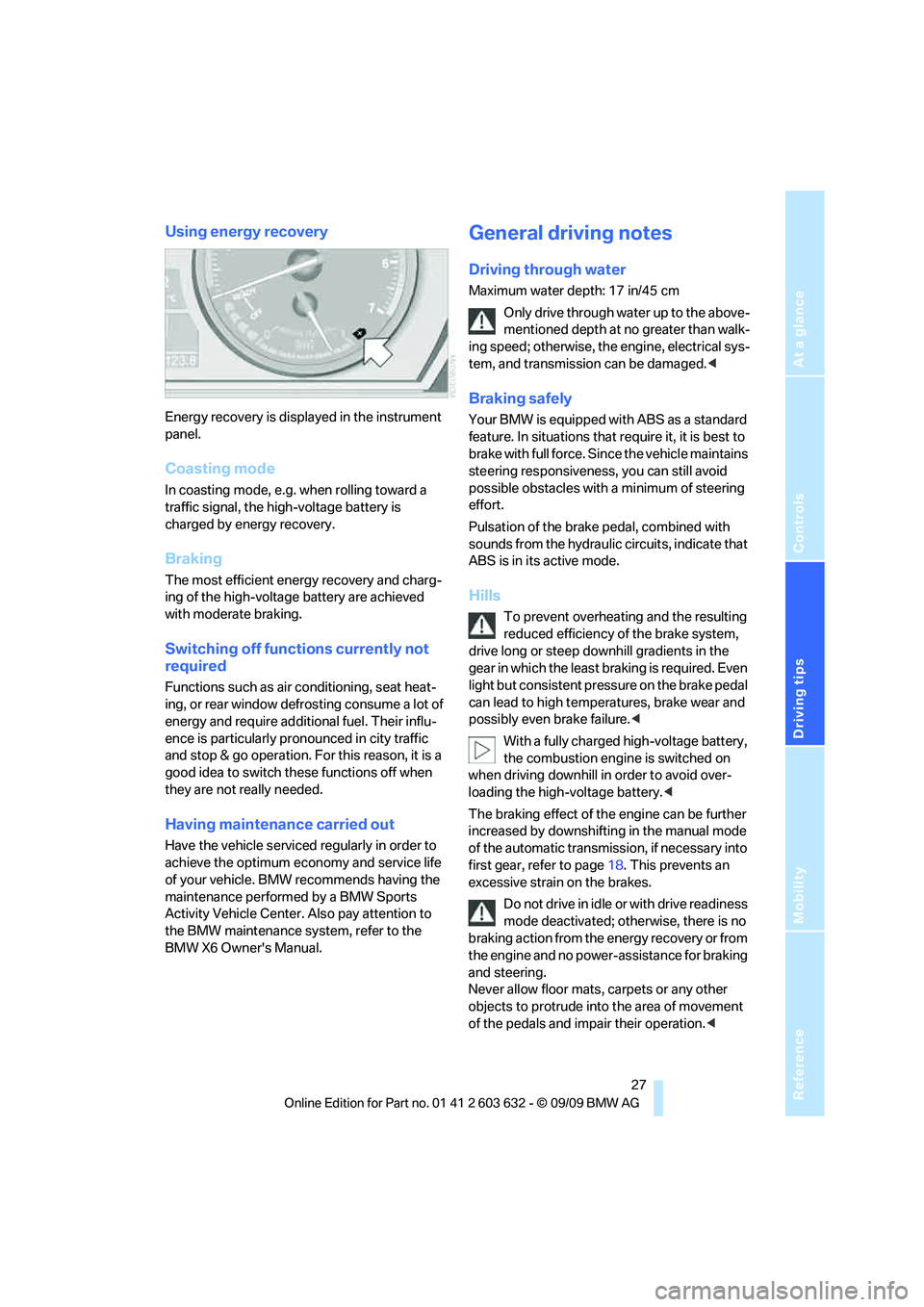
Using energy recovery
Energy recovery is displayed in the instrument
panel.
Coasting mode
In coasting mode, e.g. when rolling toward a
traffic signal, the high-voltage battery is
charged by energy recovery.
Braking
The most efficient energy recovery and charg-
ing of the high-voltage battery are achieved
with moderate braking.
Switching off functions currently not
required
Functions such as air conditioning, seat heat-
ing, or rear window defrosting consume a lot of
energy and require additional fuel. Their influ-
ence is particularly pronounced in city traffic
and stop & go operation. For this reason, it is a
good idea to switch these functions off when
they are not really needed.
Having maintenance carried out
Have the vehicle serviced regularly in order to
achieve the optimum economy and service life
of your vehicle. BMW recommends having the
maintenance performed by a BMW Sports
Activity Vehicle Center. Also pay attention to
the BMW maintenance system, refer to the
BMW X6 Owner's Manual.
General driving notes
Driving through water
Maximum water depth: 17 in/45 cm
Only drive through water up to the above-
mentioned depth at no greater than walk-
ing speed; otherwise, the engine, electrical sys-
tem, and transmission can be damaged.<
Braking safely
Your BMW is equipped with ABS as a standard
feature. In situations that require it, it is best to
brake with full force. Since the vehicle maintains
steering responsiveness, you can still avoid
possible obstacles with a minimum of steering
effort.
Pulsation of the brake pedal, combined with
sounds from the hydraulic circuits, indicate that
ABS is in its active mode.
Hills
To prevent overheating and the resulting
reduced efficiency of the brake system,
drive long or steep downhill gradients in the
gear in which the least braking is required. Even
light but consistent pressure on the brake pedal
can lead to high temperatures, brake wear and
possibly even brake failure.<
With a fully charged high-voltage battery,
the combustion engine is switched on
when driving downhill in order to avoid over-
loading the high-voltage battery.<
The braking effect of the engine can be further
increased by downshifting in the manual mode
of the automatic transmission, if necessary into
first gear, refer to page18. This prevents an
excessive strain on the brakes.
Do not drive in idle or with drive readiness
mode deactivated; otherwise, there is no
braking action from the energy recovery or from
the engine and no power-assistance for braking
and steering.
Never allow floor mats, carpets or any other
objects to protrude into the area of movement
of the pedals and impair their operation.<