height BMW ACTIVEHYBRID3 2013 User Guide
[x] Cancel search | Manufacturer: BMW, Model Year: 2013, Model line: ACTIVEHYBRID3, Model: BMW ACTIVEHYBRID3 2013Pages: 220, PDF Size: 5.09 MB
Page 154 of 220
3.Press and hold down brake pedal.4.Use the accelerator pedal to maintain an en‐
gine speed of approx. 2,000 rpm.
After a few minutes, the high-voltage battery is
fully charged again.
The battery charge indicator in the instrument
cluster, refer to page 79, is used to check the
status.
General driving notes
Closing the trunk lid Drive with the trunk lid closed
Only drive with the tailgate closed; other‐
wise, in the event of an accident or braking or
evasive maneuvers, passengers or other road
users may be injured or the vehicle may be dam‐
aged. In addition, exhaust fumes may enter the
passenger compartment.◀
If driving with the tailgate open cannot be
avoided:
▷Close all windows and the glass sunroof.▷Greatly increase the blower speed.▷Drive moderately.
Hot exhaust system
Hot exhaust system
High temperatures are generated in the
exhaust system.
Do not remove the heat shields installed and
never apply undercoating to them. When driv‐
ing, standing at idle and while parking, take care
to avoid possible contact between the hot ex‐
haust system and any highly flammable materi‐
als such as hay, leaves, grass, etc. Such contact
could lead to a fire, and with it the risk of serious
personal injury as well as property damage.
Do not touch hot exhaust pipes; otherwise, there
is the danger of getting burned.◀
Mobile communication devices in the
vehicle
Mobile communication devices in the ve‐
hicle
It is advised that you do not use mobile commu‐
nication devices, e.g., mobile phones, inside the
vehicle without connecting them directly to the
external antenna. Otherwise, the vehicle elec‐
tronics and mobile communication devices can
interfere with each other. In addition, there is no
assurance that the radiation generated during
transmission will be discharged from the vehicle
interior.◀
Hydroplaning
On wet or slushy roads, a wedge of water can
form between the tires and road surface.
This phenomenon is referred to as hydroplan‐
ing. It is characterized by a partial or complete
loss of contact between the tires and the road
surface, ultimately undermining your ability to
steer and brake the vehicle.
Hydroplaning
When driving on wet or slushy roads, re‐
duce your speed to prevent hydroplaning.◀
Driving through water
Drive though calm water only if it is not deeper
than 9.8 inches/25 cm and at this height, no
faster than walking speed, up to 6 mph/10 km/h.
Adhere to water depth and speed limita‐
tions
Do not exceed this water depth and walking
speed; otherwise, the vehicle's engine, the elec‐
trical systems and the transmission may be
damaged.◀
Braking safely
Your vehicle is equipped with ABS as a standard
feature.Seite 154Driving tipsThings to remember when driving154
Online Edition for Part no. 01 40 2 917 825 - II/13
Page 173 of 220
Tire tread
Summer tires
Do not drive with a tire tread depth of less than
0.12 in/3 mm.
There is an increased danger of hydroplaning if
the tread depth is less than 0.12 in/3 mm.
Winter tires
Do not drive with a tire tread depth of less than
0.16 in/4 mm.
Below a tread depth of 0.16 in/4 mm, tires are
less suitable for winter operation.
Minimum tread depth
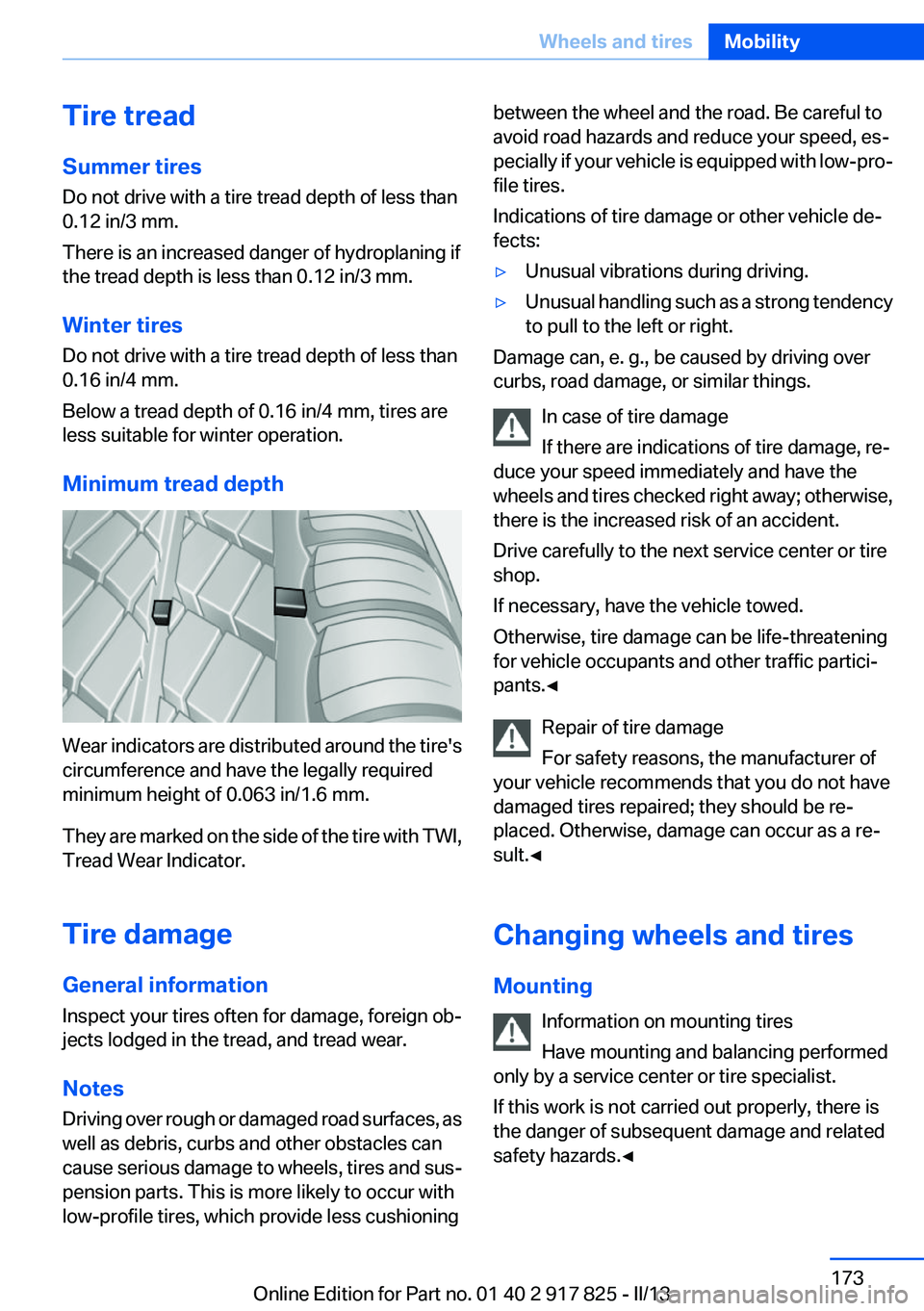
Wear indicators are distributed around the tire's
circumference and have the legally required
minimum height of 0.063 in/1.6 mm.
They are marked on the side of the tire with TWI,
Tread Wear Indicator.
Tire damage
General information
Inspect your tires often for damage, foreign ob‐
jects lodged in the tread, and tread wear.
Notes
Driving over rough or damaged road surfaces, as
well as debris, curbs and other obstacles can
cause serious damage to wheels, tires and sus‐
pension parts. This is more likely to occur with
low-profile tires, which provide less cushioning
between the wheel and the road. Be careful to
avoid road hazards and reduce your speed, es‐
pecially if your vehicle is equipped with low-pro‐
file tires.
Indications of tire damage or other vehicle de‐
fects:▷Unusual vibrations during driving.▷Unusual handling such as a strong tendency
to pull to the left or right.
Damage can, e. g., be caused by driving over
curbs, road damage, or similar things.
In case of tire damage
If there are indications of tire damage, re‐
duce your speed immediately and have the
wheels and tires checked right away; otherwise,
there is the increased risk of an accident.
Drive carefully to the next service center or tire
shop.
If necessary, have the vehicle towed.
Otherwise, tire damage can be life-threatening
for vehicle occupants and other traffic partici‐
pants.◀
Repair of tire damage
For safety reasons, the manufacturer of
your vehicle recommends that you do not have
damaged tires repaired; they should be re‐
placed. Otherwise, damage can occur as a re‐
sult.◀
Changing wheels and tires
Mounting Information on mounting tires
Have mounting and balancing performed
only by a service center or tire specialist.
If this work is not carried out properly, there is
the danger of subsequent damage and related
safety hazards.◀
Seite 173Wheels and tiresMobility173
Online Edition for Part no. 01 40 2 917 825 - II/13
Page 177 of 220
Hood
Hints Working in the engine compartment
Never attempt to perform any service or
repair operations on your vehicle without the
necessary professional technical training.
If you are unfamiliar with the statutory guide‐
lines, have any work on the vehicle performed
only by a service center.
If this work is not carried out properly, there is
the danger of subsequent damage and related
safety hazards.◀
Never reach into the engine compartment
Never reach into the intermediate spaces
or gaps in the engine compartment. Otherwise,
there is risk of injury, e.g. from rotating or hot
parts.◀
Fold down wiper arm
Before opening the hood, ensure that the
wiper arms are against the windshield, or this
may result in damage.◀
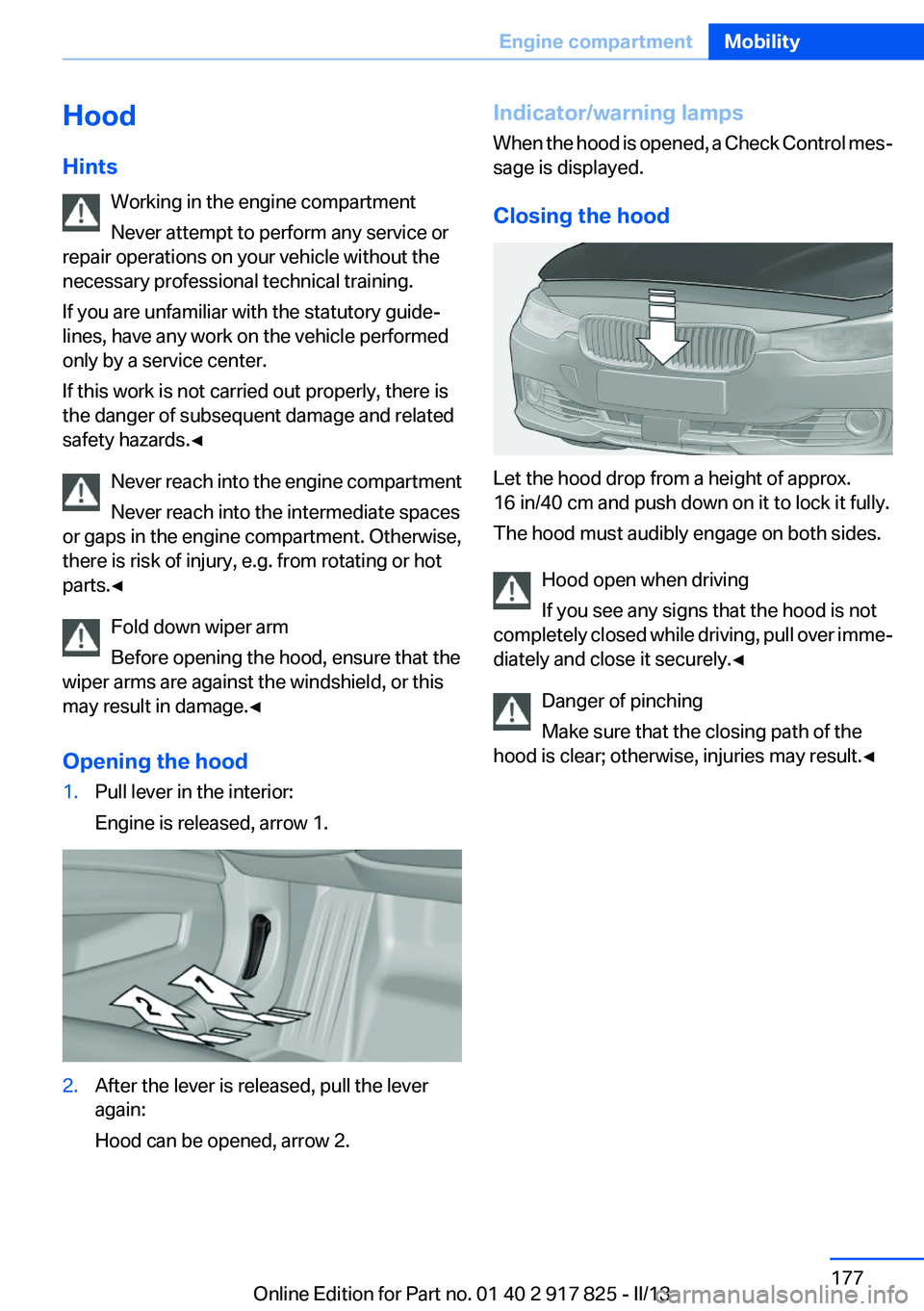
Opening the hood1.Pull lever in the interior:
Engine is released, arrow 1.2.After the lever is released, pull the lever
again:
Hood can be opened, arrow 2.Indicator/warning lamps
When the hood is opened, a Check Control mes‐
sage is displayed.
Closing the hood
Let the hood drop from a height of approx.
16 in/40 cm and push down on it to lock it fully.
The hood must audibly engage on both sides.
Hood open when driving
If you see any signs that the hood is not
completely closed while driving, pull over imme‐
diately and close it securely.◀
Danger of pinching
Make sure that the closing path of the
hood is clear; otherwise, injuries may result.◀
Seite 177Engine compartmentMobility177
Online Edition for Part no. 01 40 2 917 825 - II/13
Page 206 of 220
Technical dataVehicle equipment
All standard, country-specific and optional
equipment that is offered in the model series is
described in this chapter. Therefore, equipmentis also described that is not available in a vehicle,
e. g., because of the selected optional equip‐
ment or country variant. This also applies for
safety-related functions and systems.
Dimensions
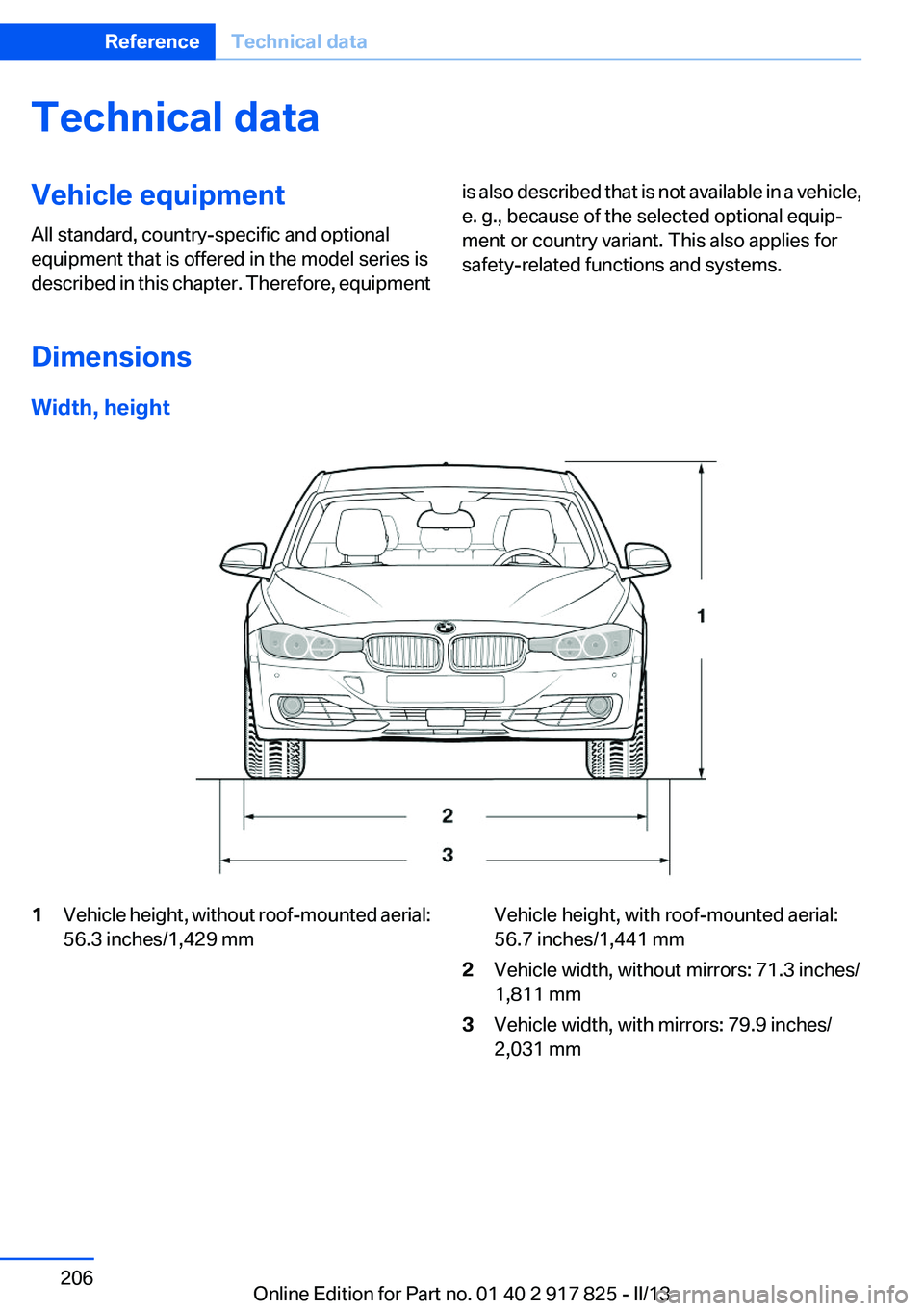
Width, height
1Vehicle height, without roof-mounted aerial:
56.3 inches/1,429 mmVehicle height, with roof-mounted aerial:
56.7 inches/1,441 mm2Vehicle width, without mirrors: 71.3 inches/
1,811 mm3Vehicle width, with mirrors: 79.9 inches/
2,031 mmSeite 206ReferenceTechnical data206
Online Edition for Part no. 01 40 2 917 825 - II/13
Page 213 of 220
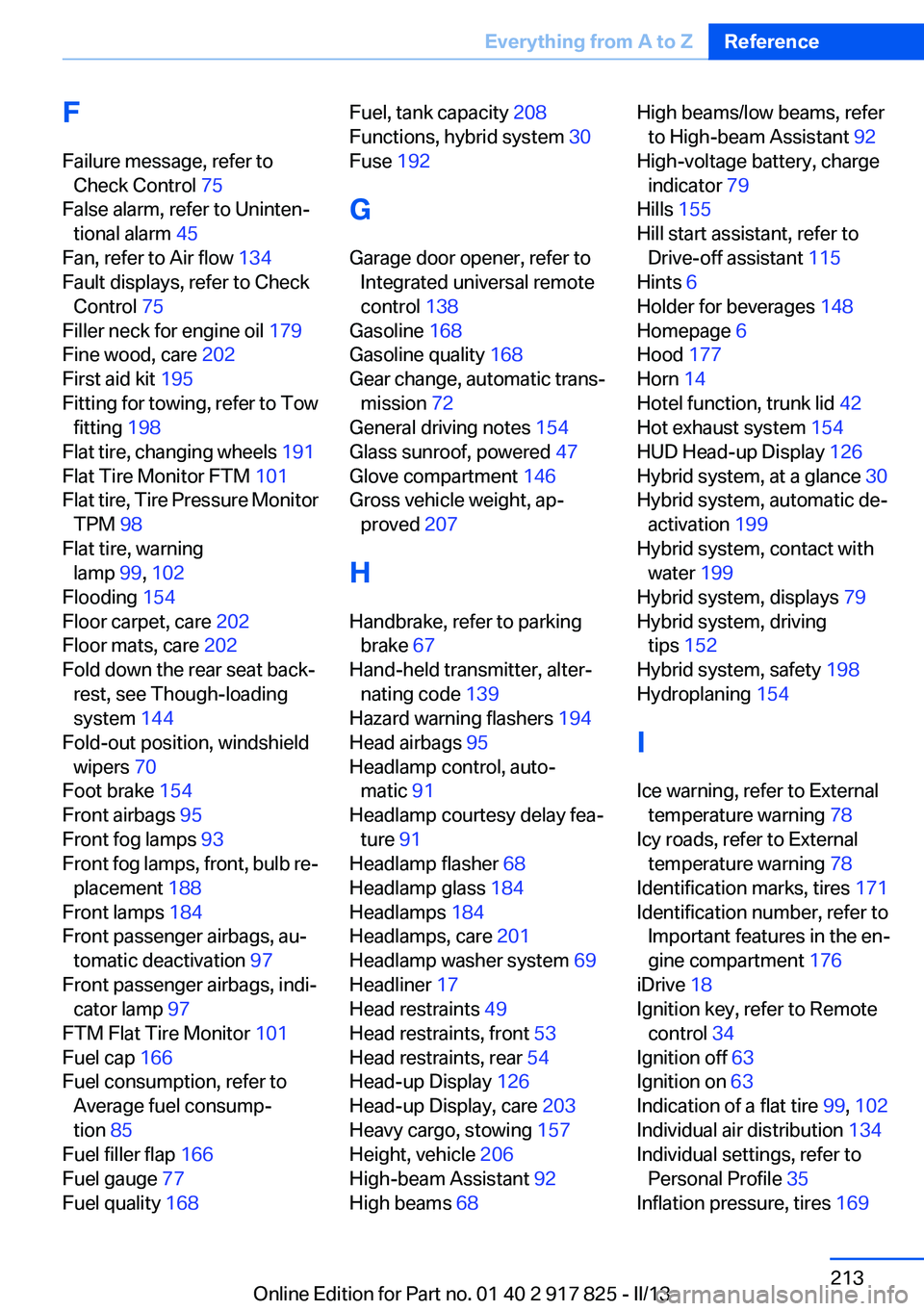
F
Failure message, refer to Check Control 75
False alarm, refer to Uninten‐ tional alarm 45
Fan, refer to Air flow 134
Fault displays, refer to Check Control 75
Filler neck for engine oil 179
Fine wood, care 202
First aid kit 195
Fitting for towing, refer to Tow fitting 198
Flat tire, changing wheels 191
Flat Tire Monitor FTM 101
Flat tire, Tire Pressure Monitor TPM 98
Flat tire, warning lamp 99, 102
Flooding 154
Floor carpet, care 202
Floor mats, care 202
Fold down the rear seat back‐ rest, see Though-loading
system 144
Fold-out position, windshield wipers 70
Foot brake 154
Front airbags 95
Front fog lamps 93
Front fog lamps, front, bulb re‐ placement 188
Front lamps 184
Front passenger airbags, au‐ tomatic deactivation 97
Front passenger airbags, indi‐ cator lamp 97
FTM Flat Tire Monitor 101
Fuel cap 166
Fuel consumption, refer to Average fuel consump‐
tion 85
Fuel filler flap 166
Fuel gauge 77
Fuel quality 168 Fuel, tank capacity 208
Functions, hybrid system 30
Fuse 192
G
Garage door opener, refer to Integrated universal remote
control 138
Gasoline 168
Gasoline quality 168
Gear change, automatic trans‐ mission 72
General driving notes 154
Glass sunroof, powered 47
Glove compartment 146
Gross vehicle weight, ap‐ proved 207
H
Handbrake, refer to parking brake 67
Hand-held transmitter, alter‐ nating code 139
Hazard warning flashers 194
Head airbags 95
Headlamp control, auto‐ matic 91
Headlamp courtesy delay fea‐ ture 91
Headlamp flasher 68
Headlamp glass 184
Headlamps 184
Headlamps, care 201
Headlamp washer system 69
Headliner 17
Head restraints 49
Head restraints, front 53
Head restraints, rear 54
Head-up Display 126
Head-up Display, care 203
Heavy cargo, stowing 157
Height, vehicle 206
High-beam Assistant 92
High beams 68 High beams/low beams, refer
to High-beam Assistant 92
High-voltage battery, charge indicator 79
Hills 155
Hill start assistant, refer to Drive-off assistant 115
Hints 6
Holder for beverages 148
Homepage 6
Hood 177
Horn 14
Hotel function, trunk lid 42
Hot exhaust system 154
HUD Head-up Display 126
Hybrid system, at a glance 30
Hybrid system, automatic de‐ activation 199
Hybrid system, contact with water 199
Hybrid system, displays 79
Hybrid system, driving tips 152
Hybrid system, safety 198
Hydroplaning 154
I
Ice warning, refer to External temperature warning 78
Icy roads, refer to External temperature warning 78
Identification marks, tires 171
Identification number, refer to Important features in the en‐
gine compartment 176
iDrive 18
Ignition key, refer to Remote control 34
Ignition off 63
Ignition on 63
Indication of a flat tire 99, 102
Individual air distribution 134
Individual settings, refer to Personal Profile 35
Inflation pressure, tires 169 Seite 213Everything from A to ZReference213
Online Edition for Part no. 01 40 2 917 825 - II/13