tow BMW CONVERTIBLE 1998 User Guide
[x] Cancel search | Manufacturer: BMW, Model Year: 1998, Model line: CONVERTIBLE, Model: BMW CONVERTIBLE 1998Pages: 179, PDF Size: 3.51 MB
Page 99 of 179
98
Stowing a loadIf you are transporting a load in your
BMW
dStow a heavy load as far forward as
possible - directly behind the back-
rests or the front wall of the luggage
compartment - and on the ßoor.
dCover sharp edges and corners.
dDo not pile objects higher than the
top edge of the backrest.
dIf the load is heavy and the rear seat
is unoccupied, put the outer safety
belt in its lock.
Securing loaddSecure smaller, lighter items with
retaining straps or draw straps (refer
to page 34).
dFor large, heavy items, see your
BMW Retailer for load-securing
devices
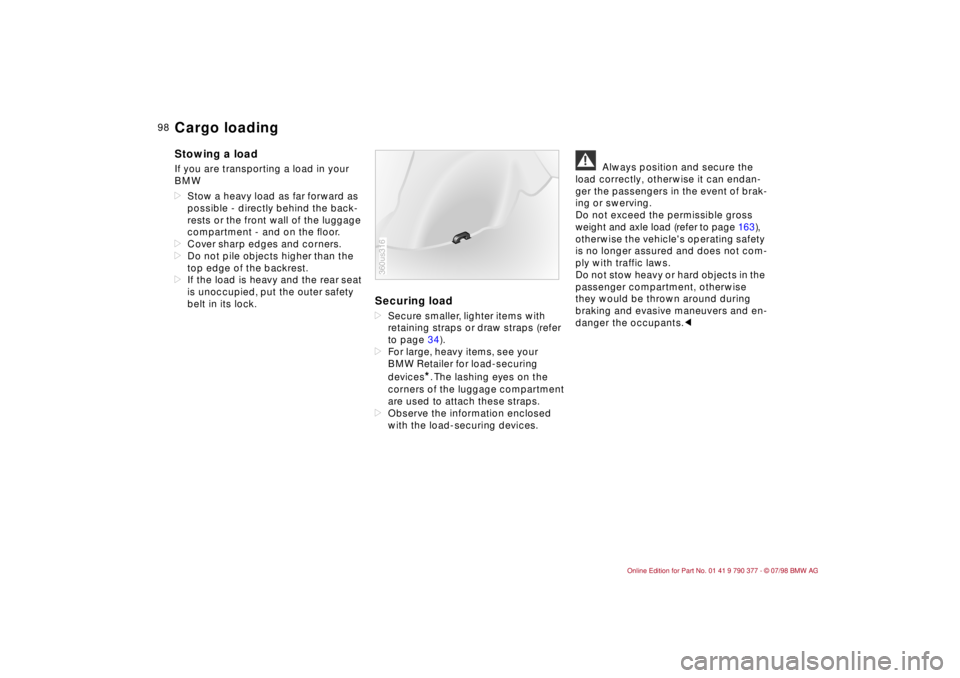
*. The lashing eyes on the
corners of the luggage compartment
are used to attach these straps.
dObserve the information enclosed
with the load-securing devices.
a
Always position and secure the
load correctly, otherwise it can endan-
ger the passengers in the event of brak-
ing or swerving.
Do not exceed the permissible gross
weight and axle load (refer to page 16 3),
otherwise the vehicle's operating safety
is no longer assured and does not com-
ply with traffic laws.
Do not stow heavy or hard objects in the
passenger compartment, otherwise
they would be thrown around during
braking and evasive maneuvers and en-
danger the occupants.c
360us316
Cargo loading
Page 103 of 179

10 2
The catalytic converter reduces harmful
exhaust emissions.
It is designed for use with unleaded fuel
only.
Even minute quantities of lead would be
enough to permanently damage both
the catalytic converter and the system's
oxygen sensor.
To ensure efficient, trouble-free engine
operation and avoid potential damage:
dAlways have your car serviced in
accordance with maintenance
instructions.
dNever continue driving until the fuel
tank is empty.
dRespond to engine miss by switching
off the engine at once.
dNever tow-start the car unless the
engine is cold, or else unburned fuel
may reach the catalytic converter.
Better yet: use jumper cables!
dAvoid other situations in which the
fuel would not be (completely)
burned, for instance:
Frequent, extended, or repeated
starting attempts during which the
engine fails to start. (Switching off
and restarting a healthy engine
causes no damage).
Never let the engine run with any of
the spark-plug cables disconnected.
a
Always observe the above points
to prevent unburned mixture from
entering the catalytic converter. This
could result in overheating, leading to
serious damage.
High temperatures occur on all vehicles
equipped with a catalytic converter.
Heat shields are installed adjacent to
some sections of the exhaust system.
Never remove these shields; do not
apply undercoating to their surfaces.
When driving, standing at idle or park-
ing the vehicle, take care to avoid con-
tact between the exhaust system and
flammable materials (e.g., grass, hay,
leaves, etc.). Such contact could lead to
a fire, resulting in personal injury and
property damage.c
Traveling abroadAlways make sure that unleaded fuel
meeting your engineÕs octane require-
ments will be available when planning
trips outside the country. The use of
fuel failing to meet the official octane
requirements could result in engine
damage.
If you are considering traveling to a
country in which unleaded fuel is not
readily available, please remember that
leaded fuel will destroy the lambda oxy-
gen sensor and the catalytic converter
on your BMW. After operation on
leaded fuel, your vehicle will no longer
meet American and Canadian exhaust
emission standards, and there will also
be a loss of fuel economy. Upon your
return to the US or Canada, you will be
expected to comply with legal ordi-
nances requiring that you replace both
the oxygen sensor and the catalytic
converter, and to have the fuel system
flushed to remove any traces of leaded
fuel.
Catalytic converter
Page 112 of 179
111
At a glanceControlsCar careRepairsTechnicalDataIndex
Information for your safetyThe factory-approved radial tires have
been selected to provide optimum
safety and driving comfort on your vehi-
cle.
In a very real sense, both tire life and
your own safety are riding on correct
tire specifications and inflation pres-
sures.
Incorrect inflation pressures are a fre-
quent cause of tire damage. To a great
extent it also influences the ability of
your BMW to hold the road.a
Check the tire pressures Ð also in
the spare tire Ð at least every two weeks,
and before every extended trip.
Incorrect inflation pressures can also
lead to tire damage and accidents.c
Tire tread - tire damageInspect your tires frequently for tread
wear, signs of damage and for foreign
objects lodged in the tread. Check the
tread depth.
The tread depth should not be less than
0.12 in (3 mm). Otherwise there is an
increased risk of aquaplaning, even at
relatively moderate speeds and with
only small amounts of water on the
road.
We recommend that you always replace
the tires once the tread wears to 0.12 in
(3 mm). Once the tread has worn to
0.063 in (1.6 mm), tread depth indica-
tors appear.a
Never continue driving on a deflat-
ed (flat) tire. A flat tire greatly impairs
steering and braking response, and can
lead to complete loss of control over the
vehicle.
Avoid overloading the vehicle so that the
permitted load on the tires is not ex-
ceeded. This can cause overheating and
gradual internal damage. The ultimate
result can assume the form of a sudden
air loss.Unusual vibrations encountered during
normal vehicle operation can indicate
tire failure or some other vehicle defect,
as can variations in normal vehicle
response, such as a pronounced ten-
dency to pull to the left or right. Should
this occur, you should respond by
immediately reducing your speed and
carefully proceeding to the nearest
BMW Retailer or professional tire cen-
ter, or having the vehicle towed in to
have it and its tires inspected.
Tire damage (up to and including blow-
outs) can endanger the lives of both the
vehicle occupants and other road
users.c
Tire inflation pressures Tire tread
Page 140 of 179
At a glance
Controls and featuresCare and maintenanceAdvanced technology
Technical data
Owner service procedure
At a glanceControlsCar careRepairsTechnicalDataIndex
Index
13 9
Replacement procedures:
Onboard tool kit140
Windshield wiper blades140
Lamp and bulbs141
Master key with battery lamp145
Changing tires146
Battery149
Fuses151
In case of electrical
malfunction:
Fuel filler door 152
Sliding/tilt sunroof 152
Assistance, giving and receiving:
Jump-starting153
Towing the vehicle154
Towing154
Page 143 of 179
14 2
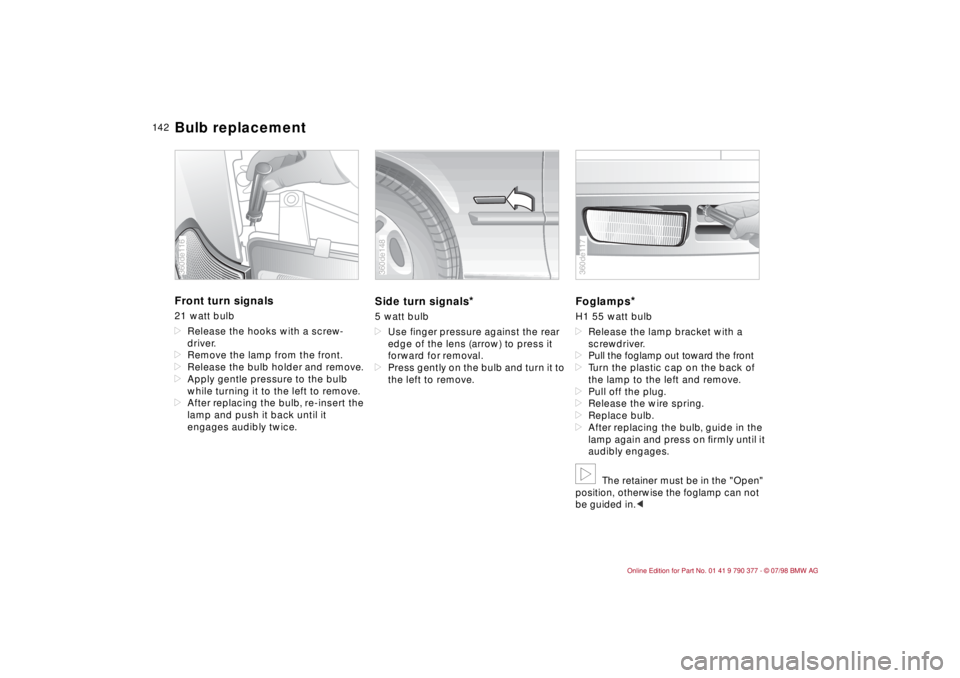
Front turn signals 21 watt bulb
dRelease the hooks with a screw-
driver.
dRemove the lamp from the front.
dRelease the bulb holder and remove.
dApply gentle pressure to the bulb
while turning it to the left to remove.
dAfter replacing the bulb, re-insert the
lamp and push it back until it
engages audibly twice.
Side turn signals
*
5 watt bulb
dUse finger pressure against the rear
edge of the lens (arrow) to press it
forward for removal.
dPress gently on the bulb and turn it to
the left to remove.
Foglamps
*
H1 55 watt bulb
dRelease the lamp bracket with a
screwdriver.
dPull the foglamp out toward the front
dTurn the plastic cap on the back of
the lamp to the left and remove.
dPull off the plug.
dRelease the wire spring.
dReplace bulb.
dAfter replacing the bulb, guide in the
lamp again and press on Þrmly until it
audibly engages.b
The retainer must be in the "Open"
position, otherwise the foglamp can not
be guided in.c
360de116
360de148
360de117
Bulb replacement
Page 155 of 179
15 4
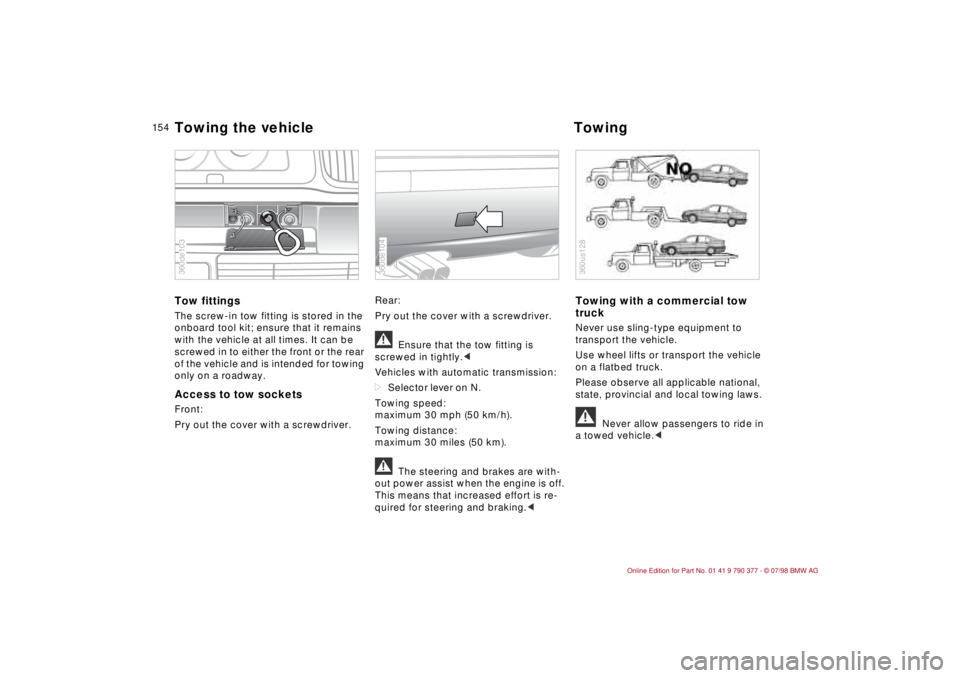
Tow fittingsThe screw-in tow fitting is stored in the
onboard tool kit; ensure that it remains
with the vehicle at all times. It can be
screwed in to either the front or the rear
of the vehicle and is intended for towing
only on a roadway. Access to tow socketsFront:
Pry out the cover with a screwdriver.Rear:
Pry out the cover with a screwdriver.
a
Ensure that the tow fitting is
screwed in tightly.c
Vehicles with automatic transmission:
dSelector lever on N.
Towing speed:
maximum 30 mph (50 km/h).
Towing distance:
maximum 30 miles (50 km).
a
The steering and brakes are with-
out power assist when the engine is off.
This means that increased effort is re-
quired for steering and braking.c
Towing with a commercial tow
truckNever use sling-type equipment to
transport the vehicle.
Use wheel lifts or transport the vehicle
on a flatbed truck.
Please observe all applicable national,
state, provincial and local towing laws.a
Never allow passengers to ride in
a towed vehicle.c
360de103
360de104
360us128
Towing the vehicle Towing
Page 172 of 179
171
At a glanceControls Car careRepairsTechnicalDataIndex
Note: This index does not correspond to the original manual in all detailsClock
66
, 67
, 68
, 69
Cockpit
16
Coinbox 94
Computer 77
, 78
, 79
, 80
,
81
, 82
, 83
Consumption display
64
Convenient closure
31
Convertible, refer to BMW
convertible
Coolant
105
, 127
, 166
Coolant, Antifreeze 105
Cooling system
166
Cruise control 62
Cruising range 79
Cup holder
94
DDashboard
16
Dashboard lighting
85
Data
Dimensions
161
Engine
160
Road performance
163
Weights
163
Data, technical
160
Date
68
, 72
, 74
Daytime light switch
85
Decommissioning of the
Vehicle
137
Deep water 101
Defrost windshields
91
Defrost, windshields 91
Defrosting position 91
DieselInjection system
19
Interference
19
Digital clock
66
, 67
, 68
, 69
Dimensions
161
Dipstik, engine oil
124
Disc brakes
104
Disconnect the battery
150
Display lighting
85
Distance, remaining
79
Door keys
30
Door locks 31
Doors, emergency actuation
31
Drive belts
167
Driver's airbag
50
Driving hints
100
Driving in winter
105
EElectric window actuator
35
Electrical seat
Adjustment
44
Electrical system
167
Electrolyte
149
Electronic unit
Vehicle immobilization
30
Elements of operation
16
Emergency actuation,
Central locking system 31
Tank cover
152
Energy Control 63
Engine coolant 166
Engine data
160
Engine oil
124Capacity
166
Filling capacity
166
Engine oil additives 125
Engine oil consumption
124
Engine oil level
20
Engine oil pressure
20
Eyelets, tow starting and
Towing
154
FFailure message
71
Failure of an electrical
device
151
Fault display
71
Filler cap cover 23
Filling capacity 166
Final drive
Capacity
166
Filling capacity
166
First aid
22
First aid kit 22
Flashers
60
Flat tire 111
, 146
Flower pollen 92
Foglight
86
Foglights, replace bulb
142
Folding
Rear backrest
95
Footbrake
104
Footwell light,
Replace bulb
145
Footwell lights 86
Front seat, position
43
FuelPreparation
160
Processing 160
Fuel consumption indicator
63
Fuel gauge
64
Fuses,
Replacing 151
GGlove compartment
93
Glove compartment light,
bulb replacement 145
Gross weight,
permissible
163
HHand light
93
Handbrake 56
Hazard warning system
22
Hazard warning triangle 22
Head restraint
43
Headlight cleaning System
124
Headlight cleaning system
166
Headlight covers, care
131
Headlight flasher
60
Heated seats
87
Height
161
Hi-Fi System
93
High beams 60
Highbeam headlights,
Replace lights
141
Hood release
118
Horn
17
Everything from A to Z
Page 174 of 179
173
At a glanceControls Car careRepairsTechnicalDataIndex
Note: This index does not correspond to the original manual in all detailscomponents
105
SSAFETY DEFECTS
7
Seat heaters
87
Seat, electric 44
Seat, mechanical
43
Seatback release 45
Seatbelts
47
Seats, adjustment
43
Selector lever, automatic
transmission
58
Service Interval Display
64
Shift programs
59
Side airbag
50
Sliding
106
Sliding/tilt sunroof
36
Close in case of electrical
fault
152
Slippery roads
105
Snow chains
105
Spare key
30
Spare keys 30
Spare tire 112
, 146
Spark plugs
167
Special oils 125
Speed warning activation
threshold 80
Sport seat 44
Start
54
Start the engine
Preheating
54
Starting assistance
153Starting problems
102
Steel wheel
115
Steering
128
Steering lock
54
Steering wheel lock
54
Stopwatch
80
Storage shelves
93
Summer tires
113
Sun visor
46
Switching off the engine
55
Switching off the vehicle 55
Symbols
4
Battery 149
TTachometer
63
Tailgate
33
Taillights 143
Taillights,
Replace bulbs
143
Tank cover
Unlock in case of
electrical fault 152
Technical Data 160
Technical data 160
Telephone
108
Temperature 91
Temperature display
66
Temperature layering 92
Tempomat
62
Thigh support
Ajustment 44
Third brake light
143Through loading system
95
Timer
81
Tire change
146
Tire damages 111
Tire inflation pressure
25
,
111
Tire inscription
113
Tire replacement 112
Tire sizes
115
Tire tread 111
Tool kit
140
Tools
140
Tow starting
154
Towing
154
Towing eyelets
154
Track
161
Trailer load, permissible
163
Trailer nose weight,
permissible
163
Transmission 57
Traveling abroad
102
Tread depth, tires 111
Trip
63
Trip distance recorder
63
Trip odometer
63
Trunk
Capacity
163
Trunk lights,
Replace bulb
145
Turn on
54
Turn signal indicator
60
Turn signal,Replace bulb
142
Turn signals
143
Turning circle 161
Turning radius 161
UUnloaded vehicle weight
163
Unlocking and locking doors
31
Used batteries
150
VVehicle care, interior
133
Vehicle decommissioning
137
Vehicle identification
129
Vehicle identification
number
129
Vehicle immobilization unit
30
Vehicle paintwork
132
Vehicle weight
163
Ventilate at a standstill
81
Ventilation, draft free
92
WWarm feet - cool head
92
Warning
71
Warning Light-On
85
Warning lights
20
Washer fluid
Add
124
Fill up 166
Washer fluid reservoir
Everything from A to Z
Page 176 of 179
175
At a glanceControls Car careRepairsTechnicalDataIndex
Note: This index does not correspond to the original manual in all details
AAdd coolant 127
Adding oil 125
Adjusting washer
nozzles 124
Antifreeze, use 127BBackup lamp,
replace bulb 143
Battery,
charging 150
Battery change,
master key 145
radio remote control 145
Battery,
add distilled water 149
discharged 153
Brake fluid, add 128
Brake lamps,
replace bulb 143
Brakes, defects 105CCheck air pressure 24
Check Control 70
Check engine oil level 124
Coolant, add 127DDefrost windshields 91
Difficult steering 129Door, emergency
actuation 32
EElectrical fault
Sliding/tilt sunroof 152
Fuel filler door 152
Emergency actuation,
Door 32
Sliding/tilt sunroof 152
Fuel filler door 152
External starts 153FFailure messages 70
Failure of an
electrical device 151
Fault displays 70
First aid 21
Fittings, tow-starting and
towing 154
Flat tire 146
Foglamps,
replace bulb 142
Footwell lamp,
replace bulb 145GGlove compartment lamp,
replace bulb 145
HHazard warning system 21
Hazard warning triangle 21
Headlamp cover, care 141
Help in case of a
breakdown 153
High beam headlamps,
replace lamps 141IIndicator lamps 19
Inflation pressure 24
Interior lamps,
replace bulbs 144KKey, battery change 145LLicense plate lamp,
replace bulb 144
Low beam headlamps,
replace lamps 141
Luggage compartment lid,
emergency actuation 32
Luggage compartment
lamps, replace bulb 145MMaintenance 63OOnboard tool kit 140
PParking lamp,
replace bulb 141
Power steering,
add oil 128
Pressure, tires 24
Protective glazing,
care 131RRear foglamps,
replace bulb 142
Remove mist on
windshields 91
Replace bulbs 141
Replace fuses 151SSliding/tilt sunroof,
close in case of power
supply interruption 152
Snow chains 105
Starting difficulties 102, 153
Starting with a discharged
battery 153TTaillamp 143
Taillamp,
replace bulb 143
Tire change 146
Tire damage 111
Tools 140
Owner service procedures from A to Z
Page 177 of 179
176
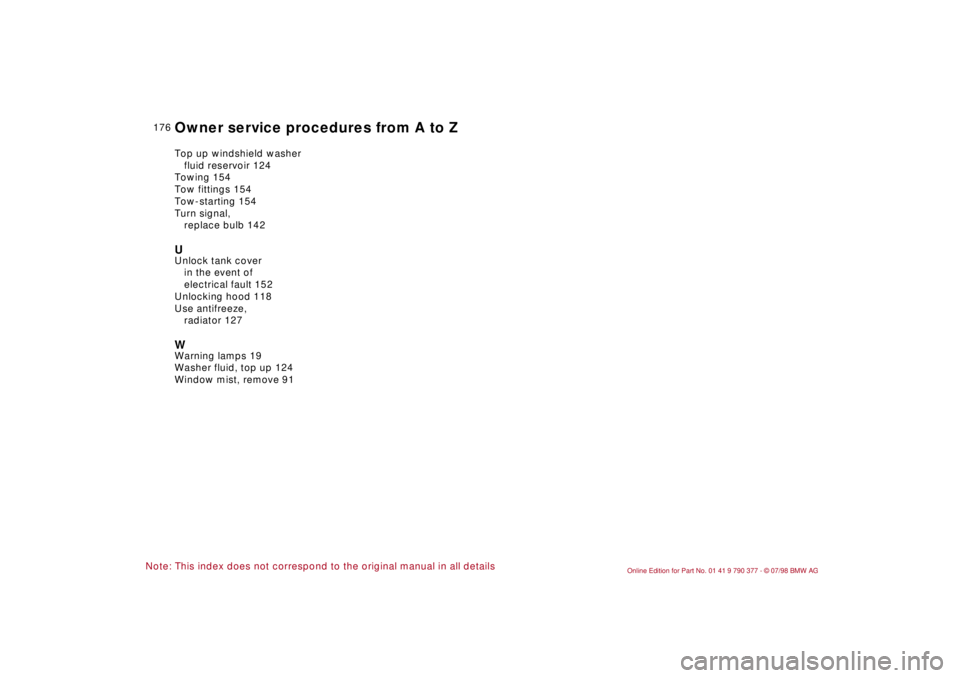
Note: This index does not correspond to the original manual in all detailsTop up windshield washer
fluid reservoir 124
Towing 154
Tow fittings 154
Tow-starting 154
Turn signal,
replace bulb 142
UUnlock tank cover
in the event of
electrical fault 152
Unlocking hood 118
Use antifreeze,
radiator 127WWarning lamps 19
Washer fluid, top up 124
Window mist, remove 91Owner service procedures from A to Z