belt BMW M ROADSTER COUPE 2001 User Guide
[x] Cancel search | Manufacturer: BMW, Model Year: 2001, Model line: M ROADSTER COUPE, Model: BMW M ROADSTER COUPE 2001Pages: 171, PDF Size: 1.98 MB
Page 52 of 171
52n
AirbagsSitting correctly with airbags
For your safety, comply with the
following instructions for the
airbags. If you do not, the airbags may
not be able to provide their maximum
protection. All passengers in the vehicle
should be aware of and comply with
this information:
The airbags are supplemental restraint
devices designed to provide extra
protection; they are not a substitute for
safety belts. Wear your safety belt at
all times.
Adjust your seat to a position that is
comfortable for you, allowing unre-
stricted vehicle operation, and is not
closer to the steering wheel than
necessary.
Always grasp the steering wheel by the
steering wheel rim, keeping your hands
at the "9-o'clock" and "3-o'clock" posi-
tions in order to minimize any risk of
injury to hands or arms if the airbag
does deploy.
There should not be any other people,
animals or objects between the airbag
and the passenger in that seat.
Do not use the cover panel for the front
airbag on the passenger side as a
storage area.
Do not apply adhesive materials to the
cover panels of the airbags, cover them
or modify them in any other way.
If you use a child restraint system, read
carefully and comply with the instruc-
tions on page 53.
Be sure that child seats are installed
correctly and with the greatest possible
distance from the airbag in the side trim
panel. Do not allow children to lean out
of the child's seat in the direction of the
side trim panel. Otherwise, serious inju-
ries could occur if the airbag is trig-
gered.<
Even when you have complied with all
of these guidelines, there is still a small
residual risk of minor facial, hand and
arm injuries from airbag deployment
occurring in isolated instances.
The ignition and inflation noise may
cause a mild temporary hearing loss in
extremely sensitive individuals.
Corresponding airbag safety precau-
tions are provided on both sun visors
and the instrument panel (US models).
For additional information concerning
the airbag system, refer to pages 122
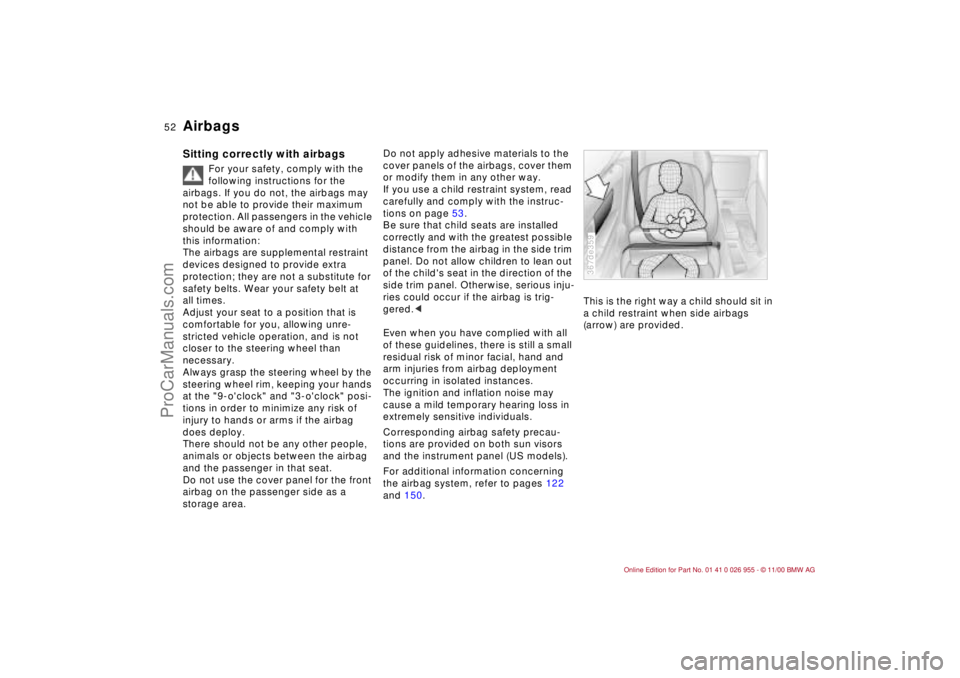
and 150.This is the right way a child should sit in
a child restraint when side airbags
(arrow) are provided.
367de359
ProCarManuals.com
Page 53 of 171
53n
IndexDataTechnologyRepairsCar careControlsOverview
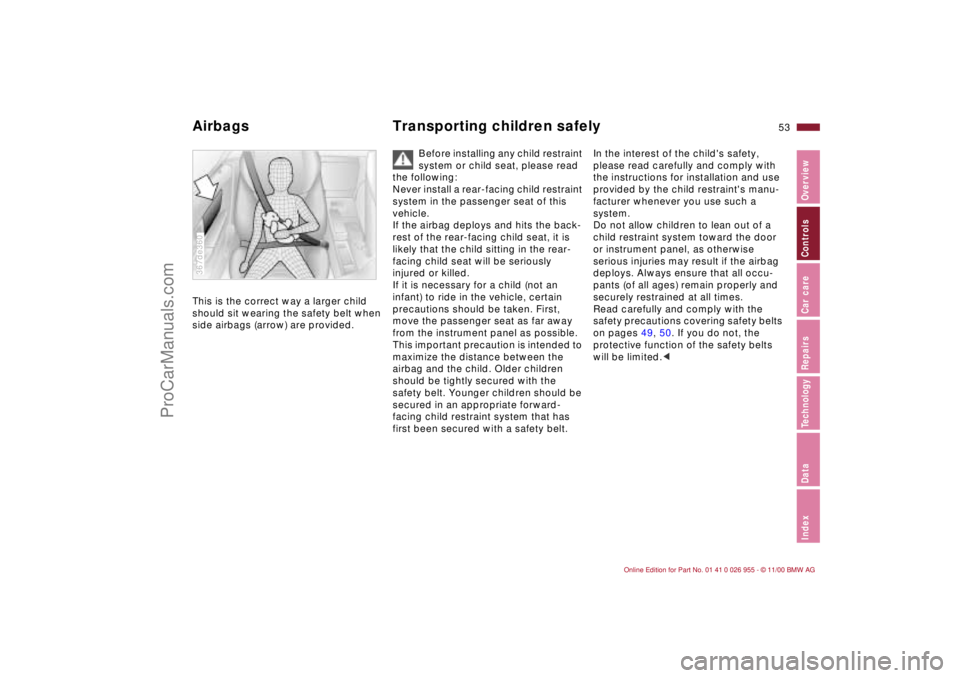
Airbags Transporting children safely This is the correct way a larger child
should sit wearing the safety belt when
side airbags (arrow) are provided.367de360
Before installing any child restraint
system or child seat, please read
the following:
Never install a rear-facing child restraint
system in the passenger seat of this
vehicle.
If the airbag deploys and hits the back-
rest of the rear-facing child seat, it is
likely that the child sitting in the rear-
facing child seat will be seriously
injured or killed.
If it is necessary for a child (not an
infant) to ride in the vehicle, certain
precautions should be taken. First,
move the passenger seat as far away
from the instrument panel as possible.
This important precaution is intended to
maximize the distance between the
airbag and the child. Older children
should be tightly secured with the
safety belt. Younger children should be
secured in an appropriate forward-
facing child restraint system that has
first been secured with a safety belt.
In the interest of the child's safety,
please read carefully and comply with
the instructions for installation and use
provided by the child restraint's manu-
facturer whenever you use such a
system.
Do not allow children to lean out of a
child restraint system toward the door
or instrument panel, as otherwise
serious injuries may result if the airbag
deploys. Always ensure that all occu-
pants (of all ages) remain properly and
securely restrained at all times.
Read carefully and comply with the
safety precautions covering safety belts
on pages 49, 50. If you do not, the
protective function of the safety belts
will be limited.<
ProCarManuals.com
Page 54 of 171
54n
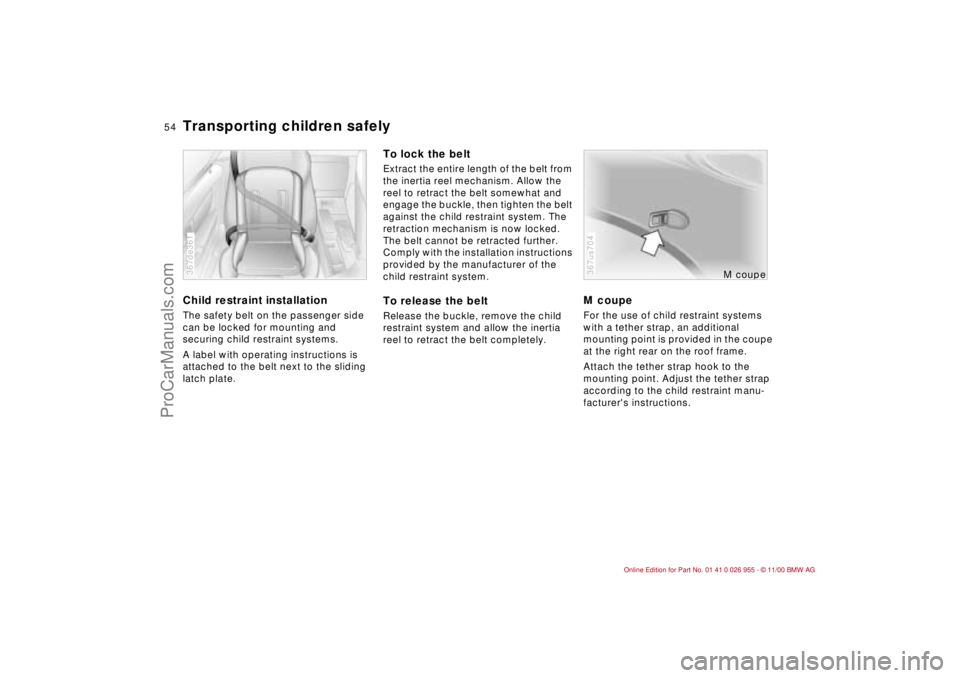
Transporting children safelyChild restraint installationThe safety belt on the passenger side
can be locked for mounting and
securing child restraint systems.
A label with operating instructions is
attached to the belt next to the sliding
latch plate.367de361
To lock the beltExtract the entire length of the belt from
the inertia reel mechanism. Allow the
reel to retract the belt somewhat and
engage the buckle, then tighten the belt
against the child restraint system. The
retraction mechanism is now locked.
The belt cannot be retracted further.
Comply with the installation instructions
provided by the manufacturer of the
child restraint system.To release the beltRelease the buckle, remove the child
restraint system and allow the inertia
reel to retract the belt completely.
M coupeFor the use of child restraint systems
with a tether strap, an additional
mounting point is provided in the coupe
at the right rear on the roof frame.
Attach the tether strap hook to the
mounting point. Adjust the tether strap
according to the child restraint manu-
facturer's instructions.367us704
M coupe
ProCarManuals.com
Page 101 of 171

101n
IndexDataTechnologyRepairsCar careControlsOverview
Wheel and tire combinationsThe right choice
Use only wheels and tires
approved by BMW for the corre-
sponding vehicle model, as otherwise
the tires may make contact with the
body as the result of tolerances despite
the same nominal size being used,
leading to serious accidents. If non-
approved wheels and tires are used,
BMW cannot evaluate their suitability,
and therefore cannot be held liable for
driving safety.<
For wheel and tire specifications
approved by BMW, refer to the informa-
tion on page 103.
The correct wheel and tire combi-
nation affects different systems
such as ABS, DSC and RDW. The func-
tion of these systems is impaired if
improper wheel and tire combinations
are used.
For this reason, use only tires of the
same brand and tread pattern on the
vehicle and, for example, restore the
approved wheel and tire combination
following a flat tire as soon as
possible.<
Codes on tires and wheelsThe code on tires has the following
meaning.
Codes on radial tires:
The speed rating indicates the
approved maximum speed for the tire.
Summer tires:
S = up to 112 mph (180 km/h)
T = up to 118 mph (190 km/h)
H = up to 130 mph (210 km/h)
V = up to 149 mph (240 km/h)
W = up to 167 mph (270 km/h)
Y = up to 186 mph (300 km/h)
ZR = over 149 mph (240 km/h) Example:
Nominal width
in mm
Aspect ratio in %
Belt rating ID code
for radial tires
Wheel diameter in inches
Load rating
(not on ZR tires)
Speed rating
(before R on ZR tires)
205/60 R 15 91 H
All season and winter tires:
Q M+S = up to 100 mph (160 km/h)
T M+S = up to 118 mph (190 km/h)
H M+S = up to 130 mph (210 km/h)
Codes on light-alloy wheels:
Protect valve inserts against dirt by
using screw-on valve caps.
Dirt in the valves frequently leads to
slow leaks.Storage Store tires in a cool, dry place,
protecting them against light whenever
possible. Protect the tires against
contact with oil, grease and fuel. Example:
Rim width
in inches
Code letter for
flange type
Symbol for full-drop
center rim
Rim diameter in inches
Extended hump on
the 2 rim shoulders
7x15EH2
J
ProCarManuals.com
Page 120 of 171

120n
Caring for your vehicleWindow careYou can use window and glass cleaner
to clean inside window surfaces and
mirrors without smearing and streaking.
Never use polishing pastes or abrasive
(quartz) cleansers on mirror lenses!
Clean the wiper blades with soapy
water. The wiper blades should be
replaced twice a year, before and after
the cold season.
Use only wiper blades which have
been approved by BMW.<
Caring for other vehicle
components and materialsLight-alloy wheels should be treated
with alloy wheel cleaner, particularly
during the winter months. Do not use
aggressive products containing acids,
strong alkalis or abrasives. Alloy wheels
should not be cleaned with a steam jet
operating at temperatures in excess of
+140 7 (+60 6). Follow the manufac-
turer's instructions.
If your vehicle is equipped with chromed
parts
* such as window frames, door
handles, etc., clean these parts thor-
oughly with plenty of water and, if they
are exposed to the effects of salt, also
with a shampoo additive. Use chrome
polish for additional treatment.
Plastic components, vinyl upholstery,
the headliners, lamp lenses, the clear
cover of the instrument cluster and
components with a sprayed dull black
surface can be cleaned with water (add
plastic shampoo as required). Do not
allow moisture to soak through the
seats or headliner. Never use solvents
such as lacquer thinner, heavy-duty
grease remover, fuels, etc.
Rubber components should be cleaned
with water only; a rubber treatment or
silicone spray may also be applied.The safety belts should be cleaned with
a mild soap and water solution without
being removed from the vehicle. Never
attempt chemical or dry cleaning, since
this could cause damage to the belt
fabric.
After cleaning, never allow the inertia
reels to retract the belts until they are
completely dry. Dirty safety belts
prevent the inertia reel mechanism from
retracting the strap properly, and thus
constitute a safety hazard.
Heavily soiled floor carpets and mats
*
can be cleaned with an interior cleaner.
The floor mats can be removed from
the vehicle for cleaning.
Please use only a damp cloth to clean
wooden fascia panels and components.
Follow up by drying with a soft cloth.
Use the cleaning and car-care
products that you can obtain at
your BMW center.<
ProCarManuals.com
Page 149 of 171
Overview
Controls and features
Operation, care
and maintenance
Owner service procedures
Technical data
Index Advanced technology
149n
IndexDataTechnologyRepairsCar careControlsOverview
Airbags150
Radio reception150
Dynamic Stability Control
(DSC)151
Safety belt tensioner151
Interior rearview mirror with
automatic dimming
feature152
Limited slip differential153
Technology
ProCarManuals.com
Page 151 of 171
151n
IndexDataTechnologyRepairsCar careControlsOverview
Highly sensitive sensors monitor the
number of revolutions of the wheels,
steering angle, lateral acceleration,
brake pressure and the movement of
the vehicle around its vertical axis.
If differences in wheel revolutions
should occur, the system will recognize
the potential danger this loss of traction
can cause and reduces the drive torque
going to the wheels. The system will
also apply the brakes to all four wheels,
if necessary.
In addition, DSC permanently monitors
the vehicle's current operating condi-
tion and compares it with an ideal
condition that is calculated from the
sensor's signals.
If conditions such as understeering or
oversteering should occur, DSC will
help stabilize the vehicle in fractions of
a second by reducing engine power
output, and applying the brakes to indi-
vidual wheels.
As a result, many dangerous skids can
be prevented even as they are just
beginning, within physically feasible
limits.You may need some time to become
accustomed to this system's interven-
tion. However, it provides optimum
drive force and vehicle stability.
The braking intervention may be
accompanied by a certain degree of
noise.
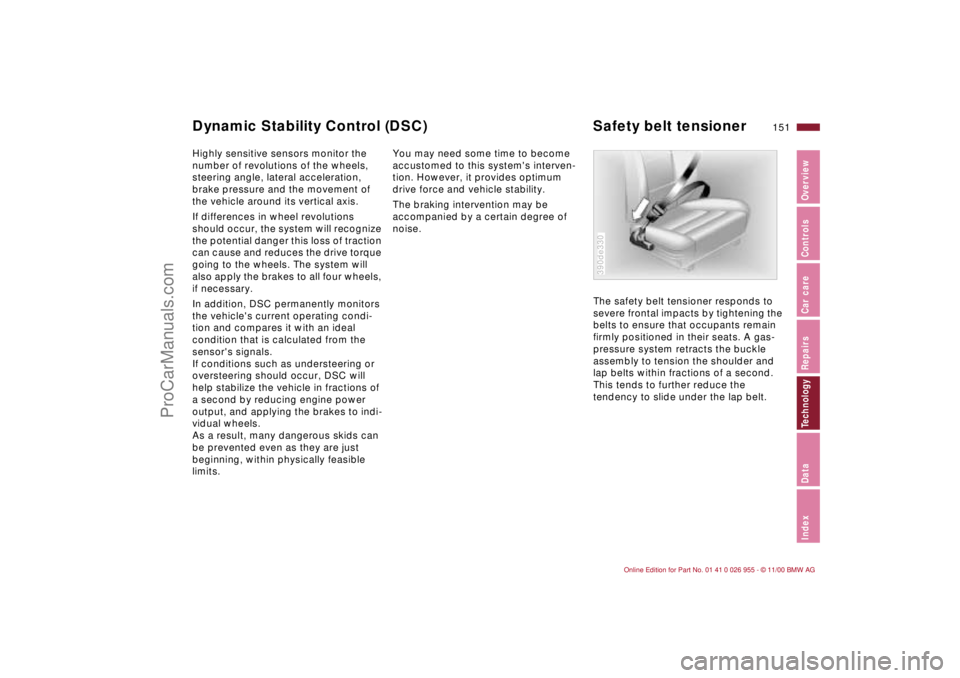
The safety belt tensioner responds to
severe frontal impacts by tightening the
belts to ensure that occupants remain
firmly positioned in their seats. A gas-
pressure system retracts the buckle
assembly to tension the shoulder and
lap belts within fractions of a second.
This tends to further reduce the
tendency to slide under the lap belt.
390de330
Dynamic Stability Control (DSC) Safety belt tensioner
ProCarManuals.com
Page 155 of 171
Overview
Controls and features
Operation, care
and maintenance
Owner service procedures
Technical data
Index Advanced technology
155n
IndexDataTechnologyRepairsCar careControlsOverview
Engine specifications156
Dimensions157
Weights158
Capacities159
Electrical system160
Drive belts160
Data
ProCarManuals.com
Page 160 of 171

160n
Electrical system Drive belts Battery12V, 70 AhSpark plugsNGK DCPR8EKP
This spark ignition system meets all
requirements of the Canadian Interfer-
ence-Causing Equipment Regulations
(ICES-2).AC alternator – Coolant pump –
Power steering
Drive belt 6 PK x 1470
A/C compressor
Drive belt 5 PK x 829You can obtain Original BMW
parts and accessories, as well as
professional advice from your BMW
center.<
ProCarManuals.com
Page 165 of 171

Everything from A to Z
165n
IndexDataTechnologyRepairsCar careControlsOverview
Cigarette lighter80
Cleaning the headlamps60
Cleaning the rear
window60
Cleaning the windshield59
Cockpit16
Code, refer to the Radio
Owner's Manual
Coin box79
Cold start56
Compartments78
Connecting a car vacuum
cleaner80
Controls, cockpit16
Convertible top
care117
electrical defect143t
operation37, 41
weather protection41
Coolant93, 112
antifreeze protection93
Coolant temperature63
Copyright4
Cornering Brake Control
(CBC)90
Cover, convertible
top38, 43
Cruise control61
Cup holder, refer to
beverage holder79
Curb weight158
DDashboard16
Data link connector for
Onboard Diagnostics125
Date, refer to the Radio
Owner's Manual
Daytime running lamps69
Deep water87
Defrost the windows and
remove condensation76
Defrosting
rear window60
mirrors47
Difficult steering94t
Dimensions157
Dipstick, engine oil109
Dirty spots on
paintwork118
Disc brakes91
Displacement156
Display lighting69
Displays18
Disposal
batteries141t
brake fluid113t
engine oil111t
Door key30
Doors
manual operation32
unlocking and locking32
DOT Quality Grades99
Drive belts160Driving notes87
Driving through water87
DSC (Dynamic Stability
Control)65, 151
Dynamic Stability Control
(DSC)65, 151
EElectric convertible top
operation41
Electric power windows35
Electrical defect
convertible top143t
fuel filler door143t
Electrical system160
Electronic immobilizer31
Emergency operation
convertible top143t
doors32t
fuel filler door143t
luggage compartment
lid34t
Engine compartment107
Engine coolant112
adding112t
Engine oil109
adding109t
dipstick109
disposal111t
grades110
level22, 109t
pressure20
viscosity110Engine output156
Engine specifications156
Exterior finish118
FFailure of an electrical
accessory142t
Fan74
Filler cap cover25
Filling the washer
reservoir108t
First-aid kit25
Fittings, tow-starting and
towing145t
Flasher, headlamp58
Flat tire98
Z3 roadster,
Z3 coupe135t
Folding top37
Footbrake91
Front airbags51, 122
Frost protection, radiator93
Fuel26
Fuel filler door
electrical defect143t
emergency
operation143t
Fuel gauge62
Fuel tank capacity159
Fuses142
ProCarManuals.com