steering BMW M ROADSTER COUPE 2001 User Guide
[x] Cancel search | Manufacturer: BMW, Model Year: 2001, Model line: M ROADSTER COUPE, Model: BMW M ROADSTER COUPE 2001Pages: 171, PDF Size: 1.98 MB
Page 83 of 171

83n
IndexDataTechnologyRepairsCar careControlsOverview
Roof-mounted luggage rackA special luggage system is available
for your coupe as an optional acces-
sory. Please comply with the precau-
tions included with the installation
instructions.
Because roof racks raise the center of
gravity of the vehicle when loaded, they
exercise a major effect on its handling
and steering response.
You should therefore always remember
not to exceed the approved roof load
capacity, the approved gross vehicle
weight or the axle loads when loading
the rack. You will find the specifications
for this under "Technical Data" on
page 158.
Make sure that the load is not too large
in size, and distribute it evenly. Always
load the heaviest pieces first (on the
bottom). Be sure that adequate clear-
ance is maintained for raising the
sunroof, and that objects do not project
into the opening path of the luggage
compartment lid.
Lash the roof luggage down correctly
and securely to prevent it from shifting
or being lost during driving – this would
endanger following traffic.Drive smoothly and avoid sudden
acceleration or braking. Do not corner
at high speeds.
The roof load increases the aerody-
namic resistance. Increased fuel
consumption results from this.
ProCarManuals.com
Page 85 of 171
Overview
Controls and features
Operation, care
and maintenance
Owner service procedures
Technical data
Index Advanced technology
85n
IndexDataTechnologyRepairsCar careControlsOverview
Special operating instructions:
Break-in procedure86
Driving notes87
Catalytic converter88
Antilock Brake System (ABS)89
Disc brakes91
Brake system92
Winter operation93
Power steering94
Cellular phone95
Radio reception95
Hardtop – roadster96
Wheels and tires:
Notes on tire inflation
pressure98
Tire condition98
Tire replacement99
Tire rotation100
Wheel and tire
combinations101
Special features of winter
tires102
Snow chains102
Approved wheel and tire
specifications103Under the hood:
Hood104
Engine compartment106
Fluids for the washer
systems108
Washer nozzles108
Engine oil109
Coolant111
Brake fluid112
Vehicle Identification
Number113
Care and maintenance:
The BMW Maintenance
System114
Caring for your vehicle115
Airbags122
Storing your vehicle123
Laws and regulations:
Technical modifications124
California Proposition
65 Warning124
OBD connector125
Car care
ProCarManuals.com
Page 87 of 171

87n
IndexDataTechnologyRepairsCar careControlsOverview
Driving notes
Brakes:
Do not drive with your foot resting
on the brake pedal. Even light but
consistent pedal pressure can lead to
high temperatures, brake wear and
possibly even brake failure.
Aquaplaning:
When driving on wet or slushy roads,
reduce vehicle speed. If you do not, a
wedge of water may form between the
tires and the road surface. This
phenomenon is referred to as aqua-
planing or hydroplaning. It is character-
ized by a partial or complete loss of
contact between the tires and the road
surface. The ultimate results are loss of
steering and braking control.
Driving through water:
When there is water on the roads, do
not drive in it if it is deeper than 1 ft
(30 cm). If the water is at that depth,
drive only at walking speed, otherwise
the vehicle can sustain damage to the
engine, the electrical systems and the
transmission.
Roll-up cover (coupe):
Never use the roll-up cover to store
heavy or bulky objects. If you do so,
such objects could injure vehicle occu-
pants during braking and evasive
maneuvers or in a crash.
Clothes hook (coupe):
Hang items of clothing on the hooks in
such a manner that they do not obstruct
the driver's vision. Do not hang heavy
objects on the hooks. If you do so, they
could cause personal injury during
braking and evasive maneuvers or in
a crash, for example.<
ProCarManuals.com
Page 89 of 171

89n
IndexDataTechnologyRepairsCar careControlsOverview
Antilock Brake System (ABS)The conceptABS increases active safety by
preventing the wheels from locking
when braking. The reason: locked
wheels are dangerous. When the front
wheels slide, the driver loses steering
control over the vehicle. Traction loss at
the rear wheels can cause the rear end
to break into an uncontrolled skid.
The system can achieve the shortest
braking distances possible under most
conditions (on straight-aways, in curves
and on various road surfaces.).
ABS is designed to meet two essential
requirements during every brake appli-
cation:
>To help provide vehicle stability.
>Assured ability to steer and maneuver
on the various road surfaces (asphalt,
concrete, dirt, wet conditions, snow
and ice).
Braking with ABSThe system is operative once the
vehicle exceeds a speed of approx.
6 mph (10 km/h). It is inactive once
again below approx. 4 mph (6 km/h).
Therefore, the wheels could theoreti-
cally tend to lock in the final phase of a
braking action, but this is insignificant in
actual practice.
If you are in a situation which requires
full braking, you will exploit the full
benefits of the ABS system if you apply
maximum brake pressure ("panic stop").
Since the vehicle maintains steering
responsiveness, you can avoid possible
obstacles with a minimum of steering
effort, despite the full brake application.The ABS closed-loop control circuit
cycles in fractions of a second. The
pulsation at the brake pedal, together
with sounds generated by the hydraulic
control system, indicate to you that the
vehicle is approaching its maximum
braking range. It is a reminder to you
that you must adapt the vehicle's road
speed to existing road conditions.
On road surfaces that have a loose
surface layer on a firm base with good
traction (on gravel, deep sand or snow,
for example), braking distances may be
longer than with locked wheels. This
also applies for driving with snow
chains. However, ABS continues to
provide enhanced vehicle stability and
steering response under these condi-
tions.
ProCarManuals.com
Page 90 of 171

90n
Antilock Brake System (ABS)Information for your safetyNot even ABS can suspend the laws
of physics. ABS alone cannot prevent
accidents if the brakes are applied
without an adequate, safe distance
between vehicles or if the speed limit
has been exceeded. Nor can it prevent
the hazards of aquaplaning. Responsi-
bility for these types of situations
remains in the hands (and at the feet) of
the driver. You should never allow the
added safety of ABS to lull you into a
false sense of security, or mislead you
into taking increased risks that could
affect your own safety and that of
others.
Do not make any modifications to
the ABS system.
Service procedures on ABS are to be
performed by authorized technicians
only.< Antilock Brake System (ABS)/
Cornering Brake Control (CBC)CBC is an advanced engineering
feature of the ABS. When braking while
cornering at high speed or braking
during high lateral acceleration, or
when braking during a lane change,
vehicle stability is improved and
steering response is enhanced.
In the event of a malfunction
The ABS warning lamp comes
on, refer to page 22. The brake
system then reverts to conven-
tional operation as on vehicles
without ABS. However, have the
brake system checked by your
BMW center as soon as possible. To
prevent undetected defects and cumu-
lative faults from adversely affecting the
brake system, refer any problems to
your BMW center at the earliest oppor-
tunity.
If the red warning lamp for the
brake hydraulic system comes
on together with the yellow indi-
cator lamps for ABS and DSC
(refer to page 21), the entire
ABS, CBC and DSC control
system has failed. Continue to
drive cautiously and defensively.
Avoid full brake applications
because the vehicle could become
unstable and go out of control.
Have the system checked by your BMW
center as soon as possible.
Warning lamps for Canadian
models.
ProCarManuals.com
Page 91 of 171

91n
IndexDataTechnologyRepairsCar careControlsOverview
Disc brakesDisc brakes furnish optimum decelera-
tion and braking control and greater
fade resistance under heavy use.
When the vehicle is driven only occa-
sionally, during extended periods when
the vehicle is not used at all, or in oper-
ating conditions where brake applica-
tions are less frequent, there is an
increased tendency for corrosion of the
discs and accumulation of contamina-
tion on the brake pads. This occurs
because the minimal pressure which
must be exerted by the pads to clean
the discs by brake applications is not
reached.
If the brake discs are corroded, they will
tend to respond to braking with a
pulsating effect which even extended
application will fail to cure.
For your own safety: use only
brake pads that BMW has
approved for your specific vehicle
model. BMW cannot evaluate non-
approved brake pads to determine if
they are suited for use, and therefore
cannot ensure the operating safety of
the vehicle in the event of their use.<
Driving notesWhile driving in wet conditions and in
heavy rain, it is advisable to apply light
pressure to the brake pedal every few
miles – watch traffic conditions to
ensure that this maneuver does not
endanger other road users. The heat
generated in this braking process helps
dry the brake pads and discs.
Maximum braking force is obtained
while the wheels continue to rotate,
peaking when the wheels remain on the
verge of locking without actually doing
so. ABS maintains this state automati-
cally. If the ABS fails, you should revert
to the staggered braking technique
described on page 94.
Extended or steep mountain descents
should be driven in the gear in which
only minimal periodic brake application
is required. This avoids excessive strain
on the brakes and possible impairment
of the braking effect.
You can increase the engine's braking
effect by selecting progressively lower
gears, downshifting into first gear, if
necessary. Should engine braking prove inade-
quate, you should still avoid extended,
continuous braking. Instead, decelerate
the vehicle with increased pressure on
the brake pedal (watch for following
traffic!), release the pedal and then
repeat the brake application (staggered
braking). This staggered braking tech-
nique allows the brakes to cool in the
intervals between active braking
phases, preventing overheating and
ensuring that full braking capacity
remains available at all times.
Do not drive the vehicle with the
clutch depressed, with the shift
lever in neutral or with the engine shut
off. The engine provides no braking
control when the transmission is in
neutral and there is no power assist for
braking and steering when the engine is
shut off.
Never allow floor mats, carpets or any
other objects to protrude into the area
around the accelerator, clutch and
brake pedals and obstruct their move-
ment.<
ProCarManuals.com
Page 93 of 171

93n
IndexDataTechnologyRepairsCar careControlsOverview
Winter operationThe onset of winter is often accompa-
nied by rapid changes in weather.
Adaptations in driving style should be
accompanied by preparations on the
vehicle itself to ensure that your vehicle
operation through the winter remains
safe and trouble-free.CoolantEnsure that the coolant contains the
year-round 50 : 50 ratio of water and
antifreeze with corrosion inhibitor.
This mixture provides protection
against freezing down to approx.
– 34 7 (– 37 6). Replace the coolant
every three years.LocksBMW door lock deicer can be used to
free the doors if they are frozen. This
deicer also contains lubricant.
After using deicer, treatment with BMW
lock cylinder grease is recommended.
Rubber seals and components In order to prevent freezing, apply BMW
rubber treatment or silicone spray to
weather-stripping on the doors, hood,
luggage compartment and to convert-
ible top seals.
A full range of car-care products is
available from your BMW center.< Snow chainsMount the BMW snow chains
* only in
pairs on the rear wheels only. Comply
with the manufacturer's safety precau-
tions. Do not exceed a speed limit of
30 mph (50 km/h) when driving with
chains. As an exception in this situa-
tion, we recommend that you deacti-
vate the DSC and RDW when snow
chains are mounted. Refer to page 65
or page 67.
Starting offWhen starting from a full stop or
"rocking" free in deep snow, we recom-
mend that you deactivate the DSC
system. Refer to page 65.Driving on low-traction road
surfacesUse smooth, gentle pressure to control
the accelerator pedal. Avoid excessive
engine speeds and shift to the next
higher gear at an early point. Shift down
into the next lowest gear when
approaching uphill or downhill grades.
Maintain an adequate distance between
yourself and the vehicle ahead.Braking Winter road conditions substantially
reduce the traction available between
the tires and the road surface.
Remember that – in every situation –
braking distances will be significantly
longer as a result of this.
ABS is intended to prevent the wheels
from locking during brake applications,
thus helping to maintain vehicle stability
and steering response.
ProCarManuals.com
Page 94 of 171

94n
Winter operation Power steeringIf it should occur that the ABS does not
respond in a critical braking situation
and the wheels lock: reduce the pres-
sure on the brake pedal until the wheels
just start to roll again while still main-
taining enough force to continue
braking. Following that, increase pedal
pressure again. Reduce the pressure as
the wheels lock, then reapply pressure.
Repeat this process.
This type of staggered braking will
lower the braking distance, and the
vehicle still remains responsive to
steering.
You can still attempt to steer around
hazards once you have reduced the
pressure on the brake pedal.
Do not shift down on slick road
surfaces. Doing so could cause
the rear wheels to lose traction and
skid, which could result in the loss of
vehicle control.<
Depress the clutch pedal during
hard braking on road surfaces
which provide only poor or uneven trac-
tion.<
Skid controlDepress the clutch pedal and release
the accelerator pedal. Countersteer
carefully and attempt to regain control
of the vehicle.ParkingEngage 1st or reverse gear. Depending
on the steepness of the incline, you can
apply the parking brake as well. In order
to prevent the parking brake pads from
locking due to frost or corrosion, dry
them by gently applying the parking
brake as the vehicle is coming to a stop.
Make sure that following traffic is not
endangered.
The brake lamps do not light
up when the parking brake is
applied.<
Changes in steering response
(high steering effort, for example):
Consult a BMW center to have the
system checked.
If the power steering fails,
increased effort will be required
to steer the vehicle.<
ProCarManuals.com
Page 98 of 171
98n
Information for your safetyThe factory-approved radial tires are
matched to your vehicle and have been
selected to provide optimum safety and
driving comfort on your vehicle.
In a very real sense, tire life, driving
comfort and your own safety are riding
on correct tire specifications and infla-
tion pressures.
Incorrect inflation pressure is a
frequent cause of tire damage. It
also significantly influences the road-
holding ability of your BMW. Check tire
inflation pressures regularly (refer to
page 26), at least every two weeks and
before you begin an extended journey.
If this is not done, incorrect tire pres-
sures may cause unstable driving, tire
damage and accidents.<
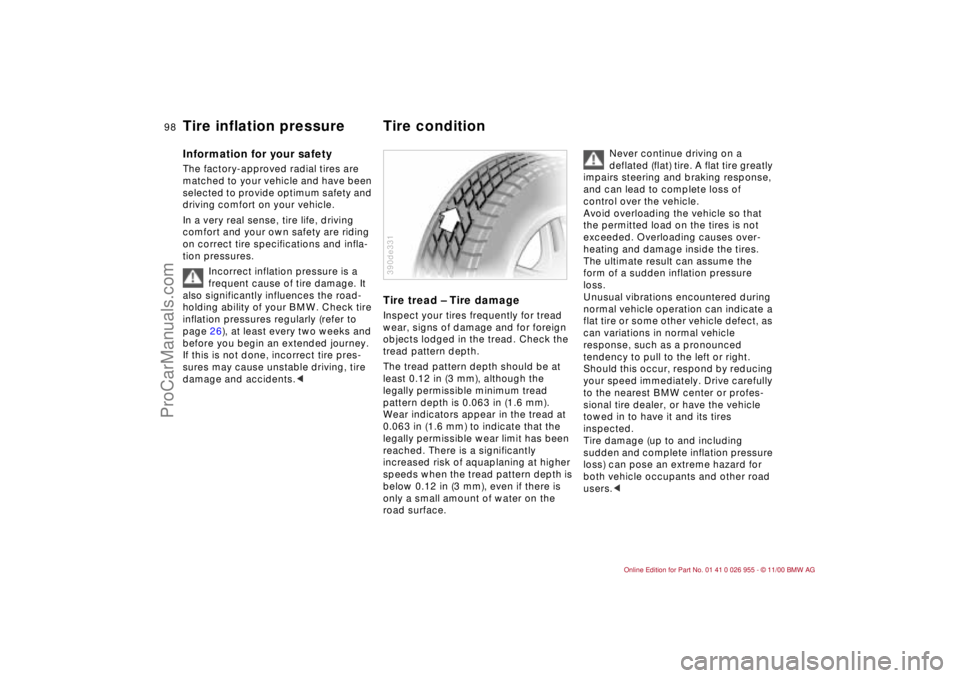
Tire tread – Tire damageInspect your tires frequently for tread
wear, signs of damage and for foreign
objects lodged in the tread. Check the
tread pattern depth.
The tread pattern depth should be at
least 0.12 in (3 mm), although the
legally permissible minimum tread
pattern depth is 0.063 in (1.6 mm).
Wear indicators appear in the tread at
0.063 in (1.6 mm) to indicate that the
legally permissible wear limit has been
reached. There is a significantly
increased risk of aquaplaning at higher
speeds when the tread pattern depth is
below 0.12 in (3 mm), even if there is
only a small amount of water on the
road surface.390de331
Never continue driving on a
deflated (flat) tire. A flat tire greatly
impairs steering and braking response,
and can lead to complete loss of
control over the vehicle.
Avoid overloading the vehicle so that
the permitted load on the tires is not
exceeded. Overloading causes over-
heating and damage inside the tires.
The ultimate result can assume the
form of a sudden inflation pressure
loss.
Unusual vibrations encountered during
normal vehicle operation can indicate a
flat tire or some other vehicle defect, as
can variations in normal vehicle
response, such as a pronounced
tendency to pull to the left or right.
Should this occur, respond by reducing
your speed immediately. Drive carefully
to the nearest BMW center or profes-
sional tire dealer, or have the vehicle
towed in to have it and its tires
inspected.
Tire damage (up to and including
sudden and complete inflation pressure
loss) can pose an extreme hazard for
both vehicle occupants and other road
users.<
Tire inflation pressure Tire condition
ProCarManuals.com
Page 102 of 171

102n
Special features of winter tires Snow chains
*
Choosing the right tireBMW recommends winter tires (M+S
radial tires) for operation under
inclement winter driving conditions.
While so-called all season tires (M+S
designation) provide better winter trac-
tion than summer tires with the load
ratings H, V, W, Y and ZR, they gener-
ally do not achieve the performance of
winter tires.
In the interests of sure tracking and safe
steering response, mount winter tires
which are made by the same manufac-
turer and which have the same tread
pattern at all four wheels.Comply with recommended speed
Never exceed the maximum
speed for which the winter tires
are rated.
Unprofessional attempts by laymen to
service tires can lead to damage and
accidents.
Have this work performed by skilled
professionals only. Any BMW center
has the required technical knowledge
and the proper equipment and will be
happy to assist you.<
Tire condition, tire pressureOnce the tire wears to below 0.16 in
(4 mm), winter tires display a percep-
tible decrease in their ability to cope
with winter driving conditions, and
should be replaced in the interest of
safety.
Comply with the specified tire inflation
pressures – and be sure to have the
wheel and tire assemblies balanced
every time you change the tires.The use of narrow-link BMW snow
chains on winter tires is approved only
in pairs and only on the rear wheels.
Comply with all manufacturer's safety
precautions when mounting the chains.
Deactivate the Tire Pressure
Warning (RDW) when using snow
chains. The snow chains can lead to
malfunction warnings and undetected
losses in pressure.
For further information, refer to
page 67.<
ProCarManuals.com