light BMW M3 CONVERTIBLE 2001 E46 Owner's Guide
[x] Cancel search | Manufacturer: BMW, Model Year: 2001, Model line: M3 CONVERTIBLE, Model: BMW M3 CONVERTIBLE 2001 E46Pages: 195, PDF Size: 1.96 MB
Page 71 of 195
71n
IndexDataTechnologyRepairsCar careControlsOverview
Washer/Wiper system Rear window defroster Cruise control Do not use the washers when the reser-
voir is empty, since this could cause
damage to the washer pump.
When the vehicle's lighting system is
switched on, the headlamps will also be
cleaned every fifth time the automatic
windshield washer is activated.Windshield washer jetsThe windshield washer jets are warmed
automatically when the ignition key is in
position 2.
To activateWith the convertible top closed or the
hardtop
* mounted, press the
button: as
long as the indicator lamp remains on,
the rear window defroster continues at
high output (rapid thaw).
After the indicator lamp goes out, the
defroster continues operating at
reduced power for a limited period
before deactivating automatically.
To deactivatePress the button if the indicator lamp is
on.
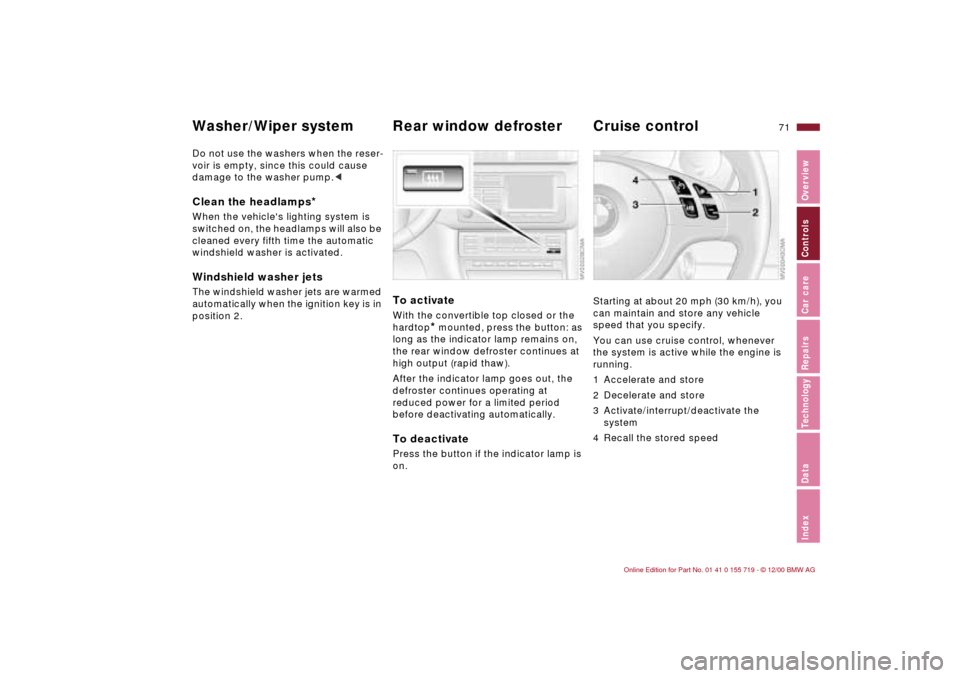
Starting at about 20 mph (30 km/h), you
can maintain and store any vehicle
speed that you specify.
You can use cruise control, whenever
the system is active while the engine is
running.
1 Accelerate and store
2 Decelerate and store
3 Activate/interrupt/deactivate the
system
4 Recall the stored speed
Page 74 of 195
74n
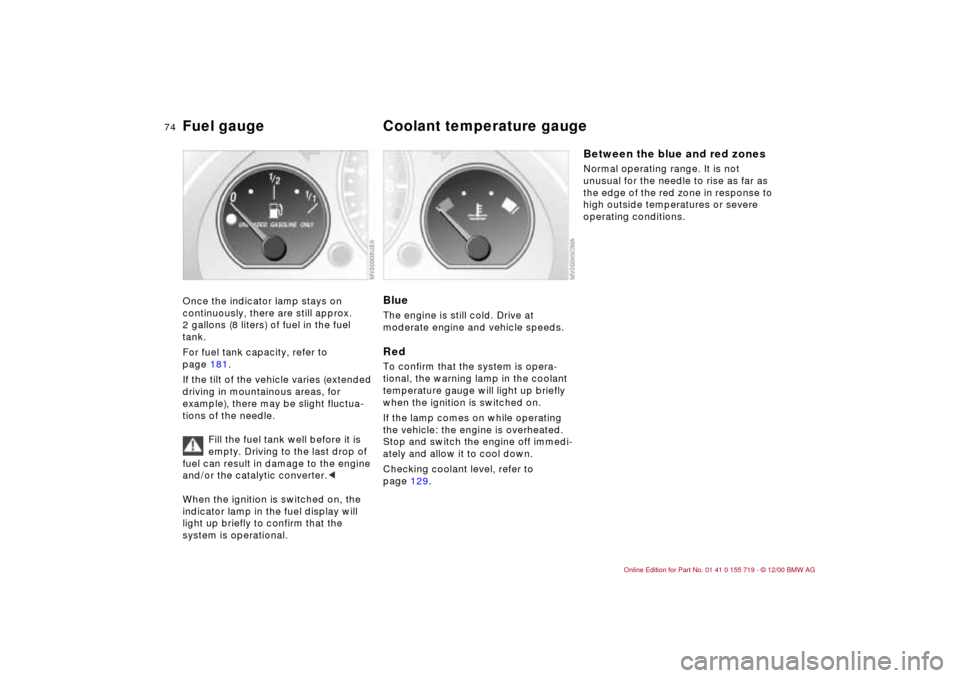
Fuel gauge Coolant temperature gauge Once the indicator lamp stays on
continuously, there are still approx.
2 gallons (8 liters) of fuel in the fuel
tank.
For fuel tank capacity, refer to
page 181.
If the tilt of the vehicle varies (extended
driving in mountainous areas, for
example), there may be slight fluctua-
tions of the needle.
Fill the fuel tank well before it is
empty. Driving to the last drop of
fuel can result in damage to the engine
and/or the catalytic converter.<
When the ignition is switched on, the
indicator lamp in the fuel display will
light up briefly to confirm that the
system is operational.
BlueThe engine is still cold. Drive at
moderate engine and vehicle speeds. RedTo confirm that the system is opera-
tional, the warning lamp in the coolant
temperature gauge will light up briefly
when the ignition is switched on.
If the lamp comes on while operating
the vehicle: the engine is overheated.
Stop and switch the engine off immedi-
ately and allow it to cool down.
Checking coolant level, refer to
page 129.
Between the blue and red zonesNormal operating range. It is not
unusual for the needle to rise as far as
the edge of the red zone in response to
high outside temperatures or severe
operating conditions.
Page 81 of 195
81n
IndexDataTechnologyRepairsCar careControlsOverview
Tire Pressure Warning (RDW)The conceptThe Tire Pressure Warning system
(RDW) monitors the tire inflation pres-
sure in all four tires while driving. The
system is designed to detect whenever
the inflation pressure in a tire drops off
significantly.
By monitoring the speeds of the tires
relative to each other, a flat tire can be
detected and reported because its
speed suddenly deviates drastically
from that of the other tires.
Initializing the systemInitializing is necessary to familiarize the
system with the correct inflation pres-
sure.
Repeat this process after any changes
in tire inflation pressure, tire rotation or
replacement. Do not carry out further
system initialization after correcting the
inflation pressure and letting the system
"learn" what condition is required.
1 Check the tire inflation pressure in all
the tires, comparing them with the
inflation pressure table (page 28),
and adjusting their pressure if neces-
sary
2 Turn the ignition key to position 2
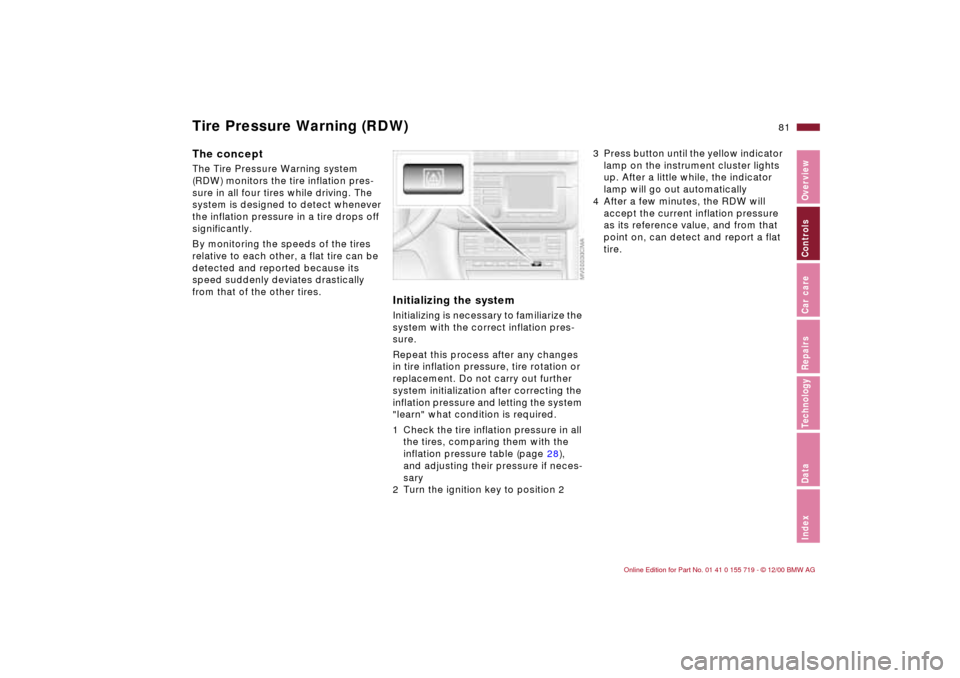
3 Press button until the yellow indicator
lamp on the instrument cluster lights
up. After a little while, the indicator
lamp will go out automatically
4 After a few minutes, the RDW will
accept the current inflation pressure
as its reference value, and from that
point on, can detect and report a flat
tire.
Page 82 of 195
82n
Tire Pressure Warning (RDW)Activating/deactivating the
systemThe system is automatically active in
ignition key position 2 and is therefore
always on during driving.
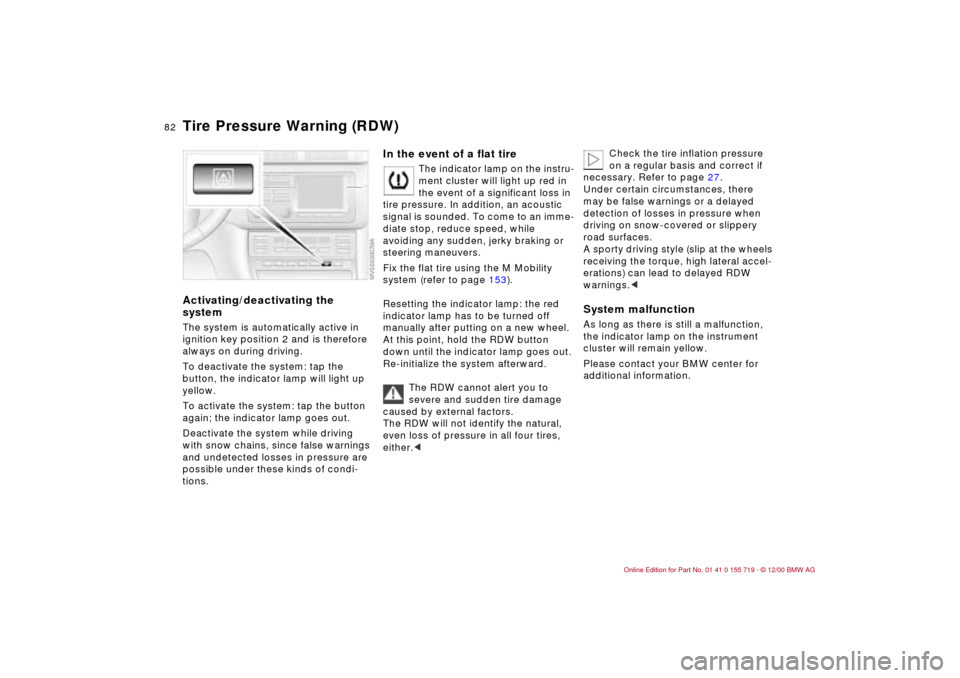
To deactivate the system: tap the
button, the indicator lamp will light up
yellow.
To activate the system: tap the button
again; the indicator lamp goes out.
Deactivate the system while driving
with snow chains, since false warnings
and undetected losses in pressure are
possible under these kinds of condi-
tions.
In the event of a flat tire
The indicator lamp on the instru-
ment cluster will light up red in
the event of a significant loss in
tire pressure. In addition, an acoustic
signal is sounded. To come to an imme-
diate stop, reduce speed, while
avoiding any sudden, jerky braking or
steering maneuvers.
Fix the flat tire using the M Mobility
system (refer to page 153).
Resetting the indicator lamp: the red
indicator lamp has to be turned off
manually after putting on a new wheel.
At this point, hold the RDW button
down until the indicator lamp goes out.
Re-initialize the system afterward.
The RDW cannot alert you to
severe and sudden tire damage
caused by external factors.
The RDW will not identify the natural,
even loss of pressure in all four tires,
either.<
Check the tire inflation pressure
on a regular basis and correct if
necessary. Refer to page 27.
Under certain circumstances, there
may be false warnings or a delayed
detection of losses in pressure when
driving on snow-covered or slippery
road surfaces.
A sporty driving style (slip at the wheels
receiving the torque, high lateral accel-
erations) can lead to delayed RDW
warnings.<
System malfunctionAs long as there is still a malfunction,
the indicator lamp on the instrument
cluster will remain yellow.
Please contact your BMW center for
additional information.
Page 83 of 195
83n
IndexDataTechnologyRepairsCar careControlsOverview
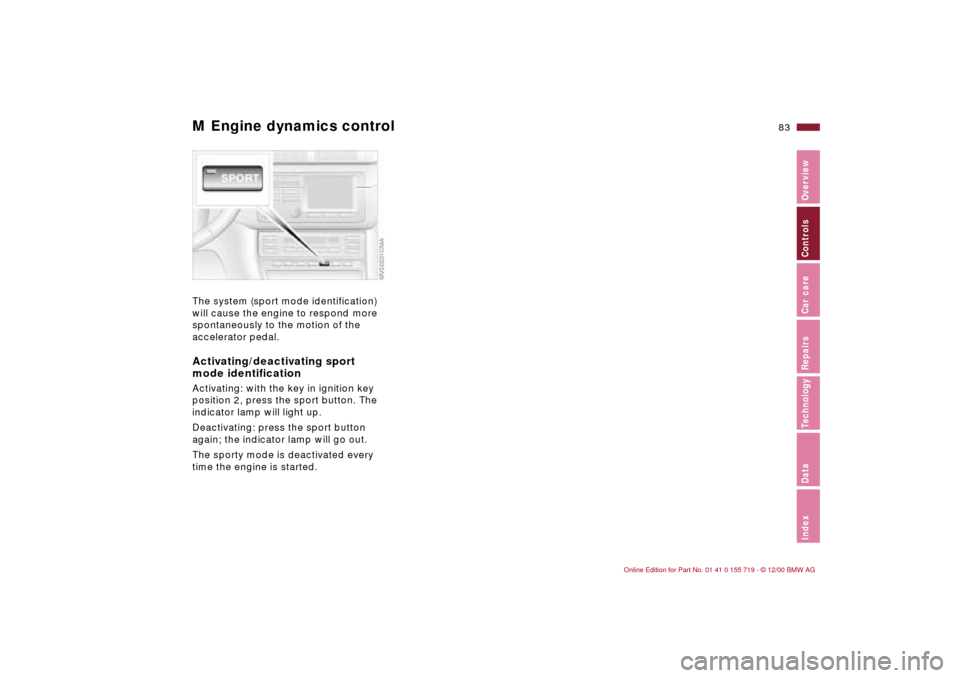
M Engine dynamics controlThe system (sport mode identification)
will cause the engine to respond more
spontaneously to the motion of the
accelerator pedal. Activating/deactivating sport
mode identificationActivating: with the key in ignition key
position 2, press the sport button. The
indicator lamp will light up.
Deactivating: press the sport button
again; the indicator lamp will go out.
The sporty mode is deactivated every
time the engine is started.
Page 84 of 195
84n
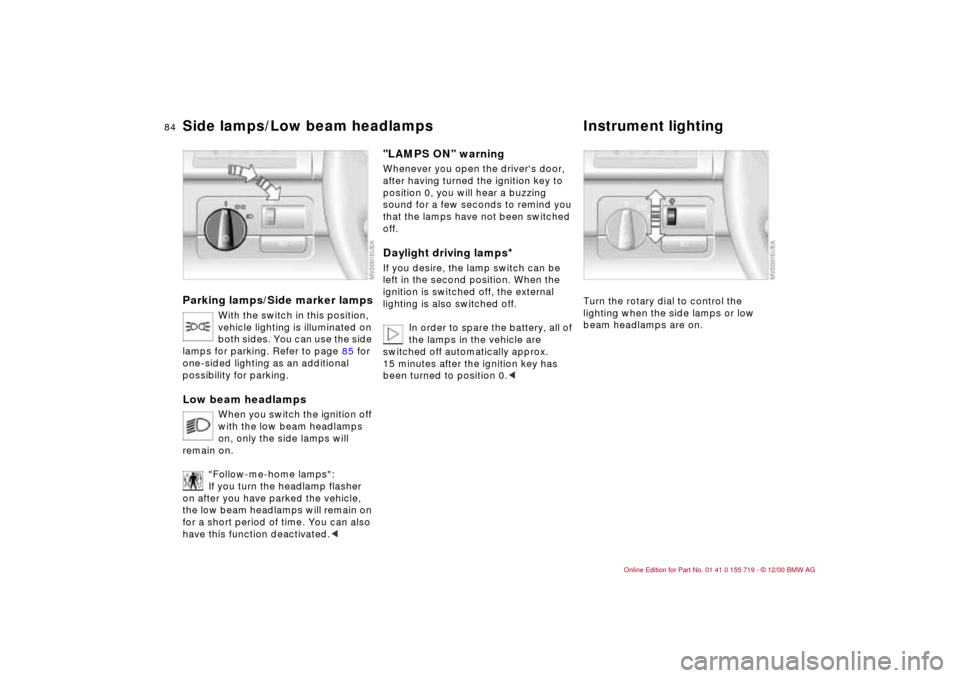
Parking lamps/Side marker lamps
With the switch in this position,
vehicle lighting is illuminated on
both sides. You can use the side
lamps for parking. Refer to page 85 for
one-sided lighting as an additional
possibility for parking.
Low beam headlamps
When you switch the ignition off
with the low beam headlamps
on, only the side lamps will
remain on.
"Follow-me-home lamps":
If you turn the headlamp flasher
on after you have parked the vehicle,
the low beam headlamps will remain on
for a short period of time. You can also
have this function deactivated.<
"LAMPS ON" warningWhenever you open the driver's door,
after having turned the ignition key to
position 0, you will hear a buzzing
sound for a few seconds to remind you
that the lamps have not been switched
off.Daylight driving lamps
*
If you desire, the lamp switch can be
left in the second position. When the
ignition is switched off, the external
lighting is also switched off.
In order to spare the battery, all of
the lamps in the vehicle are
switched off automatically approx.
15 minutes after the ignition key has
been turned to position 0.<
Turn the rotary dial to control the
lighting when the side lamps or low
beam headlamps are on.
Side lamps/Low beam headlamps Instrument lighting
Page 94 of 195
94n
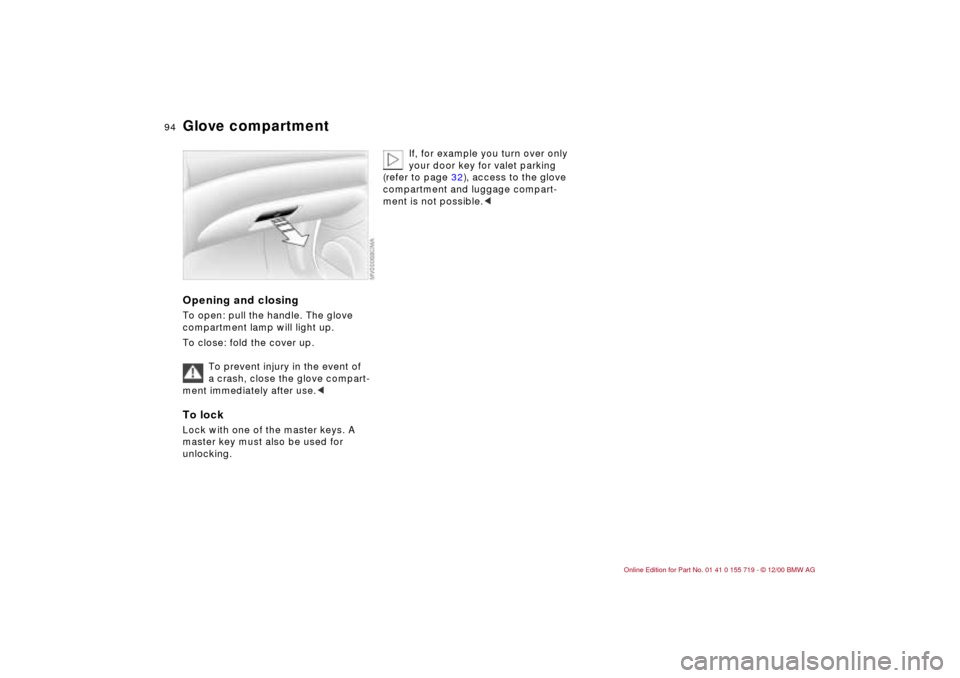
Opening and closingTo open: pull the handle. The glove
compartment lamp will light up.
To close: fold the cover up.
To prevent injury in the event of
a crash, close the glove compart-
ment immediately after use.< To lockLock with one of the master keys. A
master key must also be used for
unlocking.
If, for example you turn over only
your door key for valet parking
(refer to page 32), access to the glove
compartment and luggage compart-
ment is not possible.<
Glove compartment
Page 97 of 195
97n
IndexDataTechnologyRepairsCar careControlsOverview
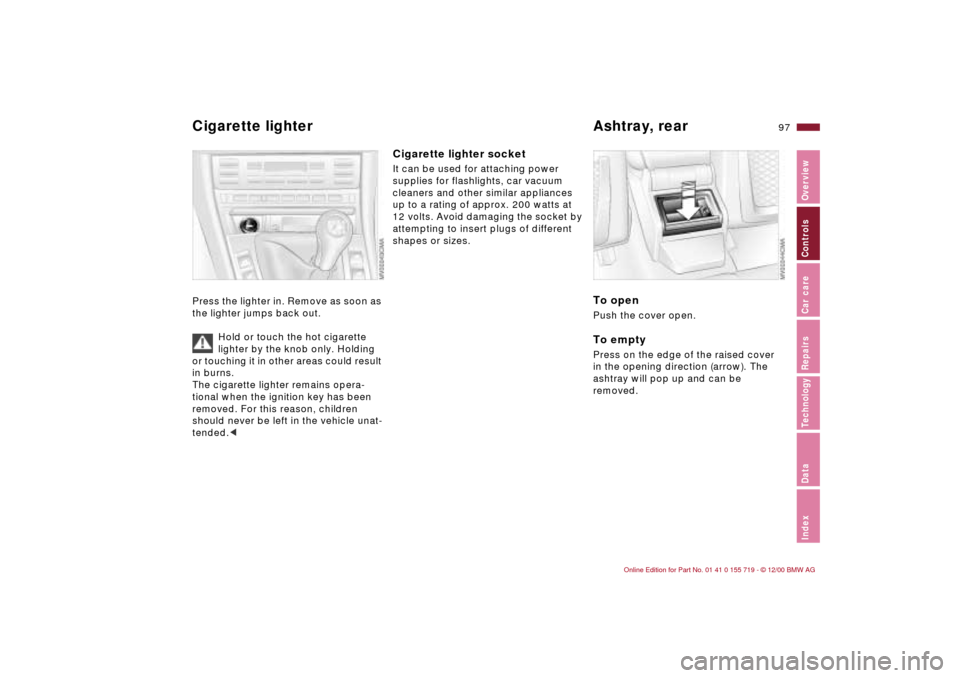
Cigarette lighter Ashtray, rear Press the lighter in. Remove as soon as
the lighter jumps back out.
Hold or touch the hot cigarette
lighter by the knob only. Holding
or touching it in other areas could result
in burns.
The cigarette lighter remains opera-
tional when the ignition key has been
removed. For this reason, children
should never be left in the vehicle unat-
tended.<
Cigarette lighter socketIt can be used for attaching power
supplies for flashlights, car vacuum
cleaners and other similar appliances
up to a rating of approx. 200 watts at
12 volts. Avoid damaging the socket by
attempting to insert plugs of different
shapes or sizes.
To openPush the cover open.To emptyPress on the edge of the raised cover
in the opening direction (arrow). The
ashtray will pop up and can be
removed.
Page 101 of 195
101n
IndexDataTechnologyRepairsCar careControlsOverview
Cargo loading Roof-mounted luggage rack for the hardtop
*
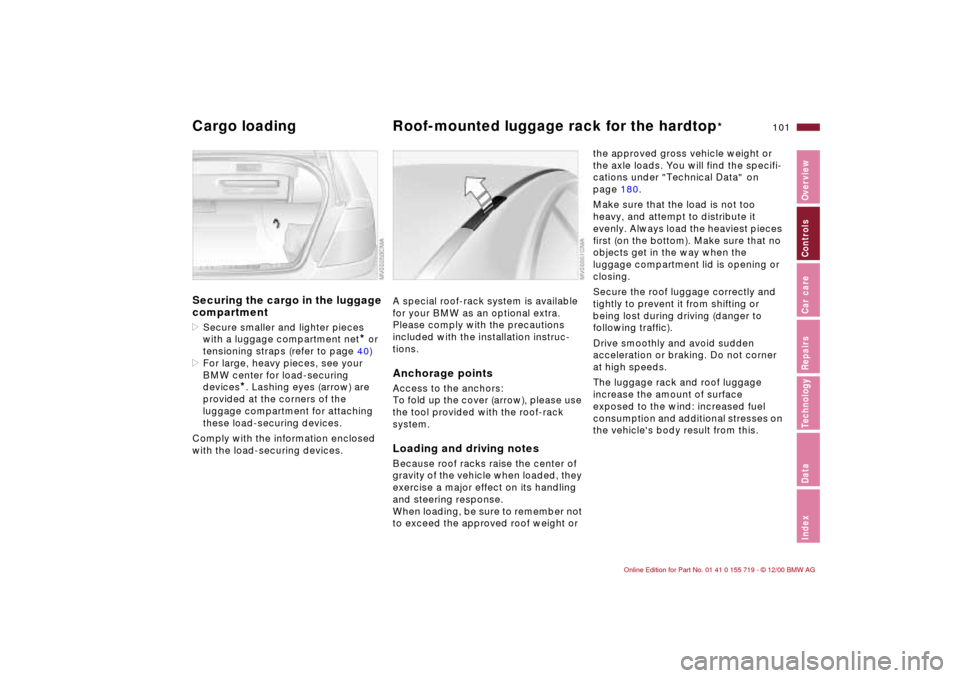
Securing the cargo in the luggage
compartment >Secure smaller and lighter pieces
with a luggage compartment net
* or
tensioning straps (refer to page 40)
>For large, heavy pieces, see your
BMW center for load-securing
devices
*. Lashing eyes (arrow) are
provided at the corners of the
luggage compartment for attaching
these load-securing devices.
Comply with the information enclosed
with the load-securing devices.
A special roof-rack system is available
for your BMW as an optional extra.
Please comply with the precautions
included with the installation instruc-
tions.Anchorage pointsAccess to the anchors:
To fold up the cover (arrow), please use
the tool provided with the roof-rack
system.Loading and driving notesBecause roof racks raise the center of
gravity of the vehicle when loaded, they
exercise a major effect on its handling
and steering response.
When loading, be sure to remember not
to exceed the approved roof weight or
the approved gross vehicle weight or
the axle loads. You will find the specifi-
cations under "Technical Data" on
page 180.
Make sure that the load is not too
heavy, and attempt to distribute it
evenly. Always load the heaviest pieces
first (on the bottom). Make sure that no
objects get in the way when the
luggage compartment lid is opening or
closing.
Secure the roof luggage correctly and
tightly to prevent it from shifting or
being lost during driving (danger to
following traffic).
Drive smoothly and avoid sudden
acceleration or braking. Do not corner
at high speeds.
The luggage rack and roof luggage
increase the amount of surface
exposed to the wind: increased fuel
consumption and additional stresses on
the vehicle's body result from this.
Page 104 of 195

104n
To ensure that your vehicle continues to
provide maximum economy throughout
an extended service life, we request
that you devote careful attention to the
following section.
Your BMW M3 convertible is a
masterpiece of superlative tech-
nology. To create the basis for many
years of driving pleasure, we urge you
to observe the following precautions
during the initial operation period.<
Engine and differential>Up to 1,200 miles (2,000 km): drive at
varying engine and road speeds, but
do not exceed the following engine or
road speeds: 5,500 rpm or 105 mph
(170 km/h)
Do not depress the accelerator pedal to
the full throttle position.
>Following the Break-In Inspection at
1,200 miles (2,000 km), you can
gradually increase engine or road
speeds.
Follow the same break-in procedure if
either the engine or the differential is
replaced in the future.
TiresDue to technical factors associated
with their manufacture, tires do not
achieve their full traction potential until
after an initial break-in period. You
should therefore drive with extra care
during the initial 200 miles (300 km).
Obey your local and state maximum
speed limits.
When the vehicle is operated on
wet or slushy roads, a wedge of
water may form between the tire and
the road surface. This phenomenon is
referred to as aquaplaning, or hydro-
planing, and can lead to partial or
complete loss of traction, vehicle
control and braking effectiveness.
Reduce your speed on wet roads.<
Brake systemApproximately 300 miles ( 500 km) must
elapse before the brake pads and discs
achieve the optimal pad-surface and
wear patterns required for troublefree
operation and long service life later on.
To break-in the separate parking brake
drums, apply the parking brake lightly
when coasting to a standstill (at a traffic
signal, for instance), provided that
traffic conditions allow you to do so. To
avoid corrosion, repeat this procedure
from time to time.
The brake lamps do not come on
when the parking brake is
engaged.
Vacuum for the brake system servo unit
on your BMW is available only when the
engine is running. When you move the
vehicle with the engine off – when
towing, for example – substantially
higher levels of pedal force will be
required to brake the vehicle.
(500 km). Drive cautiously during this
break-in period and do not shift at high
engine speeds.
Break-in procedures