light BMW M3 CONVERTIBLE 2001 E46 User Guide
[x] Cancel search | Manufacturer: BMW, Model Year: 2001, Model line: M3 CONVERTIBLE, Model: BMW M3 CONVERTIBLE 2001 E46Pages: 195, PDF Size: 1.96 MB
Page 46 of 195
46n
Convertible topKeep children away from the travel path
of the convertible top while it is in
motion.<
To close the electric power
windows while driving, always be
sure to first close either the rear
windows, or all 4 windows at the same
time, otherwise, at high speed, the
windows may not close tightly.<
At higher speeds, the ensuing
vacuum in the passenger
compartment can cause the convertible
top to begin fluttering. Increase the air
supply via the ventilation controls so
that a vacuum does not occur in the
vehicle.<
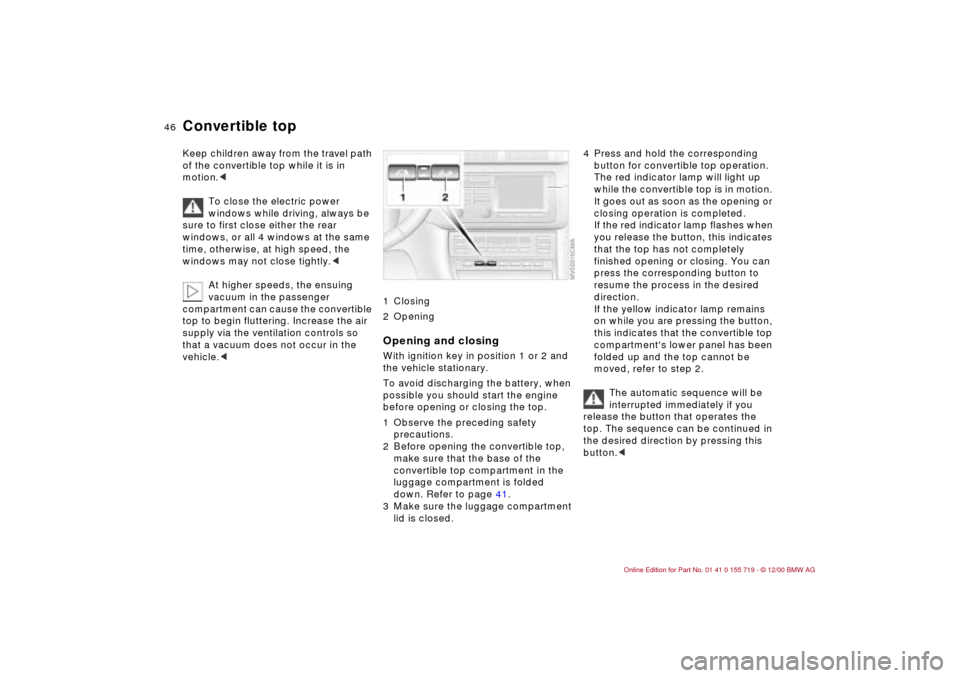
1 Closing
2 OpeningOpening and closingWith ignition key in position 1 or 2 and
the vehicle stationary.
To avoid discharging the battery, when
possible you should start the engine
before opening or closing the top.
1 Observe the preceding safety
precautions.
2 Before opening the convertible top,
make sure that the base of the
convertible top compartment in the
luggage compartment is folded
down. Refer to page 41.
3 Make sure the luggage compartment
lid is closed.
4 Press and hold the corresponding
button for convertible top operation.
The red indicator lamp will light up
while the convertible top is in motion.
It goes out as soon as the opening or
closing operation is completed.
If the red indicator lamp flashes when
you release the button, this indicates
that the top has not completely
finished opening or closing. You can
press the corresponding button to
resume the process in the desired
direction.
If the yellow indicator lamp remains
on while you are pressing the button,
this indicates that the convertible top
compartment's lower panel has been
folded up and the top cannot be
moved, refer to step 2.
The automatic sequence will be
interrupted immediately if you
release the button that operates the
top. The sequence can be continued in
the desired direction by pressing this
button.<
Page 47 of 195

47n
IndexDataTechnologyRepairsCar careControlsOverview
Convertible top
During convertible top operation
the rear window moves toward the
passenger compartment and presses
the heads of the rear passengers
slightly forward. As a rule, this is not
dangerous. To avoid possibly being
pinched, passengers in the back seat
should lean their heads slightly forward
while the convertible top is in motion.<
The side windows move downward
somewhat when the button for convert-
ible top operation is pressed, and then
up again after the opening or closing
operation is completed if you continue
to hold the button for longer than
2 seconds after the indicator lamp goes
out.
During convertible top operation the
luggage compartment lid cannot be
opened.
Do not close the side power
windows using the buttons if the
convertible top has been interrupted
while in motion. <
If the convertible top has been
stored in the convertible top
compartment for longer periods, e.g.
during the winter months while the
hardtop is being used, it may be neces-
sary to manually support the first auto-
matic closing operation: if the
convertible top should halt just before
the closing phase is completed, press
against the front part of the convertible
top frame from the outside to help the
closing process along. Keep pressing
the button while doing so until the top
starts up again on its own.<
If the opening or closing operation
is interrupted, the convertible top
remains in the respective position for
15 minutes, and the process can be
continued in the desired direction with
the button. Then the convertible top
can be moved and operated manually,
refer to page 162. This is also possible
in ignition key position 0.
In certain cases, the luggage compart-
ment lid cannot be opened if the
opening or closing operation has been
interrupted.<
One-touch operation from the
driver side door lockRefer to page 34.
Page 48 of 195
48n
For your personal safety when adjusting
the seat position, please follow the
instructions below carefully:
Never try to adjust your seat while
driving the vehicle. The seat could
respond with an unexpected move-
ment, and the ensuing loss of vehicle
control could lead to an accident.
Be sure that the safety belt remains
firmly against your body at all times. In
the event of a frontal impact, a loose lap
belt could slide over the hips, leading to
abdominal injury. In addition, the safety
belt's restraint effectiveness is reduced
if the belt is worn loosely.
Never ride with the backrest reclined to
an extreme angle (especially important
for the front passenger to remember). If
you do so, there is a risk that you will
slide under the safety belt in an acci-
dent, thus reducing the protection
provided by the safety belt.<
Correct sitting posture To reduce strain on the spinal column,
sit all the way back in the seat and rest
your back fully against the backrest.
The ideal sitting posture is achieved
with your head extending from your
spine in a straight line.
For long-distance driving, you may wish
to increase the backrest tilt angle
slightly to reduce muscular tension. You
should be able to grasp the steering
wheel at its highest point with your
arms slightly bent.
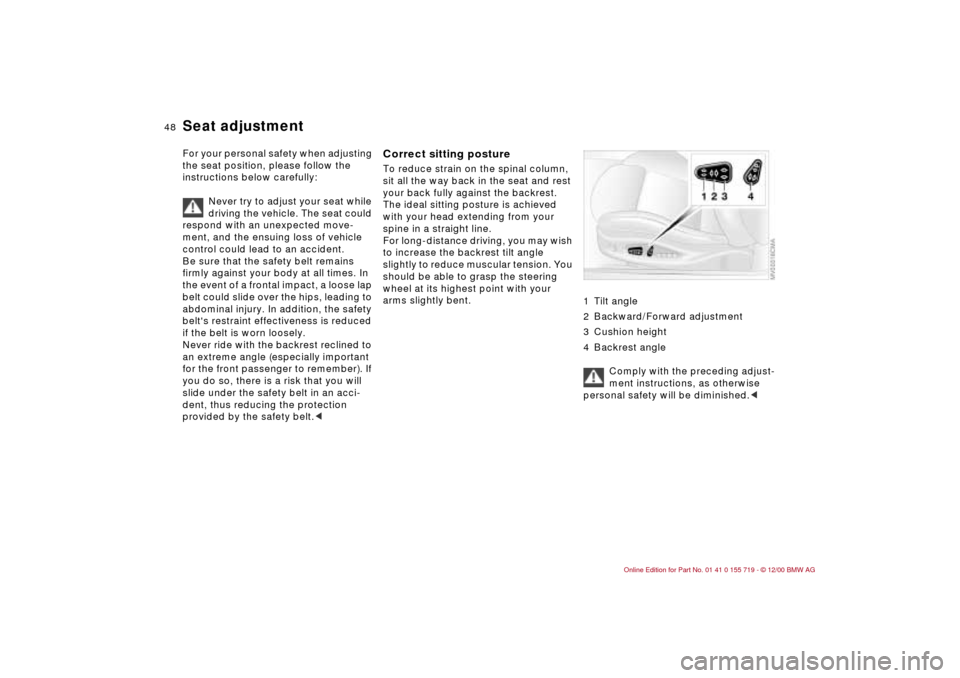
1 Tilt angle
2 Backward/Forward adjustment
3 Cushion height
4 Backrest angle
Comply with the preceding adjust-
ment instructions, as otherwise
personal safety will be diminished.<
Seat adjustment
Page 53 of 195
53n
IndexDataTechnologyRepairsCar careControlsOverview
MirrorsInterior rearview mirror with
automatic dimming featureBy responding to the effects of ambient
light and the glare from following traffic,
this mirror automatically dims through
an infinitely variable range.
The mirror switches to its clear,
undimmed mode whenever you shift
into reverse.
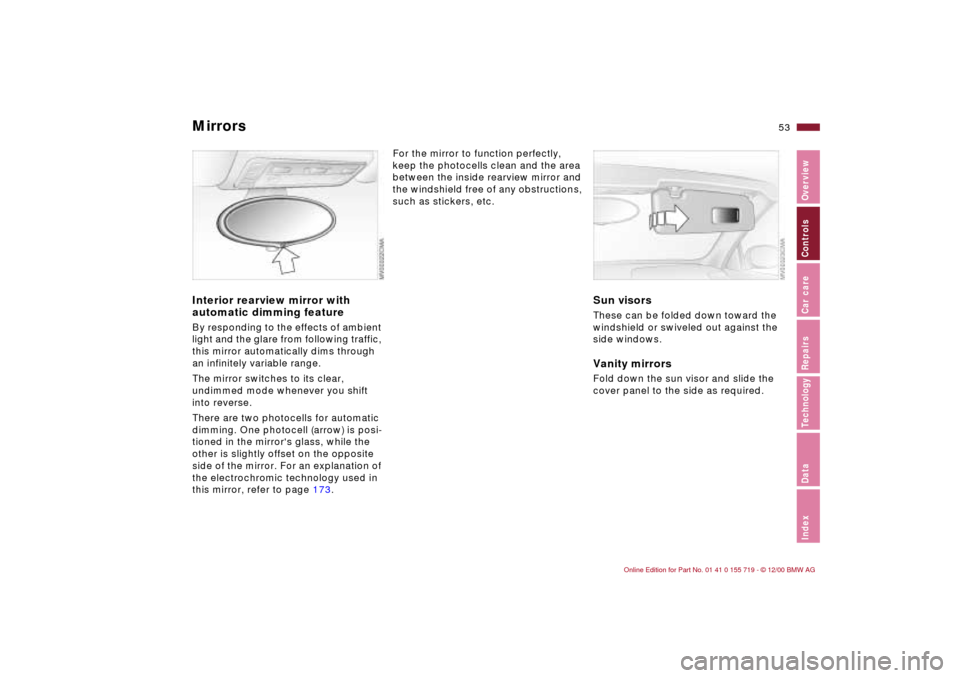
There are two photocells for automatic
dimming. One photocell (arrow) is posi-
tioned in the mirror's glass, while the
other is slightly offset on the opposite
side of the mirror. For an explanation of
the electrochromic technology used in
this mirror, refer to page 173.
For the mirror to function perfectly,
keep the photocells clean and the area
between the inside rearview mirror and
the windshield free of any obstructions,
such as stickers, etc.
Sun visorsThese can be folded down toward the
windshield or swiveled out against the
side windows.Vanity mirrors Fold down the sun visor and slide the
cover panel to the side as required.
Page 54 of 195
54n
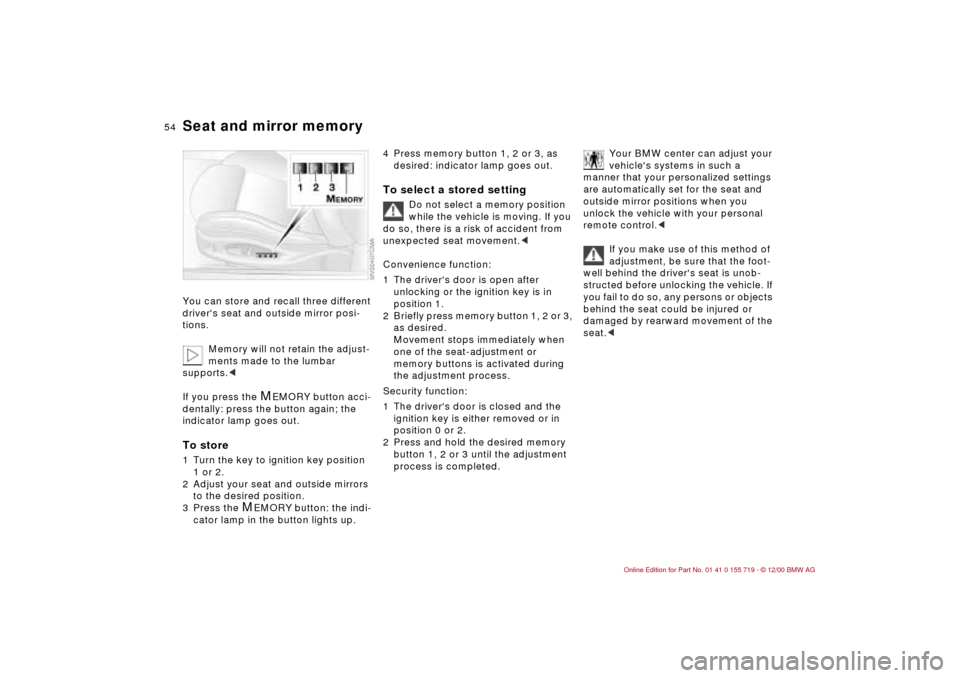
Seat and mirror memoryYou can store and recall three different
driver's seat and outside mirror posi-
tions.
Memory will not retain the adjust-
ments made to the lumbar
supports.<
If you press the
M
EMORY button acci-
dentally: press the button again; the
indicator lamp goes out.
To store1 Turn the key to ignition key position
1 or 2.
2 Adjust your seat and outside mirrors
to the desired position.
3 Press the
M
EMORY button: the indi-
cator lamp in the button lights up.
4 Press memory button 1, 2 or 3, as
desired: indicator lamp goes out.To select a stored setting
Do not select a memory position
while the vehicle is moving. If you
do so, there is a risk of accident from
unexpected seat movement.<
Convenience function:
1 The driver's door is open after
unlocking or the ignition key is in
position 1.
2 Briefly press memory button 1, 2 or 3,
as desired.
Movement stops immediately when
one of the seat-adjustment or
memory buttons is activated during
the adjustment process.
Security function:
1 The driver's door is closed and the
ignition key is either removed or in
position 0 or 2.
2 Press and hold the desired memory
button 1, 2 or 3 until the adjustment
process is completed.
Your BMW center can adjust your
vehicle's systems in such a
manner that your personalized settings
are automatically set for the seat and
outside mirror positions when you
unlock the vehicle with your personal
remote control.<
If you make use of this method of
adjustment, be sure that the foot-
well behind the driver's seat is unob-
structed before unlocking the vehicle. If
you fail to do so, any persons or objects
behind the seat could be injured or
damaged by rearward movement of the
seat.<
Page 55 of 195
55n
IndexDataTechnologyRepairsCar careControlsOverview
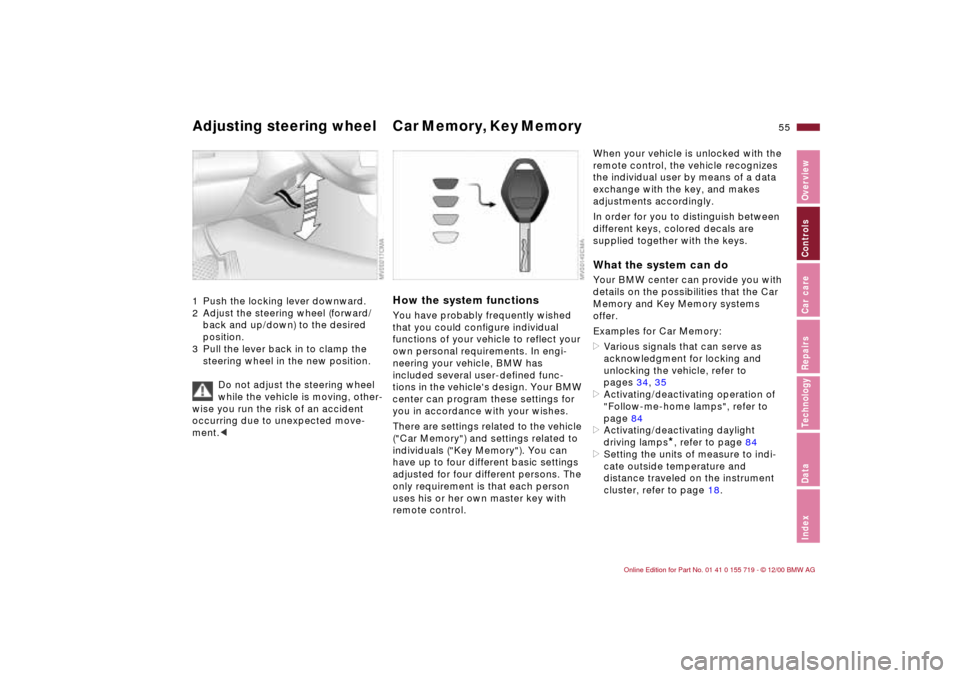
Adjusting steering wheel Car Memory, Key Memory 1 Push the locking lever downward.
2 Adjust the steering wheel (forward/
back and up/down) to the desired
position.
3 Pull the lever back in to clamp the
steering wheel in the new position.
Do not adjust the steering wheel
while the vehicle is moving, other-
wise you run the risk of an accident
occurring due to unexpected move-
ment.<
How the system functionsYou have probably frequently wished
that you could configure individual
functions of your vehicle to reflect your
own personal requirements. In engi-
neering your vehicle, BMW has
included several user-defined func-
tions in the vehicle's design. Your BMW
center can program these settings for
you in accordance with your wishes.
There are settings related to the vehicle
("Car Memory") and settings related to
individuals ("Key Memory"). You can
have up to four different basic settings
adjusted for four different persons. The
only requirement is that each person
uses his or her own master key with
remote control.
When your vehicle is unlocked with the
remote control, the vehicle recognizes
the individual user by means of a data
exchange with the key, and makes
adjustments accordingly.
In order for you to distinguish between
different keys, colored decals are
supplied together with the keys.What the system can doYour BMW center can provide you with
details on the possibilities that the Car
Memory and Key Memory systems
offer.
Examples for Car Memory:
>Various signals that can serve as
acknowledgment for locking and
unlocking the vehicle, refer to
pages 34, 35
>Activating/deactivating operation of
"Follow-me-home lamps", refer to
page 84
>Activating/deactivating daylight
driving lamps
*, refer to page 84
>Setting the units of measure to indi-
cate outside temperature and
distance traveled on the instrument
cluster, refer to page 18.
Page 61 of 195
61n
IndexDataTechnologyRepairsCar careControlsOverview
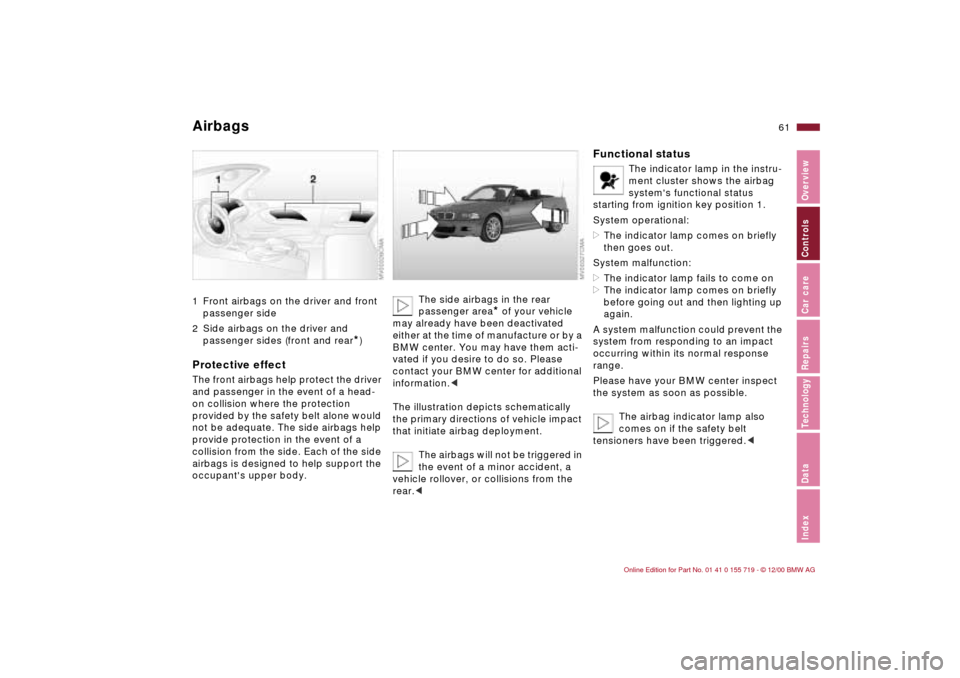
Airbags 1 Front airbags on the driver and front
passenger side
2 Side airbags on the driver and
passenger sides (front and rear
*)
Protective effectThe front airbags help protect the driver
and passenger in the event of a head-
on collision where the protection
provided by the safety belt alone would
not be adequate. The side airbags help
provide protection in the event of a
collision from the side. Each of the side
airbags is designed to help support the
occupant's upper body.
The side airbags in the rear
passenger area
* of your vehicle
may already have been deactivated
either at the time of manufacture or by a
BMW center. You may have them acti-
vated if you desire to do so. Please
contact your BMW center for additional
information.<
The illustration depicts schematically
the primary directions of vehicle impact
that initiate airbag deployment.
The airbags will not be triggered in
the event of a minor accident, a
vehicle rollover, or collisions from the
rear.<
Functional status
The indicator lamp in the instru-
ment cluster shows the airbag
system's functional status
starting from ignition key position 1.
System operational:
>The indicator lamp comes on briefly
then goes out.
System malfunction:
>The indicator lamp fails to come on
>The indicator lamp comes on briefly
before going out and then lighting up
again.
A system malfunction could prevent the
system from responding to an impact
occurring within its normal response
range.
Please have your BMW center inspect
the system as soon as possible.
The airbag indicator lamp also
comes on if the safety belt
tensioners have been triggered.<
Page 66 of 195
66n
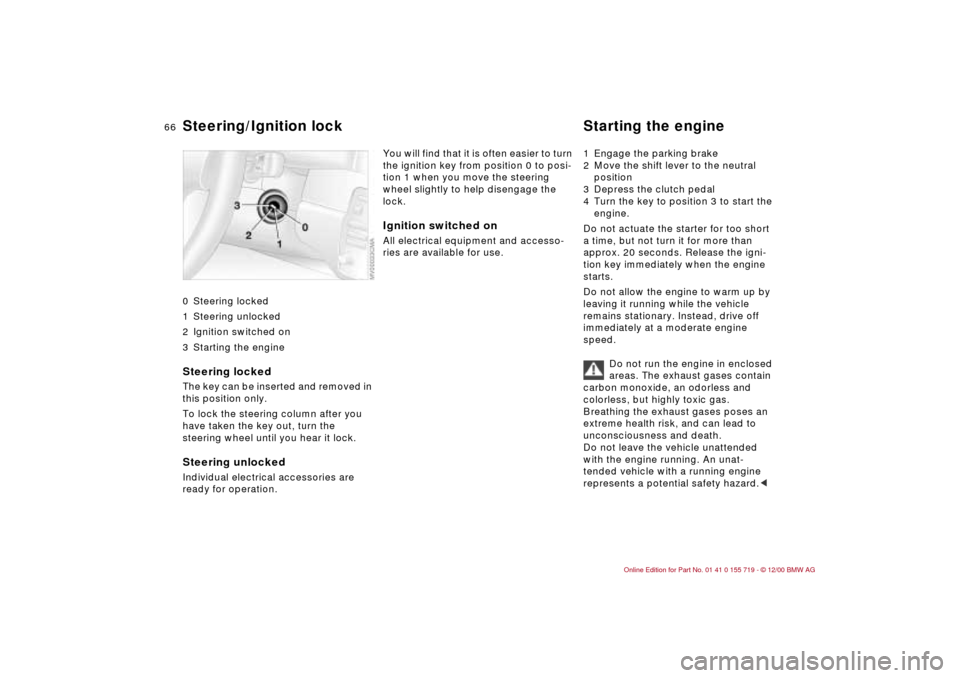
0 Steering locked
1 Steering unlocked
2 Ignition switched on
3 Starting the engine
Steering locked The key can be inserted and removed in
this position only.
To lock the steering column after you
have taken the key out, turn the
steering wheel until you hear it lock.Steering unlocked Individual electrical accessories are
ready for operation.
You will find that it is often easier to turn
the ignition key from position 0 to posi-
tion 1 when you move the steering
wheel slightly to help disengage the
lock. Ignition switched onAll electrical equipment and accesso-
ries are available for use. 1 Engage the parking brake
2 Move the shift lever to the neutral
position
3 Depress the clutch pedal
4 Turn the key to position 3 to start the
engine.
Do not actuate the starter for too short
a time, but not turn it for more than
approx. 20 seconds. Release the igni-
tion key immediately when the engine
starts.
Do not allow the engine to warm up by
leaving it running while the vehicle
remains stationary. Instead, drive off
immediately at a moderate engine
speed.
Do not run the engine in enclosed
areas. The exhaust gases contain
carbon monoxide, an odorless and
colorless, but highly toxic gas.
Breathing the exhaust gases poses an
extreme health risk, and can lead to
unconsciousness and death.
Do not leave the vehicle unattended
with the engine running. An unat-
tended vehicle with a running engine
represents a potential safety hazard.<
Steering/Ignition lock Starting the engine
Page 67 of 195
67n
IndexDataTechnologyRepairsCar careControlsOverview
Starting the engine Switching off the engine Parking brake If the engine does not start on the first
attempt (if it is very hot or cold, for
instance):
>Press the accelerator pedal halfway
down while engaging the starter.
Cold starts at very low temperatures,
starting at approx. 5 7 (–15 6) and at
high altitudes (over 1,000 meters):
>On the first start attempt, engage the
starter for a longer period (approx.
10 seconds)
>Press the accelerator pedal halfway
down while engaging the starter.
Engine idle speed is controlled by the
engine computer system. Increased
speeds at startup are normal and
should decrease as the engine warms
up. If engine speed does not decrease,
service is required.
To prevent the battery from
discharging, always deactivate elec-
trical devices that are not in use. Switch
the ignition off when the vehicle is not
being driven.Turn the ignition key to position 1 or 0.
Do not remove the ignition key
while the vehicle is still moving.
If you did so, the steering lock would
engage when the steering wheel is
turned.
When you leave the vehicle, always
remove the ignition key and engage the
steering lock.
Set the parking brake when parking on
steep hills, because under certain
conditions, putting the vehicle into first
or reverse gear may not be enough to
prevent it from rolling away.
The power assist is not available when
the engine is not on. This means that
more effort is required for braking.<
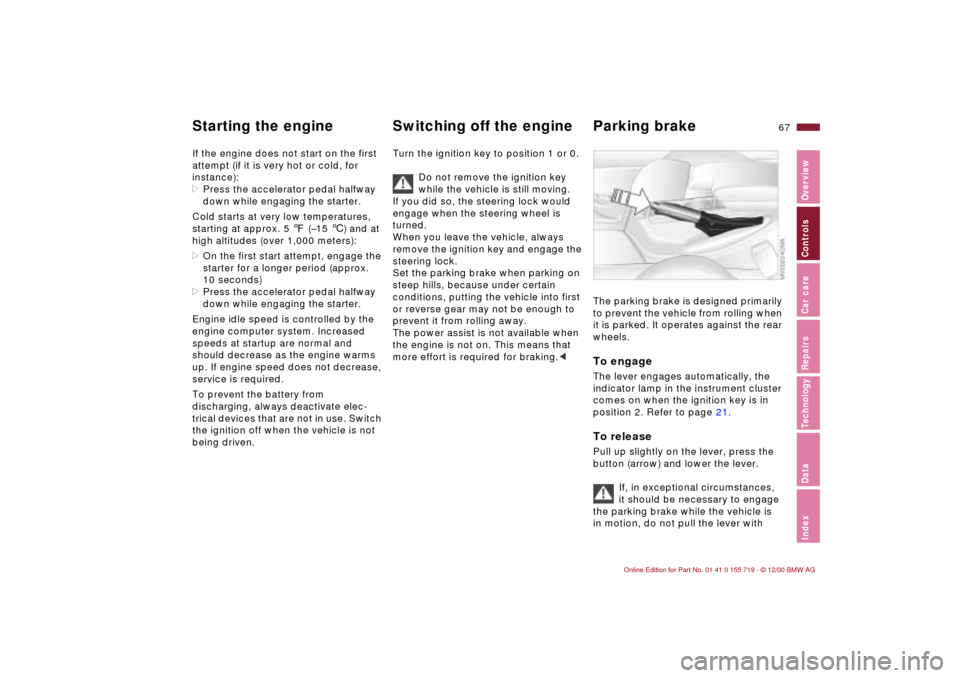
The parking brake is designed primarily
to prevent the vehicle from rolling when
it is parked. It operates against the rear
wheels. To engageThe lever engages automatically, the
indicator lamp in the instrument cluster
comes on when the ignition key is in
position 2. Refer to page 21.To releasePull up slightly on the lever, press the
button (arrow) and lower the lever.
If, in exceptional circumstances,
it should be necessary to engage
the parking brake while the vehicle is
in motion, do not pull the lever with
Page 68 of 195
68n
Parking brake Manual transmission excessive pressure. Keep your thumb
pressed against the release button
while carefully pulling up the lever to
apply moderate pressure.
Excessive pressure can lead to over-
braking and loss of traction (fishtailing)
at the rear axle.
The brake lamps do not come on when
the parking brake is engaged.
Set the parking brake when parking on
steep hills, because under certain
conditions, putting the vehicle into first
or reverse gear may not be enough to
prevent it from rolling away.<
To avoid corrosion and one-sided
braking, apply the parking brake lightly
from time to time when coasting to a
standstill (at a traffic signal, for
instance), provided that it is safe to do
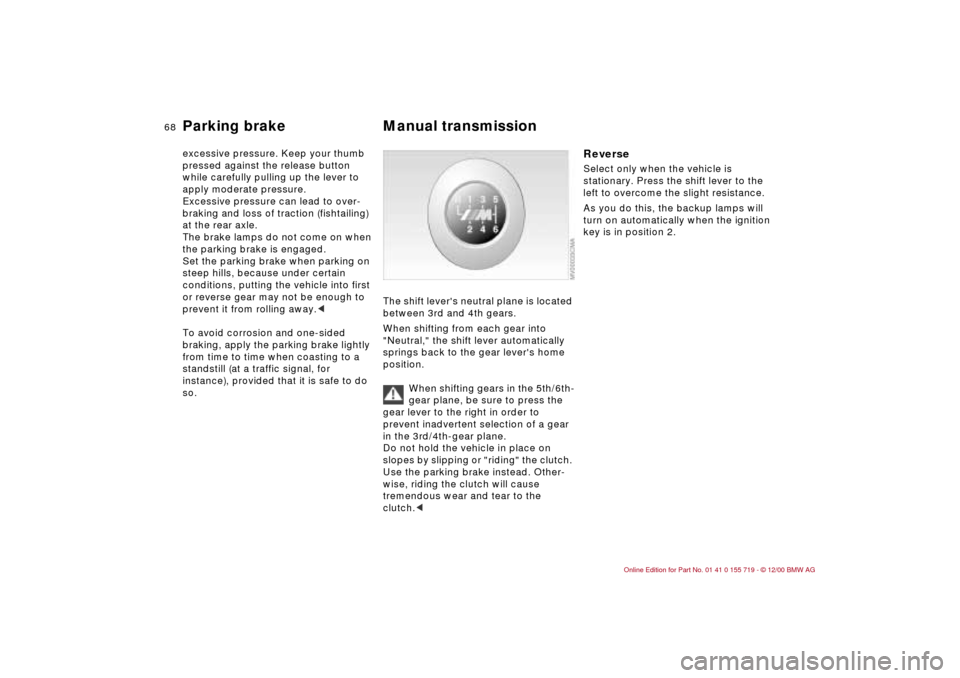
so. The shift lever's neutral plane is located
between 3rd and 4th gears.
When shifting from each gear into
"Neutral," the shift lever automatically
springs back to the gear lever's home
position.
When shifting gears in the 5th/6th-
gear plane, be sure to press the
gear lever to the right in order to
prevent inadvertent selection of a gear
in the 3rd/4th-gear plane.
Do not hold the vehicle in place on
slopes by slipping or "riding" the clutch.
Use the parking brake instead. Other-
wise, riding the clutch will cause
tremendous wear and tear to the
clutch.<
Reverse Select only when the vehicle is
stationary. Press the shift lever to the
left to overcome the slight resistance.
As you do this, the backup lamps will
turn on automatically when the ignition
key is in position 2.