airbag BMW M3 CONVERTIBLE 2001 E46 Owner's Manual
[x] Cancel search | Manufacturer: BMW, Model Year: 2001, Model line: M3 CONVERTIBLE, Model: BMW M3 CONVERTIBLE 2001 E46Pages: 195, PDF Size: 1.96 MB
Page 10 of 195

Contents
Overview
Controls and features
Cockpit16
Instrument cluster18
Indicator and warning lamps20
Multifunction steering wheel
(MFL)24
Hazard warning flashers25
Warning triangle25
Refueling26
Fuel specifications27
Tire inflation pressures27
Opening and closing:
Keys32
Electronic vehicle
immobilizer33
Central locking system33
Opening and closing – via the
door lock34
Opening and closing – via the
remote control35
Opening and closing – from
inside38
Luggage compartment lid39
Luggage compartment40
Alarm system42
Electric power windows44
Convertible top45
Adjustments:
Seats48
Mirrors52
Seat and mirror memory54
Steering wheel55
Car Memory, Key Memory55
Passenger safety systems:
Safety belts57
Transporting children safely58
Airbags61
Rollover protection system64
Driving:
Steering/Ignition lock66
Starting the engine66
Switching off the engine67
Parking brake67
Manual transmission68
Turn signal indicator/Headlamp
flasher69
Washer/Wiper system69
Rear window defroster71
Cruise control71
Everything under control:
Odometer73
Tachometer73
Engine oil temperature gauge73
Fuel gauge74
Coolant temperature gauge74
Service Interval Display75
Check Control76
Clock76
Computer77
Technology for safety and
convenience:
Park Distance Control (PDC)79
Dynamic Stability Control
(DSC)80
Tire Pressure Warning (RDW)81
M Engine dynamics control83
Contents
Page 11 of 195

11n
Controls and features
Operation, care and maintenance
Lamps:
Side lamps/Low beam
headlamps84
Instrument lighting84
High beams/Parking lamps85
Fog lamps85
Interior lamps86
Reading lamps86
Controlling the climate
for pleasant driving:
Automatic climate control88
Heated seats93
Interior conveniences:
Glove compartment94
Storage compartments95
Cellular phone96
Ashtray, front96
Cigarette lighter97
Ashtray, rear97
Loading and transporting:
Ski bag98
Cargo loading100
Roof-mounted luggage rack for
the hardtop101
Special operating instructions:
Break-in procedures104
Driving notes105
Catalytic converter105
Antilock Brake System
(ABS)106
Disc brakes108
Brake system109
Winter operation110
Power steering112
Cellular phone112
Radio reception112
Hardtop113
Wheels and tires:
Tire inflation pressures115
Tire condition115
Tire replacement116
Tire rotation117
Wheel and tire
combinations118
Special features of winter
tires119
Snow chains119
Approved wheel and tire
specifications120
Under the hood:
Hood121
Engine compartment124
Washer fluids126
Washer nozzles126
Engine oil127
Coolant129
Brake fluid130
Vehicle Identification130
Care and maintenance:
The BMW Maintenance
System131
Caring for your vehicle132
Cleaning and caring for the
convertible top137
Airbags139
Storing your vehicle140
Laws and regulations:
Technical modifications141
California Proposition 65
Warning141
OBD connector142
Page 12 of 195

Contents
Owner service procedures
Advanced technology
Technical data
Replacement procedures:
Onboard tool kit146
Windshield wiper blades146
Lamps and bulbs146
Repairing a flat tire153
Battery157
Fuses160
Replacing microfilter and
activated-charcoal filter161
In case of electrical
malfunction:
Fuel filler door161
Convertible top162
Assistance, giving and
receiving:
Jump-starting164
Towing the vehicle165Airbags168
Radio reception169
Dynamic Stability Control
(DSC)170
Safety belt tensioner170
M3 Engine concept171
Rain sensor172
Interior rearview mirror with
automatic dimming
feature173
Xenon lamps174
Rollover protection system175Engine data178
Dimensions179
Weights180
Capacities181
Electrical system182
Drive belts182
Page 19 of 195
19n
IndexDataTechnologyRepairsCar careControlsOverview
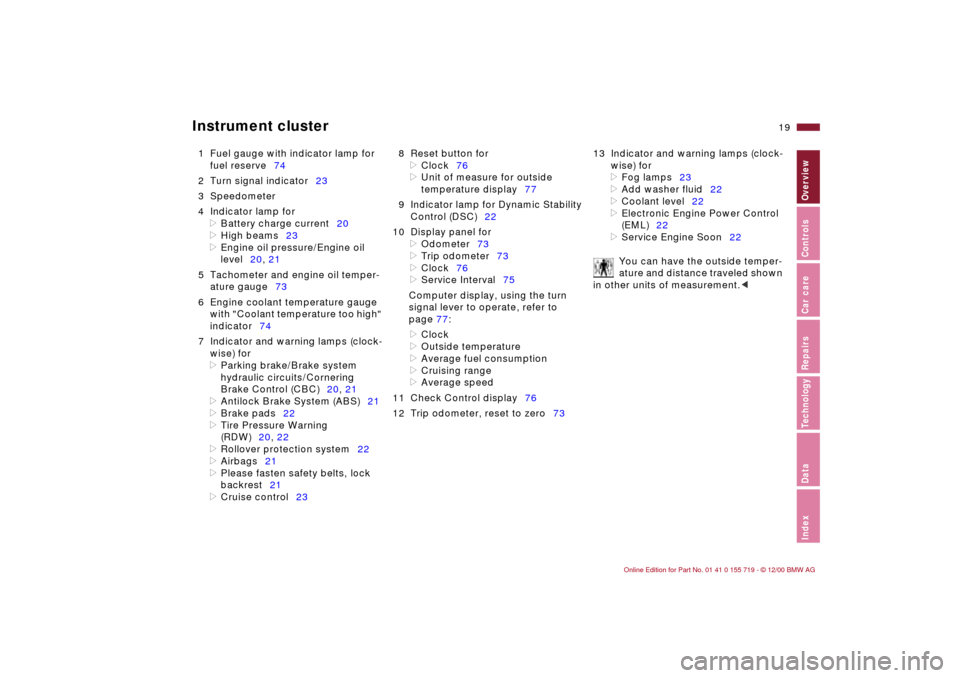
Instrument cluster
1 Fuel gauge with indicator lamp for
fuel reserve74
2 Turn signal indicator23
3 Speedometer
4 Indicator lamp for
>
Battery charge current20
>
High beams23
>
Engine oil pressure/Engine oil
level20, 21
5 Tachometer and engine oil temper-
ature gauge73
6 Engine coolant temperature gauge
with "Coolant temperature too high"
indicator74
7 Indicator and warning lamps (clock-
wise) for
>
Parking brake/Brake system
hydraulic circuits/Cornering
Brake Control (CBC)20, 21
>
Antilock Brake System (ABS)21
>
Brake pads22
>
Tire Pressure Warning
(RDW)20, 22
>
Rollover protection system22
>
Airbags21
>
Please fasten safety belts, lock
backrest21
>
Cruise control238 Reset button for
>
Clock76
>
Unit of measure for outside
temperature display77
9 Indicator lamp for Dynamic Stability
Control (DSC)22
10 Display panel for
>
Odometer73
>
Trip odometer73
>
Clock76
>
Service Interval75
Computer display, using the turn
signal lever to operate, refer to
page 77:
>
Clock
>
Outside temperature
>
Average fuel consumption
>
Cruising range
>
Average speed
11 Check Control display76
12 Trip odometer, reset to zero7313 Indicator and warning lamps (clock-
wise) for
>
Fog lamps23
>
Add washer fluid22
>
Coolant level22
>
Electronic Engine Power Control
(EML)22
>
Service Engine Soon22
You can have the outside temper-
ature and distance traveled shown
in other units of measurement.
<
Page 21 of 195
21n
IndexDataTechnologyRepairsCar careControlsOverview
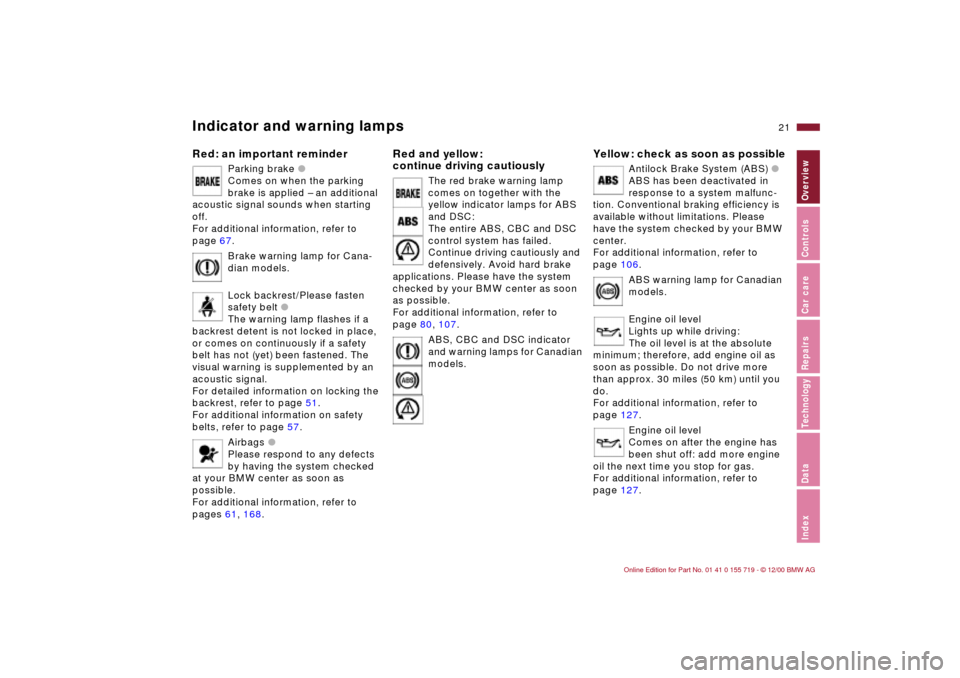
Indicator and warning lampsRed: an important reminder
Parking brake l
Comes on when the parking
brake is applied – an additional
acoustic signal sounds when starting
off.
For additional information, refer to
page 67.
Brake warning lamp for Cana-
dian models.
Lock backrest/Please fasten
safety belt l
The warning lamp flashes if a
backrest detent is not locked in place,
or comes on continuously if a safety
belt has not (yet) been fastened. The
visual warning is supplemented by an
acoustic signal.
For detailed information on locking the
backrest, refer to page 51.
For additional information on safety
belts, refer to page 57.
Airbags l
Please respond to any defects
by having the system checked
at your BMW center as soon as
possible.
For additional information, refer to
pages 61, 168.
Red and yellow:
continue driving cautiously
The red brake warning lamp
comes on together with the
yellow indicator lamps for ABS
and DSC:
The entire ABS, CBC and DSC
control system has failed.
Continue driving cautiously and
defensively. Avoid hard brake
applications. Please have the system
checked by your BMW center as soon
as possible.
For additional information, refer to
page 80, 107.
ABS, CBC and DSC indicator
and warning lamps for Canadian
models.
Yellow: check as soon as possible
Antilock Brake System (ABS) l
ABS has been deactivated in
response to a system malfunc-
tion. Conventional braking efficiency is
available without limitations. Please
have the system checked by your BMW
center.
For additional information, refer to
page 106.
ABS warning lamp for Canadian
models.
Engine oil level
Lights up while driving:
The oil level is at the absolute
minimum; therefore, add engine oil as
soon as possible. Do not drive more
than approx. 30 miles (50 km) until you
do.
For additional information, refer to
page 127.
Engine oil level
Comes on after the engine has
been shut off: add more engine
oil the next time you stop for gas.
For additional information, refer to
page 127.
Page 30 of 195
30n
Locks and security systems:
Keys32
Electronic vehicle
immobilizer33
Central locking system33
Opening and closing – via the
door lock34
Opening and closing – via the
remote control35
Opening and closing – from
inside38
Luggage compartment lid39
Luggage compartment40
Alarm system42
Electric power windows44
Convertible top45
Adjustments:
Seats48
Mirrors52
Seat and mirror memory54
Steering wheel55
Car Memory, Key Memory55
Passenger safety systems:
Safety belts57
Transporting children safely58
Airbags61
Rollover protection system64
Controls
Page 58 of 195
58n
Safety belts Transporting children safelywhere it will not exert pressure against
the abdominal area.
Leave the rear safety belts in the
holders, if they are not needed, to avoid
unwanted movement from the safety
belts at high speeds.< Safety belt height adjustmentThe front safety belts automatically
adjust to your height based on the
height adjustment of the head
restraints, refer to page 51.
If the safety belt system has been
subjected to the stresses involved
in an accident or otherwise damaged:
have the entire safety belt mechanism
replaced by your BMW center, includ-
ing the safety belt tensioner. In addi-
tion, have your BMW center inspect the
safety belt anchors. If a child restraint
system was in the vehicle during an
accident, consult the manufacturer's
instructions regarding replacement.<
Child restraint systems
*
Never install a rearward-facing
child restraint device in the front
passenger's seat. If the airbag is trig-
gered, any child in a rear-facing
restraint located within the airbag's
deployment range could sustain serious
injuries.
Children should always travel in the rear
seats, where they should be secured in
a suitable child restraint device
attached to the safety belts in the
outboard positions.
Do not use the center belts to secure a
child restraint unless the two outboard
positions are already occupied, and a
third safety seat is needed.
Never attempt to modify or change a
child restraint device in any way, as
tampering could reduce the protection
it provides in an accident.<
Commercially available child seats
complying with the legal standard are
designed to be secured with a lap belt
or with the lap belt portion of a combi-
nation lap/shoulder belt. Improperly or
inadequately installed restraint systems
can increase the risk of injury to chil-
dren. Always read and follow the
instructions that come with the system.
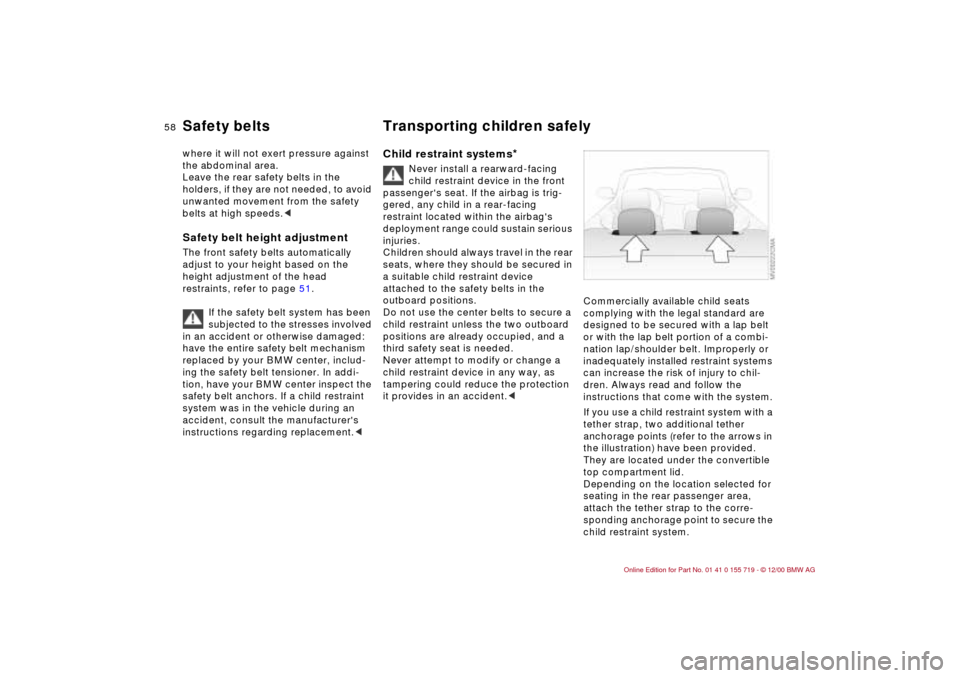
If you use a child restraint system with a
tether strap, two additional tether
anchorage points (refer to the arrows in
the illustration) have been provided.
They are located under the convertible
top compartment lid.
Depending on the location selected for
seating in the rear passenger area,
attach the tether strap to the corre-
sponding anchorage point to secure the
child restraint system.
Page 59 of 195
59n
IndexDataTechnologyRepairsCar careControlsOverview
Transporting children safelyLift the head restraint and pass the
tether strap between the headrest and
the seat back.
Adjust the tether strap according to the
child restraint manufacturer's instruc-
tions.
Before installing any child restraint
device or child seat, please read
the following:
Never install a rear-facing child restraint
system in the front passenger seat of
this vehicle.
Your vehicle is equipped with an airbag
supplemental restraint system for the
front passenger. Because the backrest
on any rear-facing child restraint
system (of the kind designed for infants
under 1 year and 20 - 30 lbs/9 - 14 kg)
would be within the airbag's deploy-
ment range, you should never mount
such a device in the front passenger
seat, as the impact of the airbag against
the child restraint's backrest could lead
to serious or fatal injuries.
If it is necessary for a child (not an
infant) to ride in the front seat, certain
precautions should be taken. First,
move the passenger seat as far away
from the dashboard as possible. This
important precaution is intended to
maximize the distance between the
airbag and the child. Older children
should be tightly secured with the
safety belt.
Younger children should be secured in
an appropriate forward-facing child
restraint system that has first been
properly secured with a safety belt.
Never install a rear-facing child restraint
system in the front passenger seat.
We strongly urge you to carefully read
and comply with the instructions for
installation and use provided by the
child restraint's manufacturer when-
ever you use such a device.
Always ensure that all occupants (of all
ages) remain properly and securely
restrained at all times.c
All rear seating positions in your vehicle
meet the recommendations of SAE
J1819, an industry recommended stan-
dard for securing child restraint
systems in motor vehicles.
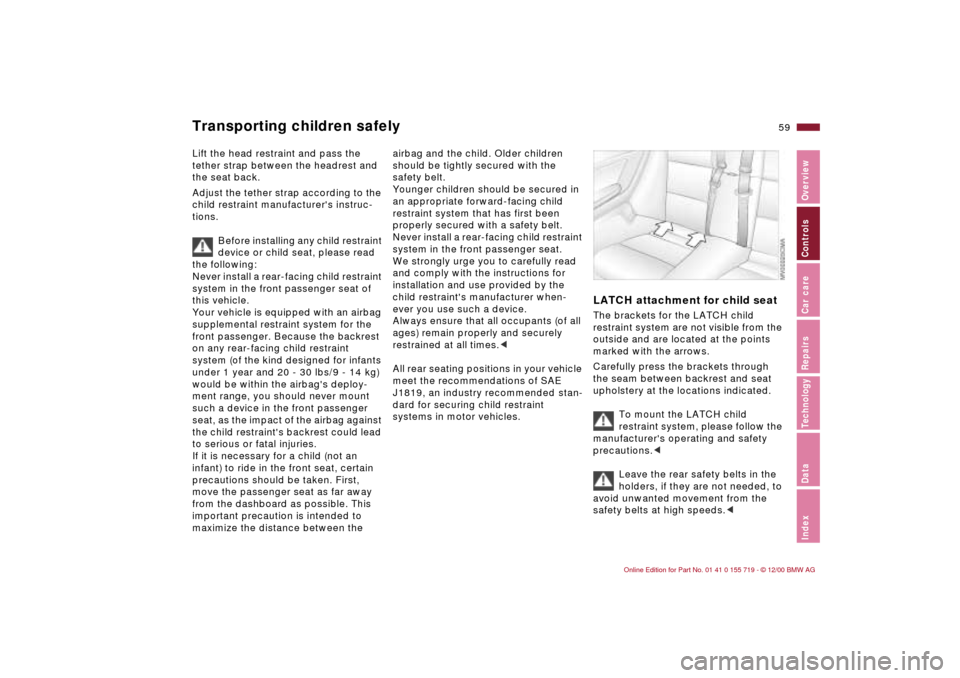
LATCH attachment for child seatThe brackets for the LATCH child
restraint system are not visible from the
outside and are located at the points
marked with the arrows.
Carefully press the brackets through
the seam between backrest and seat
upholstery at the locations indicated.
To mount the LATCH child
restraint system, please follow the
manufacturer's operating and safety
precautions.c
Leave the rear safety belts in the
holders, if they are not needed, to
avoid unwanted movement from the
safety belts at high speeds.c
Page 61 of 195
61n
IndexDataTechnologyRepairsCar careControlsOverview
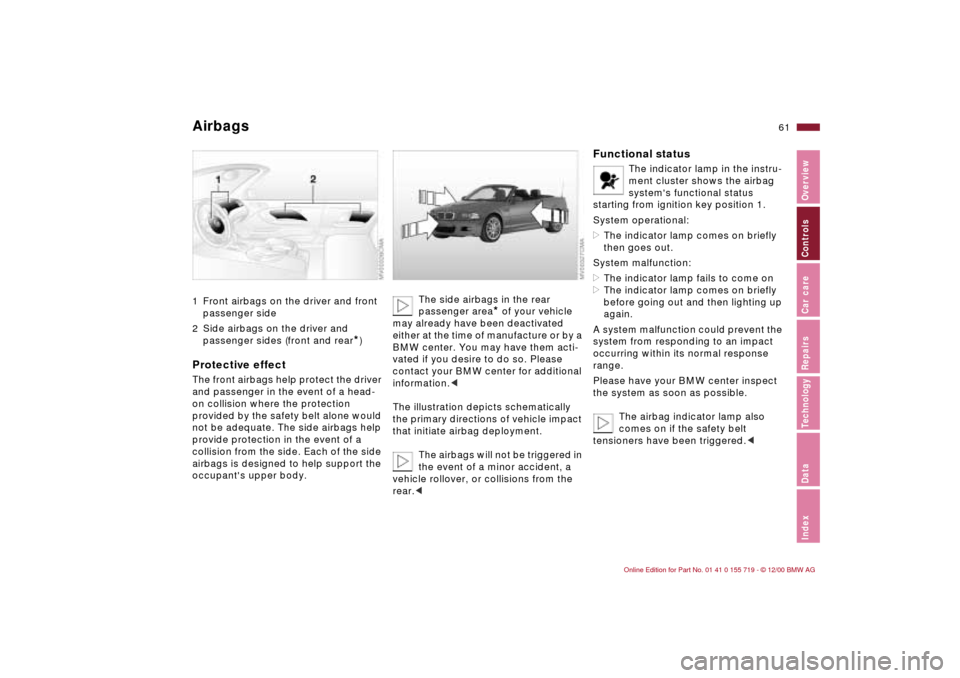
Airbags 1 Front airbags on the driver and front
passenger side
2 Side airbags on the driver and
passenger sides (front and rear
*)
Protective effectThe front airbags help protect the driver
and passenger in the event of a head-
on collision where the protection
provided by the safety belt alone would
not be adequate. The side airbags help
provide protection in the event of a
collision from the side. Each of the side
airbags is designed to help support the
occupant's upper body.
The side airbags in the rear
passenger area
* of your vehicle
may already have been deactivated
either at the time of manufacture or by a
BMW center. You may have them acti-
vated if you desire to do so. Please
contact your BMW center for additional
information.<
The illustration depicts schematically
the primary directions of vehicle impact
that initiate airbag deployment.
The airbags will not be triggered in
the event of a minor accident, a
vehicle rollover, or collisions from the
rear.<
Functional status
The indicator lamp in the instru-
ment cluster shows the airbag
system's functional status
starting from ignition key position 1.
System operational:
>The indicator lamp comes on briefly
then goes out.
System malfunction:
>The indicator lamp fails to come on
>The indicator lamp comes on briefly
before going out and then lighting up
again.
A system malfunction could prevent the
system from responding to an impact
occurring within its normal response
range.
Please have your BMW center inspect
the system as soon as possible.
The airbag indicator lamp also
comes on if the safety belt
tensioners have been triggered.<
Page 62 of 195
62n
AirbagsSitting correctly with airbags
For your safety, comply with the
following instructions for the
airbags. If you do not, the airbags may
not be able to provide their maximum
protection. All passengers in the vehicle
should be aware of and comply with
this information:
The airbags are supplemental restraint
devices designed to provide extra
protection; they are not a substitute for
safety belts. Wear your safety belt at all
times. The airbags will not be triggered
in the event of a minor accident, a
vehicle rollover, or collisions from the
rear. In these instances, the safety belt
provides optimal protection.
Airbags are located under cover panels
in the steering wheel, in the instrument
panel and in the side trim panels in the
front and rear
*.
Adjust your seat to a position that
provides maximum distance between
you and the steering wheel, the instru-
ment panel and the door while still
allowing comfortable and safe access
to all vehicle controls.
To avoid sustaining hand and arm inju-
ries, always grasp the steering wheel
on the rim with the hands at the 9 and
3 o'clock positions. Do not place your
hands on the center pad.
Never allow any objects to obstruct the
area between the airbag and an occu-
pant.
Do not use the cover panel above the
passenger side airbag as a storage
area.
Do not apply adhesive materials to the
cover panels of the airbags, cover them
or modify them in any other way.
Do not install a rear-facing child
restraint system in the front passenger
seat of this vehicle.
Children under 13 years of age and
children less than 5 feet (150 cm) tall
should ride only in the rear seat.
Infants or small children should never
be held on the lap of a passenger.
If your vehicle is equipped with side
airbags in the rear passenger area
*, be
sure that child restraints are mounted
correctly and provided with the
greatest-possible distance between the
airbags in the side trim panels. Do not
allow children to lean out of the child's
seat in the direction of the side trim
panels. If they do so, serious injuries
can occur if the airbag is triggered.
(infants and small children in appro-
priate child restraint systems; larger
children and adults using the safety
belts). Never let an occupant's head
rest near or on a side airbag because
the inflating airbag could cause a
serious or fatal injury. Please note that
the word "Airbag" imprinted on the door
trim panel indicates the airbag's loca-
tion.
Accident research shows that the
safest place for children in an automo-
bile is in the rear seat. However, a child
sitting in the rear seat and not properly
restrained may place his or her head on
or near the airbag, if so equipped. For
example, a child — even though belted
— may fall asleep with his or her head
against the side airbag. It may be diffi-
cult for a driver to ensure that children
in the rear seat will remain properly
positioned at all times and not place
their heads on or near the side airbag.
Therefore, we recommend that the rear
seat side airbags, if so equipped, be
deactivated if children will travel in the
rear seat.
The rear seat side airbags may already
have been deactivated, either at the
time of manufacture or by a BMW