brake fluid BMW M3 CONVERTIBLE 2001 E46 Owner's Manual
[x] Cancel search | Manufacturer: BMW, Model Year: 2001, Model line: M3 CONVERTIBLE, Model: BMW M3 CONVERTIBLE 2001 E46Pages: 195, PDF Size: 1.96 MB
Page 11 of 195

11n
Controls and features
Operation, care and maintenance
Lamps:
Side lamps/Low beam
headlamps84
Instrument lighting84
High beams/Parking lamps85
Fog lamps85
Interior lamps86
Reading lamps86
Controlling the climate
for pleasant driving:
Automatic climate control88
Heated seats93
Interior conveniences:
Glove compartment94
Storage compartments95
Cellular phone96
Ashtray, front96
Cigarette lighter97
Ashtray, rear97
Loading and transporting:
Ski bag98
Cargo loading100
Roof-mounted luggage rack for
the hardtop101
Special operating instructions:
Break-in procedures104
Driving notes105
Catalytic converter105
Antilock Brake System
(ABS)106
Disc brakes108
Brake system109
Winter operation110
Power steering112
Cellular phone112
Radio reception112
Hardtop113
Wheels and tires:
Tire inflation pressures115
Tire condition115
Tire replacement116
Tire rotation117
Wheel and tire
combinations118
Special features of winter
tires119
Snow chains119
Approved wheel and tire
specifications120
Under the hood:
Hood121
Engine compartment124
Washer fluids126
Washer nozzles126
Engine oil127
Coolant129
Brake fluid130
Vehicle Identification130
Care and maintenance:
The BMW Maintenance
System131
Caring for your vehicle132
Cleaning and caring for the
convertible top137
Airbags139
Storing your vehicle140
Laws and regulations:
Technical modifications141
California Proposition 65
Warning141
OBD connector142
Page 19 of 195

19n
IndexDataTechnologyRepairsCar careControlsOverview
Instrument cluster
1 Fuel gauge with indicator lamp for
fuel reserve74
2 Turn signal indicator23
3 Speedometer
4 Indicator lamp for
>
Battery charge current20
>
High beams23
>
Engine oil pressure/Engine oil
level20, 21
5 Tachometer and engine oil temper-
ature gauge73
6 Engine coolant temperature gauge
with "Coolant temperature too high"
indicator74
7 Indicator and warning lamps (clock-
wise) for
>
Parking brake/Brake system
hydraulic circuits/Cornering
Brake Control (CBC)20, 21
>
Antilock Brake System (ABS)21
>
Brake pads22
>
Tire Pressure Warning
(RDW)20, 22
>
Rollover protection system22
>
Airbags21
>
Please fasten safety belts, lock
backrest21
>
Cruise control238 Reset button for
>
Clock76
>
Unit of measure for outside
temperature display77
9 Indicator lamp for Dynamic Stability
Control (DSC)22
10 Display panel for
>
Odometer73
>
Trip odometer73
>
Clock76
>
Service Interval75
Computer display, using the turn
signal lever to operate, refer to
page 77:
>
Clock
>
Outside temperature
>
Average fuel consumption
>
Cruising range
>
Average speed
11 Check Control display76
12 Trip odometer, reset to zero7313 Indicator and warning lamps (clock-
wise) for
>
Fog lamps23
>
Add washer fluid22
>
Coolant level22
>
Electronic Engine Power Control
(EML)22
>
Service Engine Soon22
You can have the outside temper-
ature and distance traveled shown
in other units of measurement.
<
Page 20 of 195
20n
Indicator and warning lamps
Technology
that monitors itself
Many of the systems in your BMW
monitor themselves automatically, both
during engine starts and while you are
driving. Indicator and warning lamps
identified by "
l
" are tested for proper
operation whenever the ignition key is
turned. They each light up once for
different periods of time.
If a fault should occur in one of these
systems, the corresponding lamp does
not go out after the engine is started, or
it lights up while the vehicle is moving.
You will see how to react to this below.
Red: stop immediately
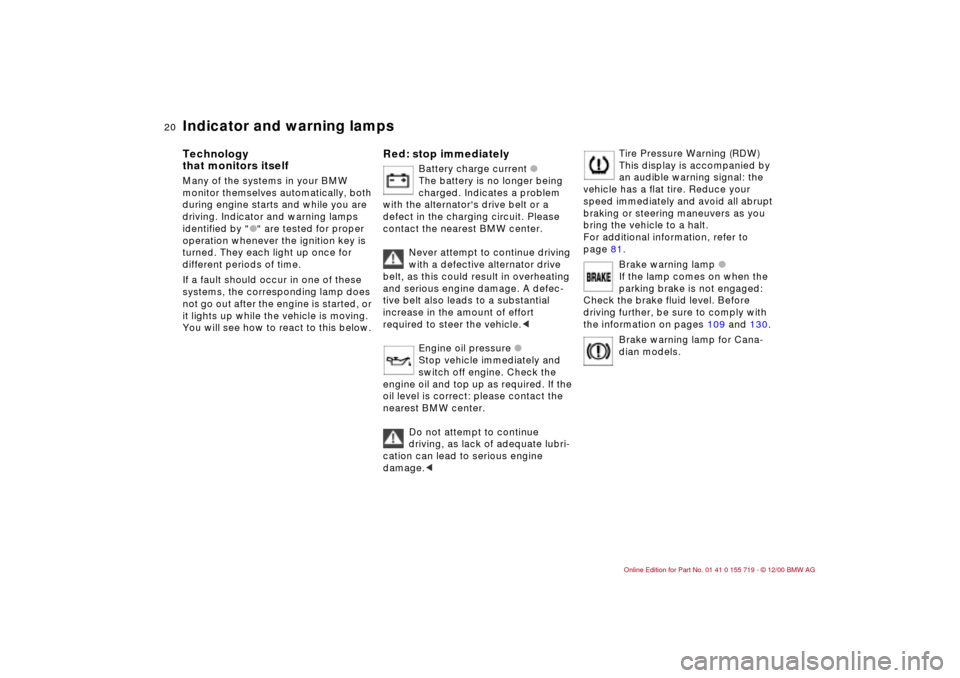
Battery charge current
l
The battery is no longer being
charged. Indicates a problem
with the alternator's drive belt or a
defect in the charging circuit. Please
contact the nearest BMW center.
Never attempt to continue driving
with a defective alternator drive
belt, as this could result in overheating
and serious engine damage. A defec-
tive belt also leads to a substantial
increase in the amount of effort
required to steer the vehicle.
<
Engine oil pressure
l
Stop vehicle immediately and
switch off engine. Check the
engine oil and top up as required. If the
oil level is correct: please contact the
nearest BMW center.
Do not attempt to continue
driving, as lack of adequate lubri-
cation can lead to serious engine
damage.
<
Tire Pressure Warning (RDW)
This display is accompanied by
an audible warning signal: the
vehicle has a flat tire. Reduce your
speed immediately and avoid all abrupt
braking or steering maneuvers as you
bring the vehicle to a halt.
For additional information, refer to
page 81.
Brake warning lamp l
If the lamp comes on when the
parking brake is not engaged:
Check the brake fluid level. Before
driving further, be sure to comply with
the information on pages 109 and 130.
Brake warning lamp for Cana-
dian models.
Page 22 of 195
22n
Indicator and warning lamps
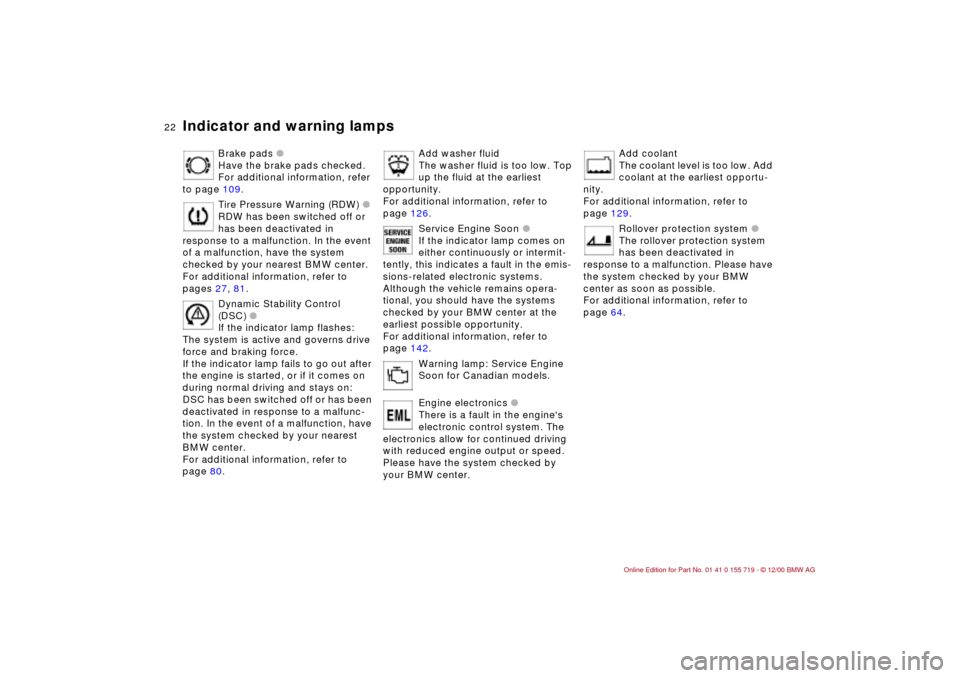
Brake pads
l
Have the brake pads checked.
For additional information, refer
to page 109.
Tire Pressure Warning (RDW)
l
RDW has been switched off or
has been deactivated in
response to a malfunction. In the event
of a malfunction, have the system
checked by your nearest BMW center.
For additional information, refer to
pages 27, 81.
Dynamic Stability Control
(DSC)
l
If the indicator lamp flashes:
The system is active and governs drive
force and braking force.
If the indicator lamp fails to go out after
the engine is started, or if it comes on
during normal driving and stays on:
DSC has been switched off or has been
deactivated in response to a malfunc-
tion. In the event of a malfunction, have
the system checked by your nearest
BMW center.
For additional information, refer to
page 80.
Add washer fluid
The washer fluid is too low. Top
up the fluid at the earliest
opportunity.
For additional information, refer to
page 126.
Service Engine Soon
l
If the indicator lamp comes on
either continuously or intermit-
tently, this indicates a fault in the emis-
sions-related electronic systems.
Although the vehicle remains opera-
tional, you should have the systems
checked by your BMW center at the
earliest possible opportunity.
For additional information, refer to
page 142.
Warning lamp: Service Engine
Soon for Canadian models.
Engine electronics
l
There is a fault in the engine's
electronic control system. The
electronics allow for continued driving
with reduced engine output or speed.
Please have the system checked by
your BMW center.
Add coolant
The coolant level is too low. Add
coolant at the earliest opportu-
nity.
For additional information, refer to
page 129.
Rollover protection system
l
The rollover protection system
has been deactivated in
response to a malfunction. Please have
the system checked by your BMW
center as soon as possible.
For additional information, refer to
page 64.
Page 103 of 195
Overview
Controls and features
Operation, care
and maintenance
Owner service procedures
Technical data
Index Advanced technology
103n
IndexDataTechnologyRepairsCar careControlsOverview
Special operating instructions:
Break-in procedures104
Driving notes105
Catalytic converter105
Antilock Brake System
(ABS)106
Disc brakes108
Brake system109
Winter operation110
Power steering112
Cellular phone112
Radio reception112
Hardtop113
Wheels and tires:
Tire inflation pressures115
Tire condition115
Tire replacement116
Tire rotation117
Wheel and tire
combinations118
Special features of winter
tires119
Snow chains119
Approved wheel and tire
specifications120Under the hood:
Hood121
Engine compartment124
Washer fluids126
Washer nozzles126
Engine oil127
Coolant129
Brake fluid130
Vehicle Identification
Number130
Care and maintenance:
The BMW Maintenance
System131
Caring for your vehicle132
Cleaning and caring for the
convertible top137
Airbags139
Storing your vehicle140
Laws and regulations:
Technical modifications141
California Proposition 65
Warning141
OBD connector142
Car care
Page 109 of 195
109n
IndexDataTechnologyRepairsCar careControlsOverview
Brake system Brake fluid level
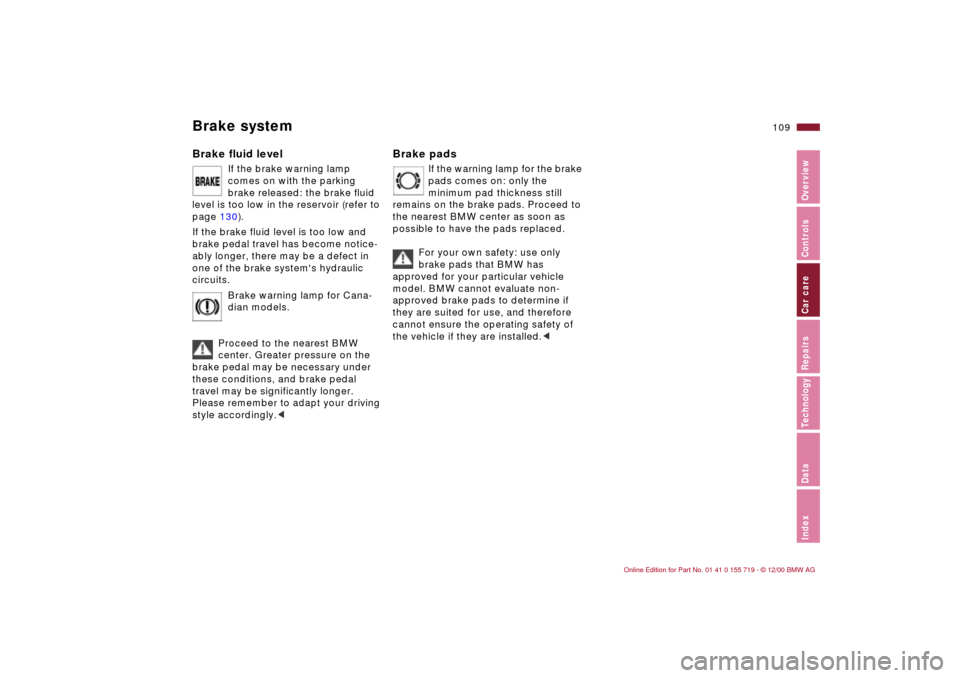
If the brake warning lamp
comes on with the parking
brake released: the brake fluid
level is too low in the reservoir (refer to
page 130).
If the brake fluid level is too low and
brake pedal travel has become notice-
ably longer, there may be a defect in
one of the brake system's hydraulic
circuits.
Brake warning lamp for Cana-
dian models.
Proceed to the nearest BMW
center. Greater pressure on the
brake pedal may be necessary under
these conditions, and brake pedal
travel may be significantly longer.
Please remember to adapt your driving
style accordingly.<
Brake pads
If the warning lamp for the brake
pads comes on: only the
minimum pad thickness still
remains on the brake pads. Proceed to
the nearest BMW center as soon as
possible to have the pads replaced.
For your own safety: use only
brake pads that BMW has
approved for your particular vehicle
model. BMW cannot evaluate non-
approved brake pads to determine if
they are suited for use, and therefore
cannot ensure the operating safety of
the vehicle if they are installed.<
Page 125 of 195

125n
IndexDataTechnologyRepairsCar careControlsOverview
Engine compartment 1 Filler neck for headlamp and
wind-
shield washer system126
2 Coolant expansion tank129
3 Auxiliary terminal for jump-starting –
positive terminal164
4 Engine oil filler cap127
5 Engine oil dipstick127
6 Brake fluid reservoir130
Page 130 of 195
130n
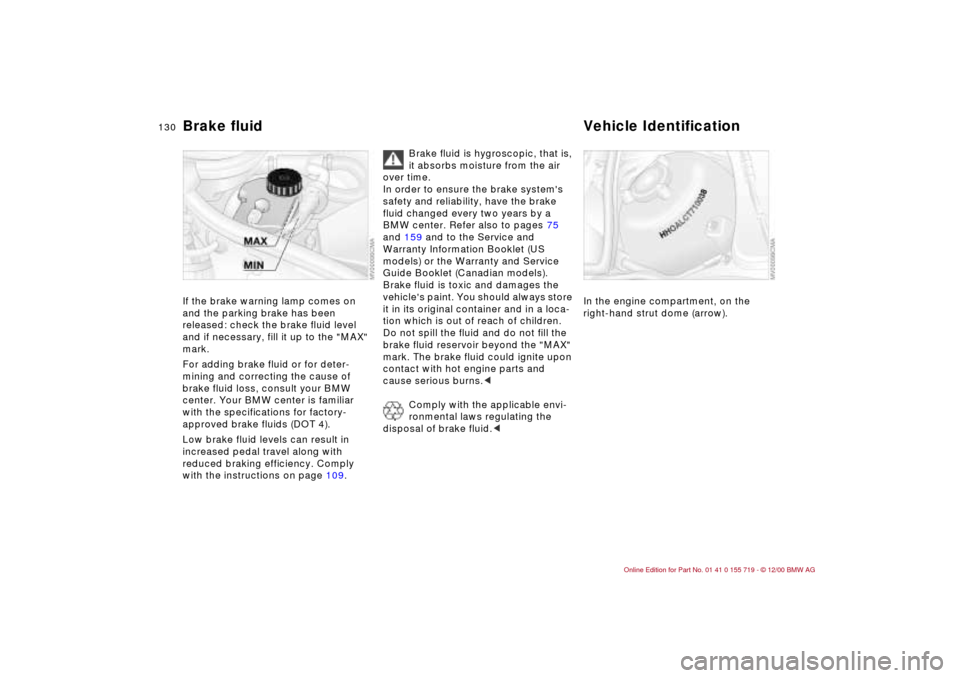
Brake fluid Vehicle Identification If the brake warning lamp comes on
and the parking brake has been
released: check the brake fluid level
and if necessary, fill it up to the "MAX"
mark.
For adding brake fluid or for deter-
mining and correcting the cause of
brake fluid loss, consult your BMW
center. Your BMW center is familiar
with the specifications for factory-
approved brake fluids (DOT 4).
Low brake fluid levels can result in
increased pedal travel along with
reduced braking efficiency. Comply
with the instructions on page 109.
Brake fluid is hygroscopic, that is,
it absorbs moisture from the air
over time.
In order to ensure the brake system's
safety and reliability, have the brake
fluid changed every two years by a
BMW center. Refer also to pages 75
and 159 and to the Service and
Warranty Information Booklet (US
models) or the Warranty and Service
Guide Booklet (Canadian models).
Brake fluid is toxic and damages the
vehicle's paint. You should always store
it in its original container and in a loca-
tion which is out of reach of children.
Do not spill the fluid and do not fill the
brake fluid reservoir beyond the "MAX"
mark. The brake fluid could ignite upon
contact with hot engine parts and
cause serious burns.<
Comply with the applicable envi-
ronmental laws regulating the
disposal of brake fluid.<
In the engine compartment, on the
right-hand strut dome (arrow).
Page 133 of 195
133n
IndexDataTechnologyRepairsCar careControlsOverview
Caring for your vehicleExterior finish To provide effective corrosion protec-
tion, multilayer paintwork is applied at
the factory. Cataphoretic immersion
priming techniques are supplemented
with special body-cavity protectants
and application of specially developed
and extensively tested materials.
A layer of flexible PVC is first applied to
the undercarriage. Following this, a
comprehensive undercoating treat-
ment with a wax-based protectant is
applied. Regular maintenance makes
an important contribution to maintaining
the safety and value of your vehicle.
Increasing awareness of the effects of
harmful environmental factors on
vehicle finishes have led paint and
vehicle manufacturers to initiate
ongoing programs designed to further
improve the durability of their finishes.
Despite this, regional environmental
factors can have negative effects on
your vehicle's finish. Consider these
factors in determining the frequency
and extent of your efforts to maintain
the vehicle finish.
Depending upon material and type of
impact (perforation of paint layer), phys-
ical stresses from sand, road salt,
gravel, etc., can cause corrosion to start extending beneath the finish,
starting at the point of impact.
Road dirt, tar spots, dead insects,
animal droppings (strong alkali effect)
and tree excretions (resins and pollen)
all contain substances capable of
causing damage when allowed to
remain on the finish of your vehicle for
any period of time. This includes spots,
etching, flaking, and separations in the
top coat.
In industrial areas, deposits of flue dust,
lime, oily soot, precipitation containing
sulfur-dioxide (acid rain) and other envi-
ronmental pollutants will damage the
vehicle's finish unless adequate care is
provided – even though this is generally
limited to the outside horizontal
surfaces.
In coastal regions, high levels of atmo-
spheric salt and humidity promote
corrosion.
In tropical zones, high humidity and
heavy ultraviolet radiation prevail, in
addition to temperatures of over 105 7
(+40 6) in the shade. Under these
conditions, light paints can reach
temperatures up to 175 7 (+80 6) and
dark ones up to 250 7 (+120 6).
Caring for the vehicle finish Regular washing is a preventive
measure against long-term effects from
substances that are harmful to the
vehicle's finish, especially if you drive
your vehicle in areas with high levels of
air pollution or aggressive natural
substances (tree resins, pollen).
Nevertheless, you should immediately
remove especially aggressive
substances. Failure to do so can lead to
changes in the paint's chemical struc-
ture or to discoloration. Gasoline spilled
during refueling, oil, grease and brake
fluid should always be cleaned away
immediately, as should bird droppings.
Any contamination remaining on the
surface of the vehicle will be especially
conspicuous after washing. Use
cleaning fluid or alcohol with a clean
cloth or cotton pad to remove these
stains. Remove tar spots with tar
remover. After cleaning, the affected
areas should be waxed to ensure
continued protection.
Use the cleaning and car-care
products available at your BMW
center.<
Page 140 of 195

140n
Storing your vehicle
If you intend to store the vehicle
for more than 3 months, be sure to
follow the maintenance instructions on
this page.<
Storage preparationsHave your BMW center perform the
following procedures:
1 Clean and apply a rustproofing agent
or other treatment to the engine,
engine compartment, undercarriage,
axles and major components in
accordance with approved repair
procedures. First wash the vehicle
surface, then clean the interior,
following up with paint- and chrome
care, after which you clean the
rubber seals for the hood and doors.
2 Change the engine oil and oil filter
with the engine warm. As an addi-
tional corrosion protection measure,
an anticorrosive agent can be added
to the engine in accordance with the
manufacturer's instructions.
3 Check the coolant level and concen-
tration, top up if necessary.
4 Check the fluid level of the wind-
shield washer fluid reservoir; top up if
necessary.
5 Fill the fuel tank completely to
prevent the formation of condensa-
tion.
6 Increase the tire inflation pressure to
51 psi (350 Kilopascal).Before parking the vehicle1 To prevent the brake discs and
drums from corroding, dry the
parking and footbrake by applying
the brakes.
2 Park the vehicle in a covered, dry,
and well-ventilated area. Place the
transmission in first gear or, if neces-
sary, chock the wheels to prevent the
vehicle from rolling. Do not set the
parking brake.
3 Remove the battery, charge it
completely and store it in a cool (but
frost-free) room.
4 Remove the hardtop and store it
separately. Refer to page 114.
5 Close the convertible top.During storageRecharge the battery every six months.
If it is not recharged, it will not be
useable. Every time the battery is
discharged, especially over extended
periods, its service life is reduced.
Removing the vehicle from
storageRecharge the battery if the "Magic
Eye
*" turns black. Refer to page 157.
Then have Inspection I performed by
your BMW center, including a brake
fluid replacement if necessary.